QUANTUM
CRYPTOGRAPHY
Girisha Shankar
AGENDA
1.Introduction to Cryptography
2.Random numbers
3.Motivation for Quantum cryptography
4.Quantum mechanics and Quantum
Computing
5.Quantum Key distribution
6.Quantum Random Number Generation
7.Post Quantum Cryptography
ELEMENTS OF CRYPTOGRAPHY
• Plain text – the original message and Cipher text – the
disguised message.
• Key – A “number” used in encryption and decryption
algorithms.
• Encryption – using a key to change plaintext into ciphertext.
• Decryption – using a key to change cipher text back into
something readable.
• Simple example is mono-alphabetic substitution cipher method, in which
each letter in the alphabet is shifted by an integer value.
• The key is an integer value – typically very large
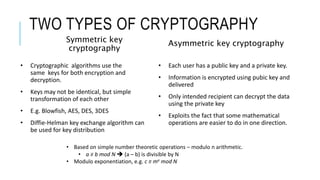
TWO TYPES OF CRYPTOGRAPHY
Symmetric key
cryptography
• Cryptographic algorithms use the
same keys for both encryption and
decryption.
• Keys may not be identical, but simple
transformation of each other
• E.g. Blowfish, AES, DES, 3DES
• Diffie-Helman key exchange algorithm can
be used for key distribution
Asymmetric key cryptography
• Each user has a public key and a private key.
• Information is encrypted using pubic key and
delivered
• Only intended recipient can decrypt the data
using the private key
• Exploits the fact that some mathematical
operations are easier to do in one direction.
• Based on simple number theoretic operations – modulo n arithmetic.
• a ≡ b mod N  (a – b) is divisible by N
• Modulo exponentiation, e.g. c ≡ me mod N
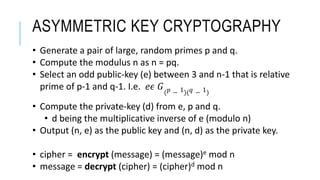
ASYMMETRIC KEY CRYPTOGRAPHY
• Generate a pair of large, random primes p and q.
• Compute the modulus n as n = pq.
• Select an odd public-key (e) between 3 and n-1 that is relative
prime of p-1 and q-1. I.e. 𝑒𝜖 𝐺( 𝑝 − 1)( 𝑞 − 1)
• Compute the private-key (d) from e, p and q.
• d being the multiplicative inverse of e (modulo n)
• Output (n, e) as the public key and (n, d) as the private key.
• cipher = encrypt (message) = (message)e mod n
• message = decrypt (cipher) = (cipher)d mod n
ASYMMETRIC KEY CRYPTOGRAPHY – A
SIMPLE EXAMPLE
Consider p = 5 and q = 11  n = 55
• p – 1 = 4 and q – 1 = 10
• Choose public-key e = 7 ( relative prime of 4 and 10)
• Choose private-key (d) such that 𝑑 × 𝑒 ≡ 1 𝑚𝑜𝑑[(𝑝 − 1 ×
𝑞 − 1 ]
• i.e. 7𝑑 ≡ 1𝑚𝑜𝑑40 d is 23.
• Output (55, 7) as the public key and (55, 23) as the private key.
Suppose message = 8
• cipher ≡ (message)e mod n ≡ 87 mod 55 = 2
• message ≡ (cipher)d mod n ≡ 223 mod 55 = 8
RANDOM NUMBER GENERATORS
• Desirable properties
• Unpredictability
• Backward security
• PRNG: Software based random number generators
• Rely on a good seed
• Higher throughput
• TRNG: system randomness used for generating random numbers
• Sources
• Thermal noise
• Voltage fluctuations
• Clock jitters
• Lower throughput
CRYPTOGRAPHY – BASIC PREMISE
• It is easy to generate random numbers
• Security reductions:
• Strength of crypto algorithm  known hard math problem
• Certain operations are easier to do one way, but reverse is hard
• Multiplication of two large numbers is easy, but factoring a large
number to its prime factors is hard
• Modular exponentiation is easy, but modular root extraction, is hard.
• Kerckhoffs’s principle
• Any cryptographic system can be compromised and all the
details of the system are perfectly known to everyone
• Crypto systems are open
• Strength of cryptography rests on choice and safekeep of keys
UNCONDITIONAL SECURITY
• As the methods of security have evolved, so have the
methods of attacks
• Currently available cryptographic methods are vulnerable –
at least in principle
• Security relies on making things difficult to break – not
impossible
• Not future proof from advances in technology and Mathematics
• Search for security that is provable and unconditional
• Not exploitable even in principle
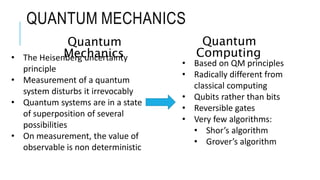
QUANTUM MECHANICS
• The Heisenberg uncertainty
principle
• Measurement of a quantum
system disturbs it irrevocably
• Quantum systems are in a state
of superposition of several
possibilities
• On measurement, the value of
observable is non deterministic
• Based on QM principles
• Radically different from
classical computing
• Qubits rather than bits
• Reversible gates
• Very few algorithms:
• Shor’s algorithm
• Grover’s algorithm
Quantum
Mechanics
Quantum
Computing
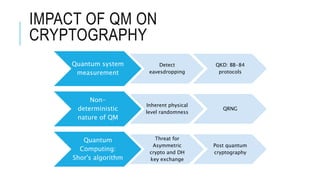
IMPACT OF QM ON
CRYPTOGRAPHY
Quantum system
measurement
Detect
eavesdropping
QKD: BB-84
protocols
Non-
deterministic
nature of QM
Inherent physical
level randomness
QRNG
Quantum
Computing:
Shor's algorithm
Threat for
Asymmetric
crypto and DH
key exchange
Post quantum
cryptography
• Classical cryptography techniques can not prevent the
key transmission to be passively monitored.
• Random numbers in use do not have enough entropy
• Use of repeated keys
• Deterministic computers generate deterministic random numbers
• Unpredictability due to lack of information is not same as
randomness
WHY QUANTUM CRYPTOGRAPHY?
• Uses principles of Quantum Mechanics to guarantee secure key
exchange
• Immediate detection of eves dropping
• Security relies on the nature of physical world – unlike complex
algorithms and computational complexity
• BB–84 protocol - developed by Charles Bennett and Gilles
Brassard in 1984
QUANTUM KEY DISTRIBUTION
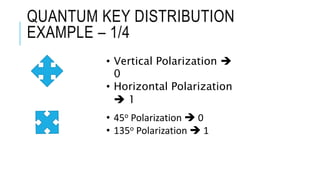
EXAMPLE – 1/4
• Vertical Polarization 
0
• Horizontal Polarization
 1
• 45o Polarization  0
• 135o Polarization  1
QUANTUM KEY DISTRIBUTION
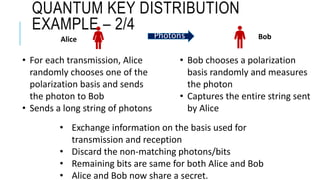
EXAMPLE – 2/4
• For each transmission, Alice
randomly chooses one of the
polarization basis and sends
the photon to Bob
• Sends a long string of photons
• Bob chooses a polarization
basis randomly and measures
the photon
• Captures the entire string sent
by Alice
Alice BobPhotons
• Exchange information on the basis used for
transmission and reception
• Discard the non-matching photons/bits
• Remaining bits are same for both Alice and Bob
• Alice and Bob now share a secret.
QUANTUM KEY DISTRIBUTION
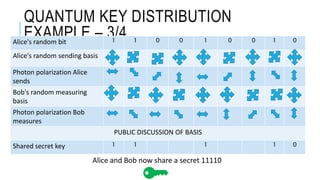
EXAMPLE – 3/4Alice's random bit 1 1 0 0 1 0 0 1 0
Alice's random sending basis
Photon polarization Alice
sends
Bob's random measuring
basis
Photon polarization Bob
measures
PUBLIC DISCUSSION OF BASIS
Shared secret key 1 1 1 1 0
Alice and Bob now share a secret 11110
• Alice and Bob compare a predetermined subset of their
transmitted bit strings.
• If a third party has gained any information about the photons'
polarization, this introduces errors in Bob's measurements.
• Other environmental conditions can cause errors in a similar
fashion.
• If more than a certain threshold of bits differ they abort the
key and try again
QUANTUM KEY DISTRIBUTION
EXAMPLE – 4/4
IMPLEMENTATIONS OF QKD
• In 2007, Los Alamos National Laboratory/NIST achieved quantum key
distribution over a 148.7 km of optic fibre
• In August 2015 the longest distance for optical fiber (307 km) was
achieved by University of Geneva and Corning Inc.
• in June 2017, Chinese physicists achieved over a distance of 1203 km
between two ground stations.
• There are currently four companies offering commercial quantum key
distribution systems
• ID Quantique (Geneva),
• MagiQ Technologies, Inc. (New York),
• QuintessenceLabs (Australia)
• SeQureNet (Paris).
Source: https://en.wikipedia.org/wiki/Quantum_key_d
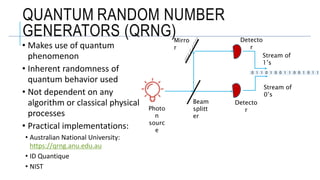
Stream of
1’s
Stream of
0’s
Mirro
r
Beam
splitt
er
Photo
n
sourc
e
Detecto
r
Detecto
r
QUANTUM RANDOM NUMBER
GENERATORS (QRNG)
• Makes use of quantum
phenomenon
• Inherent randomness of
quantum behavior used
• Not dependent on any
algorithm or classical physical
processes
• Practical implementations:
• Australian National University:
https://qrng.anu.edu.au
• ID Quantique
• NIST
0 1 1 0 1 0 0 1 1 0 0 1 0 1 1
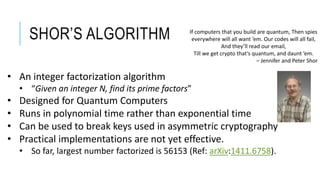
SHOR’S ALGORITHM If computers that you build are quantum, Then spies
everywhere will all want ’em. Our codes will all fail,
And they’ll read our email,
Till we get crypto that’s quantum, and daunt ’em.
– Jennifer and Peter Shor
• An integer factorization algorithm
• “Given an integer N, find its prime factors”
• Designed for Quantum Computers
• Runs in polynomial time rather than exponential time
• Can be used to break keys used in asymmetric cryptography
• Practical implementations are not yet effective.
• So far, largest number factorized is 56153 (Ref: arXiv:1411.6758).
POST QUANTUM CRYPTOGRAPHY
• Latest area of research to guard against security threat of
quantum computers
• Public key algorithms are considered unsafe
• Quantum Computer safe algorithms
• Symmetric key based algorithms
• Hash based signatures
HASH BASED SIGNATURES
• Using Hashing mechanism to generate signatures
• Lamport’s method
• Uses fixed length hashing scheme
• Large key sizes: One full digest for each bit
• Good for using only one time
• Highly inefficient
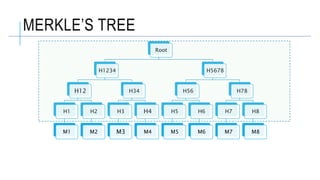
•Merkle’s tree
• Uses a binary tree of hashes
• Quite efficient compared to Lamport’s method
• Used with Blockchains
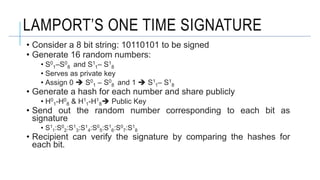
LAMPORT’S ONE TIME SIGNATURE
• Consider a 8 bit string: 10110101 to be signed
• Generate 16 random numbers:
• S0
1–S0
8 and S1
1– S1
8
• Serves as private key
• Assign 0  S0
1 – S0
8 and 1  S1
1– S1
8
• Generate a hash for each number and share publicly
• H0
1-H0
8 & H1
1-H1
8 Public Key
• Send out the random number corresponding to each bit as
signature
• S1
1:S0
2:S1
3:S1
4:S0
5:S1
6:S0
7:S1
8
• Recipient can verify the signature by comparing the hashes for
each bit.
MERKLE’S TREE
Root
H1234
H12
H1
M1
H2
M2
H34
H3
M3
H4
M4
H5678
H56
H5
M5
H6
M6
H78
H7
M7
H8
M8
WHAT LIES AHEAD?
• Search for new public key crypto algorithms
• Post-Quantum Cryptography Standardization:
https://csrc.nist.gov/Projects/Post-Quantum-
Cryptography/Post-Quantum-Cryptography-Standardization
• Open Quantum Safe (OQS) project:
https://openquantumsafe.org
• Lattice based cryptography

Quantum cryptography by Girisha Shankar, Sr. Manager, Cisco

  • 1.
  • 2.
    AGENDA 1.Introduction to Cryptography 2.Randomnumbers 3.Motivation for Quantum cryptography 4.Quantum mechanics and Quantum Computing 5.Quantum Key distribution 6.Quantum Random Number Generation 7.Post Quantum Cryptography
  • 3.
    ELEMENTS OF CRYPTOGRAPHY •Plain text – the original message and Cipher text – the disguised message. • Key – A “number” used in encryption and decryption algorithms. • Encryption – using a key to change plaintext into ciphertext. • Decryption – using a key to change cipher text back into something readable. • Simple example is mono-alphabetic substitution cipher method, in which each letter in the alphabet is shifted by an integer value. • The key is an integer value – typically very large
  • 4.
    TWO TYPES OFCRYPTOGRAPHY Symmetric key cryptography • Cryptographic algorithms use the same keys for both encryption and decryption. • Keys may not be identical, but simple transformation of each other • E.g. Blowfish, AES, DES, 3DES • Diffie-Helman key exchange algorithm can be used for key distribution Asymmetric key cryptography • Each user has a public key and a private key. • Information is encrypted using pubic key and delivered • Only intended recipient can decrypt the data using the private key • Exploits the fact that some mathematical operations are easier to do in one direction. • Based on simple number theoretic operations – modulo n arithmetic. • a ≡ b mod N  (a – b) is divisible by N • Modulo exponentiation, e.g. c ≡ me mod N
  • 5.
    ASYMMETRIC KEY CRYPTOGRAPHY •Generate a pair of large, random primes p and q. • Compute the modulus n as n = pq. • Select an odd public-key (e) between 3 and n-1 that is relative prime of p-1 and q-1. I.e. 𝑒𝜖 𝐺( 𝑝 − 1)( 𝑞 − 1) • Compute the private-key (d) from e, p and q. • d being the multiplicative inverse of e (modulo n) • Output (n, e) as the public key and (n, d) as the private key. • cipher = encrypt (message) = (message)e mod n • message = decrypt (cipher) = (cipher)d mod n
  • 6.
    ASYMMETRIC KEY CRYPTOGRAPHY– A SIMPLE EXAMPLE Consider p = 5 and q = 11  n = 55 • p – 1 = 4 and q – 1 = 10 • Choose public-key e = 7 ( relative prime of 4 and 10) • Choose private-key (d) such that 𝑑 × 𝑒 ≡ 1 𝑚𝑜𝑑[(𝑝 − 1 × 𝑞 − 1 ] • i.e. 7𝑑 ≡ 1𝑚𝑜𝑑40 d is 23. • Output (55, 7) as the public key and (55, 23) as the private key. Suppose message = 8 • cipher ≡ (message)e mod n ≡ 87 mod 55 = 2 • message ≡ (cipher)d mod n ≡ 223 mod 55 = 8
  • 7.
    RANDOM NUMBER GENERATORS •Desirable properties • Unpredictability • Backward security • PRNG: Software based random number generators • Rely on a good seed • Higher throughput • TRNG: system randomness used for generating random numbers • Sources • Thermal noise • Voltage fluctuations • Clock jitters • Lower throughput
  • 8.
    CRYPTOGRAPHY – BASICPREMISE • It is easy to generate random numbers • Security reductions: • Strength of crypto algorithm  known hard math problem • Certain operations are easier to do one way, but reverse is hard • Multiplication of two large numbers is easy, but factoring a large number to its prime factors is hard • Modular exponentiation is easy, but modular root extraction, is hard. • Kerckhoffs’s principle • Any cryptographic system can be compromised and all the details of the system are perfectly known to everyone • Crypto systems are open • Strength of cryptography rests on choice and safekeep of keys
  • 9.
    UNCONDITIONAL SECURITY • Asthe methods of security have evolved, so have the methods of attacks • Currently available cryptographic methods are vulnerable – at least in principle • Security relies on making things difficult to break – not impossible • Not future proof from advances in technology and Mathematics • Search for security that is provable and unconditional • Not exploitable even in principle
  • 10.
    QUANTUM MECHANICS • TheHeisenberg uncertainty principle • Measurement of a quantum system disturbs it irrevocably • Quantum systems are in a state of superposition of several possibilities • On measurement, the value of observable is non deterministic • Based on QM principles • Radically different from classical computing • Qubits rather than bits • Reversible gates • Very few algorithms: • Shor’s algorithm • Grover’s algorithm Quantum Mechanics Quantum Computing
  • 11.
    IMPACT OF QMON CRYPTOGRAPHY Quantum system measurement Detect eavesdropping QKD: BB-84 protocols Non- deterministic nature of QM Inherent physical level randomness QRNG Quantum Computing: Shor's algorithm Threat for Asymmetric crypto and DH key exchange Post quantum cryptography
  • 12.
    • Classical cryptographytechniques can not prevent the key transmission to be passively monitored. • Random numbers in use do not have enough entropy • Use of repeated keys • Deterministic computers generate deterministic random numbers • Unpredictability due to lack of information is not same as randomness WHY QUANTUM CRYPTOGRAPHY?
  • 13.
    • Uses principlesof Quantum Mechanics to guarantee secure key exchange • Immediate detection of eves dropping • Security relies on the nature of physical world – unlike complex algorithms and computational complexity • BB–84 protocol - developed by Charles Bennett and Gilles Brassard in 1984 QUANTUM KEY DISTRIBUTION
  • 14.
    QUANTUM KEY DISTRIBUTION EXAMPLE– 1/4 • Vertical Polarization  0 • Horizontal Polarization  1 • 45o Polarization  0 • 135o Polarization  1
  • 15.
    QUANTUM KEY DISTRIBUTION EXAMPLE– 2/4 • For each transmission, Alice randomly chooses one of the polarization basis and sends the photon to Bob • Sends a long string of photons • Bob chooses a polarization basis randomly and measures the photon • Captures the entire string sent by Alice Alice BobPhotons • Exchange information on the basis used for transmission and reception • Discard the non-matching photons/bits • Remaining bits are same for both Alice and Bob • Alice and Bob now share a secret.
  • 16.
    QUANTUM KEY DISTRIBUTION EXAMPLE– 3/4Alice's random bit 1 1 0 0 1 0 0 1 0 Alice's random sending basis Photon polarization Alice sends Bob's random measuring basis Photon polarization Bob measures PUBLIC DISCUSSION OF BASIS Shared secret key 1 1 1 1 0 Alice and Bob now share a secret 11110
  • 17.
    • Alice andBob compare a predetermined subset of their transmitted bit strings. • If a third party has gained any information about the photons' polarization, this introduces errors in Bob's measurements. • Other environmental conditions can cause errors in a similar fashion. • If more than a certain threshold of bits differ they abort the key and try again QUANTUM KEY DISTRIBUTION EXAMPLE – 4/4
  • 18.
    IMPLEMENTATIONS OF QKD •In 2007, Los Alamos National Laboratory/NIST achieved quantum key distribution over a 148.7 km of optic fibre • In August 2015 the longest distance for optical fiber (307 km) was achieved by University of Geneva and Corning Inc. • in June 2017, Chinese physicists achieved over a distance of 1203 km between two ground stations. • There are currently four companies offering commercial quantum key distribution systems • ID Quantique (Geneva), • MagiQ Technologies, Inc. (New York), • QuintessenceLabs (Australia) • SeQureNet (Paris). Source: https://en.wikipedia.org/wiki/Quantum_key_d
  • 19.
    Stream of 1’s Stream of 0’s Mirro r Beam splitt er Photo n sourc e Detecto r Detecto r QUANTUMRANDOM NUMBER GENERATORS (QRNG) • Makes use of quantum phenomenon • Inherent randomness of quantum behavior used • Not dependent on any algorithm or classical physical processes • Practical implementations: • Australian National University: https://qrng.anu.edu.au • ID Quantique • NIST 0 1 1 0 1 0 0 1 1 0 0 1 0 1 1
  • 20.
    SHOR’S ALGORITHM Ifcomputers that you build are quantum, Then spies everywhere will all want ’em. Our codes will all fail, And they’ll read our email, Till we get crypto that’s quantum, and daunt ’em. – Jennifer and Peter Shor • An integer factorization algorithm • “Given an integer N, find its prime factors” • Designed for Quantum Computers • Runs in polynomial time rather than exponential time • Can be used to break keys used in asymmetric cryptography • Practical implementations are not yet effective. • So far, largest number factorized is 56153 (Ref: arXiv:1411.6758).
  • 21.
    POST QUANTUM CRYPTOGRAPHY •Latest area of research to guard against security threat of quantum computers • Public key algorithms are considered unsafe • Quantum Computer safe algorithms • Symmetric key based algorithms • Hash based signatures
  • 22.
    HASH BASED SIGNATURES •Using Hashing mechanism to generate signatures • Lamport’s method • Uses fixed length hashing scheme • Large key sizes: One full digest for each bit • Good for using only one time • Highly inefficient •Merkle’s tree • Uses a binary tree of hashes • Quite efficient compared to Lamport’s method • Used with Blockchains
  • 23.
    LAMPORT’S ONE TIMESIGNATURE • Consider a 8 bit string: 10110101 to be signed • Generate 16 random numbers: • S0 1–S0 8 and S1 1– S1 8 • Serves as private key • Assign 0  S0 1 – S0 8 and 1  S1 1– S1 8 • Generate a hash for each number and share publicly • H0 1-H0 8 & H1 1-H1 8 Public Key • Send out the random number corresponding to each bit as signature • S1 1:S0 2:S1 3:S1 4:S0 5:S1 6:S0 7:S1 8 • Recipient can verify the signature by comparing the hashes for each bit.
  • 24.
  • 25.
    WHAT LIES AHEAD? •Search for new public key crypto algorithms • Post-Quantum Cryptography Standardization: https://csrc.nist.gov/Projects/Post-Quantum- Cryptography/Post-Quantum-Cryptography-Standardization • Open Quantum Safe (OQS) project: https://openquantumsafe.org • Lattice based cryptography