Quantum Computers
vs.
Computers Security
@veorq — http://aumasson.jp
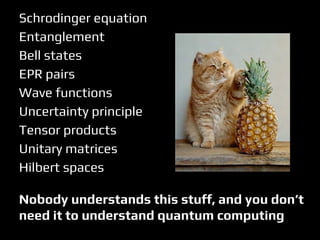
Schrodinger equation
Entanglement
Bell states
EPR pairs
Wave functions
Uncertainty principle
Tensor products
Unitary matrices
Hilbert spaces
Nobody understands this stuff, and you don’t
need it to understand quantum computing
1. QC 101
2. In practice
3. Breaking crypto
4. Post-quantum crypto
5. Quantum key distribution
6. Quantum copy protection
7. Quantum machine learning
8. Conclusions
1. QC 101
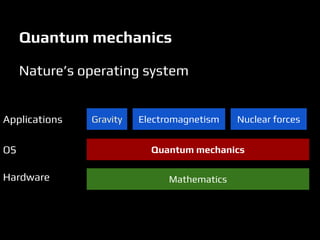
Quantum mechanics
Nature’s operating system
Quantum mechanics
Mathematics
Gravity Electromagnetism Nuclear forcesApplications
OS
Hardware
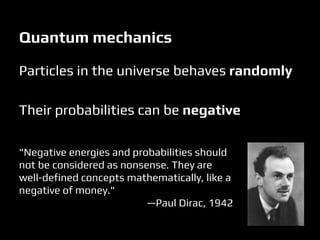
Quantum mechanics
Particles in the universe behaves randomly
Their probabilities can be negative
"Negative energies and probabilities should
not be considered as nonsense. They are
well-defined concepts mathematically, like a
negative of money."
—Paul Dirac, 1942
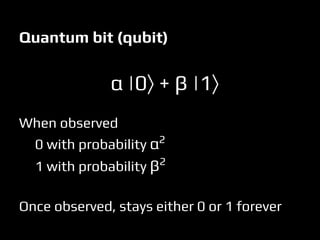
α |0⟩ + β |1⟩
When observed
0 with probability α2
1 with probability β2
Once observed, stays either 0 or 1 forever
Quantum bit (qubit)
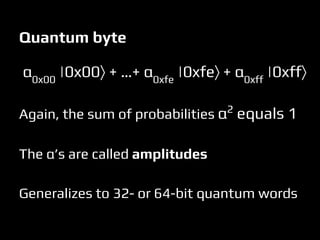
α0x00
|0x00⟩ + …+ α0xfe
|0xfe⟩ + α0xff
|0xff⟩
Again, the sum of probabilities α2
equals 1
The α’s are called amplitudes
Generalizes to 32- or 64-bit quantum words
Quantum byte
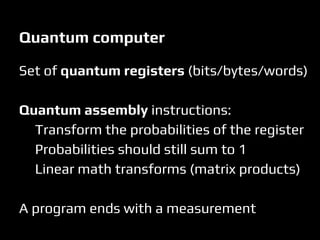
Set of quantum registers (bits/bytes/words)
Quantum assembly instructions:
Transform the probabilities of the register
Probabilities should still sum to 1
Linear math transforms (matrix products)
A program ends with a measurement
Quantum computer
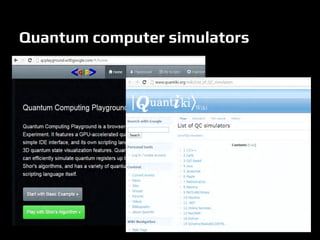
Quantum computer simulators
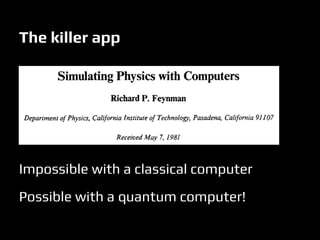
Impossible with a classical computer
Possible with a quantum computer!
The killer app
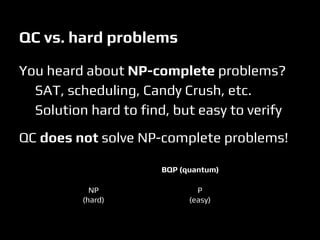
You heard about NP-complete problems?
SAT, scheduling, Candy Crush, etc.
Solution hard to find, but easy to verify
QC does not solve NP-complete problems!
QC vs. hard problems
NNP
P
(easy)NNP
NP
(hard)
NNP
BQP (quantum)
Quantum speedup
Make the impossible possible
Example: Factoring integers
Hard classically (exponential-ish)
Easy with a quantum computer!
Obvious application: break RSA!
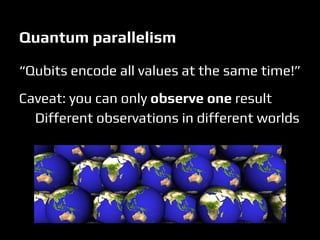
Quantum parallelism
“Qubits encode all values at the same time!”
Caveat: you can only observe one result
Different observations in different worlds
2. In practice
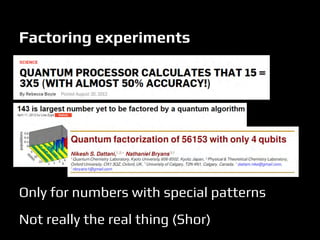
Factoring experiments
Only for numbers with special patterns
Not really the real thing (Shor)
Constructing quantum computers
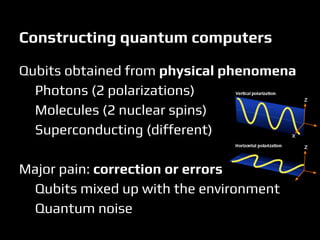
Qubits obtained from physical phenomena
Photons (2 polarizations)
Molecules (2 nuclear spins)
Superconducting (different)
Major pain: correction or errors
Qubits mixed up with the environment
Quantum noise
Recent milestone
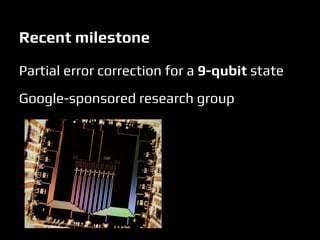
Partial error correction for a 9-qubit state
Google-sponsored research group
D-Wave
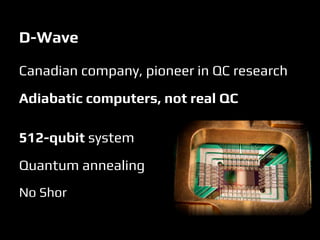
Canadian company, pioneer in QC research
Adiabatic computers, not real QC
512-qubit system
Quantum annealing
No Shor
Stability, error-correction
How much will cost “N quantum
operations” vs “N classical operations”?
Some algorithms need quantum RAM,
which we don’t really know how to do
Unlikely to come in the next decade, if ever
Many challenges
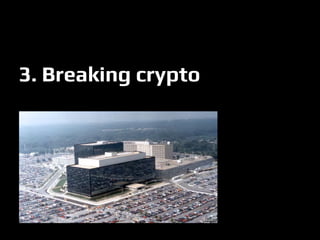
3. Breaking crypto
TL;DR: We’re doomed
RSA: broken
Diffie-Hellman: broken
Elliptic curves: broken
El Gamal: broken
RSA
No more RSA encryption or signatures
Based on the hardness of factoring
You know N = p*q, you search p and q
Hard on a classical computer (most probably)
Easy on a quantum computer!
Xe
mod N for e in [1, 2, 3, …] and some X
will repeat with a period dividing (p-1)(q-1)
A period gives information on p and q!
Shor’s algorithm:
1. Prepare qubits to encode X,X2
,X3
,X4
, ... simultaneously
2. Find the period using the Quantum Fourier Transform
3. Exploits the period to recover p and q
Shor’s idea to factor N=pq
Discrete logarithms
Problem behind Diffie-Hellman, ECC
You know g and gy
, you search y
Like factoring, a Hidden Subgroup Problem
Shor works too!
What about symmetric ciphers?
AES with a 128-bit key:
Classical: 128-bit security
Quantum: 64-bit security
Grover’s algorithm: searches in N items in
O(√N) time and O(log N) memory
Solution: upgrade to 256-bit AES
4. Post-quantum crypto
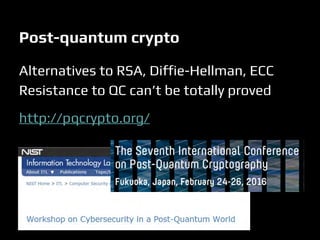
Alternatives to RSA, Diffie-Hellman, ECC
Resistance to QC can’t be totally proved
http://pqcrypto.org/
Post-quantum crypto
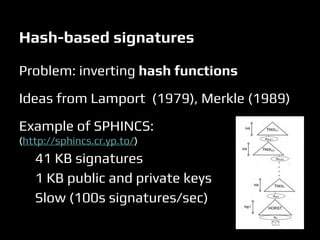
Hash-based signatures
Problem: inverting hash functions
Ideas from Lamport (1979), Merkle (1989)
Example of SPHINCS:
(http://sphincs.cr.yp.to/)
41 KB signatures
1 KB public and private keys
Slow (100s signatures/sec)
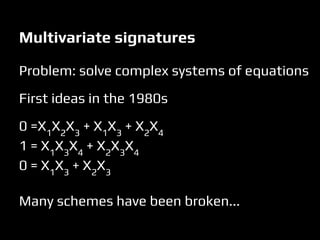
Multivariate signatures
Problem: solve complex systems of equations
First ideas in the 1980s
0 =X1
X2
X3
+ X1
X3
+ X2
X4
1 = X1
X3
X4
+ X2
X3
X4
0 = X1
X3
+ X2
X3
Many schemes have been broken...
Code-based crypto
Problem: decoding error-correcting codes
Schemes: McEliece (1979), Niederreiter (1986)
Limitations:
Large keys (100 KB+)
Fewer optimized implementations
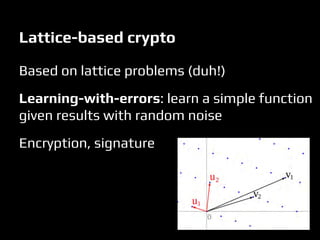
Lattice-based crypto
Based on lattice problems (duh!)
Learning-with-errors: learn a simple function
given results with random noise
Encryption, signature
5. Quantum key distribution
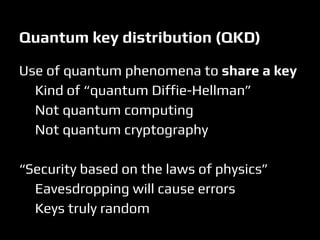
Quantum key distribution (QKD)
Use of quantum phenomena to share a key
Kind of “quantum Diffie-Hellman”
Not quantum computing
Not quantum cryptography
“Security based on the laws of physics”
Eavesdropping will cause errors
Keys truly random
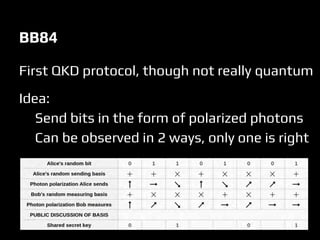
BB84
First QKD protocol, though not really quantum
Idea:
Send bits in the form of polarized photons
Can be observed in 2 ways, only one is right
Caveats
Like any security system, it’s complicated
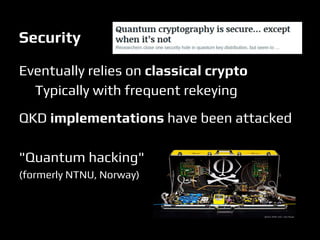
Security
Eventually relies on classical crypto
Typically with frequent rekeying
QKD implementations have been attacked
"Quantum hacking"
(formerly NTNU, Norway)
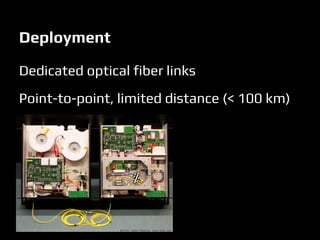
Deployment
Dedicated optical fiber links
Point-to-point, limited distance (< 100 km)
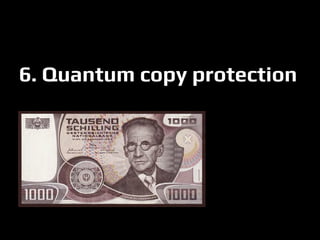
6. Quantum copy protection
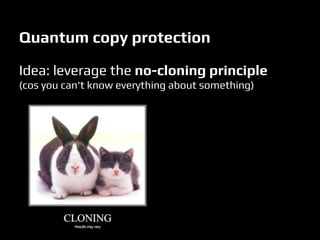
Quantum copy protection
Idea: leverage the no-cloning principle
(cos you can't know everything about something)
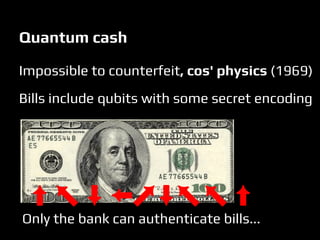
Quantum cash
Impossible to counterfeit, cos' physics (1969)
Bills include qubits with some secret encoding
⬆ ⬈ ⬇ ⬅⬉⬇⬈ ⬈ ⬆
Only the bank can authenticate bills...
Publicly verifiable quantum cash
Anyone can verify that a bill isn't counterfeit
Uses public-key crypto, non-quantum
Can be secure even with black-box verification
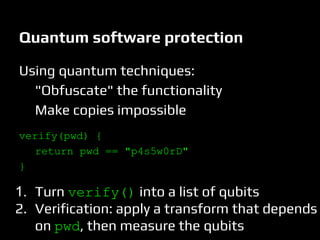
Quantum software protection
Using quantum techniques:
"Obfuscate" the functionality
Make copies impossible
verify(pwd) {
return pwd == "p4s5w0rD"
}
1. Turn verify() into a list of qubits
2. Verification: apply a transform that depends
on pwd, then measure the qubits
7. Quantum machine learning
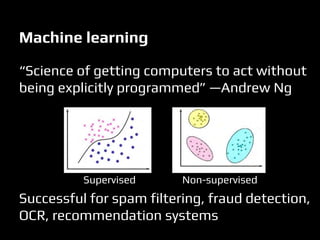
Machine learning
“Science of getting computers to act without
being explicitly programmed” —Andrew Ng
Supervised Non-supervised
Successful for spam filtering, fraud detection,
OCR, recommendation systems
No silver bullet, but may help
ML being used for
Intrusion detection (network, endpoint)
Binary vulnerability discovery
Nevertheless, vendors give neither
Details on the techniques used, nor
Effectiveness figures or measurements
Machine learning and security
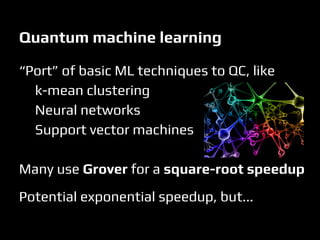
Quantum machine learning
“Port” of basic ML techniques to QC, like
k-mean clustering
Neural networks
Support vector machines
Many use Grover for a square-root speedup
Potential exponential speedup, but...
Quantum RAM (QRAM)
Awesome concept
Addresses are given in superposition
Read values are retrieved in superposition
Many QML algorithms need QRAM
But it'd be extremely complicated to build
8. Conclusions
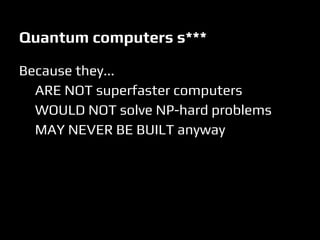
Quantum computers s***
Because they...
ARE NOT superfaster computers
WOULD NOT solve NP-hard problems
MAY NEVER BE BUILT anyway
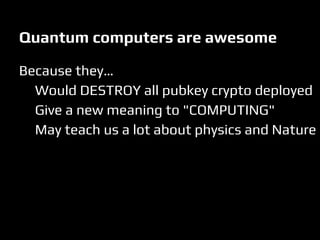
Quantum computers are awesome
Because they…
Would DESTROY all pubkey crypto deployed
Give a new meaning to "COMPUTING"
May teach us a lot about physics and Nature
Thank you!

DEF CON 23 - Phillip Aumasson - quantum computers vs computers security

  • 1.
  • 2.
    Schrodinger equation Entanglement Bell states EPRpairs Wave functions Uncertainty principle Tensor products Unitary matrices Hilbert spaces Nobody understands this stuff, and you don’t need it to understand quantum computing
  • 3.
    1. QC 101 2.In practice 3. Breaking crypto 4. Post-quantum crypto 5. Quantum key distribution 6. Quantum copy protection 7. Quantum machine learning 8. Conclusions
  • 4.
  • 5.
    Quantum mechanics Nature’s operatingsystem Quantum mechanics Mathematics Gravity Electromagnetism Nuclear forcesApplications OS Hardware
  • 6.
    Quantum mechanics Particles inthe universe behaves randomly Their probabilities can be negative "Negative energies and probabilities should not be considered as nonsense. They are well-defined concepts mathematically, like a negative of money." —Paul Dirac, 1942
  • 7.
    α |0⟩ +β |1⟩ When observed 0 with probability α2 1 with probability β2 Once observed, stays either 0 or 1 forever Quantum bit (qubit)
  • 8.
    α0x00 |0x00⟩ + …+α0xfe |0xfe⟩ + α0xff |0xff⟩ Again, the sum of probabilities α2 equals 1 The α’s are called amplitudes Generalizes to 32- or 64-bit quantum words Quantum byte
  • 9.
    Set of quantumregisters (bits/bytes/words) Quantum assembly instructions: Transform the probabilities of the register Probabilities should still sum to 1 Linear math transforms (matrix products) A program ends with a measurement Quantum computer
  • 10.
  • 11.
    Impossible with aclassical computer Possible with a quantum computer! The killer app
  • 12.
    You heard aboutNP-complete problems? SAT, scheduling, Candy Crush, etc. Solution hard to find, but easy to verify QC does not solve NP-complete problems! QC vs. hard problems NNP P (easy)NNP NP (hard) NNP BQP (quantum)
  • 13.
    Quantum speedup Make theimpossible possible Example: Factoring integers Hard classically (exponential-ish) Easy with a quantum computer! Obvious application: break RSA!
  • 14.
    Quantum parallelism “Qubits encodeall values at the same time!” Caveat: you can only observe one result Different observations in different worlds
  • 15.
  • 16.
    Factoring experiments Only fornumbers with special patterns Not really the real thing (Shor)
  • 17.
    Constructing quantum computers Qubitsobtained from physical phenomena Photons (2 polarizations) Molecules (2 nuclear spins) Superconducting (different) Major pain: correction or errors Qubits mixed up with the environment Quantum noise
  • 18.
    Recent milestone Partial errorcorrection for a 9-qubit state Google-sponsored research group
  • 19.
    D-Wave Canadian company, pioneerin QC research Adiabatic computers, not real QC 512-qubit system Quantum annealing No Shor
  • 20.
    Stability, error-correction How muchwill cost “N quantum operations” vs “N classical operations”? Some algorithms need quantum RAM, which we don’t really know how to do Unlikely to come in the next decade, if ever Many challenges
  • 21.
  • 22.
    TL;DR: We’re doomed RSA:broken Diffie-Hellman: broken Elliptic curves: broken El Gamal: broken
  • 23.
    RSA No more RSAencryption or signatures Based on the hardness of factoring You know N = p*q, you search p and q Hard on a classical computer (most probably) Easy on a quantum computer!
  • 24.
    Xe mod N fore in [1, 2, 3, …] and some X will repeat with a period dividing (p-1)(q-1) A period gives information on p and q! Shor’s algorithm: 1. Prepare qubits to encode X,X2 ,X3 ,X4 , ... simultaneously 2. Find the period using the Quantum Fourier Transform 3. Exploits the period to recover p and q Shor’s idea to factor N=pq
  • 25.
    Discrete logarithms Problem behindDiffie-Hellman, ECC You know g and gy , you search y Like factoring, a Hidden Subgroup Problem Shor works too!
  • 26.
    What about symmetricciphers? AES with a 128-bit key: Classical: 128-bit security Quantum: 64-bit security Grover’s algorithm: searches in N items in O(√N) time and O(log N) memory Solution: upgrade to 256-bit AES
  • 27.
  • 28.
    Alternatives to RSA,Diffie-Hellman, ECC Resistance to QC can’t be totally proved http://pqcrypto.org/ Post-quantum crypto
  • 29.
    Hash-based signatures Problem: invertinghash functions Ideas from Lamport (1979), Merkle (1989) Example of SPHINCS: (http://sphincs.cr.yp.to/) 41 KB signatures 1 KB public and private keys Slow (100s signatures/sec)
  • 30.
    Multivariate signatures Problem: solvecomplex systems of equations First ideas in the 1980s 0 =X1 X2 X3 + X1 X3 + X2 X4 1 = X1 X3 X4 + X2 X3 X4 0 = X1 X3 + X2 X3 Many schemes have been broken...
  • 31.
    Code-based crypto Problem: decodingerror-correcting codes Schemes: McEliece (1979), Niederreiter (1986) Limitations: Large keys (100 KB+) Fewer optimized implementations
  • 32.
    Lattice-based crypto Based onlattice problems (duh!) Learning-with-errors: learn a simple function given results with random noise Encryption, signature
  • 33.
    5. Quantum keydistribution
  • 34.
    Quantum key distribution(QKD) Use of quantum phenomena to share a key Kind of “quantum Diffie-Hellman” Not quantum computing Not quantum cryptography “Security based on the laws of physics” Eavesdropping will cause errors Keys truly random
  • 35.
    BB84 First QKD protocol,though not really quantum Idea: Send bits in the form of polarized photons Can be observed in 2 ways, only one is right
  • 36.
    Caveats Like any securitysystem, it’s complicated
  • 37.
    Security Eventually relies onclassical crypto Typically with frequent rekeying QKD implementations have been attacked "Quantum hacking" (formerly NTNU, Norway)
  • 38.
    Deployment Dedicated optical fiberlinks Point-to-point, limited distance (< 100 km)
  • 39.
    6. Quantum copyprotection
  • 40.
    Quantum copy protection Idea:leverage the no-cloning principle (cos you can't know everything about something)
  • 41.
    Quantum cash Impossible tocounterfeit, cos' physics (1969) Bills include qubits with some secret encoding ⬆ ⬈ ⬇ ⬅⬉⬇⬈ ⬈ ⬆ Only the bank can authenticate bills...
  • 42.
    Publicly verifiable quantumcash Anyone can verify that a bill isn't counterfeit Uses public-key crypto, non-quantum Can be secure even with black-box verification
  • 43.
    Quantum software protection Usingquantum techniques: "Obfuscate" the functionality Make copies impossible verify(pwd) { return pwd == "p4s5w0rD" } 1. Turn verify() into a list of qubits 2. Verification: apply a transform that depends on pwd, then measure the qubits
  • 44.
  • 45.
    Machine learning “Science ofgetting computers to act without being explicitly programmed” —Andrew Ng Supervised Non-supervised Successful for spam filtering, fraud detection, OCR, recommendation systems
  • 46.
    No silver bullet,but may help ML being used for Intrusion detection (network, endpoint) Binary vulnerability discovery Nevertheless, vendors give neither Details on the techniques used, nor Effectiveness figures or measurements Machine learning and security
  • 47.
    Quantum machine learning “Port”of basic ML techniques to QC, like k-mean clustering Neural networks Support vector machines Many use Grover for a square-root speedup Potential exponential speedup, but...
  • 48.
    Quantum RAM (QRAM) Awesomeconcept Addresses are given in superposition Read values are retrieved in superposition Many QML algorithms need QRAM But it'd be extremely complicated to build
  • 49.
  • 50.
    Quantum computers s*** Becausethey... ARE NOT superfaster computers WOULD NOT solve NP-hard problems MAY NEVER BE BUILT anyway
  • 51.
    Quantum computers areawesome Because they… Would DESTROY all pubkey crypto deployed Give a new meaning to "COMPUTING" May teach us a lot about physics and Nature
  • 52.