OBJECTIVE
• Understanding the mechanism behind working of
a ballistic missile.
• Studying types of ballistic missiles missiles
• Understanding concept of ballistics
Ballistic missile
• Rocket with a warhead
• Follows a ballistic trajectory
• Delivers one or more warhead to a predetermined target
• Both guided and unguided
• Guided during relatively brief periods of flight
• Most of the trajectory is unpowered and governed by gravity and air
resistance if in atmosphere
PRINCIPLE
• Works on Newton’s 3rd law of motion
• Continuous Ejection of Hot Gases in one direction
causes a steady motion of rocket in opposite
direction
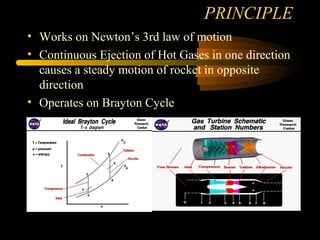
• Operates on Brayton Cycle
Types of Ballistic
•Battlefield short range ballistic
missiles [ 150 km]
•Short range ballistic missiles
[250-800 km]
•Medium range [800-2400]
•Intercontinental range ballistic
missiles[5500 km]
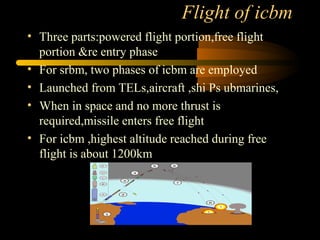
Flight of icbm
• Three parts:powered flight portion,free flight
portion &re entry phase
• For srbm, two phases of icbm are employed
• Launched from TELs,aircraft ,shi Ps ubmarines,
• When in space and no more thrust is
required,missile enters free flight
• For icbm ,highest altitude reached during free
flight is about 1200km
GUIDANCE SYSTEM
• can be compared to the human pilot of an airplane
• consists of an :
• ATTITUDE CONTROL SYSTEM
• maintains the missile in the desired attitude
• controls the missile in pitch, roll
• damps out fluctuations that tend to deflect the missile from its ordered flight
path
• FLIGHT CONTROL SYSTEM
• generate the orders to the attitude control system to maintain that path.
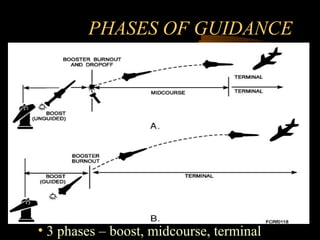
PHASES OF GUIDANCE
• 3 phases – boost, midcourse, terminal
BOOST PHASE
• Missiles are boosted to flight speed by booster
component of propulsion system
• Lasts from the time missile is launched until
booster burns up its fuel
• Missiles aimed in specific direction on orders
from fire control computer
• This establishes line of fire along which missile
must fly during boosted period
• At the end of boost , missile must be at pre-
calculated point
• Essential that it provides stability to missile
• Not always present; but when present it is
the longest in time & distance
• Changes may be needed to bring missile
onto desired course & to keep it on course
• Puts missile near target, from where reentry
phase takes over control
MID-COURSE PHASE
Re-Entry vechile phase
• after propulsive phase ,Missile typically aligns , inertially
stabilizes release a reentry vehicle on a trajectory towards a pre
selected target
• the exterior of the rv is protected from aero thermodynamic
heating by a T.P.S
• The aerodynamic shape configuration determines duration and
flight path of rv
• This, in turn, affects the vehicle systems complexity and the
heating loads on the payload.
CHARACTERISTICS
• have much longer range than would be possible for cruise missiles for
same size.
• can travel extremely quick along there flight path
• An ICBM can strike a target within a 10000km range in about 30 to 35
minutes
• With speeds of over 5000m/s , these are much harder to intercept than
cruise.
• High cost of production and maintenance
• Follows ballistic path , hence attack detectable during boost phase
Types of propellant
LIQUID PROPELLANTS-
Two separately stored liquid propellant to produce thrust.
• Cyrogenic- USES VERY COLD AND LIQUIFIED GASES AS FUEL (lh2)AND
OXIDISER. (lox)
• Distressing tendency to return to gaseous form unless kept supercool
makes them difficult to store for long periods of time
• Not much used in military rockets
• Hypergolic - COMPOSED OF A FUEL AND OXIDISER THAT IGNITE
WHEN THEY COME IN CONTACT WITH EACH OTHER.
• corrosive so special containers and facilities required
HYBRID PROPELLANT
• advantages of both liquid and solid rocket engines.
• consists of a combustion chamber , packed with a solid chemical, .
• two chemicals are hypergolic
• liquid chemical is injected into the combustion chamber
• ignition occurs and thrust is produced.
solid propellant
•combustion chamber tubes packed with a propellant that contains both fuel and
oxidizer blended together uniformly
•relatively stable therefore it can be manufactured and stored for future use
•. Solid propellants have a high density and can burn very fast
•insensitive to shock, vibration and acceleration
FUTURE AND LATEST DEVELOPMENTS
AGNI V1:
 ICBM TYPE
 NUCLEAR WARHEAD
 FOUR STAGE SOLID FUELED
 CAPABILITY TO BE LAUNCHED FROM SUBMARINES AND FROM LAND
BASED LAUNCHERS
 OPERATIONAL RANGE –( 8000-12000).
AGNI V:
 3 STAGE SOLID FUELED
 RANGE 5500 to 5800KM
THANK YOU

10 missile guidance-systems

  • 2.
    OBJECTIVE • Understanding themechanism behind working of a ballistic missile. • Studying types of ballistic missiles missiles • Understanding concept of ballistics
  • 3.
    Ballistic missile • Rocketwith a warhead • Follows a ballistic trajectory • Delivers one or more warhead to a predetermined target • Both guided and unguided • Guided during relatively brief periods of flight • Most of the trajectory is unpowered and governed by gravity and air resistance if in atmosphere
  • 4.
    PRINCIPLE • Works onNewton’s 3rd law of motion • Continuous Ejection of Hot Gases in one direction causes a steady motion of rocket in opposite direction • Operates on Brayton Cycle
  • 5.
    Types of Ballistic •Battlefieldshort range ballistic missiles [ 150 km] •Short range ballistic missiles [250-800 km] •Medium range [800-2400] •Intercontinental range ballistic missiles[5500 km]
  • 6.
    Flight of icbm •Three parts:powered flight portion,free flight portion &re entry phase • For srbm, two phases of icbm are employed • Launched from TELs,aircraft ,shi Ps ubmarines, • When in space and no more thrust is required,missile enters free flight • For icbm ,highest altitude reached during free flight is about 1200km
  • 7.
    GUIDANCE SYSTEM • canbe compared to the human pilot of an airplane • consists of an : • ATTITUDE CONTROL SYSTEM • maintains the missile in the desired attitude • controls the missile in pitch, roll • damps out fluctuations that tend to deflect the missile from its ordered flight path • FLIGHT CONTROL SYSTEM • generate the orders to the attitude control system to maintain that path.
  • 8.
    PHASES OF GUIDANCE •3 phases – boost, midcourse, terminal
  • 9.
    BOOST PHASE • Missilesare boosted to flight speed by booster component of propulsion system • Lasts from the time missile is launched until booster burns up its fuel • Missiles aimed in specific direction on orders from fire control computer • This establishes line of fire along which missile must fly during boosted period • At the end of boost , missile must be at pre- calculated point • Essential that it provides stability to missile
  • 10.
    • Not alwayspresent; but when present it is the longest in time & distance • Changes may be needed to bring missile onto desired course & to keep it on course • Puts missile near target, from where reentry phase takes over control MID-COURSE PHASE
  • 11.
    Re-Entry vechile phase •after propulsive phase ,Missile typically aligns , inertially stabilizes release a reentry vehicle on a trajectory towards a pre selected target • the exterior of the rv is protected from aero thermodynamic heating by a T.P.S • The aerodynamic shape configuration determines duration and flight path of rv • This, in turn, affects the vehicle systems complexity and the heating loads on the payload.
  • 12.
    CHARACTERISTICS • have muchlonger range than would be possible for cruise missiles for same size. • can travel extremely quick along there flight path • An ICBM can strike a target within a 10000km range in about 30 to 35 minutes • With speeds of over 5000m/s , these are much harder to intercept than cruise. • High cost of production and maintenance • Follows ballistic path , hence attack detectable during boost phase
  • 13.
    Types of propellant LIQUIDPROPELLANTS- Two separately stored liquid propellant to produce thrust. • Cyrogenic- USES VERY COLD AND LIQUIFIED GASES AS FUEL (lh2)AND OXIDISER. (lox) • Distressing tendency to return to gaseous form unless kept supercool makes them difficult to store for long periods of time • Not much used in military rockets • Hypergolic - COMPOSED OF A FUEL AND OXIDISER THAT IGNITE WHEN THEY COME IN CONTACT WITH EACH OTHER. • corrosive so special containers and facilities required
  • 14.
    HYBRID PROPELLANT • advantagesof both liquid and solid rocket engines. • consists of a combustion chamber , packed with a solid chemical, . • two chemicals are hypergolic • liquid chemical is injected into the combustion chamber • ignition occurs and thrust is produced. solid propellant •combustion chamber tubes packed with a propellant that contains both fuel and oxidizer blended together uniformly •relatively stable therefore it can be manufactured and stored for future use •. Solid propellants have a high density and can burn very fast •insensitive to shock, vibration and acceleration
  • 15.
    FUTURE AND LATESTDEVELOPMENTS AGNI V1:  ICBM TYPE  NUCLEAR WARHEAD  FOUR STAGE SOLID FUELED  CAPABILITY TO BE LAUNCHED FROM SUBMARINES AND FROM LAND BASED LAUNCHERS  OPERATIONAL RANGE –( 8000-12000). AGNI V:  3 STAGE SOLID FUELED  RANGE 5500 to 5800KM
  • 16.