International Research Journal of Engineering and Technology (IRJET) e-ISSN: 2395 -0056
Volume: 04 Issue: 03 | March -2017 www.irjet.net p-ISSN: 2395-0072
© 2017, IRJET | Impact Factor value: 5.181 | ISO 9001:2008 Certified Journal | Page 10
GSM BASED AGRICULTURE MONITORING SYSTEM
Aprajita Anand1, Akansha Parasar2, Assoc. Prof. A Prabhakar3
1.2Btech in Electronics and telecommunication engg. BVDUCOE,Pune,Maharashtra,India
3Assoc. Professor in Electronics and telecommunication dept., BVDUCOE,Pune, Maharashtra,India
---------------------------------------------------------------------***---------------------------------------------------------------------
Abstract - Last 10 years have seen a rapid evolution in this
technology. In the United States, ongoingresearchinprecision
agriculture has been effectively applied to large agri-
businesses at scale. But small farmers do not have the capital
resources to invest in expensive monitoring systems. Hence to
address these issues, we have designed an Arduino based
agriculture monitoring system which operates on GSM
network. This system will monitor the humidity levels and
surrounding temperature and control the water flow
accordingly. The controller activates the relay driver unit
when the message is received through GSM and pumps motor
by using relay switches. This design can be used for alarming
the user via SMS (Short message service) if the moisture level
and temperature goes beyond threshold value.
Key Words: GSM, agriculture, soil moisture sensor,
temperature sensor, monitoring, Arduino
1. INTRODUCTION
Agriculture plays an important role in economy and
development. The agriculture is in the transition from
traditional agriculture to modern agriculture currently. For
continuously increasing demand of food necessities, rapid
improvement in production of food technology isimportant.
In the paper our main focus is to maintain, control or
monitor the agricultural trends or system making it easier
for the user, to get data at regular interval about the field. In
many areas one person is not enough to monitoring thefield
status and control things. To improve we have to focus on
the agriculture monitoring system and to collect more area
information. In agriculture, there are two important factors,
first to get information about fertility of soil and second is to
measure moisture content in soil. Nowadays for irrigation,
different techniques are available which is used to reduce
the dependency on rain. And mostly this technique is driven
by electrical power and on/off schedulingcontrolledsystem.
Here we have used sensors to create an agricultural
monitoring system like soil moisture sensor, temperature
sensor. Soil moisture sensor is basically used to measurethe
soil moisture level and the temperature sensor is used to
keep the track of temperature.GSM sim 900 is being usedfor
sending the data to the user.
1.1 SYSTEM ARCHITECTURE
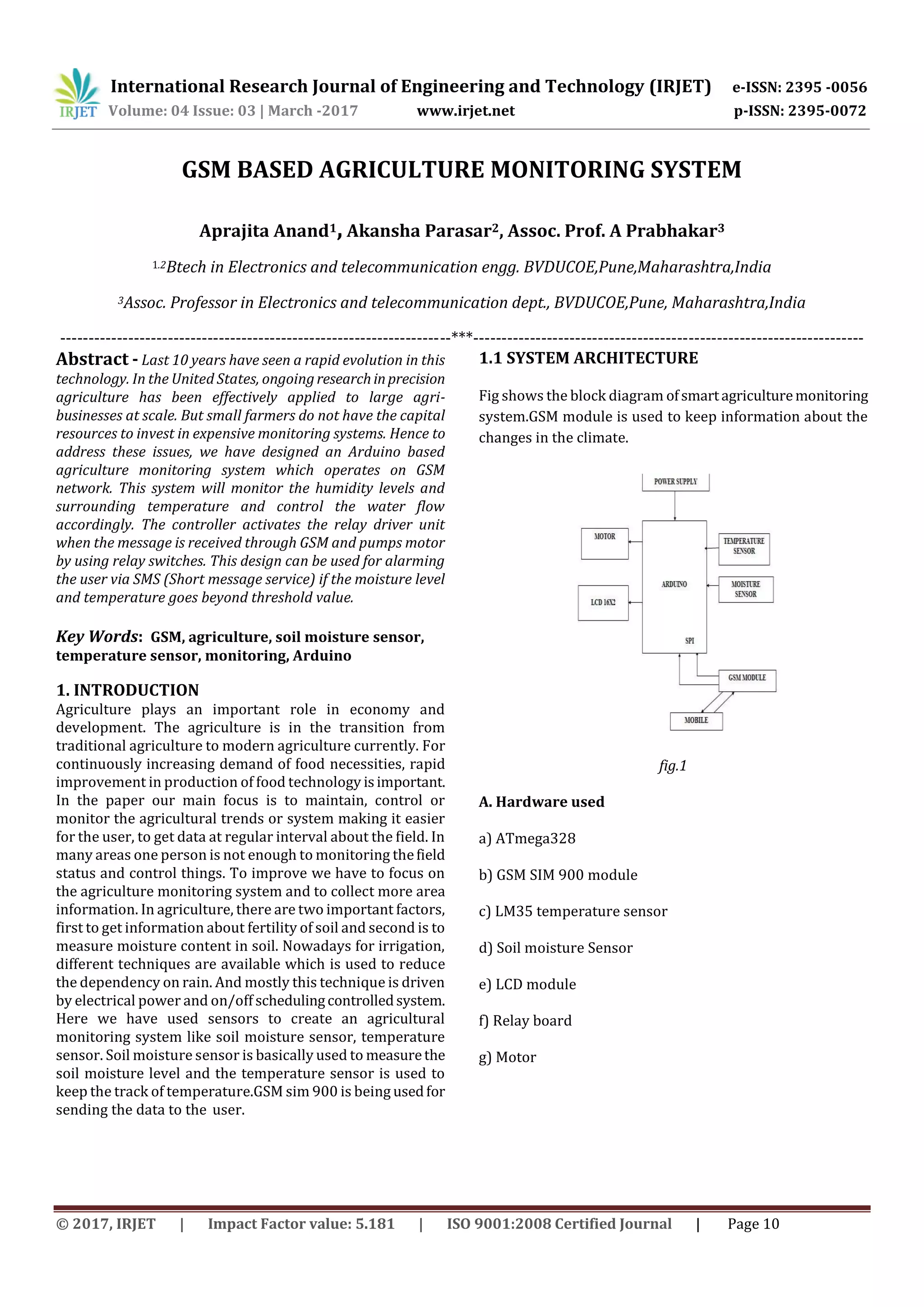
Fig shows the block diagram ofsmartagriculturemonitoring
system.GSM module is used to keep information about the
changes in the climate.
fig.1
A. Hardware used
a) ATmega328
b) GSM SIM 900 module
c) LM35 temperature sensor
d) Soil moisture Sensor
e) LCD module
f) Relay board
g) Motor
International Research Journal of Engineering and Technology (IRJET) e-ISSN: 2395 -0056
Volume: 04 Issue: 03 | March -2017 www.irjet.net p-ISSN: 2395-0072
© 2017, IRJET | Impact Factor value: 5.181 | ISO 9001:2008 Certified Journal | Page 11
ATmega328:
fig.2
ATMega328 is the ATMEL MicrocontrolleronwhichArduino
UNO is based. The Atmel 8-bit AVR RISC-based
microcontroller combines 32 kB ISP flash memory with
read-while-write capabilities, 1 kB EEPROM, 2 kB SRAM,23
general purpose I/O lines, 32 general purpose working
registers, three flexible timer/counters with compare
modes, internal and external interrupts, serial
programmable USART, a byte-oriented 2-wire serial
interface, SPI serial port, 6-channel 10-bit A/D converter (8-
channels in TQFP and QFN/MLF packages), programmable
watchdog timer with internal oscillator, and five software
selectable power saving modes. The device operates
between 1.8-5.5 volts. The device achieves throughput
approaching 1 MIPS per MHz Serial data to the MCU is
clocked on the rising edge and data from the MCU is clocked
on the falling edge. Power is applied to VCC whileRESET and
SCK are set to zero. ATmega328 is commonly used in many
projects and autonomous systems where a simple, low-
powered, low-cost micro-controller is needed.
GSM SIM 900:
fig.3
The words, “Mobile Station” (MS) or “Mobile Equipment”
(ME) are used for mobileterminalsSupportingGSMservices.
A call from a GSM mobile station to the PSTN is called a
“mobile originated call” (MOC) or “Outgoing call”, and a call
from a fixed network to a GSM mobile station is called a
“Mobile Terminated call” (MTC) or “incoming call”.AT
commands are instructions used to control a modem.AT is
the abbreviation of ATtention. Every command line starts
with "AT" or "at".
LM35:
fig.4
LM35 is a precision IC temperature sensor with its output
proportional to the temperature (in oC).Thesensorcircuitry
is sealed and therefore it is not subjected to oxidation and
other processes. With LM35, temperature can be measured
more accurately than with a thermistor. It also possess low
self heating and does notcausemorethan0.1oCtemperature
rise in still air. The operating temperature range is from -
55°C to 150°C. The output voltage varies by 10mV in
response to every oC rise/fall inambienttemperature, i.e., its
scale factor is 0.01V/ oC.
SOIL MOISTURE SENSOR:
fig.5
Soil moisture sensors measure the water content in soil. A
soil moisture probe is made up of multiple soil moisture
sensors. Technologies commonly used in soil moisture
sensors include:
- Neutron moisture gauges, utilize the moderator properties
of water for neutrons.
- Electrical resistance of the soil
In this particular project, we will use the moisture sensors
which can be inserted in the soil, in order to measure the
moisture content of the soil.
LCD MODULE:
A 16X2 LCD is connected with Arduino at 2, 3, 4,5,11 and 12
pins to display the reading of various sensors.
RELAY:
Relays are simple switches which can be operated both
mechanically and electrically in which electromagnet is
present. Relay works when there is a low-power signal and
International Research Journal of Engineering and Technology (IRJET) e-ISSN: 2395 -0056
Volume: 04 Issue: 03 | March -2017 www.irjet.net p-ISSN: 2395-0072
© 2017, IRJET | Impact Factor value: 5.181 | ISO 9001:2008 Certified Journal | Page 12
this information is used to control the circuit. It is used,
where a number of circuits are controlled by a single signal.
They are used for switching incoming signals from one
source to different destinations. Relays are also used to
perform Boolean and other logical operationsina computer.
B. Software Description
Arduino is a single-board microcontroller designed to
make the process of using electronics in multidisciplinary
projects more accessible. The hardware consists of a
simple open-source hardware board designed around an
8-bit Atmel AVR microcontroller, though a new model has
been designed around a 32-bit Atmel ARM. The software
consists of a standard programming language compiler
and a boot loader that executes on the microcontroller.
The Arduino board is made up of an Atmel AVR
microprocessor, a crystal or oscillator (a crude clock that
sends time pulses at a specified frequency to enable it to
operate at the correct speed) and a 5V voltage regulator.
To program the Arduino the Arduino IDE is used which is
free software that enables programming in the language
that the Arduino understands. In the case of the Arduino,
the language is based on C/C++ and can even be extended
through C++ libraries. The IDE enables writing a computer
program, which is a set of step-by-step instructions that is
then uploaded to the Arduino. Arduino will then carry out
those instructions and interact with whatever it has been
connected to it. In the Arduino world, programs are known
as “sketches”.
ARDUINO UNO:-
Table. 1
Microcontroller ATmega328
Operating
Voltage
5V
Input Voltage
(recommended)
7-12V
Input Voltage
(limits)
6-20V
Digital I/O Pins
14 (of which 6 provide
PWM output)
Analog Input
Pins
6
DC Current per
I/O Pin
40 Ma
DC Current for
3.3V Pin
50 Ma
Flash Memory
32 KB (ATmega328) of
which 0.5 KB used by
bootloader
SRAM 2 KB (ATmega328)
EEPROM 1 KB (ATmega328)
Clock Speed 16 MHz
Length 68.6 mm
Width 53.4 mm
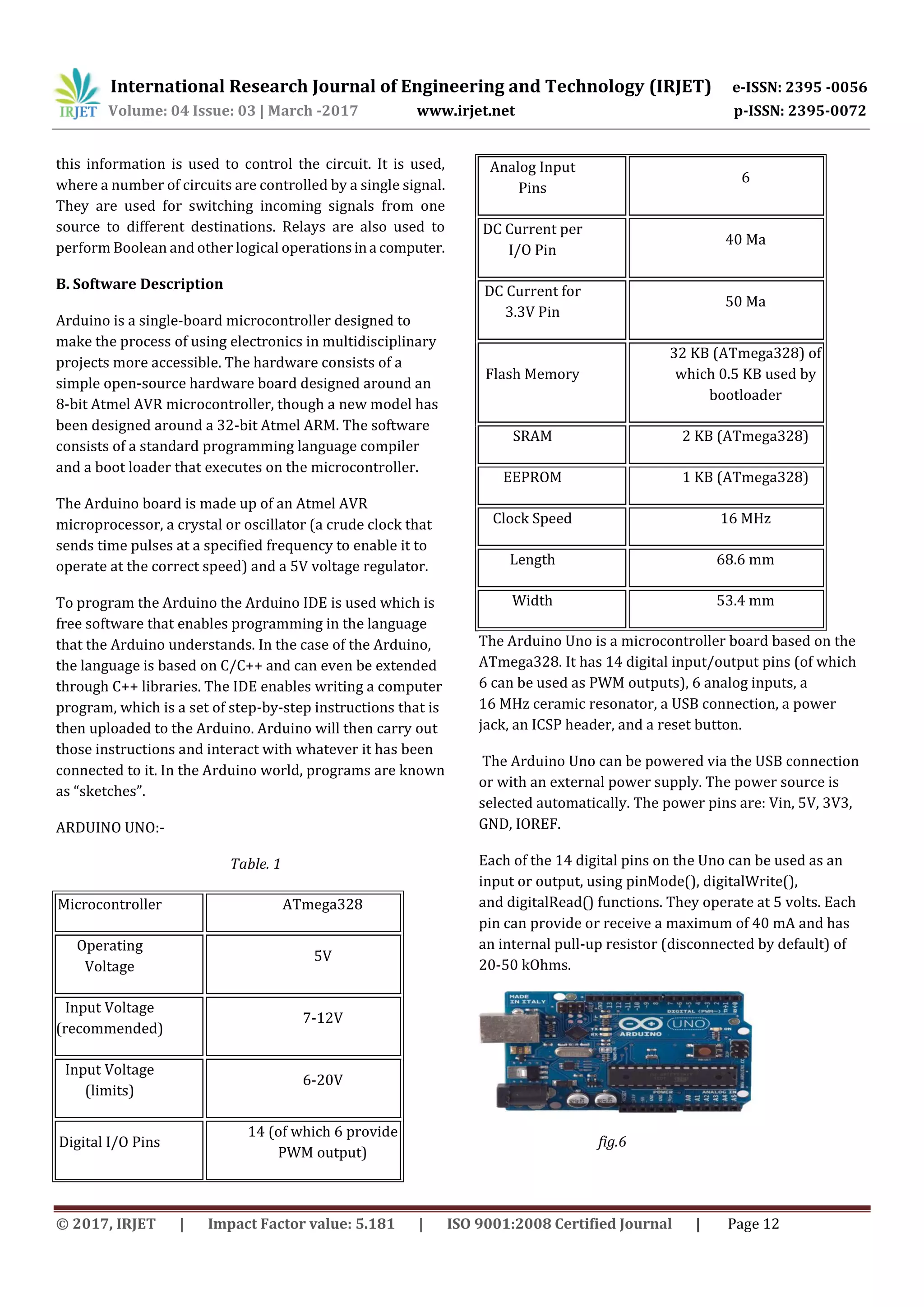
The Arduino Uno is a microcontroller board based on the
ATmega328. It has 14 digital input/output pins (of which
6 can be used as PWM outputs), 6 analog inputs, a
16 MHz ceramic resonator, a USB connection, a power
jack, an ICSP header, and a reset button.
The Arduino Uno can be powered via the USB connection
or with an external power supply. The power source is
selected automatically. The power pins are: Vin, 5V, 3V3,
GND, IOREF.
Each of the 14 digital pins on the Uno can be used as an
input or output, using pinMode(), digitalWrite(),
and digitalRead() functions. They operate at 5 volts. Each
pin can provide or receive a maximum of 40 mA and has
an internal pull-up resistor (disconnected by default) of
20-50 kOhms.
fig.6
International Research Journal of Engineering and Technology (IRJET) e-ISSN: 2395 -0056
Volume: 04 Issue: 03 | March -2017 www.irjet.net p-ISSN: 2395-0072
© 2017, IRJET | Impact Factor value: 5.181 | ISO 9001:2008 Certified Journal | Page 13
1.2 WORKING
Arduino board is connected to GSM modem in which
transmitter of Arduino is connected to the receiver of GSM
modem and receiver of Arduino is connected to the
transmitter of GSM modem. GSM modem is working simply
like a mobile phone when we messageonthenumberofGSM
modem it replies back and can be operated according to the
coding which we have done in microcontroller. The soil
moisture sensor and temperature sensor are connected to
analog pins of an Arduino board. 5v power supply is
generated from USB cable which is connected to Arduino
board. First of all GSM/GPRS module is initialized and waits
until it connects to the network.12v power supply is
scheduled to the GSM/GPRS module through adaptor. The
red light indicator illustrates GSM/GPRS is ON. The data
sensed by soil moisture sensor and temperature sensor is
transmitted to micro-controller. Threshold values are
programmed into an Arduino board initially. So, the values
which are received from sensors are compared with
threshold values. If the readings from the temperature
sensor are more than the threshold value and the soil
moisture reading is lesser than the threshold value. Then a
SMS alert is sent to the user by GSM/GPRS module. Then the
motor pump is switched ON by the user as soon as the
message ON is received.
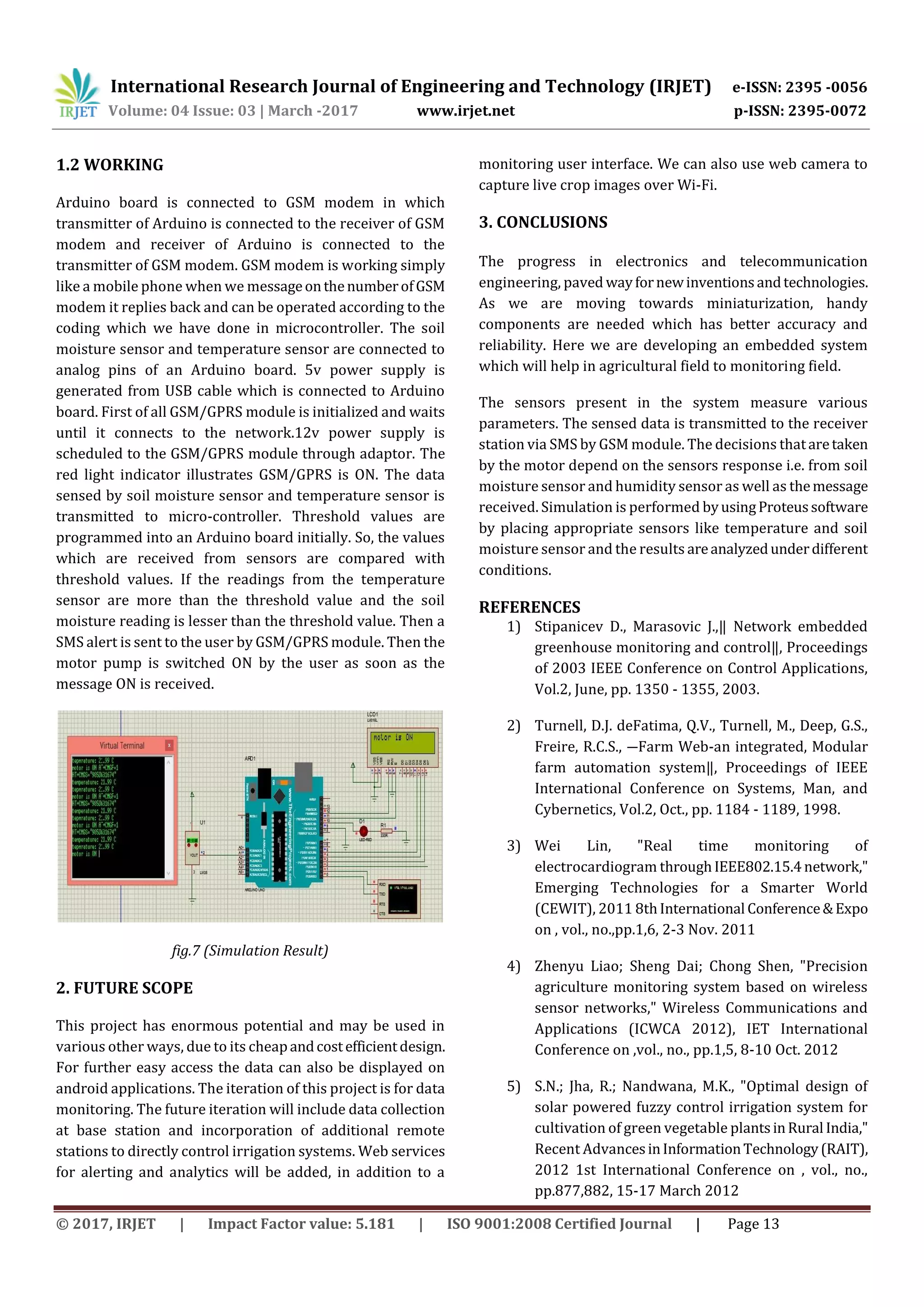
fig.7 (Simulation Result)
2. FUTURE SCOPE
This project has enormous potential and may be used in
various other ways, due to its cheapandcostefficientdesign.
For further easy access the data can also be displayed on
android applications. The iteration of this project is for data
monitoring. The future iteration will include data collection
at base station and incorporation of additional remote
stations to directly control irrigation systems. Web services
for alerting and analytics will be added, in addition to a
monitoring user interface. We can also use web camera to
capture live crop images over Wi-Fi.
3. CONCLUSIONS
The progress in electronics and telecommunication
engineering, paved wayfornewinventionsandtechnologies.
As we are moving towards miniaturization, handy
components are needed which has better accuracy and
reliability. Here we are developing an embedded system
which will help in agricultural field to monitoring field.
The sensors present in the system measure various
parameters. The sensed data is transmitted to the receiver
station via SMS by GSM module. The decisions thataretaken
by the motor depend on the sensors response i.e. from soil
moisture sensor and humidity sensor as well as themessage
received. Simulation is performed byusingProteussoftware
by placing appropriate sensors like temperature and soil
moisture sensor and the results areanalyzedunderdifferent
conditions.
REFERENCES
1) Stipanicev D., Marasovic J.,‖ Network embedded
greenhouse monitoring and control‖, Proceedings
of 2003 IEEE Conference on Control Applications,
Vol.2, June, pp. 1350 - 1355, 2003.
2) Turnell, D.J. deFatima, Q.V., Turnell, M., Deep, G.S.,
Freire, R.C.S., ―Farm Web-an integrated, Modular
farm automation system‖, Proceedings of IEEE
International Conference on Systems, Man, and
Cybernetics, Vol.2, Oct., pp. 1184 - 1189, 1998.
3) Wei Lin, "Real time monitoring of
electrocardiogram throughIEEE802.15.4network,"
Emerging Technologies for a Smarter World
(CEWIT), 2011 8thInternational Conference&Expo
on , vol., no.,pp.1,6, 2-3 Nov. 2011
4) Zhenyu Liao; Sheng Dai; Chong Shen, "Precision
agriculture monitoring system based on wireless
sensor networks," Wireless Communications and
Applications (ICWCA 2012), IET International
Conference on ,vol., no., pp.1,5, 8-10 Oct. 2012
5) S.N.; Jha, R.; Nandwana, M.K., "Optimal design of
solar powered fuzzy control irrigation system for
cultivation of green vegetable plantsinRural India,"
Recent AdvancesinInformationTechnology(RAIT),
2012 1st International Conference on , vol., no.,
pp.877,882, 15-17 March 2012
International Research Journal of Engineering and Technology (IRJET) e-ISSN: 2395 -0056
Volume: 04 Issue: 03 | March -2017 www.irjet.net p-ISSN: 2395-0072
© 2017, IRJET | Impact Factor value: 5.181 | ISO 9001:2008 Certified Journal | Page 14
BIOGRAPHIES
I,Aprajita Anand, am a final year
student of Electronics & Telecom.
Dept. in Bharati Vidyapeeth
Deemed University College of
Engineering,Pune.
I,Akansha Parasar, am a final year
student of Electronics & Telecom.
Dept. in Bharati Vidyapeeth
Deemed University College of
Engineering,Pune.
I, A.Prabhakar, am an Associate
Professor in Electronics &
Telecom. Dept. in Bharati
Vidyapeeth Deemed University
College of Engineering,Pune.

GSM based agriculture monitoring system

  • 1.
    International Research Journalof Engineering and Technology (IRJET) e-ISSN: 2395 -0056 Volume: 04 Issue: 03 | March -2017 www.irjet.net p-ISSN: 2395-0072 © 2017, IRJET | Impact Factor value: 5.181 | ISO 9001:2008 Certified Journal | Page 10 GSM BASED AGRICULTURE MONITORING SYSTEM Aprajita Anand1, Akansha Parasar2, Assoc. Prof. A Prabhakar3 1.2Btech in Electronics and telecommunication engg. BVDUCOE,Pune,Maharashtra,India 3Assoc. Professor in Electronics and telecommunication dept., BVDUCOE,Pune, Maharashtra,India ---------------------------------------------------------------------***--------------------------------------------------------------------- Abstract - Last 10 years have seen a rapid evolution in this technology. In the United States, ongoingresearchinprecision agriculture has been effectively applied to large agri- businesses at scale. But small farmers do not have the capital resources to invest in expensive monitoring systems. Hence to address these issues, we have designed an Arduino based agriculture monitoring system which operates on GSM network. This system will monitor the humidity levels and surrounding temperature and control the water flow accordingly. The controller activates the relay driver unit when the message is received through GSM and pumps motor by using relay switches. This design can be used for alarming the user via SMS (Short message service) if the moisture level and temperature goes beyond threshold value. Key Words: GSM, agriculture, soil moisture sensor, temperature sensor, monitoring, Arduino 1. INTRODUCTION Agriculture plays an important role in economy and development. The agriculture is in the transition from traditional agriculture to modern agriculture currently. For continuously increasing demand of food necessities, rapid improvement in production of food technology isimportant. In the paper our main focus is to maintain, control or monitor the agricultural trends or system making it easier for the user, to get data at regular interval about the field. In many areas one person is not enough to monitoring thefield status and control things. To improve we have to focus on the agriculture monitoring system and to collect more area information. In agriculture, there are two important factors, first to get information about fertility of soil and second is to measure moisture content in soil. Nowadays for irrigation, different techniques are available which is used to reduce the dependency on rain. And mostly this technique is driven by electrical power and on/off schedulingcontrolledsystem. Here we have used sensors to create an agricultural monitoring system like soil moisture sensor, temperature sensor. Soil moisture sensor is basically used to measurethe soil moisture level and the temperature sensor is used to keep the track of temperature.GSM sim 900 is being usedfor sending the data to the user. 1.1 SYSTEM ARCHITECTURE Fig shows the block diagram ofsmartagriculturemonitoring system.GSM module is used to keep information about the changes in the climate. fig.1 A. Hardware used a) ATmega328 b) GSM SIM 900 module c) LM35 temperature sensor d) Soil moisture Sensor e) LCD module f) Relay board g) Motor
  • 2.
    International Research Journalof Engineering and Technology (IRJET) e-ISSN: 2395 -0056 Volume: 04 Issue: 03 | March -2017 www.irjet.net p-ISSN: 2395-0072 © 2017, IRJET | Impact Factor value: 5.181 | ISO 9001:2008 Certified Journal | Page 11 ATmega328: fig.2 ATMega328 is the ATMEL MicrocontrolleronwhichArduino UNO is based. The Atmel 8-bit AVR RISC-based microcontroller combines 32 kB ISP flash memory with read-while-write capabilities, 1 kB EEPROM, 2 kB SRAM,23 general purpose I/O lines, 32 general purpose working registers, three flexible timer/counters with compare modes, internal and external interrupts, serial programmable USART, a byte-oriented 2-wire serial interface, SPI serial port, 6-channel 10-bit A/D converter (8- channels in TQFP and QFN/MLF packages), programmable watchdog timer with internal oscillator, and five software selectable power saving modes. The device operates between 1.8-5.5 volts. The device achieves throughput approaching 1 MIPS per MHz Serial data to the MCU is clocked on the rising edge and data from the MCU is clocked on the falling edge. Power is applied to VCC whileRESET and SCK are set to zero. ATmega328 is commonly used in many projects and autonomous systems where a simple, low- powered, low-cost micro-controller is needed. GSM SIM 900: fig.3 The words, “Mobile Station” (MS) or “Mobile Equipment” (ME) are used for mobileterminalsSupportingGSMservices. A call from a GSM mobile station to the PSTN is called a “mobile originated call” (MOC) or “Outgoing call”, and a call from a fixed network to a GSM mobile station is called a “Mobile Terminated call” (MTC) or “incoming call”.AT commands are instructions used to control a modem.AT is the abbreviation of ATtention. Every command line starts with "AT" or "at". LM35: fig.4 LM35 is a precision IC temperature sensor with its output proportional to the temperature (in oC).Thesensorcircuitry is sealed and therefore it is not subjected to oxidation and other processes. With LM35, temperature can be measured more accurately than with a thermistor. It also possess low self heating and does notcausemorethan0.1oCtemperature rise in still air. The operating temperature range is from - 55°C to 150°C. The output voltage varies by 10mV in response to every oC rise/fall inambienttemperature, i.e., its scale factor is 0.01V/ oC. SOIL MOISTURE SENSOR: fig.5 Soil moisture sensors measure the water content in soil. A soil moisture probe is made up of multiple soil moisture sensors. Technologies commonly used in soil moisture sensors include: - Neutron moisture gauges, utilize the moderator properties of water for neutrons. - Electrical resistance of the soil In this particular project, we will use the moisture sensors which can be inserted in the soil, in order to measure the moisture content of the soil. LCD MODULE: A 16X2 LCD is connected with Arduino at 2, 3, 4,5,11 and 12 pins to display the reading of various sensors. RELAY: Relays are simple switches which can be operated both mechanically and electrically in which electromagnet is present. Relay works when there is a low-power signal and
  • 3.
    International Research Journalof Engineering and Technology (IRJET) e-ISSN: 2395 -0056 Volume: 04 Issue: 03 | March -2017 www.irjet.net p-ISSN: 2395-0072 © 2017, IRJET | Impact Factor value: 5.181 | ISO 9001:2008 Certified Journal | Page 12 this information is used to control the circuit. It is used, where a number of circuits are controlled by a single signal. They are used for switching incoming signals from one source to different destinations. Relays are also used to perform Boolean and other logical operationsina computer. B. Software Description Arduino is a single-board microcontroller designed to make the process of using electronics in multidisciplinary projects more accessible. The hardware consists of a simple open-source hardware board designed around an 8-bit Atmel AVR microcontroller, though a new model has been designed around a 32-bit Atmel ARM. The software consists of a standard programming language compiler and a boot loader that executes on the microcontroller. The Arduino board is made up of an Atmel AVR microprocessor, a crystal or oscillator (a crude clock that sends time pulses at a specified frequency to enable it to operate at the correct speed) and a 5V voltage regulator. To program the Arduino the Arduino IDE is used which is free software that enables programming in the language that the Arduino understands. In the case of the Arduino, the language is based on C/C++ and can even be extended through C++ libraries. The IDE enables writing a computer program, which is a set of step-by-step instructions that is then uploaded to the Arduino. Arduino will then carry out those instructions and interact with whatever it has been connected to it. In the Arduino world, programs are known as “sketches”. ARDUINO UNO:- Table. 1 Microcontroller ATmega328 Operating Voltage 5V Input Voltage (recommended) 7-12V Input Voltage (limits) 6-20V Digital I/O Pins 14 (of which 6 provide PWM output) Analog Input Pins 6 DC Current per I/O Pin 40 Ma DC Current for 3.3V Pin 50 Ma Flash Memory 32 KB (ATmega328) of which 0.5 KB used by bootloader SRAM 2 KB (ATmega328) EEPROM 1 KB (ATmega328) Clock Speed 16 MHz Length 68.6 mm Width 53.4 mm The Arduino Uno is a microcontroller board based on the ATmega328. It has 14 digital input/output pins (of which 6 can be used as PWM outputs), 6 analog inputs, a 16 MHz ceramic resonator, a USB connection, a power jack, an ICSP header, and a reset button. The Arduino Uno can be powered via the USB connection or with an external power supply. The power source is selected automatically. The power pins are: Vin, 5V, 3V3, GND, IOREF. Each of the 14 digital pins on the Uno can be used as an input or output, using pinMode(), digitalWrite(), and digitalRead() functions. They operate at 5 volts. Each pin can provide or receive a maximum of 40 mA and has an internal pull-up resistor (disconnected by default) of 20-50 kOhms. fig.6
  • 4.
    International Research Journalof Engineering and Technology (IRJET) e-ISSN: 2395 -0056 Volume: 04 Issue: 03 | March -2017 www.irjet.net p-ISSN: 2395-0072 © 2017, IRJET | Impact Factor value: 5.181 | ISO 9001:2008 Certified Journal | Page 13 1.2 WORKING Arduino board is connected to GSM modem in which transmitter of Arduino is connected to the receiver of GSM modem and receiver of Arduino is connected to the transmitter of GSM modem. GSM modem is working simply like a mobile phone when we messageonthenumberofGSM modem it replies back and can be operated according to the coding which we have done in microcontroller. The soil moisture sensor and temperature sensor are connected to analog pins of an Arduino board. 5v power supply is generated from USB cable which is connected to Arduino board. First of all GSM/GPRS module is initialized and waits until it connects to the network.12v power supply is scheduled to the GSM/GPRS module through adaptor. The red light indicator illustrates GSM/GPRS is ON. The data sensed by soil moisture sensor and temperature sensor is transmitted to micro-controller. Threshold values are programmed into an Arduino board initially. So, the values which are received from sensors are compared with threshold values. If the readings from the temperature sensor are more than the threshold value and the soil moisture reading is lesser than the threshold value. Then a SMS alert is sent to the user by GSM/GPRS module. Then the motor pump is switched ON by the user as soon as the message ON is received. fig.7 (Simulation Result) 2. FUTURE SCOPE This project has enormous potential and may be used in various other ways, due to its cheapandcostefficientdesign. For further easy access the data can also be displayed on android applications. The iteration of this project is for data monitoring. The future iteration will include data collection at base station and incorporation of additional remote stations to directly control irrigation systems. Web services for alerting and analytics will be added, in addition to a monitoring user interface. We can also use web camera to capture live crop images over Wi-Fi. 3. CONCLUSIONS The progress in electronics and telecommunication engineering, paved wayfornewinventionsandtechnologies. As we are moving towards miniaturization, handy components are needed which has better accuracy and reliability. Here we are developing an embedded system which will help in agricultural field to monitoring field. The sensors present in the system measure various parameters. The sensed data is transmitted to the receiver station via SMS by GSM module. The decisions thataretaken by the motor depend on the sensors response i.e. from soil moisture sensor and humidity sensor as well as themessage received. Simulation is performed byusingProteussoftware by placing appropriate sensors like temperature and soil moisture sensor and the results areanalyzedunderdifferent conditions. REFERENCES 1) Stipanicev D., Marasovic J.,‖ Network embedded greenhouse monitoring and control‖, Proceedings of 2003 IEEE Conference on Control Applications, Vol.2, June, pp. 1350 - 1355, 2003. 2) Turnell, D.J. deFatima, Q.V., Turnell, M., Deep, G.S., Freire, R.C.S., ―Farm Web-an integrated, Modular farm automation system‖, Proceedings of IEEE International Conference on Systems, Man, and Cybernetics, Vol.2, Oct., pp. 1184 - 1189, 1998. 3) Wei Lin, "Real time monitoring of electrocardiogram throughIEEE802.15.4network," Emerging Technologies for a Smarter World (CEWIT), 2011 8thInternational Conference&Expo on , vol., no.,pp.1,6, 2-3 Nov. 2011 4) Zhenyu Liao; Sheng Dai; Chong Shen, "Precision agriculture monitoring system based on wireless sensor networks," Wireless Communications and Applications (ICWCA 2012), IET International Conference on ,vol., no., pp.1,5, 8-10 Oct. 2012 5) S.N.; Jha, R.; Nandwana, M.K., "Optimal design of solar powered fuzzy control irrigation system for cultivation of green vegetable plantsinRural India," Recent AdvancesinInformationTechnology(RAIT), 2012 1st International Conference on , vol., no., pp.877,882, 15-17 March 2012
  • 5.
    International Research Journalof Engineering and Technology (IRJET) e-ISSN: 2395 -0056 Volume: 04 Issue: 03 | March -2017 www.irjet.net p-ISSN: 2395-0072 © 2017, IRJET | Impact Factor value: 5.181 | ISO 9001:2008 Certified Journal | Page 14 BIOGRAPHIES I,Aprajita Anand, am a final year student of Electronics & Telecom. Dept. in Bharati Vidyapeeth Deemed University College of Engineering,Pune. I,Akansha Parasar, am a final year student of Electronics & Telecom. Dept. in Bharati Vidyapeeth Deemed University College of Engineering,Pune. I, A.Prabhakar, am an Associate Professor in Electronics & Telecom. Dept. in Bharati Vidyapeeth Deemed University College of Engineering,Pune.