International Research Journal of Engineering and Technology (IRJET) e-ISSN: 2395-0056
Volume: 07 Issue: 03 | Mar 2020 www.irjet.net p-ISSN: 2395-0072
© 2020, IRJET | Impact Factor value: 7.34 | ISO 9001:2008 Certified Journal | Page 666
Automatic Irrigation System using Arduino UNO
Aishwarya Soni1, Rifat Shaikh2, Aafreen Khan3 ,Nilama Biredar4 ,Vijay N.Kukre5
1,2,3,4Students, Dept. of Computer Engineering, AISSMS’s Polytechnic, Pune, Maharashtra, India
5HOD, Dept. of Computer Engineering, AISSMS’s Polytechnic, Pune, Maharashtra, India
---------------------------------------------------------------------***----------------------------------------------------------------------
Abstract - Revamping the process of agriculture is a
very critical stage for a country like India with a
population of 1.3 billion people. A huge amount of
architectural and technological modifications has been
adopted in the past years to improve the productivity of
the agricultural field. Keeping a track of the environmental
conditions and adjusting the irrigation according to this
observation is one of the major challenges of the
agriculture. Due to the use of traditional farming
techniques used by Indian farmers, excessive use of or
under use of watering or other such issues occur which
results in less efficient and productive crops. The
presented work is about having control over the irrigation
and monitoring of the agricultural field using IoT. The
proposed system connects the physical sensing devices
and connects irrigation control mechanism with the cloud.
The specialty of this paper is how we can efficiently
control the water supply to the agricultural fields
according to the environmental conditions and crop
requirements.
Key Words: Arduino UNO, GSM SIM800A, LCD display,
Relay and Sensors.
1. INTRODUCTION
According to statistics, 85% of available freshwater
resources are used in agriculture worldwide. Because of
population growth and increased demand of food, this
percentage is increasing rapidly. It is very crucial to create
strategies based on science and technology for sustainable
use of water, including technical, agronomic, managerial
and institutional improvements. By using a micro-
controller, some sensors and relay we can control water
flow and hence reduce wastage in irrigation. Hence, our
system can greatly improve the utilization of water and
can increase water productivity. Our system has been
designed to overcome the unnecessary water flow into the
agricultural fields and to irrigate the crops according to
requirement. Temperature and moisture readings are
regularly monitored by using temperature and moisture
sensors and GSM module is used to send these values to
the assigned device. Once the soil moisture value exceeds
or deceeds the particular limit then the relay, which is
connected to the Arduino microcontroller turns the motor
on and off accordingly.
1.1 Necessity of the Project-
As population is increasing day by day and hence our
natural resources are depleting speedily. It is our
responsibility as an individual to help to save our land
resources. Water shortage is the main problem in our
nation. Agriculture area is growing hastily and hence a lot
of water is necessary for irrigation. A huge amount of
water is unnecessarily wasted while moistening the fields
due to water logging. The growth of the crop is also slowed
down since; derivable amount of water is not given to
crop. So, an automatic crop irrigation system will help to
save a lot of water and will protect vital growth of the
crop. This will also reduce the need of manual workers on
the field and also saves a lot of time.
1.2 Project Outline
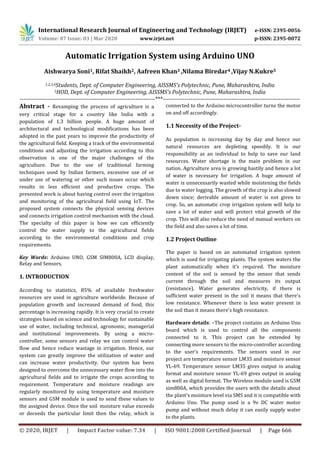
The paper is based on an automated irrigation system
which is used for irrigating plants. The system waters the
plant automatically when it’s required. The moisture
content of the soil is sensed by the sensor that sends
current through the soil and measures its output
(resistance). Water generates electricity, if there is
sufficient water present in the soil it means that there's
low resistance. Whenever there is less water present in
the soil than it means there's high resistance.
Hardware details: –The project contains an Arduino Uno
board which is used to control all the components
connected to it. This project can be extended by
connecting more sensors to the micro-controller according
to the user's requirements. The sensors used in our
project are temperature sensor LM35 and moisture sensor
YL-69. Temperature sensor LM35 gives output in analog
format and moisture sensor YL-69 gives output in analog
as well as digital format. The Wireless module used is GSM
sim800A, which provides the users with the details about
the plant's moisture level via SMS and it is compatible with
Arduino Uno. The pump used is a 9v DC water motor
pump and without much delay it can easily supply water
to the plants.
International Research Journal of Engineering and Technology (IRJET) e-ISSN: 2395-0056
Volume: 07 Issue: 03 | Mar 2020 www.irjet.net p-ISSN: 2395-0072
© 2020, IRJET | Impact Factor value: 7.34 | ISO 9001:2008 Certified Journal | Page 667
Software details: The Arduino IDE is used for this project.
This Arduino IDE makes the programming of Arduino
board easier and simpler. It provides number of libraries
which are easy to handle. Because of this we can establish
connection between Arduino board and different
components. Hence, it becomes quite easy to operate
those components. The range of the soil moisture sensor
YL-69 is 0 to 1023. We have set the threshold value as 800.
This means that when the output of moisture sensor is
between 0 and 800, there is no need to water the plants
and when the output of moisture sensor is between 800
and 1023 it means there is no water and water needs to be
supplied immediately. The system supplies water to the
soil accordingly to which the threshold value has been set.
The system should work automatically.
For controlling the water motor pump, we have used a
single channel Relay of 5 volt to supply the water to the
plants. It takes the input commands from the micro-
controller to turn-on and turn-off the motor according to
the level of moisture content of the soil. There are three
sockets present on the relay board which are: NO i.e
nnormally open, NC i.e nnormally closed and COM i.e.
common. We have used nnormally open and common
sockets in our system. We have set are relay to normally
open so that the circuit remains open i.e. incomplete until
the relay receives a signal to close or complete the circuit.
2. System Architecture
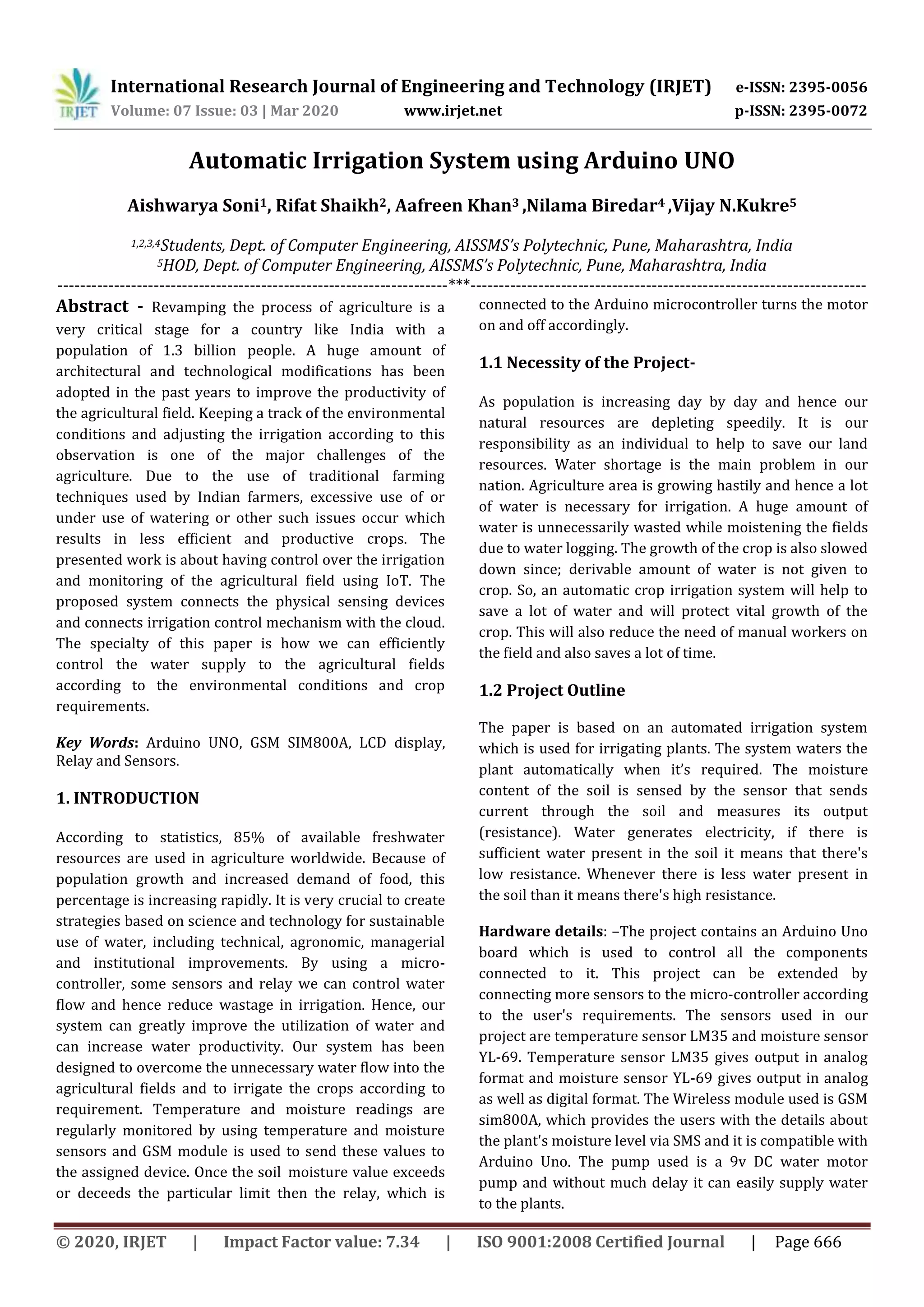
Fig -1: System Block diagram
2.1. Arduino UNO
For building electronics projects, it is an open-source
platform used. It is based on easy-to-use hardware and
software. Input are read from micro controller - light for
the signal and button to refresh - and turn it into an
output. For building electronics projects it provides a
standard form factor that breaks out the functions of the
micro-controller into a more accessible package. There are
14 I/O digital and 6 analog pins assembled on the board
that allows the external connection with any circuit with
the board. These pins make it quite flexible and easy to use
by the external devices that can be connected through
these pins. There is no hard and fast interface required for
making a connection between the devices and the board.
We need to simply plug the external device into the pins of
the board that are laid out on the board in the form of
header. The 6 analog pins are marked as A0 to A5 and
come with a resolution of 10 bits. These pins measure
from 0V to 5V, However, they can be configured to the
high range using the function analog Reference () and
AREF pin. The number of instructions in the form of code
are stored using 13KB of flash memory. To turn the board
on, only 5V input is required, which can be achieved
directly using USB port or external adopter.
Fig -2: Arduino UNO Module
2.2. GSM module SIM800A
SIM800A support Quad-band 850/900/1800/1900 MHz
and can transmit Voice, SMS and data information with
low power consumption. The SIM800A modem supports a
GSM on-chip and RS232 port for connection with the PC or
laptop using the USB to the Serial connector.
International Research Journal of Engineering and Technology (IRJET) e-ISSN: 2395-0056
Volume: 07 Issue: 03 | Mar 2020 www.irjet.net p-ISSN: 2395-0072
© 2020, IRJET | Impact Factor value: 7.34 | ISO 9001:2008 Certified Journal | Page 668
Fig -3: GSM module SIM800A
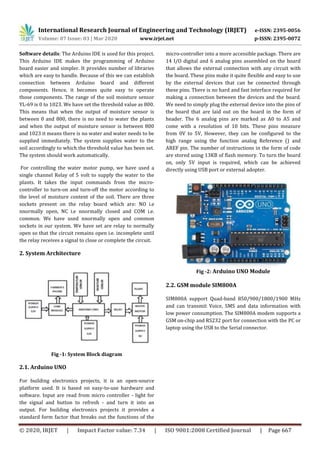
2.3. Relay
Relay used to control the on and off status of water motor.
The Single Channel Relay Module is used to control high
voltage it is a convenient board, high current load such as
motor, solenoid valves, lamps and AC load. It is designed to
interface with micro controller such as Arduino, PIC and
etc.It also comes with a LED to indicate the status of relay.
Fig -4: Relay Module
2.4. Temperature Sensor LM35
It is used to measure the amount of heat. Minimum and
maximum input voltage is 35V and -2V respectively.
Typically, at 5V, it can measure temperature ranging from
-55°C to 150°C. It's output voltage is directly proportional
o temperature (i.e.) there will be a rise of 10mV (0.01V)
for every 1°C rise in temperature with an accuracy of
±0.5°C.
Fig -5: Temperature Sensor LM35
2.5. Moisture Sensor YL-69
It is used to sense soil moisture. The output can be a
digital signal (low or high), depending on the water
content. If the soil humidity exceeds a set point value also
called as threshold value, the module's output is low,
otherwise high. The threshold value for the digital signal
can be adjusted using a potentiometer provided with the
sensor. The output can be an analog signal ranging
between 0 and 1023.
Fig -6: Moisture Sensor YL-69
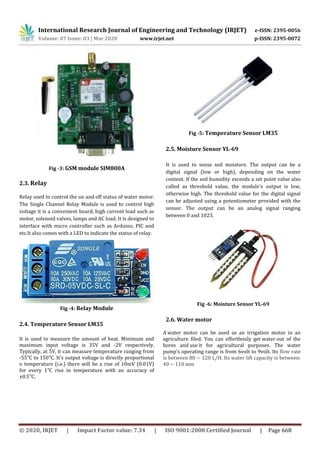
2.6. Water motor
A water motor can be used as an irrigation motor in an
agriculture filed. You can effortlessly get water out of the
bores and use it for agricultural purposes. The water
pump’s operating range is from 6volt to 9volt. Its flow rate
is between 80 ~ 120 L/H. Its water lift capacity is between:
40 ~ 110 mm
International Research Journal of Engineering and Technology (IRJET) e-ISSN: 2395-0056
Volume: 07 Issue: 03 | Mar 2020 www.irjet.net p-ISSN: 2395-0072
© 2020, IRJET | Impact Factor value: 7.34 | ISO 9001:2008 Certified Journal | Page 669
Fig -7: Water Motor 9V
3. CONCLUSION
Our project is basically an automatic irrigation system
designed using Arduino. The prepared model of the
project worked properly when tested on dry as well as wet
soils. We have used such components in the project that
are easy to operate and can be availed easily. This system
provides an efficient way to irrigate the plants which is
much better than manual irrigation. The system senses
and automatically irrigates the plants and also sends SMS
to the farmer accordingly. The farmer can use this saved
time in other significant activities. This system is very
helpful in areas with scarcity of water as it helps us save
water by providing plants just the required amount of
water and avoid its wastage. Hence, it results in
enhancement of the quality of plants. The future scope of
this project is addition of a more powerful motor to pump
water to the fields. Thus, the large-scale implementation of
the project can be done.
ACKNOWLEDGEMENT
A lot of diligence and enthusiasm was put into the project.
So, we would like to express our gratitude to all the those
without whose recommendations this paper would not
have been completed successfully. The Computer
Engineering department of our institution give us with
such good chance and supportive faculty. Secondly, we
would like to express our gratitude to our guide
Mr.V.N.Kukre who guided us throughout the project and
offered us with all the support we needed. Finally, the
suggestions of our classmates who helped us during the
project and we are thankful to all of them.
REFERENCES
[1] C. Ashwini, Diparna Adhikary, Amisha Mishra, Shruti
Duggal"AUTOMATIC IRRIGATION SYSTEM USING
ARDUINO" Oct. 2018
[2] L. Bhaskar, B. Koli, P. Kumar, V. Gaur, "Automatic crop
irrigation system", 2015 4th International Conference
on Reliability Infocom Technologies and Optimization
(ICRITO) (Trends and Future) Directions), pp. 1-4,
2015.
[3] Y. Kim and R. G. Evans, ―Software design for wireless
sensor-based site-specific irrigation, Compute.
Electron. Agriculture., vol. 66, no.2,pp. 159–165, May
2009.
[4] S. Rakshak , Prof. R. W. Deshpande, Automated
Irrigation System Based on Arduino Controller Using
Sensors. International Journal of Innovative Research
in Computer and Communication Engineering 5(7),
2017, 13394-13400

IRJET- Automatic Irrigation System using Arduino UNO

  • 1.
    International Research Journalof Engineering and Technology (IRJET) e-ISSN: 2395-0056 Volume: 07 Issue: 03 | Mar 2020 www.irjet.net p-ISSN: 2395-0072 © 2020, IRJET | Impact Factor value: 7.34 | ISO 9001:2008 Certified Journal | Page 666 Automatic Irrigation System using Arduino UNO Aishwarya Soni1, Rifat Shaikh2, Aafreen Khan3 ,Nilama Biredar4 ,Vijay N.Kukre5 1,2,3,4Students, Dept. of Computer Engineering, AISSMS’s Polytechnic, Pune, Maharashtra, India 5HOD, Dept. of Computer Engineering, AISSMS’s Polytechnic, Pune, Maharashtra, India ---------------------------------------------------------------------***---------------------------------------------------------------------- Abstract - Revamping the process of agriculture is a very critical stage for a country like India with a population of 1.3 billion people. A huge amount of architectural and technological modifications has been adopted in the past years to improve the productivity of the agricultural field. Keeping a track of the environmental conditions and adjusting the irrigation according to this observation is one of the major challenges of the agriculture. Due to the use of traditional farming techniques used by Indian farmers, excessive use of or under use of watering or other such issues occur which results in less efficient and productive crops. The presented work is about having control over the irrigation and monitoring of the agricultural field using IoT. The proposed system connects the physical sensing devices and connects irrigation control mechanism with the cloud. The specialty of this paper is how we can efficiently control the water supply to the agricultural fields according to the environmental conditions and crop requirements. Key Words: Arduino UNO, GSM SIM800A, LCD display, Relay and Sensors. 1. INTRODUCTION According to statistics, 85% of available freshwater resources are used in agriculture worldwide. Because of population growth and increased demand of food, this percentage is increasing rapidly. It is very crucial to create strategies based on science and technology for sustainable use of water, including technical, agronomic, managerial and institutional improvements. By using a micro- controller, some sensors and relay we can control water flow and hence reduce wastage in irrigation. Hence, our system can greatly improve the utilization of water and can increase water productivity. Our system has been designed to overcome the unnecessary water flow into the agricultural fields and to irrigate the crops according to requirement. Temperature and moisture readings are regularly monitored by using temperature and moisture sensors and GSM module is used to send these values to the assigned device. Once the soil moisture value exceeds or deceeds the particular limit then the relay, which is connected to the Arduino microcontroller turns the motor on and off accordingly. 1.1 Necessity of the Project- As population is increasing day by day and hence our natural resources are depleting speedily. It is our responsibility as an individual to help to save our land resources. Water shortage is the main problem in our nation. Agriculture area is growing hastily and hence a lot of water is necessary for irrigation. A huge amount of water is unnecessarily wasted while moistening the fields due to water logging. The growth of the crop is also slowed down since; derivable amount of water is not given to crop. So, an automatic crop irrigation system will help to save a lot of water and will protect vital growth of the crop. This will also reduce the need of manual workers on the field and also saves a lot of time. 1.2 Project Outline The paper is based on an automated irrigation system which is used for irrigating plants. The system waters the plant automatically when it’s required. The moisture content of the soil is sensed by the sensor that sends current through the soil and measures its output (resistance). Water generates electricity, if there is sufficient water present in the soil it means that there's low resistance. Whenever there is less water present in the soil than it means there's high resistance. Hardware details: –The project contains an Arduino Uno board which is used to control all the components connected to it. This project can be extended by connecting more sensors to the micro-controller according to the user's requirements. The sensors used in our project are temperature sensor LM35 and moisture sensor YL-69. Temperature sensor LM35 gives output in analog format and moisture sensor YL-69 gives output in analog as well as digital format. The Wireless module used is GSM sim800A, which provides the users with the details about the plant's moisture level via SMS and it is compatible with Arduino Uno. The pump used is a 9v DC water motor pump and without much delay it can easily supply water to the plants.
  • 2.
    International Research Journalof Engineering and Technology (IRJET) e-ISSN: 2395-0056 Volume: 07 Issue: 03 | Mar 2020 www.irjet.net p-ISSN: 2395-0072 © 2020, IRJET | Impact Factor value: 7.34 | ISO 9001:2008 Certified Journal | Page 667 Software details: The Arduino IDE is used for this project. This Arduino IDE makes the programming of Arduino board easier and simpler. It provides number of libraries which are easy to handle. Because of this we can establish connection between Arduino board and different components. Hence, it becomes quite easy to operate those components. The range of the soil moisture sensor YL-69 is 0 to 1023. We have set the threshold value as 800. This means that when the output of moisture sensor is between 0 and 800, there is no need to water the plants and when the output of moisture sensor is between 800 and 1023 it means there is no water and water needs to be supplied immediately. The system supplies water to the soil accordingly to which the threshold value has been set. The system should work automatically. For controlling the water motor pump, we have used a single channel Relay of 5 volt to supply the water to the plants. It takes the input commands from the micro- controller to turn-on and turn-off the motor according to the level of moisture content of the soil. There are three sockets present on the relay board which are: NO i.e nnormally open, NC i.e nnormally closed and COM i.e. common. We have used nnormally open and common sockets in our system. We have set are relay to normally open so that the circuit remains open i.e. incomplete until the relay receives a signal to close or complete the circuit. 2. System Architecture Fig -1: System Block diagram 2.1. Arduino UNO For building electronics projects, it is an open-source platform used. It is based on easy-to-use hardware and software. Input are read from micro controller - light for the signal and button to refresh - and turn it into an output. For building electronics projects it provides a standard form factor that breaks out the functions of the micro-controller into a more accessible package. There are 14 I/O digital and 6 analog pins assembled on the board that allows the external connection with any circuit with the board. These pins make it quite flexible and easy to use by the external devices that can be connected through these pins. There is no hard and fast interface required for making a connection between the devices and the board. We need to simply plug the external device into the pins of the board that are laid out on the board in the form of header. The 6 analog pins are marked as A0 to A5 and come with a resolution of 10 bits. These pins measure from 0V to 5V, However, they can be configured to the high range using the function analog Reference () and AREF pin. The number of instructions in the form of code are stored using 13KB of flash memory. To turn the board on, only 5V input is required, which can be achieved directly using USB port or external adopter. Fig -2: Arduino UNO Module 2.2. GSM module SIM800A SIM800A support Quad-band 850/900/1800/1900 MHz and can transmit Voice, SMS and data information with low power consumption. The SIM800A modem supports a GSM on-chip and RS232 port for connection with the PC or laptop using the USB to the Serial connector.
  • 3.
    International Research Journalof Engineering and Technology (IRJET) e-ISSN: 2395-0056 Volume: 07 Issue: 03 | Mar 2020 www.irjet.net p-ISSN: 2395-0072 © 2020, IRJET | Impact Factor value: 7.34 | ISO 9001:2008 Certified Journal | Page 668 Fig -3: GSM module SIM800A 2.3. Relay Relay used to control the on and off status of water motor. The Single Channel Relay Module is used to control high voltage it is a convenient board, high current load such as motor, solenoid valves, lamps and AC load. It is designed to interface with micro controller such as Arduino, PIC and etc.It also comes with a LED to indicate the status of relay. Fig -4: Relay Module 2.4. Temperature Sensor LM35 It is used to measure the amount of heat. Minimum and maximum input voltage is 35V and -2V respectively. Typically, at 5V, it can measure temperature ranging from -55°C to 150°C. It's output voltage is directly proportional o temperature (i.e.) there will be a rise of 10mV (0.01V) for every 1°C rise in temperature with an accuracy of ±0.5°C. Fig -5: Temperature Sensor LM35 2.5. Moisture Sensor YL-69 It is used to sense soil moisture. The output can be a digital signal (low or high), depending on the water content. If the soil humidity exceeds a set point value also called as threshold value, the module's output is low, otherwise high. The threshold value for the digital signal can be adjusted using a potentiometer provided with the sensor. The output can be an analog signal ranging between 0 and 1023. Fig -6: Moisture Sensor YL-69 2.6. Water motor A water motor can be used as an irrigation motor in an agriculture filed. You can effortlessly get water out of the bores and use it for agricultural purposes. The water pump’s operating range is from 6volt to 9volt. Its flow rate is between 80 ~ 120 L/H. Its water lift capacity is between: 40 ~ 110 mm
  • 4.
    International Research Journalof Engineering and Technology (IRJET) e-ISSN: 2395-0056 Volume: 07 Issue: 03 | Mar 2020 www.irjet.net p-ISSN: 2395-0072 © 2020, IRJET | Impact Factor value: 7.34 | ISO 9001:2008 Certified Journal | Page 669 Fig -7: Water Motor 9V 3. CONCLUSION Our project is basically an automatic irrigation system designed using Arduino. The prepared model of the project worked properly when tested on dry as well as wet soils. We have used such components in the project that are easy to operate and can be availed easily. This system provides an efficient way to irrigate the plants which is much better than manual irrigation. The system senses and automatically irrigates the plants and also sends SMS to the farmer accordingly. The farmer can use this saved time in other significant activities. This system is very helpful in areas with scarcity of water as it helps us save water by providing plants just the required amount of water and avoid its wastage. Hence, it results in enhancement of the quality of plants. The future scope of this project is addition of a more powerful motor to pump water to the fields. Thus, the large-scale implementation of the project can be done. ACKNOWLEDGEMENT A lot of diligence and enthusiasm was put into the project. So, we would like to express our gratitude to all the those without whose recommendations this paper would not have been completed successfully. The Computer Engineering department of our institution give us with such good chance and supportive faculty. Secondly, we would like to express our gratitude to our guide Mr.V.N.Kukre who guided us throughout the project and offered us with all the support we needed. Finally, the suggestions of our classmates who helped us during the project and we are thankful to all of them. REFERENCES [1] C. Ashwini, Diparna Adhikary, Amisha Mishra, Shruti Duggal"AUTOMATIC IRRIGATION SYSTEM USING ARDUINO" Oct. 2018 [2] L. Bhaskar, B. Koli, P. Kumar, V. Gaur, "Automatic crop irrigation system", 2015 4th International Conference on Reliability Infocom Technologies and Optimization (ICRITO) (Trends and Future) Directions), pp. 1-4, 2015. [3] Y. Kim and R. G. Evans, ―Software design for wireless sensor-based site-specific irrigation, Compute. Electron. Agriculture., vol. 66, no.2,pp. 159–165, May 2009. [4] S. Rakshak , Prof. R. W. Deshpande, Automated Irrigation System Based on Arduino Controller Using Sensors. International Journal of Innovative Research in Computer and Communication Engineering 5(7), 2017, 13394-13400