International Research Journal of Engineering and Technology (IRJET) e-ISSN: 2395-0056
Volume: 06 Issue: 11 | Nov 2019 www.irjet.net p-ISSN: 2395-0072
© 2019, IRJET | Impact Factor value: 7.34 | ISO 9001:2008 Certified Journal | Page 30
Measuring Current and Power of Different Electrical Engines
Noé Ramírez Rodríguez1, Fernando De Gante Leal2,Moisés Sánchez Moredia3,Jonny Carmona
Reyes4, María Judith Ortiz Ramos5, Haynet Rivera Flores6
1Industrial Maintenance Engineering, Technological University of Tlaxcala, Highway to El Carmen Xalpatlahuaya
Huamantla, Tlaxcala, Mexico.
---------------------------------------------------------------------***----------------------------------------------------------------------
Abstract - The project consists on designing a device
controlled by Arduino to measure the power and current
consumed by electric motors through three non-invasive
current sensors. These sensors operate on the basis of the
magnetic flux that occurs in the cable when the current
circulates through it. The sensor detects the magnetic flux
which, by means of conversions, produces the current
intensity, the power at which it works, and displays it on the
2.8 inch TFT display.
When the measurements are obtained, they are stored in a
micro SD memory using the SD module of the 2.8 inch TFT
display. This device is powered by an adjustable power
supply that will allow us to power the Arduino Mega 2560 to
7v which acts as controller of the device, the advantage is to
have more pins to program, control the 2.8 inch TFT display,
non-invasive sensors, and micro SD module. In turn
everything is mounted inside a cabinet of 13 cm x 17 cm x 6
cm, which protects the internal circuit of the device.
The three sensors measure the current of single-phase,
biphasic and three-phase electric motors, compare the
energy consumption between the lines that powerthemand
determine whether there are large differences between
them.
Key Words: Keyword 1 – Arduino (Hardware and
software platform, Keyword 2 – CT (Current
Transformer), Keyword 3 – TFT LCD (Thin-film-
transistor liquid-crystal display)
1. INTRODUCTION
The electric current is defined as the flow of electrons
through a conductor medium,electrical devicesconnectedto
a power source (voltage) perform a work (power). For
example, in a three-phase induction engine, in theory, the
current consumed by each phase should be the same; when
this is not met it is due to internal engine problems such as a
deterioration of the isolation of the stator or by the
imbalance of the voltage producing a significant increase of
the engine temperature shortening up to 50% its useful life.
A sensor is a device that, from the energy of the medium
where it is measured, gives a transducible output signal that
is a function of the measurement variable.
Sensor and transducer aresometimesusedassynonyms, but
sensor suggests a more extensive meaning: broadening the
senses to acquire a knowledge of physical quantities that,by
their nature or size, cannot be perceived directly by the
senses. Transducer, on the other hand, suggests that the
input signal and the output signal should not be
homogeneous.
The sensors are everywhere; in the housing units, the
installations of a company, in the machinery of the
industries, in the appliances, since they were used for the
first time to date, sensors have changed and made life easier
for people around the world. Arduino is a development
platform based on a free hardware electronic board that
incorporates a re-programmable microcontroller,a series of
female pins, which allow connections between the
microcontroller, different sensors and actuators in a very
simple way (mainly with dupont cables).
An electronic board is a PCB (a printed circuit board). Pcbs
flat surfaces made from a non-conductive material, which
coast from different layers of conductive material. A PCB is
the most compact and stable way to build an electronic
circuit. So the Arduino plate is nothing more than a PCB that
implements a certain design of internal circuitry, so the end
user should not worry about the electrical connections that
the microcontroller needs to operate, and you can start
directly developing the different electronic applicationsyou
need.
When it comes to Arduino, the specific model must be
specified, since different models of official Arduino plates
have been manufactured, each one with a different purpose
and varied characteristics (such as physical size, number of
I/O pins, microcontroller model, etc.). Despite the various
plates that exist all belong to the same family
(microcontrollers AVR brand Atmel), this means that they
share most of their software features, such as architecture,
libraries and documentation.
A TFT screen is a device, the acronym TFT means ("Thin
Film Transistor") or thin film transistor. This is a technology
based on field effect transistors, that is, an electrode is
placed on a glass plate (sheet that conducts electricity), on
which thin layers are placed, and when activated by means
of the electrode each, the colors are activated, thus forming
each pixel.
2. DEVELOPMENT
The following materials were used for the device:
 Arduino Mega 2560
International Research Journal of Engineering and Technology (IRJET) e-ISSN: 2395-0056
Volume: 06 Issue: 10 | Oct 2019 www.irjet.net p-ISSN: 2395-0072
© 2019, IRJET | Impact Factor value: 7.34 | ISO 9001:2008 Certified Journal | Page 31
 2.8 inch TFT LCD
 Processor 3 LM358
 Plastic Cabinet 13 cm X 17 cm X 6 cm
 Three Non-invasive Current Sensors SCT - 100
 3.5 mm Jack port
 Transformer 120/16 volts and 0.5 amps
 A switch
 Two male banana inputs
 Two female banana inputs
 Two ceramic lentil capacitors
 An electrolytic capacitor of 1000 microfaradia at 35
volts
 An electrolytic capacitor of 1000 microfaradia at 16
volts
 A plug
 Four diodes 1n4007
For the programming of the non-invasive current sensors
SCT [ 100 the base code was obtained from the website
https:///naylampmechatronics.com/blog/51_tutol-sensor-de-
corriente-ac-non-invasive-s.html, from there the code for
three sensors was adapted. The programmingofthe2.8inch
TFT screen was also found on a website, the base code was
also adapted to show a start menu in the language selection
(English/Spanish), buttons on/off for each sensor, sensor
readings are displayed on the TFT screen once the area of
the display where they are displayed is delimited, and at the
same time they are stored on a micro SD memory, taking
advantage of the fact that the screen has a micro SD module.
The code of the module was also found in its base form on
another different website, it was adapted for all three
sensors, it was even defined how often that information
should be saved (for this case the module saves it every
second), this also applies for the measurements that the
screen displays for each sensor.
The Mega 2560 Arduino plate is energized at 7 volts thanks
to a power supply adjusted to the sameamount.Ontheother
hand, the TFT screen is powered by 3.3 V. of the mega
arduino plate, unlike the screen, the sensors need 5 V.
Continuity is checked on the 3 Jack inputs with the
multimeter, this to ensure that the circuit is closed for the
sensors when they are connected, proceed to weld the
corresponding cables that will go directly to the plate. The
design of the power supply was made on the basis of a
previous one.
Finally, the Arduino plate, the circuit board of the power
supply, and the three sensors aremountedinsidethecabinet
so as not to disturb each other, the TFT display is mounted
on top of the cabinet. Subsequently, tests were carried out
measuring the current of three three-phase motors of
different voltage (440V and 220V).
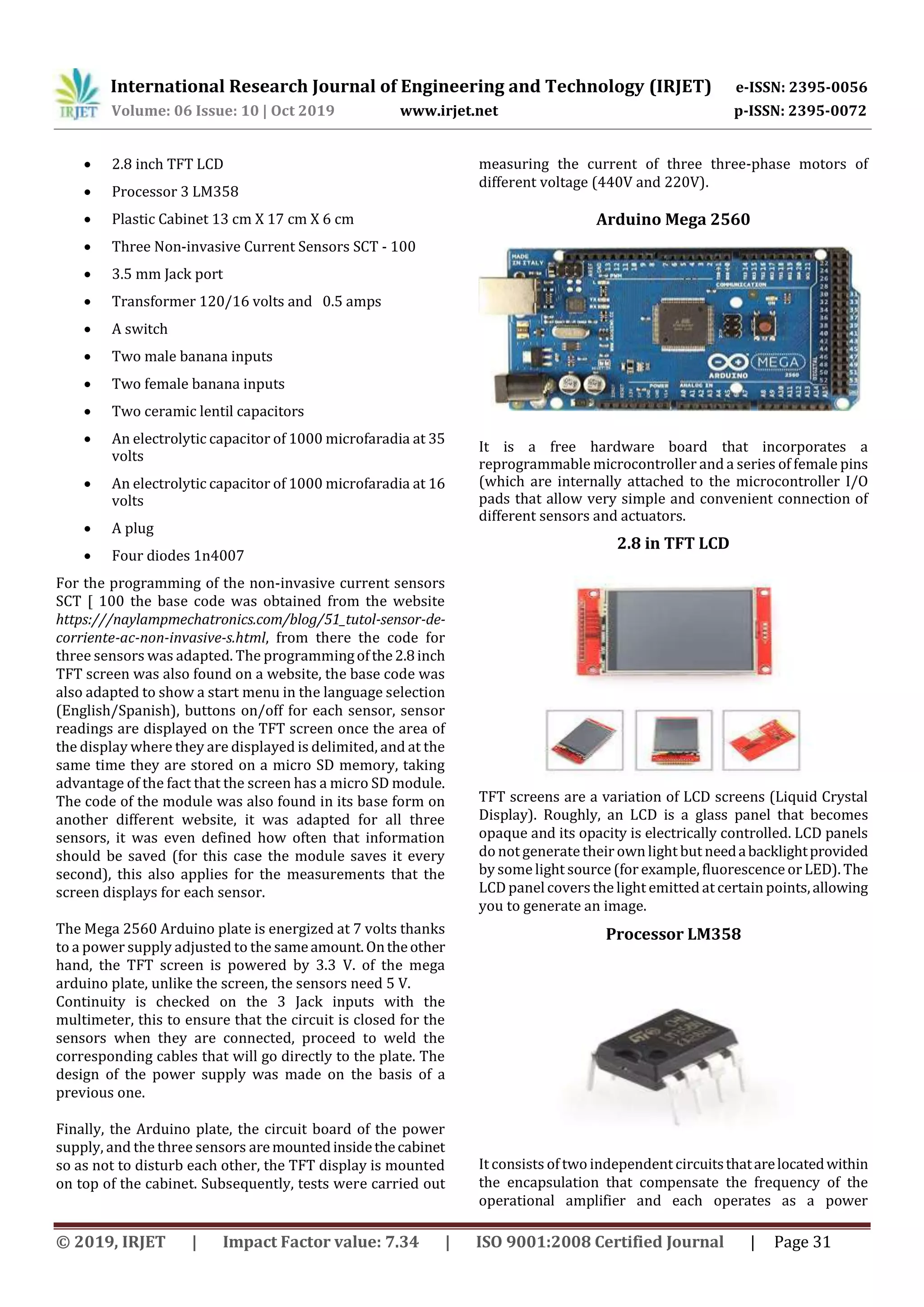
Arduino Mega 2560
It is a free hardware board that incorporates a
reprogrammable microcontroller and a series of female pins
(which are internally attached to the microcontroller I/O
pads that allow very simple and convenient connection of
different sensors and actuators.
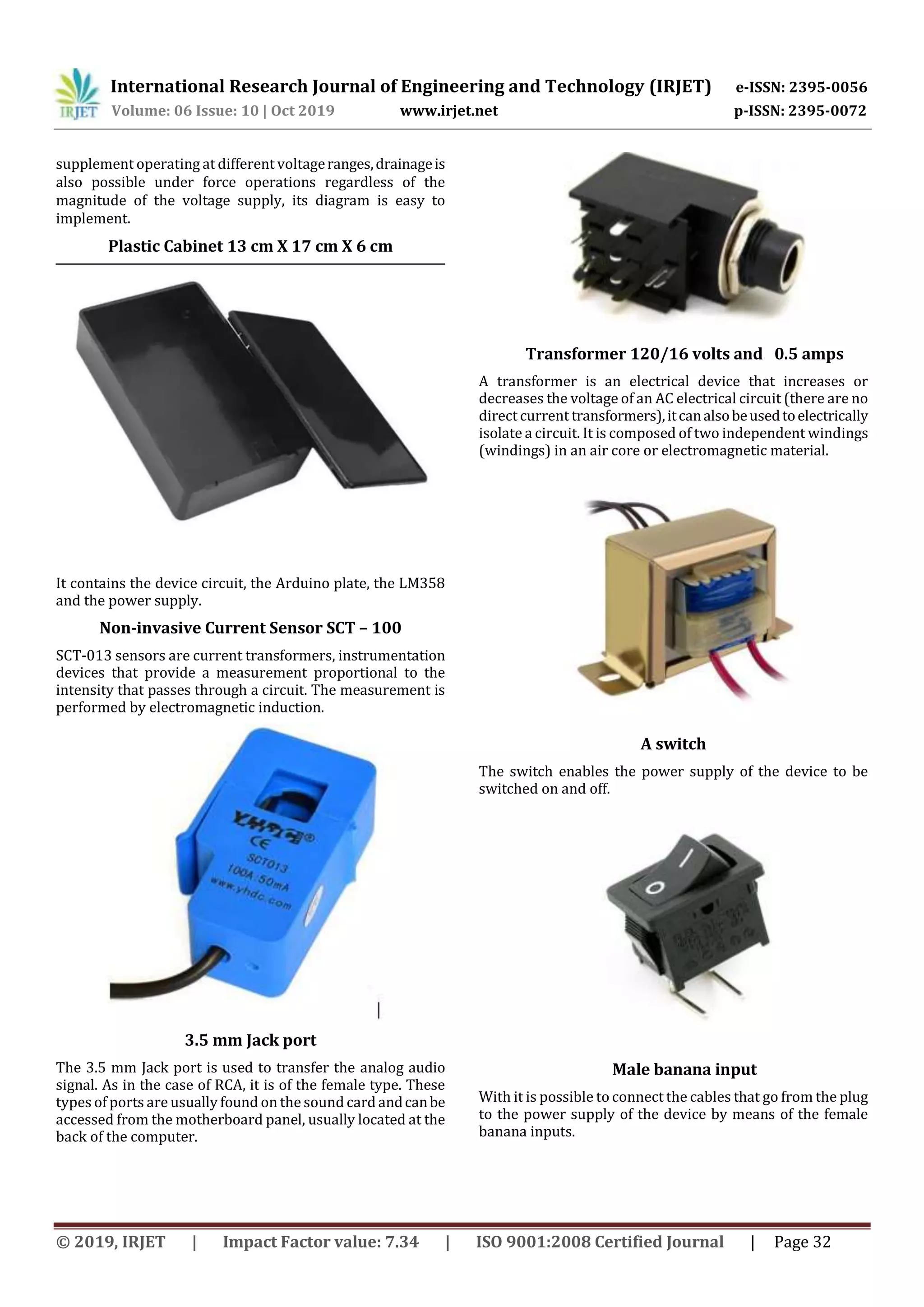
2.8 in TFT LCD
TFT screens are a variation of LCD screens (Liquid Crystal
Display). Roughly, an LCD is a glass panel that becomes
opaque and its opacity is electrically controlled. LCD panels
do not generatetheir own light but needabacklightprovided
by somelight source (for example, fluorescence or LED). The
LCD panelcovers the light emitted at certain points,allowing
you to generate an image.
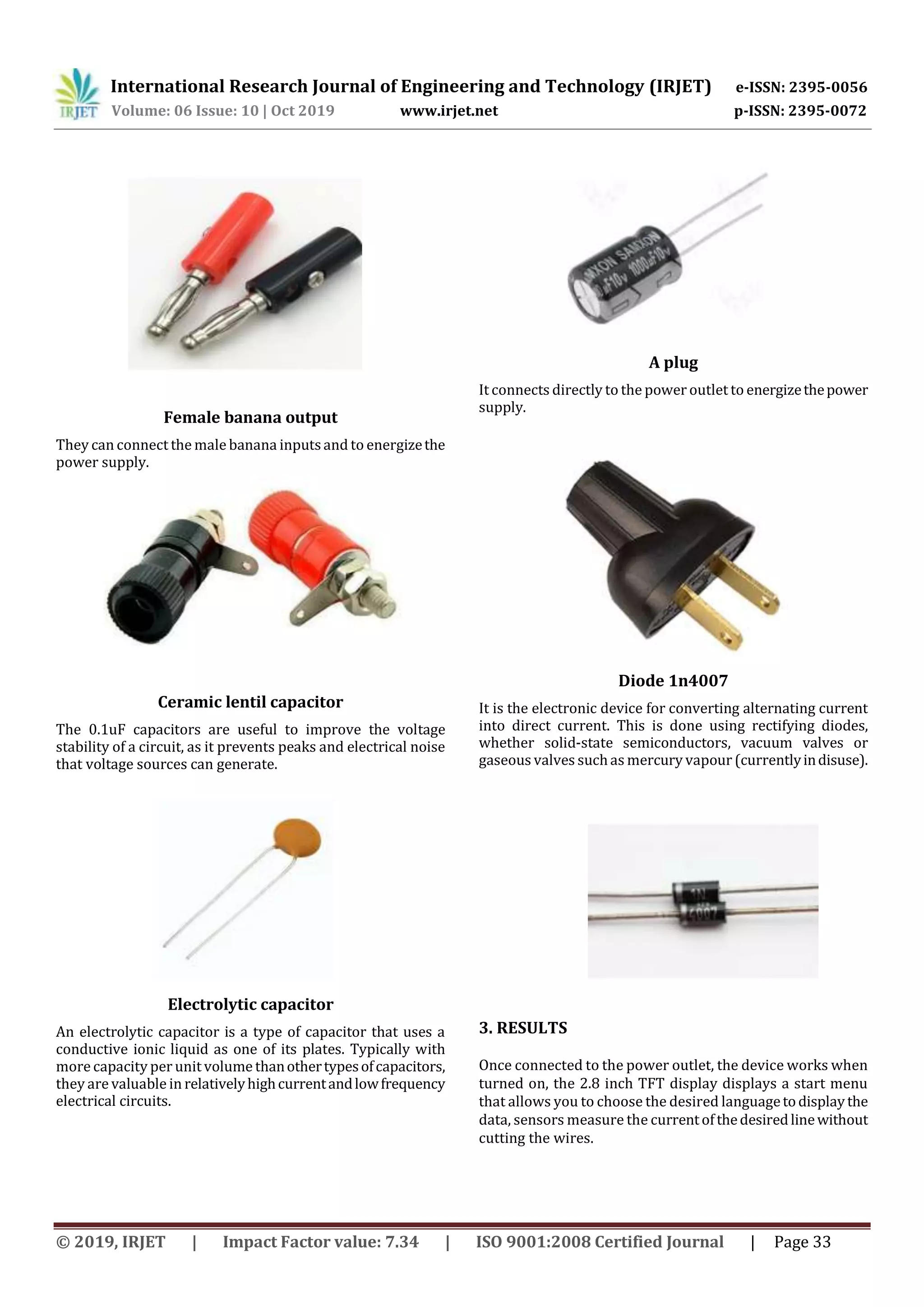
Processor LM358
It consists of two independent circuitsthatarelocatedwithin
the encapsulation that compensate the frequency of the
operational amplifier and each operates as a power
International Research Journal of Engineering and Technology (IRJET) e-ISSN: 2395-0056
Volume: 06 Issue: 10 | Oct 2019 www.irjet.net p-ISSN: 2395-0072
© 2019, IRJET | Impact Factor value: 7.34 | ISO 9001:2008 Certified Journal | Page 32
supplement operating at different voltageranges,drainageis
also possible under force operations regardless of the
magnitude of the voltage supply, its diagram is easy to
implement.
Plastic Cabinet 13 cm X 17 cm X 6 cm
It contains the device circuit, the Arduino plate, the LM358
and the power supply.
Non-invasive Current Sensor SCT – 100
SCT-013 sensors are current transformers, instrumentation
devices that provide a measurement proportional to the
intensity that passes through a circuit. The measurement is
performed by electromagnetic induction.
3.5 mm Jack port
The 3.5 mm Jack port is used to transfer the analog audio
signal. As in the case of RCA, it is of the female type. These
types of ports are usually found on the sound card andcanbe
accessed from the motherboard panel, usually located at the
back of the computer.
Transformer 120/16 volts and 0.5 amps
A transformer is an electrical device that increases or
decreases the voltage of an AC electrical circuit (there are no
direct current transformers),itcanalsobeusedtoelectrically
isolate a circuit. It is composed of two independent windings
(windings) in an air core or electromagnetic material.
A switch
The switch enables the power supply of the device to be
switched on and off.
Male banana input
With it is possible to connect the cables that go from the plug
to the power supply of the device by means of the female
banana inputs.
International Research Journal of Engineering and Technology (IRJET) e-ISSN: 2395-0056
Volume: 06 Issue: 10 | Oct 2019 www.irjet.net p-ISSN: 2395-0072
© 2019, IRJET | Impact Factor value: 7.34 | ISO 9001:2008 Certified Journal | Page 33
Female banana output
They can connect the male banana inputsand to energizethe
power supply.
Ceramic lentil capacitor
The 0.1uF capacitors are useful to improve the voltage
stability of a circuit, as it prevents peaks and electrical noise
that voltage sources can generate.
Electrolytic capacitor
An electrolytic capacitor is a type of capacitor that uses a
conductive ionic liquid as one of its plates. Typically with
more capacity per unit volume thanothertypesofcapacitors,
they are valuable in relativelyhighcurrentandlowfrequency
electrical circuits.
A plug
It connects directly to the power outlet to energizethepower
supply.
Diode 1n4007
It is the electronic device for converting alternating current
into direct current. This is done using rectifying diodes,
whether solid-state semiconductors, vacuum valves or
gaseous valves suchas mercury vapour (currentlyindisuse).
3. RESULTS
Once connected to the power outlet, the device works when
turned on, the 2.8 inch TFT display displays a start menu
that allows you to choose the desired languagetodisplaythe
data, sensors measure the currentofthedesiredlinewithout
cutting the wires.
International Research Journal of Engineering and Technology (IRJET) e-ISSN: 2395-0056
Volume: 06 Issue: 10 | Oct 2019 www.irjet.net p-ISSN: 2395-0072
© 2019, IRJET | Impact Factor value: 7.34 | ISO 9001:2008 Certified Journal | Page 34
Fig. -1: Front view of the device measuring current of a
three-phase motor
Fig.- 2: Rear view of the device, see the components inside
the cabinet.
It was possible to measure the current ofthemotorswithout
any inconvenience,thesensorsareactivatedanddeactivated
according to the choice of which should work thanks to the
buttons that were implemented on the 2.8 inch TFT screen.
4. CONCLUSIONS
With the design of this device it was possible to measure the
current of the electric motors (especially the biphasic and
three-phase) continuously, the user is sure to know how
much current is consumed by the motors, and best ofall isto
be able to monitor them without anyonenecessarilybeing at
the place where the measurements are made. This helps
maintenance personnel to prevent a possible engine failure
due to the difference in current circulating on each of its
lines, as mentioned above, this difference in currents may
cause the engine to burn. Above all, the priority is to
maintain the safety of the installations of companies or
universities where electric motors are used for production
activities or simply for academic purposes.Itcanalsobesaid
that by knowing the current consumed can be deduced the
costs that are generated in matter of electric power, the
users can have a better visualization about the performance
of the machines, Check them if necessaryforsensor readings
on the engines.
This will prevent any engine from burning, and therefore
maintenance costs will decrease, and failure shutdowns will
also decrease. In the company, failure stoppages are very
expensive because they are stopped, spent onrepairs,and in
more severe cases, accidents at work could occur.
REFERENCES
[1] Areny, R. P. (2001). Sensores y Acondicionadores de
Señal. México: Alfaomega.
[2] Boylestad, R. L., & L., N. (2011). Introductory Circuit
Analysis. Pearson Education.
[3] Cortés, F. R., & Cid Monjaraz, J. (2015). Arduino
Aplicaciones en robótica, mecatrónica e ingeniería.
México: Alfaomega.
[4] Gómez, J. R., & Aguirre, F. A. (2013). Circuitos eléctricos
y aplicaciones digitales. Naucalpan de Juárez: Pearson.
[5] Harper, G. E. (2014). Control de motores eléctricos.
México: Limusa.
[6] Mileaf, H. (|1997). Electronics One - Seven . Hayden
Book Company,
[7] Rotgé, H. G. (1998). Electricidad y Magnetismo
Preguntas y respuestas. México: Trillas.
BIOGRAPHIES
Noé Ramírez Rodríguez
graduated from the University of
the Tlaxcala Valley in Modern
Languages, currently a student in
Industrial Maintenance
Engineering at the Technological
University of Tlaxcala, he
graduated as T.S.U. in 2018. He
worked as a language teacher
(English and German) during the
years 2013 and 2014, he also
worked as a laboratory assistantin
the area of quality at GeosycS.A.de
C.V.
Fernando De Gante Leal
graduated from T.S.U. in Industrial
Area Maintenance at the
Technological University of
Tlaxcala in 2018. During the May-
August period she worked in the
company Gonac. He is currently
studying Industrial Maintenance
Engineering at the Technological
University of Tlaxcala.
International Research Journal of Engineering and Technology (IRJET) e-ISSN: 2395-0056
Volume: 06 Issue: 10 | Oct 2019 www.irjet.net p-ISSN: 2395-0072
© 2019, IRJET | Impact Factor value: 7.34 | ISO 9001:2008 Certified Journal | Page 35
Moisés Sánchez Moredia earned
a Bachelor of Arts in Applied
Modern Languages, specialized in
English as a second language
teaching byUniversidadAutónoma
de Tlaxcala. He holds a Master´s
Degree in School Administration
and Management by Universidad
Internacional de la Rioja (UNIR).
From 2016 to 2018, He was the
coordinator of the English area in
Universidad Tecnologica de
Tlaxcala where he currently
teaches English in Industrial
Maintenance Engineering.
Jonny Carmona Reyes graduated
from the Technological Institute of
Apizaco in 2010 with a bachelor´s
degree in Electronic Engineering,
especially in automation and
instrumentation. Since to 2013, he
has been working as a teacher in
the Technological University of
Tlaxcala in the Industrial
Maintenance career.
María Judith Ortiz Ramos is a
professor in the area of Social
Sciences at the Technological
University of Tlaxcala for T.S.U.
and Engineering.
Haynet Rivera Flores graduatein
applied linguistics from the
Universidad Autónoma de
Tlaxcala, she has a specializationin
teaching and a master’s degree in
administrative engineering from
the Instituto Tecnológico de
Apizaco. She served as a language
assistant in the United Kingdom
for a period of one year. Trainer of
the method for teaching English
Rassias. Author of articles
presented at national and
international congresses and
published in indexed journals.
Currently working at the
Technological University of
Tlaxcala, as a research professor
and teacher of the English
language

IRJET- Measuring Current and Power of Different Electrical Engines

  • 1.
    International Research Journalof Engineering and Technology (IRJET) e-ISSN: 2395-0056 Volume: 06 Issue: 11 | Nov 2019 www.irjet.net p-ISSN: 2395-0072 © 2019, IRJET | Impact Factor value: 7.34 | ISO 9001:2008 Certified Journal | Page 30 Measuring Current and Power of Different Electrical Engines Noé Ramírez Rodríguez1, Fernando De Gante Leal2,Moisés Sánchez Moredia3,Jonny Carmona Reyes4, María Judith Ortiz Ramos5, Haynet Rivera Flores6 1Industrial Maintenance Engineering, Technological University of Tlaxcala, Highway to El Carmen Xalpatlahuaya Huamantla, Tlaxcala, Mexico. ---------------------------------------------------------------------***---------------------------------------------------------------------- Abstract - The project consists on designing a device controlled by Arduino to measure the power and current consumed by electric motors through three non-invasive current sensors. These sensors operate on the basis of the magnetic flux that occurs in the cable when the current circulates through it. The sensor detects the magnetic flux which, by means of conversions, produces the current intensity, the power at which it works, and displays it on the 2.8 inch TFT display. When the measurements are obtained, they are stored in a micro SD memory using the SD module of the 2.8 inch TFT display. This device is powered by an adjustable power supply that will allow us to power the Arduino Mega 2560 to 7v which acts as controller of the device, the advantage is to have more pins to program, control the 2.8 inch TFT display, non-invasive sensors, and micro SD module. In turn everything is mounted inside a cabinet of 13 cm x 17 cm x 6 cm, which protects the internal circuit of the device. The three sensors measure the current of single-phase, biphasic and three-phase electric motors, compare the energy consumption between the lines that powerthemand determine whether there are large differences between them. Key Words: Keyword 1 – Arduino (Hardware and software platform, Keyword 2 – CT (Current Transformer), Keyword 3 – TFT LCD (Thin-film- transistor liquid-crystal display) 1. INTRODUCTION The electric current is defined as the flow of electrons through a conductor medium,electrical devicesconnectedto a power source (voltage) perform a work (power). For example, in a three-phase induction engine, in theory, the current consumed by each phase should be the same; when this is not met it is due to internal engine problems such as a deterioration of the isolation of the stator or by the imbalance of the voltage producing a significant increase of the engine temperature shortening up to 50% its useful life. A sensor is a device that, from the energy of the medium where it is measured, gives a transducible output signal that is a function of the measurement variable. Sensor and transducer aresometimesusedassynonyms, but sensor suggests a more extensive meaning: broadening the senses to acquire a knowledge of physical quantities that,by their nature or size, cannot be perceived directly by the senses. Transducer, on the other hand, suggests that the input signal and the output signal should not be homogeneous. The sensors are everywhere; in the housing units, the installations of a company, in the machinery of the industries, in the appliances, since they were used for the first time to date, sensors have changed and made life easier for people around the world. Arduino is a development platform based on a free hardware electronic board that incorporates a re-programmable microcontroller,a series of female pins, which allow connections between the microcontroller, different sensors and actuators in a very simple way (mainly with dupont cables). An electronic board is a PCB (a printed circuit board). Pcbs flat surfaces made from a non-conductive material, which coast from different layers of conductive material. A PCB is the most compact and stable way to build an electronic circuit. So the Arduino plate is nothing more than a PCB that implements a certain design of internal circuitry, so the end user should not worry about the electrical connections that the microcontroller needs to operate, and you can start directly developing the different electronic applicationsyou need. When it comes to Arduino, the specific model must be specified, since different models of official Arduino plates have been manufactured, each one with a different purpose and varied characteristics (such as physical size, number of I/O pins, microcontroller model, etc.). Despite the various plates that exist all belong to the same family (microcontrollers AVR brand Atmel), this means that they share most of their software features, such as architecture, libraries and documentation. A TFT screen is a device, the acronym TFT means ("Thin Film Transistor") or thin film transistor. This is a technology based on field effect transistors, that is, an electrode is placed on a glass plate (sheet that conducts electricity), on which thin layers are placed, and when activated by means of the electrode each, the colors are activated, thus forming each pixel. 2. DEVELOPMENT The following materials were used for the device:  Arduino Mega 2560
  • 2.
    International Research Journalof Engineering and Technology (IRJET) e-ISSN: 2395-0056 Volume: 06 Issue: 10 | Oct 2019 www.irjet.net p-ISSN: 2395-0072 © 2019, IRJET | Impact Factor value: 7.34 | ISO 9001:2008 Certified Journal | Page 31  2.8 inch TFT LCD  Processor 3 LM358  Plastic Cabinet 13 cm X 17 cm X 6 cm  Three Non-invasive Current Sensors SCT - 100  3.5 mm Jack port  Transformer 120/16 volts and 0.5 amps  A switch  Two male banana inputs  Two female banana inputs  Two ceramic lentil capacitors  An electrolytic capacitor of 1000 microfaradia at 35 volts  An electrolytic capacitor of 1000 microfaradia at 16 volts  A plug  Four diodes 1n4007 For the programming of the non-invasive current sensors SCT [ 100 the base code was obtained from the website https:///naylampmechatronics.com/blog/51_tutol-sensor-de- corriente-ac-non-invasive-s.html, from there the code for three sensors was adapted. The programmingofthe2.8inch TFT screen was also found on a website, the base code was also adapted to show a start menu in the language selection (English/Spanish), buttons on/off for each sensor, sensor readings are displayed on the TFT screen once the area of the display where they are displayed is delimited, and at the same time they are stored on a micro SD memory, taking advantage of the fact that the screen has a micro SD module. The code of the module was also found in its base form on another different website, it was adapted for all three sensors, it was even defined how often that information should be saved (for this case the module saves it every second), this also applies for the measurements that the screen displays for each sensor. The Mega 2560 Arduino plate is energized at 7 volts thanks to a power supply adjusted to the sameamount.Ontheother hand, the TFT screen is powered by 3.3 V. of the mega arduino plate, unlike the screen, the sensors need 5 V. Continuity is checked on the 3 Jack inputs with the multimeter, this to ensure that the circuit is closed for the sensors when they are connected, proceed to weld the corresponding cables that will go directly to the plate. The design of the power supply was made on the basis of a previous one. Finally, the Arduino plate, the circuit board of the power supply, and the three sensors aremountedinsidethecabinet so as not to disturb each other, the TFT display is mounted on top of the cabinet. Subsequently, tests were carried out measuring the current of three three-phase motors of different voltage (440V and 220V). Arduino Mega 2560 It is a free hardware board that incorporates a reprogrammable microcontroller and a series of female pins (which are internally attached to the microcontroller I/O pads that allow very simple and convenient connection of different sensors and actuators. 2.8 in TFT LCD TFT screens are a variation of LCD screens (Liquid Crystal Display). Roughly, an LCD is a glass panel that becomes opaque and its opacity is electrically controlled. LCD panels do not generatetheir own light but needabacklightprovided by somelight source (for example, fluorescence or LED). The LCD panelcovers the light emitted at certain points,allowing you to generate an image. Processor LM358 It consists of two independent circuitsthatarelocatedwithin the encapsulation that compensate the frequency of the operational amplifier and each operates as a power
  • 3.
    International Research Journalof Engineering and Technology (IRJET) e-ISSN: 2395-0056 Volume: 06 Issue: 10 | Oct 2019 www.irjet.net p-ISSN: 2395-0072 © 2019, IRJET | Impact Factor value: 7.34 | ISO 9001:2008 Certified Journal | Page 32 supplement operating at different voltageranges,drainageis also possible under force operations regardless of the magnitude of the voltage supply, its diagram is easy to implement. Plastic Cabinet 13 cm X 17 cm X 6 cm It contains the device circuit, the Arduino plate, the LM358 and the power supply. Non-invasive Current Sensor SCT – 100 SCT-013 sensors are current transformers, instrumentation devices that provide a measurement proportional to the intensity that passes through a circuit. The measurement is performed by electromagnetic induction. 3.5 mm Jack port The 3.5 mm Jack port is used to transfer the analog audio signal. As in the case of RCA, it is of the female type. These types of ports are usually found on the sound card andcanbe accessed from the motherboard panel, usually located at the back of the computer. Transformer 120/16 volts and 0.5 amps A transformer is an electrical device that increases or decreases the voltage of an AC electrical circuit (there are no direct current transformers),itcanalsobeusedtoelectrically isolate a circuit. It is composed of two independent windings (windings) in an air core or electromagnetic material. A switch The switch enables the power supply of the device to be switched on and off. Male banana input With it is possible to connect the cables that go from the plug to the power supply of the device by means of the female banana inputs.
  • 4.
    International Research Journalof Engineering and Technology (IRJET) e-ISSN: 2395-0056 Volume: 06 Issue: 10 | Oct 2019 www.irjet.net p-ISSN: 2395-0072 © 2019, IRJET | Impact Factor value: 7.34 | ISO 9001:2008 Certified Journal | Page 33 Female banana output They can connect the male banana inputsand to energizethe power supply. Ceramic lentil capacitor The 0.1uF capacitors are useful to improve the voltage stability of a circuit, as it prevents peaks and electrical noise that voltage sources can generate. Electrolytic capacitor An electrolytic capacitor is a type of capacitor that uses a conductive ionic liquid as one of its plates. Typically with more capacity per unit volume thanothertypesofcapacitors, they are valuable in relativelyhighcurrentandlowfrequency electrical circuits. A plug It connects directly to the power outlet to energizethepower supply. Diode 1n4007 It is the electronic device for converting alternating current into direct current. This is done using rectifying diodes, whether solid-state semiconductors, vacuum valves or gaseous valves suchas mercury vapour (currentlyindisuse). 3. RESULTS Once connected to the power outlet, the device works when turned on, the 2.8 inch TFT display displays a start menu that allows you to choose the desired languagetodisplaythe data, sensors measure the currentofthedesiredlinewithout cutting the wires.
  • 5.
    International Research Journalof Engineering and Technology (IRJET) e-ISSN: 2395-0056 Volume: 06 Issue: 10 | Oct 2019 www.irjet.net p-ISSN: 2395-0072 © 2019, IRJET | Impact Factor value: 7.34 | ISO 9001:2008 Certified Journal | Page 34 Fig. -1: Front view of the device measuring current of a three-phase motor Fig.- 2: Rear view of the device, see the components inside the cabinet. It was possible to measure the current ofthemotorswithout any inconvenience,thesensorsareactivatedanddeactivated according to the choice of which should work thanks to the buttons that were implemented on the 2.8 inch TFT screen. 4. CONCLUSIONS With the design of this device it was possible to measure the current of the electric motors (especially the biphasic and three-phase) continuously, the user is sure to know how much current is consumed by the motors, and best ofall isto be able to monitor them without anyonenecessarilybeing at the place where the measurements are made. This helps maintenance personnel to prevent a possible engine failure due to the difference in current circulating on each of its lines, as mentioned above, this difference in currents may cause the engine to burn. Above all, the priority is to maintain the safety of the installations of companies or universities where electric motors are used for production activities or simply for academic purposes.Itcanalsobesaid that by knowing the current consumed can be deduced the costs that are generated in matter of electric power, the users can have a better visualization about the performance of the machines, Check them if necessaryforsensor readings on the engines. This will prevent any engine from burning, and therefore maintenance costs will decrease, and failure shutdowns will also decrease. In the company, failure stoppages are very expensive because they are stopped, spent onrepairs,and in more severe cases, accidents at work could occur. REFERENCES [1] Areny, R. P. (2001). Sensores y Acondicionadores de Señal. México: Alfaomega. [2] Boylestad, R. L., & L., N. (2011). Introductory Circuit Analysis. Pearson Education. [3] Cortés, F. R., & Cid Monjaraz, J. (2015). Arduino Aplicaciones en robótica, mecatrónica e ingeniería. México: Alfaomega. [4] Gómez, J. R., & Aguirre, F. A. (2013). Circuitos eléctricos y aplicaciones digitales. Naucalpan de Juárez: Pearson. [5] Harper, G. E. (2014). Control de motores eléctricos. México: Limusa. [6] Mileaf, H. (|1997). Electronics One - Seven . Hayden Book Company, [7] Rotgé, H. G. (1998). Electricidad y Magnetismo Preguntas y respuestas. México: Trillas. BIOGRAPHIES Noé Ramírez Rodríguez graduated from the University of the Tlaxcala Valley in Modern Languages, currently a student in Industrial Maintenance Engineering at the Technological University of Tlaxcala, he graduated as T.S.U. in 2018. He worked as a language teacher (English and German) during the years 2013 and 2014, he also worked as a laboratory assistantin the area of quality at GeosycS.A.de C.V. Fernando De Gante Leal graduated from T.S.U. in Industrial Area Maintenance at the Technological University of Tlaxcala in 2018. During the May- August period she worked in the company Gonac. He is currently studying Industrial Maintenance Engineering at the Technological University of Tlaxcala.
  • 6.
    International Research Journalof Engineering and Technology (IRJET) e-ISSN: 2395-0056 Volume: 06 Issue: 10 | Oct 2019 www.irjet.net p-ISSN: 2395-0072 © 2019, IRJET | Impact Factor value: 7.34 | ISO 9001:2008 Certified Journal | Page 35 Moisés Sánchez Moredia earned a Bachelor of Arts in Applied Modern Languages, specialized in English as a second language teaching byUniversidadAutónoma de Tlaxcala. He holds a Master´s Degree in School Administration and Management by Universidad Internacional de la Rioja (UNIR). From 2016 to 2018, He was the coordinator of the English area in Universidad Tecnologica de Tlaxcala where he currently teaches English in Industrial Maintenance Engineering. Jonny Carmona Reyes graduated from the Technological Institute of Apizaco in 2010 with a bachelor´s degree in Electronic Engineering, especially in automation and instrumentation. Since to 2013, he has been working as a teacher in the Technological University of Tlaxcala in the Industrial Maintenance career. María Judith Ortiz Ramos is a professor in the area of Social Sciences at the Technological University of Tlaxcala for T.S.U. and Engineering. Haynet Rivera Flores graduatein applied linguistics from the Universidad Autónoma de Tlaxcala, she has a specializationin teaching and a master’s degree in administrative engineering from the Instituto Tecnológico de Apizaco. She served as a language assistant in the United Kingdom for a period of one year. Trainer of the method for teaching English Rassias. Author of articles presented at national and international congresses and published in indexed journals. Currently working at the Technological University of Tlaxcala, as a research professor and teacher of the English language