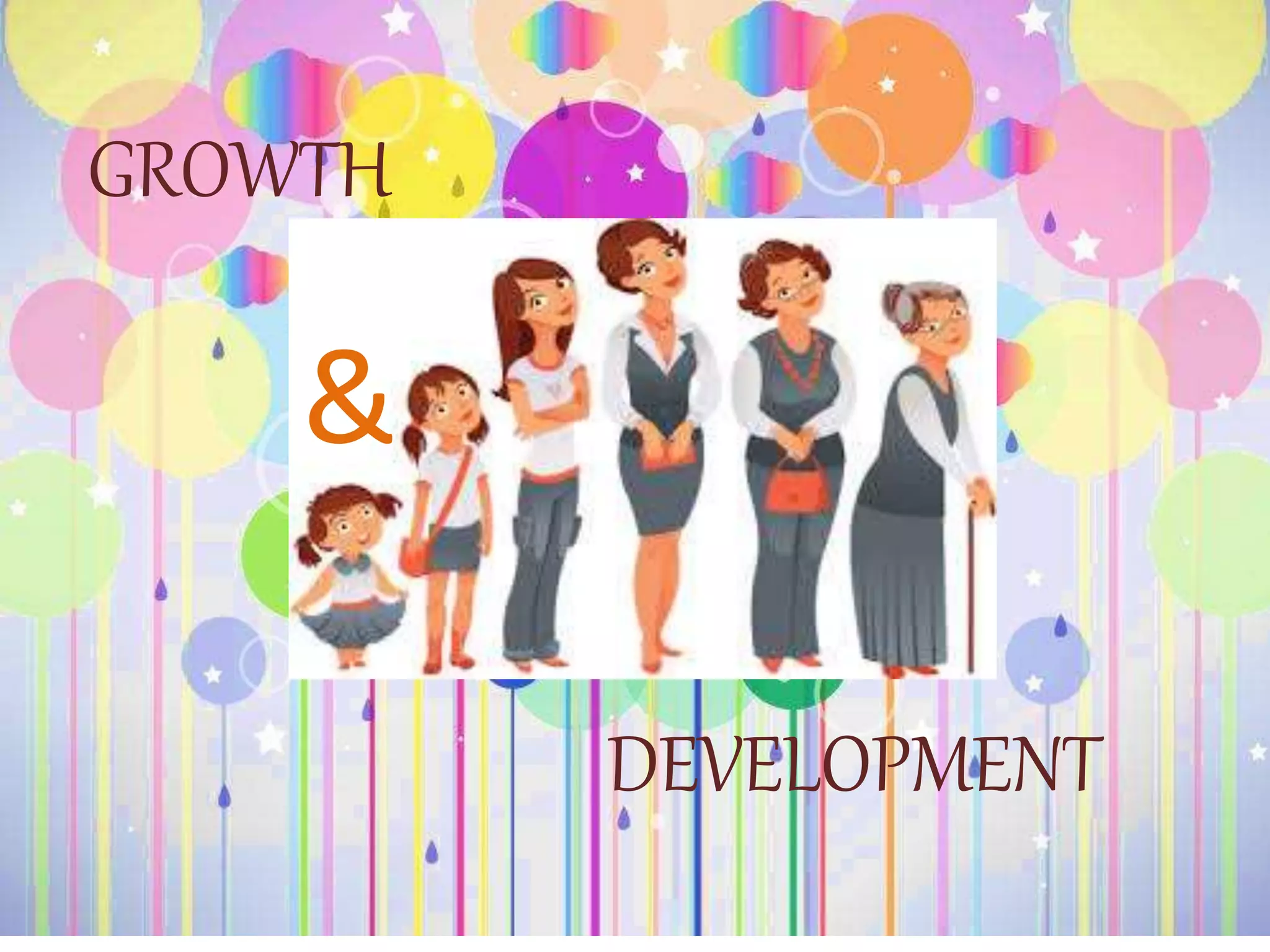
GROWTH
DEVELOPMENT
&
GROWTH
According to crow and crow
Growth means structural
and physiological changes.
Growth is a process of
becoming larger or longer.
DEVELOPMENT
Development means a
series of progressive
changes that occur in an
orderly predictable pattern
as a result of maturation
and experience.
PRICIPLES OF
GROWTH &
DEVELOPMENT
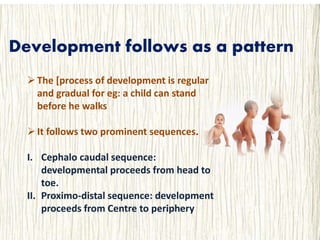
Development follows as a pattern
The [process of development is regular
and gradual for eg: a child can stand
before he walks
It follows two prominent sequences.
I. Cephalo caudal sequence:
developmental proceeds from head to
toe.
II. Proximo-distal sequence: development
proceeds from Centre to periphery
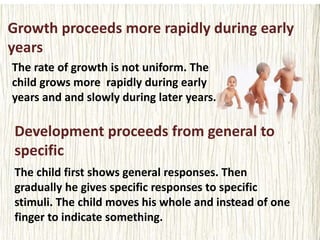
Growth proceeds more rapidly during early
years
The rate of growth is not uniform. The
child grows more rapidly during early
years and and slowly during later years.
Development proceeds from general to
specific
The child first shows general responses. Then
gradually he gives specific responses to specific
stimuli. The child moves his whole and instead of one
finger to indicate something.
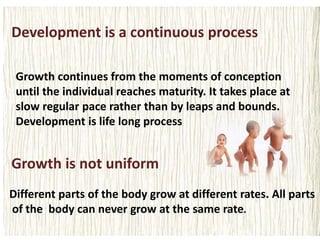
Development is a continuous process
Growth continues from the moments of conception
until the individual reaches maturity. It takes place at
slow regular pace rather than by leaps and bounds.
Development is life long process
Growth is not uniform
Different parts of the body grow at different rates. All parts
of the body can never grow at the same rate.
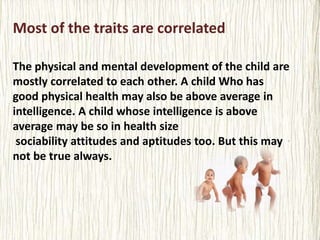
Most of the traits are correlated
The physical and mental development of the child are
mostly correlated to each other. A child Who has
good physical health may also be above average in
intelligence. A child whose intelligence is above
average may be so in health size
sociability attitudes and aptitudes too. But this may
not be true always.
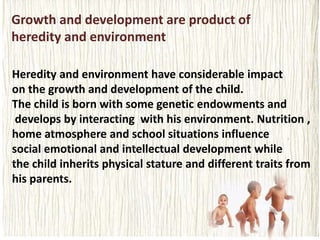
Growth and development are product of
heredity and environment
Heredity and environment have considerable impact
on the growth and development of the child.
The child is born with some genetic endowments and
develops by interacting with his environment. Nutrition ,
home atmosphere and school situations influence
social emotional and intellectual development while
the child inherits physical stature and different traits from
his parents.
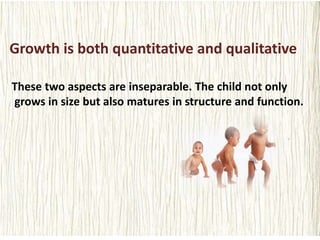
Growth is both quantitative and qualitative
These two aspects are inseparable. The child not only
grows in size but also matures in structure and function.
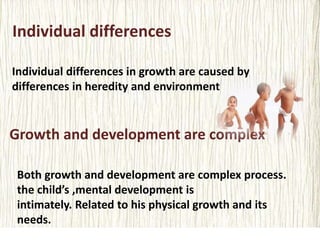
Individual differences
Individual differences in growth are caused by
differences in heredity and environment
Growth and development are complex
Both growth and development are complex process.
the child’s ,mental development is
intimately. Related to his physical growth and its
needs.
DIFFERENCE BETWEEN
GROWTH AND
DEVELOPMENT
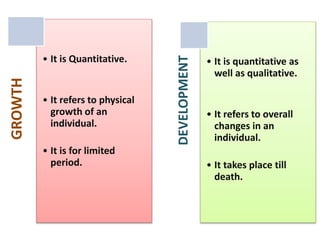
GROWTH
• It is Quantitative.
• It refers to physical
growth of an
individual.
• It is for limited
period.
DEVELOPMENT
• It is quantitative as
well as qualitative.
• It refers to overall
changes in an
individual.
• It takes place till
death.
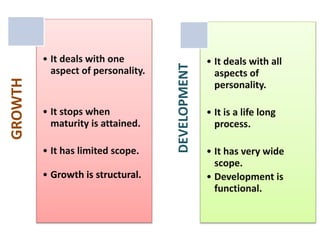
GROWTH
• It deals with one
aspect of personality.
• It stops when
maturity is attained.
• It has limited scope.
• Growth is structural.
DEVELOPMENT
• It deals with all
aspects of
personality.
• It is a life long
process.
• It has very wide
scope.
• Development is
functional.
FACTORS
AFFECTING
GROWTH
AND
DEVELOPMENT
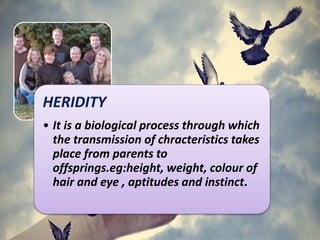
HERIDITY
• It is a biological process through which
the transmission of chracteristics takes
place from parents to
offsprings.eg:height, weight, colour of
hair and eye , aptitudes and instinct.
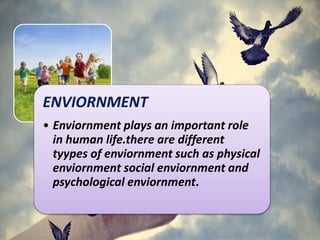
ENVIORNMENT
• Enviornment plays an important role
in human life.there are different
tyypes of enviornment such as physical
enviornment social enviornment and
psychological enviornment.
GENDER
• There is difference in growth and
development of boys and girls.in
general the body constitution and
structural growth of boys are
different from girls.
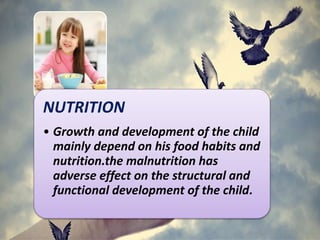
NUTRITION
• Growth and development of the child
mainly depend on his food habits and
nutrition.the malnutrition has
adverse effect on the structural and
functional development of the child.
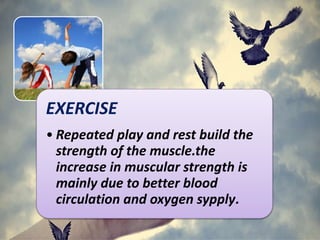
EXERCISE
• Repeated play and rest build the
strength of the muscle.the
increase in muscular strength is
mainly due to better blood
circulation and oxygen sypply.
HORMONES
• Hormones are physiological
substances having the power to raise
or lower the activity level of body .The
imbalance in the amount of different
hormones in the body affects growth
and development.
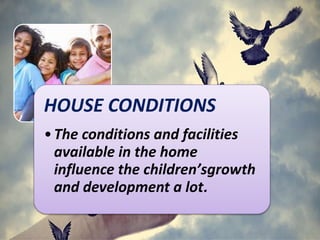
HOUSE CONDITIONS
•The conditions and facilities
available in the home
influence the children’sgrowth
and development a lot.
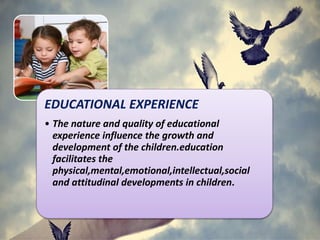
EDUCATIONAL EXPERIENCE
• The nature and quality of educational
experience influence the growth and
development of the children.education
facilitates the
physical,mental,emotional,intellectual,social
and attitudinal developments in children.
EDUCATIONAL
IMPLICATIONS
 Effective teaching depends on considering the growth
and development of learners
 Education is a process and product of development.
 Teachers and parents should be aware of the abilities of
the learners.
 Knowledge of growth and development of learners is
 essential for developing them.
Teachers and parents should neither expect nor demand
from pupils anything that is beyond their stage growth and
development.
The provision of play, games ,and sports facilitate good
physical growth and development of children.
Teachers and parents help in cultivating in pupils the
habits of balanced eating
growth and development

growth and development

  • 1.
  • 2.
    GROWTH According to crowand crow Growth means structural and physiological changes. Growth is a process of becoming larger or longer.
  • 3.
    DEVELOPMENT Development means a seriesof progressive changes that occur in an orderly predictable pattern as a result of maturation and experience.
  • 4.
  • 5.
    Development follows asa pattern The [process of development is regular and gradual for eg: a child can stand before he walks It follows two prominent sequences. I. Cephalo caudal sequence: developmental proceeds from head to toe. II. Proximo-distal sequence: development proceeds from Centre to periphery
  • 6.
    Growth proceeds morerapidly during early years The rate of growth is not uniform. The child grows more rapidly during early years and and slowly during later years. Development proceeds from general to specific The child first shows general responses. Then gradually he gives specific responses to specific stimuli. The child moves his whole and instead of one finger to indicate something.
  • 7.
    Development is acontinuous process Growth continues from the moments of conception until the individual reaches maturity. It takes place at slow regular pace rather than by leaps and bounds. Development is life long process Growth is not uniform Different parts of the body grow at different rates. All parts of the body can never grow at the same rate.
  • 8.
    Most of thetraits are correlated The physical and mental development of the child are mostly correlated to each other. A child Who has good physical health may also be above average in intelligence. A child whose intelligence is above average may be so in health size sociability attitudes and aptitudes too. But this may not be true always.
  • 9.
    Growth and developmentare product of heredity and environment Heredity and environment have considerable impact on the growth and development of the child. The child is born with some genetic endowments and develops by interacting with his environment. Nutrition , home atmosphere and school situations influence social emotional and intellectual development while the child inherits physical stature and different traits from his parents.
  • 10.
    Growth is bothquantitative and qualitative These two aspects are inseparable. The child not only grows in size but also matures in structure and function.
  • 11.
    Individual differences Individual differencesin growth are caused by differences in heredity and environment Growth and development are complex Both growth and development are complex process. the child’s ,mental development is intimately. Related to his physical growth and its needs.
  • 12.
  • 13.
    GROWTH • It isQuantitative. • It refers to physical growth of an individual. • It is for limited period. DEVELOPMENT • It is quantitative as well as qualitative. • It refers to overall changes in an individual. • It takes place till death.
  • 14.
    GROWTH • It dealswith one aspect of personality. • It stops when maturity is attained. • It has limited scope. • Growth is structural. DEVELOPMENT • It deals with all aspects of personality. • It is a life long process. • It has very wide scope. • Development is functional.
  • 15.
  • 16.
    HERIDITY • It isa biological process through which the transmission of chracteristics takes place from parents to offsprings.eg:height, weight, colour of hair and eye , aptitudes and instinct.
  • 17.
    ENVIORNMENT • Enviornment playsan important role in human life.there are different tyypes of enviornment such as physical enviornment social enviornment and psychological enviornment.
  • 18.
    GENDER • There isdifference in growth and development of boys and girls.in general the body constitution and structural growth of boys are different from girls.
  • 19.
    NUTRITION • Growth anddevelopment of the child mainly depend on his food habits and nutrition.the malnutrition has adverse effect on the structural and functional development of the child.
  • 20.
    EXERCISE • Repeated playand rest build the strength of the muscle.the increase in muscular strength is mainly due to better blood circulation and oxygen sypply.
  • 21.
    HORMONES • Hormones arephysiological substances having the power to raise or lower the activity level of body .The imbalance in the amount of different hormones in the body affects growth and development.
  • 22.
    HOUSE CONDITIONS •The conditionsand facilities available in the home influence the children’sgrowth and development a lot.
  • 23.
    EDUCATIONAL EXPERIENCE • Thenature and quality of educational experience influence the growth and development of the children.education facilitates the physical,mental,emotional,intellectual,social and attitudinal developments in children.
  • 24.
  • 25.
     Effective teachingdepends on considering the growth and development of learners  Education is a process and product of development.  Teachers and parents should be aware of the abilities of the learners.  Knowledge of growth and development of learners is  essential for developing them.
  • 26.
    Teachers and parentsshould neither expect nor demand from pupils anything that is beyond their stage growth and development. The provision of play, games ,and sports facilitate good physical growth and development of children. Teachers and parents help in cultivating in pupils the habits of balanced eating