Razieh Rahmani
Scholar student in Education
University of Mysore, India
Growth

Patterns of Growth

development

Factors affecting G& D

Maturation

Type of the Growth

Stages of G & D
Last page viewed
Growth
Growth refers to an increase in physical size of the whole body or any of its parts.
Quantitative multiplication of cells
It is simply a quantitative change in the child’s body.
It can be measured in Kg, pounds, meters, inches, ….. etc
Child Growth

We use the term growth exclusively to refer to changes that are quantitative in nature
Changes in bodily proportions with age.

Last page viewed
Development
• Development refers to a progressive increase in skill and capacity of function.

• It is a qualitative change in the child’s functioning.
• It can be measured through observation.
• A continuous, orderly series of conditions that leads to activities, new motives

for activities, and patterns of behavior

Last page viewed
Development
• Longitudinal continuous, sustained, comprehensive process over the time.

• It’s related to skills ( speaking, running, jumping, walking…..)
Nature of development
• It is a product of interaction
• It is continuous process
• Follows an orderly sequence
• Proceed from general to specific

• Different aspects of development are interdependent
• Development is an individuals process
• Each stage has its traits.
• It is depends on heredity and environment, maturation and learning
Different between growth & development
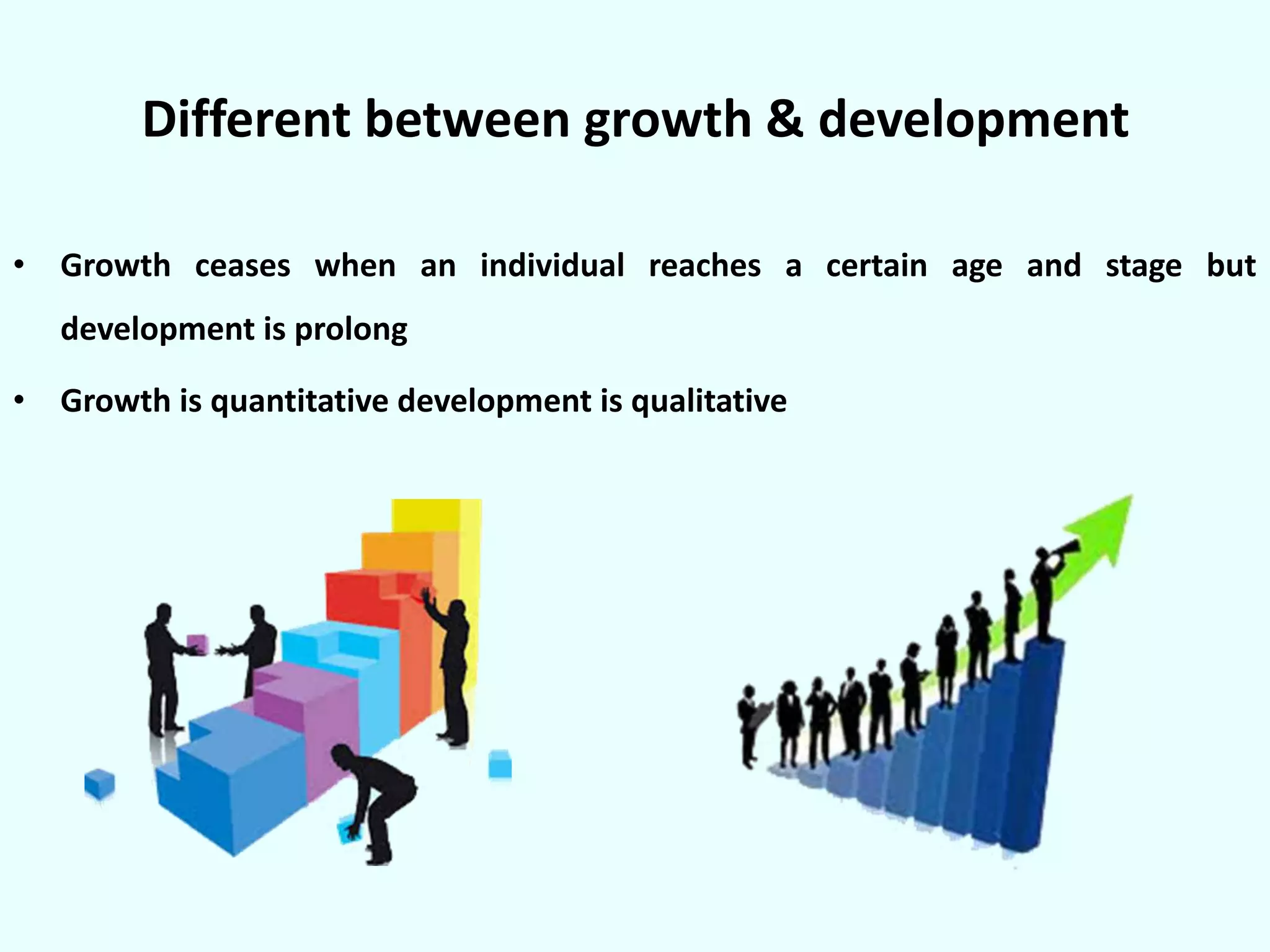
• Growth ceases when an individual reaches a certain age and stage but

development is prolong
• Growth is quantitative development is qualitative
Different between growth & development
Growth

development

•

Quantitative

•

Qualitative

•

Ends with maturity

•

Continuous from womb to grave

•

Structural and physiological changes

•

Changes in organism a whole

•

Growth is one of the developmental process •

Overall changes in individual

•

Does not depend upon maturation or learning Depends upon maturation and learning
•

•

Observable and measurable changes

•

Is not directly observable

•

May or may not bring development

•

Is possible without growth
Principles of Growth & Development
 Development is cumulative: changes appear dramatic but it is due to the long

period of silent preparation
 Development is continuous process
 Predictable Sequence

 Growth don’t progress at the same rate
 Not all body parts grow in the same rate at the same time.
 Each stage of G&D is affected by the preceding types of development.

Last page viewed
Principles of Growth & Development
 Development is orderly( standing before walking, babbling before talking
 Individualized – each child is unique
 Development becomes increasingly integrated and complex
 Growth is influenced by heredity and environment

 Growth is complex process
Last page viewed
Maturation
• The emergence of personal and behavioral characteristics through growth

processes.
• Natural unfolding of inherited tendency
• Any change with age in the conditions of learning which depends

primarily upon organic growth factors rather than upon prior practice or
experience
• It is describing the qualitative change in a structure.

• No special training is needed
Maturation
• Paves the way or foundation for learning

• The level of maturation depends on child’s heredity.
• Learning and maturation are complementary process.
• It determines the limit of one’s achievement
• It also determines the rate of learning
• Maturation refers to the learning readiness of an individual
Readiness
Capability of successfully mastering the learning activity
and this appears to be the most appropriate time to
introduce the new expedience
These people have abnormally in……

Development
Growth

maturation
Which one is mature enough for climbing the ladder?
These people have abnormally in……

Development
Growth

maturation
Patterns of Growth
The child’s pattern of growth is in a head- to- toe direction, or cephalically, and
in an inward to outward pattern

(head to toe)

(from center outward)
Last page viewed
Periods of greatest growth

• A rapid pace from birth to 2 years
• A slower pace from 2 years to puberty
• A rapid pace from puberty to approximately 15 years
• A sharp decline from 16 years to approximately 24 years when full adult
size is reached
Factors affecting growth and development:
 Hereditary

 Environmental factors
- Prenatal environment

- Post-Natal Environment

Last page viewed
Heredity
• Genetic information that is passed on from generation to
generation

• These genes are also affected by environmental factors
• For example, malnutrition may prevent an individual from growing
to their maximum potential height
Prenatal Environment

1-Factors related to mothers during pregnancy:
- Nutritional deficiencies
- Diabetic mother
- Exposure to radiation
- Infection with German measles
- Smoking
- Use of drugs
2-Factors related to fetus
• Malposition in uterus
• Faulty placental implantation
Post-Natal Environment
I - External environment:
- socio-economic status of the family
- child’s nutrition
- climate and season
- child’s ordinal position in the family
- Number of siblings in the family
- Family structure (single parent or extended family … )
Nutrition
• Adequate nutrients are essential for growth & development
• Carbohydrates and fats are primarily used for energy
• Proteins contribute to the growth and repair of body tissues, including muscle
• Vitamins, minerals and water are also essential for various functions and
reactions that occur in the body
Nutrition
• Undernourishment or malnutrition can delay
growth
• Undernourishment exists even in countries
with abundant food supplies
• Overeating is also a problem in these

countries and can lead to obesity when
combined with a sedentary lifestyle
Socioeconomic Status
• Body size is positively related to socioeconomic
status and may be related to nutrition

• That is, socioeconomic status affects
• Income (money to spend on food)
• Education (knowledge about healthy food)

• Time (food selection and preparation time)
• Availability (access to stores with healthy
food choices)
Socioeconomic Status
• Other factors may contribute to the differences observed in

growth & development among individuals, such as
• Lower levels of stress;
• Better sleeping patterns; and

• Regular exercise

• These factors are easier to ensure when the basic necessities are
met
Exercise & Bone Development
• Regular exercise tends to increase the diameter and density of bone
• Increased strength and durability
• Increased length of non-weight bearing bones such as the arms
• Overuse injuries can be incurred by young children who over-train
• Too much strain on a bone during a period of growth can lead to the dearrangement of the normal process of bone growth
Exercise & Body Composition

• Active children and teenagers show:
 An increase in lean body mass
 A decrease in percent body fat

 Muscle hypertrophy with exercise
Perceptual Motor Development Across the G & D Cycle
• The importance of physical education as an integral part of the
school curriculum is often overlooked
• Some parents discourage physical education and emphasize
academics
• Other parents encourage physical activity pursuits by enrolling their

children in organized physical activity programs
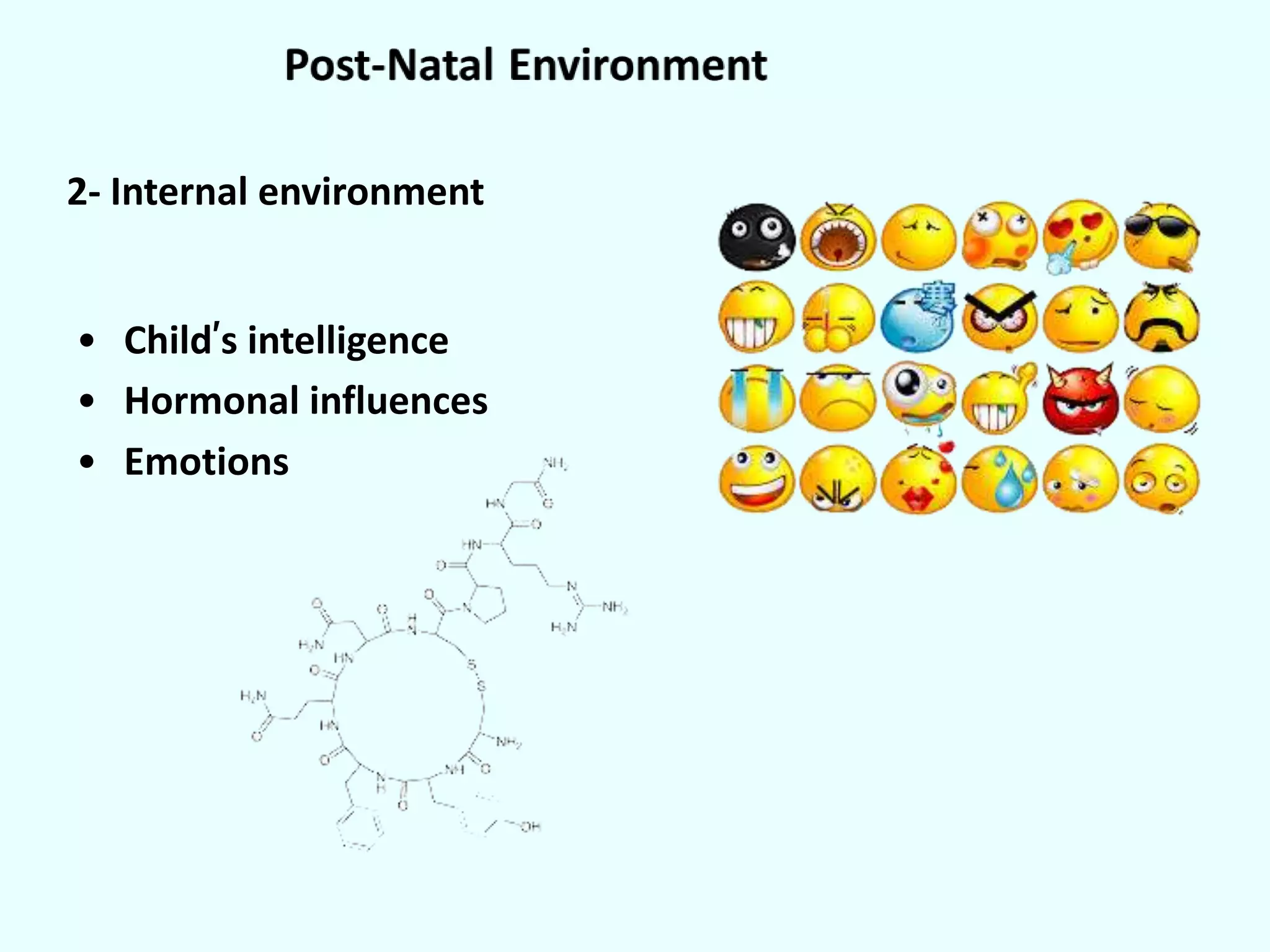
2- Internal environment

• Child’s intelligence
• Hormonal influences
• Emotions
- Nutritional deficiencies
- Diabetic mother
- Exposure to radiation

 Factors related to pregnancy

- Smoking
- Use of drugs

1- Hereditary

 Prenatal
•Malposition in uterus

 Factors related to fetus
2- Environmental factors

•Faulty placental implantation

- socio-economic status of the family

o External environment

- child’s nutrition
- climate and season



- child’s ordinal position in the family

- Post-Natal

- Number of siblings in the family
- Family structure

o Internal environment

 Child’s intelligence
 Hormonal influences
 Emotions
Types of Growth
Types of growth:
- Physical growth (Ht, Wt, head & chest circumference)
- Physiological growth (vital signs …)
Types of development


Motor Development
Types of development

 Cognitive Development
Types of development

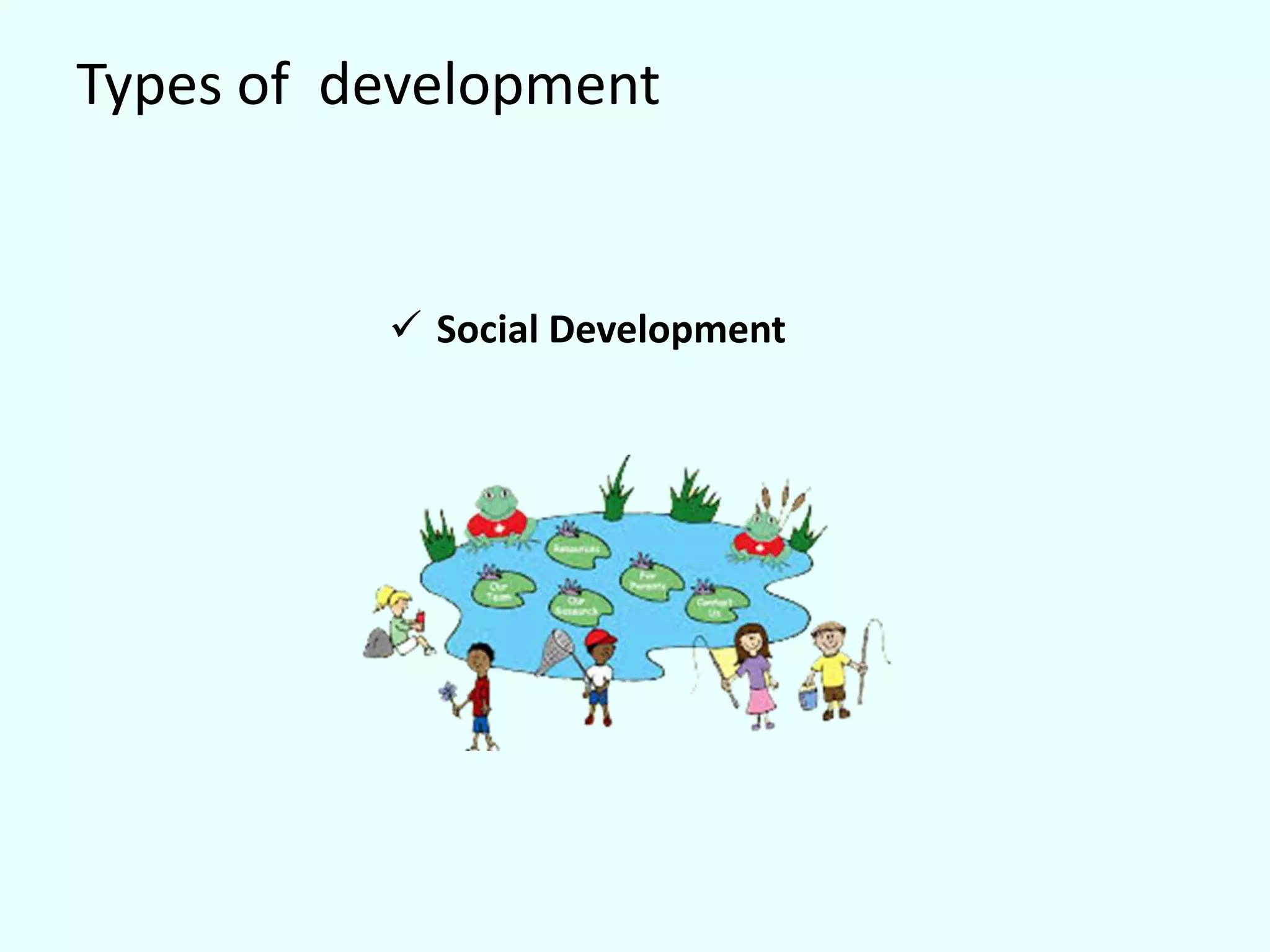
 Social Development
Types of development
 Emotional development
Stages of Growth and Development

• Certain landmark have been identified by developmental psychologist
• This division serve a purpose, it would help parents and teachers to
identify certain dominant characteristics which are relevant to training
and teaching
• Curriculum- planning hinges on this phenomenon

Last page viewed
Stages of Growth and Development
• Infancy

• Birth to 1 year
• Early Childhood
– Toddler
• 1-3 years
– Preschool

• 3-6 years

• Middle Childhood
– School age
• 6 to 12 years

• Late Childhood
– Adolescent
• 13 years to
approximately 18 years
Infancy
• BIRTH  ONE YEAR
• Period of rapid growth
• Males are usually heavier and taller than females at birth
Toddler 1-3 years

Safety becomes a problem as the toddler becomes more
mobile.
Fine Motor - toddler
• 1 year old: transfer objects from hand to hand
• 2 year old: can hold a crayon and color vertical strokes
• Turn the page of a book

• Build a tower of six blocks

• 3 year old: copy a circle and a cross – build using small blocks
Pre-School
Preschool stage
Definition:

It is the stage where child is 3 to 6 years of age. The growth during this period is
relatively slow.

Weight: The preschooler gains approximately 1.8kg/year.

Height: He doubles birth length by 4–5 years of age.
School-Age
School-age period is between the age of 6 to 12 years. The child's growth and
development is characterized by gradual growth.
Motor development
• Rides a bicycle.

• Runs Jumps, climbs and hops.
• Has improved eye-hand coordination.
• Prints word and learn cursive writing.
• Can brush and comb hair.
Educational Implication
• Knowing these enable teachers to understand how children develop
and growth.
• What is expected of them at each stage and how to guide them and
provide proper environment for optimum development

• Don’t teach too much too soon
Last page viewed
Click for more
reading
Click for more
reading
Click for more
reading

Growth & developmentweb

  • 1.
    Razieh Rahmani Scholar studentin Education University of Mysore, India
  • 2.
    Growth Patterns of Growth development Factorsaffecting G& D Maturation Type of the Growth Stages of G & D
  • 3.
  • 4.
    Growth Growth refers toan increase in physical size of the whole body or any of its parts. Quantitative multiplication of cells It is simply a quantitative change in the child’s body. It can be measured in Kg, pounds, meters, inches, ….. etc
  • 5.
    Child Growth We usethe term growth exclusively to refer to changes that are quantitative in nature
  • 6.
    Changes in bodilyproportions with age. Last page viewed
  • 7.
    Development • Development refersto a progressive increase in skill and capacity of function. • It is a qualitative change in the child’s functioning. • It can be measured through observation. • A continuous, orderly series of conditions that leads to activities, new motives for activities, and patterns of behavior Last page viewed
  • 8.
    Development • Longitudinal continuous,sustained, comprehensive process over the time. • It’s related to skills ( speaking, running, jumping, walking…..)
  • 9.
    Nature of development •It is a product of interaction • It is continuous process • Follows an orderly sequence • Proceed from general to specific • Different aspects of development are interdependent • Development is an individuals process • Each stage has its traits. • It is depends on heredity and environment, maturation and learning
  • 10.
    Different between growth& development • Growth ceases when an individual reaches a certain age and stage but development is prolong • Growth is quantitative development is qualitative
  • 11.
    Different between growth& development Growth development • Quantitative • Qualitative • Ends with maturity • Continuous from womb to grave • Structural and physiological changes • Changes in organism a whole • Growth is one of the developmental process • Overall changes in individual • Does not depend upon maturation or learning Depends upon maturation and learning • • Observable and measurable changes • Is not directly observable • May or may not bring development • Is possible without growth
  • 12.
    Principles of Growth& Development  Development is cumulative: changes appear dramatic but it is due to the long period of silent preparation  Development is continuous process  Predictable Sequence  Growth don’t progress at the same rate  Not all body parts grow in the same rate at the same time.  Each stage of G&D is affected by the preceding types of development. Last page viewed
  • 13.
    Principles of Growth& Development  Development is orderly( standing before walking, babbling before talking  Individualized – each child is unique  Development becomes increasingly integrated and complex  Growth is influenced by heredity and environment  Growth is complex process
  • 14.
  • 15.
    Maturation • The emergenceof personal and behavioral characteristics through growth processes. • Natural unfolding of inherited tendency • Any change with age in the conditions of learning which depends primarily upon organic growth factors rather than upon prior practice or experience • It is describing the qualitative change in a structure. • No special training is needed
  • 16.
    Maturation • Paves theway or foundation for learning • The level of maturation depends on child’s heredity. • Learning and maturation are complementary process. • It determines the limit of one’s achievement • It also determines the rate of learning • Maturation refers to the learning readiness of an individual
  • 17.
    Readiness Capability of successfullymastering the learning activity and this appears to be the most appropriate time to introduce the new expedience
  • 18.
    These people haveabnormally in…… Development Growth maturation
  • 19.
    Which one ismature enough for climbing the ladder?
  • 20.
    These people haveabnormally in…… Development Growth maturation
  • 21.
    Patterns of Growth Thechild’s pattern of growth is in a head- to- toe direction, or cephalically, and in an inward to outward pattern (head to toe) (from center outward) Last page viewed
  • 22.
    Periods of greatestgrowth • A rapid pace from birth to 2 years • A slower pace from 2 years to puberty • A rapid pace from puberty to approximately 15 years • A sharp decline from 16 years to approximately 24 years when full adult size is reached
  • 23.
    Factors affecting growthand development:  Hereditary  Environmental factors - Prenatal environment - Post-Natal Environment Last page viewed
  • 24.
    Heredity • Genetic informationthat is passed on from generation to generation • These genes are also affected by environmental factors • For example, malnutrition may prevent an individual from growing to their maximum potential height
  • 25.
    Prenatal Environment 1-Factors relatedto mothers during pregnancy: - Nutritional deficiencies - Diabetic mother - Exposure to radiation - Infection with German measles - Smoking - Use of drugs
  • 26.
    2-Factors related tofetus • Malposition in uterus • Faulty placental implantation
  • 27.
    Post-Natal Environment I -External environment: - socio-economic status of the family - child’s nutrition - climate and season - child’s ordinal position in the family - Number of siblings in the family - Family structure (single parent or extended family … )
  • 28.
    Nutrition • Adequate nutrientsare essential for growth & development • Carbohydrates and fats are primarily used for energy • Proteins contribute to the growth and repair of body tissues, including muscle • Vitamins, minerals and water are also essential for various functions and reactions that occur in the body
  • 29.
    Nutrition • Undernourishment ormalnutrition can delay growth • Undernourishment exists even in countries with abundant food supplies • Overeating is also a problem in these countries and can lead to obesity when combined with a sedentary lifestyle
  • 30.
    Socioeconomic Status • Bodysize is positively related to socioeconomic status and may be related to nutrition • That is, socioeconomic status affects • Income (money to spend on food) • Education (knowledge about healthy food) • Time (food selection and preparation time) • Availability (access to stores with healthy food choices)
  • 31.
    Socioeconomic Status • Otherfactors may contribute to the differences observed in growth & development among individuals, such as • Lower levels of stress; • Better sleeping patterns; and • Regular exercise • These factors are easier to ensure when the basic necessities are met
  • 32.
    Exercise & BoneDevelopment • Regular exercise tends to increase the diameter and density of bone • Increased strength and durability • Increased length of non-weight bearing bones such as the arms • Overuse injuries can be incurred by young children who over-train • Too much strain on a bone during a period of growth can lead to the dearrangement of the normal process of bone growth
  • 33.
    Exercise & BodyComposition • Active children and teenagers show:  An increase in lean body mass  A decrease in percent body fat  Muscle hypertrophy with exercise
  • 34.
    Perceptual Motor DevelopmentAcross the G & D Cycle • The importance of physical education as an integral part of the school curriculum is often overlooked • Some parents discourage physical education and emphasize academics • Other parents encourage physical activity pursuits by enrolling their children in organized physical activity programs
  • 35.
    2- Internal environment •Child’s intelligence • Hormonal influences • Emotions
  • 36.
    - Nutritional deficiencies -Diabetic mother - Exposure to radiation  Factors related to pregnancy - Smoking - Use of drugs 1- Hereditary  Prenatal •Malposition in uterus  Factors related to fetus 2- Environmental factors •Faulty placental implantation - socio-economic status of the family o External environment - child’s nutrition - climate and season  - child’s ordinal position in the family - Post-Natal - Number of siblings in the family - Family structure o Internal environment  Child’s intelligence  Hormonal influences  Emotions
  • 37.
    Types of Growth Typesof growth: - Physical growth (Ht, Wt, head & chest circumference) - Physiological growth (vital signs …)
  • 38.
  • 39.
    Types of development Cognitive Development
  • 40.
    Types of development Social Development
  • 41.
    Types of development Emotional development
  • 42.
    Stages of Growthand Development • Certain landmark have been identified by developmental psychologist • This division serve a purpose, it would help parents and teachers to identify certain dominant characteristics which are relevant to training and teaching • Curriculum- planning hinges on this phenomenon Last page viewed
  • 43.
    Stages of Growthand Development • Infancy • Birth to 1 year • Early Childhood – Toddler • 1-3 years – Preschool • 3-6 years • Middle Childhood – School age • 6 to 12 years • Late Childhood – Adolescent • 13 years to approximately 18 years
  • 44.
    Infancy • BIRTH ONE YEAR • Period of rapid growth • Males are usually heavier and taller than females at birth
  • 45.
    Toddler 1-3 years Safetybecomes a problem as the toddler becomes more mobile.
  • 46.
    Fine Motor -toddler • 1 year old: transfer objects from hand to hand • 2 year old: can hold a crayon and color vertical strokes • Turn the page of a book • Build a tower of six blocks • 3 year old: copy a circle and a cross – build using small blocks
  • 47.
  • 48.
    Preschool stage Definition: It isthe stage where child is 3 to 6 years of age. The growth during this period is relatively slow. Weight: The preschooler gains approximately 1.8kg/year. Height: He doubles birth length by 4–5 years of age.
  • 50.
    School-Age School-age period isbetween the age of 6 to 12 years. The child's growth and development is characterized by gradual growth.
  • 51.
    Motor development • Ridesa bicycle. • Runs Jumps, climbs and hops. • Has improved eye-hand coordination. • Prints word and learn cursive writing. • Can brush and comb hair.
  • 52.
    Educational Implication • Knowingthese enable teachers to understand how children develop and growth. • What is expected of them at each stage and how to guide them and provide proper environment for optimum development • Don’t teach too much too soon
  • 53.
  • 54.
  • 55.
  • 56.