


Group
Dynamics
Presented by:
Kessie Castillo
General Topics
– GROUP DYNAMICS
– GROUP
– GROUP MAKING DECISION
Subtopics
A. Group
– Classification of Groups
– Why people join groups?
– Group development theories
– Stages of group development
– Group structure
B. Group Making Decision
– Strengths and weakness of group decision making
– Groupthink and Groupshift
– Decision Making Decision Techniques
– Chand, S. (n.d.). http://www.yourarticlelibrary.com/. Retrieved April 29, 2016,
from http://www.yourarticlelibrary.com/:
http://www.yourarticlelibrary.com/management/4-techniques-for-group-
decision-making-process-more-effective/3506/
– Forsyth, D. R. (2006). Group Dynamics. USA: Thomson Wadsworth.
– Kirpal, N. (n.d.). https://us.experteer.com. Retrieved April 29, 2016, from
https://us.experteer.com: https://us.experteer.com/magazine/impact-of-
hawthorne-effect-on-productivity-at-work/
– Kirpal, N. (2014, October 20). https://us.experteer.com. Retrieved April 28,
2016, from https://us.experteer.com:
https://us.experteer.com/magazine/impact-of-hawthorne-effect-on-
productivity-at-work/
References
References
– Luthans, F. (2005). Organizational behavior. McGraw-Hill.
– McMillan, A., & Barnett, T. (n.d.). http://www.referenceforbusiness.com/.
Retrieved April 29, 2016, from http://www.referenceforbusiness.com/:
http://www.referenceforbusiness.com/management/Gr-Int/Group-
Dynamics.html
– Rao, V. S. (2009). Organizational Behaviour. Excel Books.
– Robert Kreitner, A. K. (2012). Organizational Behavior. McGraw-Hill Education.
– Stephen P. Robbins, T. J. (2010). Organizational Behaviour. Pearson.
– Stephen Robbins, T. A. (2013). Organisational Behaviour. Pearson Higher
Education AU.
Learning Outcomes
After studying this chapter, students must be able to:
– Define group and distinguish different types of groups.
– Understand group development theories
– Identify the 5 stages of development
– Understand the 6 group properties that affects the organization
– Define group decision making and identify its techniques
– Compare and contrast the strengths and weaknesses of group
making
– Compare the effectiveness of interacting, brainstorming,
nominal group technique and electronic.
Definition of Group (s) C& Group
Dynamics
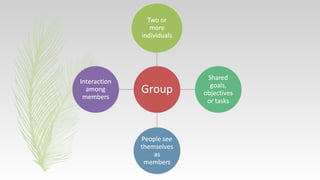
Group
– Two or more individuals interacting interdependent, who
have come together to accomplish a particular objective,
tasks or projects.
Group dynamics
– It refers to the attitude or behavior of a group. Its
primarily concern is about the types, characteristics,
structure and process.
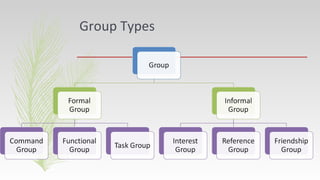
Group Types
Why people join group?
– Security
– Status
– Self esteem
– Affiliation
– Power
– Goal Achievement
Group Development Theories
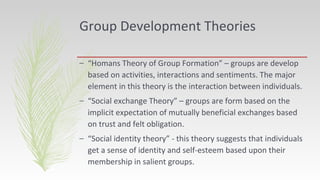
– “Homans Theory of Group Formation” – groups are develop
based on activities, interactions and sentiments. The major
element in this theory is the interaction between individuals.
– “Social exchange Theory” – groups are form based on the
implicit expectation of mutually beneficial exchanges based
on trust and felt obligation.
– “Social identity theory” - this theory suggests that individuals
get a sense of identity and self-esteem based upon their
membership in salient groups.
Group Development Theories
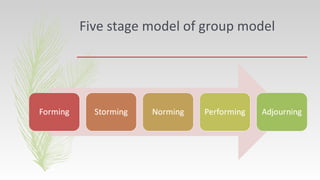
– Bruce Tukman (1960) – provided the common
framework on “how” group was made.
– 5 Stages of Group Development
Five stage model of group model
Group Structure
– Roles
– Norms
– Status
– Size
– Cohesiveness
– Diversity
Group Structure: Roles
Role (s)
– A set of expected behavior patterns attributed to someone
occupying a given position in a social unit.
Classification of Roles
– Work/task roles
– Maintenance roles
Group Structure: Roles
Role Ambiguity
– Discrepancy between sent role and received role
Role Conflict
– A situation in which an individual is confronted by divergent
role expectations.
Group Structure: Norms
Norms
– Acceptable standards of behavior within a group that are
shared by the group’s members.
Classes of Norms:
•Performance norms
•Appearance norms
•Social Arrangement norms
•Allocation of resources norms
Group Norms & The Hawthorne
Studies
– A series of studies undertaken by Elton Mayo at Western Electric
Company’s Hawthorne Works in Chicago between 1924 and 1932.
– Research Conclusions:
– The aptitudes of individuals are imperfect predictors of job
performance
– Informal organization affects productivity
– Work-group norms affect productivity
– The workplace is a social system
Group Properties: Norms
Reference Groups
– Important groups to which individuals belong or hope to belong
and with whose norms individuals are likely to conform.
Conformity
– Adjusting one’s behavior to align with the norms of the group.
Defying Norms: Deviant Workplace
Behavior
Deviant Workplace Behavior
– Also called antisocial behavior or workplace
incivility
– Voluntary behavior that violates significant
organizational norms and, in doing so,
threatens the well-being of the organization
Defying Norms: Deviant Workplace
Behavior
Typology:
– Production – working speed
– Property – damage and stealing
– Political – favoritism and gossip
– Personal Aggression – harassment (sexual or
verbal)
Group Structure: Status
Status is a socially defined position or rank given to
a group or its group members by other people.
Status characteristics theory sources:
– Power over others
– Ability to contribute
– Personal characteristics
Group Structure: Status effect
On Norms and Conformity
– High-status members are less restrained by norms and
pressure to conform
– Some level of deviance is allowed to high-status members so
long as it doesn’t affect group goal achievement
On Group Interaction
– High-status members are more assertive
– Large status differences limit diversity of ideas and creativity
On Equity
– If status is perceived to be inequitable, it will result in various
forms of corrective behavior
Group Structure: Size
Group size has an impact with one’s behaviour.
– Large group
– Small group
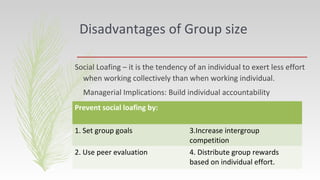
Disadvantages of Group size
Social Loafing – it is the tendency of an individual to exert less effort
when working collectively than when working individual.
Managerial Implications: Build individual accountability
Prevent social loafing by:
1. Set group goals 3.Increase intergroup
competition
2. Use peer evaluation 4. Distribute group rewards
based on individual effort.
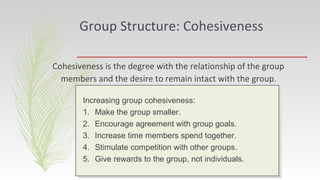
Group Structure: Cohesiveness
Cohesiveness is the degree with the relationship of the group
members and the desire to remain intact with the group.
Increasing group cohesiveness:
1. Make the group smaller.
2. Encourage agreement with group goals.
3. Increase time members spend together.
4. Stimulate competition with other groups.
5. Give rewards to the group, not individuals.
Increasing group cohesiveness:
1. Make the group smaller.
2. Encourage agreement with group goals.
3. Increase time members spend together.
4. Stimulate competition with other groups.
5. Give rewards to the group, not individuals.
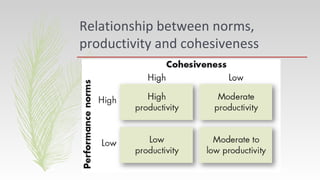
Relationship between norms,
productivity and cohesiveness
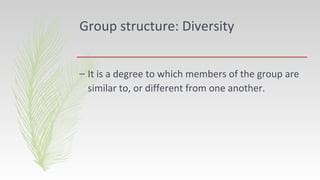
Group structure: Diversity
– It is a degree to which members of the group are
similar to, or different from one another.
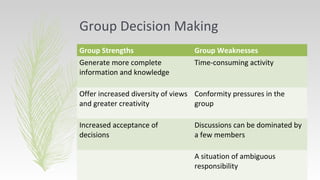
Group Decision Making
Group Strengths Group Weaknesses
Generate more complete
information and knowledge
Time-consuming activity
Offer increased diversity of views
and greater creativity
Conformity pressures in the
group
Increased acceptance of
decisions
Discussions can be dominated by
a few members
A situation of ambiguous
responsibility
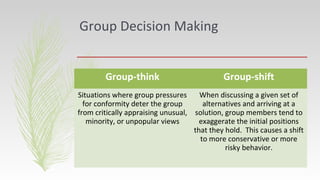
Group Decision Making
Group-think Group-shift
Situations where group pressures
for conformity deter the group
from critically appraising unusual,
minority, or unpopular views
When discussing a given set of
alternatives and arriving at a
solution, group members tend to
exaggerate the initial positions
that they hold. This causes a shift
to more conservative or more
risky behavior.
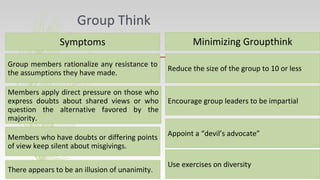
Group Think
Symptoms Minimizing Groupthink
Group members rationalize any resistance to
the assumptions they have made.
Reduce the size of the group to 10 or less
Members apply direct pressure on those who
express doubts about shared views or who
question the alternative favored by the
majority.
Encourage group leaders to be impartial
Members who have doubts or differing points
of view keep silent about misgivings.
Appoint a “devil’s advocate”
There appears to be an illusion of unanimity.
Use exercises on diversity
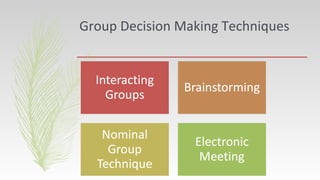
Group Decision Making Techniques
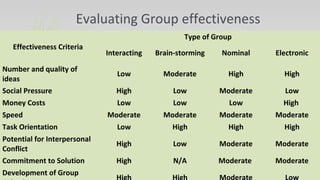
Evaluating Group effectiveness
Effectiveness Criteria
Type of Group
Interacting Brain-storming Nominal Electronic
Number and quality of
ideas
Low Moderate High High
Social Pressure High Low Moderate Low
Money Costs Low Low Low High
Speed Moderate Moderate Moderate Moderate
Task Orientation Low High High High
Potential for Interpersonal
Conflict
High Low Moderate Moderate
Commitment to Solution High N/A Moderate Moderate
Development of Group
High High Moderate Low
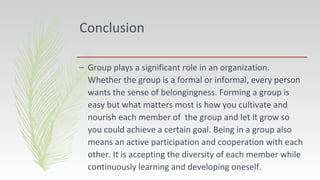
Conclusion
– Group plays a significant role in an organization.
Whether the group is a formal or informal, every person
wants the sense of belongingness. Forming a group is
easy but what matters most is how you cultivate and
nourish each member of the group and let it grow so
you could achieve a certain goal. Being in a group also
means an active participation and cooperation with each
other. It is accepting the diversity of each member while
continuously learning and developing oneself.

Group dynamics

  • 1.
  • 2.
    General Topics – GROUPDYNAMICS – GROUP – GROUP MAKING DECISION
  • 3.
    Subtopics A. Group – Classificationof Groups – Why people join groups? – Group development theories – Stages of group development – Group structure B. Group Making Decision – Strengths and weakness of group decision making – Groupthink and Groupshift – Decision Making Decision Techniques
  • 4.
    – Chand, S.(n.d.). http://www.yourarticlelibrary.com/. Retrieved April 29, 2016, from http://www.yourarticlelibrary.com/: http://www.yourarticlelibrary.com/management/4-techniques-for-group- decision-making-process-more-effective/3506/ – Forsyth, D. R. (2006). Group Dynamics. USA: Thomson Wadsworth. – Kirpal, N. (n.d.). https://us.experteer.com. Retrieved April 29, 2016, from https://us.experteer.com: https://us.experteer.com/magazine/impact-of- hawthorne-effect-on-productivity-at-work/ – Kirpal, N. (2014, October 20). https://us.experteer.com. Retrieved April 28, 2016, from https://us.experteer.com: https://us.experteer.com/magazine/impact-of-hawthorne-effect-on- productivity-at-work/ References
  • 5.
    References – Luthans, F.(2005). Organizational behavior. McGraw-Hill. – McMillan, A., & Barnett, T. (n.d.). http://www.referenceforbusiness.com/. Retrieved April 29, 2016, from http://www.referenceforbusiness.com/: http://www.referenceforbusiness.com/management/Gr-Int/Group- Dynamics.html – Rao, V. S. (2009). Organizational Behaviour. Excel Books. – Robert Kreitner, A. K. (2012). Organizational Behavior. McGraw-Hill Education. – Stephen P. Robbins, T. J. (2010). Organizational Behaviour. Pearson. – Stephen Robbins, T. A. (2013). Organisational Behaviour. Pearson Higher Education AU.
  • 6.
    Learning Outcomes After studyingthis chapter, students must be able to: – Define group and distinguish different types of groups. – Understand group development theories – Identify the 5 stages of development – Understand the 6 group properties that affects the organization – Define group decision making and identify its techniques – Compare and contrast the strengths and weaknesses of group making – Compare the effectiveness of interacting, brainstorming, nominal group technique and electronic.
  • 8.
    Definition of Group(s) C& Group Dynamics Group – Two or more individuals interacting interdependent, who have come together to accomplish a particular objective, tasks or projects. Group dynamics – It refers to the attitude or behavior of a group. Its primarily concern is about the types, characteristics, structure and process.
  • 9.
  • 10.
    Why people joingroup? – Security – Status – Self esteem – Affiliation – Power – Goal Achievement
  • 11.
    Group Development Theories –“Homans Theory of Group Formation” – groups are develop based on activities, interactions and sentiments. The major element in this theory is the interaction between individuals. – “Social exchange Theory” – groups are form based on the implicit expectation of mutually beneficial exchanges based on trust and felt obligation. – “Social identity theory” - this theory suggests that individuals get a sense of identity and self-esteem based upon their membership in salient groups.
  • 12.
    Group Development Theories –Bruce Tukman (1960) – provided the common framework on “how” group was made. – 5 Stages of Group Development
  • 13.
    Five stage modelof group model
  • 14.
    Group Structure – Roles –Norms – Status – Size – Cohesiveness – Diversity
  • 15.
    Group Structure: Roles Role(s) – A set of expected behavior patterns attributed to someone occupying a given position in a social unit. Classification of Roles – Work/task roles – Maintenance roles
  • 16.
    Group Structure: Roles RoleAmbiguity – Discrepancy between sent role and received role Role Conflict – A situation in which an individual is confronted by divergent role expectations.
  • 17.
    Group Structure: Norms Norms –Acceptable standards of behavior within a group that are shared by the group’s members. Classes of Norms: •Performance norms •Appearance norms •Social Arrangement norms •Allocation of resources norms
  • 18.
    Group Norms &The Hawthorne Studies – A series of studies undertaken by Elton Mayo at Western Electric Company’s Hawthorne Works in Chicago between 1924 and 1932. – Research Conclusions: – The aptitudes of individuals are imperfect predictors of job performance – Informal organization affects productivity – Work-group norms affect productivity – The workplace is a social system
  • 19.
    Group Properties: Norms ReferenceGroups – Important groups to which individuals belong or hope to belong and with whose norms individuals are likely to conform. Conformity – Adjusting one’s behavior to align with the norms of the group.
  • 20.
    Defying Norms: DeviantWorkplace Behavior Deviant Workplace Behavior – Also called antisocial behavior or workplace incivility – Voluntary behavior that violates significant organizational norms and, in doing so, threatens the well-being of the organization
  • 21.
    Defying Norms: DeviantWorkplace Behavior Typology: – Production – working speed – Property – damage and stealing – Political – favoritism and gossip – Personal Aggression – harassment (sexual or verbal)
  • 22.
    Group Structure: Status Statusis a socially defined position or rank given to a group or its group members by other people. Status characteristics theory sources: – Power over others – Ability to contribute – Personal characteristics
  • 23.
    Group Structure: Statuseffect On Norms and Conformity – High-status members are less restrained by norms and pressure to conform – Some level of deviance is allowed to high-status members so long as it doesn’t affect group goal achievement On Group Interaction – High-status members are more assertive – Large status differences limit diversity of ideas and creativity On Equity – If status is perceived to be inequitable, it will result in various forms of corrective behavior
  • 24.
    Group Structure: Size Groupsize has an impact with one’s behaviour. – Large group – Small group
  • 25.
    Disadvantages of Groupsize Social Loafing – it is the tendency of an individual to exert less effort when working collectively than when working individual. Managerial Implications: Build individual accountability Prevent social loafing by: 1. Set group goals 3.Increase intergroup competition 2. Use peer evaluation 4. Distribute group rewards based on individual effort.
  • 26.
    Group Structure: Cohesiveness Cohesivenessis the degree with the relationship of the group members and the desire to remain intact with the group. Increasing group cohesiveness: 1. Make the group smaller. 2. Encourage agreement with group goals. 3. Increase time members spend together. 4. Stimulate competition with other groups. 5. Give rewards to the group, not individuals. Increasing group cohesiveness: 1. Make the group smaller. 2. Encourage agreement with group goals. 3. Increase time members spend together. 4. Stimulate competition with other groups. 5. Give rewards to the group, not individuals.
  • 27.
  • 28.
    Group structure: Diversity –It is a degree to which members of the group are similar to, or different from one another.
  • 29.
    Group Decision Making GroupStrengths Group Weaknesses Generate more complete information and knowledge Time-consuming activity Offer increased diversity of views and greater creativity Conformity pressures in the group Increased acceptance of decisions Discussions can be dominated by a few members A situation of ambiguous responsibility
  • 30.
    Group Decision Making Group-thinkGroup-shift Situations where group pressures for conformity deter the group from critically appraising unusual, minority, or unpopular views When discussing a given set of alternatives and arriving at a solution, group members tend to exaggerate the initial positions that they hold. This causes a shift to more conservative or more risky behavior.
  • 31.
    Group Think Symptoms MinimizingGroupthink Group members rationalize any resistance to the assumptions they have made. Reduce the size of the group to 10 or less Members apply direct pressure on those who express doubts about shared views or who question the alternative favored by the majority. Encourage group leaders to be impartial Members who have doubts or differing points of view keep silent about misgivings. Appoint a “devil’s advocate” There appears to be an illusion of unanimity. Use exercises on diversity
  • 32.
  • 33.
    Evaluating Group effectiveness EffectivenessCriteria Type of Group Interacting Brain-storming Nominal Electronic Number and quality of ideas Low Moderate High High Social Pressure High Low Moderate Low Money Costs Low Low Low High Speed Moderate Moderate Moderate Moderate Task Orientation Low High High High Potential for Interpersonal Conflict High Low Moderate Moderate Commitment to Solution High N/A Moderate Moderate Development of Group High High Moderate Low
  • 34.
    Conclusion – Group playsa significant role in an organization. Whether the group is a formal or informal, every person wants the sense of belongingness. Forming a group is easy but what matters most is how you cultivate and nourish each member of the group and let it grow so you could achieve a certain goal. Being in a group also means an active participation and cooperation with each other. It is accepting the diversity of each member while continuously learning and developing oneself.

Editor's Notes

  • #10 Formal Group A designated work group defined by the organization’s structure. Informal Group A group that is neither formally structured nor organizationally determined; appears in response to the need for social contact. Command Group A group composed of the individuals who report directly to a given manager. Task Group Those working together to complete a job or task. A functional group is created by the organization to accomplish specific goals within an unspecified time frame.  Interest Group Those working together to attain a specific objective with which each is concerned. Friendship Group Those brought together because they share one or more common characteristics.
  • #18 Performance norms - level of acceptable work Appearance norms - what to wear Social arrangement norms - friendships and the like Allocation of resources norms - distribution and assignments of jobs and material
  • #33 Interacting Groups Typical groups, in which the members interact with each other face-to-face. Nominal Group Technique A group decision-making method in which individual members meet face-to-face to pool their judgments in a systematic but independent fashion. Brainstorming An idea-generation process that specifically encourages any and all alternatives, while withholding any criticism of those alternatives Electronic Meeting A meeting in which members interact on computers, allowing for anonymity of comments and aggregation of votes.