GROUP DYNAMICS
Dr.N.R.SARAVANAN
MBA, MBA, MA(Yoga), PGDHRM, M.PhIL, Ph.D.,
ASSOCIATE PROFESSOR & RESEARCH ADVISOR
Individuals constitute the group and several groups constitute the
organisation. A group is an important unit for sociological and
psychological analysis to understand organisational behaviour. It
affects the behaviour of its members, other roups, and the whole
organisation.
Definitions of Group
G C Homans: "A group is any number of people who share goals, often
communicate with each other over a period of time, and are few enough
so that each individual may communicate with all the others, person-to
person.
A group is collection of two or more people who have common objectives
or interests and interact with each other to accomplish their objectives,
are aware of each other and perceive themselves to be a part of a group.
Groups in Organisation
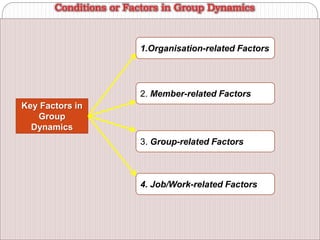
Conditions or Factors in Group Dynamics
Key Factors in
Group
Dynamics
1.Organisation-related Factors
4. Job/Work-related Factors
2. Member-related Factors
3. Group-related Factors
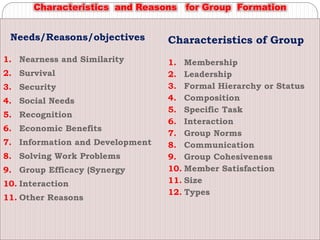
Needs/Reasons/objectives
1. Nearness and Similarity
2. Survival
3. Security
4. Social Needs
5. Recognition
6. Economic Benefits
7. Information and Development
8. Solving Work Problems
9. Group Efficacy (Synergy
10. Interaction
11. Other Reasons
Characteristics of Group
1. Membership
2. Leadership
3. Formal Hierarchy or Status
4. Composition
5. Specific Task
6. Interaction
7. Group Norms
8. Communication
9. Group Cohesiveness
10. Member Satisfaction
11. Size
12. Types
Characteristics and Reasons for Group Formation
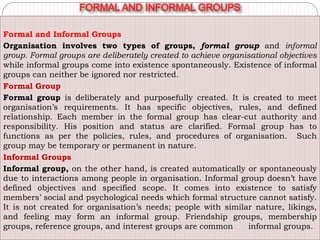
FORMAL AND INFORMAL GROUPS
6
Formal and Informal Groups
Organisation involves two types of groups, formal group and informal
group. Formal groups are deliberately created to achieve organisational objectives
while informal groups come into existence spontaneously. Existence of informal
groups can neither be ignored nor restricted.
Formal Group
Formal group is deliberately and purposefully created. It is created to meet
organisation’s requirements. It has specific objectives, rules, and defined
relationship. Each member in the formal group has clear-cut authority and
responsibility. His position and status are clarified. Formal group has to
functions as per the policies, rules, and procedures of organisation. Such
group may be temporary or permanent in nature.
Informal Groups
Informal group, on the other hand, is created automatically or spontaneously
due to interactions among people in organisation. Informal group doesn’t have
defined objectives and specified scope. It comes into existence to satisfy
members’ social and psychological needs which formal structure cannot satisfy.
It is not created for organisation’s needs; people with similar nature, likings,
and feeling may form an informal group. Friendship groups, membership
groups, reference groups, and interest groups are common informal groups.
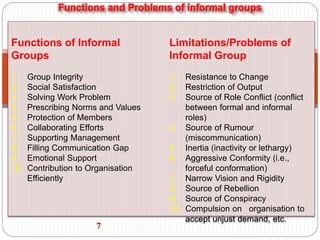
Functions and Problems of informal groups
7
Functions of Informal
Groups
1. Group Integrity
2. Social Satisfaction
3. Solving Work Problem
4. Prescribing Norms and Values
5. Protection of Members
6. Collaborating Efforts
7. Supporting Management
8. Filling Communication Gap
9. Emotional Support
10. Contribution to Organisation
Efficiently
Limitations/Problems of
Informal Group
1. Resistance to Change
2. Restriction of Output
3. Source of Role Conflict (conflict
between formal and informal
roles)
4. Source of Rumour
(miscommunication)
5. Inertia (inactivity or lethargy)
6. Aggressive Conformity (i.e.,
forceful conformation)
7. Narrow Vision and Rigidity
8. Source of Rebellion
9. Source of Conspiracy
10. Compulsion on organisation to
accept unjust demand, etc.
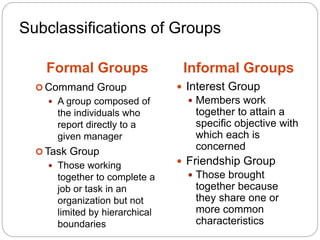
Subclassifications of Groups
Formal Groups Informal Groups
 Command Group
 A group composed of
the individuals who
report directly to a
given manager
 Task Group
 Those working
together to complete a
job or task in an
organization but not
limited by hierarchical
boundaries
 Interest Group
 Members work
together to attain a
specific objective with
which each is
concerned
 Friendship Group
 Those brought
together because
they share one or
more common
characteristics
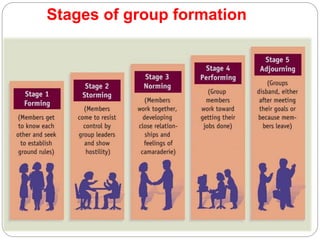
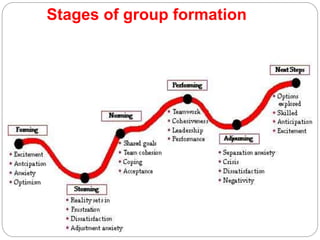
Stages of group formation
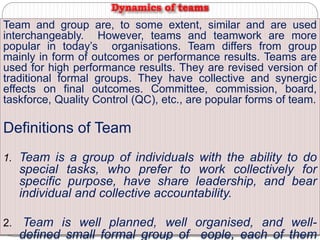
Team and group are, to some extent, similar and are used
interchangeably. However, teams and teamwork are more
popular in today’s organisations. Team differs from group
mainly in form of outcomes or performance results. Teams are
used for high performance results. They are revised version of
traditional formal groups. They have collective and synergic
effects on final outcomes. Committee, commission, board,
taskforce, Quality Control (QC), etc., are popular forms of team.
Definitions of Team
1. Team is a group of individuals with the ability to do
special tasks, who prefer to work collectively for
specific purpose, have share leadership, and bear
individual and collective accountability.
2. Team is well planned, well organised, and well-
defined small formal group of eople, each of them
Dynamics of teams
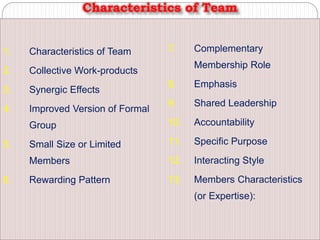
1. Characteristics of Team
2. Collective Work-products
3. Synergic Effects
4. Improved Version of Formal
Group
5. Small Size or Limited
Members
6. Rewarding Pattern
7. Complementary
Membership Role
8. Emphasis
9. Shared Leadership
10. Accountability
11. Specific Purpose
12. Interacting Style
13. Members Characteristics
(or Expertise):
Characteristics of Team
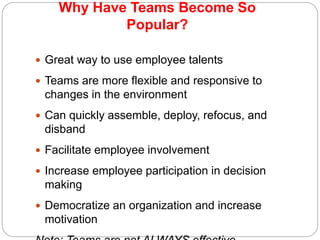
Why Have Teams Become So
Popular?
10-13
 Great way to use employee talents
 Teams are more flexible and responsive to
changes in the environment
 Can quickly assemble, deploy, refocus, and
disband
 Facilitate employee involvement
 Increase employee participation in decision
making
 Democratize an organization and increase
motivation
Differences between Groups and
Teams
10-14
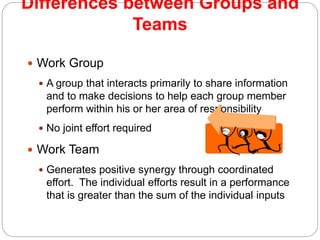
 Work Group
 A group that interacts primarily to share information
and to make decisions to help each group member
perform within his or her area of responsibility
 No joint effort required
 Work Team
 Generates positive synergy through coordinated
effort. The individual efforts result in a performance
that is greater than the sum of the individual inputs
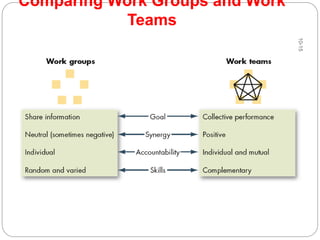
Comparing Work Groups and Work
Teams
10-15
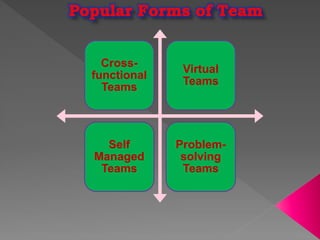
Cross-
functional
Teams
Virtual
Teams
Self
Managed
Teams
Problem-
solving
Teams
Types of Teams
10-17
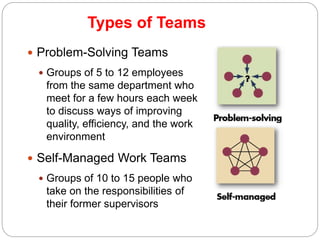
 Problem-Solving Teams
 Groups of 5 to 12 employees
from the same department who
meet for a few hours each week
to discuss ways of improving
quality, efficiency, and the work
environment
 Self-Managed Work Teams
 Groups of 10 to 15 people who
take on the responsibilities of
their former supervisors
Types of Teams (Continued)
10-18
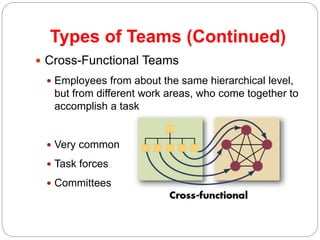
 Cross-Functional Teams
 Employees from about the same hierarchical level,
but from different work areas, who come together to
accomplish a task
 Very common
 Task forces
 Committees
Types of Teams (Continued)
10-19
Virtual Teams
 Teams that use computer technology to tie together
physically dispersed members in order to achieve a
common goal
 Characteristics
 Limited socializing
 The ability to overcome time and space constraints
 To be effective, needs:
 Trust among members
 Close monitoring
 To be publicized
Creating Effective Teams:
Context
10-20
 Adequate Resources
 Need the tools to complete the job
 Effective Leadership and Structure
 Agreeing to the specifics of work and how the team fits
together to integrate individual skills
 Even “self-managed” teams need leaders
 Leadership especially important in multi-team systems
 Climate of Trust
 Members must trust each other and the leader
 Performance and Rewards Systems that Reflect
Team Contributions
 Cannot just be based on individual effort
Creating Effective Teams:
Composition
10-21
 Abilities of Members
 Need technical expertise, problem-solving, decision-
making, and good interpersonal skills
 Personality of Members
 Conscientiousness, openness to experience, and
agreeableness all relate to team performance
 Allocating Roles and Diversity
 Many necessary roles must be filled
 Diversity can often lead to lower performance
 Size of Team
 The smaller the better: 5 to 9 is optimal
 Members’ Preference for Teamwork
 Do the members want to be on teams?

Group dynamics ppt notes

  • 1.
    GROUP DYNAMICS Dr.N.R.SARAVANAN MBA, MBA,MA(Yoga), PGDHRM, M.PhIL, Ph.D., ASSOCIATE PROFESSOR & RESEARCH ADVISOR
  • 2.
    Individuals constitute thegroup and several groups constitute the organisation. A group is an important unit for sociological and psychological analysis to understand organisational behaviour. It affects the behaviour of its members, other roups, and the whole organisation. Definitions of Group G C Homans: "A group is any number of people who share goals, often communicate with each other over a period of time, and are few enough so that each individual may communicate with all the others, person-to person. A group is collection of two or more people who have common objectives or interests and interact with each other to accomplish their objectives, are aware of each other and perceive themselves to be a part of a group. Groups in Organisation
  • 3.
    Conditions or Factorsin Group Dynamics Key Factors in Group Dynamics 1.Organisation-related Factors 4. Job/Work-related Factors 2. Member-related Factors 3. Group-related Factors
  • 4.
    Needs/Reasons/objectives 1. Nearness andSimilarity 2. Survival 3. Security 4. Social Needs 5. Recognition 6. Economic Benefits 7. Information and Development 8. Solving Work Problems 9. Group Efficacy (Synergy 10. Interaction 11. Other Reasons Characteristics of Group 1. Membership 2. Leadership 3. Formal Hierarchy or Status 4. Composition 5. Specific Task 6. Interaction 7. Group Norms 8. Communication 9. Group Cohesiveness 10. Member Satisfaction 11. Size 12. Types Characteristics and Reasons for Group Formation
  • 5.
    FORMAL AND INFORMALGROUPS 6 Formal and Informal Groups Organisation involves two types of groups, formal group and informal group. Formal groups are deliberately created to achieve organisational objectives while informal groups come into existence spontaneously. Existence of informal groups can neither be ignored nor restricted. Formal Group Formal group is deliberately and purposefully created. It is created to meet organisation’s requirements. It has specific objectives, rules, and defined relationship. Each member in the formal group has clear-cut authority and responsibility. His position and status are clarified. Formal group has to functions as per the policies, rules, and procedures of organisation. Such group may be temporary or permanent in nature. Informal Groups Informal group, on the other hand, is created automatically or spontaneously due to interactions among people in organisation. Informal group doesn’t have defined objectives and specified scope. It comes into existence to satisfy members’ social and psychological needs which formal structure cannot satisfy. It is not created for organisation’s needs; people with similar nature, likings, and feeling may form an informal group. Friendship groups, membership groups, reference groups, and interest groups are common informal groups.
  • 6.
    Functions and Problemsof informal groups 7 Functions of Informal Groups 1. Group Integrity 2. Social Satisfaction 3. Solving Work Problem 4. Prescribing Norms and Values 5. Protection of Members 6. Collaborating Efforts 7. Supporting Management 8. Filling Communication Gap 9. Emotional Support 10. Contribution to Organisation Efficiently Limitations/Problems of Informal Group 1. Resistance to Change 2. Restriction of Output 3. Source of Role Conflict (conflict between formal and informal roles) 4. Source of Rumour (miscommunication) 5. Inertia (inactivity or lethargy) 6. Aggressive Conformity (i.e., forceful conformation) 7. Narrow Vision and Rigidity 8. Source of Rebellion 9. Source of Conspiracy 10. Compulsion on organisation to accept unjust demand, etc.
  • 7.
    Subclassifications of Groups FormalGroups Informal Groups  Command Group  A group composed of the individuals who report directly to a given manager  Task Group  Those working together to complete a job or task in an organization but not limited by hierarchical boundaries  Interest Group  Members work together to attain a specific objective with which each is concerned  Friendship Group  Those brought together because they share one or more common characteristics
  • 8.
    Stages of groupformation
  • 9.
    Stages of groupformation
  • 10.
    Team and groupare, to some extent, similar and are used interchangeably. However, teams and teamwork are more popular in today’s organisations. Team differs from group mainly in form of outcomes or performance results. Teams are used for high performance results. They are revised version of traditional formal groups. They have collective and synergic effects on final outcomes. Committee, commission, board, taskforce, Quality Control (QC), etc., are popular forms of team. Definitions of Team 1. Team is a group of individuals with the ability to do special tasks, who prefer to work collectively for specific purpose, have share leadership, and bear individual and collective accountability. 2. Team is well planned, well organised, and well- defined small formal group of eople, each of them Dynamics of teams
  • 11.
    1. Characteristics ofTeam 2. Collective Work-products 3. Synergic Effects 4. Improved Version of Formal Group 5. Small Size or Limited Members 6. Rewarding Pattern 7. Complementary Membership Role 8. Emphasis 9. Shared Leadership 10. Accountability 11. Specific Purpose 12. Interacting Style 13. Members Characteristics (or Expertise): Characteristics of Team
  • 12.
    Why Have TeamsBecome So Popular? 10-13  Great way to use employee talents  Teams are more flexible and responsive to changes in the environment  Can quickly assemble, deploy, refocus, and disband  Facilitate employee involvement  Increase employee participation in decision making  Democratize an organization and increase motivation
  • 13.
    Differences between Groupsand Teams 10-14  Work Group  A group that interacts primarily to share information and to make decisions to help each group member perform within his or her area of responsibility  No joint effort required  Work Team  Generates positive synergy through coordinated effort. The individual efforts result in a performance that is greater than the sum of the individual inputs
  • 14.
    Comparing Work Groupsand Work Teams 10-15
  • 15.
  • 16.
    Types of Teams 10-17 Problem-Solving Teams  Groups of 5 to 12 employees from the same department who meet for a few hours each week to discuss ways of improving quality, efficiency, and the work environment  Self-Managed Work Teams  Groups of 10 to 15 people who take on the responsibilities of their former supervisors
  • 17.
    Types of Teams(Continued) 10-18  Cross-Functional Teams  Employees from about the same hierarchical level, but from different work areas, who come together to accomplish a task  Very common  Task forces  Committees
  • 18.
    Types of Teams(Continued) 10-19 Virtual Teams  Teams that use computer technology to tie together physically dispersed members in order to achieve a common goal  Characteristics  Limited socializing  The ability to overcome time and space constraints  To be effective, needs:  Trust among members  Close monitoring  To be publicized
  • 19.
    Creating Effective Teams: Context 10-20 Adequate Resources  Need the tools to complete the job  Effective Leadership and Structure  Agreeing to the specifics of work and how the team fits together to integrate individual skills  Even “self-managed” teams need leaders  Leadership especially important in multi-team systems  Climate of Trust  Members must trust each other and the leader  Performance and Rewards Systems that Reflect Team Contributions  Cannot just be based on individual effort
  • 20.
    Creating Effective Teams: Composition 10-21 Abilities of Members  Need technical expertise, problem-solving, decision- making, and good interpersonal skills  Personality of Members  Conscientiousness, openness to experience, and agreeableness all relate to team performance  Allocating Roles and Diversity  Many necessary roles must be filled  Diversity can often lead to lower performance  Size of Team  The smaller the better: 5 to 9 is optimal  Members’ Preference for Teamwork  Do the members want to be on teams?

Editor's Notes

  • #9 Within the category of formal groups there are two main types. The command group is one that reports directly to a given manager such as a department or unit. A task group is formed to accomplish a particular objective but is not limited by the structure or departments of the organization. Informal groups also have subgroups. They are typically formed around a common interest such as an interest group or around common characteristics such as a friendship group.
  • #14 Over the last decade we have seen the use of teams grow exponentially in organizations. There are a number of reasons why this is true. Teams can enhance the use of employee talents and tend to be more flexible and responsive to change. Teams can help to keep employees engaged in their work and increase their participation in decision making, thus increasing their motivation. However, teams are not always effective and so it is important to take a look at how to deploy teams effectively.
  • #15 Groups and teams are not the same thing. A group is primarily there to share information and make decisions, no real joint effort is required. A team works in a more coordinated effort to achieve a goal.
  • #16 Work groups and work teams differ in their goals, level of synergy, accountability, and skills. Their function is different. Work groups share information where work teams work together for a collective performance. The synergy in groups is neutral where work teams have a positive synergy. Accountability can be individual in both but it is more often mutual in teams. The skills in a group will be varied where the skills on a team need to be complementary.
  • #18 There are a number of different types of teams. Problem-solving teams are a very popular method used in many organizations. Typically this type of team meets for a few hours each week to solve a particular problem. Self-managed work teams are comprised of a group of people who do not have a manager and the group takes on the responsibilities of the supervisor.
  • #19 Cross-functional teams gather workers from many different work areas to come together to accomplish a task that needs to utilize multiple perspectives.
  • #20 Virtual teams are increasing in their use. This type of team uses computer technology to bring people together to achieve a common goal. Typically these types of teams get right to work with little socializing, but need to overcome time and space constraints to accomplish the task. In order to be effective, virtual teams need to find ways to establish trust among the members, have close monitoring, and results need to be publicized.
  • #21 Understanding the context is important for teams to be effective. The team needs the right resources to do the job well. They also need effective leadership and structure to facilitate a process that will help the team succeed. It is important that teams fit together so they can successfully utilize the individual skills present in the group. Trust is also an important aspect of teams and essential for group cohesiveness as we have seen previously. Finally, the reward system needs to be equitable and based on team contributions.
  • #22 A manager must pay close attention to how they put a team together to assure group cohesiveness and effectiveness. Each member should be selected based on the type of skills and abilities needed to accomplish the task at hand. However, abilities are not the only characteristic that managers need to pay attention to; personality is also important so that the team can bond and form trust. In addition, the manager must be sure he assigns the right people to fill the roles needed, but still maintain adequate diversity so that idea generation still occurs. The manager must also pay attention to the size of the team and that the members want to be on the team and enjoy teamwork.