By: Tanoj patidar
Curt Lewin, a social psychologist at the university of Iowa, USA, was
the creator of the term group dynamics. Group dynamics is the study of
groups and also a general term for group process. Relevant to the fields of
psychology, sociology and communication studies, a group is consider as
two or more individuals connected to each other by social relationship.
Group dynamics deals with the attitude and behavioural patterns of a
group. Group dynamics concern how groups are formed ; what is their
structure and which processes are followed in their functioning. Thus, it is
concerned with the interaction and forces operating between groups.
In group dynamics the phrase group process refers to an insight into
the behaviour of group members and to incline their behaviours towards
the achievement of group goals. On the basis of interaction between group
members, each group holds a characteristics feature that sets it apart from
the rest . The interaction is influenced by norms, roles, relations, need to
belong social influence and effects on behaviour.
A social group is a given aggregate of people, playing
inter-related roles and recognized by themselves or others as a
unit of interaction.
by-Williams
Group dynamics is the study of activities or processes that are
responsible for various group phenomena.
I. Each group has its own identity and structure.
II. A group includes at least two or more people.
III. Group member have a shared purpose and goal.
IV. Group member have a conscious identification with each other.
V. Group members need each other’s help to accomplish the purpose
for which they have organized.
VI. Group members influence, interact and accomplish with each
other.
VII. Every group has its own rules and norms members are supposed
to follow.
According to Dwight Sanderson :
 Involuntary group
 Voluntary group
 Delegate group
Charles Cooley classified :
 Primary group
 Secondary group
According to George Hasen :
 Unsocial group
 Pseudo social group
 Antisocial group
 Prosocial group
According to the Way of Formality :
 Formal group
 Informal group
According to the size :
 Small group
 Large group
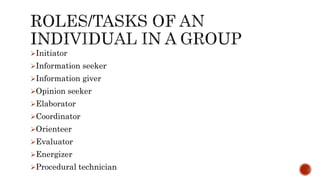
Initiator
Information seeker
Information giver
Opinion seeker
Elaborator
Coordinator
Orienteer
Evaluator
Energizer
Procedural technician
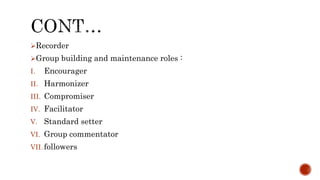
Recorder
Group building and maintenance roles :
I. Encourager
II. Harmonizer
III. Compromiser
IV. Facilitator
V. Standard setter
VI. Group commentator
VII. followers
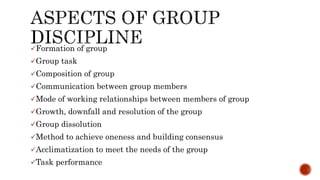
Formation of group
Group task
Composition of group
Communication between group members
Mode of working relationships between members of group
Growth, downfall and resolution of the group
Group dissolution
Method to achieve oneness and building consensus
Acclimatization to meet the needs of the group
Task performance
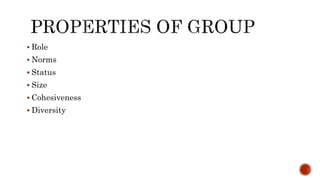
 Role
 Norms
 Status
 Size
 Cohesiveness
 Diversity
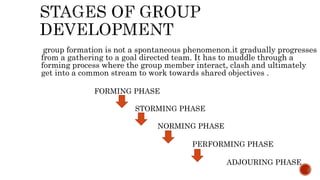
group formation is not a spontaneous phenomenon.it gradually progresses
from a gathering to a goal directed team. It has to muddle through a
forming process where the group member interact, clash and ultimately
get into a common stream to work towards shared objectives .
FORMING PHASE
STORMING PHASE
NORMING PHASE
PERFORMING PHASE
ADJOURING PHASE
 Individuals participating in a group must have clear understanding of
individuals goals as well as group objectives so that their interaction is goal
oriented.
 People participating in a group must have clear idea about expectations
within a group.
 Group member must have clear understanding of their responsibilities and
should be committed towards their designated responsibilities.
 Member in a group must follow the principle of positive competence; so that
assigned task can be carried out more competently and efficiently.
 Appropriate control over the functioning of group member must be
maintained for cohesiveness and smooth functioning in a group.
 The success of a group primarily depends on the collaboration of the
functions of its members. group member must carry out their
functions with a collaborative approach.
 Effective communication is essential for efficient group functioning
 Coordination between individual tasks is essential in achieving
efficient group functioning
 Heterogeneity in processes.
 Diversity of views
 Increased acceptance of a solution
 More productive
 More resources
 More reliable
 Learn things from individual
 New methods and ideas
 Information exchange
 Team commitment
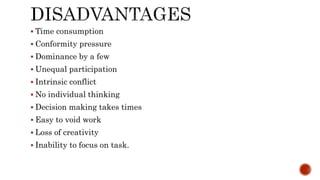
 Time consumption
 Conformity pressure
 Dominance by a few
 Unequal participation
 Intrinsic conflict
 No individual thinking
 Decision making takes times
 Easy to void work
 Loss of creativity
 Inability to focus on task.

Group dynamics

  • 1.
  • 2.
    Curt Lewin, asocial psychologist at the university of Iowa, USA, was the creator of the term group dynamics. Group dynamics is the study of groups and also a general term for group process. Relevant to the fields of psychology, sociology and communication studies, a group is consider as two or more individuals connected to each other by social relationship. Group dynamics deals with the attitude and behavioural patterns of a group. Group dynamics concern how groups are formed ; what is their structure and which processes are followed in their functioning. Thus, it is concerned with the interaction and forces operating between groups. In group dynamics the phrase group process refers to an insight into the behaviour of group members and to incline their behaviours towards the achievement of group goals. On the basis of interaction between group members, each group holds a characteristics feature that sets it apart from the rest . The interaction is influenced by norms, roles, relations, need to belong social influence and effects on behaviour.
  • 3.
    A social groupis a given aggregate of people, playing inter-related roles and recognized by themselves or others as a unit of interaction. by-Williams
  • 4.
    Group dynamics isthe study of activities or processes that are responsible for various group phenomena.
  • 5.
    I. Each grouphas its own identity and structure. II. A group includes at least two or more people. III. Group member have a shared purpose and goal. IV. Group member have a conscious identification with each other. V. Group members need each other’s help to accomplish the purpose for which they have organized. VI. Group members influence, interact and accomplish with each other. VII. Every group has its own rules and norms members are supposed to follow.
  • 6.
    According to DwightSanderson :  Involuntary group  Voluntary group  Delegate group Charles Cooley classified :  Primary group  Secondary group According to George Hasen :  Unsocial group  Pseudo social group
  • 7.
     Antisocial group Prosocial group According to the Way of Formality :  Formal group  Informal group According to the size :  Small group  Large group
  • 8.
    Initiator Information seeker Information giver Opinionseeker Elaborator Coordinator Orienteer Evaluator Energizer Procedural technician
  • 9.
    Recorder Group building andmaintenance roles : I. Encourager II. Harmonizer III. Compromiser IV. Facilitator V. Standard setter VI. Group commentator VII. followers
  • 10.
    Formation of group Grouptask Composition of group Communication between group members Mode of working relationships between members of group Growth, downfall and resolution of the group Group dissolution Method to achieve oneness and building consensus Acclimatization to meet the needs of the group Task performance
  • 11.
     Role  Norms Status  Size  Cohesiveness  Diversity
  • 12.
    group formation isnot a spontaneous phenomenon.it gradually progresses from a gathering to a goal directed team. It has to muddle through a forming process where the group member interact, clash and ultimately get into a common stream to work towards shared objectives . FORMING PHASE STORMING PHASE NORMING PHASE PERFORMING PHASE ADJOURING PHASE
  • 13.
     Individuals participatingin a group must have clear understanding of individuals goals as well as group objectives so that their interaction is goal oriented.  People participating in a group must have clear idea about expectations within a group.  Group member must have clear understanding of their responsibilities and should be committed towards their designated responsibilities.  Member in a group must follow the principle of positive competence; so that assigned task can be carried out more competently and efficiently.  Appropriate control over the functioning of group member must be maintained for cohesiveness and smooth functioning in a group.
  • 14.
     The successof a group primarily depends on the collaboration of the functions of its members. group member must carry out their functions with a collaborative approach.  Effective communication is essential for efficient group functioning  Coordination between individual tasks is essential in achieving efficient group functioning
  • 15.
     Heterogeneity inprocesses.  Diversity of views  Increased acceptance of a solution  More productive  More resources  More reliable  Learn things from individual  New methods and ideas  Information exchange  Team commitment
  • 16.
     Time consumption Conformity pressure  Dominance by a few  Unequal participation  Intrinsic conflict  No individual thinking  Decision making takes times  Easy to void work  Loss of creativity  Inability to focus on task.