The ADDIE and
ASSURE Models:
Their Application to Virtual Education
Group 4 Members: Mary Canales, Martha Rodriguez, Christopher
Smallwood, and Juando Morales


                                                               1
Introduction
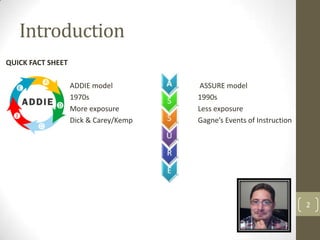
QUICK FACT SHEET

                   ADDIE model          ASSURE model
                   1970s               1990s
                   More exposure       Less exposure
                   Dick & Carey/Kemp   Gagne’s Events of Instruction


                                                                       2
Introduction
      Mary Canales – Overview of Models


      Martha Rodriguez – Comparison of Models


      Christopher Smallwood – Implementation of Models


      Juando Morales – Hybrid Model

                                                         3
Overview of ADDIE & ASSURE Models
The ADDIE model is a well-known design model and the best practice model
to use when designing or developing programs. It’s an instructional design
model that provides a step-by-step process and helps training specialists plan
and create training programs.

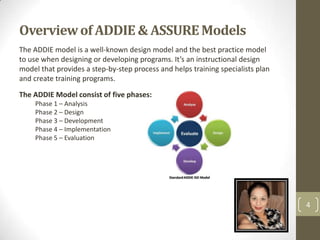
The ADDIE Model consist of five phases:
    Phase 1 – Analysis
    Phase 2 – Design
    Phase 3 – Development
    Phase 4 – Implementation
    Phase 5 – Evaluation


                                                                                 4
Overview of ADDIE & ASSURE Models
The ASSURE model is an ISD (Instructional Systems Design) model that is being
used all around the world to help educators with their classroom instruction.

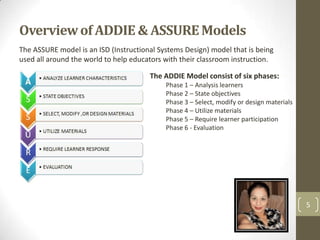
                                       The ADDIE Model consist of six phases:
                                            Phase 1 – Analysis learners
                                            Phase 2 – State objectives
                                            Phase 3 – Select, modify or design materials
                                            Phase 4 – Utilize materials
                                            Phase 5 – Require learner participation
                                            Phase 6 - Evaluation


                                                                                           5
Comparison of ADDIE & ASSURE Models

Selected Characteristics            ADDIE                    ASSURE
Typical Output                 Maybe used in           Classroom oriented
                                classrooms                (traditionally)
Team or Individual          Team and Individual        Team and Individual
Amount of Analysis                   High                     High
Technological              Utilizes effective use of   Utilizes technology,
Complexity                          media              media and materials
Amount of revision                   High                     High


                                                                              6
Conclusion: Implementation
Addressing ADDIE Model Implementation Issues
  • Develop rollout timetable for the course
  • Schedule courses and enrollment of learners
  • Setup online course platform.
  • Notify learner.
  • Inform learners the technological requirements required to be
    successful.
  • Reevaluated process to ensure smooth and effective transition.

  NOTE: The learning environment must be well organized and expectations
  must be clearly defined.


                                                                           7
Conclusion: Implementation
Addressing ASSURE Model Implementation Issues
   • Kidd (2010) - peer evaluation is an important part of the
     implementation process.
   • Culatta (2011) – the need for reflective evaluation in online education.

Integration of peer evaluation and reflective evaluation will enhance the
   virtual environment by:
    • Reducing distance between the learner and course material; and
    • Reducing the distance between learner and peers


                                                                                8
Conclusion: Implementation
Integration of both the ADDIE and ASSURE Models
Implementation of the ADDIE and ASSURE models requires minor
modifications:
   • Integration of instructional strategies that foster increased socialization
       and reduce virtual distance
       •   Student to teacher
       •   Student to peers
       •   Student to course materials
       •   Student to technological interface
    • Integration of instructional strategies that reduce
       •   Unnecessary stress for the student
       •   Extra work for the teacher
       •   Decreased instructional time
       •   Dissatisfaction with online education
                                                                                   9
Conclusion: Hybrid Model


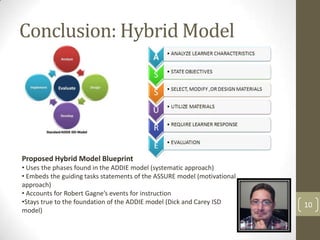
Proposed Hybrid Model Blueprint
• Uses the phases found in the ADDIE model (systematic approach)
• Embeds the guiding tasks statements of the ASSURE model (motivational
approach)
• Accounts for Robert Gagne’s events for instruction
•Stays true to the foundation of the ADDIE model (Dick and Carey ISD      10
model)
Conclusion: Hybrid Model
             Phase (ADDIE)                              Tasks (ASSURE)
Analysis                                   • Analyze Learners
Design & Development                       • State Objectives
                                           • Select Methods, Media and Materials
                                           • Utilize Media and Materials
Implementation                             • Require Learner Participation
Evaluation                                 • Evaluate and Revise


Proposed Hybrid Model Blueprint
• Uses the phases found in the ADDIE model (systematic approach)
• Embeds the guiding tasks statements of the ASSURE model (motivational
approach)
• Accounts for Robert Gagne’s events for instruction
•Stays true to the foundation of the ADDIE model (Dick and Carey ISD               11
model)
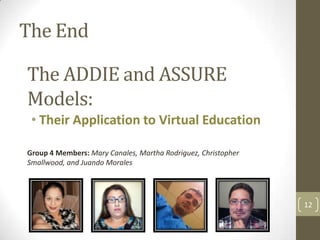
The End

The ADDIE and ASSURE
Models:
 • Their Application to Virtual Education

Group 4 Members: Mary Canales, Martha Rodriguez, Christopher
Smallwood, and Juando Morales


                                                               12

Group 4 collaborative project the addie and assure models multimedia

  • 1.
    The ADDIE and ASSUREModels: Their Application to Virtual Education Group 4 Members: Mary Canales, Martha Rodriguez, Christopher Smallwood, and Juando Morales 1
  • 2.
    Introduction QUICK FACT SHEET ADDIE model ASSURE model 1970s 1990s More exposure Less exposure Dick & Carey/Kemp Gagne’s Events of Instruction 2
  • 3.
    Introduction Mary Canales – Overview of Models Martha Rodriguez – Comparison of Models Christopher Smallwood – Implementation of Models Juando Morales – Hybrid Model 3
  • 4.
    Overview of ADDIE& ASSURE Models The ADDIE model is a well-known design model and the best practice model to use when designing or developing programs. It’s an instructional design model that provides a step-by-step process and helps training specialists plan and create training programs. The ADDIE Model consist of five phases: Phase 1 – Analysis Phase 2 – Design Phase 3 – Development Phase 4 – Implementation Phase 5 – Evaluation 4
  • 5.
    Overview of ADDIE& ASSURE Models The ASSURE model is an ISD (Instructional Systems Design) model that is being used all around the world to help educators with their classroom instruction. The ADDIE Model consist of six phases: Phase 1 – Analysis learners Phase 2 – State objectives Phase 3 – Select, modify or design materials Phase 4 – Utilize materials Phase 5 – Require learner participation Phase 6 - Evaluation 5
  • 6.
    Comparison of ADDIE& ASSURE Models Selected Characteristics ADDIE ASSURE Typical Output Maybe used in Classroom oriented classrooms (traditionally) Team or Individual Team and Individual Team and Individual Amount of Analysis High High Technological Utilizes effective use of Utilizes technology, Complexity media media and materials Amount of revision High High 6
  • 7.
    Conclusion: Implementation Addressing ADDIEModel Implementation Issues • Develop rollout timetable for the course • Schedule courses and enrollment of learners • Setup online course platform. • Notify learner. • Inform learners the technological requirements required to be successful. • Reevaluated process to ensure smooth and effective transition. NOTE: The learning environment must be well organized and expectations must be clearly defined. 7
  • 8.
    Conclusion: Implementation Addressing ASSUREModel Implementation Issues • Kidd (2010) - peer evaluation is an important part of the implementation process. • Culatta (2011) – the need for reflective evaluation in online education. Integration of peer evaluation and reflective evaluation will enhance the virtual environment by: • Reducing distance between the learner and course material; and • Reducing the distance between learner and peers 8
  • 9.
    Conclusion: Implementation Integration ofboth the ADDIE and ASSURE Models Implementation of the ADDIE and ASSURE models requires minor modifications: • Integration of instructional strategies that foster increased socialization and reduce virtual distance • Student to teacher • Student to peers • Student to course materials • Student to technological interface • Integration of instructional strategies that reduce • Unnecessary stress for the student • Extra work for the teacher • Decreased instructional time • Dissatisfaction with online education 9
  • 10.
    Conclusion: Hybrid Model ProposedHybrid Model Blueprint • Uses the phases found in the ADDIE model (systematic approach) • Embeds the guiding tasks statements of the ASSURE model (motivational approach) • Accounts for Robert Gagne’s events for instruction •Stays true to the foundation of the ADDIE model (Dick and Carey ISD 10 model)
  • 11.
    Conclusion: Hybrid Model Phase (ADDIE) Tasks (ASSURE) Analysis • Analyze Learners Design & Development • State Objectives • Select Methods, Media and Materials • Utilize Media and Materials Implementation • Require Learner Participation Evaluation • Evaluate and Revise Proposed Hybrid Model Blueprint • Uses the phases found in the ADDIE model (systematic approach) • Embeds the guiding tasks statements of the ASSURE model (motivational approach) • Accounts for Robert Gagne’s events for instruction •Stays true to the foundation of the ADDIE model (Dick and Carey ISD 11 model)
  • 12.
    The End The ADDIEand ASSURE Models: • Their Application to Virtual Education Group 4 Members: Mary Canales, Martha Rodriguez, Christopher Smallwood, and Juando Morales 12