Study Tour UK
10 October 2014
Ale.Armellini@northampton.ac.uk
@alejandroa
www.northampton.ac.uk/ilt
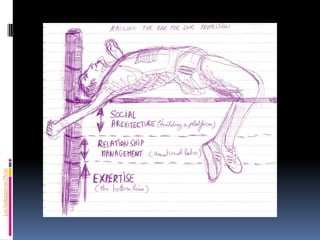
ImagebyLucGaloppinonFlickr
Aims
 To outline Northampton’s directions and
priorities in learning and teaching
 To spark new ideas and stimulate discussion on
the items on your agenda!
Image by Bluekdesign on Flickr
Your focus
 Why do students fail?
 Examples of innovative practices in curriculum
structures & formats, assessment methods &
policy, promotion of student success
 Successful examples of online and blended
learning
 Standards & QE vs lecturers’ workload
 Validation
 Change management strategies for curriculum
change or renewal
Bars we have been raising
 Delivering excellence and innovation in 21st Century
learning, teaching and assessment.
 Enabling transformational learning experiences through
inspirational teaching.
 Embracing and fostering inclusive open practices.
 Exceeding the needs and expectations of all students,
regardless of mode of study.
 Staff CPD and recognition for innovation and positive
change
… and many more
A possible USP
Enabling ___________ learning experiences
for __________ and lasting social change, through
___________, research-informed teaching
_____________ the expectations
of all students in every mode of study.
A possible USP
Enabling transformational learning
experiences for positive and lasting social
change, through inspirational, research-
informed teaching exceeding the
expectations of all students in every mode
of study.
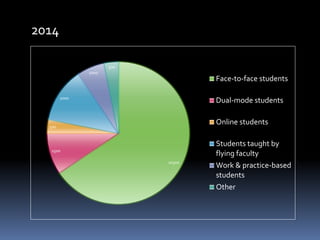
10500
1500
500
2000
1000
500
Face-to-face students
Dual-mode students
Online students
Students taught by
flying faculty
Work & practice-based
students
Other
2014
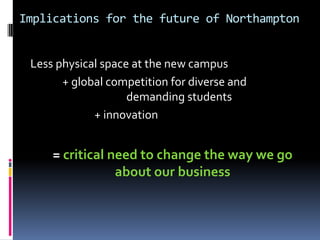
Implications for the future of Northampton
Less physical space at the new campus
+ global competition for diverse and
demanding students
+ innovation
= critical need to change the way we go
about our business
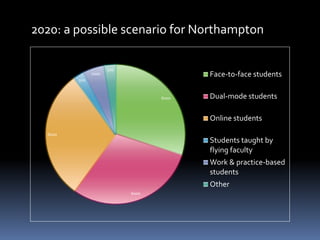
2020: a possible scenario for Northampton
6000
6000
6000
500
1000
500
Face-to-face students
Dual-mode students
Online students
Students taught by
flying faculty
Work & practice-based
students
Other
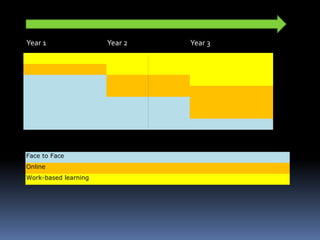
Year 1 Year 2 Year 3
Face to Face
Online
Work-based learning
Year 1 Year 2 Year 3
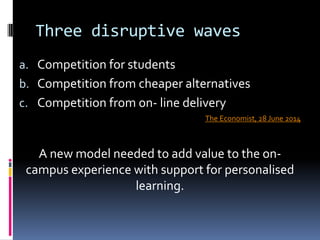
Three disruptive waves
a. Competition for students
b. Competition from cheaper alternatives
c. Competition from on- line delivery
The Economist, 28 June 2014
A new model needed to add value to the on-
campus experience with support for personalised
learning.
Need
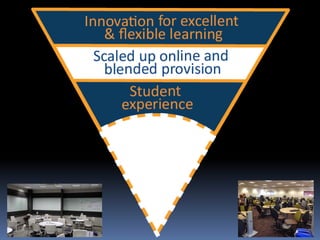
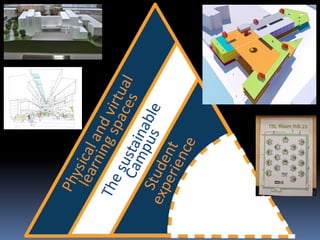
To maximise the affordances of the learning
spaces of the new campus (physical and virtual),
to provide exciting, innovative, sustainable and
effective experiences for 21st Century learners
Principles
 Transformational learning experiences
through inspirational teaching
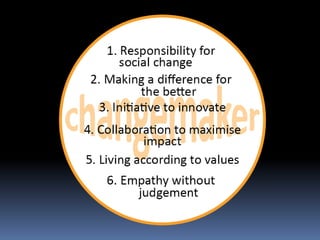
 The six Changemaker values
 Low cost, high value for our students and
colleagues
 Knowledge and learning and open, mobile,
connected and scalable
 Modes of study overlap:
‘blended’ = ‘campus & mobile’
UTS’s experience
Learning 2014
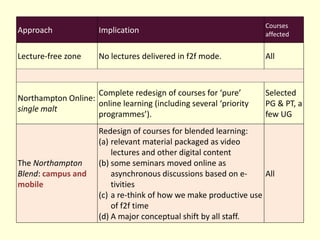
Approach Implication
Courses
affected
Lecture-free zone No lectures delivered in f2f mode. All
Northampton Online:
single malt
Complete redesign of courses for ‘pure’
online learning (including several ‘priority
programmes’).
Selected
PG & PT, a
few UG
The Northampton
Blend: campus and
mobile
Redesign of courses for blended learning:
(a) relevant material packaged as video
lectures and other digital content
(b) some seminars moved online as
asynchronous discussions based on e-
tivities
(c) a re-think of how we make productive use
of f2f time
(d) A major conceptual shift by all staff.
All
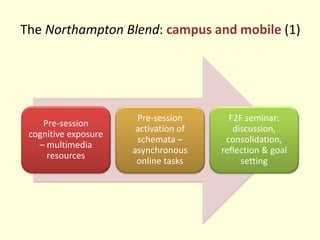
The Northampton Blend: campus and mobile (1)
Pre-session
cognitive exposure
– multimedia
resources
Pre-session
activation of
schemata –
asynchronous
online tasks
F2F seminar:
discussion,
consolidation,
reflection & goal
setting
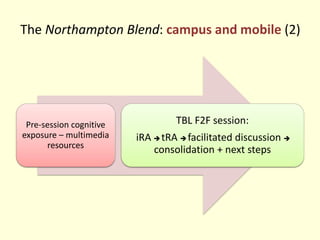
Pre-session cognitive
exposure – multimedia
resources
TBL F2F session:
iRA  tRA  facilitated discussion 
consolidation + next steps
The Northampton Blend: campus and mobile (2)
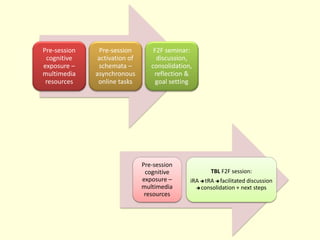
Pre-session
cognitive
exposure –
multimedia
resources
Pre-session
activation of
schemata –
asynchronous
online tasks
F2F seminar:
discussion,
consolidation,
reflection &
goal setting
Pre-session
cognitive
exposure –
multimedia
resources
TBL F2F session:
iRA tRA facilitated discussion
consolidation + next steps
@alejandroa 25
CAIeRO = Carpe Diem @ Northampton
Creating Aligned Interactive educational
Resource Opportunities
NILE (our LMS)
CLEO (another workshop)
…
@alejandroa 26
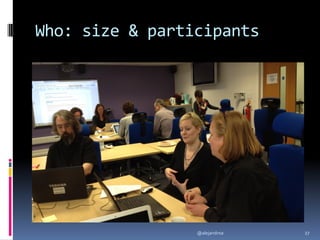
Who: size & participants
@alejandroa 27
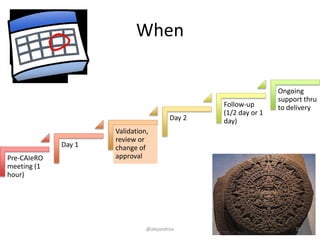
When
Pre-CAIeRO
meeting (1
hour)
Day 1
Validation,
review or
change of
approval
Day 2
Follow-up
(1/2 day or 1
day)
Ongoing
support thru
to delivery
@alejandroa 28
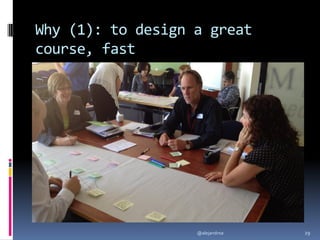
Why (1): to design a great
course, fast
@alejandroa 29
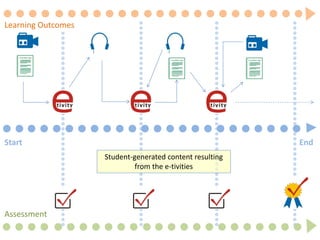
Start End
Assessment
Learning Outcomes
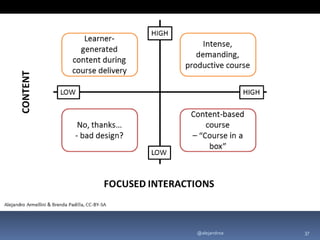
Student-generated content resulting
from the e-tivities
31
@alejandroa 32
33
@alejandroa 34
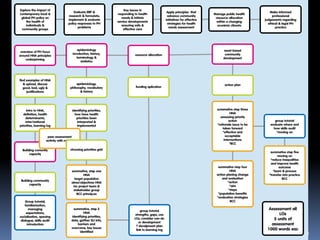
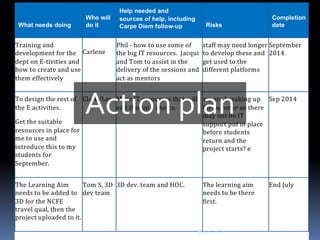
Action plan
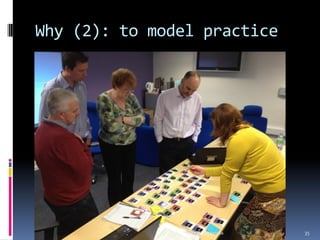
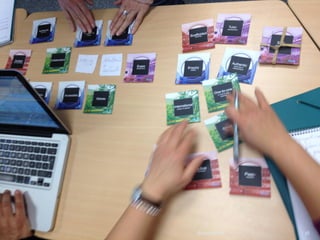
Why (2): to model practice
@alejandroa 35
@alejandroa 36
@alejandroa 37
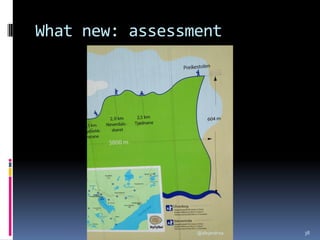
What new: assessment
@alejandroa 38
How scaled up (2): mass
CAIeROs?
@alejandroa 39
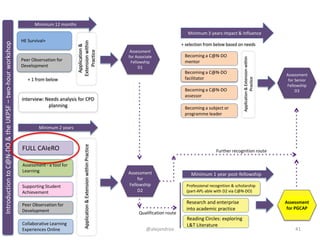
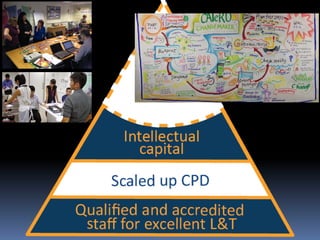
How rolled out: a CPD framework for
staff
Changemaking @ Northampton –
Development Opportunities
C@N-DO: a framework for enabling positive
change
@alejandroa 40
IntroductiontoC@N-DO&theUKPSF–two-hourworkshop
Minimum 12 months
Assessment
for Associate
Fellowship
D1
Minimum 2 years
Assessment
for
Fellowship
D2
FULL CAIeRO
Collaborative Learning
Experiences Online
Assessment - a tool for
Learning
Supporting Student
Achievement
Peer Observation for
Development
Reading Circles: exploring
L&T Literature
HE Survival+
Peer Observation for
Development
+ 1 from below Application&
Extensionwithin
Practice
Application&ExtensionwithinPractice
Assessment
for PGCAP
Minimum 1 year post-fellowship
Professional recognition & scholarship
(part-APL-able with D2 via C@N-DO)
Research and enterprise
into academic practice
Minimum 3 years Impact & Influence
Assessment
for Senior
Fellowship
D3
+ selection from below based on needs
Becoming a C@N-DO
mentor
Becoming a C@N-DO
assessor
Becoming a C@N-DO
facilitator
Application&Extensionwithin
Practice
Interview: Needs analysis for CPD
planning
Further recognition route
Qualification route
Becoming a subject or
programme leader
@alejandroa 41
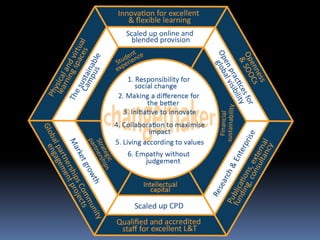
Delivering our USP
Image by Photosteve101 on Flickr
THANK YOU
ProfessorAlejandro Armellini
Director, Institute of Learning andTeaching in Higher Education
www.northampton.ac.uk/ilt
Ale.Armellini@northampton.ac.uk
@alejandroa
10 October, 2014
ImagebyTopgoldonFlickr

Dutch visit oct 2014

  • 1.
    Study Tour UK 10October 2014 Ale.Armellini@northampton.ac.uk @alejandroa www.northampton.ac.uk/ilt
  • 2.
  • 3.
    Aims  To outlineNorthampton’s directions and priorities in learning and teaching  To spark new ideas and stimulate discussion on the items on your agenda! Image by Bluekdesign on Flickr
  • 4.
    Your focus  Whydo students fail?  Examples of innovative practices in curriculum structures & formats, assessment methods & policy, promotion of student success  Successful examples of online and blended learning  Standards & QE vs lecturers’ workload  Validation  Change management strategies for curriculum change or renewal
  • 5.
    Bars we havebeen raising  Delivering excellence and innovation in 21st Century learning, teaching and assessment.  Enabling transformational learning experiences through inspirational teaching.  Embracing and fostering inclusive open practices.  Exceeding the needs and expectations of all students, regardless of mode of study.  Staff CPD and recognition for innovation and positive change … and many more
  • 6.
    A possible USP Enabling___________ learning experiences for __________ and lasting social change, through ___________, research-informed teaching _____________ the expectations of all students in every mode of study.
  • 7.
    A possible USP Enablingtransformational learning experiences for positive and lasting social change, through inspirational, research- informed teaching exceeding the expectations of all students in every mode of study.
  • 8.
    10500 1500 500 2000 1000 500 Face-to-face students Dual-mode students Onlinestudents Students taught by flying faculty Work & practice-based students Other 2014
  • 9.
    Implications for thefuture of Northampton Less physical space at the new campus + global competition for diverse and demanding students + innovation = critical need to change the way we go about our business
  • 10.
    2020: a possiblescenario for Northampton 6000 6000 6000 500 1000 500 Face-to-face students Dual-mode students Online students Students taught by flying faculty Work & practice-based students Other
  • 11.
    Year 1 Year2 Year 3 Face to Face Online Work-based learning Year 1 Year 2 Year 3
  • 12.
    Three disruptive waves a.Competition for students b. Competition from cheaper alternatives c. Competition from on- line delivery The Economist, 28 June 2014 A new model needed to add value to the on- campus experience with support for personalised learning.
  • 13.
    Need To maximise theaffordances of the learning spaces of the new campus (physical and virtual), to provide exciting, innovative, sustainable and effective experiences for 21st Century learners
  • 14.
    Principles  Transformational learningexperiences through inspirational teaching  The six Changemaker values  Low cost, high value for our students and colleagues  Knowledge and learning and open, mobile, connected and scalable  Modes of study overlap: ‘blended’ = ‘campus & mobile’
  • 15.
  • 16.
    Approach Implication Courses affected Lecture-free zoneNo lectures delivered in f2f mode. All Northampton Online: single malt Complete redesign of courses for ‘pure’ online learning (including several ‘priority programmes’). Selected PG & PT, a few UG The Northampton Blend: campus and mobile Redesign of courses for blended learning: (a) relevant material packaged as video lectures and other digital content (b) some seminars moved online as asynchronous discussions based on e- tivities (c) a re-think of how we make productive use of f2f time (d) A major conceptual shift by all staff. All
  • 17.
    The Northampton Blend:campus and mobile (1) Pre-session cognitive exposure – multimedia resources Pre-session activation of schemata – asynchronous online tasks F2F seminar: discussion, consolidation, reflection & goal setting
  • 18.
    Pre-session cognitive exposure –multimedia resources TBL F2F session: iRA  tRA  facilitated discussion  consolidation + next steps The Northampton Blend: campus and mobile (2)
  • 19.
    Pre-session cognitive exposure – multimedia resources Pre-session activation of schemata– asynchronous online tasks F2F seminar: discussion, consolidation, reflection & goal setting Pre-session cognitive exposure – multimedia resources TBL F2F session: iRA tRA facilitated discussion consolidation + next steps
  • 25.
  • 26.
    CAIeRO = CarpeDiem @ Northampton Creating Aligned Interactive educational Resource Opportunities NILE (our LMS) CLEO (another workshop) … @alejandroa 26
  • 27.
    Who: size &participants @alejandroa 27
  • 28.
    When Pre-CAIeRO meeting (1 hour) Day 1 Validation, reviewor change of approval Day 2 Follow-up (1/2 day or 1 day) Ongoing support thru to delivery @alejandroa 28
  • 29.
    Why (1): todesign a great course, fast @alejandroa 29
  • 30.
    Start End Assessment Learning Outcomes Student-generatedcontent resulting from the e-tivities
  • 31.
  • 32.
  • 33.
  • 34.
  • 35.
    Why (2): tomodel practice @alejandroa 35
  • 36.
  • 37.
  • 38.
  • 39.
    How scaled up(2): mass CAIeROs? @alejandroa 39
  • 40.
    How rolled out:a CPD framework for staff Changemaking @ Northampton – Development Opportunities C@N-DO: a framework for enabling positive change @alejandroa 40
  • 41.
    IntroductiontoC@N-DO&theUKPSF–two-hourworkshop Minimum 12 months Assessment forAssociate Fellowship D1 Minimum 2 years Assessment for Fellowship D2 FULL CAIeRO Collaborative Learning Experiences Online Assessment - a tool for Learning Supporting Student Achievement Peer Observation for Development Reading Circles: exploring L&T Literature HE Survival+ Peer Observation for Development + 1 from below Application& Extensionwithin Practice Application&ExtensionwithinPractice Assessment for PGCAP Minimum 1 year post-fellowship Professional recognition & scholarship (part-APL-able with D2 via C@N-DO) Research and enterprise into academic practice Minimum 3 years Impact & Influence Assessment for Senior Fellowship D3 + selection from below based on needs Becoming a C@N-DO mentor Becoming a C@N-DO assessor Becoming a C@N-DO facilitator Application&Extensionwithin Practice Interview: Needs analysis for CPD planning Further recognition route Qualification route Becoming a subject or programme leader @alejandroa 41
  • 42.
    Delivering our USP Imageby Photosteve101 on Flickr
  • 51.
    THANK YOU ProfessorAlejandro Armellini Director,Institute of Learning andTeaching in Higher Education www.northampton.ac.uk/ilt Ale.Armellini@northampton.ac.uk @alejandroa 10 October, 2014 ImagebyTopgoldonFlickr