ADDIE + DICK AND CAREY
MODEL
Jasmine Morley
HRD 647
Dr. Larson
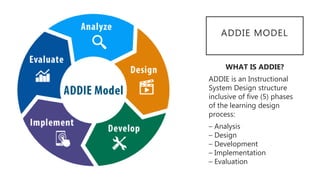
ADDIE MODEL
WHAT IS ADDIE?
ADDIE is an Instructional
System Design structure
inclusive of five (5) phases
of the learning design
process:
– Analysis
– Design
– Development
– Implementation
– Evaluation
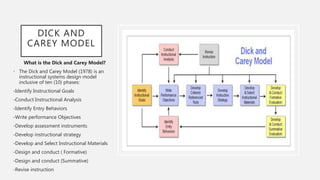
DICK AND
CAREY MODEL
What is the Dick and Carey Model?
• The Dick and Carey Model (1978) is an
instructional systems design model
inclusive of ten (10) phases:
-Identify Instructional Goals
-Conduct Instructional Analysis
-Identify Entry Behaviors
-Write performance Objectives
-Develop assessment instruments
-Develop instructional strategy
-Develop and Select Instructional Materials
-Design and conduct ( Formative)
-Design and conduct (Summative)
-Revise instruction
MODEL
SIMILARITIES
• Both consist of phases (steps)
targeted towards gathering
information.
• Both recognize the importance of
establishing goals that are to be
achieved in the learning process.
• Both recognize the need to
determine what the learner already
knows.
• Both models focus on input, output
and the process of designing.
• Both models recognize the
importance of evaluation.
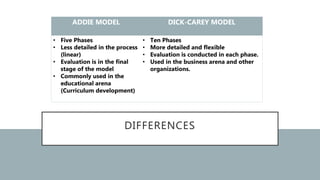
DIFFERENCES
ADDIE MODEL DICK-CAREY MODEL
• Five Phases
• Less detailed in the process
(linear)
• Evaluation is in the final
stage of the model
• Commonly used in the
educational arena
(Curriculum development)
• Ten Phases
• More detailed and flexible
• Evaluation is conducted in each phase.
• Used in the business arena and other
organizations.
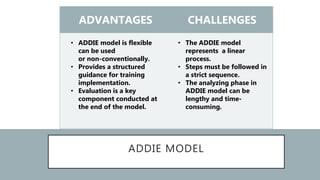
ADDIE MODEL
ADVANTAGES CHALLENGES
• ADDIE model is flexible
can be used
or non-conventionally.
• Provides a structured
guidance for training
implementation.
• Evaluation is a key
component conducted at
the end of the model.
• The ADDIE model
represents a linear
process.
• Steps must be followed in
a strict sequence.
• The analyzing phase in
ADDIE model can be
lengthy and time-
consuming.
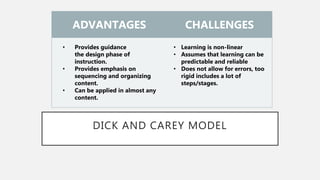
DICK AND CAREY MODEL
ADVANTAGES CHALLENGES
• Provides guidance
the design phase of
instruction.
• Provides emphasis on
sequencing and organizing
content.
• Can be applied in almost any
content.
• Learning is non-linear
• Assumes that learning can be
predictable and reliable
• Does not allow for errors, too
rigid includes a lot of
steps/stages.
REFERENCES
• Educational Technology. (2018). ADDIE model:
Instructional design. Retrieved from
https://educationaltechnology.net/the-addie-model-
instructional-design/
• Kurt, S. (2018, December 16). ADDIE Model: Instructional
Design. Retrieved from
https://educationaltechnology.net/the-addie-model-
instructional-design/
• Kurt, S. (2016, December 12). Dick and Carey Instructional
Model. Retrieved from
https://educationaltechnology.net/dick-and-carey-
instructional-model/

ADDIE Model + Dick and Carey Model

  • 1.
    ADDIE + DICKAND CAREY MODEL Jasmine Morley HRD 647 Dr. Larson
  • 2.
    ADDIE MODEL WHAT ISADDIE? ADDIE is an Instructional System Design structure inclusive of five (5) phases of the learning design process: – Analysis – Design – Development – Implementation – Evaluation
  • 3.
    DICK AND CAREY MODEL Whatis the Dick and Carey Model? • The Dick and Carey Model (1978) is an instructional systems design model inclusive of ten (10) phases: -Identify Instructional Goals -Conduct Instructional Analysis -Identify Entry Behaviors -Write performance Objectives -Develop assessment instruments -Develop instructional strategy -Develop and Select Instructional Materials -Design and conduct ( Formative) -Design and conduct (Summative) -Revise instruction
  • 4.
    MODEL SIMILARITIES • Both consistof phases (steps) targeted towards gathering information. • Both recognize the importance of establishing goals that are to be achieved in the learning process. • Both recognize the need to determine what the learner already knows. • Both models focus on input, output and the process of designing. • Both models recognize the importance of evaluation.
  • 5.
    DIFFERENCES ADDIE MODEL DICK-CAREYMODEL • Five Phases • Less detailed in the process (linear) • Evaluation is in the final stage of the model • Commonly used in the educational arena (Curriculum development) • Ten Phases • More detailed and flexible • Evaluation is conducted in each phase. • Used in the business arena and other organizations.
  • 6.
    ADDIE MODEL ADVANTAGES CHALLENGES •ADDIE model is flexible can be used or non-conventionally. • Provides a structured guidance for training implementation. • Evaluation is a key component conducted at the end of the model. • The ADDIE model represents a linear process. • Steps must be followed in a strict sequence. • The analyzing phase in ADDIE model can be lengthy and time- consuming.
  • 7.
    DICK AND CAREYMODEL ADVANTAGES CHALLENGES • Provides guidance the design phase of instruction. • Provides emphasis on sequencing and organizing content. • Can be applied in almost any content. • Learning is non-linear • Assumes that learning can be predictable and reliable • Does not allow for errors, too rigid includes a lot of steps/stages.
  • 8.
    REFERENCES • Educational Technology.(2018). ADDIE model: Instructional design. Retrieved from https://educationaltechnology.net/the-addie-model- instructional-design/ • Kurt, S. (2018, December 16). ADDIE Model: Instructional Design. Retrieved from https://educationaltechnology.net/the-addie-model- instructional-design/ • Kurt, S. (2016, December 12). Dick and Carey Instructional Model. Retrieved from https://educationaltechnology.net/dick-and-carey- instructional-model/