PRODUCTION ANALYSIS
Production


An entrepreneur must put together
resources -- land, labour, capital -- and
produce a product people will be
willing and able to purchase
Theory of Production and
Costs
Focus- mainly on the the firm.
 We will examine


◦ Its production capacity given available
resources
◦ the related costs involved
What is a firm?
A firm is an entity concerned with the
purchase and employment of resources in
the production of various goods and
services.
 Assumptions:


◦ the firm aims to maximize its profit with the use of
resources that are substitutable to a certain
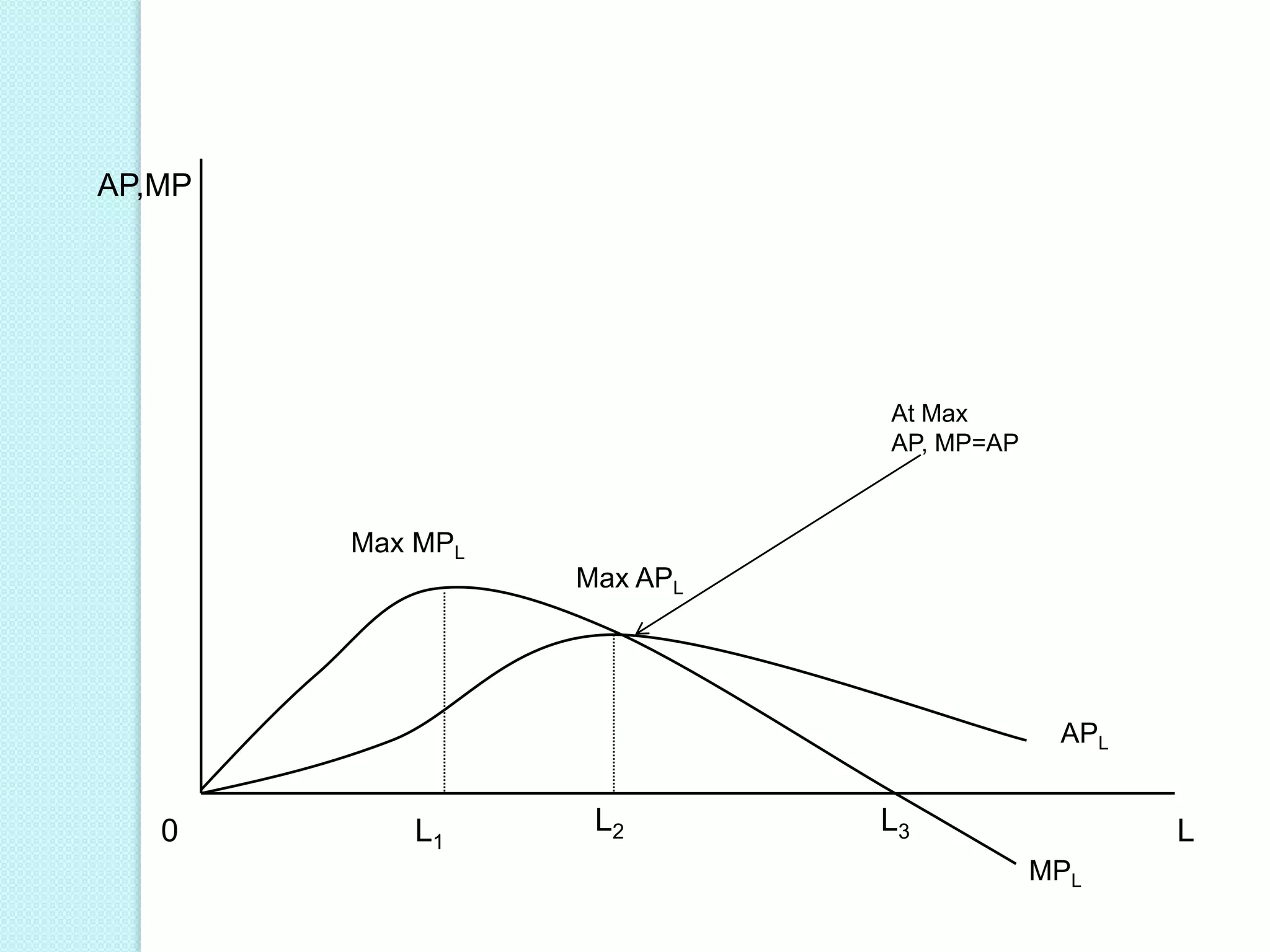
degree
◦ the firm is" a price taker in terms of the resources
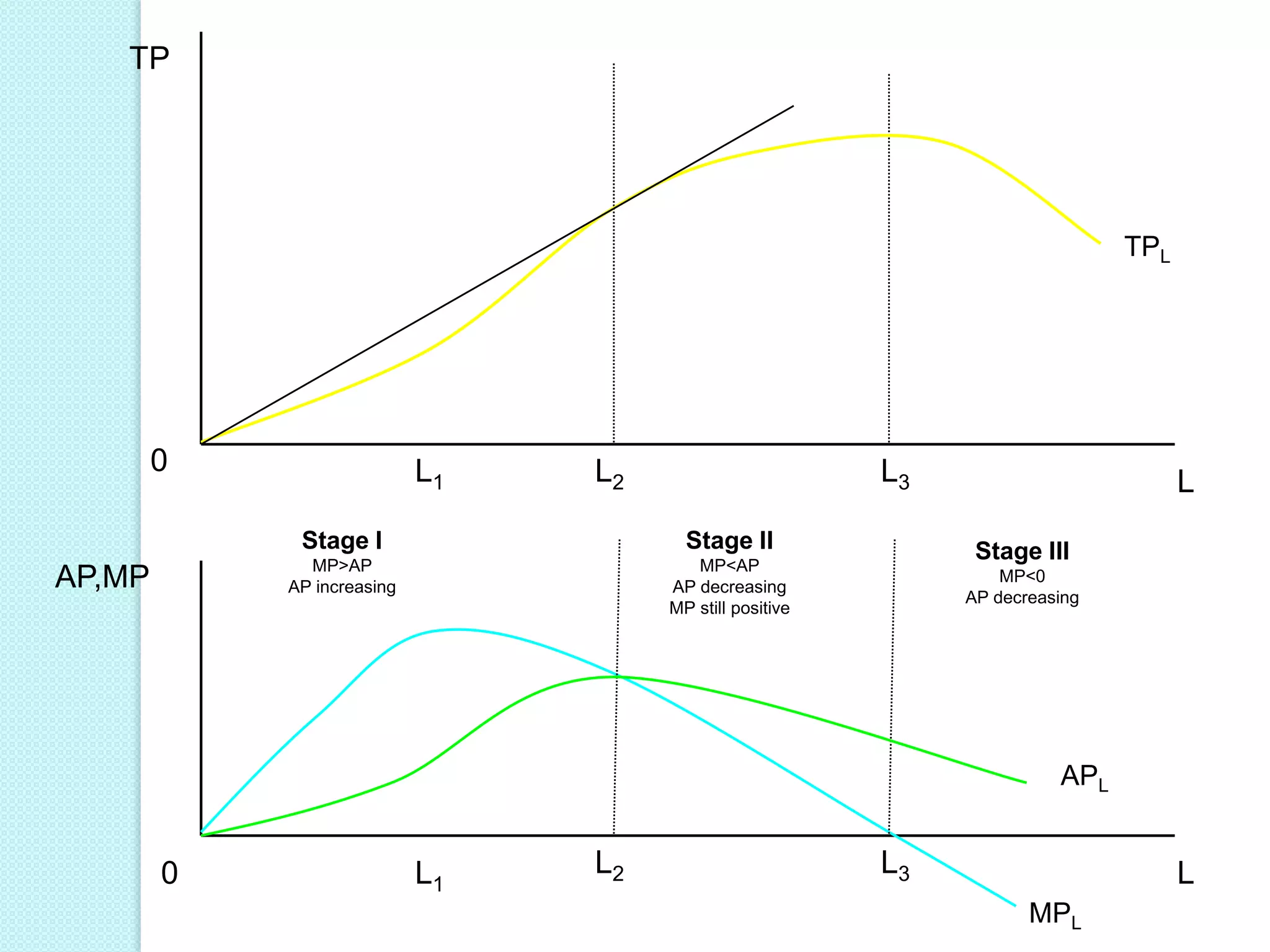
it uses.
What Is Production Function


Production function deals with the
maximum output that can be produced
with a limited and given quantity of
inputs.



The production function is dependent
on different time frames. Firms can
produce for a brief or lengthy period of
time.
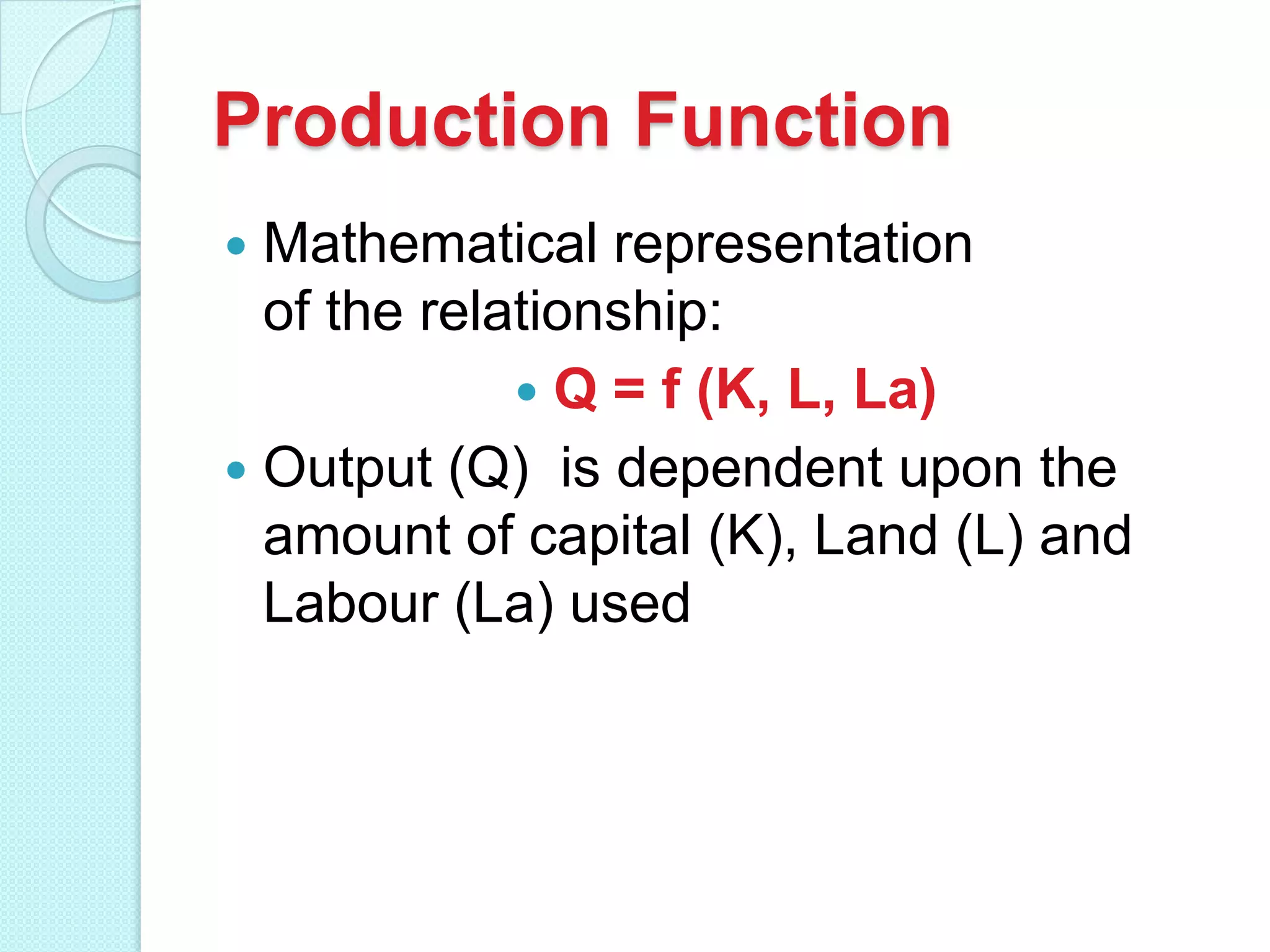
Production Function
Mathematical representation
of the relationship:
 Q = f (K, L, La)
 Output (Q) is dependent upon the
amount of capital (K), Land (L) and
Labour (La) used

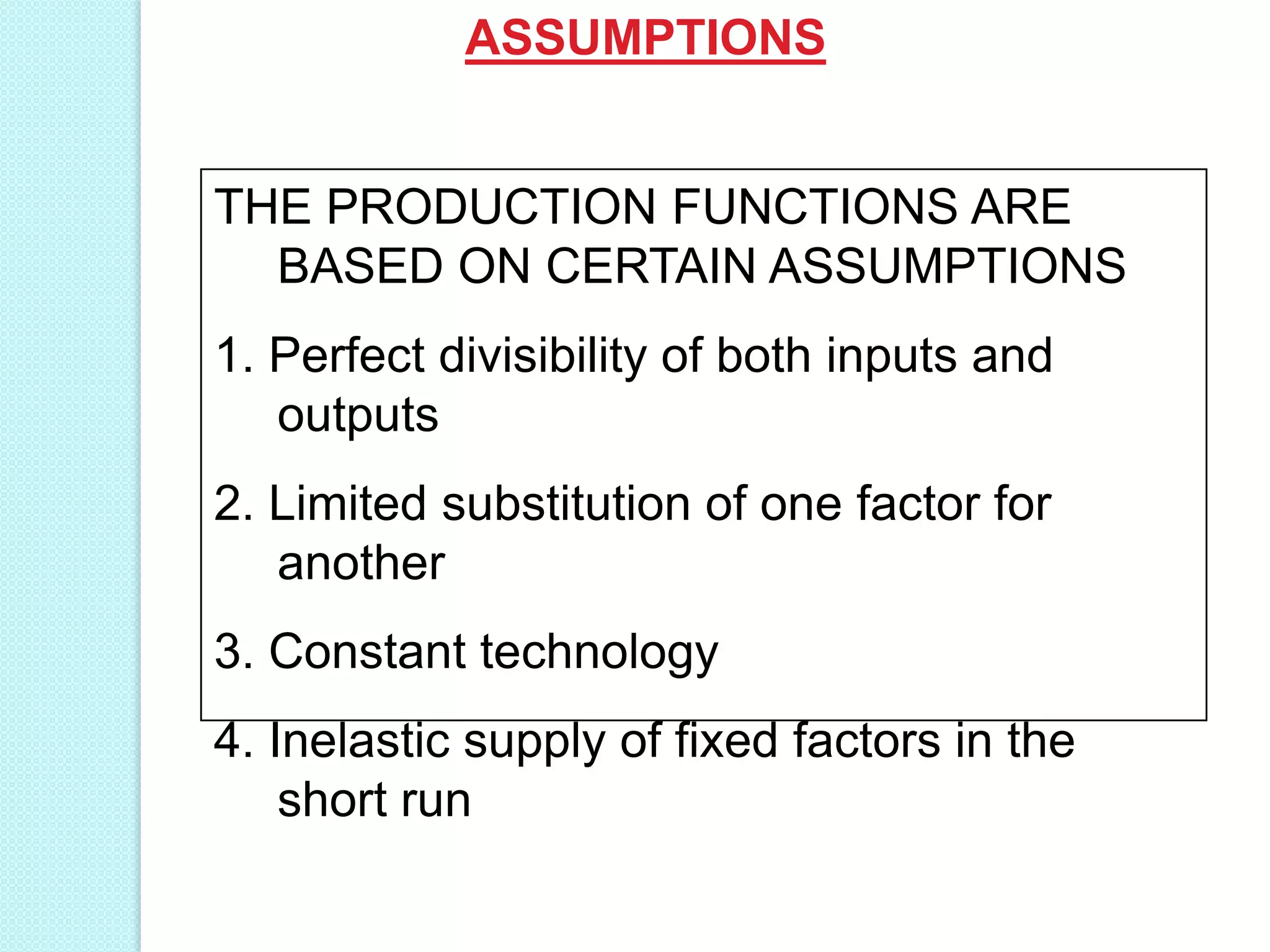
ASSUMPTIONS

THE PRODUCTION FUNCTIONS ARE
BASED ON CERTAIN ASSUMPTIONS

1. Perfect divisibility of both inputs and
outputs
2. Limited substitution of one factor for
another
3. Constant technology
4. Inelastic supply of fixed factors in the
short run
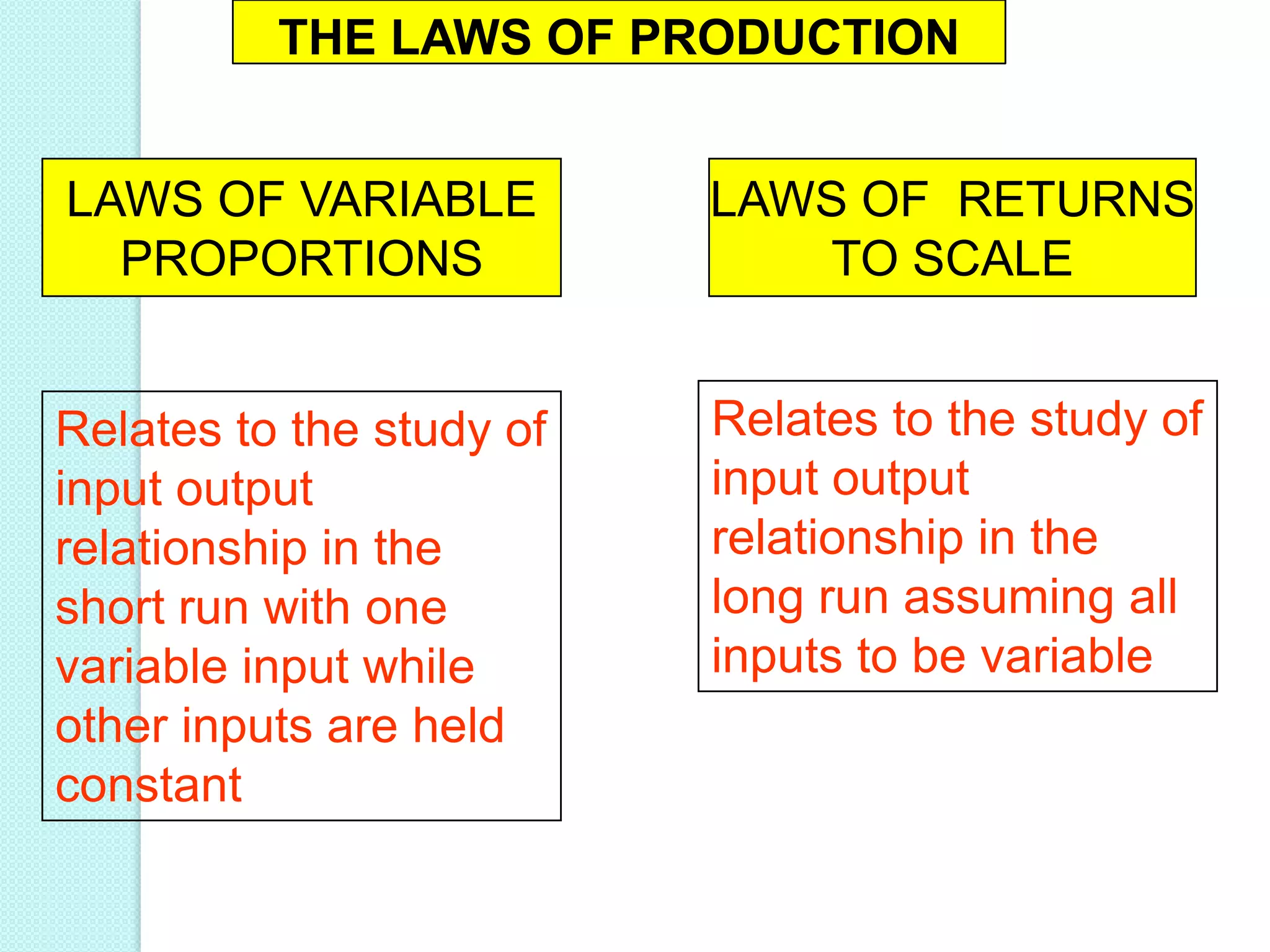
THE LAWS OF PRODUCTION
LAWS OF VARIABLE
PROPORTIONS

LAWS OF RETURNS
TO SCALE

Relates to the study of
input output
relationship in the
short run with one
variable input while
other inputs are held
constant

Relates to the study of
input output
relationship in the
long run assuming all
inputs to be variable
Firm’s Inputs


Inputs - are resources that contribute
in the production of a commodity.



Most resources are lumped into three
categories:
◦ Land,
◦ Labor,
◦ Capital.
Fixed vs. Variable Inputs
Fixed inputs -resources used at a constant
amount in the production of a commodity.
 Variable inputs - resources that can change
in quantity depending on the level of output
being produced.
 The longer planning the period, the
distinction between fixed and variable
inputs disappears, i.e., all inputs are
variable in the long run.

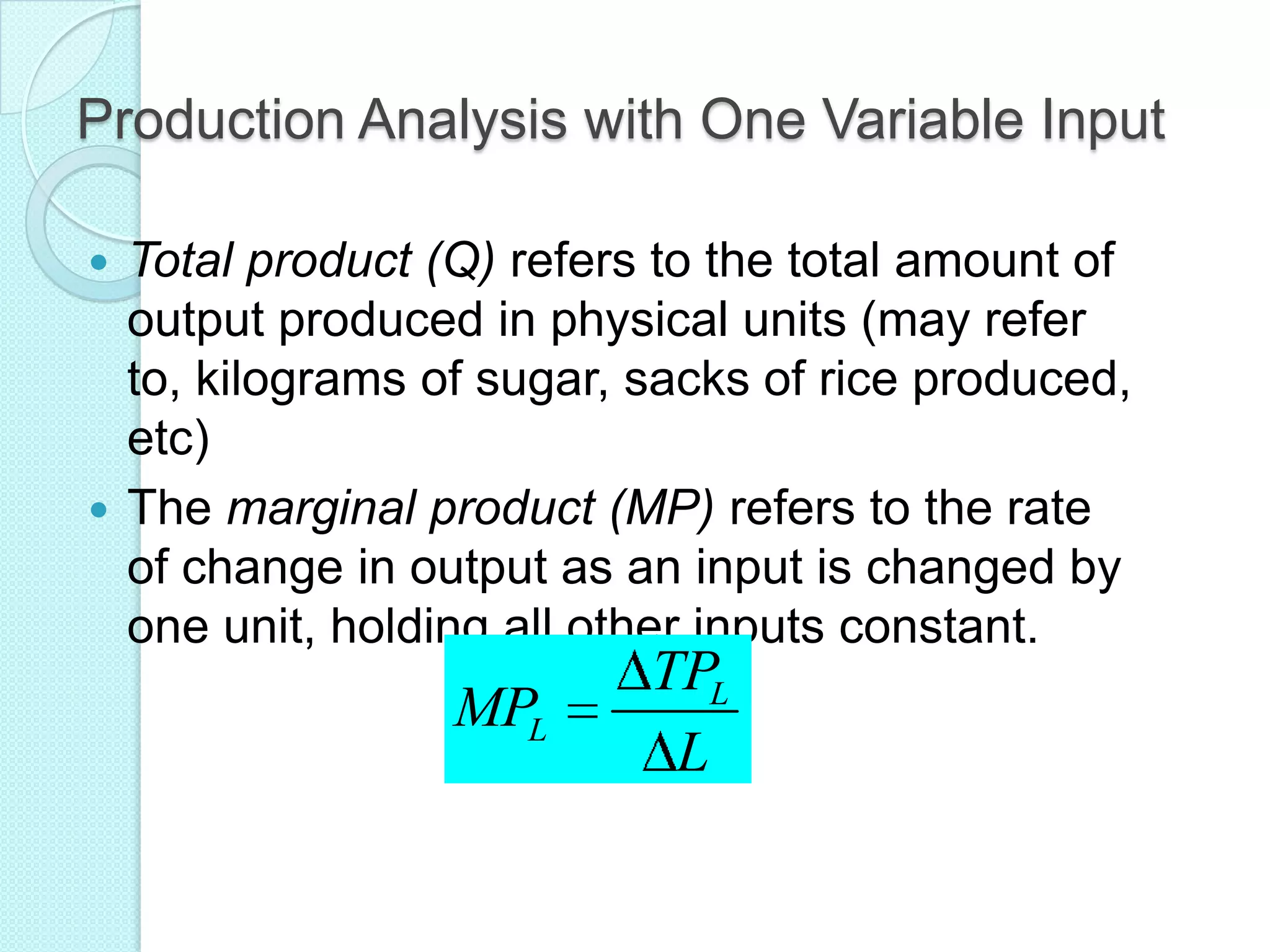
Production Analysis with One Variable Input
Total product (Q) refers to the total amount of
output produced in physical units (may refer
to, kilograms of sugar, sacks of rice produced,
etc)
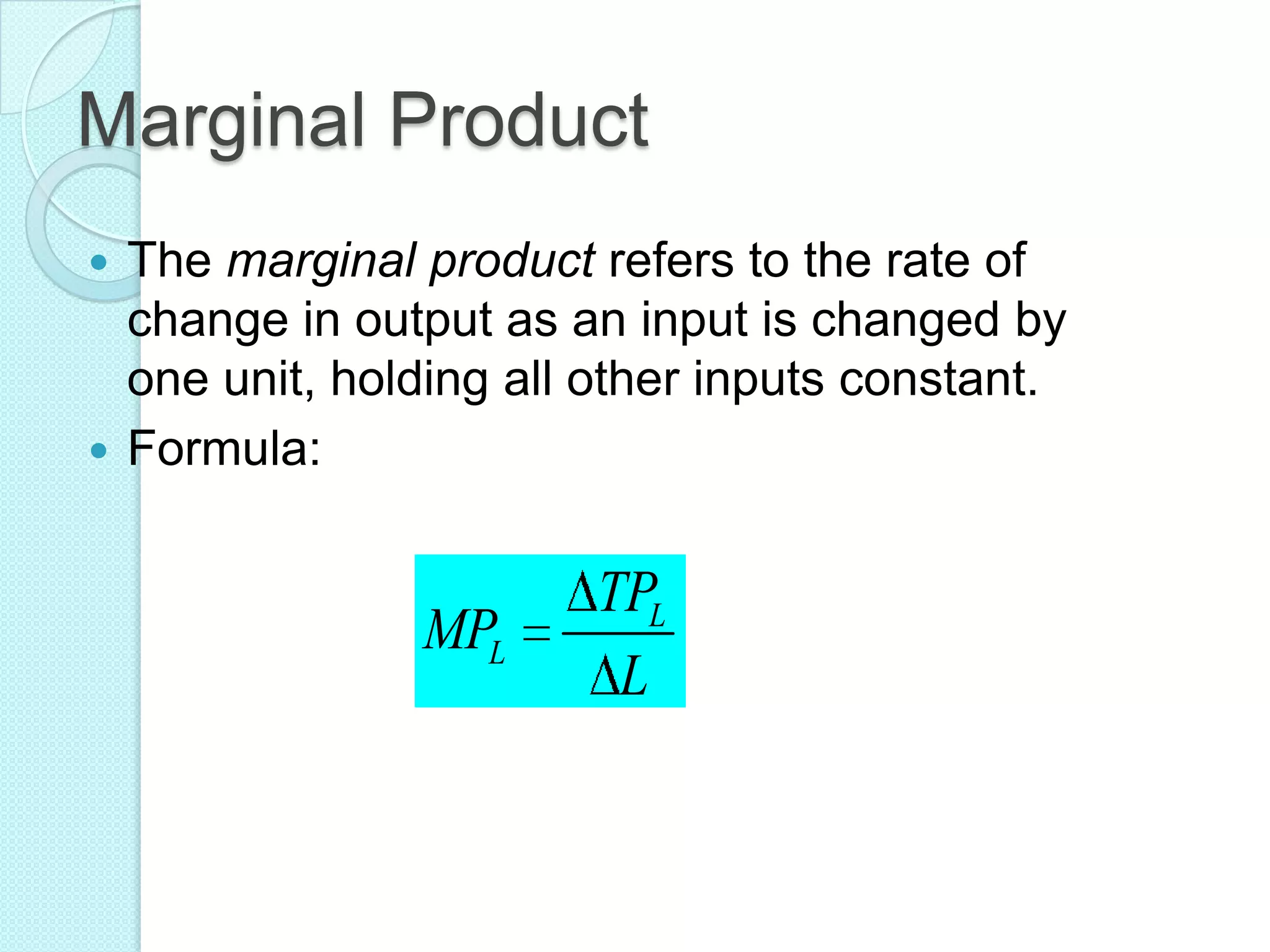
 The marginal product (MP) refers to the rate
of change in output as an input is changed by
one unit, holding all other inputs constant.


MPL

TPL
L
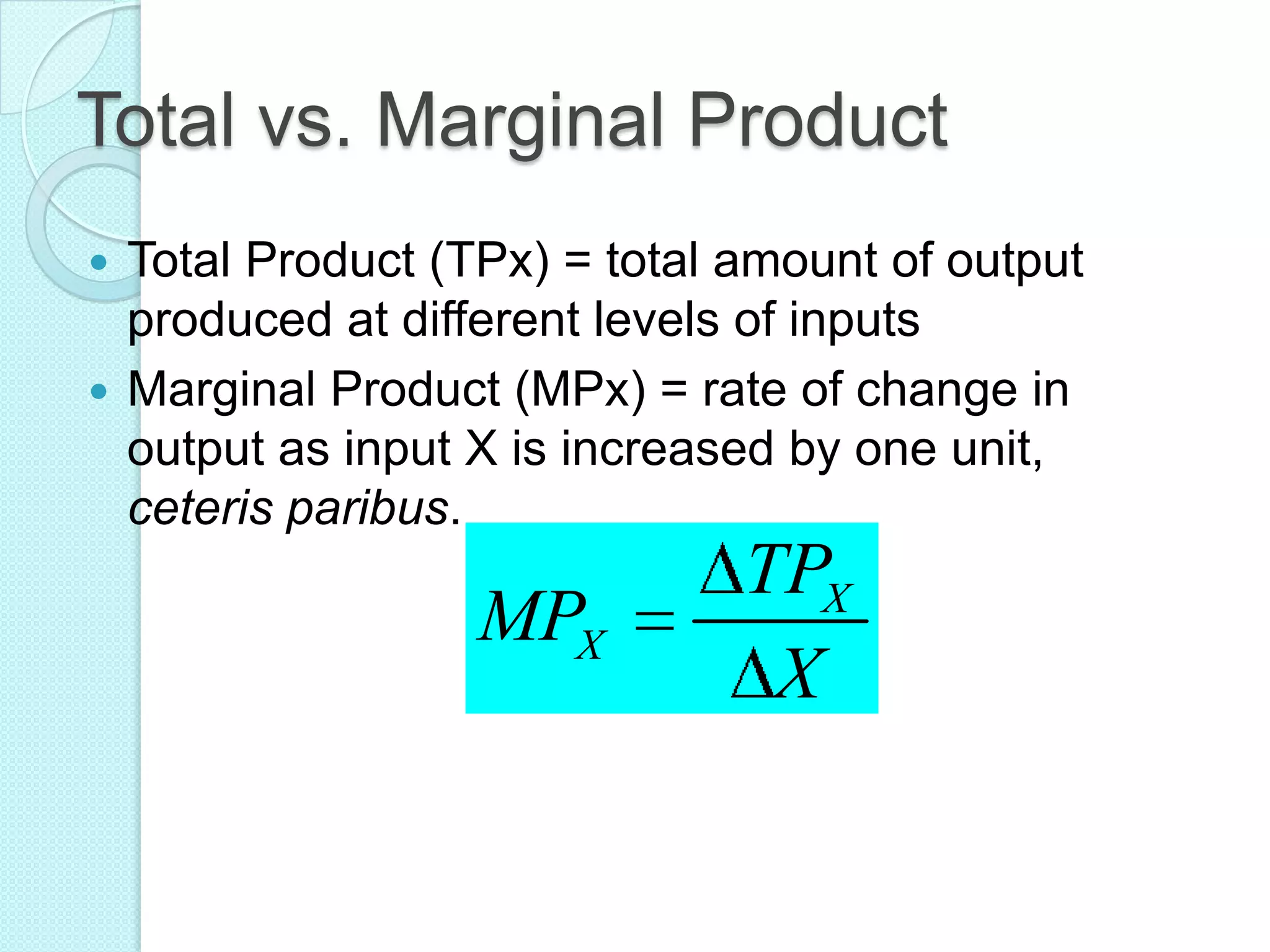
Total vs. Marginal Product
Total Product (TPx) = total amount of output
produced at different levels of inputs
 Marginal Product (MPx) = rate of change in
output as input X is increased by one unit,
ceteris paribus.


MPX

TPX
X
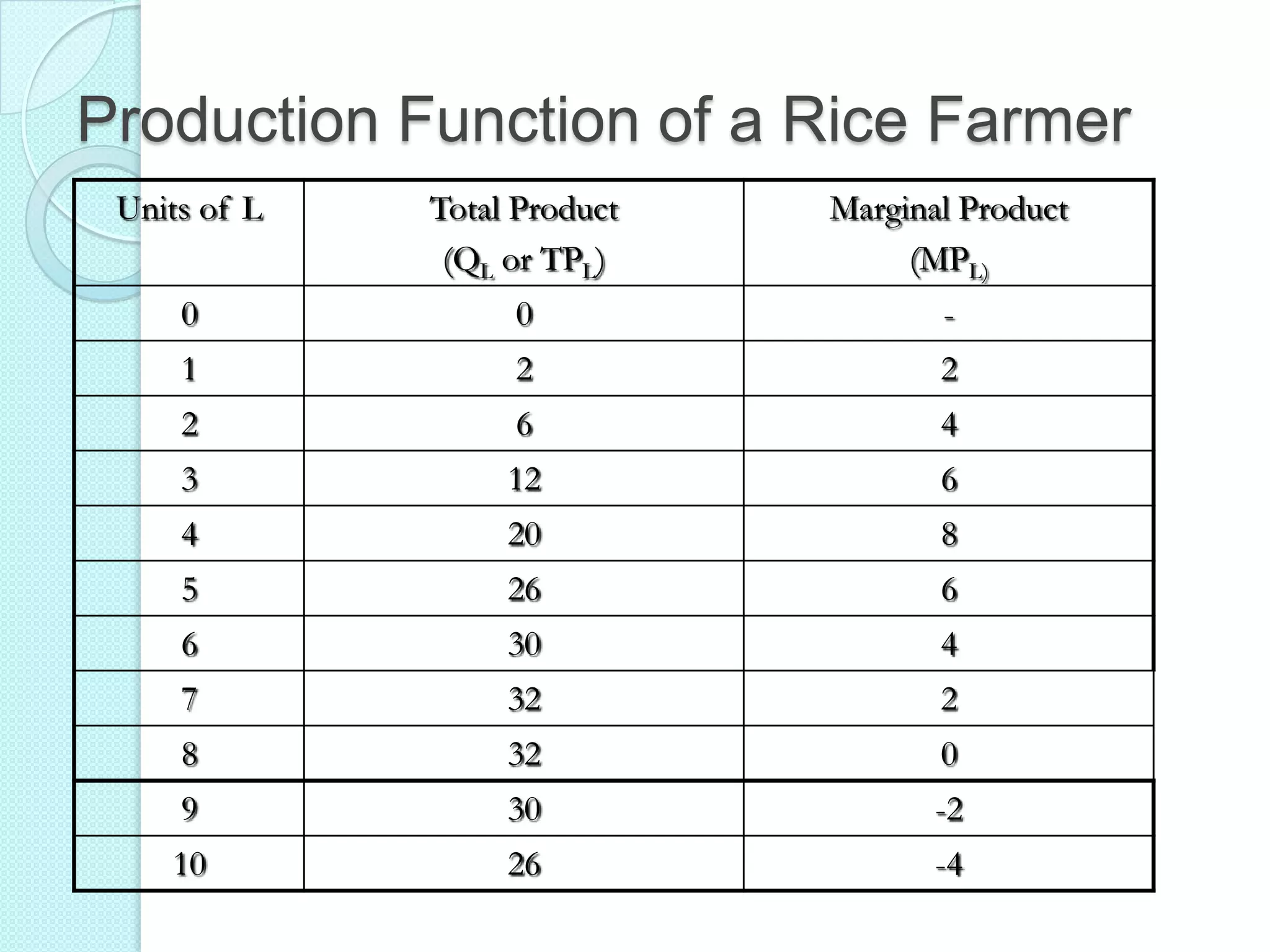
Production Function of a Rice Farmer
Units of L

Total Product
(QL or TPL)

Marginal Product
(MPL)

0

0

-

1

2

2

2

6

4

3

12

6

4

20

8

5

26

6

6

30

4

7

32

2

8

32

0

9

30

-2

10

26

-4
QL

32
30

Total product

26

QL

20

12

6
2

L
0

1

2

3

4

5

6

7

8

9

10

Labor

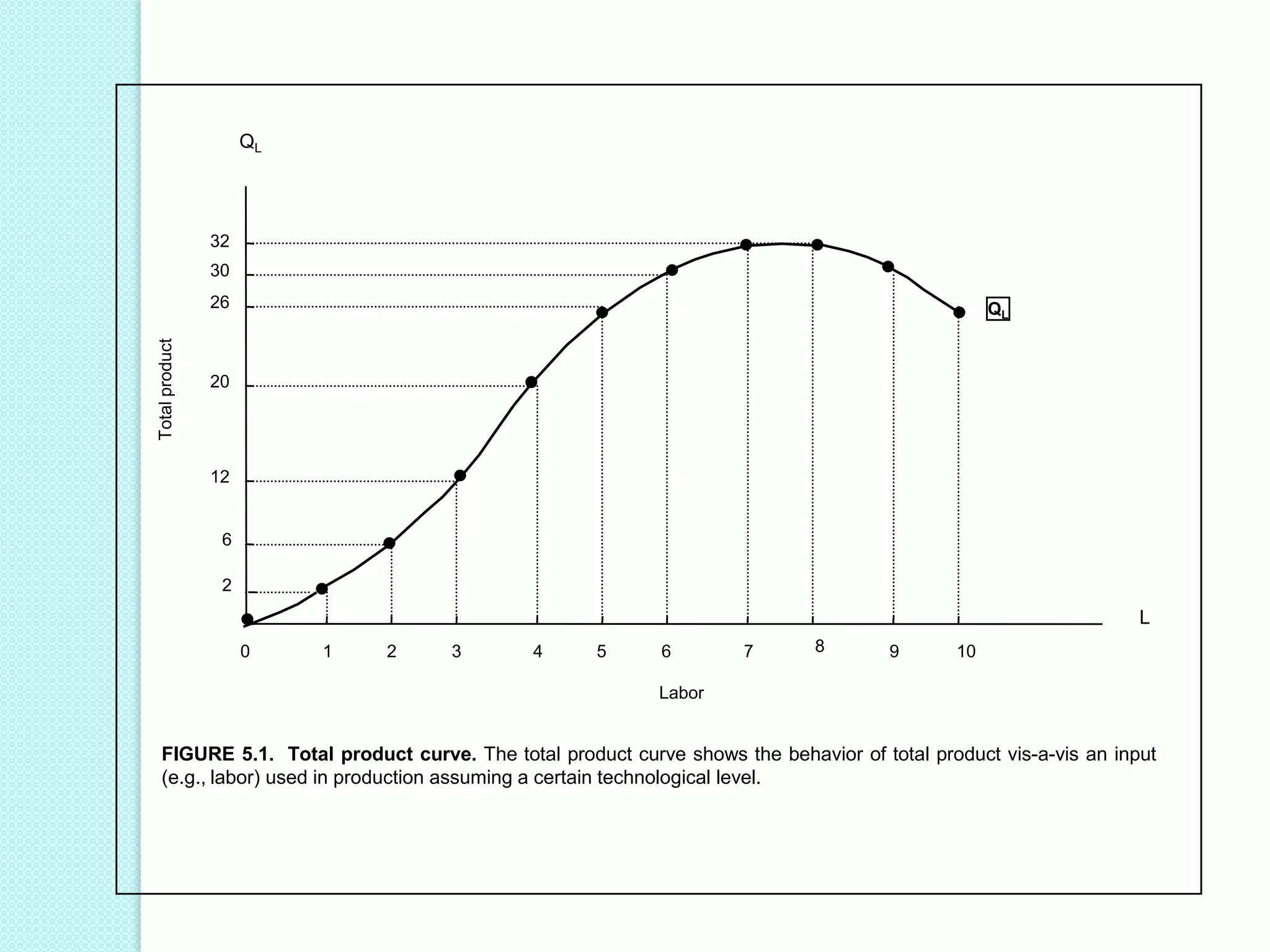
FIGURE 5.1. Total product curve. The total product curve shows the behavior of total product vis-a-vis an input
(e.g., labor) used in production assuming a certain technological level.
Marginal Product
The marginal product refers to the rate of
change in output as an input is changed by
one unit, holding all other inputs constant.
 Formula:


MPL

TPL
L
Marginal Product
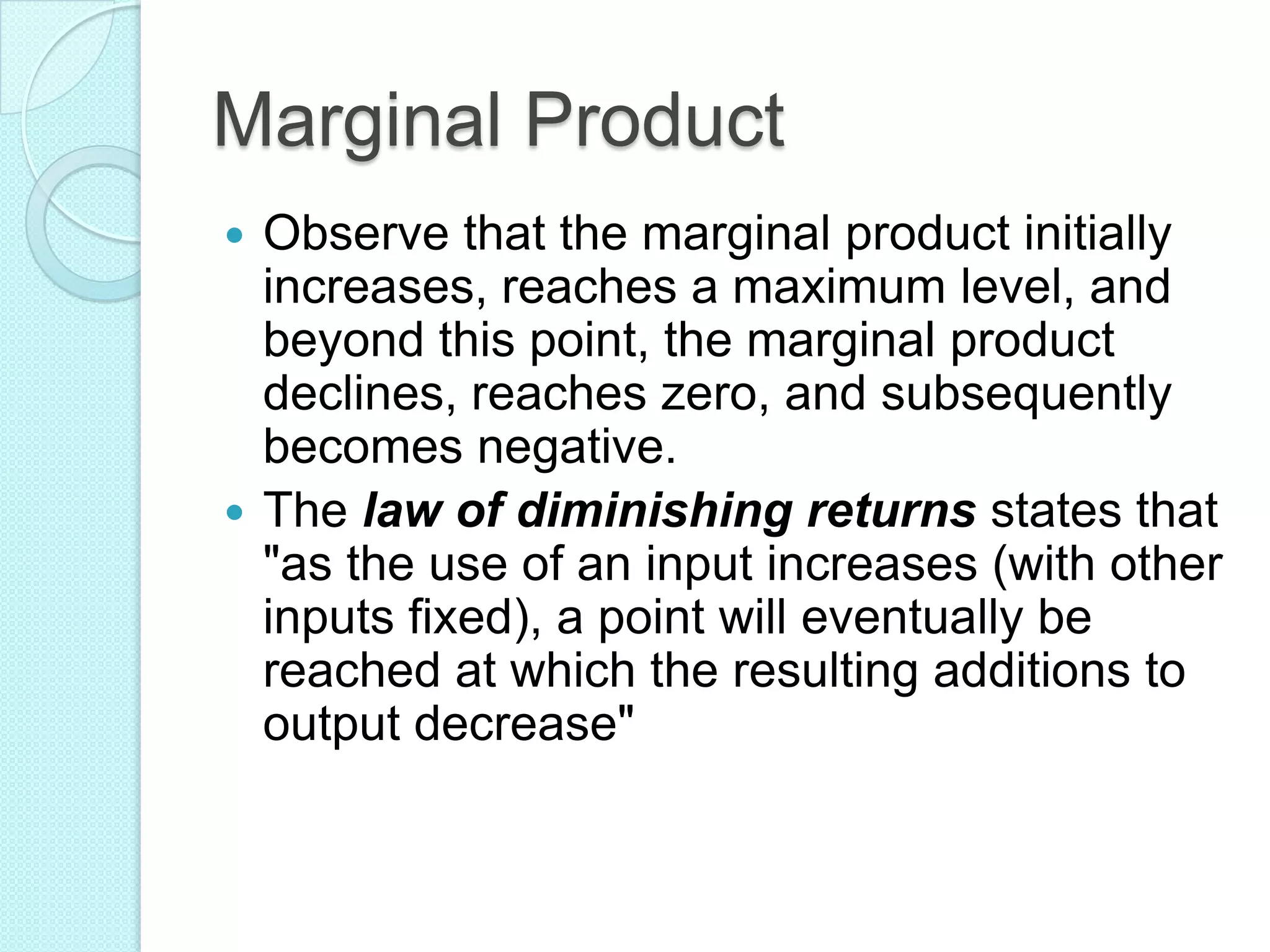
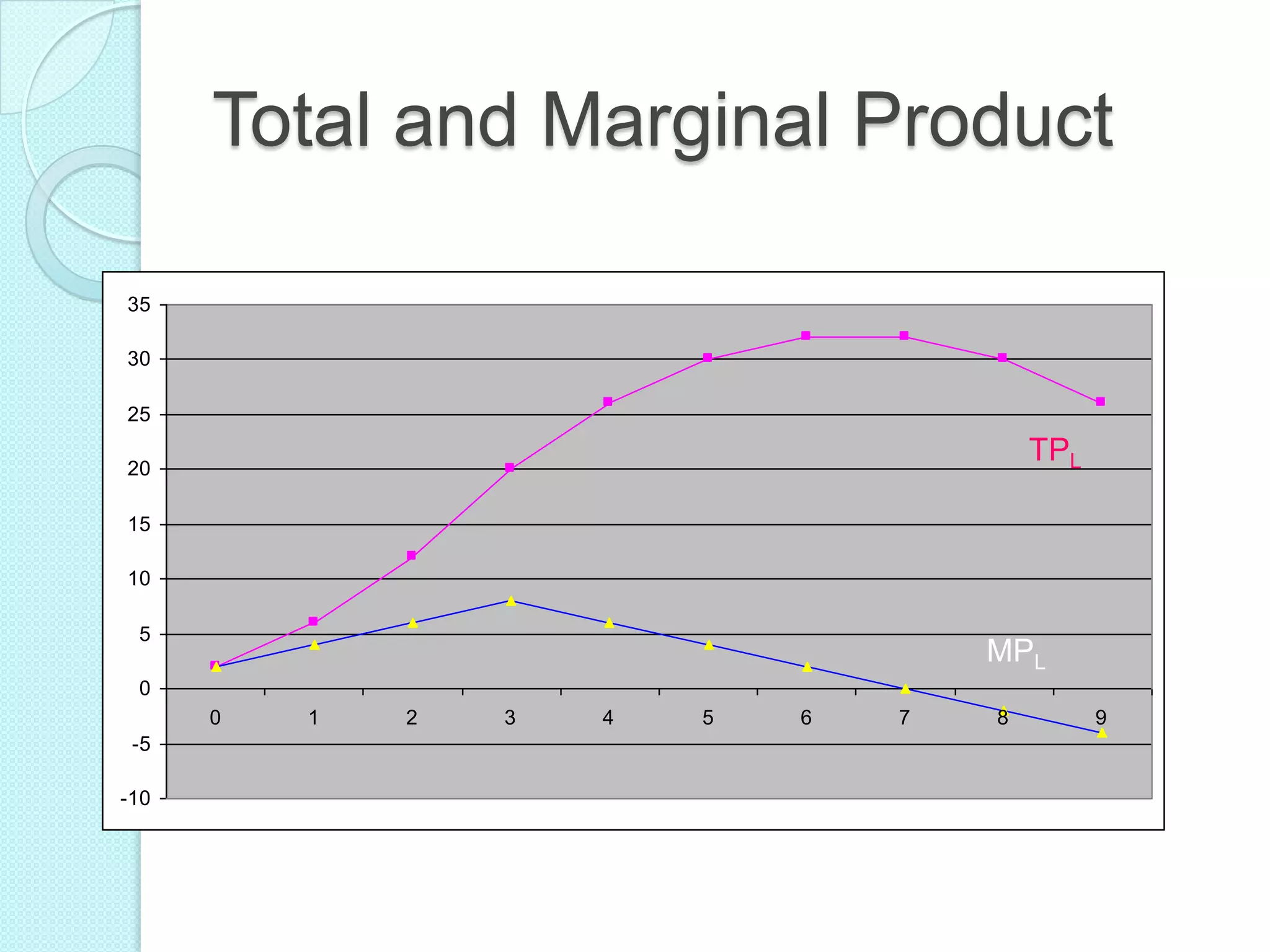
Observe that the marginal product initially
increases, reaches a maximum level, and
beyond this point, the marginal product
declines, reaches zero, and subsequently
becomes negative.
 The law of diminishing returns states that
"as the use of an input increases (with other
inputs fixed), a point will eventually be
reached at which the resulting additions to
output decrease"

Total and Marginal Product
35
30
25

TPL

20
15
10
5

MPL

0
0
-5
-10

1

2

3

4

5

6

7

8

9
Law of Diminishing Marginal
Returns
As more and more of an input is
added (given a fixed amount of other
inputs), total output may increase;
however, the additions to total output
will tend to diminish.
 Counter-intuitive proof: if the law of
diminishing returns does not hold, the
world’s supply of food can be
produced in a hectare of land.

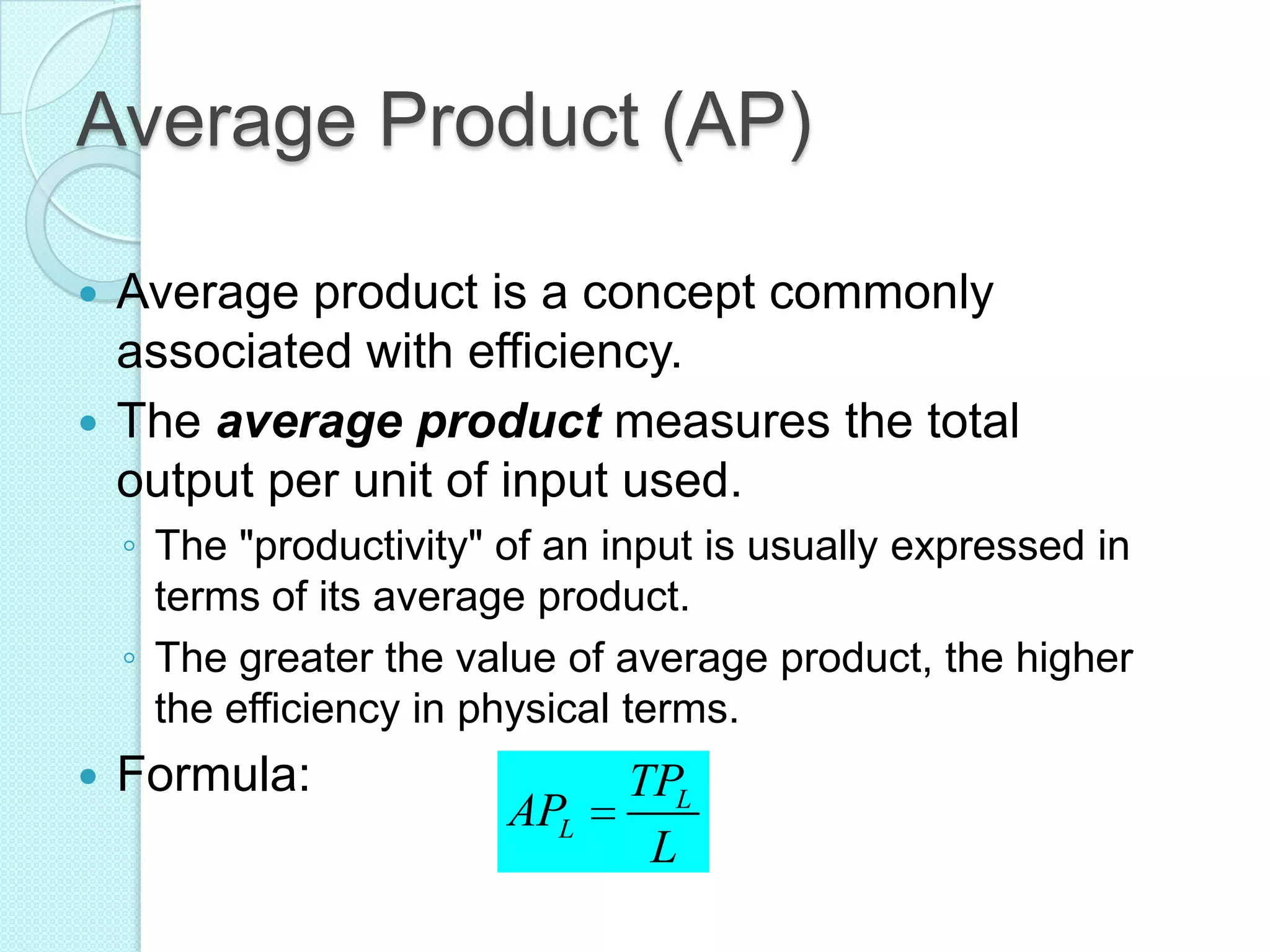
Average Product (AP)
Average product is a concept commonly
associated with efficiency.
 The average product measures the total
output per unit of input used.


◦ The "productivity" of an input is usually expressed in
terms of its average product.
◦ The greater the value of average product, the higher
the efficiency in physical terms.


Formula:

APL

TPL
L
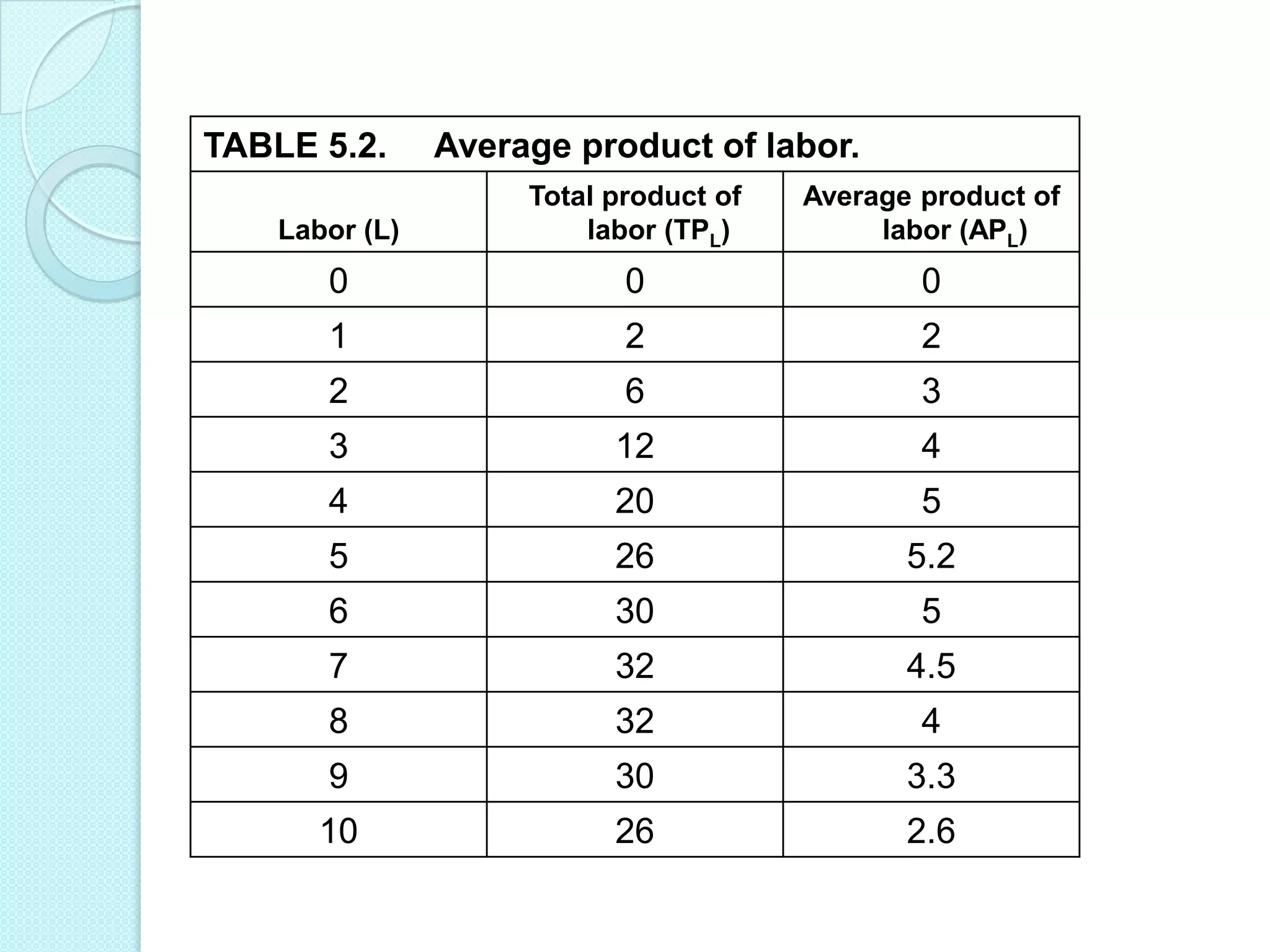
TABLE 5.2.

Average product of labor.

Labor (L)

Total product of
labor (TPL)

Average product of
labor (APL)

0

0

0

1

2

2

2

6

3

3

12

4

4

20

5

5

26

5.2

6

30

5

7

32

4.5

8

32

4

9

30

3.3

10

26

2.6
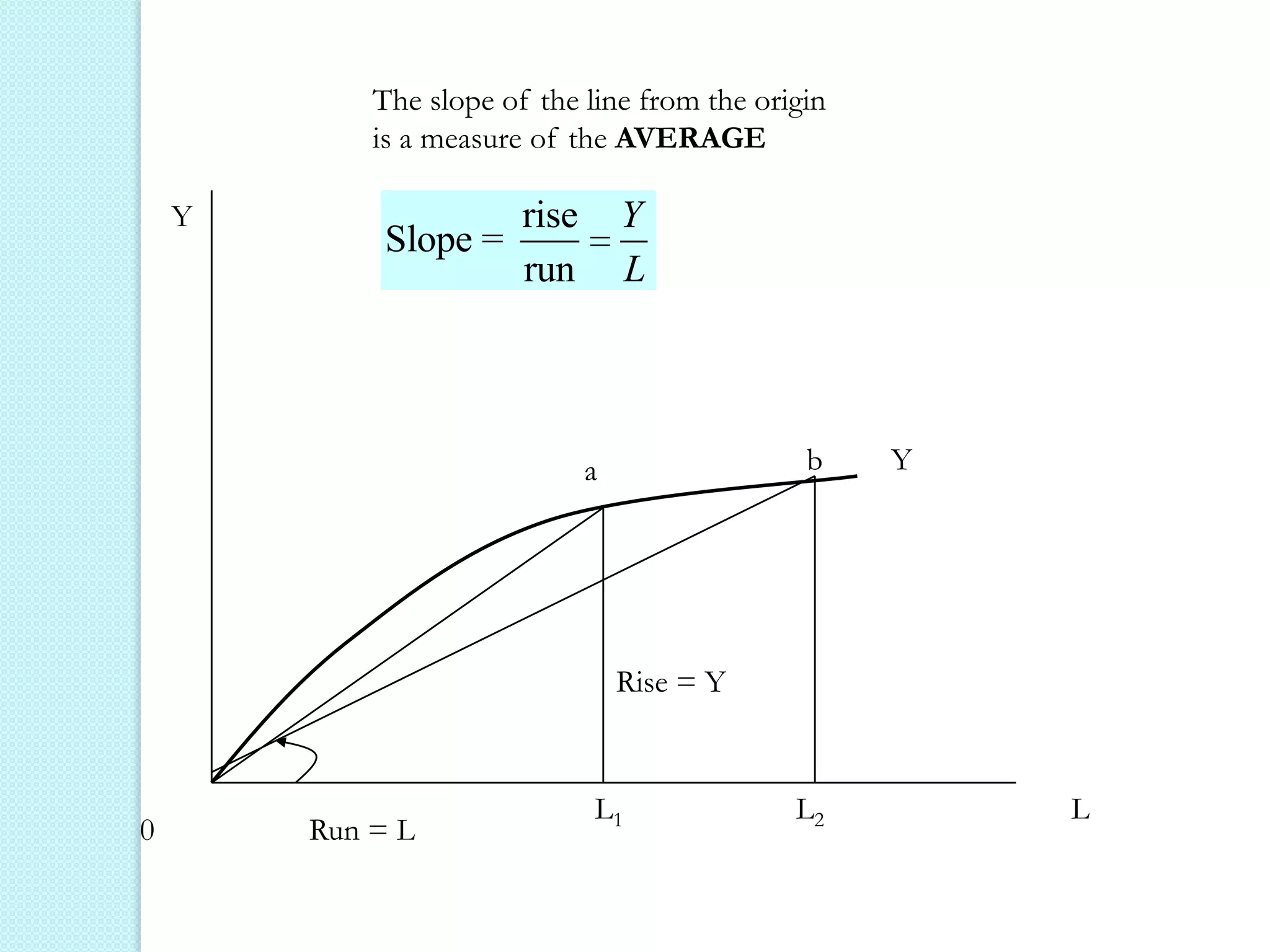
The slope of the line from the origin
is a measure of the AVERAGE
Y

Slope =

rise
run

Y
L

b

a

Y

Rise = Y

0

Run = L

L1

L2

L
Total
Product

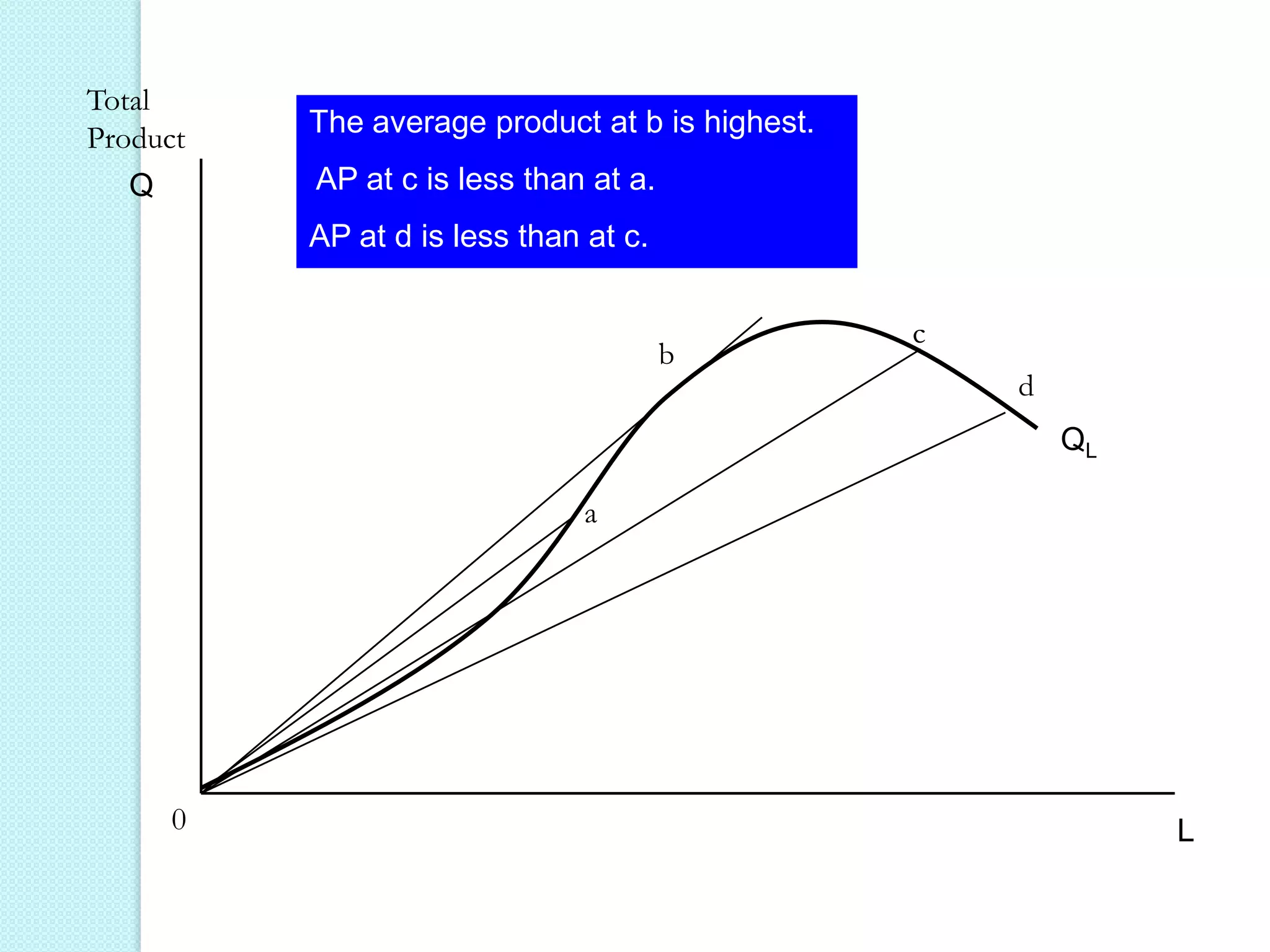
The average product at b is highest.
AP at c is less than at a.

Q

AP at d is less than at c.

b

c
d
QL

a

0

L
Q

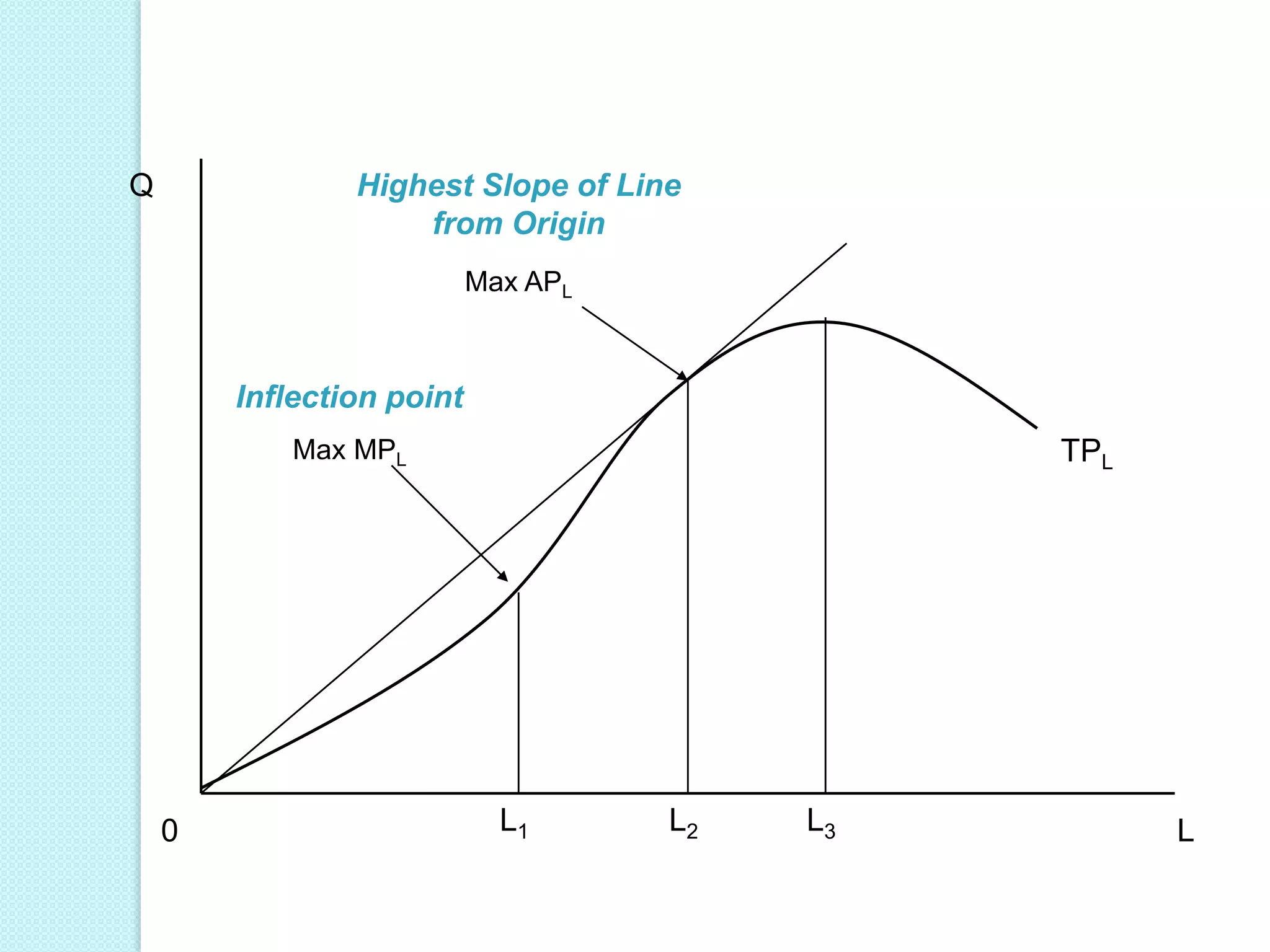
Highest Slope of Line
from Origin
Max APL

Inflection point

TPL

Max MPL

0

L1

L2

L3

L
Relationship between Average and
Marginal Curves: Rule of Thumb
When the marginal is less than the
average, the average decreases.
 When the marginal is equal to the
average, the average does not change
(it is either at maximum or minimum)
 When the marginal is greater than the
average, the average increases

AP,MP

At Max
AP, MP=AP

Max MPL
Max APL

APL

0

L1

L2

L3

L
MPL
TP

TPL

0

L1

L2

L3

Stage I
MP>AP
AP increasing

AP,MP

Stage II
MP<AP
AP decreasing
MP still positive

L
Stage III
MP<0
AP decreasing

APL

0

L1

L2

L3

L
MPL
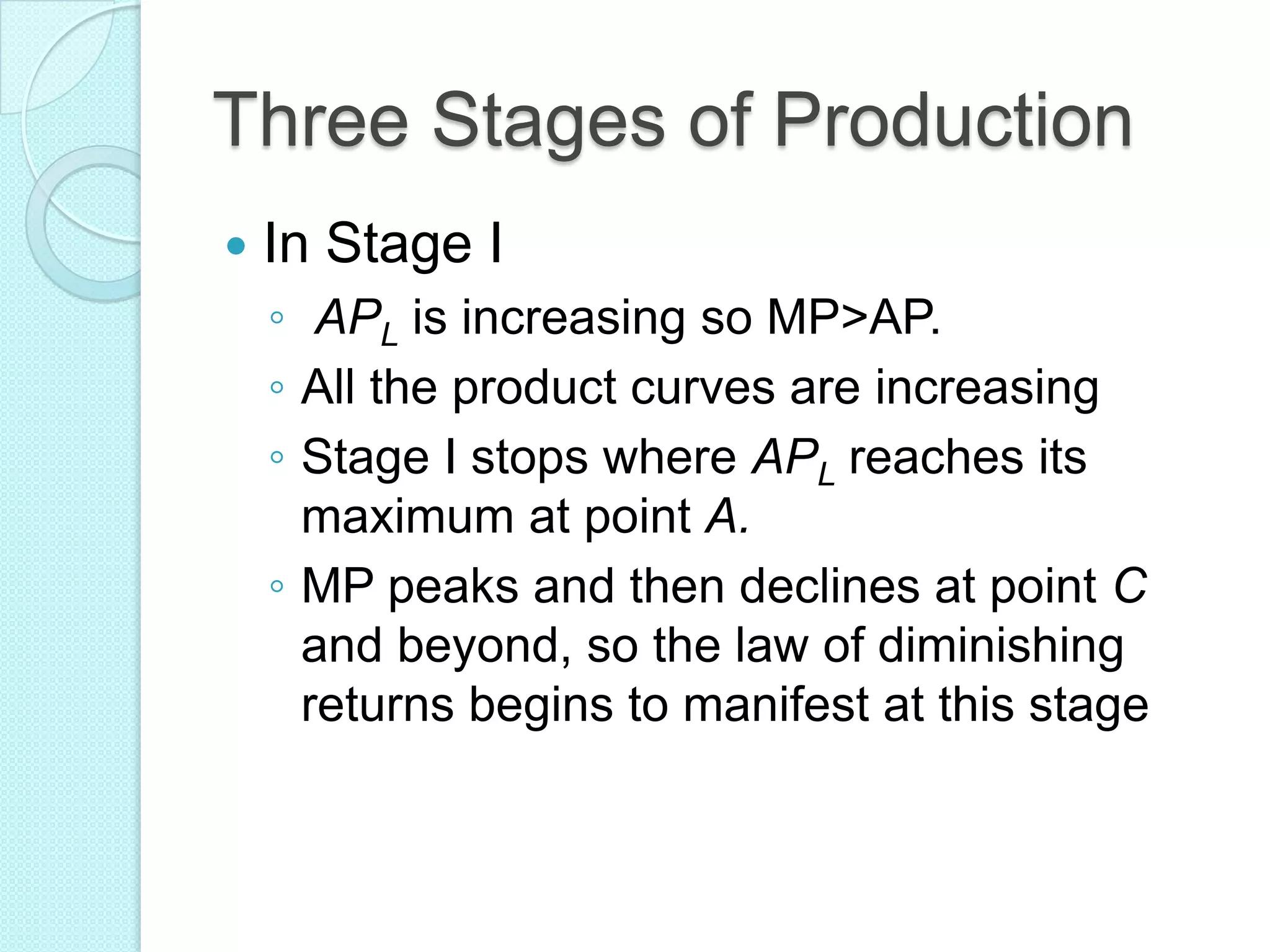
Three Stages of Production


In Stage I
◦ APL is increasing so MP>AP.
◦ All the product curves are increasing
◦ Stage I stops where APL reaches its
maximum at point A.
◦ MP peaks and then declines at point C
and beyond, so the law of diminishing
returns begins to manifest at this stage
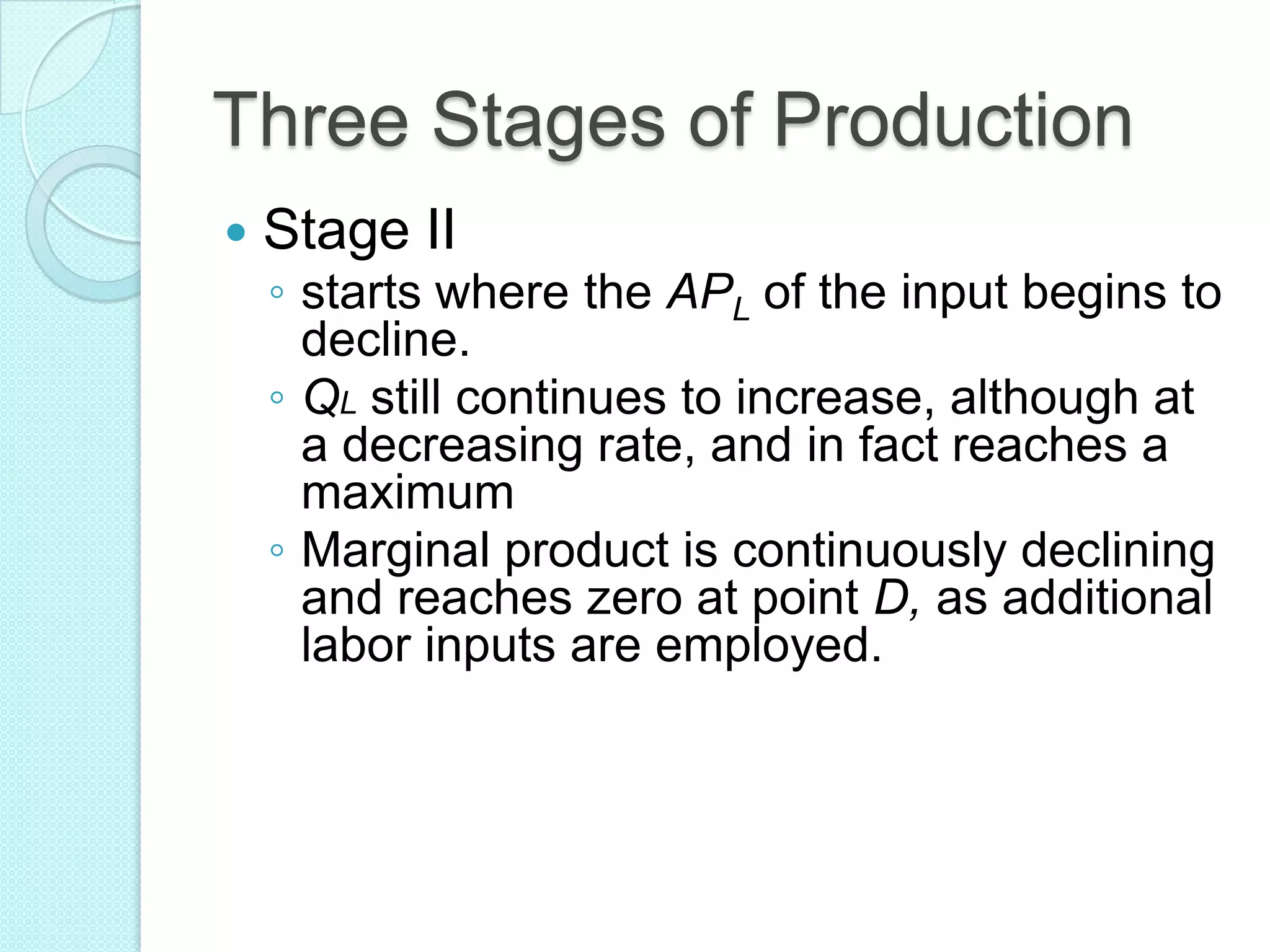
Three Stages of Production


Stage II

◦ starts where the APL of the input begins to
decline.
◦ QL still continues to increase, although at
a decreasing rate, and in fact reaches a
maximum
◦ Marginal product is continuously declining
and reaches zero at point D, as additional
labor inputs are employed.
Three Stages of Production
Stage

III starts where the MPL has
turned negative.
◦ all product curves are decreasing.
◦ total output starts falling even as the input
is increased
The Law of Variable Proportions
•

•

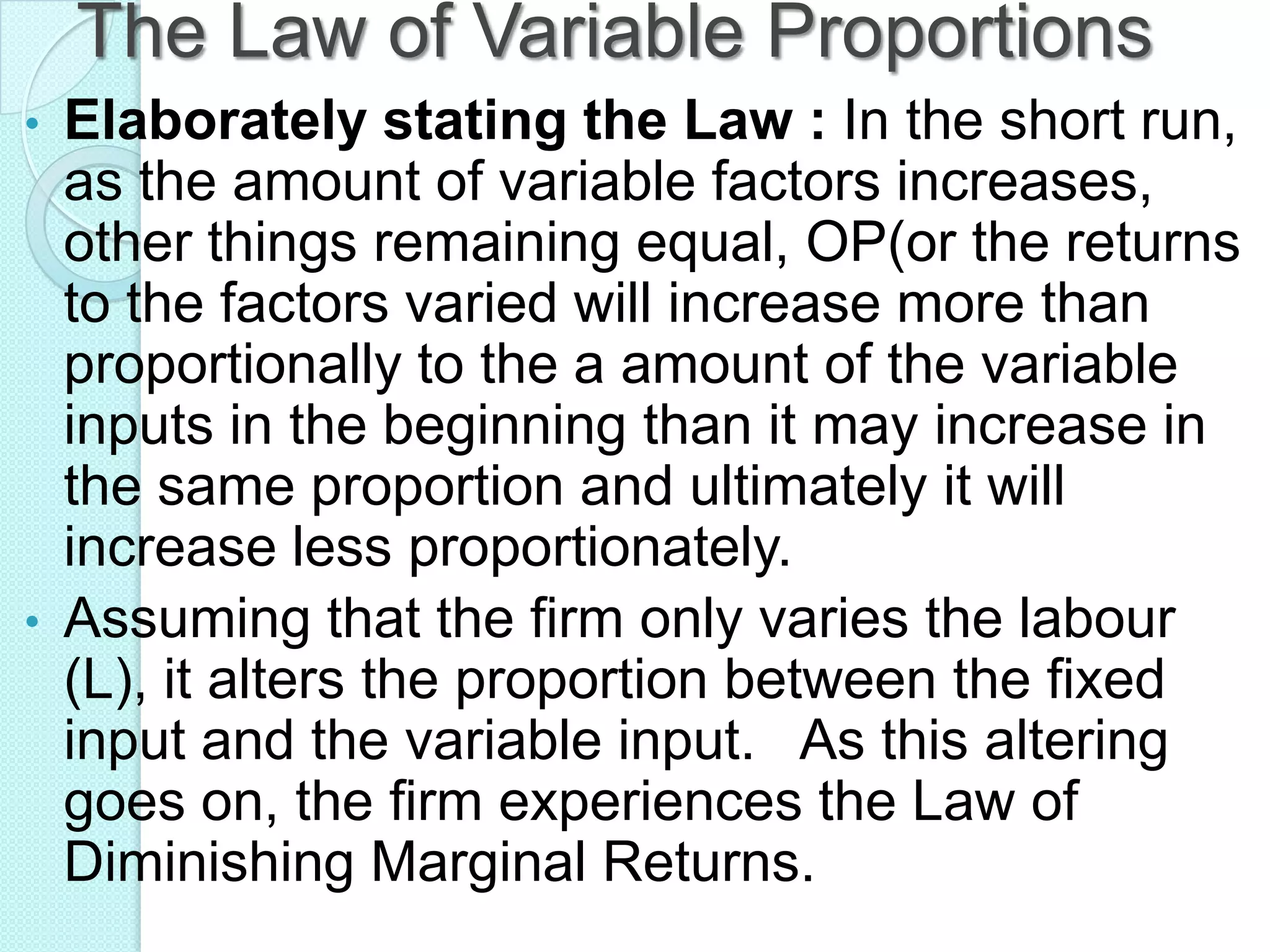
Elaborately stating the Law : In the short run,
as the amount of variable factors increases,
other things remaining equal, OP(or the returns
to the factors varied will increase more than
proportionally to the a amount of the variable
inputs in the beginning than it may increase in
the same proportion and ultimately it will
increase less proportionately.
Assuming that the firm only varies the labour
(L), it alters the proportion between the fixed
input and the variable input. As this altering
goes on, the firm experiences the Law of
Diminishing Marginal Returns.
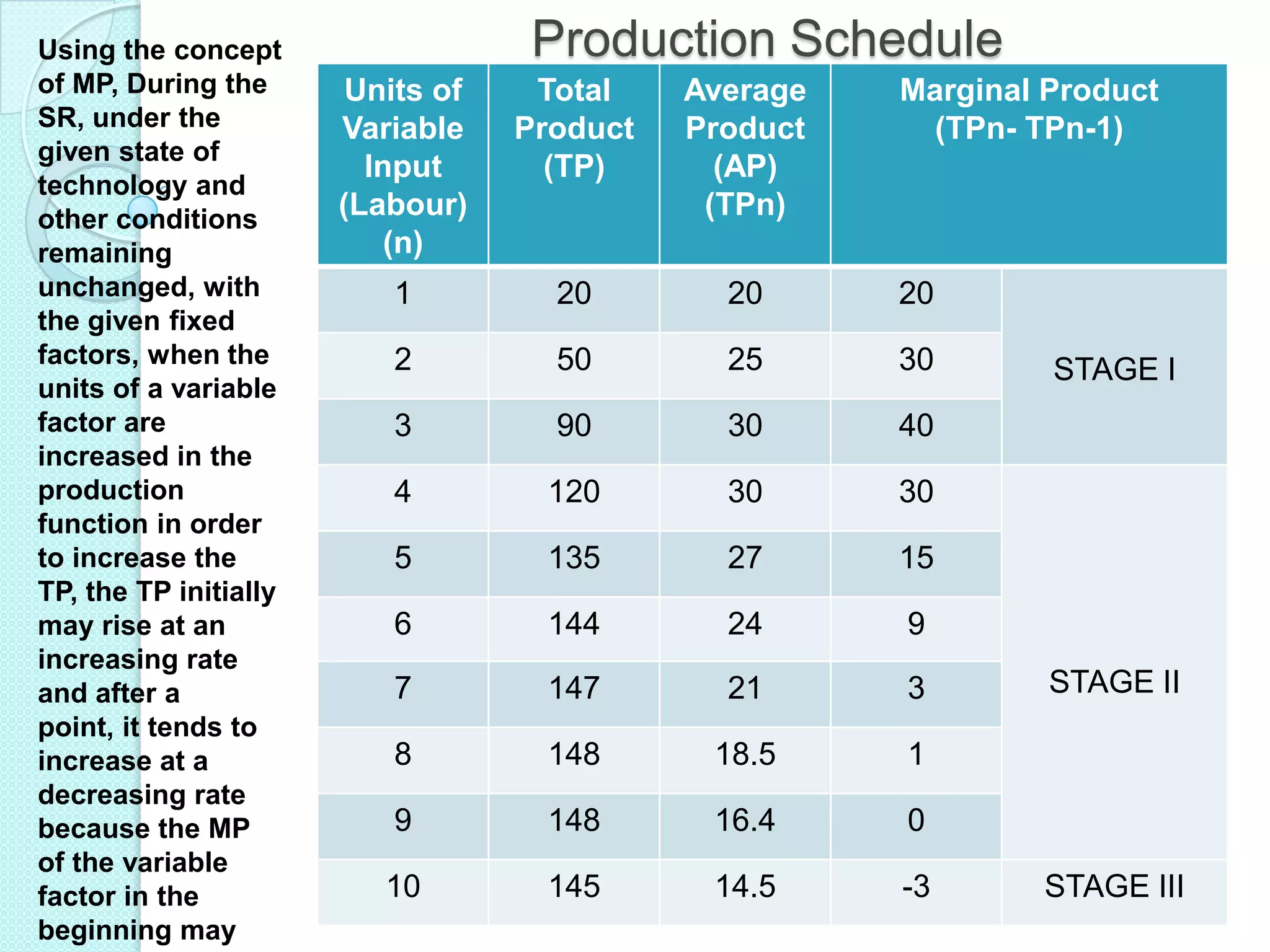
Using the concept
of MP, During the
SR, under the
given state of
technology and
other conditions
remaining
unchanged, with
the given fixed
factors, when the
units of a variable
factor are
increased in the
production
function in order
to increase the
TP, the TP initially
may rise at an
increasing rate
and after a
point, it tends to
increase at a
decreasing rate
because the MP
of the variable
factor in the
beginning may

Production Schedule
Units of
Variable
Input
(Labour)
(n)

Total
Product
(TP)

Average
Product
(AP)
(TPn)

Marginal Product
(TPn- TPn-1)

1

20

20

20

2

50

25

30

3

90

30

40

4

120

30

30

5

135

27

15

6

144

24

9

7

147

21

3

8

148

18.5

1

9

148

16.4

0

10

145

14.5

-3

STAGE I

STAGE II

STAGE III
TP
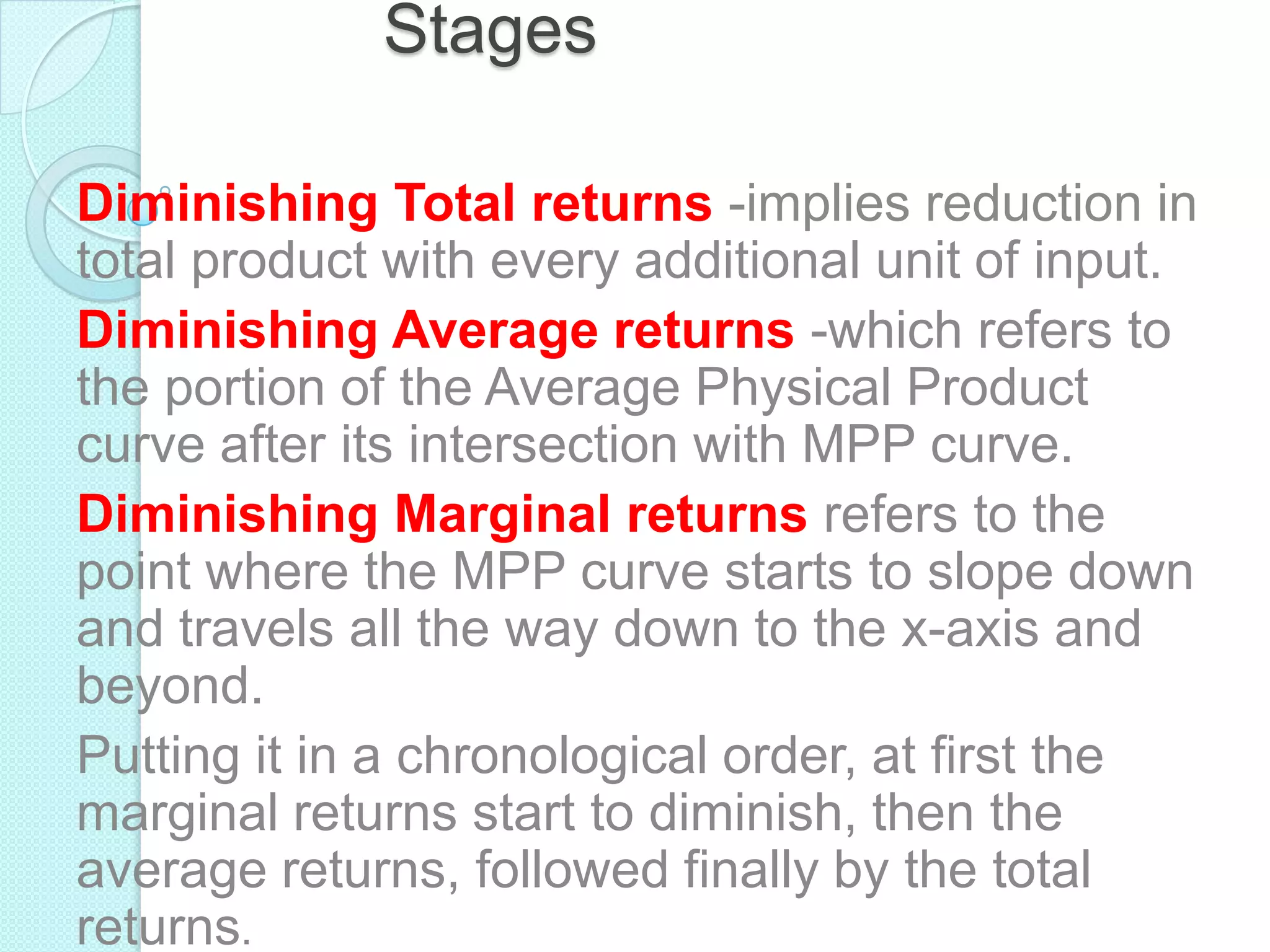
Stages
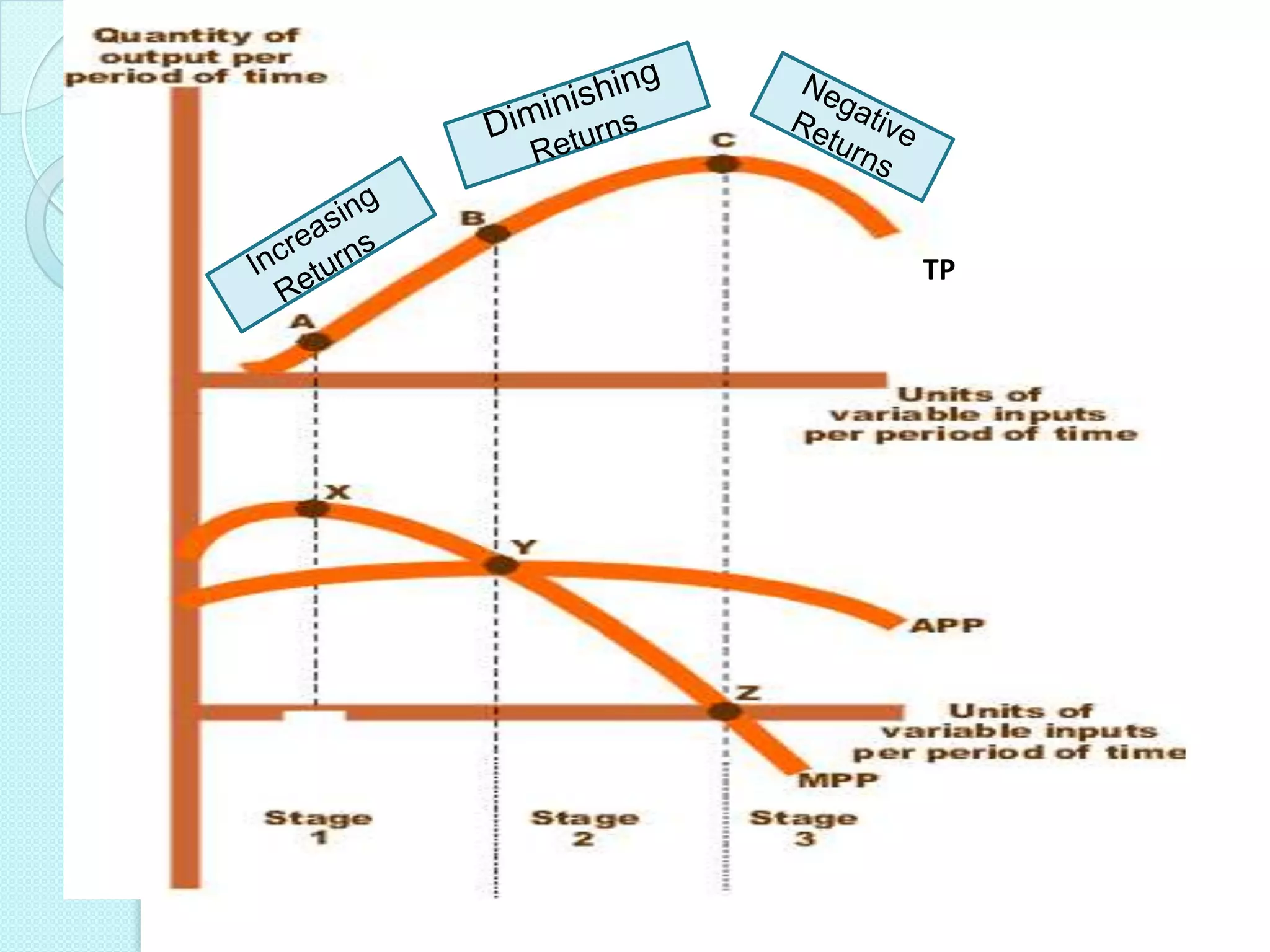
Diminishing Total returns -implies reduction in
total product with every additional unit of input.
Diminishing Average returns -which refers to
the portion of the Average Physical Product
curve after its intersection with MPP curve.
Diminishing Marginal returns refers to the
point where the MPP curve starts to slope down
and travels all the way down to the x-axis and
beyond.
Putting it in a chronological order, at first the
marginal returns start to diminish, then the
average returns, followed finally by the total
returns.
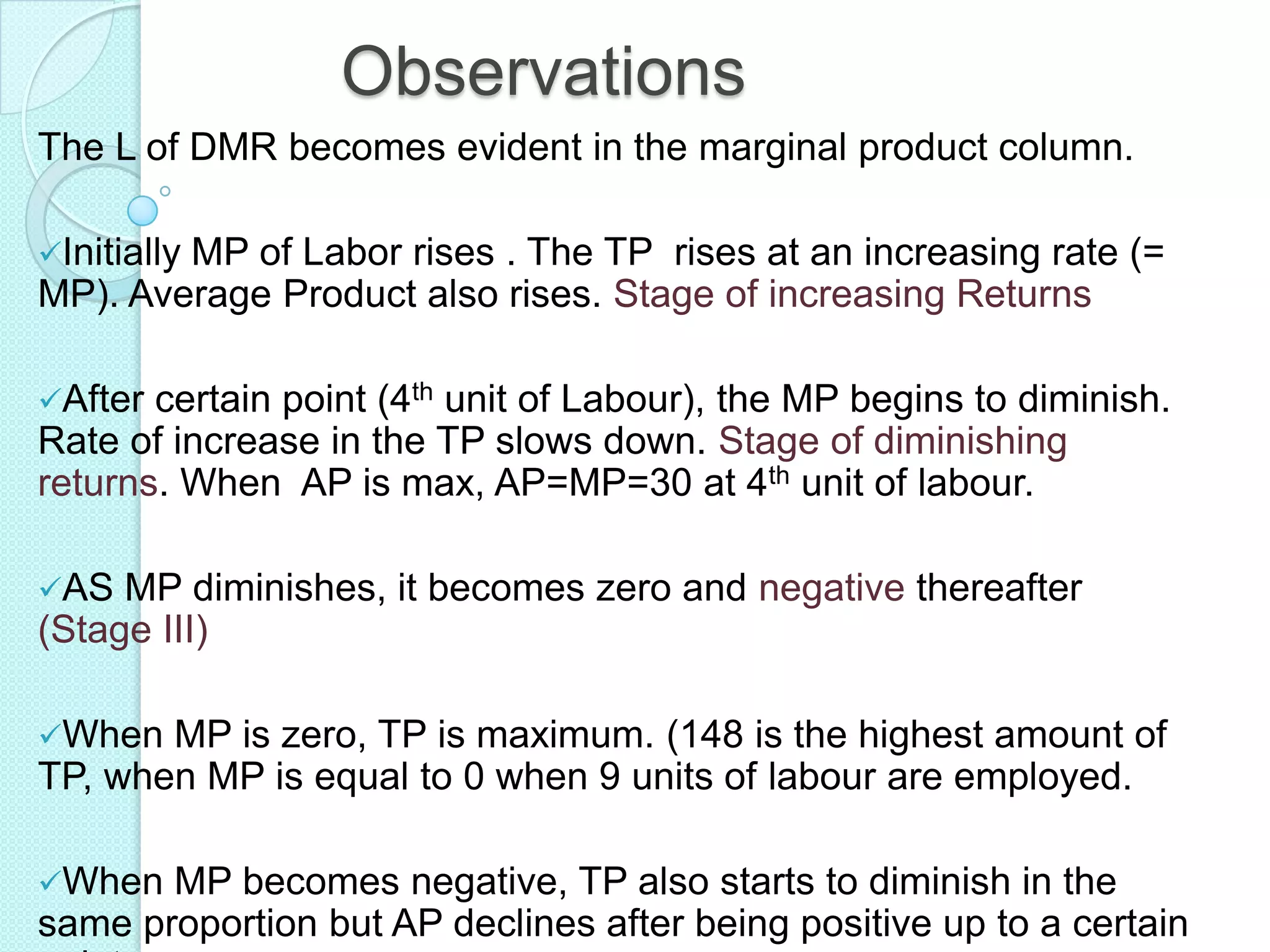
Observations
The L of DMR becomes evident in the marginal product column.
Initially

MP of Labor rises . The TP rises at an increasing rate (=
MP). Average Product also rises. Stage of increasing Returns
certain point (4th unit of Labour), the MP begins to diminish.
Rate of increase in the TP slows down. Stage of diminishing
returns. When AP is max, AP=MP=30 at 4th unit of labour.
After

AS

MP diminishes, it becomes zero and negative thereafter
(Stage III)
When

MP is zero, TP is maximum. (148 is the highest amount of
TP, when MP is equal to 0 when 9 units of labour are employed.
When

MP becomes negative, TP also starts to diminish in the
same proportion but AP declines after being positive up to a certain
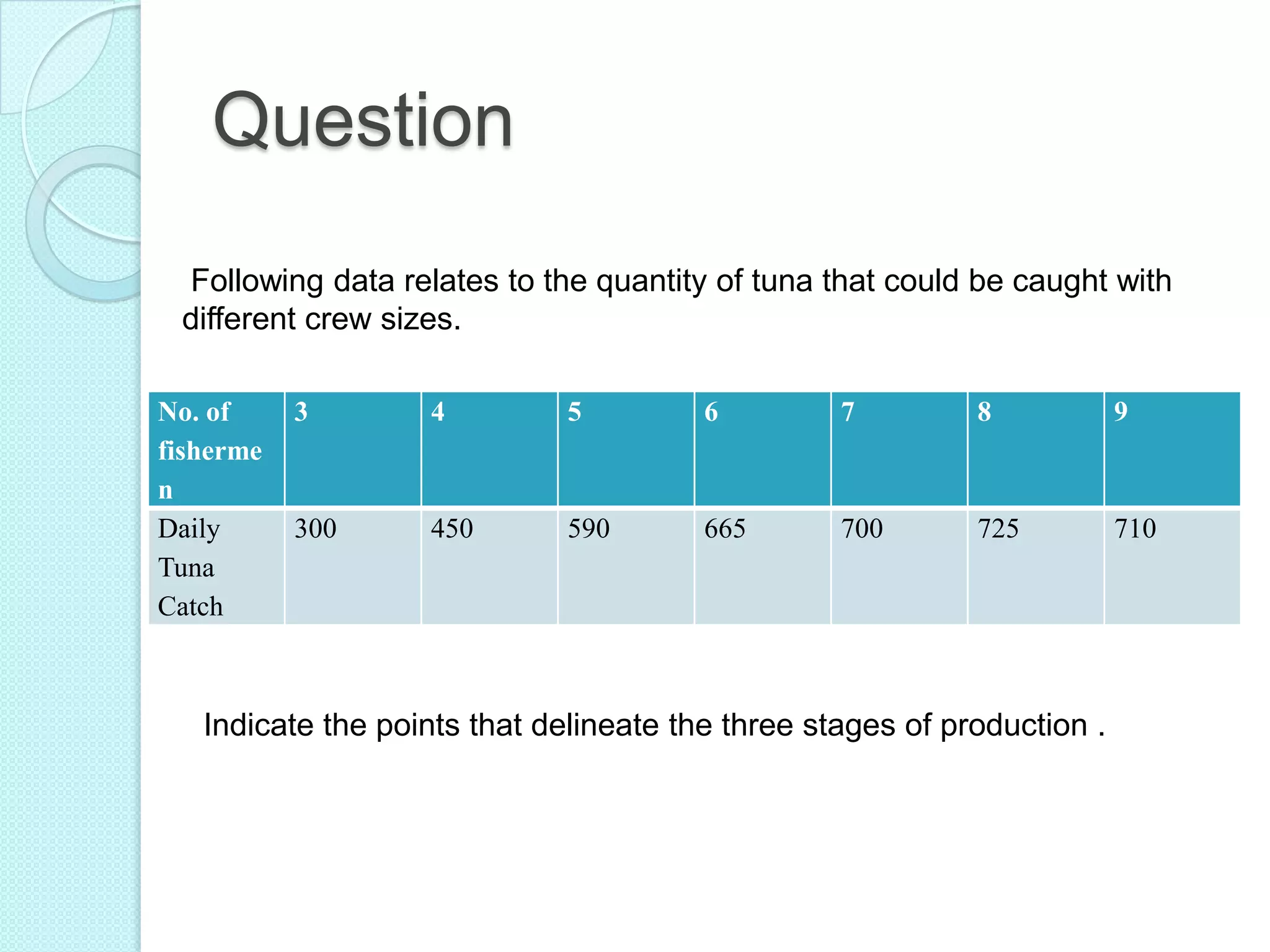
Question
Following data relates to the quantity of tuna that could be caught with
different crew sizes.
No. of
fisherme
n
Daily
Tuna
Catch

3

4

5

6

7

8

9

300

450

590

665

700

725

710

Indicate the points that delineate the three stages of production .
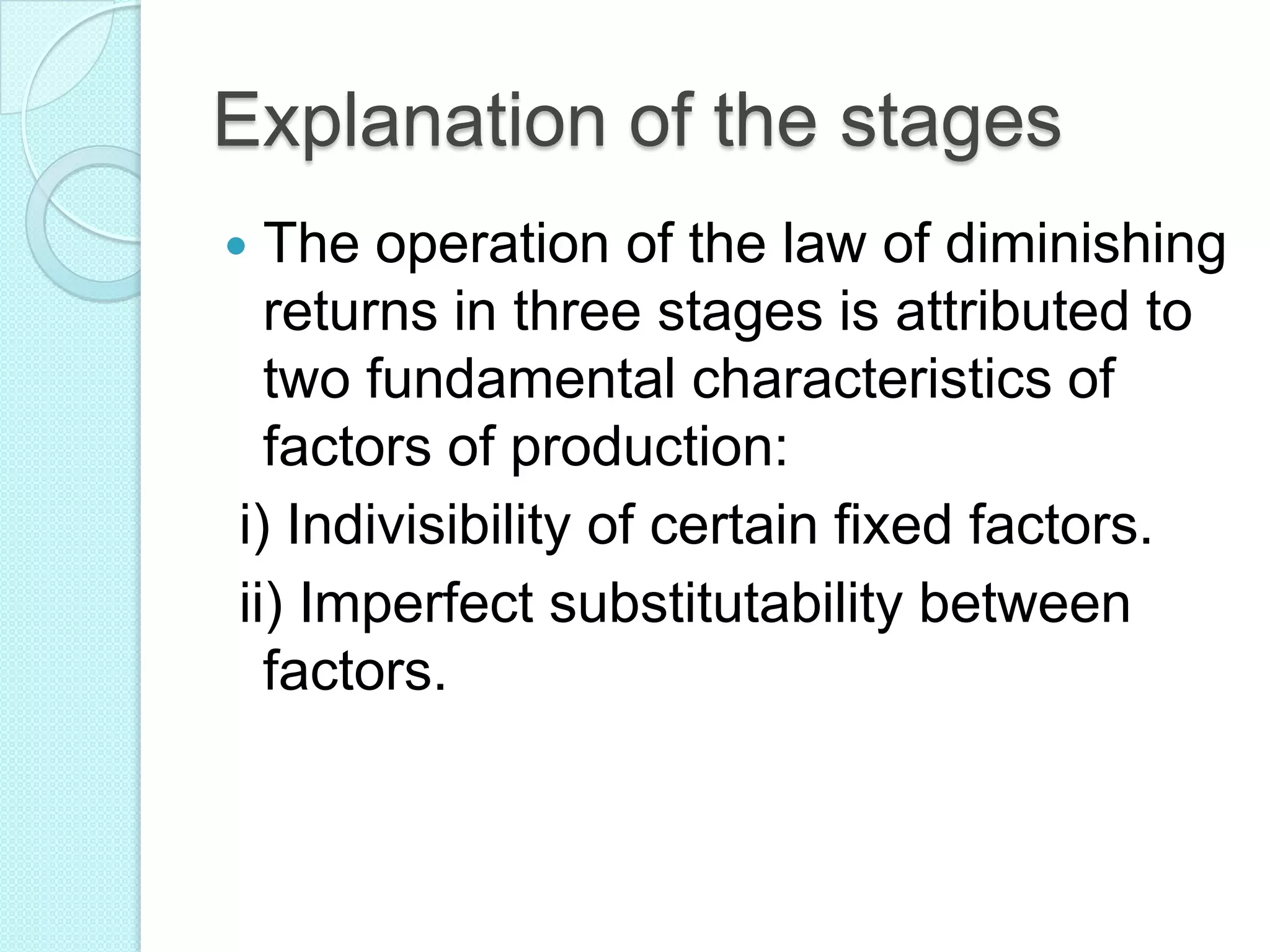
Explanation of the stages
The operation of the law of diminishing
returns in three stages is attributed to
two fundamental characteristics of
factors of production:
i) Indivisibility of certain fixed factors.
ii) Imperfect substitutability between
factors.


Marginal Revenue
Productivity




The marginal revenue productivity , also referred to
as the marginal revenue product of labor and the
value of the marginal product or VMPL, is the
change in total revenue earned by a firm that
results from employing one more unit of labor. It
determines, under some conditions, the optimal
number of workers to employ at an exogenously
determined market wage rate.
In a competitive firm, the marginal revenue product
will equal the product of the price and the marginal
product of labor. It is not efficient for a firm to pay
its workers more than it will earn in profits from
their labor
Production function with one variable
input
Total Product: Q = 30L+20L2-L3
 Average Product : Q /L
 Marginal Product : MP = dQ/dL = 30+40L3L2

What is long run production function
?


Long run refers to that time in the future
when all inputs are variable inputs.



In the long run both capital and labour are
included



Output can be varied by changing the
levels of both L & K and the long run
production function is expressed as:
Q = f (L, K)
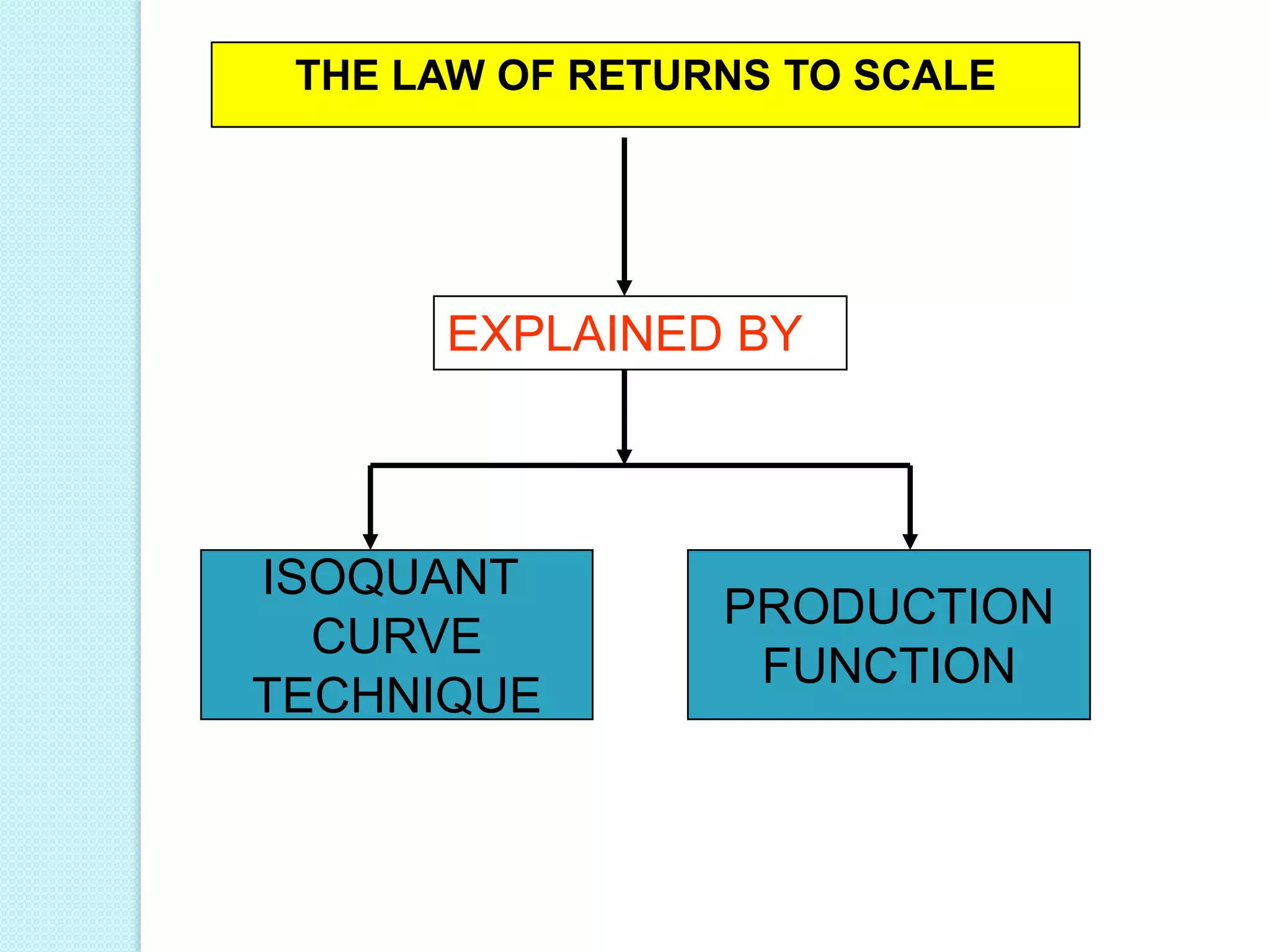
THE LAW OF RETURNS TO SCALE

EXPLAINED BY

ISOQUANT
CURVE
TECHNIQUE

PRODUCTION
FUNCTION
LONG RUN TOTAL PRODUCTIONReturns to scale


During the short period, some factors of production
are relatively scarce, therefore , the proportion of
the factors may be changed but not their scale. But
in the long run, all factors are variable, therefore,
the scale of production can be changed in the long
run



Returns to scale is a factor that is studied in the
long run.



Returns to scale show the responsiveness of total
product when all the inputs are increased
proportionately.
Returns to Scale
When all inputs are changed in the
same proportion (or scale of production
is changed),the total product may
respond in three possible ways:
1) Increasing returns to scale
2) Constant returns to scale, and
3) Diminishing returns to scale

INCREASING RETURNS TO SCALE






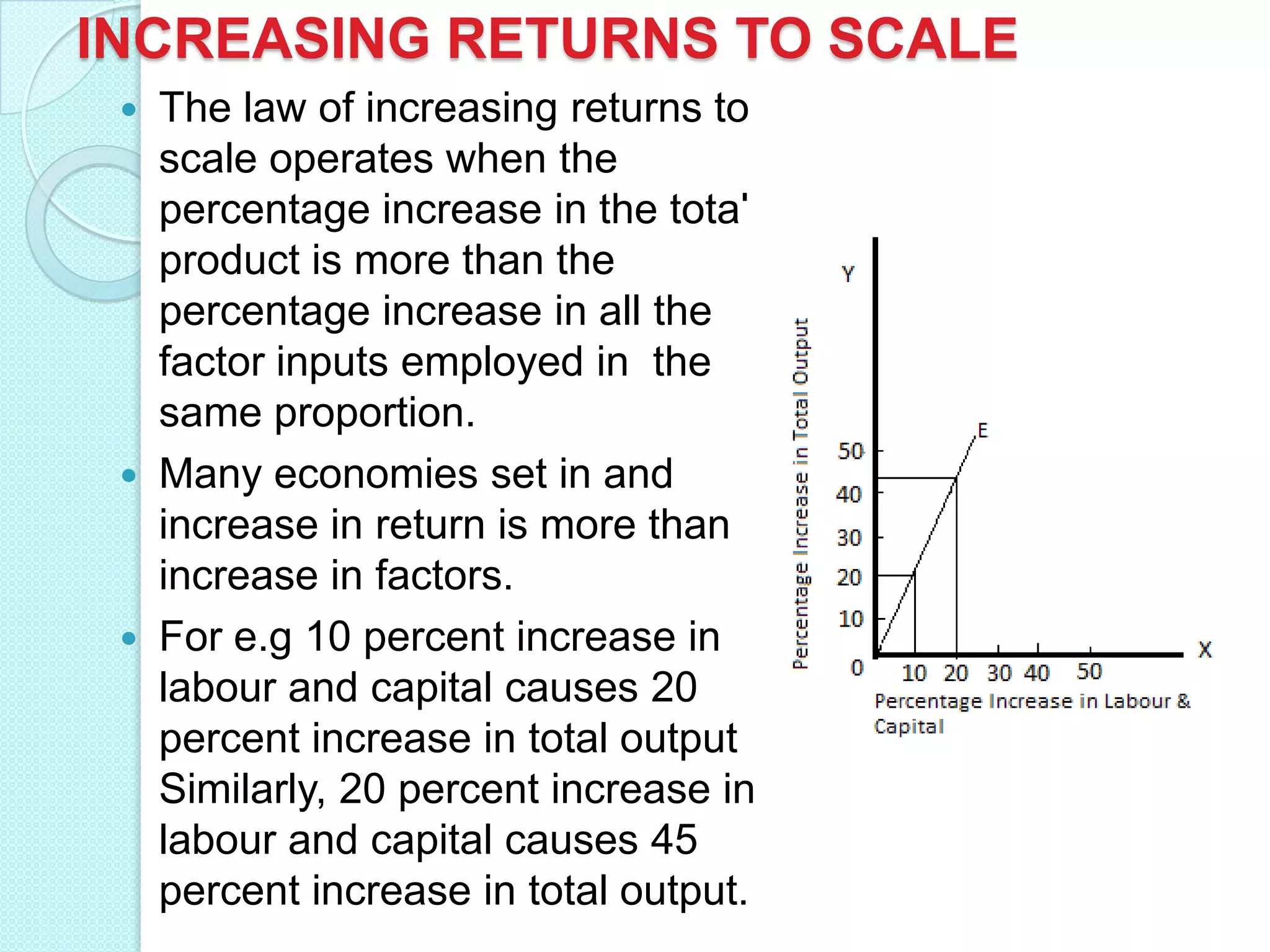
The law of increasing returns to
scale operates when the
percentage increase in the total
product is more than the
percentage increase in all the
factor inputs employed in the
same proportion.
Many economies set in and
increase in return is more than
increase in factors.
For e.g 10 percent increase in
labour and capital causes 20
percent increase in total output.
Similarly, 20 percent increase in
labour and capital causes 45
percent increase in total output.
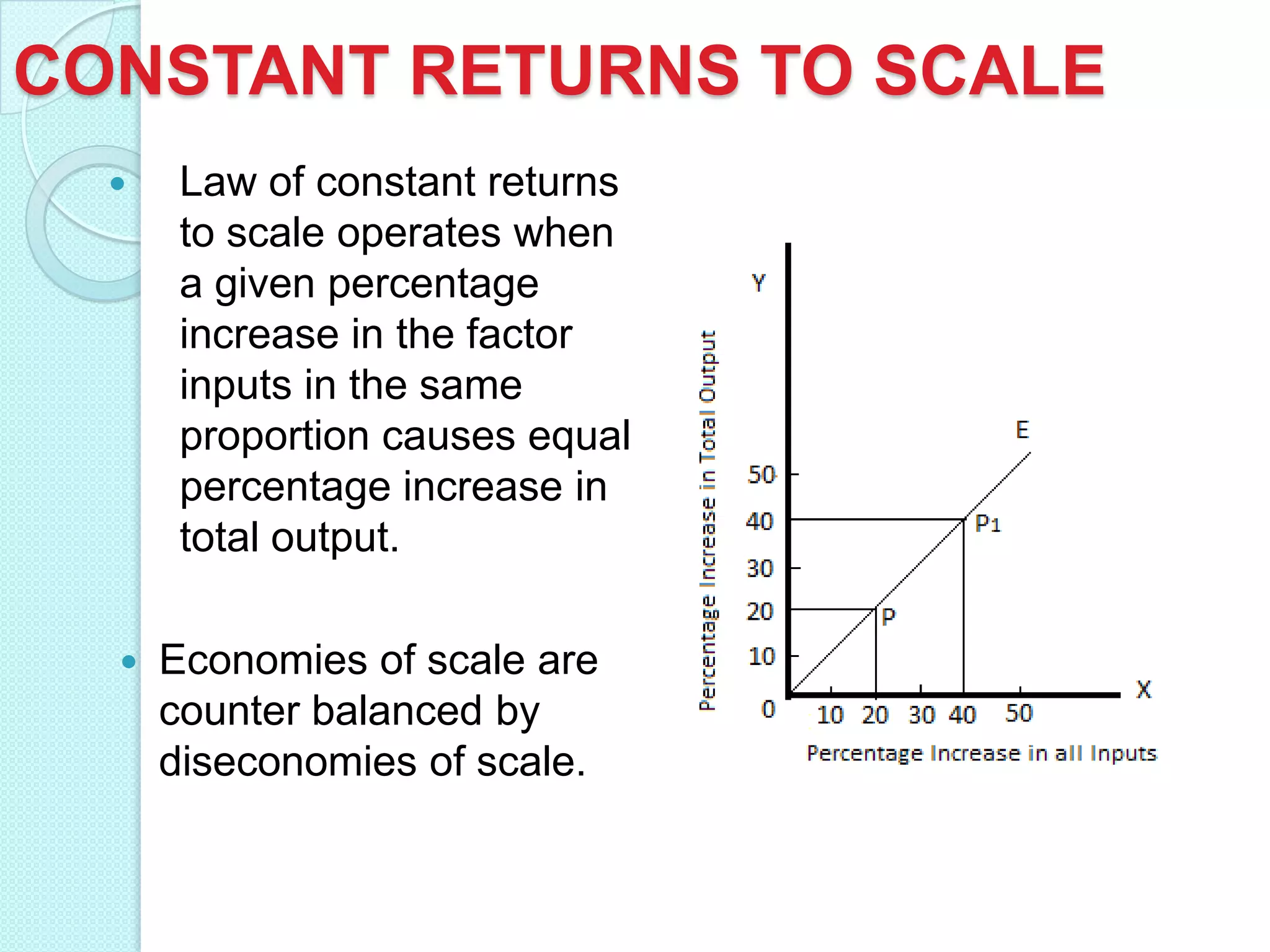
CONSTANT RETURNS TO SCALE




Law of constant returns
to scale operates when
a given percentage
increase in the factor
inputs in the same
proportion causes equal
percentage increase in
total output.
Economies of scale are
counter balanced by
diseconomies of scale.
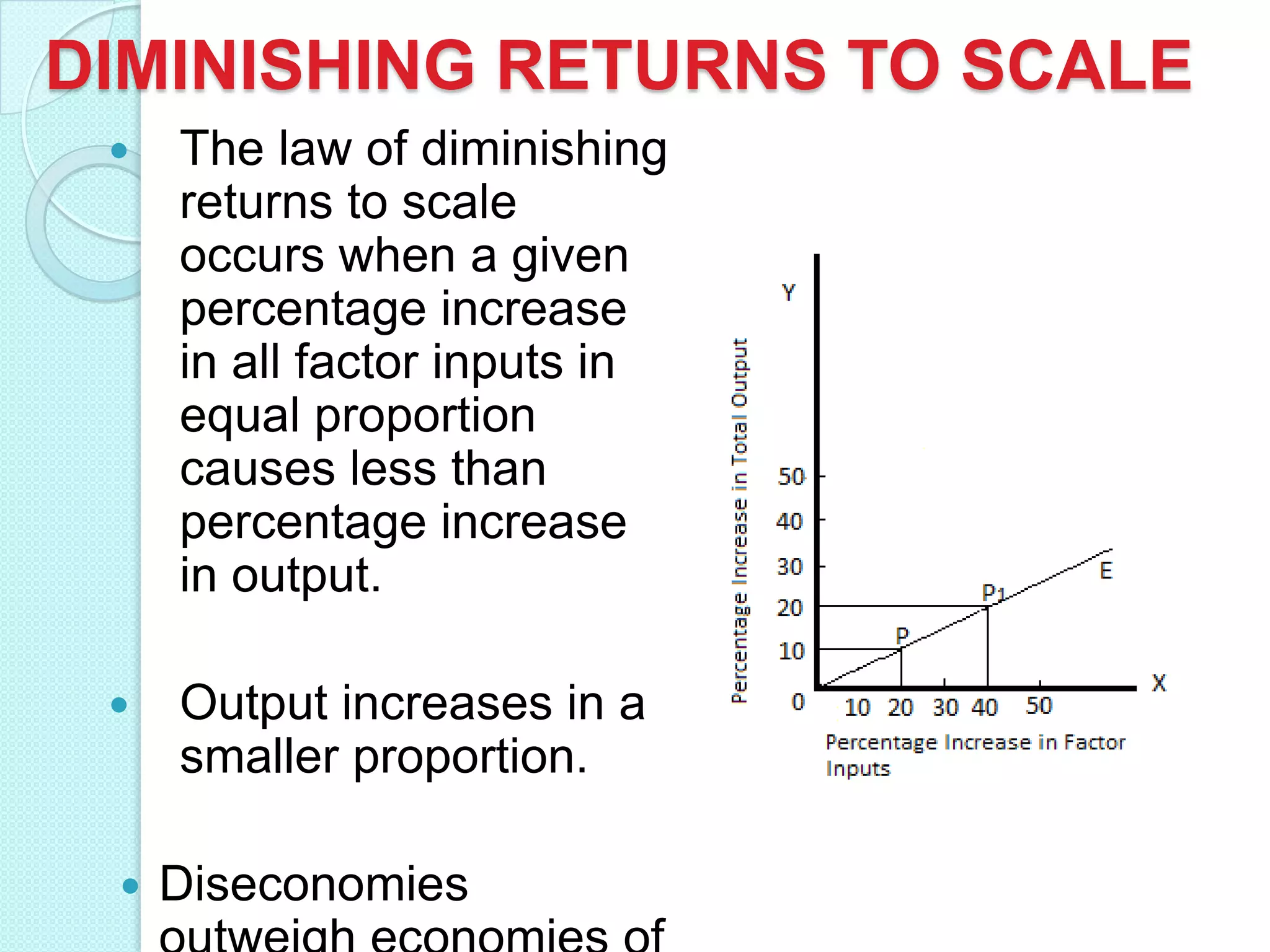
DIMINISHING RETURNS TO SCALE


The law of diminishing
returns to scale
occurs when a given
percentage increase
in all factor inputs in
equal proportion
causes less than
percentage increase
in output.



Output increases in a
smaller proportion.



Diseconomies
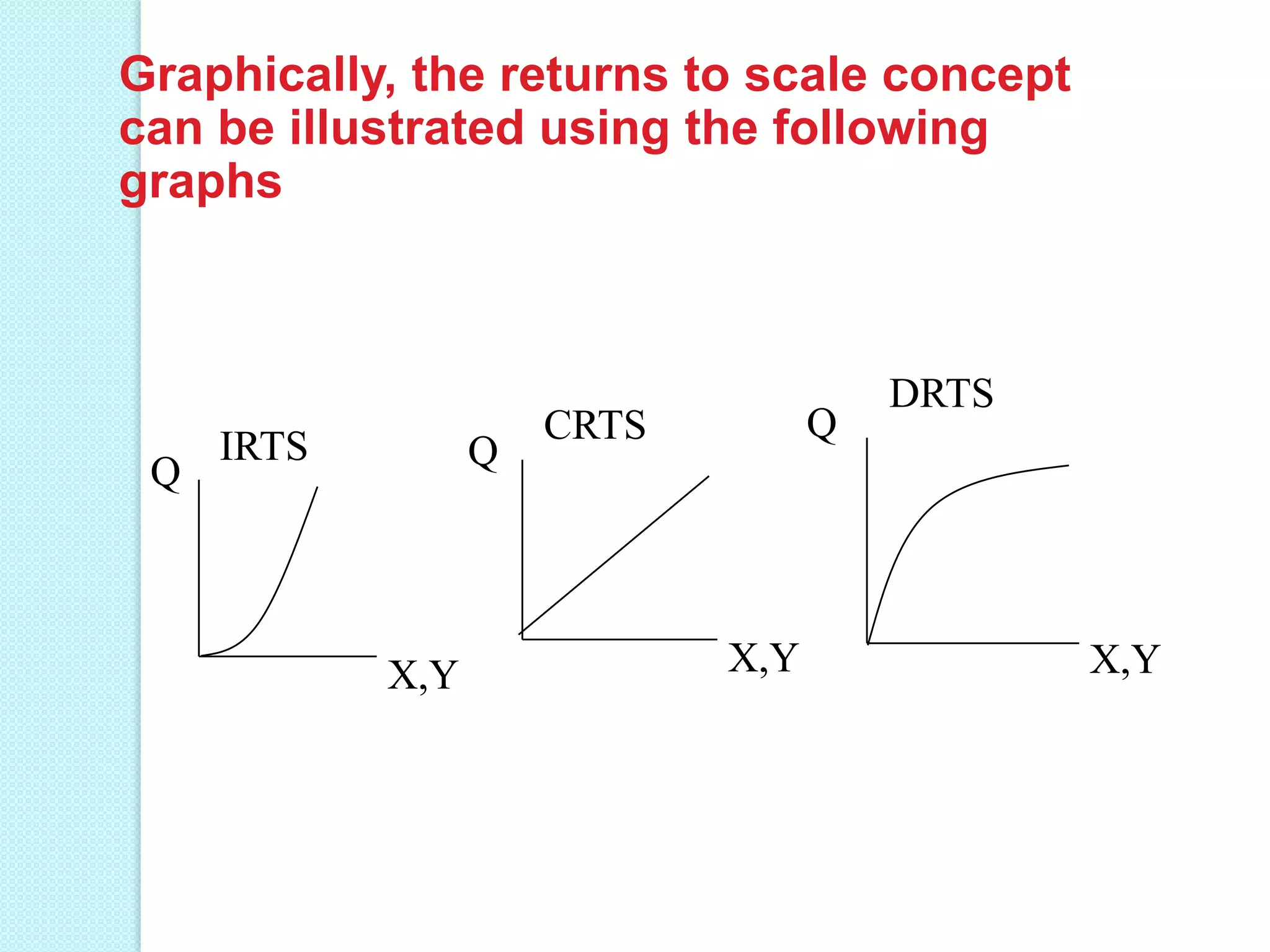
Graphically, the returns to scale concept
can be illustrated using the following
graphs

Q

IRTS

Q

X,Y

Q

CRTS

X,Y

DRTS

X,Y
Production Isoquants/ isoquant
curve/iso-product curve
• In the long run, all inputs are variable &
isoquants are used to study production
decisions
– An isoquant or iso-product curve is a curve
showing all possible input combinations
capable of producing a given level of output
– Isoquants are downward sloping; if greater
amounts of labor are used, less capital is
required to produce a given output
47
Isoquant
a

curve showing all possible efficient
combinations of input that are capable of
producing a certain quantity of output
(Note:

iso means same, so isoquant means
same quantity)
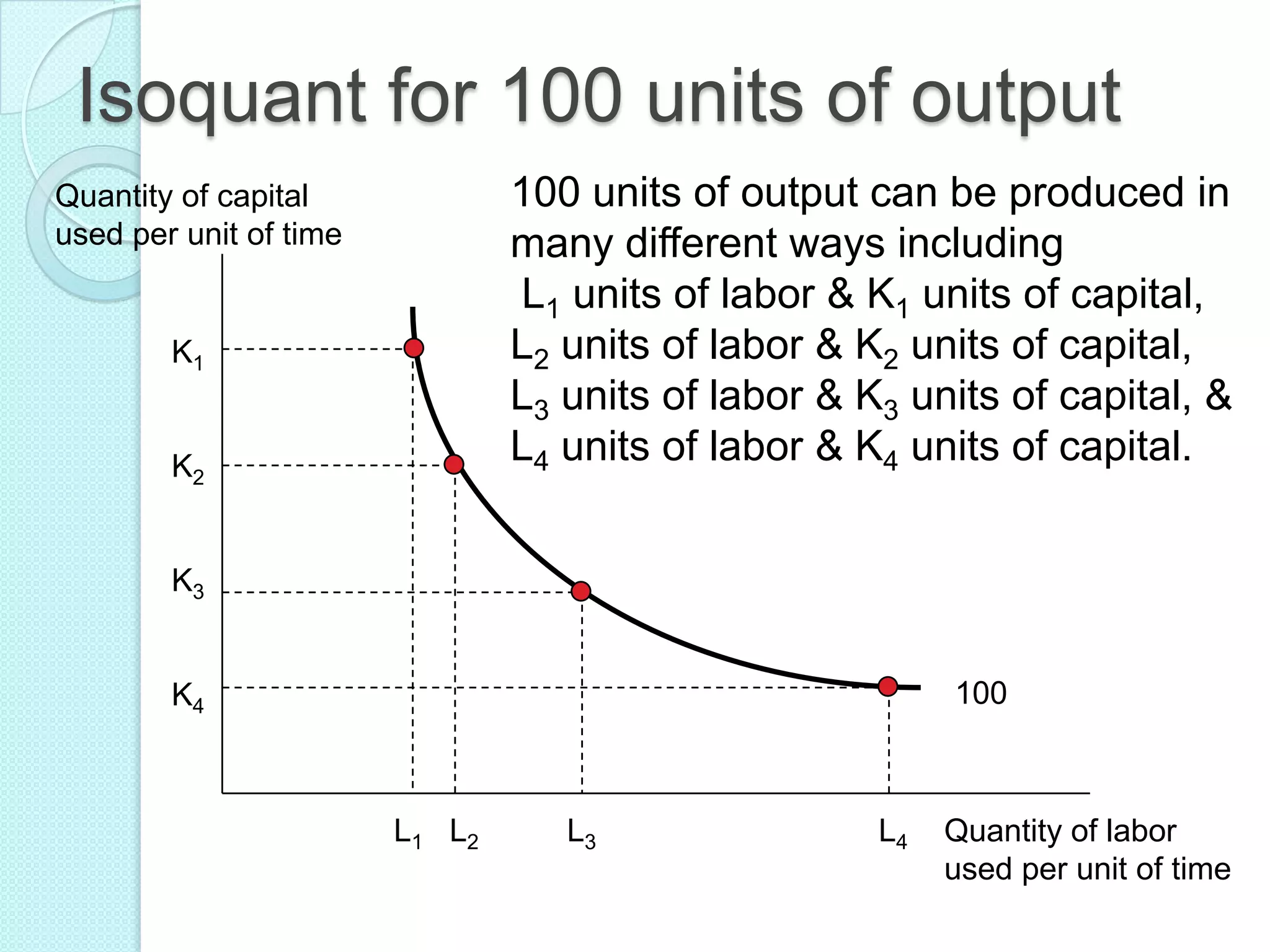
Isoquant for 100 units of output
100 units of output can be produced in
many different ways including
L1 units of labor & K1 units of capital,
L2 units of labor & K2 units of capital,
L3 units of labor & K3 units of capital, &
L4 units of labor & K4 units of capital.

Quantity of capital
used per unit of time

K1
K2
K3

100

K4

L1 L2

L3

L4

Quantity of labor
used per unit of time
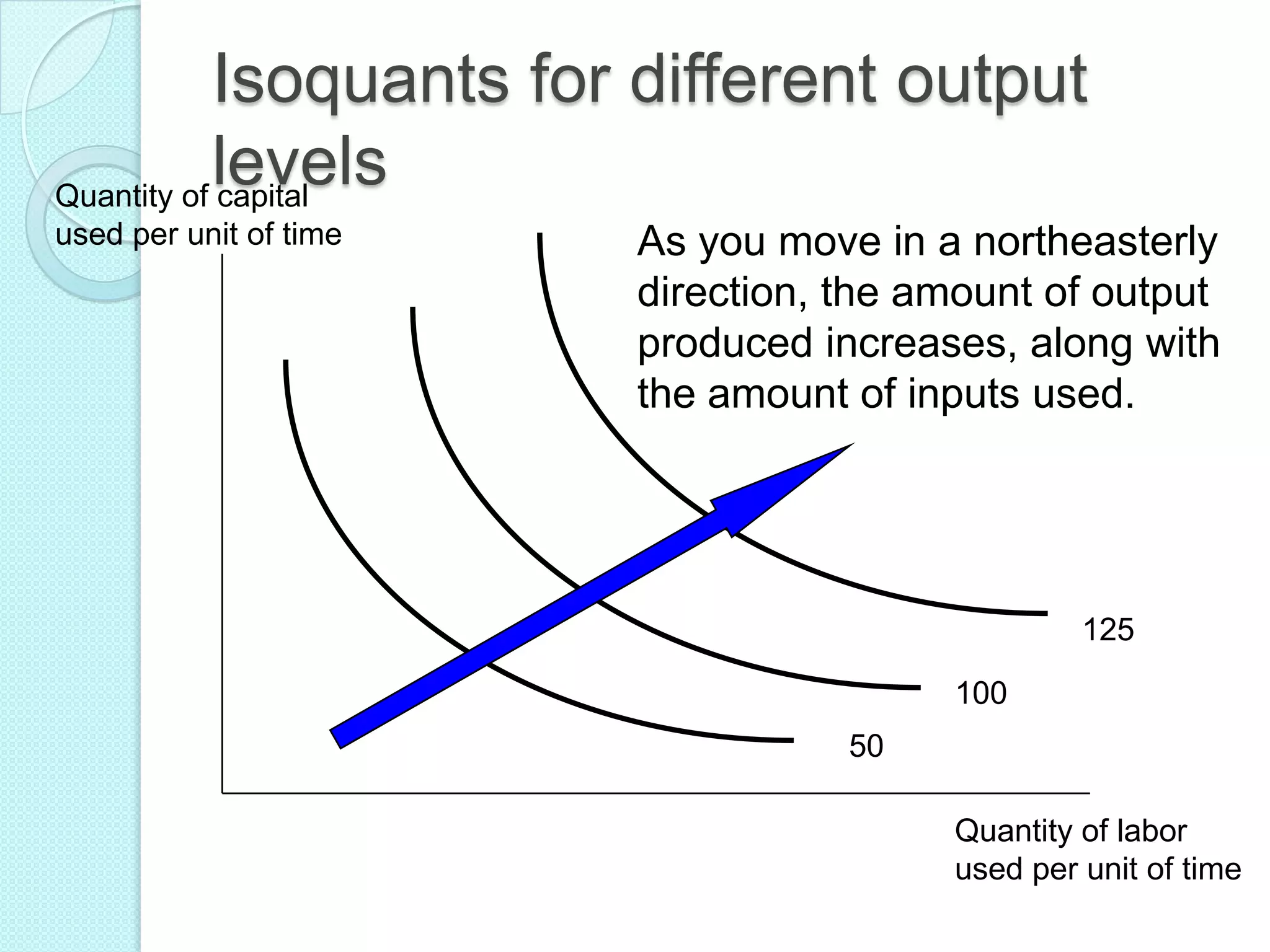
Isoquants for different output
levels
Quantity of capital
used per unit of time

As you move in a northeasterly
direction, the amount of output
produced increases, along with
the amount of inputs used.

125
100

50
Quantity of labor
used per unit of time
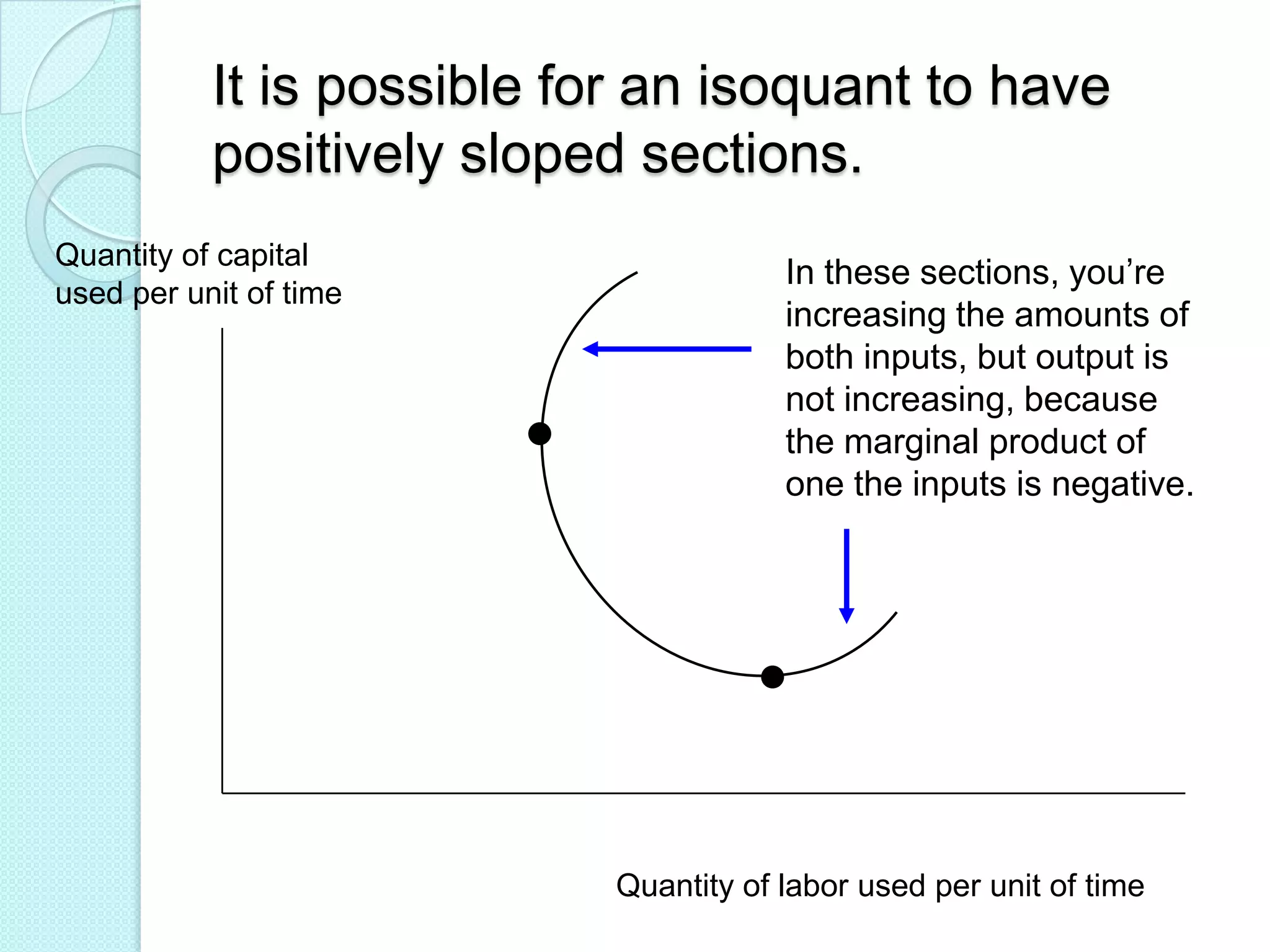
It is possible for an isoquant to have
positively sloped sections.
Quantity of capital
used per unit of time

In these sections, you’re
increasing the amounts of
both inputs, but output is
not increasing, because
the marginal product of
one the inputs is negative.

Quantity of labor used per unit of time
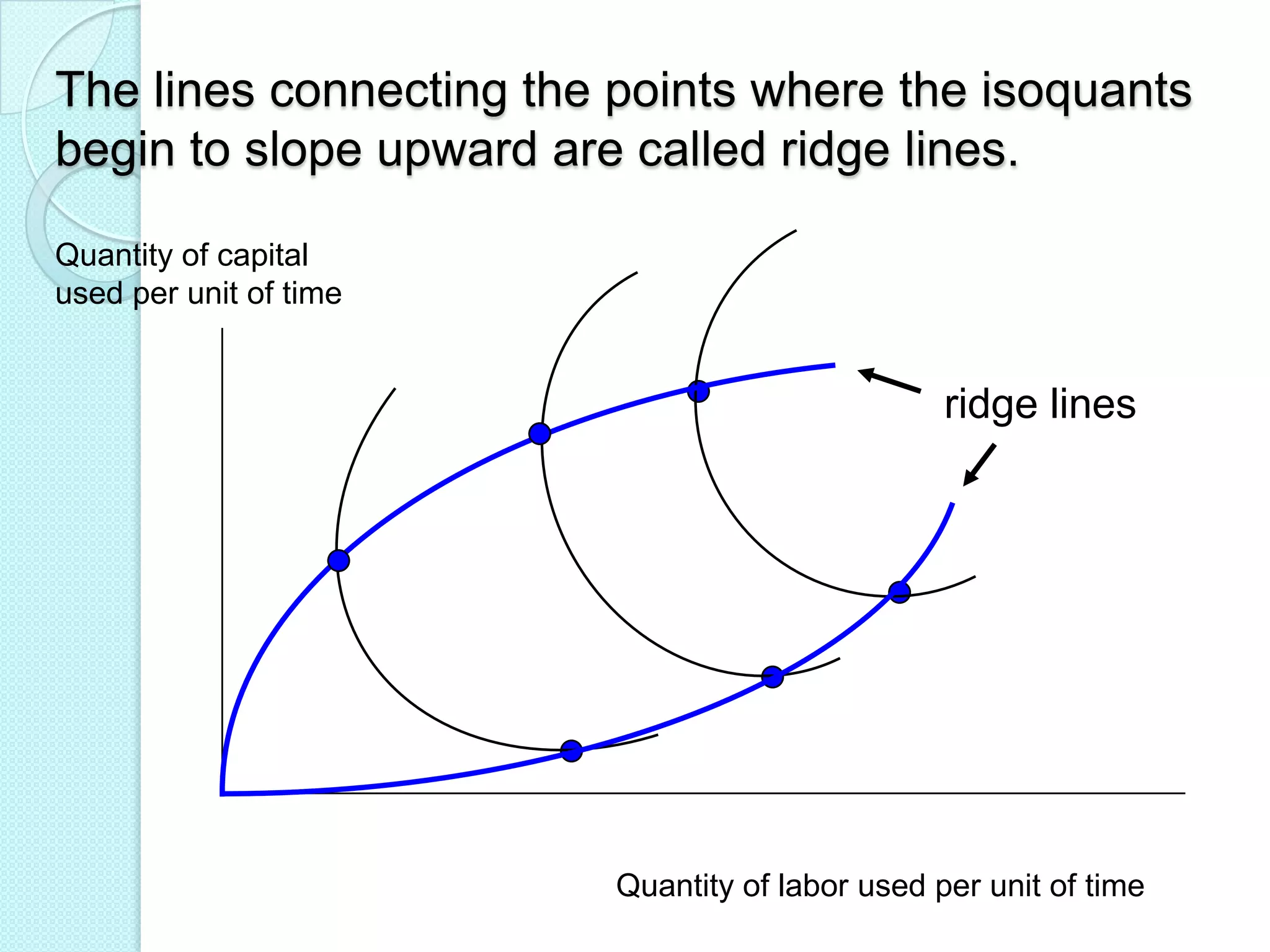
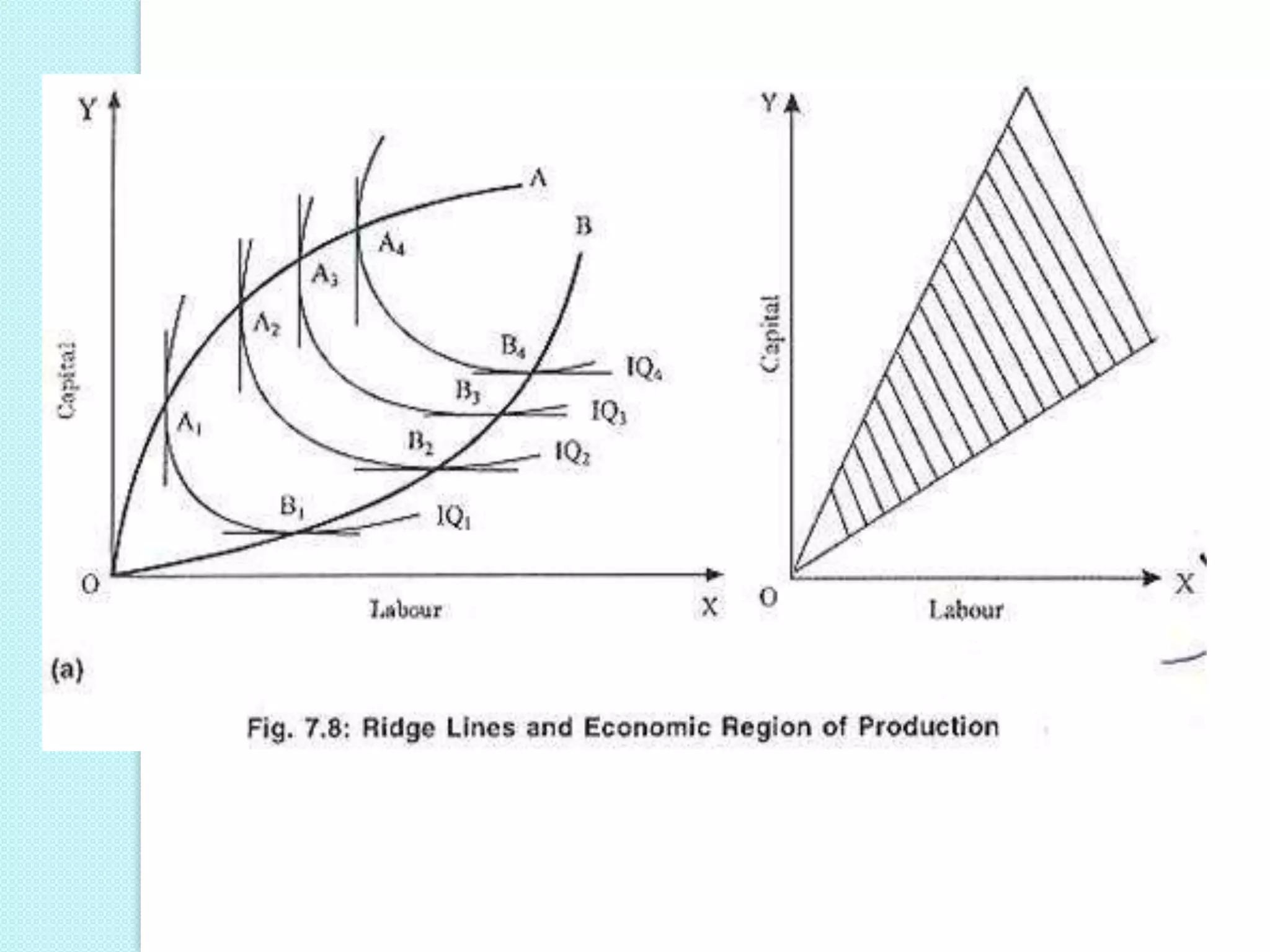
The lines connecting the points where the isoquants
begin to slope upward are called ridge lines.
Quantity of capital
used per unit of time

ridge lines

Quantity of labor used per unit of time
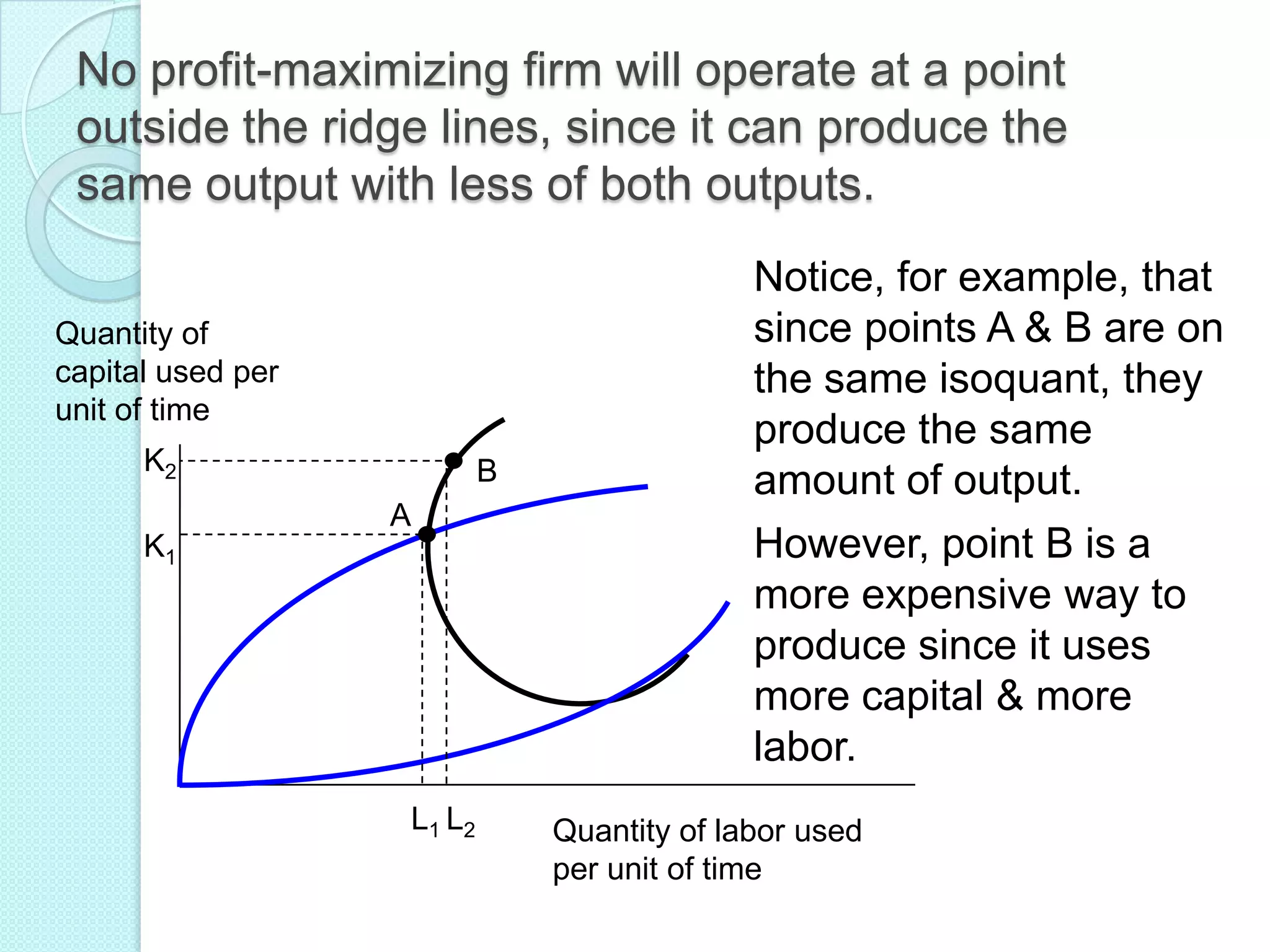
No profit-maximizing firm will operate at a point
outside the ridge lines, since it can produce the
same output with less of both outputs.
Quantity of
capital used per
unit of time
K2

B
A

K1

L1 L2

Notice, for example, that
since points A & B are on
the same isoquant, they
produce the same
amount of output.

However, point B is a
more expensive way to
produce since it uses
more capital & more
labor.
Quantity of labor used
per unit of time
Marginal rate of technical substitution
(MRTS)
The slope of the isoquant
The rate at which you can trade off inputs
and still produce the same amount of output.
For example, if you can decrease the
amount of capital by 1 unit while increasing
the amount of labor by 3 units, & still
produce the same amount of output, the
marginal rate of technical substitution is 1/3.
Marginal Rate of Technical
Substitution (MRTS)
or slope of an isoquant
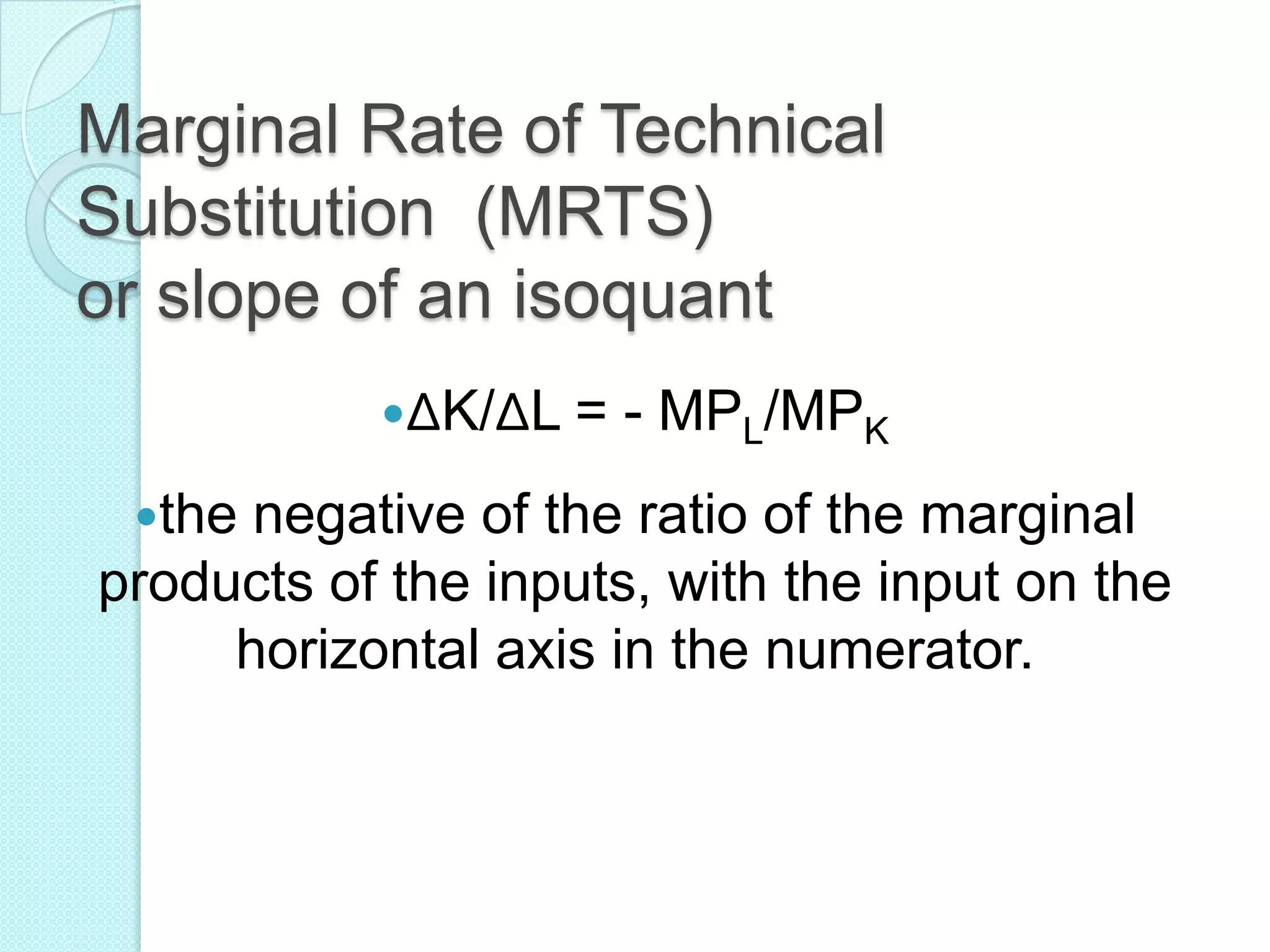
ΔK/ΔL =
the

- MPL/MPK

negative of the ratio of the marginal
products of the inputs, with the input on the
horizontal axis in the numerator.
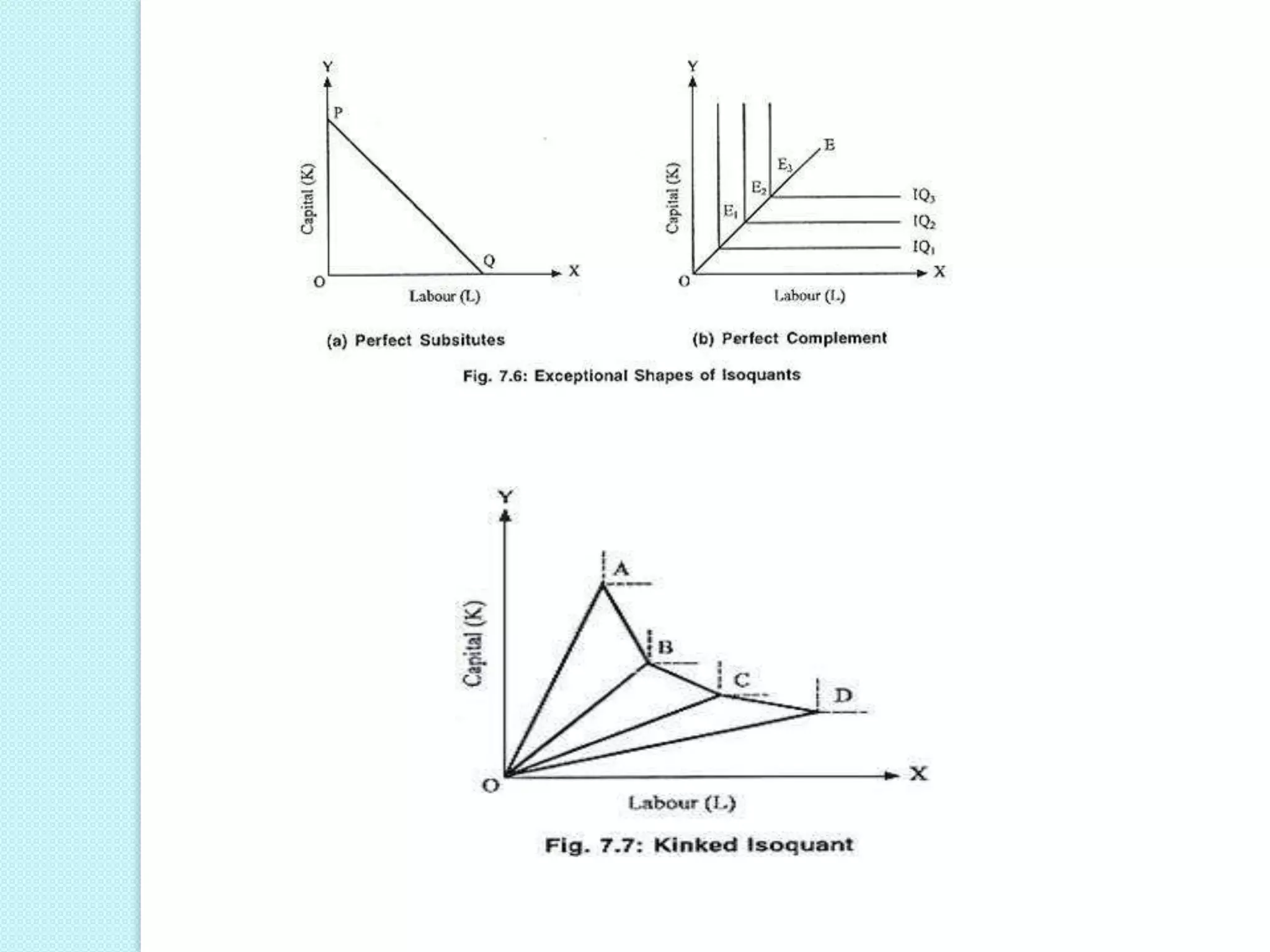
Other types of Isoquants
Linear Isoquants
 L- shaped Isoquants
 Kinked Isoquants

How does output respond to changes in
scale in the long run?
Three possibilities:
 1. Constant returns to scale
 2. Increasing returns to scale
 3. Decreasing returns to scale

Constant returns to scale


Doubling inputs results in double the
output.
Constant returns to scale
Attributed to the limits of the
economies of scale.
 When economies of scale reach their
limits and diseconomies of scale are
yet to begin, returns to scale become
constant.

Increasing returns to scale
Doubling

inputs results in more than double
the output.
One reason this may occur is that a firm
may be able to use production techniques
that it could not use in a smaller operation.
Decreasing returns to scale
Doubling

inputs results in less than double
the output.
One reason this may occur is the difficulty
in coordinating large organizations (more
paper work, red tape, etc.)
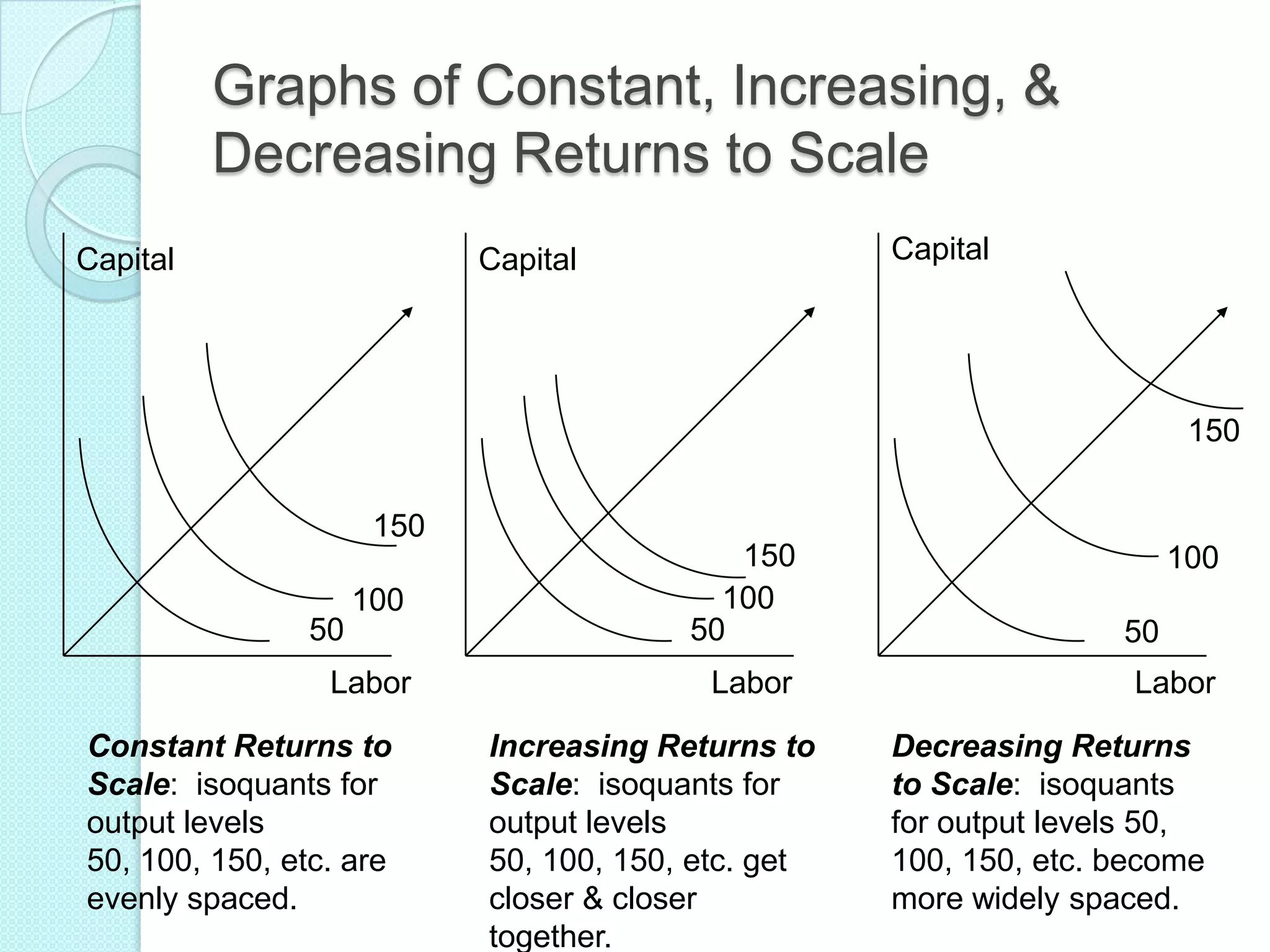
Graphs of Constant, Increasing, &
Decreasing Returns to Scale
Capital

Capital

Capital

150
150
100
50
Labor

Constant Returns to
Scale: isoquants for
output levels
50, 100, 150, etc. are
evenly spaced.

150
100
50
Labor

Increasing Returns to
Scale: isoquants for
output levels
50, 100, 150, etc. get
closer & closer
together.

100
50
Labor

Decreasing Returns
to Scale: isoquants
for output levels 50,
100, 150, etc. become
more widely spaced.
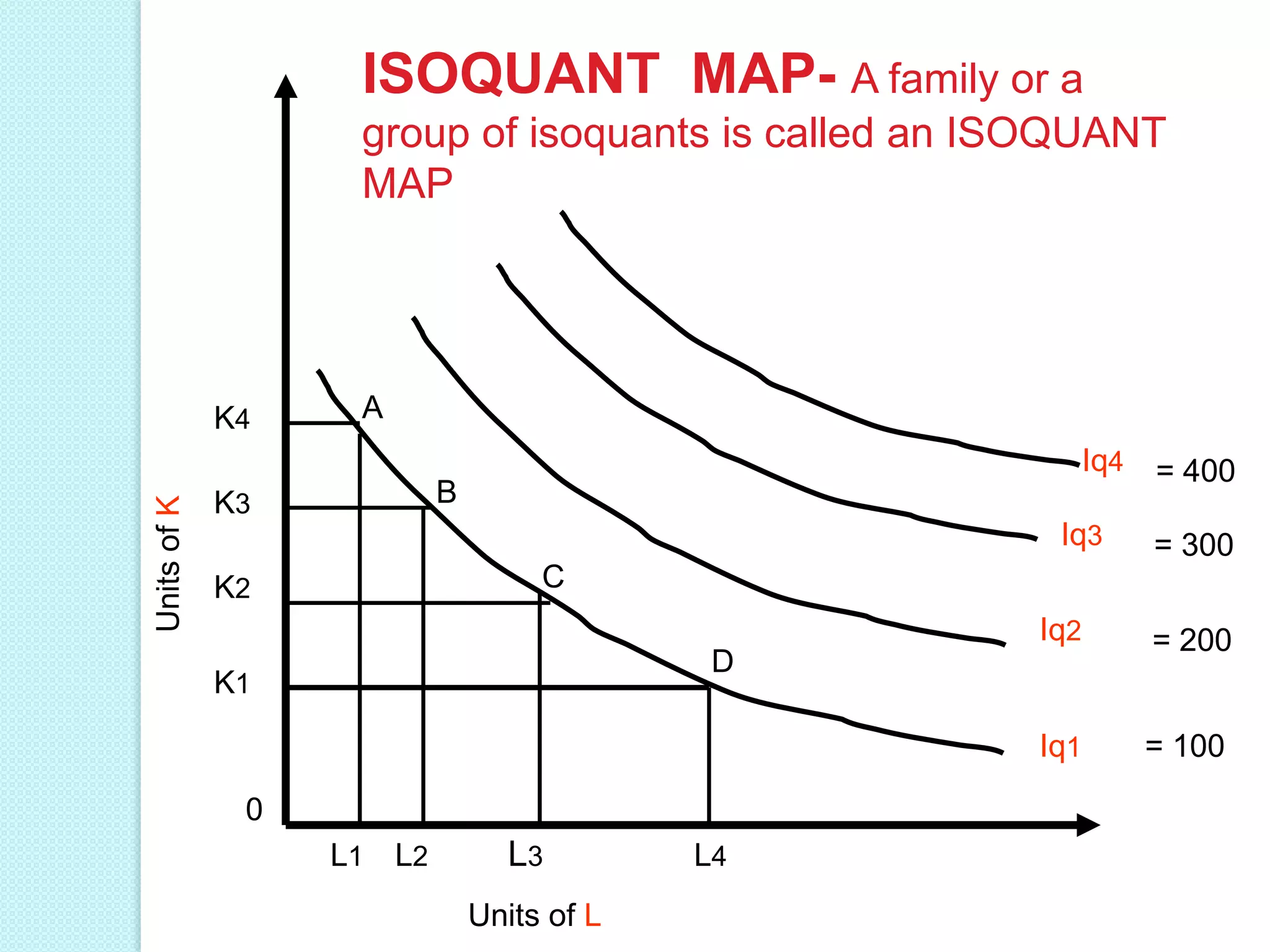
ISOQUANT MAP- A family or a
group of isoquants is called an ISOQUANT
MAP

K4

A

Units of K

Iq4
B

K3

Iq3

= 400

= 300

C

K2

Iq2

= 200

Iq1

= 100

D

K1

0
L1 L2

L3
Units of L

L4
Capital, K (machines rented)

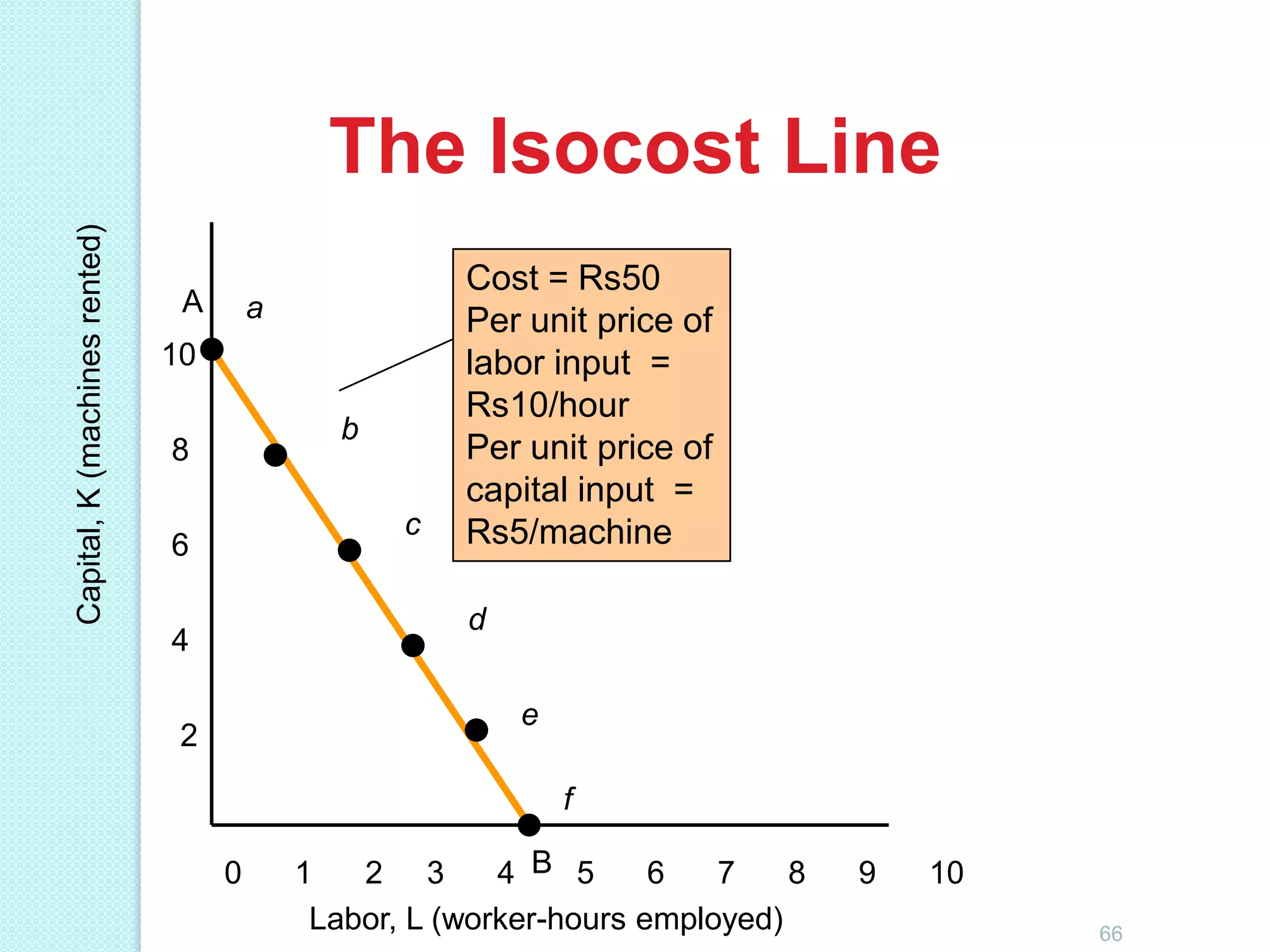
The Isocost Line
A

a

10
b

8

c

6

Cost = Rs50
Per unit price of
labor input =
Rs10/hour
Per unit price of
capital input =
Rs5/machine
d

4

e

2

f
0

1
2 3
4 B 5
6
7
8
Labor, L (worker-hours employed)

9

10
66
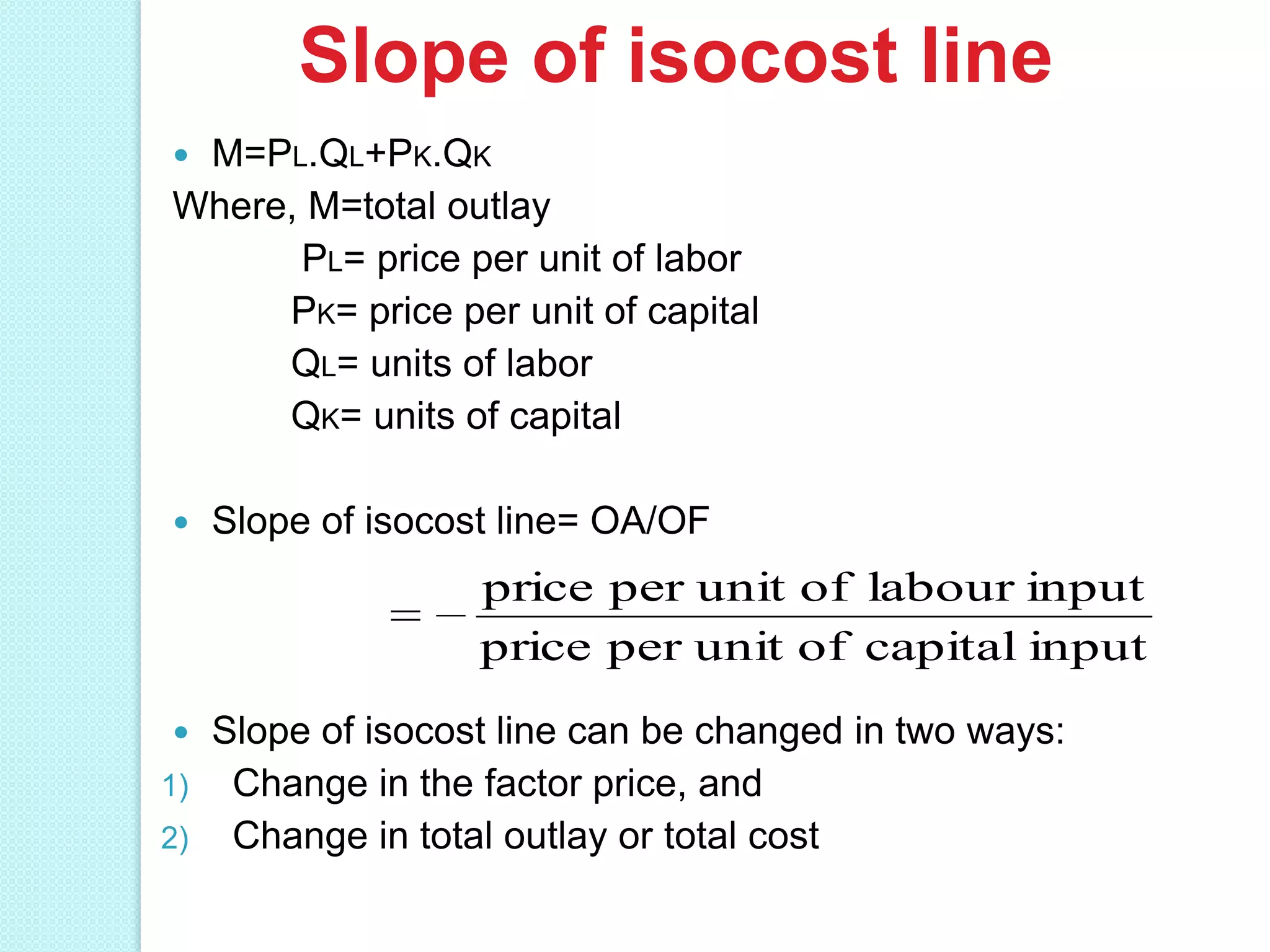
Slope of isocost line
M=PL.QL+PK.QK
Where, M=total outlay
PL= price per unit of labor
PK= price per unit of capital
QL= units of labor
QK= units of capital




Slope of isocost line= OA/OF

price per unit of labour input
price per unit of capital input
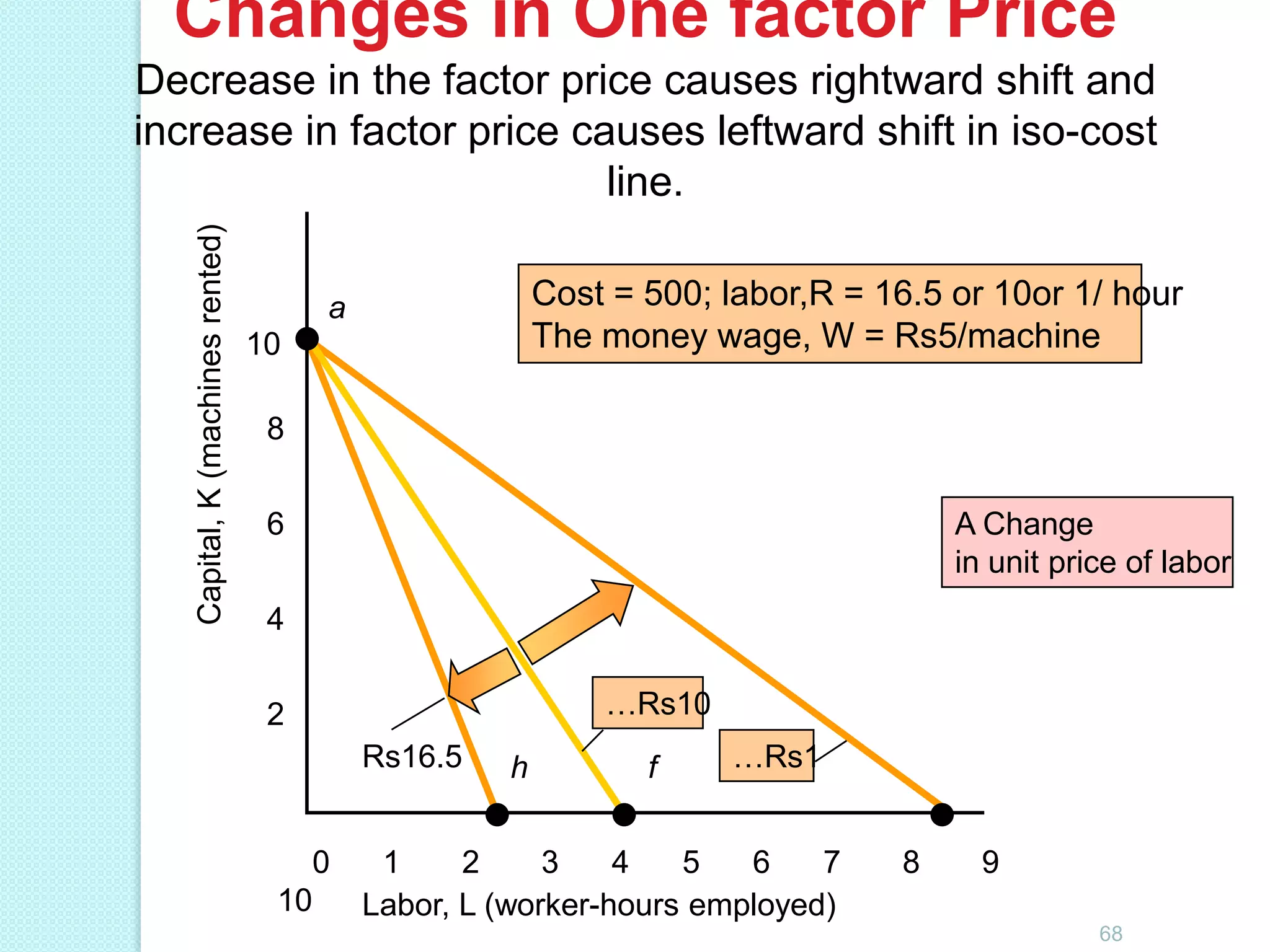
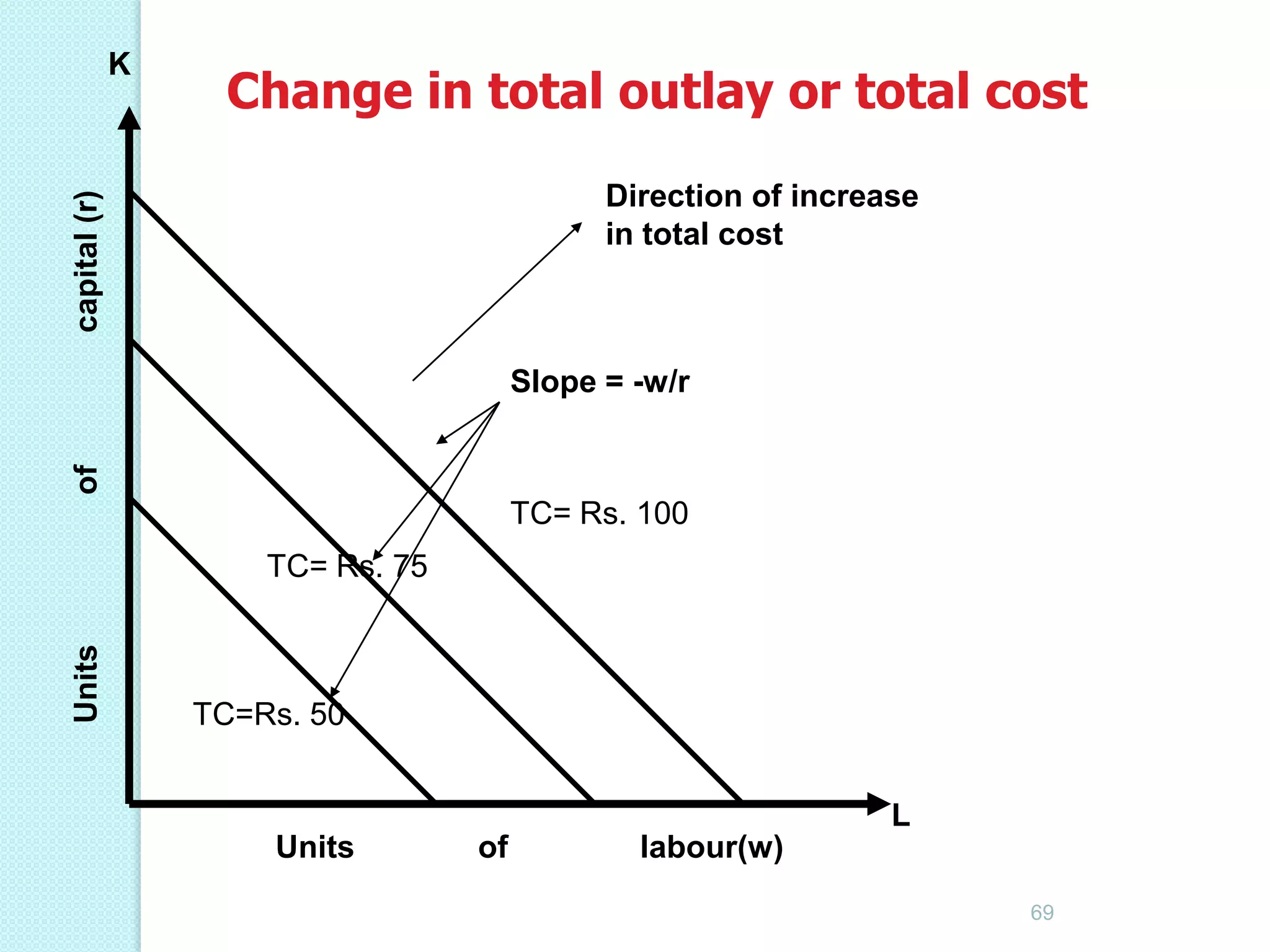
Slope of isocost line can be changed in two ways:
1) Change in the factor price, and
2) Change in total outlay or total cost

Changes in One factor Price
Capital, K (machines rented)

Decrease in the factor price causes rightward shift and
increase in factor price causes leftward shift in iso-cost
line.
Cost = 500; labor,R = 16.5 or 10or 1/ hour
The money wage, W = Rs5/machine

a
10
8

6

A Change
in unit price of labor

4
…Rs10

2

Rs16.5
0
10

h

f

…Rs1

1
2
3
4
5
6
7
Labor, L (worker-hours employed)

8

9
68
Change in total outlay or total cost
Direction of increase
in total cost

capital (r)

K

of

Slope = -w/r

TC= Rs. 100

Units

TC= Rs. 75

TC=Rs. 50
L
Units

of

labour(w)
69
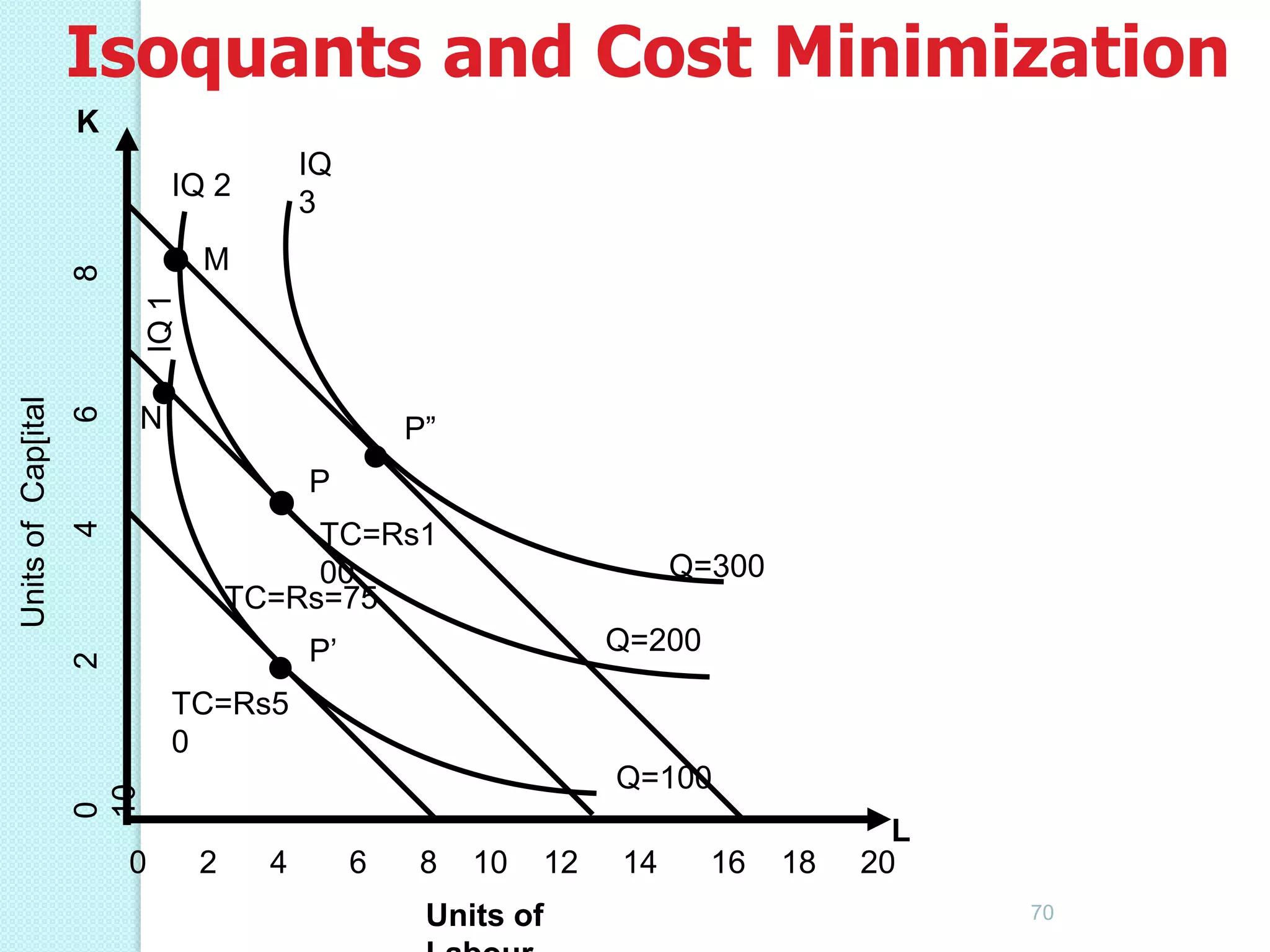
Isoquants and Cost Minimization
K
IQ
3

IQ 2
M

•

4

6

•

N

P

•

P”

TC=Rs1
00
TC=Rs=75

2

•

Q=300
Q=200

P’

TC=Rs5
0

Q=100

0
10

Units of Cap[ital

IQ 1

8

•

0

2

4

6

8

10

12

Units of

14

16

18

L
20
70
Optimization & Cost
•

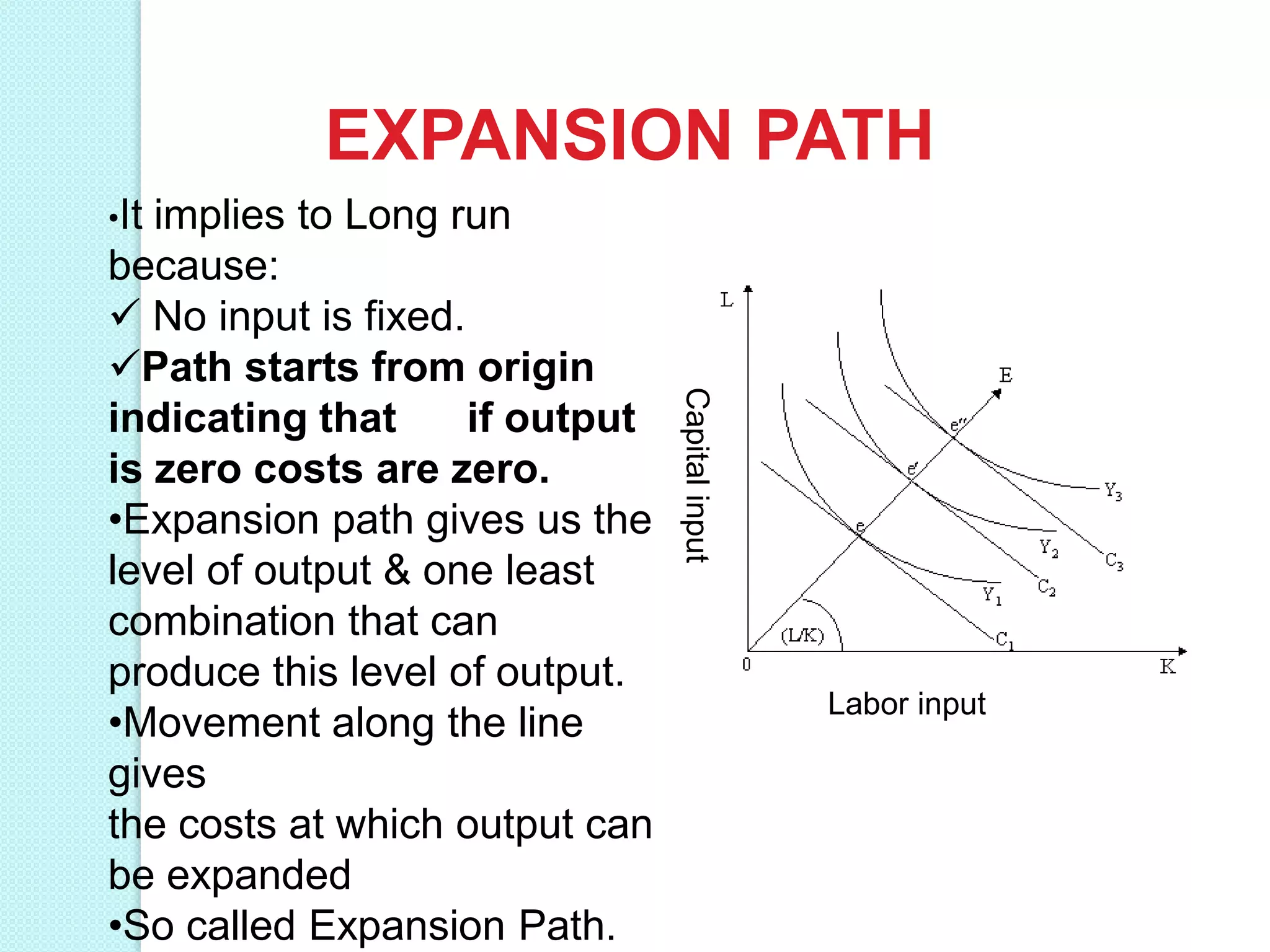
Expansion path gives the efficient
(least-cost) input combinations of labor
and capital
needed for every level of
output.
Derived for a specific set of input prices
Along expansion path, input-price ratio is
constant & equal to the marginal rate of
technical substitution
• It is defined as the locus of tangency points
between iso-cost lines and isoquants.

71
EXPANSION PATH
•It

Capital input

implies to Long run
because:
 No input is fixed.
Path starts from origin
indicating that
if output
is zero costs are zero.
•Expansion path gives us the
level of output & one least
combination that can
produce this level of output.
•Movement along the line
gives
the costs at which output can
be expanded
•So called Expansion Path.

Labor input
Estimation of production function – Cobb
Douglas Production Function
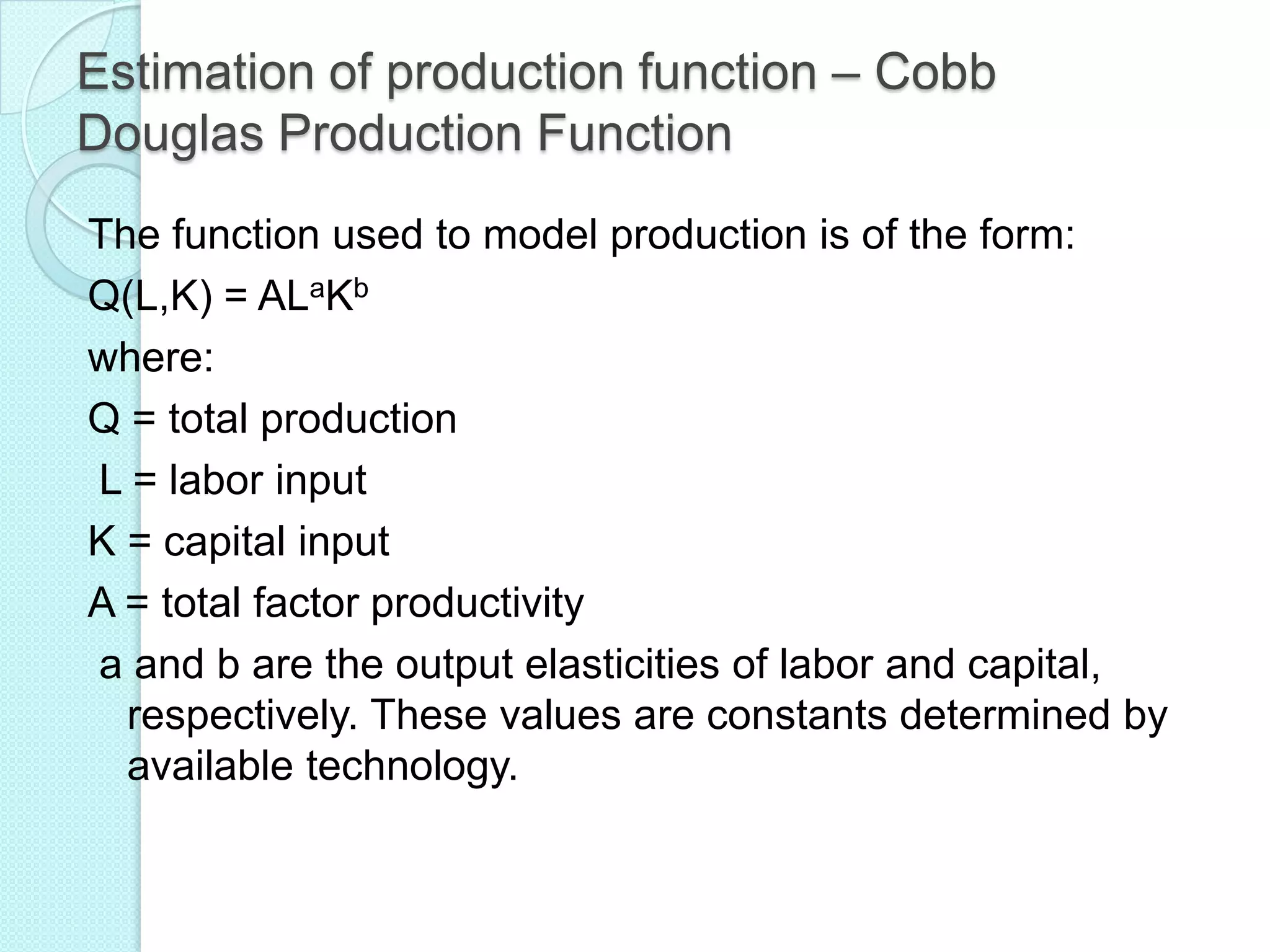
The function used to model production is of the form:
Q(L,K) = ALaKb
where:
Q = total production
L = labor input
K = capital input
A = total factor productivity
a and b are the output elasticities of labor and capital,
respectively. These values are constants determined by
available technology.
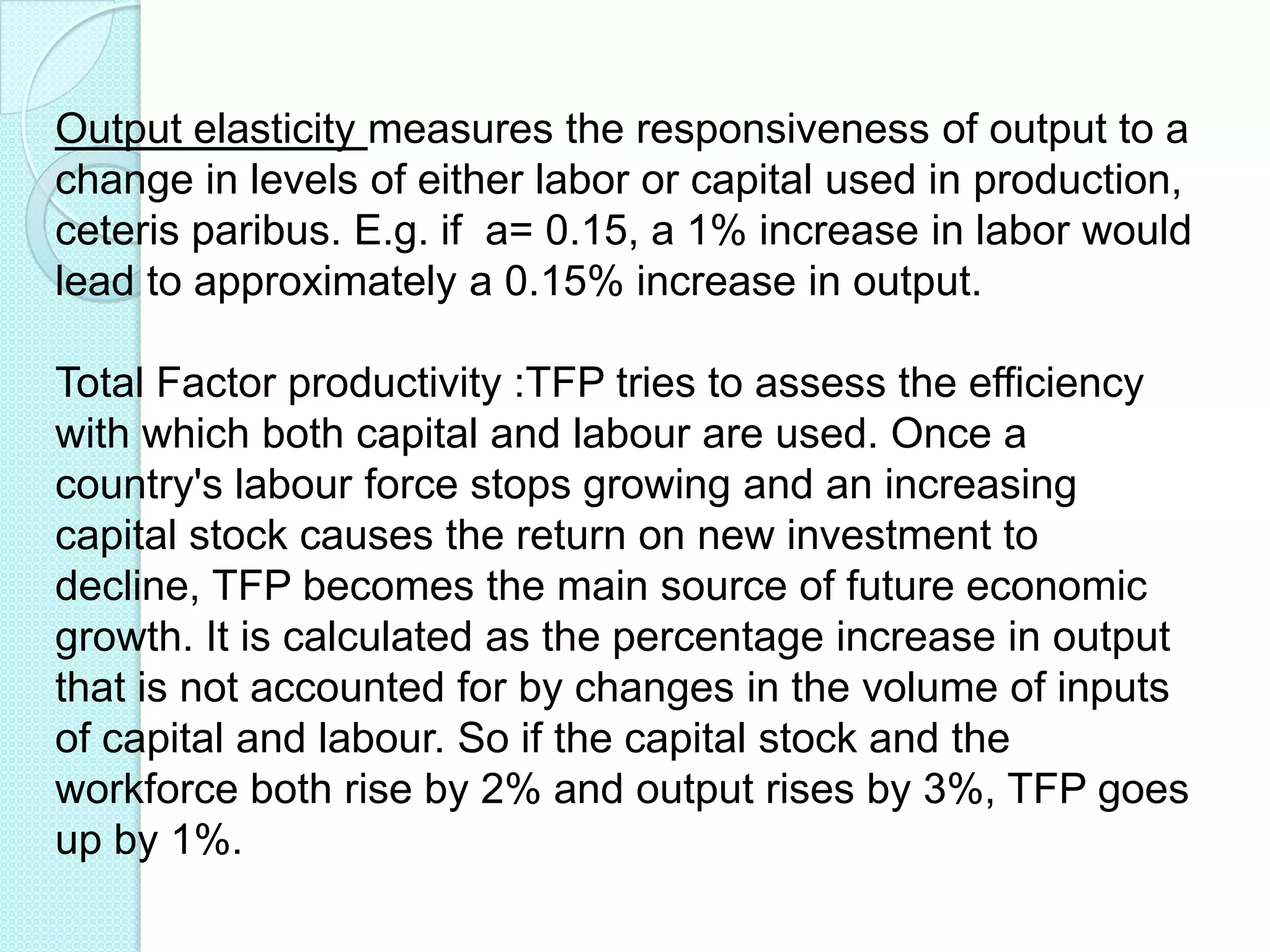
Output elasticity measures the responsiveness of output to a
change in levels of either labor or capital used in production,
ceteris paribus. E.g. if a= 0.15, a 1% increase in labor would
lead to approximately a 0.15% increase in output.
Total Factor productivity :TFP tries to assess the efficiency
with which both capital and labour are used. Once a
country's labour force stops growing and an increasing
capital stock causes the return on new investment to
decline, TFP becomes the main source of future economic
growth. It is calculated as the percentage increase in output
that is not accounted for by changes in the volume of inputs
of capital and labour. So if the capital stock and the
workforce both rise by 2% and output rises by 3%, TFP goes
up by 1%.
Returns to scale based on Cobb
Douglas function
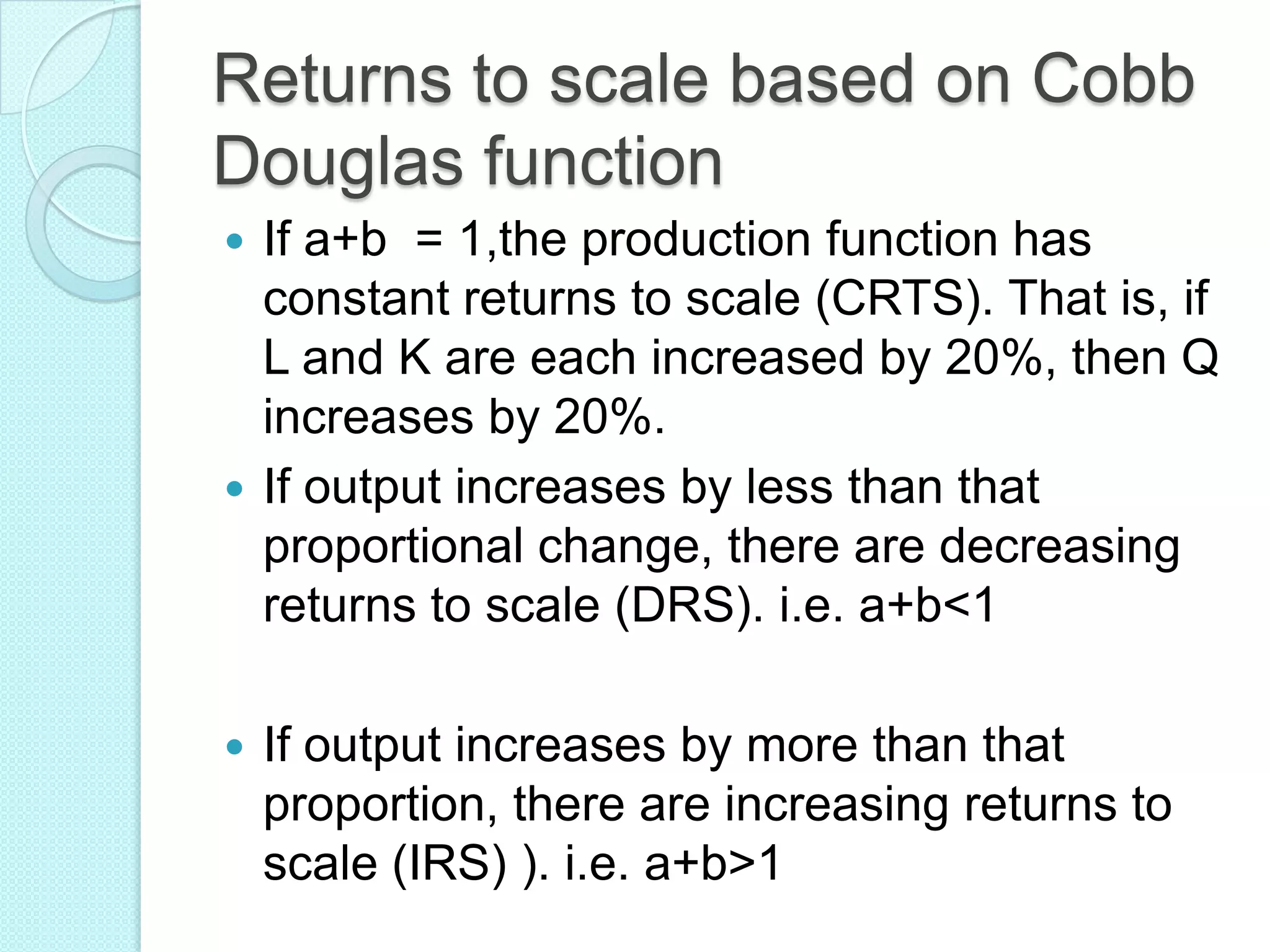
If a+b = 1,the production function has
constant returns to scale (CRTS). That is, if
L and K are each increased by 20%, then Q
increases by 20%.
 If output increases by less than that
proportional change, there are decreasing
returns to scale (DRS). i.e. a+b<1




If output increases by more than that
proportion, there are increasing returns to
scale (IRS) ). i.e. a+b>1
Leontif Production function
Capital and labor are perfect
complements.
 Capital and labor are used in fixedproportions.
 Q = min {bK, cL}
 Since capital and labor are consumed
in fixed proportions there is no input
substitution along isoquants (hence,
no MRTSKL).


Production function

  • 1.
  • 2.
    Production  An entrepreneur mustput together resources -- land, labour, capital -- and produce a product people will be willing and able to purchase
  • 3.
    Theory of Productionand Costs Focus- mainly on the the firm.  We will examine  ◦ Its production capacity given available resources ◦ the related costs involved
  • 4.
    What is afirm? A firm is an entity concerned with the purchase and employment of resources in the production of various goods and services.  Assumptions:  ◦ the firm aims to maximize its profit with the use of resources that are substitutable to a certain degree ◦ the firm is" a price taker in terms of the resources it uses.
  • 5.
    What Is ProductionFunction  Production function deals with the maximum output that can be produced with a limited and given quantity of inputs.  The production function is dependent on different time frames. Firms can produce for a brief or lengthy period of time.
  • 6.
    Production Function Mathematical representation ofthe relationship:  Q = f (K, L, La)  Output (Q) is dependent upon the amount of capital (K), Land (L) and Labour (La) used 
  • 7.
    ASSUMPTIONS THE PRODUCTION FUNCTIONSARE BASED ON CERTAIN ASSUMPTIONS 1. Perfect divisibility of both inputs and outputs 2. Limited substitution of one factor for another 3. Constant technology 4. Inelastic supply of fixed factors in the short run
  • 8.
    THE LAWS OFPRODUCTION LAWS OF VARIABLE PROPORTIONS LAWS OF RETURNS TO SCALE Relates to the study of input output relationship in the short run with one variable input while other inputs are held constant Relates to the study of input output relationship in the long run assuming all inputs to be variable
  • 9.
    Firm’s Inputs  Inputs -are resources that contribute in the production of a commodity.  Most resources are lumped into three categories: ◦ Land, ◦ Labor, ◦ Capital.
  • 10.
    Fixed vs. VariableInputs Fixed inputs -resources used at a constant amount in the production of a commodity.  Variable inputs - resources that can change in quantity depending on the level of output being produced.  The longer planning the period, the distinction between fixed and variable inputs disappears, i.e., all inputs are variable in the long run. 
  • 11.
    Production Analysis withOne Variable Input Total product (Q) refers to the total amount of output produced in physical units (may refer to, kilograms of sugar, sacks of rice produced, etc)  The marginal product (MP) refers to the rate of change in output as an input is changed by one unit, holding all other inputs constant.  MPL TPL L
  • 12.
    Total vs. MarginalProduct Total Product (TPx) = total amount of output produced at different levels of inputs  Marginal Product (MPx) = rate of change in output as input X is increased by one unit, ceteris paribus.  MPX TPX X
  • 13.
    Production Function ofa Rice Farmer Units of L Total Product (QL or TPL) Marginal Product (MPL) 0 0 - 1 2 2 2 6 4 3 12 6 4 20 8 5 26 6 6 30 4 7 32 2 8 32 0 9 30 -2 10 26 -4
  • 14.
    QL 32 30 Total product 26 QL 20 12 6 2 L 0 1 2 3 4 5 6 7 8 9 10 Labor FIGURE 5.1.Total product curve. The total product curve shows the behavior of total product vis-a-vis an input (e.g., labor) used in production assuming a certain technological level.
  • 15.
    Marginal Product The marginalproduct refers to the rate of change in output as an input is changed by one unit, holding all other inputs constant.  Formula:  MPL TPL L
  • 16.
    Marginal Product Observe thatthe marginal product initially increases, reaches a maximum level, and beyond this point, the marginal product declines, reaches zero, and subsequently becomes negative.  The law of diminishing returns states that "as the use of an input increases (with other inputs fixed), a point will eventually be reached at which the resulting additions to output decrease" 
  • 17.
    Total and MarginalProduct 35 30 25 TPL 20 15 10 5 MPL 0 0 -5 -10 1 2 3 4 5 6 7 8 9
  • 18.
    Law of DiminishingMarginal Returns As more and more of an input is added (given a fixed amount of other inputs), total output may increase; however, the additions to total output will tend to diminish.  Counter-intuitive proof: if the law of diminishing returns does not hold, the world’s supply of food can be produced in a hectare of land. 
  • 19.
    Average Product (AP) Averageproduct is a concept commonly associated with efficiency.  The average product measures the total output per unit of input used.  ◦ The "productivity" of an input is usually expressed in terms of its average product. ◦ The greater the value of average product, the higher the efficiency in physical terms.  Formula: APL TPL L
  • 20.
    TABLE 5.2. Average productof labor. Labor (L) Total product of labor (TPL) Average product of labor (APL) 0 0 0 1 2 2 2 6 3 3 12 4 4 20 5 5 26 5.2 6 30 5 7 32 4.5 8 32 4 9 30 3.3 10 26 2.6
  • 21.
    The slope ofthe line from the origin is a measure of the AVERAGE Y Slope = rise run Y L b a Y Rise = Y 0 Run = L L1 L2 L
  • 22.
    Total Product The average productat b is highest. AP at c is less than at a. Q AP at d is less than at c. b c d QL a 0 L
  • 23.
    Q Highest Slope ofLine from Origin Max APL Inflection point TPL Max MPL 0 L1 L2 L3 L
  • 24.
    Relationship between Averageand Marginal Curves: Rule of Thumb When the marginal is less than the average, the average decreases.  When the marginal is equal to the average, the average does not change (it is either at maximum or minimum)  When the marginal is greater than the average, the average increases 
  • 25.
    AP,MP At Max AP, MP=AP MaxMPL Max APL APL 0 L1 L2 L3 L MPL
  • 26.
    TP TPL 0 L1 L2 L3 Stage I MP>AP AP increasing AP,MP StageII MP<AP AP decreasing MP still positive L Stage III MP<0 AP decreasing APL 0 L1 L2 L3 L MPL
  • 27.
    Three Stages ofProduction  In Stage I ◦ APL is increasing so MP>AP. ◦ All the product curves are increasing ◦ Stage I stops where APL reaches its maximum at point A. ◦ MP peaks and then declines at point C and beyond, so the law of diminishing returns begins to manifest at this stage
  • 28.
    Three Stages ofProduction  Stage II ◦ starts where the APL of the input begins to decline. ◦ QL still continues to increase, although at a decreasing rate, and in fact reaches a maximum ◦ Marginal product is continuously declining and reaches zero at point D, as additional labor inputs are employed.
  • 29.
    Three Stages ofProduction Stage III starts where the MPL has turned negative. ◦ all product curves are decreasing. ◦ total output starts falling even as the input is increased
  • 30.
    The Law ofVariable Proportions • • Elaborately stating the Law : In the short run, as the amount of variable factors increases, other things remaining equal, OP(or the returns to the factors varied will increase more than proportionally to the a amount of the variable inputs in the beginning than it may increase in the same proportion and ultimately it will increase less proportionately. Assuming that the firm only varies the labour (L), it alters the proportion between the fixed input and the variable input. As this altering goes on, the firm experiences the Law of Diminishing Marginal Returns.
  • 31.
    Using the concept ofMP, During the SR, under the given state of technology and other conditions remaining unchanged, with the given fixed factors, when the units of a variable factor are increased in the production function in order to increase the TP, the TP initially may rise at an increasing rate and after a point, it tends to increase at a decreasing rate because the MP of the variable factor in the beginning may Production Schedule Units of Variable Input (Labour) (n) Total Product (TP) Average Product (AP) (TPn) Marginal Product (TPn- TPn-1) 1 20 20 20 2 50 25 30 3 90 30 40 4 120 30 30 5 135 27 15 6 144 24 9 7 147 21 3 8 148 18.5 1 9 148 16.4 0 10 145 14.5 -3 STAGE I STAGE II STAGE III
  • 32.
  • 33.
    Stages Diminishing Total returns-implies reduction in total product with every additional unit of input. Diminishing Average returns -which refers to the portion of the Average Physical Product curve after its intersection with MPP curve. Diminishing Marginal returns refers to the point where the MPP curve starts to slope down and travels all the way down to the x-axis and beyond. Putting it in a chronological order, at first the marginal returns start to diminish, then the average returns, followed finally by the total returns.
  • 34.
    Observations The L ofDMR becomes evident in the marginal product column. Initially MP of Labor rises . The TP rises at an increasing rate (= MP). Average Product also rises. Stage of increasing Returns certain point (4th unit of Labour), the MP begins to diminish. Rate of increase in the TP slows down. Stage of diminishing returns. When AP is max, AP=MP=30 at 4th unit of labour. After AS MP diminishes, it becomes zero and negative thereafter (Stage III) When MP is zero, TP is maximum. (148 is the highest amount of TP, when MP is equal to 0 when 9 units of labour are employed. When MP becomes negative, TP also starts to diminish in the same proportion but AP declines after being positive up to a certain
  • 35.
    Question Following data relatesto the quantity of tuna that could be caught with different crew sizes. No. of fisherme n Daily Tuna Catch 3 4 5 6 7 8 9 300 450 590 665 700 725 710 Indicate the points that delineate the three stages of production .
  • 36.
    Explanation of thestages The operation of the law of diminishing returns in three stages is attributed to two fundamental characteristics of factors of production: i) Indivisibility of certain fixed factors. ii) Imperfect substitutability between factors. 
  • 37.
    Marginal Revenue Productivity   The marginalrevenue productivity , also referred to as the marginal revenue product of labor and the value of the marginal product or VMPL, is the change in total revenue earned by a firm that results from employing one more unit of labor. It determines, under some conditions, the optimal number of workers to employ at an exogenously determined market wage rate. In a competitive firm, the marginal revenue product will equal the product of the price and the marginal product of labor. It is not efficient for a firm to pay its workers more than it will earn in profits from their labor
  • 38.
    Production function withone variable input Total Product: Q = 30L+20L2-L3  Average Product : Q /L  Marginal Product : MP = dQ/dL = 30+40L3L2 
  • 39.
    What is longrun production function ?  Long run refers to that time in the future when all inputs are variable inputs.  In the long run both capital and labour are included  Output can be varied by changing the levels of both L & K and the long run production function is expressed as: Q = f (L, K)
  • 40.
    THE LAW OFRETURNS TO SCALE EXPLAINED BY ISOQUANT CURVE TECHNIQUE PRODUCTION FUNCTION
  • 41.
    LONG RUN TOTALPRODUCTIONReturns to scale  During the short period, some factors of production are relatively scarce, therefore , the proportion of the factors may be changed but not their scale. But in the long run, all factors are variable, therefore, the scale of production can be changed in the long run  Returns to scale is a factor that is studied in the long run.  Returns to scale show the responsiveness of total product when all the inputs are increased proportionately.
  • 42.
    Returns to Scale Whenall inputs are changed in the same proportion (or scale of production is changed),the total product may respond in three possible ways: 1) Increasing returns to scale 2) Constant returns to scale, and 3) Diminishing returns to scale 
  • 43.
    INCREASING RETURNS TOSCALE    The law of increasing returns to scale operates when the percentage increase in the total product is more than the percentage increase in all the factor inputs employed in the same proportion. Many economies set in and increase in return is more than increase in factors. For e.g 10 percent increase in labour and capital causes 20 percent increase in total output. Similarly, 20 percent increase in labour and capital causes 45 percent increase in total output.
  • 44.
    CONSTANT RETURNS TOSCALE   Law of constant returns to scale operates when a given percentage increase in the factor inputs in the same proportion causes equal percentage increase in total output. Economies of scale are counter balanced by diseconomies of scale.
  • 45.
    DIMINISHING RETURNS TOSCALE  The law of diminishing returns to scale occurs when a given percentage increase in all factor inputs in equal proportion causes less than percentage increase in output.  Output increases in a smaller proportion.  Diseconomies
  • 46.
    Graphically, the returnsto scale concept can be illustrated using the following graphs Q IRTS Q X,Y Q CRTS X,Y DRTS X,Y
  • 47.
    Production Isoquants/ isoquant curve/iso-productcurve • In the long run, all inputs are variable & isoquants are used to study production decisions – An isoquant or iso-product curve is a curve showing all possible input combinations capable of producing a given level of output – Isoquants are downward sloping; if greater amounts of labor are used, less capital is required to produce a given output 47
  • 48.
    Isoquant a curve showing allpossible efficient combinations of input that are capable of producing a certain quantity of output (Note: iso means same, so isoquant means same quantity)
  • 49.
    Isoquant for 100units of output 100 units of output can be produced in many different ways including L1 units of labor & K1 units of capital, L2 units of labor & K2 units of capital, L3 units of labor & K3 units of capital, & L4 units of labor & K4 units of capital. Quantity of capital used per unit of time K1 K2 K3 100 K4 L1 L2 L3 L4 Quantity of labor used per unit of time
  • 50.
    Isoquants for differentoutput levels Quantity of capital used per unit of time As you move in a northeasterly direction, the amount of output produced increases, along with the amount of inputs used. 125 100 50 Quantity of labor used per unit of time
  • 51.
    It is possiblefor an isoquant to have positively sloped sections. Quantity of capital used per unit of time In these sections, you’re increasing the amounts of both inputs, but output is not increasing, because the marginal product of one the inputs is negative. Quantity of labor used per unit of time
  • 52.
    The lines connectingthe points where the isoquants begin to slope upward are called ridge lines. Quantity of capital used per unit of time ridge lines Quantity of labor used per unit of time
  • 54.
    No profit-maximizing firmwill operate at a point outside the ridge lines, since it can produce the same output with less of both outputs. Quantity of capital used per unit of time K2 B A K1 L1 L2 Notice, for example, that since points A & B are on the same isoquant, they produce the same amount of output. However, point B is a more expensive way to produce since it uses more capital & more labor. Quantity of labor used per unit of time
  • 55.
    Marginal rate oftechnical substitution (MRTS) The slope of the isoquant The rate at which you can trade off inputs and still produce the same amount of output. For example, if you can decrease the amount of capital by 1 unit while increasing the amount of labor by 3 units, & still produce the same amount of output, the marginal rate of technical substitution is 1/3.
  • 56.
    Marginal Rate ofTechnical Substitution (MRTS) or slope of an isoquant ΔK/ΔL = the - MPL/MPK negative of the ratio of the marginal products of the inputs, with the input on the horizontal axis in the numerator.
  • 57.
    Other types ofIsoquants Linear Isoquants  L- shaped Isoquants  Kinked Isoquants 
  • 59.
    How does outputrespond to changes in scale in the long run? Three possibilities:  1. Constant returns to scale  2. Increasing returns to scale  3. Decreasing returns to scale 
  • 60.
    Constant returns toscale  Doubling inputs results in double the output.
  • 61.
    Constant returns toscale Attributed to the limits of the economies of scale.  When economies of scale reach their limits and diseconomies of scale are yet to begin, returns to scale become constant. 
  • 62.
    Increasing returns toscale Doubling inputs results in more than double the output. One reason this may occur is that a firm may be able to use production techniques that it could not use in a smaller operation.
  • 63.
    Decreasing returns toscale Doubling inputs results in less than double the output. One reason this may occur is the difficulty in coordinating large organizations (more paper work, red tape, etc.)
  • 64.
    Graphs of Constant,Increasing, & Decreasing Returns to Scale Capital Capital Capital 150 150 100 50 Labor Constant Returns to Scale: isoquants for output levels 50, 100, 150, etc. are evenly spaced. 150 100 50 Labor Increasing Returns to Scale: isoquants for output levels 50, 100, 150, etc. get closer & closer together. 100 50 Labor Decreasing Returns to Scale: isoquants for output levels 50, 100, 150, etc. become more widely spaced.
  • 65.
    ISOQUANT MAP- Afamily or a group of isoquants is called an ISOQUANT MAP K4 A Units of K Iq4 B K3 Iq3 = 400 = 300 C K2 Iq2 = 200 Iq1 = 100 D K1 0 L1 L2 L3 Units of L L4
  • 66.
    Capital, K (machinesrented) The Isocost Line A a 10 b 8 c 6 Cost = Rs50 Per unit price of labor input = Rs10/hour Per unit price of capital input = Rs5/machine d 4 e 2 f 0 1 2 3 4 B 5 6 7 8 Labor, L (worker-hours employed) 9 10 66
  • 67.
    Slope of isocostline M=PL.QL+PK.QK Where, M=total outlay PL= price per unit of labor PK= price per unit of capital QL= units of labor QK= units of capital   Slope of isocost line= OA/OF price per unit of labour input price per unit of capital input Slope of isocost line can be changed in two ways: 1) Change in the factor price, and 2) Change in total outlay or total cost 
  • 68.
    Changes in Onefactor Price Capital, K (machines rented) Decrease in the factor price causes rightward shift and increase in factor price causes leftward shift in iso-cost line. Cost = 500; labor,R = 16.5 or 10or 1/ hour The money wage, W = Rs5/machine a 10 8 6 A Change in unit price of labor 4 …Rs10 2 Rs16.5 0 10 h f …Rs1 1 2 3 4 5 6 7 Labor, L (worker-hours employed) 8 9 68
  • 69.
    Change in totaloutlay or total cost Direction of increase in total cost capital (r) K of Slope = -w/r TC= Rs. 100 Units TC= Rs. 75 TC=Rs. 50 L Units of labour(w) 69
  • 70.
    Isoquants and CostMinimization K IQ 3 IQ 2 M • 4 6 • N P • P” TC=Rs1 00 TC=Rs=75 2 • Q=300 Q=200 P’ TC=Rs5 0 Q=100 0 10 Units of Cap[ital IQ 1 8 • 0 2 4 6 8 10 12 Units of 14 16 18 L 20 70
  • 71.
    Optimization & Cost • Expansionpath gives the efficient (least-cost) input combinations of labor and capital needed for every level of output. Derived for a specific set of input prices Along expansion path, input-price ratio is constant & equal to the marginal rate of technical substitution • It is defined as the locus of tangency points between iso-cost lines and isoquants. 71
  • 72.
    EXPANSION PATH •It Capital input impliesto Long run because:  No input is fixed. Path starts from origin indicating that if output is zero costs are zero. •Expansion path gives us the level of output & one least combination that can produce this level of output. •Movement along the line gives the costs at which output can be expanded •So called Expansion Path. Labor input
  • 73.
    Estimation of productionfunction – Cobb Douglas Production Function The function used to model production is of the form: Q(L,K) = ALaKb where: Q = total production L = labor input K = capital input A = total factor productivity a and b are the output elasticities of labor and capital, respectively. These values are constants determined by available technology.
  • 74.
    Output elasticity measuresthe responsiveness of output to a change in levels of either labor or capital used in production, ceteris paribus. E.g. if a= 0.15, a 1% increase in labor would lead to approximately a 0.15% increase in output. Total Factor productivity :TFP tries to assess the efficiency with which both capital and labour are used. Once a country's labour force stops growing and an increasing capital stock causes the return on new investment to decline, TFP becomes the main source of future economic growth. It is calculated as the percentage increase in output that is not accounted for by changes in the volume of inputs of capital and labour. So if the capital stock and the workforce both rise by 2% and output rises by 3%, TFP goes up by 1%.
  • 75.
    Returns to scalebased on Cobb Douglas function If a+b = 1,the production function has constant returns to scale (CRTS). That is, if L and K are each increased by 20%, then Q increases by 20%.  If output increases by less than that proportional change, there are decreasing returns to scale (DRS). i.e. a+b<1   If output increases by more than that proportion, there are increasing returns to scale (IRS) ). i.e. a+b>1
  • 76.
    Leontif Production function Capitaland labor are perfect complements.  Capital and labor are used in fixedproportions.  Q = min {bK, cL}  Since capital and labor are consumed in fixed proportions there is no input substitution along isoquants (hence, no MRTSKL). 