Presented ByRitesh Kumar Tiwari
Mohd. Sajid


Trading A/C



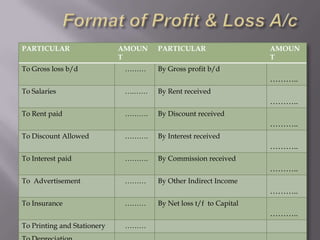
Profit & Loss A/C



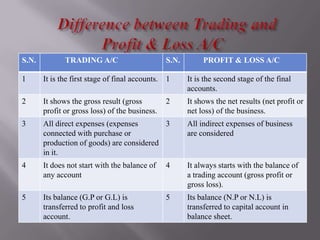
Difference between Trading and Profit & Loss
A/C



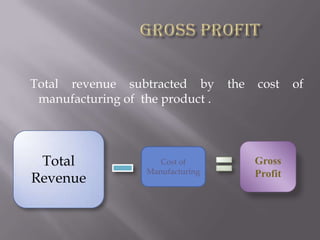
Gross Profit



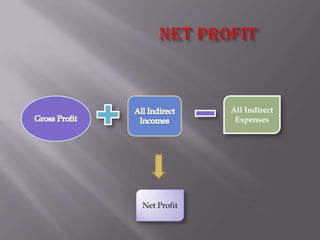
Net Profit



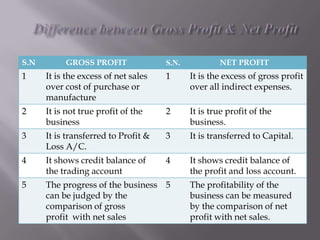
Difference between Gross Profit & Net Profit


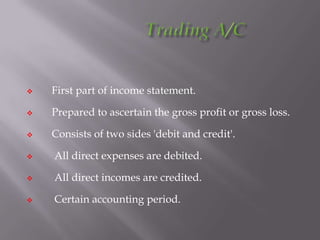
First part of income statement.



Prepared to ascertain the gross profit or gross loss.



Consists of two sides 'debit and credit'.



All direct expenses are debited.



All direct incomes are credited.



Certain accounting period.
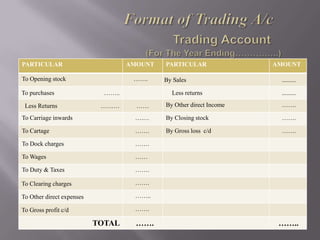
PARTICULAR

AMOUNT

To Opening stock

…….

To purchases

……..

PARTICULAR
By Sales
Less returns

AMOUNT
.........
.........

……

By Other direct Income

…….

To Carriage inwards

….…

By Closing stock

…….

To Cartage

…….

By Gross loss c/d

…….

To Dock charges

…….

To Wages

……

To Duty & Taxes

…….

To Clearing charges

…….

To Other direct expenses

……..

To Gross profit c/d

…….

Less Returns

………

TOTAL

…….

……..


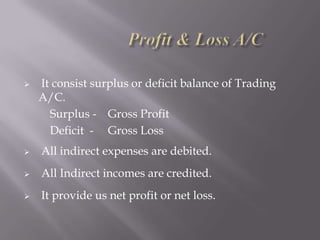
It consist surplus or deficit balance of Trading
A/C.
Surplus - Gross Profit
Deficit - Gross Loss



All indirect expenses are debited.



All Indirect incomes are credited.



It provide us net profit or net loss.
PARTICULAR
To Gross loss b/d

AMOUN
T
………

PARTICULAR

AMOUN
T

By Gross profit b/d

………..
To Salaries

….……

By Rent received

………..
To Rent paid

……….

By Discount received

………..
To Discount Allowed

……….

By Interest received

………..
To Interest paid

……….

By Commission received

………..
To Advertisement

………

By Other Indirect Income

………..
To Insurance

………

By Net loss t/f to Capital

………..
To Printing and Stationery

………
S.N.

TRADING A/C

S.N.

PROFIT & LOSS A/C

1

It is the first stage of final accounts.

1

It is the second stage of the final
accounts.

2

It shows the gross result (gross
profit or gross loss) of the business.

2

It shows the net results (net profit or
net loss) of the business.

3

All direct expenses (expenses
3
connected with purchase or
production of goods) are considered
in it.

All indirect expenses of business
are considered

4

It does not start with the balance of
any account

4

It always starts with the balance of
a trading account (gross profit or
gross loss).

5

Its balance (G.P or G.L) is
transferred to profit and loss
account.

5

Its balance (N.P or N.L) is
transferred to capital account in
balance sheet.
Total revenue subtracted by
manufacturing of the product .

Total
Revenue

Cost of
Manufacturing

the

cost

Gross
Profit

of
All Indirect
Expenses

Net Profit
S.N

GROSS PROFIT

S.N.

NET PROFIT

1

It is the excess of net sales
over cost of purchase or
manufacture

1

It is the excess of gross profit
over all indirect expenses.

2

It is not true profit of the
business

2

It is true profit of the
business.

3

It is transferred to Profit &
Loss A/C.

3

It is transferred to Capital.

4

It shows credit balance of
the trading account

4

It shows credit balance of
the profit and loss account.

5

The progress of the business 5
can be judged by the
comparison of gross
profit with net sales

The profitability of the
business can be measured
by the comparison of net
profit with net sales.
Trading & pl ac

Trading & pl ac

  • 1.
    Presented ByRitesh KumarTiwari Mohd. Sajid
  • 2.
     Trading A/C  Profit &Loss A/C  Difference between Trading and Profit & Loss A/C  Gross Profit  Net Profit  Difference between Gross Profit & Net Profit
  • 3.
     First part ofincome statement.  Prepared to ascertain the gross profit or gross loss.  Consists of two sides 'debit and credit'.  All direct expenses are debited.  All direct incomes are credited.  Certain accounting period.
  • 4.
    PARTICULAR AMOUNT To Opening stock ……. Topurchases …….. PARTICULAR By Sales Less returns AMOUNT ......... ......... …… By Other direct Income ……. To Carriage inwards ….… By Closing stock ……. To Cartage ……. By Gross loss c/d ……. To Dock charges ……. To Wages …… To Duty & Taxes ……. To Clearing charges ……. To Other direct expenses …….. To Gross profit c/d ……. Less Returns ……… TOTAL ……. ……..
  • 5.
     It consist surplusor deficit balance of Trading A/C. Surplus - Gross Profit Deficit - Gross Loss  All indirect expenses are debited.  All Indirect incomes are credited.  It provide us net profit or net loss.
  • 6.
    PARTICULAR To Gross lossb/d AMOUN T ……… PARTICULAR AMOUN T By Gross profit b/d ……….. To Salaries ….…… By Rent received ……….. To Rent paid ………. By Discount received ……….. To Discount Allowed ………. By Interest received ……….. To Interest paid ………. By Commission received ……….. To Advertisement ……… By Other Indirect Income ……….. To Insurance ……… By Net loss t/f to Capital ……….. To Printing and Stationery ………
  • 7.
    S.N. TRADING A/C S.N. PROFIT &LOSS A/C 1 It is the first stage of final accounts. 1 It is the second stage of the final accounts. 2 It shows the gross result (gross profit or gross loss) of the business. 2 It shows the net results (net profit or net loss) of the business. 3 All direct expenses (expenses 3 connected with purchase or production of goods) are considered in it. All indirect expenses of business are considered 4 It does not start with the balance of any account 4 It always starts with the balance of a trading account (gross profit or gross loss). 5 Its balance (G.P or G.L) is transferred to profit and loss account. 5 Its balance (N.P or N.L) is transferred to capital account in balance sheet.
  • 8.
    Total revenue subtractedby manufacturing of the product . Total Revenue Cost of Manufacturing the cost Gross Profit of
  • 9.
  • 10.
    S.N GROSS PROFIT S.N. NET PROFIT 1 Itis the excess of net sales over cost of purchase or manufacture 1 It is the excess of gross profit over all indirect expenses. 2 It is not true profit of the business 2 It is true profit of the business. 3 It is transferred to Profit & Loss A/C. 3 It is transferred to Capital. 4 It shows credit balance of the trading account 4 It shows credit balance of the profit and loss account. 5 The progress of the business 5 can be judged by the comparison of gross profit with net sales The profitability of the business can be measured by the comparison of net profit with net sales.