Dr.Archana Koshy
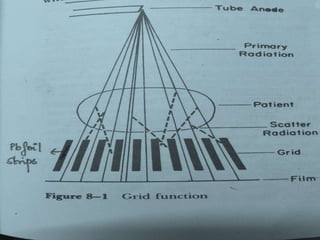
• The radiographic grid consists of a series of Lead foil
strips separated by X-ray transparent spacers .
• Invented by Dr.Gustave Bucky in 1913
• Most effective way of removing scatter radiation from
large radiographic fields .
• The interspaces of grids are filled either with aluminium
or some organic compound .
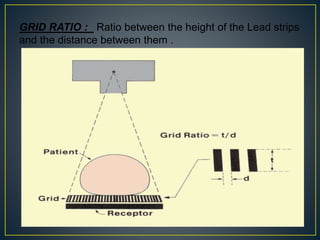
GRID RATIO : Ratio between the height of the Lead strips
and the distance between them .
• GRID PATTERN : Orientation of the Lead strips in their
longitudinal axis .
• Pattern of the grid that we see from as a view from the
top
I. LINEAR GRID
II. CROSSED GRID
III. PARALLEL GRID
IV. FOCUSSED GRID
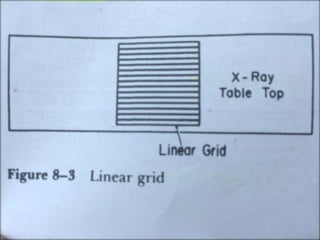
LINEAR GRID
The Lead strips are parallel to each other in their
longitudinal axis
Major advantage is that they allow us to angle the X-ray
tube along the length of the Grid without loss of primary
radiation from grid ‘cutoff ‘
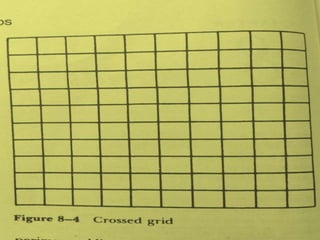
CROSSED GRID
Made of two superimposed linear grids that have the same
focusing distance .
Grid ratio of two crossed grids is equal to the sum of the
ratio of the two linear grids .
Cannot be used with oblique techniques requiring
angulation of the Xray tube .
FOCUSSED GRID
Grid made up of lead strips that are slightly angled so that
they focus in space .
May be either linear or crossed .
Line focused grids converge at a line in space called
CONVERGENT LINE .
Crossed Grids converge in a point in space called
CONVERGENT POINT .
FOCAL DISTANCE : Perpendicular distance between the
grid and the convergent line or point .
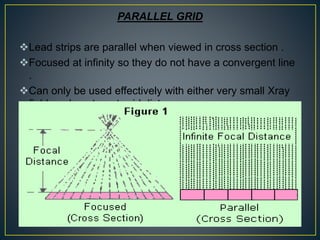
PARALLEL GRID
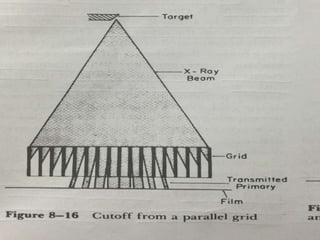
Lead strips are parallel when viewed in cross section .
Focused at infinity so they do not have a convergent line
.
Can only be used effectively with either very small Xray
fields or long target-grid distances .
LINES PER INCH : Number of Lead strips per inch of
the grid .
Calculated by adding the thickness of the Lead strips and
interspaces and dividing this sum into 1 .
• Three main methods :
I. PRIMARY TRANSMISSION (Tp)
II. BUCKY FACTOR (B)
III. CONTRAST IMPROVEMENT FACTOR (K)
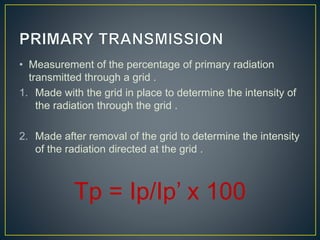
• Measurement of the percentage of primary radiation
transmitted through a grid .
1. Made with the grid in place to determine the intensity of
the radiation through the grid .
2. Made after removal of the grid to determine the intensity
of the radiation directed at the grid .
Tp = Ip/Ip’ x 100
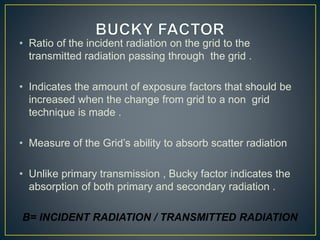
• Ratio of the incident radiation on the grid to the
transmitted radiation passing through the grid .
• Indicates the amount of exposure factors that should be
increased when the change from grid to a non grid
technique is made .
• Measure of the Grid’s ability to absorb scatter radiation
• Unlike primary transmission , Bucky factor indicates the
absorption of both primary and secondary radiation .
B= INCIDENT RADIATION / TRANSMITTED RADIATION
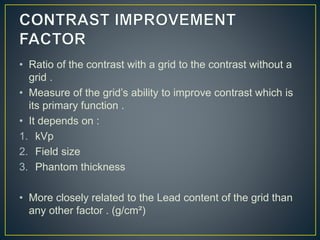
• Ratio of the contrast with a grid to the contrast without a
grid .
• Measure of the grid’s ability to improve contrast which is
its primary function .
• It depends on :
1. kVp
2. Field size
3. Phantom thickness
• More closely related to the Lead content of the grid than
any other factor . (g/cm²)
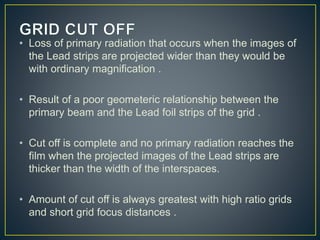
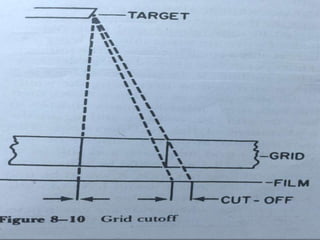
• Loss of primary radiation that occurs when the images of
the Lead strips are projected wider than they would be
with ordinary magnification .
• Result of a poor geometeric relationship between the
primary beam and the Lead foil strips of the grid .
• Cut off is complete and no primary radiation reaches the
film when the projected images of the Lead strips are
thicker than the width of the interspaces.
• Amount of cut off is always greatest with high ratio grids
and short grid focus distances .
• 4 SITUATIONS THAT PRODUCE GRID CUT OFF :
1. FOCUSED GRIDS USED UPSIDE DOWN
2. LATERAL DECENTERING (GRID ANGULATION )
3. FOCUS GRID DISTANCE DECENTERING
4. COMBINED LATERAL AND FOCUS-GRID DISTANCE
DECENTERING .
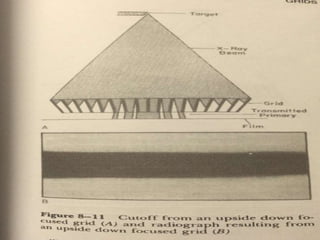
• When a focused grid is used upside down, there is
severe peripheral cut off with a dark band of exposure in
the center of the film with no exposure at the periphery .
• The higher the grid ratio,narrower the exposed area .
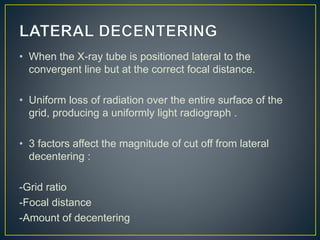
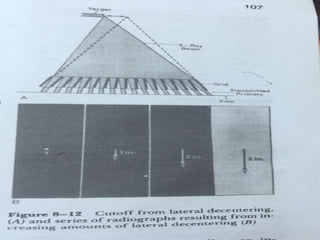
• When the X-ray tube is positioned lateral to the
convergent line but at the correct focal distance.
• Uniform loss of radiation over the entire surface of the
grid, producing a uniformly light radiograph .
• 3 factors affect the magnitude of cut off from lateral
decentering :
-Grid ratio
-Focal distance
-Amount of decentering
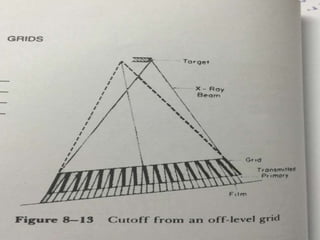
OFF LEVEL GRIDS
When a linear grid is tilted , there is uniform
loss of primary radiation across the entire
surface of the grid .
Effect on the film being same as that of
lateral decentering .
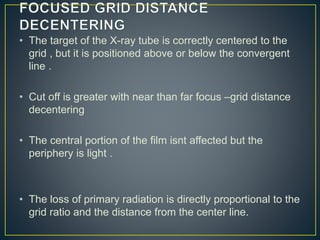
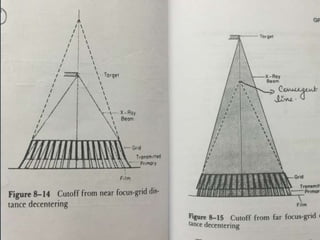
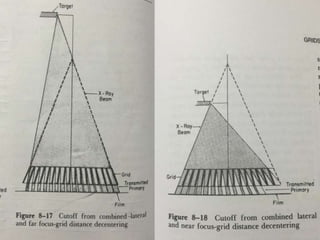
• The target of the X-ray tube is correctly centered to the
grid , but it is positioned above or below the convergent
line .
• Cut off is greater with near than far focus –grid distance
decentering
• The central portion of the film isnt affected but the
periphery is light .
• The loss of primary radiation is directly proportional to the
grid ratio and the distance from the center line.
• Causes an uneven exposure resulting in a film that is
light on one side and dark on the other side.
• Directly proportional to the grid ratio and decentering
distance and inversely proportional to the focal distance
of the grid .
• Invented by Dr.Hollis.E.Potter in 1920 .
• Also called a Bucky grid
• Moved to blur out the shadows cast by the lead strips .
• Continuously moves 1 to 3 cm back and forth throughout
the exposure .
• Precautions :
1. The grid must move fast enough to blue the lead strips
2. The transverse motion of the grid should be
synchronous with the pulses of the Xray generator .
DISADVANTAGES :
• Costly
• Subject to failure
• May vibrate the Xray table
• Places a limit on the minimum exposure time because
they move slowly .
• INCREASES THE PATIENT RADIATION DOSE.
• The price of increased “cleanup “ with high ratio grids is
that patient exposure is considerably increased and that
Xray tube centering becomes critical .

• 8:1 grids will give adequate results below 90 kVp
• Above 90 kvp,12:1 grids are preferred
• In cases of Biplane cerebral angiography, crossed grids
are preferred as there is a great deal of scatter radiation.
• Scatter radiation arising from the patient from Compton
reactions disperses in all directions , so the patient acts
like a large light bulb .
• The closer the patient is to the film, the greater the
concentration of scatter per unit area .
• With an air gap, the concentration decreases due to more
photons missing the film in the gap .
• Used in Magnification radiography and Chest
radiography .
1. Thicker the part,the more advantageous a larger air gap
2. The first inch of any air gap improves contrast more
than any subsequent inch
3. Image sharpness deteriorates with increasing gap width
unless the focal film distance is increased to
compensate for the greater magnification.
4. If the gap is widened by moving the patient away from
the film with a fixed focal film distance the patient is
closer to the X-ray tube and his exposure increases.
Grids

Grids

  • 1.
  • 2.
    • The radiographicgrid consists of a series of Lead foil strips separated by X-ray transparent spacers . • Invented by Dr.Gustave Bucky in 1913 • Most effective way of removing scatter radiation from large radiographic fields . • The interspaces of grids are filled either with aluminium or some organic compound .
  • 4.
    GRID RATIO :Ratio between the height of the Lead strips and the distance between them .
  • 5.
    • GRID PATTERN: Orientation of the Lead strips in their longitudinal axis . • Pattern of the grid that we see from as a view from the top I. LINEAR GRID II. CROSSED GRID III. PARALLEL GRID IV. FOCUSSED GRID
  • 6.
    LINEAR GRID The Leadstrips are parallel to each other in their longitudinal axis Major advantage is that they allow us to angle the X-ray tube along the length of the Grid without loss of primary radiation from grid ‘cutoff ‘ CROSSED GRID Made of two superimposed linear grids that have the same focusing distance . Grid ratio of two crossed grids is equal to the sum of the ratio of the two linear grids . Cannot be used with oblique techniques requiring angulation of the Xray tube .
  • 9.
    FOCUSSED GRID Grid madeup of lead strips that are slightly angled so that they focus in space . May be either linear or crossed . Line focused grids converge at a line in space called CONVERGENT LINE . Crossed Grids converge in a point in space called CONVERGENT POINT . FOCAL DISTANCE : Perpendicular distance between the grid and the convergent line or point .
  • 10.
    PARALLEL GRID Lead stripsare parallel when viewed in cross section . Focused at infinity so they do not have a convergent line . Can only be used effectively with either very small Xray fields or long target-grid distances .
  • 11.
    LINES PER INCH: Number of Lead strips per inch of the grid . Calculated by adding the thickness of the Lead strips and interspaces and dividing this sum into 1 .
  • 12.
    • Three mainmethods : I. PRIMARY TRANSMISSION (Tp) II. BUCKY FACTOR (B) III. CONTRAST IMPROVEMENT FACTOR (K)
  • 13.
    • Measurement ofthe percentage of primary radiation transmitted through a grid . 1. Made with the grid in place to determine the intensity of the radiation through the grid . 2. Made after removal of the grid to determine the intensity of the radiation directed at the grid . Tp = Ip/Ip’ x 100
  • 14.
    • Ratio ofthe incident radiation on the grid to the transmitted radiation passing through the grid . • Indicates the amount of exposure factors that should be increased when the change from grid to a non grid technique is made . • Measure of the Grid’s ability to absorb scatter radiation • Unlike primary transmission , Bucky factor indicates the absorption of both primary and secondary radiation . B= INCIDENT RADIATION / TRANSMITTED RADIATION
  • 15.
    • Ratio ofthe contrast with a grid to the contrast without a grid . • Measure of the grid’s ability to improve contrast which is its primary function . • It depends on : 1. kVp 2. Field size 3. Phantom thickness • More closely related to the Lead content of the grid than any other factor . (g/cm²)
  • 16.
    • Loss ofprimary radiation that occurs when the images of the Lead strips are projected wider than they would be with ordinary magnification . • Result of a poor geometeric relationship between the primary beam and the Lead foil strips of the grid . • Cut off is complete and no primary radiation reaches the film when the projected images of the Lead strips are thicker than the width of the interspaces. • Amount of cut off is always greatest with high ratio grids and short grid focus distances .
  • 18.
    • 4 SITUATIONSTHAT PRODUCE GRID CUT OFF : 1. FOCUSED GRIDS USED UPSIDE DOWN 2. LATERAL DECENTERING (GRID ANGULATION ) 3. FOCUS GRID DISTANCE DECENTERING 4. COMBINED LATERAL AND FOCUS-GRID DISTANCE DECENTERING .
  • 19.
    • When afocused grid is used upside down, there is severe peripheral cut off with a dark band of exposure in the center of the film with no exposure at the periphery . • The higher the grid ratio,narrower the exposed area .
  • 21.
    • When theX-ray tube is positioned lateral to the convergent line but at the correct focal distance. • Uniform loss of radiation over the entire surface of the grid, producing a uniformly light radiograph . • 3 factors affect the magnitude of cut off from lateral decentering : -Grid ratio -Focal distance -Amount of decentering
  • 23.
    OFF LEVEL GRIDS Whena linear grid is tilted , there is uniform loss of primary radiation across the entire surface of the grid . Effect on the film being same as that of lateral decentering .
  • 25.
    • The targetof the X-ray tube is correctly centered to the grid , but it is positioned above or below the convergent line . • Cut off is greater with near than far focus –grid distance decentering • The central portion of the film isnt affected but the periphery is light . • The loss of primary radiation is directly proportional to the grid ratio and the distance from the center line.
  • 28.
    • Causes anuneven exposure resulting in a film that is light on one side and dark on the other side. • Directly proportional to the grid ratio and decentering distance and inversely proportional to the focal distance of the grid .
  • 30.
    • Invented byDr.Hollis.E.Potter in 1920 . • Also called a Bucky grid • Moved to blur out the shadows cast by the lead strips . • Continuously moves 1 to 3 cm back and forth throughout the exposure . • Precautions : 1. The grid must move fast enough to blue the lead strips 2. The transverse motion of the grid should be synchronous with the pulses of the Xray generator .
  • 31.
    DISADVANTAGES : • Costly •Subject to failure • May vibrate the Xray table • Places a limit on the minimum exposure time because they move slowly . • INCREASES THE PATIENT RADIATION DOSE.
  • 32.
    • The priceof increased “cleanup “ with high ratio grids is that patient exposure is considerably increased and that Xray tube centering becomes critical . • 8:1 grids will give adequate results below 90 kVp • Above 90 kvp,12:1 grids are preferred • In cases of Biplane cerebral angiography, crossed grids are preferred as there is a great deal of scatter radiation.
  • 34.
    • Scatter radiationarising from the patient from Compton reactions disperses in all directions , so the patient acts like a large light bulb . • The closer the patient is to the film, the greater the concentration of scatter per unit area . • With an air gap, the concentration decreases due to more photons missing the film in the gap . • Used in Magnification radiography and Chest radiography .
  • 36.
    1. Thicker thepart,the more advantageous a larger air gap 2. The first inch of any air gap improves contrast more than any subsequent inch 3. Image sharpness deteriorates with increasing gap width unless the focal film distance is increased to compensate for the greater magnification. 4. If the gap is widened by moving the patient away from the film with a fixed focal film distance the patient is closer to the X-ray tube and his exposure increases.

Editor's Notes

  • #3 Scatter radiation is multidirectional and arises from many poinbts within the patient .so most of it is absorbed by Lead strips and only a small amount passes between them . Main purpose of the interspace material is to support the thin lead foil strips . Aluminium grids are structurally stronger than grids with organic interspacers . Patient exposures are higher with aluminium because it absorbes more primary radiation . Contrast improvement is better .
  • #5 Grid ratios are usually expressed as two numbers such as 10:1 or 5:1 ..1 Is usually a constant and the first number being the actual value . Grid ratio is a parameter widely used to describe a grids ability to remove scatter radiation . Higher the grid ratio, better the grid functions .
  • #7 Biggest advantage
  • #10 May be either linear or crossed because the focussing refers to the cross sectional plane . In practise grids have a focusing range that indicates the distance within which the grid can be used without significant loss of primary radiation . Focusing range is fairly wide for a low ratio grid and narrow for a high ratio grid .
  • #12 The grid ratio, lines per inch and the lead content are closely related . I ll b talking about Lead content in the upcoming slides. A grid with many lines per inch is gfenerally thinner and has a lower lead content than a grid of comparable ratio with fewer liner per inch .
  • #13 Grids are used to improve contrast by absorbing secondary radiation before it reaches the film . Idea grid would asborb all secondary radiation and no primary radiation Price of better film contrast is increased patient exposure .
  • #14 Two measurements must be made to determine the percentage of primary transmission Tp= primary transmission Intensity with grid Iuntensity without grid MEASURED PRIMARY TRANSMISSION IS ALWAYS LESSER THAN THE CALCULATED PRIMARY TRANSMISSION This difference is mainly due to the result of absorption by interpsace material Also some loss in primary radiation because of manufacturing imoerfections in the focusing of the lead strips . Ip intensity without grid Ip’ intensity without grid
  • #15 Also tells us how much of the patients exposure is increased with the use of a grid . Unlike primary transmission which only tells us the amount of primary radiation absorbed by a grid . TRANSMI RADN MEASURED WITH THE GRID IN PLACE AND INCIDENT RADN WITHOUT THE GRID
  • #16 These three factors determine the amount of scatter radiation . High ratio grids absorb more scatter radiation and have larger bucky factors than low ratio grids. Imagine cutting up a grid into I cm squares and then weighing them . Its weight in grams Is the lead content of the grid. The amount of Lead is a good indicator to improve contrast provided the grid is well designed .
  • #17 Primary disad-increase the amount of radiation a person receives and the careful centering of the xray tube because of the danger of grid cut off. The final image with be light in the area in which cut off occurs .
  • #20 THE FOCUS OF the lead strips is called the tube side and all focused grids have it . When a crossed grid is used upside down , only a small square in the center of the film is exposed .
  • #22 All the lead strips cut off the same amount of primary radiation Most common type of grid cut off but cannot be recognised by inspection of the film. Cut off increases as the grid ratio and the decentering distance increases and it decreases as the focal distance decreases . Loss of primary radiation can be minimized with low ratio grids and a long focal distance. In case of protable radiographs,exact centering is not possib;e , therefore low radio gridds and long focal distances should be used.
  • #23 Shows a series of films taken with the same xposure factors but with increasing amounts of lateral decentering ., The xray tube was centered at the convergent line for the film strip at the left anf tyhern laterally decentered 1 in , 2 in and 3 inches respectivelkyt for the next three rfilms . Films become progressively lightrer but the exposure still remains uniform .
  • #24 Its usually tilted in case of protable radiography
  • #26 If it is placed above the convergent line – far focus grid distance decentering Placed below – near focus grid distance decentering The loss of primary radiation increases as the grid ratio increases and as the distance from the center of the grid increases . The loss with greater with NEAR THAN FAR focus grid distance centering Parallel grids are focused at infinity so they re always used with near focus grid distance decentering Dark center amd light edges because of near focus grid distance decntering .
  • #28 Parallel grids are focused at infinity so they re always used with near focus grid distance decentering Dark center amd light edges because of near focus grid distance decntering .
  • #29 COMBINED DECENTERING IS EASY TO RTECOGNISE . 2 types depending on whether the tube is placed above or below the target line.
  • #30 The projected images of the lead strips are broader on the side opposite the tibe target than on the same side and the film is lighter on the far side.(near focus )
  • #31 They start moving when the xray tube anode ebgins to rotate. Advantages are that they eliminate grid lines from the film Back in the olden days this used ot be important because lead strips were thick and unevenly spaced. Now recently since grids have imporved stationary grids are preferred to moving grids . If the grid moves slowly u ll either see the grid lines or varying densities throughout the film . The shadow of each lead strip is sumperimposed on the shadow of its neighbour . Each pulse produces a faint image Thus even though the grid moves, the grid lines will be distinct .
  • #32 The patient dose is increased due to lateral decentering . It moves 1 to 3 cm during the exposuretube is not centered directly over the center of the grid during most of the exposure . Results in a loss of as much as 20 Percent of the primary radiation with a high ratio grid and a short focusing distance.
  • #33 ITS ALWays a compromise
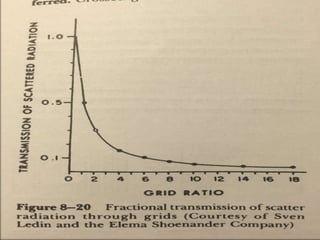
  • #34 Plots the fractional transmission of scatter radiation against grid ratio. Little decrease in transmitted scatter beyond an 8:1 ratio and almost no change between 12:1 and 16:1 ratio fr routine angio The improvement in film quality is not worth the patient increased exposure .
  • #35 The xray grid is the most effective means of reducing scatter radiation with large radiographic fields An akternate method known as air gap produces comparable results with less patient exposure . Basic principle of the air gap is quite simple . In chest radiography, the air gap is used instead of a grid and techniques are desgined around the air gap / A LARGE AIR GAP LIKE A HIGH GRID RATIO REMOVES JUST AS MUCH SCATTER RADIATION 2 factors determine the magnification radiography, the object – film distance and the focal-film distance Greatset with short focal film distance and along object film distance .
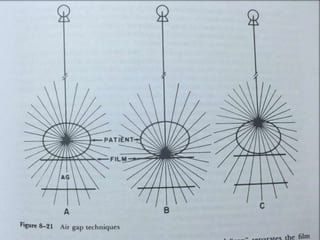
  • #36 \with increasing energy,more photons scatter in the forward direction but the increase is negligible in the diagnostic range . With a strong forward bias, as in megavol therapy , air gaps are ineffective as a means of controlling scatter radiaiton . Figure B and C compares the distribution of scattered radiation arising from tissue blocks on opposite side of the patient. In case of figure C many scattered photons from their inout surface are absorbed during their long journey through the patient . Wherease those originating near the exit surface have only a short escape distance . AIR GAP is most effective in removing scatter radiation when the scatter originates closer to the film .
  • #37 An increase in focal distance from 6 in to 10 in is customary oin chest radios to compensate if any loss of hsarpness occurs but a further increase is usually not possible because of space limitations or due to the heat tolerance of the xray tube . Patient exposures are greater with air gaps than with grids because focal film distances are increased with air gao techniques in order to maintain image sharpness . However Xray exposure factorss are higher eith air gap because grids absorb primary photons ;.