Radiographic grid
Swastika Pandit
B.Sc. MIT 2nd
year
NAMS, Bir hospital
Contents
1.Introduction
2.Types
3.Construction
4.Uses
5.Errors
6.Advantages
7.Disadvantages
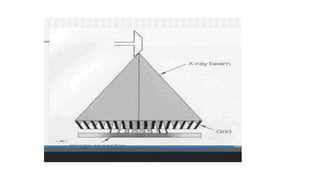
• Grid is an effective device for reducing the level of scatter
radiation . These are made up of radiopaque material ( grid
lines) alternating with section of radiolucent material
(interspace material).
These radio-opaque materials are of a series of lead foil
strips separated by x-ray transparent spacers.
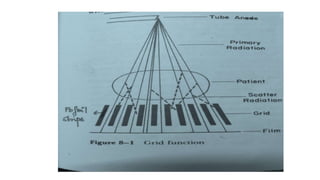
It is designed to transmit only those x-rays whose direction
is on a straight line from the source to the image receptor.
Scatter x-rays are absorbed in the grid material.
History
• Invented by Dr. Gustav Bucky in 1913,and is still the most effective way
of removing the scattered radiation from large radiographic fields.
• Nowadays called Bucky .
• The primary radiation is oriented in the same axis as the lead strips and
passes between them to reach the film unaffected by the grid.
• Scatter radiation arises from many points within the patient and is
multidirectional ,so most of it is absorbed by the lead strips and only a
small amount passes between them .
• The interspaces of grids are filled either with aluminium or
some organic compound.
The main purpose of the interspace material is to support the
thin leadfoil strips. Aluminium interspaces grids can probably
be manufactured more precisely ,and they are structurally
stronger and less hygroscopic than grids with organic
interspacers.
Patient exposures are higher with aluminium because it absorbs
more primary radiation
Grid ratio
• Grid ratio is defined as the ratio between the height of the lead
strips and the distance between them.
• The lead strips are approximately 0.05 mm thick , so that they
may approximately be considered lead foil.
• Generally ,the higher the ratio , the better the grid functions .
• Grid ratios are indicated on the top of grids by manufacturers.
• Ratios usually ranges from 4:1 to 16:1.
Grid pattern
• It refers to the orientation of the lead strips in their
longitudinal axis .
• It is a pattern of the grid what we see from a top
view.
• The two basic grid patterns are linear and crossed.
Linear grid
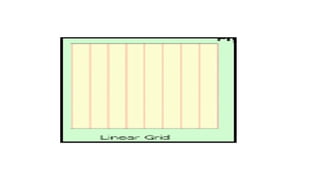
• In a linear grid the lead strips are parallel to each
other in their longitudinal axis.
• Most x-ray tables are equipped with the linear grids.
• The major advantage is that it allows us to angle the
x-ray tube along the length of the grid without the
loss of primary radiation from grid" cut off".
Crossed grid
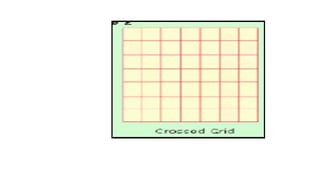
• A crossed grid generally is made up of two superimposed
linear grids that have the same focusing distance.
• The grid ratio of crossed grids is equal to the sum of the the
ratios of the linear grids.
• Crossed grids can’t be used with the oblique technique
requiring angulations.
Focussed grid
• A focussed grid is a grid made up of lead strips that are angled slightly so that
they focus in space.
• A focussed grid may be linear or crossed because the focussing refers to the
cross-sectional plane of the lead strips .
• Most grid are focused
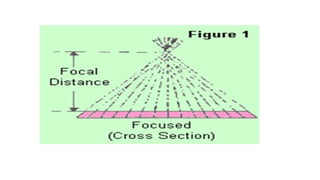
• focussed grids converge at a line in space called the convergent point.
• The focal distance is the perpendicular distance between the grid
and the convergent line or point.
• The focussing range is fairly wide for a low -ratio grid and
narrow for a high ratio grid .
Parallel grid
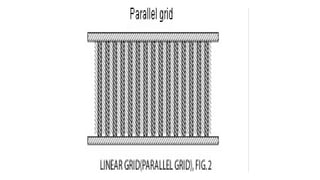
• A parallel grid is one in which the lead strips are parallel
when viewed in cross-section.
• They are focussed at infinity ,so they do not have a
convergent line.
• These grids can only be used effectively with either very
small x-ray fields or long target grids distances.
• Usually used in fluoroscopic spot film devices & low
modern radiological use.
Lines per inch
• It is the no. of lead strips per inch of grid . It can be calculated by adding the
thickness of lead strips and interspaces and dividing this sum.
• Also called grid frequency.
• Most grids have frequency is in the range of 25-45 lines/cm.
• The grid frequency can be calculated by adding the thickness of interspaces
and lead strip and dividing the sum by 25.4.
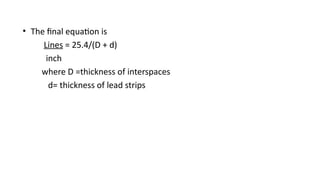
• The final equation is
Lines = 25.4/(D + d)
inch
where D =thickness of interspaces
d= thickness of lead strips
Evaluation of grid performance
• The grids are used to improve the contrast by absorbing the secondary
radiation before it reaches the film . An ideal grid will absorb all the
secondary radiations and no primary radiation.
• The grid performance is necessary for the grids to determine how much
effective it is for the patient.
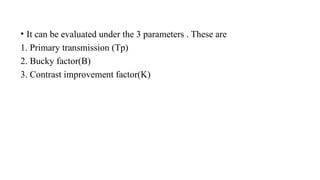
• It can be evaluated under the 3 parameters . These are
1. Primary transmission (Tp)
2. Bucky factor(B)
3. Contrast improvement factor(K)
1.Primary transmission
• It is the measurement of the percentage of the primary
radiation transmitted through a grid.
• Ideally it should be 100%.The formula for measuring the
primary radiation is shown below .
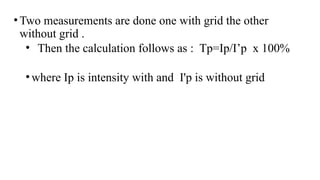
•Two measurements are done one with grid the other
without grid .
• Then the calculation follows as : Tp=Ip/I’p x 100%
•where Ip is intensity with and I'p is without grid
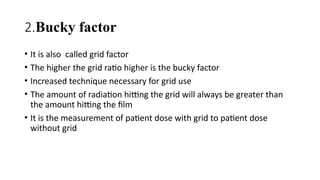
2.Bucky factor
• It is also called grid factor
• The higher the grid ratio higher is the bucky factor
• Increased technique necessary for grid use
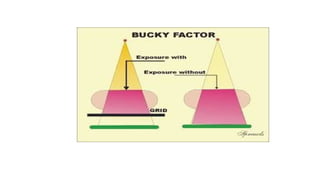
• The amount of radiation hitting the grid will always be greater than
the amount hitting the film
• It is the measurement of patient dose with grid to patient dose
without grid
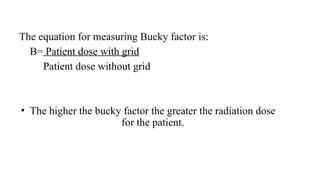
The equation for measuring Bucky factor is:
B= Patient dose with grid
Patient dose without grid
• The higher the bucky factor the greater the radiation dose
for the patient.
3.Contrast improvement factor
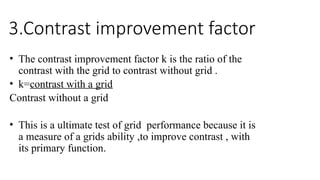
• The contrast improvement factor k is the ratio of the
contrast with the grid to contrast without grid .
• k=contrast with a grid
Contrast without a grid
• This is a ultimate test of grid performance because it is
a measure of a grids ability ,to improve contrast , with
its primary function.
• This mainly depends upon kvp ,field size and phantom
thickness.
• It is helpful for the comparison of different grids . The
relative quality of 2 grids appears to be independent of the
factors like kvp ,field size and phantom thickness.
Lead content
• The lead content of a grid is expressed in g/cm².
• The weight of lead per sq.cm of grid is its lead content.
• The amount of lead in a grid is a good indicator of its ability to
improve contrast ,provided the grid is well signed.
• There is a definite relationship between the grid ratio ,lead
content and no of lines per inch .
• If the grid ratio remains constant and the no of lines
per inch is increased ,the lead content must
decrease .
• The only way to increase no of lines per inch is by
decreasing the thickness of either of the lead strips
or interspaces .
• Thus a thin sheet of lead is used to increase the grid
ratio.
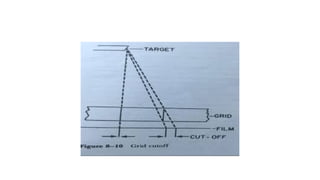
Grid cut off
• Grid cutoff is the loss of primary radiation that occurs
when the grid is improperly positioned.
• it is the result of poor geometric relationship between
the primary beam and the lead foil strip of the grid.
• Cutoff is complete and no primary radiation reaches the
film when the projected images of the lead strips are
thicker than the width of the interspaces.
• The resultant radiograph will be light in the area in which
the cutoff occurs.
• The amount of cutoff is high for with high ratio grids and
short grid focus distances.
• There are four situations that produce grid cutoff . They are:
-Upside down focused grid
-Lateral decentering
-Focussed grid distance decentering
-Combined lateral and focused grid distance decentering
Upside down focused grid
• All focused grids have a tube side ,which is the side of the focus
of lead strips .
• When the focussed grid is upside down ,there is severe peripheral
cutoff with a dark band of exposure in the center of the film and
no exposure to the films periphery.
• The higher the grid ratio the narrower the exposed area.
• When a crossed grid is kept upside down ,only a small square in
the center of the is exposed.
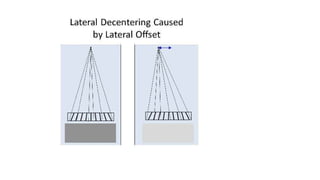
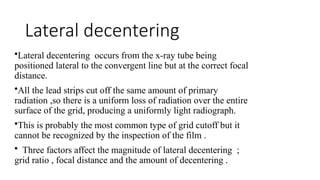
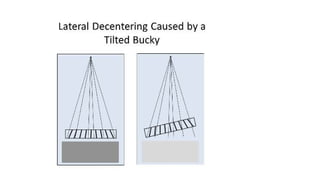
Lateral decentering
•Lateral decentering occurs from the x-ray tube being
positioned lateral to the convergent line but at the correct focal
distance.
•All the lead strips cut off the same amount of primary
radiation ,so there is a uniform loss of radiation over the entire
surface of the grid, producing a uniformly light radiograph.
•This is probably the most common type of grid cutoff but it
cannot be recognized by the inspection of the film .
• Three factors affect the magnitude of lateral decentering ;
grid ratio , focal distance and the amount of decentering .
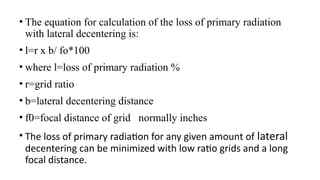
• The equation for calculation of the loss of primary radiation
with lateral decentering is:
• l=r x b/ fo*100
• where l=loss of primary radiation %
• r=grid ratio
• b=lateral decentering distance
• f0=focal distance of grid normally inches
• The loss of primary radiation for any given amount of lateral
decentering can be minimized with low ratio grids and a long
focal distance.
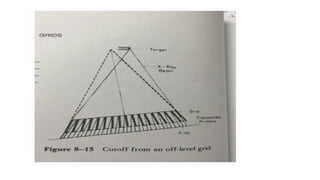
Off level grids
• When a linear grid is tilted ,as it frequently is in portable
radiography , there is a uniform loss of primary radiation
across the entire surface of the grid .
• The effect on the film is the same as the effect of lateral
decentering.
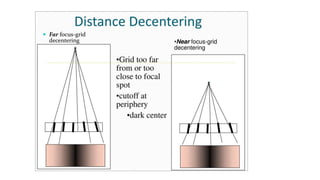
Focus-grid distance decentering
• In focus grid distance decentering ,the target of the
x-ray tube is correctly centered to the grid ,but is
positioned above or below the convergent line .
• Cut of is greater with the target inside the
convergent line and minimal with the target outside
the convergent.
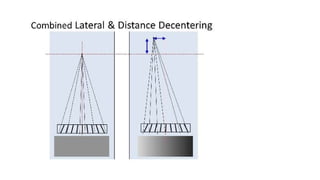
Combined lateral and focus distance
decentering
• This the most common type.
• It is easy to recognize.
• It causes an uneven exposure ,resulting in a film that is light
on one side and dark on the other .
• The amount of cut off is directly proportional to the grid ratio
and the decentering distance and inversely proportional to the
focal distance of the grid.
•With high ratio grids and large decentering errors
there is a large loss of primary radiation.
•With long focal grid distances ,there is less loss of
primary radiation.
•Cutoff is greatest directly under the x-ray tube and
least on the side under the x-ray tube.
Moving grids
• Invented by Dr .Hollis E .Potter in 1920 and was potter-
bucky grid for many years.in these recent years its name was
changed to Bucky grid .
•Most moving grids are reciprocating ,which means they
continuously move 1 to 3 cm back and forth throughout the
exposure.
•They start moving when x-ray tube anode starts moving.
• Older grids moved only in one direction so must be cocked
for each exposure.
•They were set to a timer to remove grid lines.
•The fact in modern moving grids where they omitted the
grid lines.
• But these are costly to install ,subject to failure , may
vibrate the x-ray table and put a limit on the minimum
exposure time because they move slowly.
• Lateral decentering may also occur and increases the
patient doses.
• But even are better than the stationary grids
Grid selection
•Grid should provide good contrast and minimize the
scattered radiation.
•But with patient doses in morale there is a little to be
gained using a high ratio grids in the low kvp range .
•Usually ,8:1 grids will give adequate results below 90
kvp ,above 90kvp 12:1 grids are preferred.
Air gap technique
•The x-ray grid is the most important means of
reducing scatter radiation with large radiographic
fields but under certain circumstances, an alternate
method ,an air gap, produces comparable results with
less patient exposure.
•The basic principle of air gap technique is quite
simple .
•Scatter radiation arising in the patient from the
compton reactions disperses in all directions , so the
patient acts like as a large light bulb.
•The closer the patient is to the film,the greater the
scatter per unit area.
•With an air gap technique,the concentration decreases
due to more photons missing the film in the gap.
Advantages of grid
1.Reduction of scatter radiation
2.Improvement of image quality
Disadvantages of grid
1.Increase in patient dose
2.Costly
3.Limits patients exposure time
Thank you
References
• Radiologic science for technologists
• Chesney equipment
1.

Radiographic grid uses and its types .pptx

  • 1.
    Radiographic grid Swastika Pandit B.Sc.MIT 2nd year NAMS, Bir hospital
  • 2.
  • 3.
    • Grid isan effective device for reducing the level of scatter radiation . These are made up of radiopaque material ( grid lines) alternating with section of radiolucent material (interspace material). These radio-opaque materials are of a series of lead foil strips separated by x-ray transparent spacers. It is designed to transmit only those x-rays whose direction is on a straight line from the source to the image receptor. Scatter x-rays are absorbed in the grid material.
  • 4.
    History • Invented byDr. Gustav Bucky in 1913,and is still the most effective way of removing the scattered radiation from large radiographic fields. • Nowadays called Bucky . • The primary radiation is oriented in the same axis as the lead strips and passes between them to reach the film unaffected by the grid. • Scatter radiation arises from many points within the patient and is multidirectional ,so most of it is absorbed by the lead strips and only a small amount passes between them .
  • 6.
    • The interspacesof grids are filled either with aluminium or some organic compound. The main purpose of the interspace material is to support the thin leadfoil strips. Aluminium interspaces grids can probably be manufactured more precisely ,and they are structurally stronger and less hygroscopic than grids with organic interspacers. Patient exposures are higher with aluminium because it absorbs more primary radiation
  • 7.
    Grid ratio • Gridratio is defined as the ratio between the height of the lead strips and the distance between them. • The lead strips are approximately 0.05 mm thick , so that they may approximately be considered lead foil. • Generally ,the higher the ratio , the better the grid functions . • Grid ratios are indicated on the top of grids by manufacturers. • Ratios usually ranges from 4:1 to 16:1.
  • 8.
    Grid pattern • Itrefers to the orientation of the lead strips in their longitudinal axis . • It is a pattern of the grid what we see from a top view. • The two basic grid patterns are linear and crossed.
  • 9.
    Linear grid • Ina linear grid the lead strips are parallel to each other in their longitudinal axis. • Most x-ray tables are equipped with the linear grids. • The major advantage is that it allows us to angle the x-ray tube along the length of the grid without the loss of primary radiation from grid" cut off".
  • 11.
    Crossed grid • Acrossed grid generally is made up of two superimposed linear grids that have the same focusing distance. • The grid ratio of crossed grids is equal to the sum of the the ratios of the linear grids. • Crossed grids can’t be used with the oblique technique requiring angulations.
  • 13.
    Focussed grid • Afocussed grid is a grid made up of lead strips that are angled slightly so that they focus in space. • A focussed grid may be linear or crossed because the focussing refers to the cross-sectional plane of the lead strips . • Most grid are focused • focussed grids converge at a line in space called the convergent point.
  • 14.
    • The focaldistance is the perpendicular distance between the grid and the convergent line or point. • The focussing range is fairly wide for a low -ratio grid and narrow for a high ratio grid .
  • 16.
    Parallel grid • Aparallel grid is one in which the lead strips are parallel when viewed in cross-section. • They are focussed at infinity ,so they do not have a convergent line. • These grids can only be used effectively with either very small x-ray fields or long target grids distances. • Usually used in fluoroscopic spot film devices & low modern radiological use.
  • 18.
    Lines per inch •It is the no. of lead strips per inch of grid . It can be calculated by adding the thickness of lead strips and interspaces and dividing this sum. • Also called grid frequency. • Most grids have frequency is in the range of 25-45 lines/cm. • The grid frequency can be calculated by adding the thickness of interspaces and lead strip and dividing the sum by 25.4.
  • 19.
    • The finalequation is Lines = 25.4/(D + d) inch where D =thickness of interspaces d= thickness of lead strips
  • 20.
    Evaluation of gridperformance • The grids are used to improve the contrast by absorbing the secondary radiation before it reaches the film . An ideal grid will absorb all the secondary radiations and no primary radiation. • The grid performance is necessary for the grids to determine how much effective it is for the patient.
  • 21.
    • It canbe evaluated under the 3 parameters . These are 1. Primary transmission (Tp) 2. Bucky factor(B) 3. Contrast improvement factor(K)
  • 22.
    1.Primary transmission • Itis the measurement of the percentage of the primary radiation transmitted through a grid. • Ideally it should be 100%.The formula for measuring the primary radiation is shown below .
  • 23.
    •Two measurements aredone one with grid the other without grid . • Then the calculation follows as : Tp=Ip/I’p x 100% •where Ip is intensity with and I'p is without grid
  • 24.
    2.Bucky factor • Itis also called grid factor • The higher the grid ratio higher is the bucky factor • Increased technique necessary for grid use • The amount of radiation hitting the grid will always be greater than the amount hitting the film • It is the measurement of patient dose with grid to patient dose without grid
  • 25.
    The equation formeasuring Bucky factor is: B= Patient dose with grid Patient dose without grid • The higher the bucky factor the greater the radiation dose for the patient.
  • 27.
    3.Contrast improvement factor •The contrast improvement factor k is the ratio of the contrast with the grid to contrast without grid . • k=contrast with a grid Contrast without a grid • This is a ultimate test of grid performance because it is a measure of a grids ability ,to improve contrast , with its primary function.
  • 28.
    • This mainlydepends upon kvp ,field size and phantom thickness. • It is helpful for the comparison of different grids . The relative quality of 2 grids appears to be independent of the factors like kvp ,field size and phantom thickness.
  • 29.
    Lead content • Thelead content of a grid is expressed in g/cm². • The weight of lead per sq.cm of grid is its lead content. • The amount of lead in a grid is a good indicator of its ability to improve contrast ,provided the grid is well signed. • There is a definite relationship between the grid ratio ,lead content and no of lines per inch .
  • 30.
    • If thegrid ratio remains constant and the no of lines per inch is increased ,the lead content must decrease . • The only way to increase no of lines per inch is by decreasing the thickness of either of the lead strips or interspaces . • Thus a thin sheet of lead is used to increase the grid ratio.
  • 31.
    Grid cut off •Grid cutoff is the loss of primary radiation that occurs when the grid is improperly positioned. • it is the result of poor geometric relationship between the primary beam and the lead foil strip of the grid. • Cutoff is complete and no primary radiation reaches the film when the projected images of the lead strips are thicker than the width of the interspaces.
  • 33.
    • The resultantradiograph will be light in the area in which the cutoff occurs. • The amount of cutoff is high for with high ratio grids and short grid focus distances. • There are four situations that produce grid cutoff . They are: -Upside down focused grid -Lateral decentering -Focussed grid distance decentering -Combined lateral and focused grid distance decentering
  • 34.
    Upside down focusedgrid • All focused grids have a tube side ,which is the side of the focus of lead strips . • When the focussed grid is upside down ,there is severe peripheral cutoff with a dark band of exposure in the center of the film and no exposure to the films periphery. • The higher the grid ratio the narrower the exposed area. • When a crossed grid is kept upside down ,only a small square in the center of the is exposed.
  • 36.
    Lateral decentering •Lateral decenteringoccurs from the x-ray tube being positioned lateral to the convergent line but at the correct focal distance. •All the lead strips cut off the same amount of primary radiation ,so there is a uniform loss of radiation over the entire surface of the grid, producing a uniformly light radiograph. •This is probably the most common type of grid cutoff but it cannot be recognized by the inspection of the film . • Three factors affect the magnitude of lateral decentering ; grid ratio , focal distance and the amount of decentering .
  • 37.
    • The equationfor calculation of the loss of primary radiation with lateral decentering is: • l=r x b/ fo*100 • where l=loss of primary radiation % • r=grid ratio • b=lateral decentering distance • f0=focal distance of grid normally inches • The loss of primary radiation for any given amount of lateral decentering can be minimized with low ratio grids and a long focal distance.
  • 40.
    Off level grids •When a linear grid is tilted ,as it frequently is in portable radiography , there is a uniform loss of primary radiation across the entire surface of the grid . • The effect on the film is the same as the effect of lateral decentering.
  • 42.
    Focus-grid distance decentering •In focus grid distance decentering ,the target of the x-ray tube is correctly centered to the grid ,but is positioned above or below the convergent line . • Cut of is greater with the target inside the convergent line and minimal with the target outside the convergent.
  • 44.
    Combined lateral andfocus distance decentering • This the most common type. • It is easy to recognize. • It causes an uneven exposure ,resulting in a film that is light on one side and dark on the other . • The amount of cut off is directly proportional to the grid ratio and the decentering distance and inversely proportional to the focal distance of the grid.
  • 45.
    •With high ratiogrids and large decentering errors there is a large loss of primary radiation. •With long focal grid distances ,there is less loss of primary radiation. •Cutoff is greatest directly under the x-ray tube and least on the side under the x-ray tube.
  • 47.
    Moving grids • Inventedby Dr .Hollis E .Potter in 1920 and was potter- bucky grid for many years.in these recent years its name was changed to Bucky grid . •Most moving grids are reciprocating ,which means they continuously move 1 to 3 cm back and forth throughout the exposure. •They start moving when x-ray tube anode starts moving.
  • 48.
    • Older gridsmoved only in one direction so must be cocked for each exposure. •They were set to a timer to remove grid lines. •The fact in modern moving grids where they omitted the grid lines.
  • 49.
    • But theseare costly to install ,subject to failure , may vibrate the x-ray table and put a limit on the minimum exposure time because they move slowly. • Lateral decentering may also occur and increases the patient doses. • But even are better than the stationary grids
  • 50.
    Grid selection •Grid shouldprovide good contrast and minimize the scattered radiation. •But with patient doses in morale there is a little to be gained using a high ratio grids in the low kvp range . •Usually ,8:1 grids will give adequate results below 90 kvp ,above 90kvp 12:1 grids are preferred.
  • 51.
    Air gap technique •Thex-ray grid is the most important means of reducing scatter radiation with large radiographic fields but under certain circumstances, an alternate method ,an air gap, produces comparable results with less patient exposure. •The basic principle of air gap technique is quite simple .
  • 52.
    •Scatter radiation arisingin the patient from the compton reactions disperses in all directions , so the patient acts like as a large light bulb. •The closer the patient is to the film,the greater the scatter per unit area. •With an air gap technique,the concentration decreases due to more photons missing the film in the gap.
  • 53.
    Advantages of grid 1.Reductionof scatter radiation 2.Improvement of image quality
  • 54.
    Disadvantages of grid 1.Increasein patient dose 2.Costly 3.Limits patients exposure time
  • 55.
  • 56.
    References • Radiologic sciencefor technologists • Chesney equipment
  • 57.