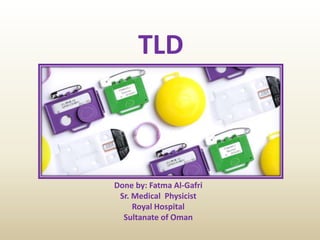
TLD
Done by: Fatma Al-Gafri
Sr. Medical Physicist
Royal Hospital
Sultanate of Oman
Outline
o Radiation
o Radiation Detection Devices
o Personal Dosimeters
o What is TLDs
o How does it work
o Types of TLDs
o Advantage & Disadvantage
of TLDs
Radiation
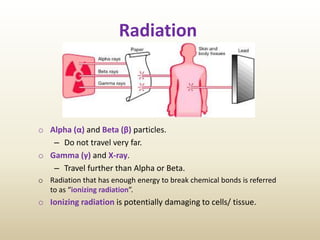
o Alpha (α) and Beta (β) particles.
– Do not travel very far.
o Gamma (γ) and X-ray.
– Travel further than Alpha or Beta.
o Radiation that has enough energy to break chemical bonds is referred
to as “ionizing radiation”.
o Ionizing radiation is potentially damaging to cells/ tissue.
Radiation Detection Devices
o Instruments that can identify the presence of
radiation:
• In the environment
• On the surface of people (external contamination)
• Inside people (internal contamination)
• Received by people as exposure
o There are many types of radiation detection
devices.
• No single device can detect all kinds of radiation.
• No one device is useful in all situations.
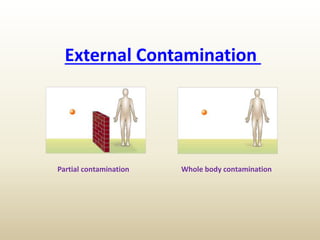
External Contamination
Partial contamination Whole body contamination
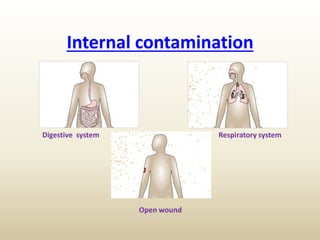
Internal contamination
Digestive system Respiratory system
Open wound
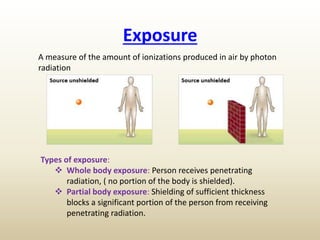
Exposure
Types of exposure:
 Whole body exposure: Person receives penetrating
radiation, ( no portion of the body is shielded).
 Partial body exposure: Shielding of sufficient thickness
blocks a significant portion of the person from receiving
penetrating radiation.
A measure of the amount of ionizations produced in air by photon
radiation
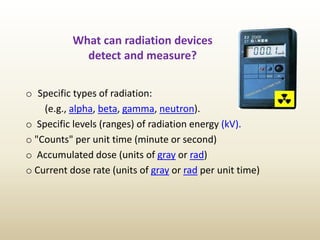
What can radiation devices
detect and measure?
o Specific types of radiation:
(e.g., alpha, beta, gamma, neutron).
o Specific levels (ranges) of radiation energy (kV).
o "Counts" per unit time (minute or second)
o Accumulated dose (units of gray or rad)
o Current dose rate (units of gray or rad per unit time)
Personal Dosimeters
• What is a personal dosimeter?
– A small radiation monitoring device worn
by persons entering environments that
may contain radiation .
• Who should wear a personal
dosimeter?
– Workers in ( emergency / non emergency)
environments that may contain radiation .
– Workers in industrial environments where
radiation is used .
Personal monitoring – Why??
• To ensure dose limits are not exceeded
20 mSv /y for whole body.
• To check that doses are ALARA
• Provides documentation in case of
ionization incident / emergency.
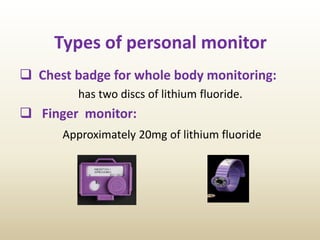
Types of personal monitor
 Chest badge for whole body monitoring:
has two discs of lithium fluoride.
 Finger monitor:
Approximately 20mg of lithium fluoride
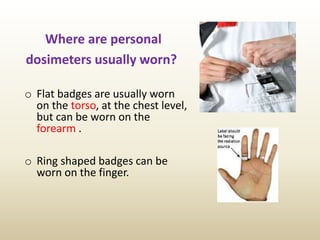
Where are personal
dosimeters usually worn?
o Flat badges are usually worn
on the torso, at the chest level,
but can be worn on the
forearm .
o Ring shaped badges can be
worn on the finger.
TLD
Thermoluminsecence Dose meter
o The primary form of personal radiation monitoring
dosmoter.
o Thermo luminescence is the emission of light by
heat.
o TLD measures ionizing radiation exposure by
measuring the amount of visible light emitted from
a crystal in the detector when the crystal is heated.
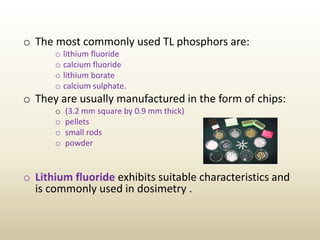
o The most commonly used TL phosphors are:
o lithium fluoride
o calcium fluoride
o lithium borate
o calcium sulphate.
o They are usually manufactured in the form of chips:
o (3.2 mm square by 0.9 mm thick)
o pellets
o small rods
o powder
o Lithium fluoride exhibits suitable characteristics and
is commonly used in dosimetry .
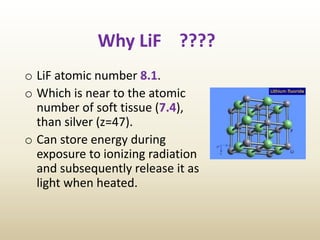
Why LiF ????
o LiF atomic number 8.1.
o Which is near to the atomic
number of soft tissue (7.4),
than silver (z=47).
o Can store energy during
exposure to ionizing radiation
and subsequently release it as
light when heated.
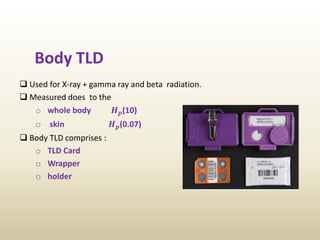
Body TLD
 Used for X-ray + gamma ray and beta radiation.
 Measured does to the
o whole body 𝑯 𝒑(10)
o skin 𝑯 𝒑(0.07)
 Body TLD comprises :
o TLD Card
o Wrapper
o holder
Contains
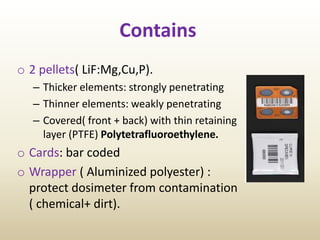
o 2 pellets( LiF:Mg,Cu,P).
– Thicker elements: strongly penetrating
– Thinner elements: weakly penetrating
– Covered( front + back) with thin retaining
layer (PTFE) Polytetrafluoroethylene.
o Cards: bar coded
o Wrapper ( Aluminized polyester) :
protect dosimeter from contamination
( chemical+ dirt).
Cont…
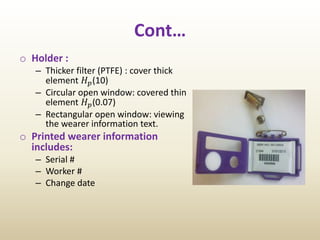
o Holder :
– Thicker filter (PTFE) : cover thick
element 𝐻 𝑝(10)
– Circular open window: covered thin
element 𝐻 𝑝(0.07)
– Rectangular open window: viewing
the wearer information text.
o Printed wearer information
includes:
– Serial #
– Worker #
– Change date
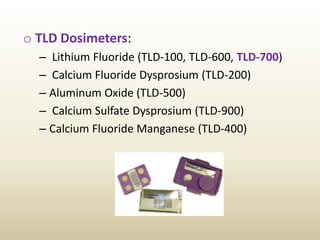
o TLD Dosimeters:
– Lithium Fluoride (TLD-100, TLD-600, TLD-700)
– Calcium Fluoride Dysprosium (TLD-200)
– Aluminum Oxide (TLD-500)
– Calcium Sulfate Dysprosium (TLD-900)
– Calcium Fluoride Manganese (TLD-400)
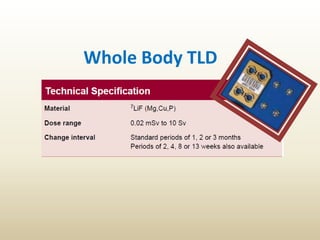
Whole Body TLD
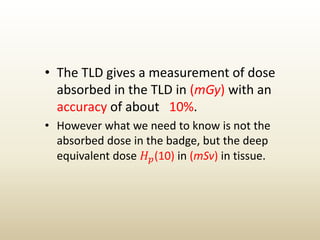
• The TLD gives a measurement of dose
absorbed in the TLD in (mGy) with an
accuracy of about 10%.
• However what we need to know is not the
absorbed dose in the badge, but the deep
equivalent dose 𝐻 𝑝(10) in (mSv) in tissue.
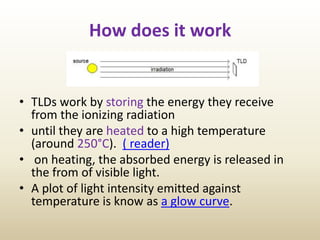
How does it work
• TLDs work by storing the energy they receive
from the ionizing radiation
• until they are heated to a high temperature
(around 250°C). ( reader)
• on heating, the absorbed energy is released in
the from of visible light.
• A plot of light intensity emitted against
temperature is know as a glow curve.
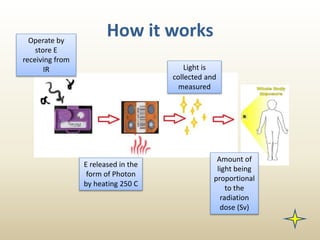
How it worksOperate by
store E
receiving from
IR
E released in the
form of Photon
by heating 250 C
Light is
collected and
measured
Amount of
light being
proportional
to the
radiation
dose (Sv)
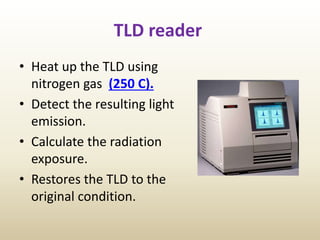
TLD reader
• Heat up the TLD using
nitrogen gas (250 C).
• Detect the resulting light
emission.
• Calculate the radiation
exposure.
• Restores the TLD to the
original condition.
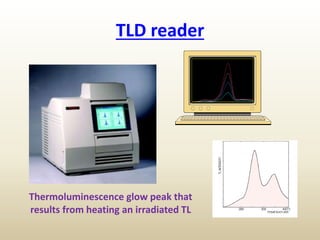
TLD reader
Thermoluminescence glow peak that
results from heating an irradiated TL
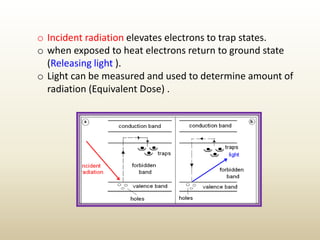
o Incident radiation elevates electrons to trap states.
o when exposed to heat electrons return to ground state
(Releasing light ).
o Light can be measured and used to determine amount of
radiation (Equivalent Dose) .
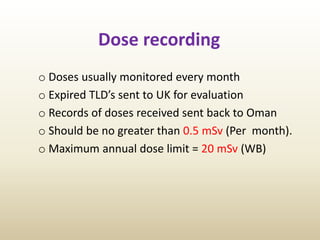
Dose recording
o Doses usually monitored every month
o Expired TLD’s sent to UK for evaluation
o Records of doses received sent back to Oman
o Should be no greater than 0.5 mSv (Per month).
o Maximum annual dose limit = 20 mSv (WB)
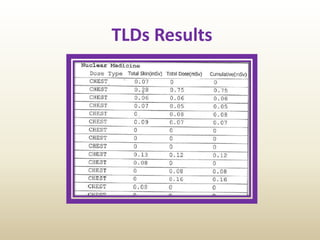
TLDs Results
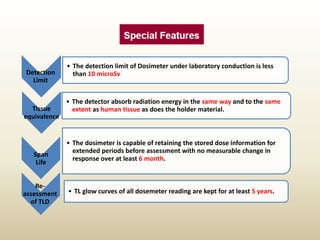
Detection
Limit
• The detection limit of Dosimeter under laboratory conduction is less
than 10 microSv
Tissue
equivalence
• The detector absorb radiation energy in the same way and to the same
extent as human tissue as does the holder material.
Span
Life
• The dosimeter is capable of retaining the stored dose information for
extended periods before assessment with no measurable change in
response over at least 6 month.
Re-
assessment
of TLD
• TL glow curves of all dosemeter reading are kept for at least 5 years.
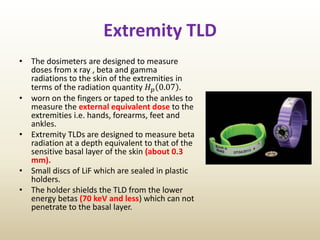
Extremity TLD
• The dosimeters are designed to measure
doses from x ray , beta and gamma
radiations to the skin of the extremities in
terms of the radiation quantity 𝐻 𝑝 0.07 .
• worn on the fingers or taped to the ankles to
measure the external equivalent dose to the
extremities i.e. hands, forearms, feet and
ankles.
• Extremity TLDs are designed to measure beta
radiation at a depth equivalent to that of the
sensitive basal layer of the skin (about 0.3
mm).
• Small discs of LiF which are sealed in plastic
holders.
• The holder shields the TLD from the lower
energy betas (70 keV and less) which can not
penetrate to the basal layer.
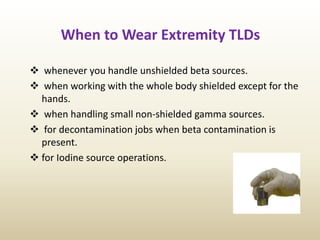
When to Wear Extremity TLDs
 whenever you handle unshielded beta sources.
 when working with the whole body shielded except for the
hands.
 when handling small non-shielded gamma sources.
 for decontamination jobs when beta contamination is
present.
 for Iodine source operations.
• The minimum detectable dose for
TLD ring dosimeters :
– [ 30 millirem for x-rays and gamma
rays]
– [40 millirem for energetic beta
radiation] .
• Both the body and ring badges do
not detect radiation from beta
emitters with energies less than
250 keV.
• To avoid contaminating your ring
badge when using open sources,
wear your ring under the glove.
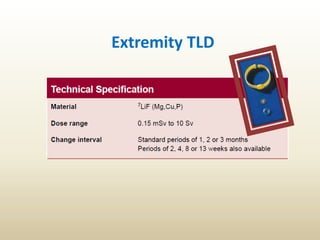
Extremity TLD
Advantage (WB TLD)
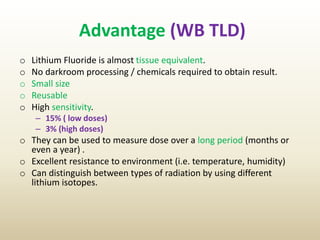
o Lithium Fluoride is almost tissue equivalent.
o No darkroom processing / chemicals required to obtain result.
o Small size
o Reusable
o High sensitivity.
– 15% ( low doses)
– 3% (high doses)
o They can be used to measure dose over a long period (months or
even a year) .
o Excellent resistance to environment (i.e. temperature, humidity)
o Can distinguish between types of radiation by using different
lithium isotopes.
Disadvantage ( WB TLD)
• Re-usable: stored signal is cleared .
• The process of reading out eliminates the dose
effect, so it can only be done once.
• Not permanent record.
• Dust on the detector will glow when heated and
will be recorded by the phototube as a false
reading.
• The TLDs are sensitive to exposure by ultraviolet
light and therefore must be sealed in a light-tight
badge.
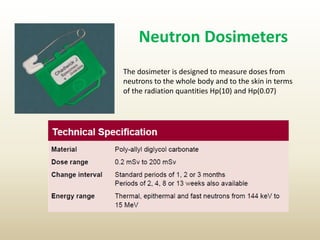
Neutron Dosimeters
The dosimeter is designed to measure doses from
neutrons to the whole body and to the skin in terms
of the radiation quantities Hp(10) and Hp(0.07)
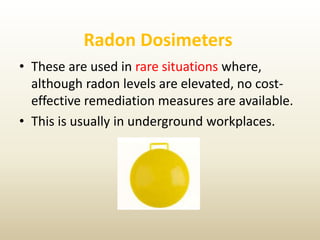
Radon Dosimeters
• These are used in rare situations where,
although radon levels are elevated, no cost-
effective remediation measures are available.
• This is usually in underground workplaces.
Guidelines for Use
o Never share your badges or wear another
person’s badges.
o Do not intentionally expose badges to radiation.
o No matter how curious you are, do not wear
your badges when you receive a medical x-ray or
other medical radiation treatment. Your badges
are intended to document occupational dose,
not medical dose.
storage
o Store your badges in a safe place, at work rather than
at home.
o Be sure to store badges away from sources of radiation.
o If you store your badges clipped to your lab coat, make
sure that your lab coat (or any other lab coat near it) is
not contaminated.
o Store your badges away from sources of heat (some
badges such as TLDs show some sensitivity to
environmental factors like heat). For example, badges
left in cars over hot summer weekends may give false
exposure readings.
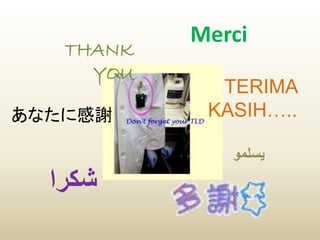
THANK
YOU
TERIMA
KASIH…..あなたに感謝
‫شكرا‬
‫يسلمو‬
Merci

TLD

  • 1.
    TLD Done by: FatmaAl-Gafri Sr. Medical Physicist Royal Hospital Sultanate of Oman
  • 2.
    Outline o Radiation o RadiationDetection Devices o Personal Dosimeters o What is TLDs o How does it work o Types of TLDs o Advantage & Disadvantage of TLDs
  • 3.
    Radiation o Alpha (α)and Beta (β) particles. – Do not travel very far. o Gamma (γ) and X-ray. – Travel further than Alpha or Beta. o Radiation that has enough energy to break chemical bonds is referred to as “ionizing radiation”. o Ionizing radiation is potentially damaging to cells/ tissue.
  • 4.
    Radiation Detection Devices oInstruments that can identify the presence of radiation: • In the environment • On the surface of people (external contamination) • Inside people (internal contamination) • Received by people as exposure o There are many types of radiation detection devices. • No single device can detect all kinds of radiation. • No one device is useful in all situations.
  • 5.
  • 6.
    Internal contamination Digestive systemRespiratory system Open wound
  • 7.
    Exposure Types of exposure: Whole body exposure: Person receives penetrating radiation, ( no portion of the body is shielded).  Partial body exposure: Shielding of sufficient thickness blocks a significant portion of the person from receiving penetrating radiation. A measure of the amount of ionizations produced in air by photon radiation
  • 8.
    What can radiationdevices detect and measure? o Specific types of radiation: (e.g., alpha, beta, gamma, neutron). o Specific levels (ranges) of radiation energy (kV). o "Counts" per unit time (minute or second) o Accumulated dose (units of gray or rad) o Current dose rate (units of gray or rad per unit time)
  • 9.
    Personal Dosimeters • Whatis a personal dosimeter? – A small radiation monitoring device worn by persons entering environments that may contain radiation . • Who should wear a personal dosimeter? – Workers in ( emergency / non emergency) environments that may contain radiation . – Workers in industrial environments where radiation is used .
  • 10.
    Personal monitoring –Why?? • To ensure dose limits are not exceeded 20 mSv /y for whole body. • To check that doses are ALARA • Provides documentation in case of ionization incident / emergency.
  • 11.
    Types of personalmonitor  Chest badge for whole body monitoring: has two discs of lithium fluoride.  Finger monitor: Approximately 20mg of lithium fluoride
  • 12.
    Where are personal dosimetersusually worn? o Flat badges are usually worn on the torso, at the chest level, but can be worn on the forearm . o Ring shaped badges can be worn on the finger.
  • 13.
    TLD Thermoluminsecence Dose meter oThe primary form of personal radiation monitoring dosmoter. o Thermo luminescence is the emission of light by heat. o TLD measures ionizing radiation exposure by measuring the amount of visible light emitted from a crystal in the detector when the crystal is heated.
  • 14.
    o The mostcommonly used TL phosphors are: o lithium fluoride o calcium fluoride o lithium borate o calcium sulphate. o They are usually manufactured in the form of chips: o (3.2 mm square by 0.9 mm thick) o pellets o small rods o powder o Lithium fluoride exhibits suitable characteristics and is commonly used in dosimetry .
  • 15.
    Why LiF ???? oLiF atomic number 8.1. o Which is near to the atomic number of soft tissue (7.4), than silver (z=47). o Can store energy during exposure to ionizing radiation and subsequently release it as light when heated.
  • 16.
    Body TLD  Usedfor X-ray + gamma ray and beta radiation.  Measured does to the o whole body 𝑯 𝒑(10) o skin 𝑯 𝒑(0.07)  Body TLD comprises : o TLD Card o Wrapper o holder
  • 17.
    Contains o 2 pellets(LiF:Mg,Cu,P). – Thicker elements: strongly penetrating – Thinner elements: weakly penetrating – Covered( front + back) with thin retaining layer (PTFE) Polytetrafluoroethylene. o Cards: bar coded o Wrapper ( Aluminized polyester) : protect dosimeter from contamination ( chemical+ dirt).
  • 18.
    Cont… o Holder : –Thicker filter (PTFE) : cover thick element 𝐻 𝑝(10) – Circular open window: covered thin element 𝐻 𝑝(0.07) – Rectangular open window: viewing the wearer information text. o Printed wearer information includes: – Serial # – Worker # – Change date
  • 19.
    o TLD Dosimeters: –Lithium Fluoride (TLD-100, TLD-600, TLD-700) – Calcium Fluoride Dysprosium (TLD-200) – Aluminum Oxide (TLD-500) – Calcium Sulfate Dysprosium (TLD-900) – Calcium Fluoride Manganese (TLD-400)
  • 20.
  • 21.
    • The TLDgives a measurement of dose absorbed in the TLD in (mGy) with an accuracy of about 10%. • However what we need to know is not the absorbed dose in the badge, but the deep equivalent dose 𝐻 𝑝(10) in (mSv) in tissue.
  • 22.
    How does itwork • TLDs work by storing the energy they receive from the ionizing radiation • until they are heated to a high temperature (around 250°C). ( reader) • on heating, the absorbed energy is released in the from of visible light. • A plot of light intensity emitted against temperature is know as a glow curve.
  • 23.
    How it worksOperateby store E receiving from IR E released in the form of Photon by heating 250 C Light is collected and measured Amount of light being proportional to the radiation dose (Sv)
  • 24.
    TLD reader • Heatup the TLD using nitrogen gas (250 C). • Detect the resulting light emission. • Calculate the radiation exposure. • Restores the TLD to the original condition.
  • 25.
    TLD reader Thermoluminescence glowpeak that results from heating an irradiated TL
  • 26.
    o Incident radiationelevates electrons to trap states. o when exposed to heat electrons return to ground state (Releasing light ). o Light can be measured and used to determine amount of radiation (Equivalent Dose) .
  • 27.
    Dose recording o Dosesusually monitored every month o Expired TLD’s sent to UK for evaluation o Records of doses received sent back to Oman o Should be no greater than 0.5 mSv (Per month). o Maximum annual dose limit = 20 mSv (WB)
  • 28.
  • 29.
    Detection Limit • The detectionlimit of Dosimeter under laboratory conduction is less than 10 microSv Tissue equivalence • The detector absorb radiation energy in the same way and to the same extent as human tissue as does the holder material. Span Life • The dosimeter is capable of retaining the stored dose information for extended periods before assessment with no measurable change in response over at least 6 month. Re- assessment of TLD • TL glow curves of all dosemeter reading are kept for at least 5 years.
  • 30.
    Extremity TLD • Thedosimeters are designed to measure doses from x ray , beta and gamma radiations to the skin of the extremities in terms of the radiation quantity 𝐻 𝑝 0.07 . • worn on the fingers or taped to the ankles to measure the external equivalent dose to the extremities i.e. hands, forearms, feet and ankles. • Extremity TLDs are designed to measure beta radiation at a depth equivalent to that of the sensitive basal layer of the skin (about 0.3 mm). • Small discs of LiF which are sealed in plastic holders. • The holder shields the TLD from the lower energy betas (70 keV and less) which can not penetrate to the basal layer.
  • 31.
    When to WearExtremity TLDs  whenever you handle unshielded beta sources.  when working with the whole body shielded except for the hands.  when handling small non-shielded gamma sources.  for decontamination jobs when beta contamination is present.  for Iodine source operations.
  • 32.
    • The minimumdetectable dose for TLD ring dosimeters : – [ 30 millirem for x-rays and gamma rays] – [40 millirem for energetic beta radiation] . • Both the body and ring badges do not detect radiation from beta emitters with energies less than 250 keV. • To avoid contaminating your ring badge when using open sources, wear your ring under the glove.
  • 33.
  • 34.
    Advantage (WB TLD) oLithium Fluoride is almost tissue equivalent. o No darkroom processing / chemicals required to obtain result. o Small size o Reusable o High sensitivity. – 15% ( low doses) – 3% (high doses) o They can be used to measure dose over a long period (months or even a year) . o Excellent resistance to environment (i.e. temperature, humidity) o Can distinguish between types of radiation by using different lithium isotopes.
  • 35.
    Disadvantage ( WBTLD) • Re-usable: stored signal is cleared . • The process of reading out eliminates the dose effect, so it can only be done once. • Not permanent record. • Dust on the detector will glow when heated and will be recorded by the phototube as a false reading. • The TLDs are sensitive to exposure by ultraviolet light and therefore must be sealed in a light-tight badge.
  • 36.
    Neutron Dosimeters The dosimeteris designed to measure doses from neutrons to the whole body and to the skin in terms of the radiation quantities Hp(10) and Hp(0.07)
  • 37.
    Radon Dosimeters • Theseare used in rare situations where, although radon levels are elevated, no cost- effective remediation measures are available. • This is usually in underground workplaces.
  • 38.
    Guidelines for Use oNever share your badges or wear another person’s badges. o Do not intentionally expose badges to radiation. o No matter how curious you are, do not wear your badges when you receive a medical x-ray or other medical radiation treatment. Your badges are intended to document occupational dose, not medical dose.
  • 39.
    storage o Store yourbadges in a safe place, at work rather than at home. o Be sure to store badges away from sources of radiation. o If you store your badges clipped to your lab coat, make sure that your lab coat (or any other lab coat near it) is not contaminated. o Store your badges away from sources of heat (some badges such as TLDs show some sensitivity to environmental factors like heat). For example, badges left in cars over hot summer weekends may give false exposure readings.
  • 40.