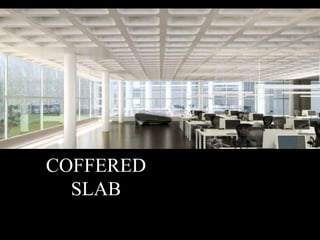
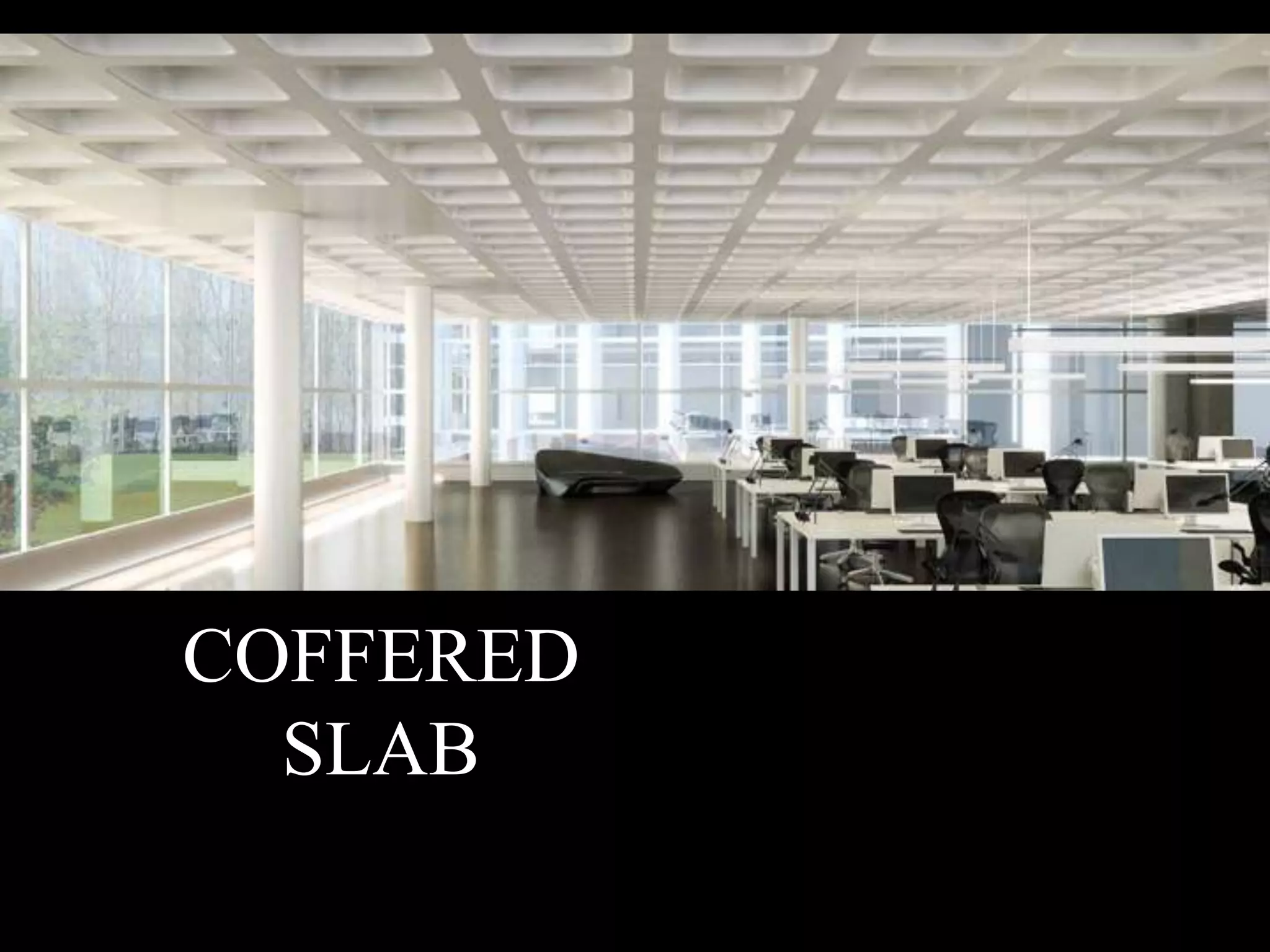
COFFERED
SLAB
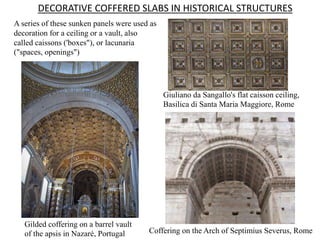
Gilded coffering on a barrel vault
of the apsis in Nazaré, Portugal
Giuliano da Sangallo's flat caisson ceiling,
Basilica di Santa Maria Maggiore, Rome
DECORATIVE COFFERED SLABS IN HISTORICAL STRUCTURES
Coffering on the Arch of Septimius Severus, Rome
A series of these sunken panels were used as
decoration for a ceiling or a vault, also
called caissons ('boxes"), or lacunaria
("spaces, openings")
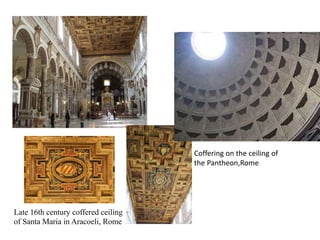
Late 16th century coffered ceiling
of Santa Maria in Aracoeli, Rome
Coffering on the ceiling of
the Pantheon,Rome
WORKING
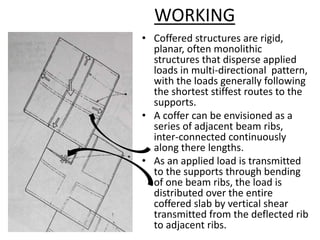
• Coffered structures are rigid,
planar, often monolithic
structures that disperse applied
loads in multi-directional pattern,
with the loads generally following
the shortest stiffest routes to the
supports.
• A coffer can be envisioned as a
series of adjacent beam ribs,
inter-connected continuously
along there lengths.
• As an applied load is transmitted
to the supports through bending
of one beam ribs, the load is
distributed over the entire
coffered slab by vertical shear
transmitted from the deflected rib
to adjacent ribs.
WORKING
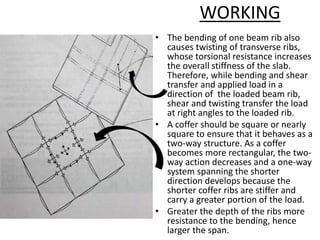
• The bending of one beam rib also
causes twisting of transverse ribs,
whose torsional resistance increases
the overall stiffness of the slab.
Therefore, while bending and shear
transfer and applied load in a
direction of the loaded beam rib,
shear and twisting transfer the load
at right angles to the loaded rib.
• A coffer should be square or nearly
square to ensure that it behaves as a
two-way structure. As a coffer
becomes more rectangular, the two-
way action decreases and a one-way
system spanning the shorter
direction develops because the
shorter coffer ribs are stiffer and
carry a greater portion of the load.
• Greater the depth of the ribs more
resistance to the bending, hence
larger the span.
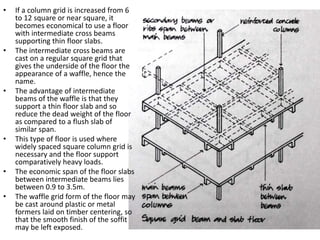
• If a column grid is increased from 6
to 12 square or near square, it
becomes economical to use a floor
with intermediate cross beams
supporting thin floor slabs.
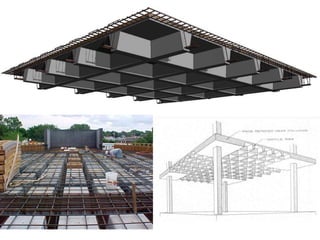
• The intermediate cross beams are
cast on a regular square grid that
gives the underside of the floor the
appearance of a waffle, hence the
name.
• The advantage of intermediate
beams of the waffle is that they
support a thin floor slab and so
reduce the dead weight of the floor
as compared to a flush slab of
similar span.
• This type of floor is used where
widely spaced square column grid is
necessary and the floor support
comparatively heavy loads.
• The economic span of the floor slabs
between intermediate beams lies
between 0.9 to 3.5m.
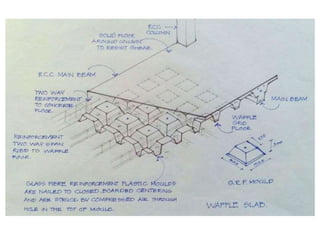
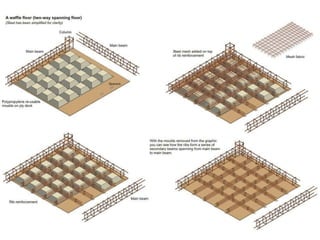
• The waffle grid form of the floor may
be cast around plastic or metal
formers laid on timber centering, so
that the smooth finish of the soffit
may be left exposed.
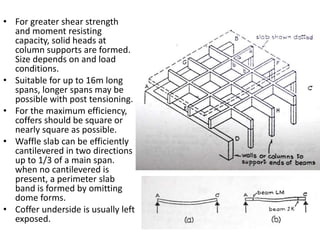
• For greater shear strength
and moment resisting
capacity, solid heads at
column supports are formed.
Size depends on and load
conditions.
• Suitable for up to 16m long
spans, longer spans may be
possible with post tensioning.
• For the maximum efficiency,
coffers should be square or
nearly square as possible.
• Waffle slab can be efficiently
cantilevered in two directions
up to 1/3 of a main span.
when no cantilevered is
present, a perimeter slab
band is formed by omitting
dome forms.
• Coffer underside is usually left
exposed.
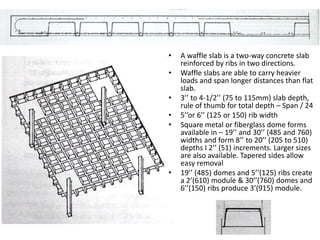
• A waffle slab is a two-way concrete slab
reinforced by ribs in two directions.
• Waffle slabs are able to carry heavier
loads and span longer distances than flat
slab.
• 3’’ to 4-1/2’’ (75 to 115mm) slab depth,
rule of thumb for total depth – Span / 24
• 5’’or 6’’ (125 or 150) rib width
• Square metal or fiberglass dome forms
available in – 19’’ and 30’’ (485 and 760)
widths and form 8’’ to 20’’ (205 to 510)
depths I 2’’ (51) increments. Larger sizes
are also available. Tapered sides allow
easy removal
• 19’’ (485) domes and 5’’(125) ribs create
a 2’(610) module & 30’’(760) domes and
6’’(150) ribs produce 3’(915) module.
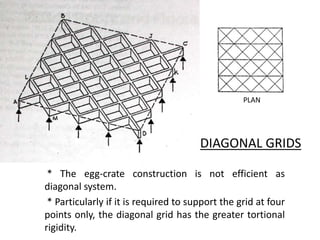
DIAGONAL GRIDS
* The egg-crate construction is not efficient as
diagonal system.
* Particularly if it is required to support the grid at four
points only, the diagonal grid has the greater tortional
rigidity.
PLAN
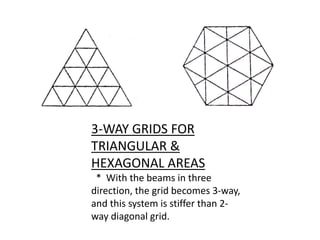
3-WAY GRIDS FOR
TRIANGULAR &
HEXAGONAL AREAS
* With the beams in three
direction, the grid becomes 3-way,
and this system is stiffer than 2-
way diagonal grid.
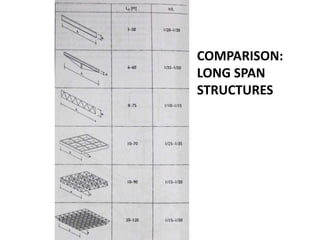
COMPARISON:
LONG SPAN
STRUCTURES
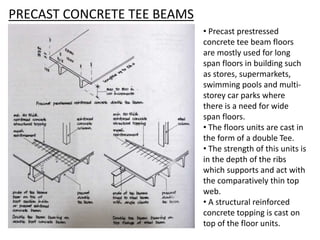
PRECAST CONCRETE TEE BEAMS
• Precast prestressed
concrete tee beam floors
are mostly used for long
span floors in building such
as stores, supermarkets,
swimming pools and multi-
storey car parks where
there is a need for wide
span floors.
• The floors units are cast in
the form of a double Tee.
• The strength of this units is
in the depth of the ribs
which supports and act with
the comparatively thin top
web.
• A structural reinforced
concrete topping is cast on
top of the floor units.
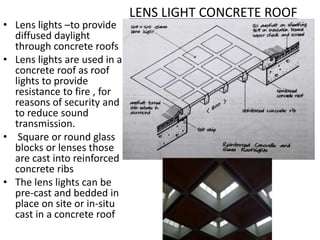
LENS LIGHT CONCRETE ROOF
• Lens lights –to provide
diffused daylight
through concrete roofs
• Lens lights are used in a
concrete roof as roof
lights to provide
resistance to fire , for
reasons of security and
to reduce sound
transmission.
• Square or round glass
blocks or lenses those
are cast into reinforced
concrete ribs
• The lens lights can be
pre-cast and bedded in
place on site or in-situ
cast in a concrete roof
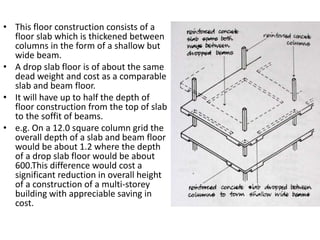
• This floor construction consists of a
floor slab which is thickened between
columns in the form of a shallow but
wide beam.
• A drop slab floor is of about the same
dead weight and cost as a comparable
slab and beam floor.
• It will have up to half the depth of
floor construction from the top of slab
to the soffit of beams.
• e.g. On a 12.0 square column grid the
overall depth of a slab and beam floor
would be about 1.2 where the depth
of a drop slab floor would be about
600.This difference would cost a
significant reduction in overall height
of a construction of a multi-storey
building with appreciable saving in
cost.
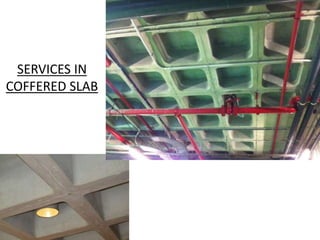
SERVICES IN
COFFERED SLAB
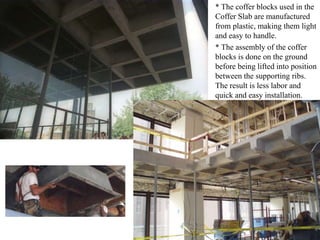
* The coffer blocks used in the
Coffer Slab are manufactured
from plastic, making them light
and easy to handle.
* The assembly of the coffer
blocks is done on the ground
before being lifted into position
between the supporting ribs.
The result is less labor and
quick and easy installation.
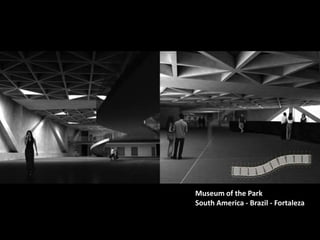
Museum of the Park
South America - Brazil - Fortaleza
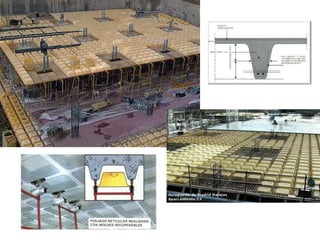
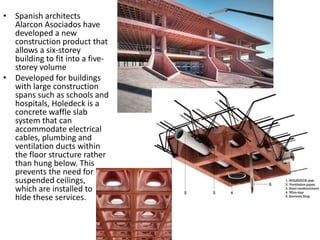
• Spanish architects
Alarcon Asociados have
developed a new
construction product that
allows a six-storey
building to fit into a five-
storey volume
• Developed for buildings
with large construction
spans such as schools and
hospitals, Holedeck is a
concrete waffle slab
system that can
accommodate electrical
cables, plumbing and
ventilation ducts within
the floor structure rather
than hung below. This
prevents the need for
suspended ceilings,
which are installed to
hide these services.

235562808 coffered-slab

  • 1.
  • 2.
    Gilded coffering ona barrel vault of the apsis in Nazaré, Portugal Giuliano da Sangallo's flat caisson ceiling, Basilica di Santa Maria Maggiore, Rome DECORATIVE COFFERED SLABS IN HISTORICAL STRUCTURES Coffering on the Arch of Septimius Severus, Rome A series of these sunken panels were used as decoration for a ceiling or a vault, also called caissons ('boxes"), or lacunaria ("spaces, openings")
  • 3.
    Late 16th centurycoffered ceiling of Santa Maria in Aracoeli, Rome Coffering on the ceiling of the Pantheon,Rome
  • 4.
    WORKING • Coffered structuresare rigid, planar, often monolithic structures that disperse applied loads in multi-directional pattern, with the loads generally following the shortest stiffest routes to the supports. • A coffer can be envisioned as a series of adjacent beam ribs, inter-connected continuously along there lengths. • As an applied load is transmitted to the supports through bending of one beam ribs, the load is distributed over the entire coffered slab by vertical shear transmitted from the deflected rib to adjacent ribs.
  • 5.
    WORKING • The bendingof one beam rib also causes twisting of transverse ribs, whose torsional resistance increases the overall stiffness of the slab. Therefore, while bending and shear transfer and applied load in a direction of the loaded beam rib, shear and twisting transfer the load at right angles to the loaded rib. • A coffer should be square or nearly square to ensure that it behaves as a two-way structure. As a coffer becomes more rectangular, the two- way action decreases and a one-way system spanning the shorter direction develops because the shorter coffer ribs are stiffer and carry a greater portion of the load. • Greater the depth of the ribs more resistance to the bending, hence larger the span.
  • 6.
    • If acolumn grid is increased from 6 to 12 square or near square, it becomes economical to use a floor with intermediate cross beams supporting thin floor slabs. • The intermediate cross beams are cast on a regular square grid that gives the underside of the floor the appearance of a waffle, hence the name. • The advantage of intermediate beams of the waffle is that they support a thin floor slab and so reduce the dead weight of the floor as compared to a flush slab of similar span. • This type of floor is used where widely spaced square column grid is necessary and the floor support comparatively heavy loads. • The economic span of the floor slabs between intermediate beams lies between 0.9 to 3.5m. • The waffle grid form of the floor may be cast around plastic or metal formers laid on timber centering, so that the smooth finish of the soffit may be left exposed.
  • 7.
    • For greatershear strength and moment resisting capacity, solid heads at column supports are formed. Size depends on and load conditions. • Suitable for up to 16m long spans, longer spans may be possible with post tensioning. • For the maximum efficiency, coffers should be square or nearly square as possible. • Waffle slab can be efficiently cantilevered in two directions up to 1/3 of a main span. when no cantilevered is present, a perimeter slab band is formed by omitting dome forms. • Coffer underside is usually left exposed.
  • 8.
    • A waffleslab is a two-way concrete slab reinforced by ribs in two directions. • Waffle slabs are able to carry heavier loads and span longer distances than flat slab. • 3’’ to 4-1/2’’ (75 to 115mm) slab depth, rule of thumb for total depth – Span / 24 • 5’’or 6’’ (125 or 150) rib width • Square metal or fiberglass dome forms available in – 19’’ and 30’’ (485 and 760) widths and form 8’’ to 20’’ (205 to 510) depths I 2’’ (51) increments. Larger sizes are also available. Tapered sides allow easy removal • 19’’ (485) domes and 5’’(125) ribs create a 2’(610) module & 30’’(760) domes and 6’’(150) ribs produce 3’(915) module.
  • 12.
    DIAGONAL GRIDS * Theegg-crate construction is not efficient as diagonal system. * Particularly if it is required to support the grid at four points only, the diagonal grid has the greater tortional rigidity. PLAN
  • 13.
    3-WAY GRIDS FOR TRIANGULAR& HEXAGONAL AREAS * With the beams in three direction, the grid becomes 3-way, and this system is stiffer than 2- way diagonal grid.
  • 14.
  • 15.
    PRECAST CONCRETE TEEBEAMS • Precast prestressed concrete tee beam floors are mostly used for long span floors in building such as stores, supermarkets, swimming pools and multi- storey car parks where there is a need for wide span floors. • The floors units are cast in the form of a double Tee. • The strength of this units is in the depth of the ribs which supports and act with the comparatively thin top web. • A structural reinforced concrete topping is cast on top of the floor units.
  • 16.
    LENS LIGHT CONCRETEROOF • Lens lights –to provide diffused daylight through concrete roofs • Lens lights are used in a concrete roof as roof lights to provide resistance to fire , for reasons of security and to reduce sound transmission. • Square or round glass blocks or lenses those are cast into reinforced concrete ribs • The lens lights can be pre-cast and bedded in place on site or in-situ cast in a concrete roof
  • 17.
    • This floorconstruction consists of a floor slab which is thickened between columns in the form of a shallow but wide beam. • A drop slab floor is of about the same dead weight and cost as a comparable slab and beam floor. • It will have up to half the depth of floor construction from the top of slab to the soffit of beams. • e.g. On a 12.0 square column grid the overall depth of a slab and beam floor would be about 1.2 where the depth of a drop slab floor would be about 600.This difference would cost a significant reduction in overall height of a construction of a multi-storey building with appreciable saving in cost.
  • 18.
  • 20.
    * The cofferblocks used in the Coffer Slab are manufactured from plastic, making them light and easy to handle. * The assembly of the coffer blocks is done on the ground before being lifted into position between the supporting ribs. The result is less labor and quick and easy installation.
  • 21.
    Museum of thePark South America - Brazil - Fortaleza
  • 22.
    • Spanish architects AlarconAsociados have developed a new construction product that allows a six-storey building to fit into a five- storey volume • Developed for buildings with large construction spans such as schools and hospitals, Holedeck is a concrete waffle slab system that can accommodate electrical cables, plumbing and ventilation ducts within the floor structure rather than hung below. This prevents the need for suspended ceilings, which are installed to hide these services.