Coordinate Geometry
Class X
1. Cartesian Coordinate
system and Quadrants
2. Distance formula
3. Area of a triangle
4. Section formula
Objectives
• The use of algebra to study
geometric properties i.e.
operates on symbols is defined
as the coordinate system.
What is co-ordinate geometry ?
IntroductIon
 A system of geometry where the position of points on the plane is described
using an ordered pair of numbers.
 The method of describing the location of points in this way was
 proposed by the French mathematician René Descartes .
 He proposed further that curves and lines could be described by
equations using this technique, thus being the first to link
algebra and geometry. 
 In honor of his work, the coordinates of a point are often referred to as
its Cartesian coordinates, and the coordinate plane as the Cartesian
Coordinate Plane.
Coordinate Geometry
SoME BASIc PoIntS
To locate the position of a point on a plane,we
require a pair of coordinate axes.
The distance of a point from the y-axis is called its
x-coordinate,OR abscissa.
The distance of a point from the x-axis is called its
y-coordinate,OR ordinate.
The coordinates of a point on the x-axis are
of the form (x, 0) and of a point on the y-axis
are of the form (0, y).
RECAP
Coordinate Plane
X
X’
Y
Y’
O
Origin
1 2 3 4
+ve direction
-1
-2
-3
-4
-ve direction
-1
-2
-3
-ve
direction
1
2
3
+ve
direction
X-axis : X’OX
Y-axis : Y’OY
Quadrants
X
X’ O
Y
Y’
I
II
III IV
(+,+)
(-,+)
(-,-) (+,-)
Coordinates
X
X’
Y
Y’
O
1 2 3 4
-1
-2
-3
-4
-1
-2
-3
1
2
3
(2,1)
(-3,-2)
Ordinate
Abcissa
(?,?)
X
X’ O
Y
Y’
I
II
III IV
(+,+)
(-,+)
(-,-) (+,-)
Q : (1,0) lies in which Quadrant?
Ist? IInd?
A : None. Points which lie on the axes do not lie in any
quadrant.
Distance Formula
0
x1
x2
y2
y1
P(x1,y1)
Q(x2,y2)
Y-axis
X-axis
 Let us now find the distance between any two points P(x1, y1) and
Q(x1, y2)
 Draw PR and QS ⊥ x-axis. A
perpendicular from the point P on
 QS is draw to meet it at the point T
So, OR = x1 , OS = x2 ,
PR = PS = y1 , QS = y2
Then , PT = x2 – x1 ,
QT = y2 – y1
x
Y
P (x1 , y1)
Q(x2 , y2)
T
R S
O
Distance Formula
Now, applying the Pythagoras theorem in ΔPTQ, we get
Therefore
2
2
2
QT
PT
PQ +
=
( ) ( )2
1
2
2
1
2 y
y
x
x
PQ −
+
−
=
which is called the distance formula.
Example 1: Find the distance between P(1,-3) and Q(5,7).
The exact distance between A(1, -3) and B(5, 7) is
Distance From Origin
Distance of P(x, y) from the origin is
( ) ( )
2 2
x 0 y 0
= − + −
2 2
x y
= +
Applications of Distance Formula
To check which type of triangle is
formed by given 3 coordinates.
and
To check which type of quadrilateral is
formed by given 4 coordinates.
Applications of Distance Formula
Parallelogram
Prove opposite sides are equal or diagonals bisect
each other
Applications of Distance Formula
Rhombus
Prove all 4 sides are equal
Applications of Distance Formula
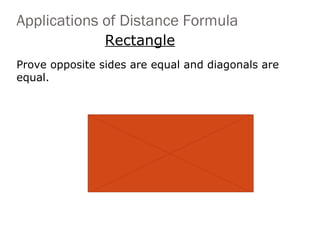
Rectangle
Prove opposite sides are equal and diagonals are
equal.
Applications of Distance Formula
Square
Prove all 4 sides are equal and diagonals are equal.
Collinearity of Three Points
Use Distance Formula
a b
c
Show that a+b = c
Section Formula
2
1
m
m
PB
PA
=
 Consider any two points A(x1 , y1) and B(x1 ,y2) and assume that P (x, y)
divides AB internally in the ratio m1: m2 i.e.
 Draw AR, PS and BT ⊥ x-axis.
 Draw AQ and PC parallel to the x-axis.
Then,
by the AA similarity criterion,
x
Y
A (x1 , y1)
B(x2 , y2)
P (x , y)
R S
O T
m1
m2
Q
C
Section Formula
ΔPAQ ~ ΔBPC
---------------- (1)
Now,
AQ = RS = OS – OR = x– x1
PC = ST = OT – OS = x2– x
PQ = PS – QS = PS – AR = y– y1
BC = BT– CT = BT – PS = y2– y
Substituting these values in (1), we get
BC
PQ
PC
AQ
BP
PA
=
=
( )
( )
( )
( )
y
y
y
y
x
x
x
x
m
m
−
−
=
−
−
=
2
1
2
1
2
1 ( )
( )
( )
( )
y
y
y
y
x
x
x
x
m
m
−
−
=
−
−
=
2
1
2
1
2
1
Section Formula
For x - coordinate
Taking
or
( )
( )
x
x
x
x
m
m
−
−
=
2
1
2
1
( ) ( )
1
2
2
1 x
x
m
x
x
m −
=
−
1
2
2
1
2
1 x
m
x
m
x
m
x
m −
=
−
or
or ( )
1
2
1
2
2
1 m
m
x
x
m
x
m +
=
+
1
2
1
2
2
1
m
m
x
m
x
m
x
+
+
=
Section Formula
For y – coordinate
Taking ( )
( )
y
y
y
y
m
m
−
−
=
2
1
2
1
( ) ( )
1
2
2
1 y
y
m
y
y
m −
=
−
1
2
2
1
2
1 y
m
y
m
y
m
y
m −
=
−
( )
1
2
1
2
2
1 m
m
y
y
m
y
m +
=
+
1
2
1
2
2
1
m
m
y
m
y
m
y
+
+
=
or
or
or
Midpoint
Midpoint of A(x1, y1) and B(x2,y2)
m:n ≡ 1:1
1 2 1 2
x x y y
P ,
2 2
+ +
 
∴ ≡  
 
Find the Mid-Point of P(1,-3) and Q(5,7).
Area of a Triangle
 Let ABC be any triangle whose vertices are A(x1, y1), B(x2 , y2) and
C(x3 , y3).
 Draw AP, BQ and CR
 perpendiculars from A,B and C,
 respectively, to the x-axis.
Clearly ABQP, APRC and
BQRC are all trapezium,
Now, from figure
QP = (x2 – x1)
PR = (x3 – x1)
QR = (x3 – x2)
x
Y
A (x1 , y1)
B(x2 , y2)
C (x3 , y3)
P Q
O R
Area of a Triangle
X
X’
Y’
O
Y A(x1, y1)
C(x3, y3)
B(x
2
,
y
2
)
M L N
Area of ∆ ABC =
Area of trapezium ABML + Area of trapezium ALNC
- Area of trapezium BMNC
Area of a Triangle
Area of ABC
Δ = Area of trapezium ABQP + Area of
trapezium BQRC– Area of trapezium APRC.
We also know that ,
Area of trapezium =
Therefore,
Area of ABC
Δ =
( )( )
em
between th
distance
sides
parallel
of
sum
2
1
( ) ( ) ( )PR
CR
+
AP
2
1
CR
+
BQ
2
1
QP
AP
+
BQ
2
1
−
+ QR
( )( ) ( )( ) ( )( )
1
3
3
1
2
3
3
2
1
2
1
2
2
1
2
1
2
1
x
x
y
y
x
x
y
y
x
x
y
y −
+
−
−
+
+
−
+
=
( ) ( ) ( )
[ ]
1
3
3
3
1
1
3
1
2
3
3
3
2
2
3
2
1
1
2
1
1
2
2
2
2
1
x
y
x
y
x
y
x
y
x
y
x
y
x
y
x
y
x
y
x
y
x
y
x
y −
+
−
−
−
+
−
+
−
+
−
=
( ) ( ) ( )
[ ]
1
2
3
3
1
2
2
3
1
2
1
y
y
x
y
y
x
y
y
x −
+
−
+
−
=
Area of Δ ABC
PROJECT
Mark coordinate axes on your city map and
find distances between important landmarks-
bus stand, railway station, airport, hospital, school,
Your house, Any river etc.
THANK YOU

CGc10.pdf

  • 1.
  • 2.
    1. Cartesian Coordinate systemand Quadrants 2. Distance formula 3. Area of a triangle 4. Section formula Objectives
  • 3.
    • The useof algebra to study geometric properties i.e. operates on symbols is defined as the coordinate system. What is co-ordinate geometry ? IntroductIon
  • 4.
     A systemof geometry where the position of points on the plane is described using an ordered pair of numbers.  The method of describing the location of points in this way was  proposed by the French mathematician René Descartes .  He proposed further that curves and lines could be described by equations using this technique, thus being the first to link algebra and geometry.   In honor of his work, the coordinates of a point are often referred to as its Cartesian coordinates, and the coordinate plane as the Cartesian Coordinate Plane. Coordinate Geometry
  • 5.
    SoME BASIc PoIntS Tolocate the position of a point on a plane,we require a pair of coordinate axes. The distance of a point from the y-axis is called its x-coordinate,OR abscissa. The distance of a point from the x-axis is called its y-coordinate,OR ordinate. The coordinates of a point on the x-axis are of the form (x, 0) and of a point on the y-axis are of the form (0, y).
  • 6.
    RECAP Coordinate Plane X X’ Y Y’ O Origin 1 23 4 +ve direction -1 -2 -3 -4 -ve direction -1 -2 -3 -ve direction 1 2 3 +ve direction X-axis : X’OX Y-axis : Y’OY
  • 7.
  • 8.
    Coordinates X X’ Y Y’ O 1 2 34 -1 -2 -3 -4 -1 -2 -3 1 2 3 (2,1) (-3,-2) Ordinate Abcissa (?,?)
  • 9.
    X X’ O Y Y’ I II III IV (+,+) (-,+) (-,-)(+,-) Q : (1,0) lies in which Quadrant? Ist? IInd? A : None. Points which lie on the axes do not lie in any quadrant.
  • 10.
  • 11.
     Let usnow find the distance between any two points P(x1, y1) and Q(x1, y2)  Draw PR and QS ⊥ x-axis. A perpendicular from the point P on  QS is draw to meet it at the point T So, OR = x1 , OS = x2 , PR = PS = y1 , QS = y2 Then , PT = x2 – x1 , QT = y2 – y1 x Y P (x1 , y1) Q(x2 , y2) T R S O Distance Formula
  • 12.
    Now, applying thePythagoras theorem in ΔPTQ, we get Therefore 2 2 2 QT PT PQ + = ( ) ( )2 1 2 2 1 2 y y x x PQ − + − = which is called the distance formula.
  • 13.
    Example 1: Findthe distance between P(1,-3) and Q(5,7). The exact distance between A(1, -3) and B(5, 7) is
  • 14.
    Distance From Origin Distanceof P(x, y) from the origin is ( ) ( ) 2 2 x 0 y 0 = − + − 2 2 x y = +
  • 15.
    Applications of DistanceFormula To check which type of triangle is formed by given 3 coordinates. and To check which type of quadrilateral is formed by given 4 coordinates.
  • 16.
    Applications of DistanceFormula Parallelogram Prove opposite sides are equal or diagonals bisect each other
  • 17.
    Applications of DistanceFormula Rhombus Prove all 4 sides are equal
  • 18.
    Applications of DistanceFormula Rectangle Prove opposite sides are equal and diagonals are equal.
  • 19.
    Applications of DistanceFormula Square Prove all 4 sides are equal and diagonals are equal.
  • 20.
    Collinearity of ThreePoints Use Distance Formula a b c Show that a+b = c
  • 21.
    Section Formula 2 1 m m PB PA =  Considerany two points A(x1 , y1) and B(x1 ,y2) and assume that P (x, y) divides AB internally in the ratio m1: m2 i.e.  Draw AR, PS and BT ⊥ x-axis.  Draw AQ and PC parallel to the x-axis. Then, by the AA similarity criterion, x Y A (x1 , y1) B(x2 , y2) P (x , y) R S O T m1 m2 Q C
  • 22.
    Section Formula ΔPAQ ~ΔBPC ---------------- (1) Now, AQ = RS = OS – OR = x– x1 PC = ST = OT – OS = x2– x PQ = PS – QS = PS – AR = y– y1 BC = BT– CT = BT – PS = y2– y Substituting these values in (1), we get BC PQ PC AQ BP PA = = ( ) ( ) ( ) ( ) y y y y x x x x m m − − = − − = 2 1 2 1 2 1 ( ) ( ) ( ) ( ) y y y y x x x x m m − − = − − = 2 1 2 1 2 1
  • 23.
    Section Formula For x- coordinate Taking or ( ) ( ) x x x x m m − − = 2 1 2 1 ( ) ( ) 1 2 2 1 x x m x x m − = − 1 2 2 1 2 1 x m x m x m x m − = − or or ( ) 1 2 1 2 2 1 m m x x m x m + = + 1 2 1 2 2 1 m m x m x m x + + =
  • 24.
    Section Formula For y– coordinate Taking ( ) ( ) y y y y m m − − = 2 1 2 1 ( ) ( ) 1 2 2 1 y y m y y m − = − 1 2 2 1 2 1 y m y m y m y m − = − ( ) 1 2 1 2 2 1 m m y y m y m + = + 1 2 1 2 2 1 m m y m y m y + + = or or or
  • 25.
    Midpoint Midpoint of A(x1,y1) and B(x2,y2) m:n ≡ 1:1 1 2 1 2 x x y y P , 2 2 + +   ∴ ≡     Find the Mid-Point of P(1,-3) and Q(5,7).
  • 26.
    Area of aTriangle  Let ABC be any triangle whose vertices are A(x1, y1), B(x2 , y2) and C(x3 , y3).  Draw AP, BQ and CR  perpendiculars from A,B and C,  respectively, to the x-axis. Clearly ABQP, APRC and BQRC are all trapezium, Now, from figure QP = (x2 – x1) PR = (x3 – x1) QR = (x3 – x2) x Y A (x1 , y1) B(x2 , y2) C (x3 , y3) P Q O R
  • 27.
    Area of aTriangle X X’ Y’ O Y A(x1, y1) C(x3, y3) B(x 2 , y 2 ) M L N Area of ∆ ABC = Area of trapezium ABML + Area of trapezium ALNC - Area of trapezium BMNC
  • 28.
    Area of aTriangle Area of ABC Δ = Area of trapezium ABQP + Area of trapezium BQRC– Area of trapezium APRC. We also know that , Area of trapezium = Therefore, Area of ABC Δ = ( )( ) em between th distance sides parallel of sum 2 1 ( ) ( ) ( )PR CR + AP 2 1 CR + BQ 2 1 QP AP + BQ 2 1 − + QR ( )( ) ( )( ) ( )( ) 1 3 3 1 2 3 3 2 1 2 1 2 2 1 2 1 2 1 x x y y x x y y x x y y − + − − + + − + = ( ) ( ) ( ) [ ] 1 3 3 3 1 1 3 1 2 3 3 3 2 2 3 2 1 1 2 1 1 2 2 2 2 1 x y x y x y x y x y x y x y x y x y x y x y x y − + − − − + − + − + − = ( ) ( ) ( ) [ ] 1 2 3 3 1 2 2 3 1 2 1 y y x y y x y y x − + − + − = Area of Δ ABC
  • 29.
    PROJECT Mark coordinate axeson your city map and find distances between important landmarks- bus stand, railway station, airport, hospital, school, Your house, Any river etc.
  • 31.