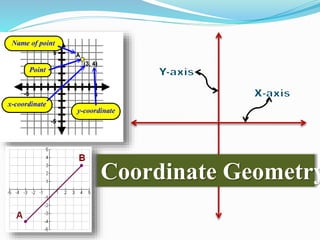
Coordinate Geometry
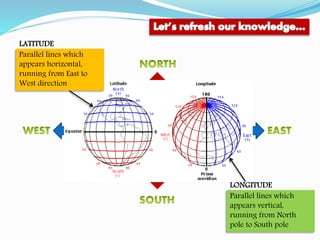
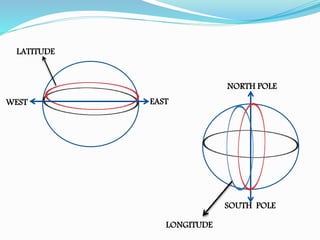
LATITUDE
Parallel lines which
appears horizontal,
running from East to
West direction
LONGITUDE
Parallel lines which
appears vertical,
running from North
pole to South pole
LATITUDE
LONGITUDE
EASTWEST
SOUTH POLE
NORTH POLE
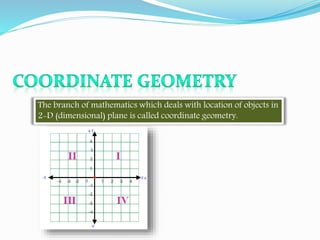
The branch of mathematics which deals with location of objects in
2-D (dimensional) plane is called coordinate geometry.
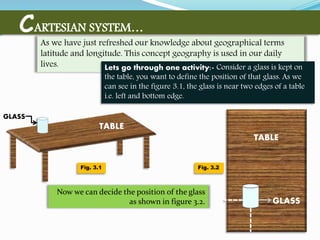
As we have just refreshed our knowledge about geographical terms
latitude and longitude. This concept geography is used in our daily
lives. Lets go through one activity:- Consider a glass is kept on
the table, you want to define the position of that glass. As we
can see in the figure 3.1, the glass is near two edges of a table
i.e. left and bottom edge.
Now we can decide the position of the glass
as shown in figure 3.2.
Fig. 3.1 Fig. 3.2
CARTESIAN SYSTEM…
TABLE
GLASS
TABLE
GLASS
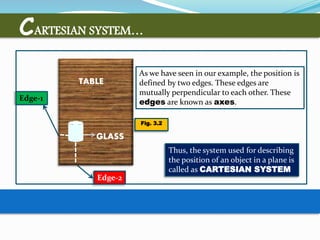
Fig. 3.2
Edge-1
Edge-2
As we have seen in our example, the position is
defined by two edges. These edges are
mutually perpendicular to each other. These
edges are known as axes.
Thus, the system used for describing
the position of an object in a plane is
called as CARTESIAN SYSTEM
CARTESIAN SYSTEM…
TABLE
GLASS
ACTIVITY: Draw a plan of the seating in your classroom, pushing the desks
together. Represent each desk by a square, in it write the name of the student
occupying the desk, position of each student is represented as:-
a) The row in which he/she sits,
b) The column in which he/she sits
ANSWER
A
4
3
2
1
0
4321
COLUMN
ROW
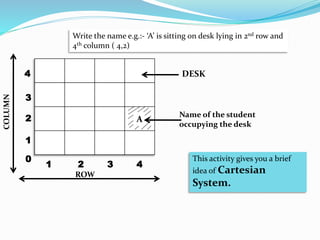
Write the name e.g.:- ‘A’ is sitting on desk lying in 2nd row and
4th column ( 4,2)
This activity gives you a brief
idea of Cartesian
System.
DESK
Name of the student
occupying the desk
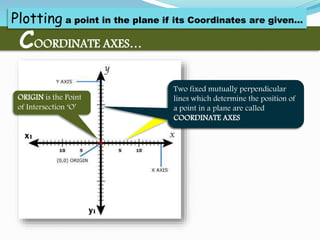
COORDINATE AXES…
ORIGIN is the Point
of Intersection ‘O’
y1
x1
Plotting a point in the plane if its Coordinates are given…
Two fixed mutually perpendicular
lines which determine the position of
a point in a plane are called
COORDINATE AXES
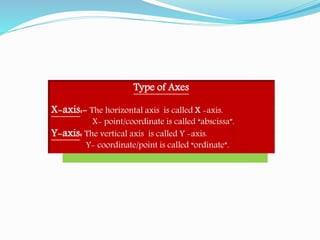
Type of Axes
X-axis:- The horizontal axis is called X -axis.
X- point/coordinate is called “abscissa”.
Y-axis: The vertical axis is called Y -axis.
Y- coordinate/point is called “ordinate”.
SOME ILLUSTRATIONS…
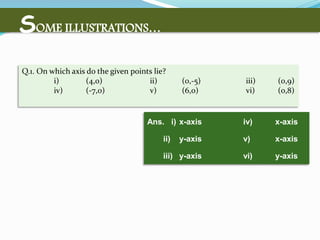
Q.1. On which axis do the given points lie?
i) (4,0) ii) (0,-5) iii) (0,9)
iv) (-7,0) v) (6,0) vi) (0,8)
Ans. i) x-axis iv) x-axis
ii) y-axis v) x-axis
iii) y-axis vi) y-axis
0
X1
X
Y1
Y
-1
-2
-3
-4
-5
-6
1 2 3 4 5 6
6
5
4
3
2
1
-6 -5 -4 -3 -2 -1




3.)
(0,6)
2.)
(0,3)
4.)
(0,-2)
1.)
(-5,0)
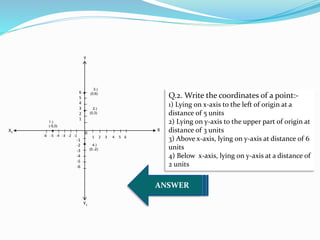
Q.2. Write the coordinates of a point:-
1) Lying on x-axis to the left of origin at a
distance of 5 units
2) Lying on y-axis to the upper part of origin at
distance of 3 units
3) Above x-axis, lying on y-axis at distance of 6
units
4) Below x-axis, lying on y-axis at a distance of
2 units
ANSWER
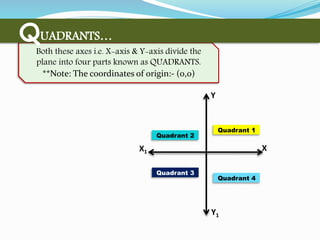
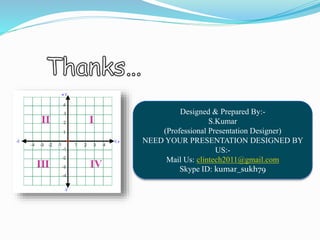
Quadrant 2
XX1
Y1
Y
Quadrant 1
Quadrant 4
Quadrant 3
Both these axes i.e. X-axis & Y-axis divide the
plane into four parts known as QUADRANTS.
**Note: The coordinates of origin:- (0,0)
QUADRANTS…
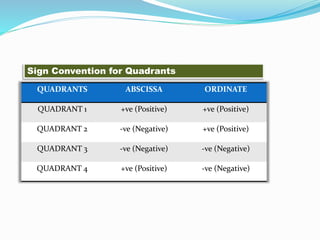
QUADRANTS ABSCISSA ORDINATE
QUADRANT 1 +ve (Positive) +ve (Positive)
QUADRANT 2 -ve (Negative) +ve (Positive)
QUADRANT 3 -ve (Negative) -ve (Negative)
QUADRANT 4 +ve (Positive) -ve (Negative)
Sign Convention for Quadrants
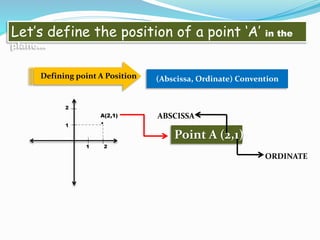
(Abscissa, Ordinate) ConventionDefining point A Position
Let’s define the position of a point ‘A’ in the
plane…
Point A (2,1)
ABSCISSA
ORDINATE
A(2,1)
2
1
1 2

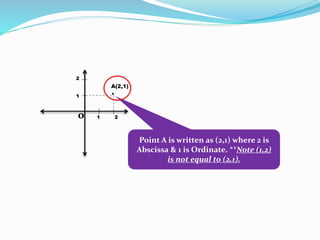
Point A is written as (2,1) where 2 is
Abscissa & 1 is Ordinate. **Note (1,2)
is not equal to (2,1).
A(2,1)
2
1
1 2

o
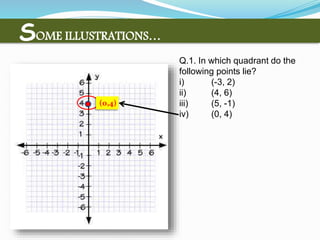
(0,4)
SOME ILLUSTRATIONS…
Q.1. In which quadrant do the
following points lie?
i) (-3, 2)
ii) (4, 6)
iii) (5, -1)
iv) (0, 4)
Answers
i) As abscissa is negative and ordinate is positive so (-3, 2) lies in
Quadrant 2
ii) As abscissa and ordinate both are positive, so (4, 6) lies in
Quadrant 1
iii) As abscissa is positive and ordinate is negative so (5, -1) lies in
Quadrant 4
iv) As abscissa is “zero”, then this point lies on y – axis itself. As
ordinate is positive (0, 4) lies on upper y – axis .
Points to Remember while plotting a point on a
plane…
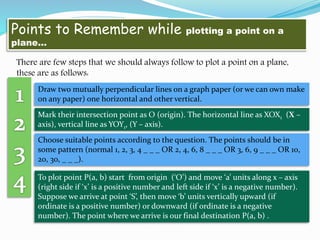
There are few steps that we should always follow to plot a point on a plane,
these are as follows:
Draw two mutually perpendicular lines on a graph paper (or we can own make
on any paper) one horizontal and other vertical.
Mark their intersection point as O (origin). The horizontal line as XOX1 (X –
axis), vertical line as YOY1, (Y – axis).
Choose suitable points according to the question. The points should be in
some pattern (normal 1, 2, 3, 4 _ _ _ OR 2, 4, 6, 8 _ _ _ OR 3, 6, 9 _ _ _ OR 10,
20, 30, _ _ _).
To plot point P(a, b) start from origin (‘O’) and move ‘a’ units along x – axis
(right side if ‘x’ is a positive number and left side if ‘x’ is a negative number).
Suppose we arrive at point ‘S’, then move ‘b’ units vertically upward (if
ordinate is a positive number) or downward (if ordinate is a negative
number). The point where we arrive is our final destination P(a, b) .
Time allowed: 10 minutes
HOTS (Higher Order Thinking Skills)
1) The perpendicular distance of a point P(4,3) from y- axis is:-
a) 4 b) 3 c) 5 d) 7
Answer (a)
2) The perpendicular distance of a point P(8,2) from x-axis is:-
a) 2 b) 3 c) 4 d) 6
Answer (a)
3) The area of triangle formed by the points A(2,0), B(6,0), C(1,6) is
Height
Base
a)24 sq. units c) 10 sq. units b)12 sq. units d)none of these
Answer (b)
[Hint: Area of triangle = ½ × base × height]
4) The measure of angle between the coordinate axes is:-
a) 00 b) 900 c) 1800 d) 3600
Answer (b)
5) Points (-4,0) and (6,0) lie
a) in first Quadrant c) y-axis
b) x-axis d) second Quadrant
Answer (b)
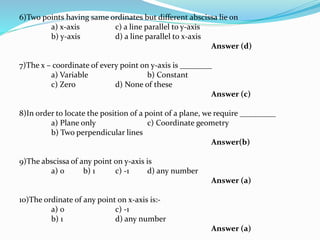
6)Two points having same ordinates but different abscissa lie on
a) x-axis c) a line parallel to y-axis
b) y-axis d) a line parallel to x-axis
Answer (d)
7)The x – coordinate of every point on y-axis is ________
a) Variable b) Constant
c) Zero d) None of these
Answer (c)
8)In order to locate the position of a point of a plane, we require _________
a) Plane only c) Coordinate geometry
b) Two perpendicular lines
Answer(b)
9)The abscissa of any point on y-axis is
a) 0 b) 1 c) -1 d) any number
Answer (a)
10)The ordinate of any point on x-axis is:-
a) 0 c) -1
b) 1 d) any number
Answer (a)
Designed & Prepared By:-
S.Kumar
(Professional Presentation Designer)
NEED YOUR PRESENTATION DESIGNED BY
US:-
Mail Us: clintech2011@gmail.com
Skype ID: kumar_sukh79

Coordinate geometry

  • 1.
  • 2.
    LATITUDE Parallel lines which appearshorizontal, running from East to West direction LONGITUDE Parallel lines which appears vertical, running from North pole to South pole
  • 3.
  • 4.
    The branch ofmathematics which deals with location of objects in 2-D (dimensional) plane is called coordinate geometry.
  • 5.
    As we havejust refreshed our knowledge about geographical terms latitude and longitude. This concept geography is used in our daily lives. Lets go through one activity:- Consider a glass is kept on the table, you want to define the position of that glass. As we can see in the figure 3.1, the glass is near two edges of a table i.e. left and bottom edge. Now we can decide the position of the glass as shown in figure 3.2. Fig. 3.1 Fig. 3.2 CARTESIAN SYSTEM… TABLE GLASS TABLE GLASS
  • 6.
    Fig. 3.2 Edge-1 Edge-2 As wehave seen in our example, the position is defined by two edges. These edges are mutually perpendicular to each other. These edges are known as axes. Thus, the system used for describing the position of an object in a plane is called as CARTESIAN SYSTEM CARTESIAN SYSTEM… TABLE GLASS
  • 7.
    ACTIVITY: Draw aplan of the seating in your classroom, pushing the desks together. Represent each desk by a square, in it write the name of the student occupying the desk, position of each student is represented as:- a) The row in which he/she sits, b) The column in which he/she sits ANSWER
  • 8.
    A 4 3 2 1 0 4321 COLUMN ROW Write the namee.g.:- ‘A’ is sitting on desk lying in 2nd row and 4th column ( 4,2) This activity gives you a brief idea of Cartesian System. DESK Name of the student occupying the desk
  • 9.
    COORDINATE AXES… ORIGIN isthe Point of Intersection ‘O’ y1 x1 Plotting a point in the plane if its Coordinates are given… Two fixed mutually perpendicular lines which determine the position of a point in a plane are called COORDINATE AXES
  • 10.
    Type of Axes X-axis:-The horizontal axis is called X -axis. X- point/coordinate is called “abscissa”. Y-axis: The vertical axis is called Y -axis. Y- coordinate/point is called “ordinate”.
  • 11.
    SOME ILLUSTRATIONS… Q.1. Onwhich axis do the given points lie? i) (4,0) ii) (0,-5) iii) (0,9) iv) (-7,0) v) (6,0) vi) (0,8) Ans. i) x-axis iv) x-axis ii) y-axis v) x-axis iii) y-axis vi) y-axis
  • 12.
    0 X1 X Y1 Y -1 -2 -3 -4 -5 -6 1 2 34 5 6 6 5 4 3 2 1 -6 -5 -4 -3 -2 -1     3.) (0,6) 2.) (0,3) 4.) (0,-2) 1.) (-5,0) Q.2. Write the coordinates of a point:- 1) Lying on x-axis to the left of origin at a distance of 5 units 2) Lying on y-axis to the upper part of origin at distance of 3 units 3) Above x-axis, lying on y-axis at distance of 6 units 4) Below x-axis, lying on y-axis at a distance of 2 units ANSWER
  • 13.
    Quadrant 2 XX1 Y1 Y Quadrant 1 Quadrant4 Quadrant 3 Both these axes i.e. X-axis & Y-axis divide the plane into four parts known as QUADRANTS. **Note: The coordinates of origin:- (0,0) QUADRANTS…
  • 14.
    QUADRANTS ABSCISSA ORDINATE QUADRANT1 +ve (Positive) +ve (Positive) QUADRANT 2 -ve (Negative) +ve (Positive) QUADRANT 3 -ve (Negative) -ve (Negative) QUADRANT 4 +ve (Positive) -ve (Negative) Sign Convention for Quadrants
  • 15.
    (Abscissa, Ordinate) ConventionDefiningpoint A Position Let’s define the position of a point ‘A’ in the plane… Point A (2,1) ABSCISSA ORDINATE A(2,1) 2 1 1 2 
  • 16.
    Point A iswritten as (2,1) where 2 is Abscissa & 1 is Ordinate. **Note (1,2) is not equal to (2,1). A(2,1) 2 1 1 2  o
  • 17.
    (0,4) SOME ILLUSTRATIONS… Q.1. Inwhich quadrant do the following points lie? i) (-3, 2) ii) (4, 6) iii) (5, -1) iv) (0, 4)
  • 18.
    Answers i) As abscissais negative and ordinate is positive so (-3, 2) lies in Quadrant 2 ii) As abscissa and ordinate both are positive, so (4, 6) lies in Quadrant 1 iii) As abscissa is positive and ordinate is negative so (5, -1) lies in Quadrant 4 iv) As abscissa is “zero”, then this point lies on y – axis itself. As ordinate is positive (0, 4) lies on upper y – axis .
  • 19.
    Points to Rememberwhile plotting a point on a plane… There are few steps that we should always follow to plot a point on a plane, these are as follows: Draw two mutually perpendicular lines on a graph paper (or we can own make on any paper) one horizontal and other vertical. Mark their intersection point as O (origin). The horizontal line as XOX1 (X – axis), vertical line as YOY1, (Y – axis). Choose suitable points according to the question. The points should be in some pattern (normal 1, 2, 3, 4 _ _ _ OR 2, 4, 6, 8 _ _ _ OR 3, 6, 9 _ _ _ OR 10, 20, 30, _ _ _). To plot point P(a, b) start from origin (‘O’) and move ‘a’ units along x – axis (right side if ‘x’ is a positive number and left side if ‘x’ is a negative number). Suppose we arrive at point ‘S’, then move ‘b’ units vertically upward (if ordinate is a positive number) or downward (if ordinate is a negative number). The point where we arrive is our final destination P(a, b) .
  • 20.
    Time allowed: 10minutes HOTS (Higher Order Thinking Skills) 1) The perpendicular distance of a point P(4,3) from y- axis is:- a) 4 b) 3 c) 5 d) 7 Answer (a) 2) The perpendicular distance of a point P(8,2) from x-axis is:- a) 2 b) 3 c) 4 d) 6 Answer (a) 3) The area of triangle formed by the points A(2,0), B(6,0), C(1,6) is Height Base a)24 sq. units c) 10 sq. units b)12 sq. units d)none of these Answer (b) [Hint: Area of triangle = ½ × base × height] 4) The measure of angle between the coordinate axes is:- a) 00 b) 900 c) 1800 d) 3600 Answer (b) 5) Points (-4,0) and (6,0) lie a) in first Quadrant c) y-axis b) x-axis d) second Quadrant Answer (b)
  • 21.
    6)Two points havingsame ordinates but different abscissa lie on a) x-axis c) a line parallel to y-axis b) y-axis d) a line parallel to x-axis Answer (d) 7)The x – coordinate of every point on y-axis is ________ a) Variable b) Constant c) Zero d) None of these Answer (c) 8)In order to locate the position of a point of a plane, we require _________ a) Plane only c) Coordinate geometry b) Two perpendicular lines Answer(b) 9)The abscissa of any point on y-axis is a) 0 b) 1 c) -1 d) any number Answer (a) 10)The ordinate of any point on x-axis is:- a) 0 c) -1 b) 1 d) any number Answer (a)
  • 22.
    Designed & PreparedBy:- S.Kumar (Professional Presentation Designer) NEED YOUR PRESENTATION DESIGNED BY US:- Mail Us: clintech2011@gmail.com Skype ID: kumar_sukh79