GREEN BUILDING
CASE STUDY – MANIPAL UNIVERSITY, JAIPUR
MADE BY :
RAHUL JANGID ARCHIT JAIN
AAKANSHA MEHTA JAISHVI NANWANA
AYUSH KHENDELWAL MD. SIDDIQ SALIM
BATCH 2015-20
B-ARCH
POORNIMA UNIVERSITY, JAIPUR
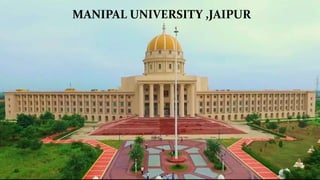
MANIPAL UNIVERSITY ,JAIPUR
INTRODUCTION
Manipal University’s Jaipur campus is being designed to be a LEED Platinum and GRIHA 5 star
rated project. When completed, the campus will accommodate 20,000 students and will have an
engineering college,a medical college and facilities for postgraduate studies. It will also house
administrative buildings, state of the art research facilities, workshops, labs, library, and
residential facilities. Terra Viridis is working on this project as green building consultants
assisting the architects in integrating passive design strategies such as improved day lighting,
optimizing external shading solutions, better natural ventilation, maximizing mixed mode
ventilation and night cooling, etc. with the objective of making the campus significantly
comfortable in the otherwise harsh weather of Jaipur while ensuring maximum energy
reduction.
ABOUT MANIPAL UNIVERSITY, JAIPUR
 Location : Dehmi Kalan, Jaipur
 Site Area : 20 Acres (Total 66 Acres)
 Built up Area : Admin. Block – 21,113.1 m2; Academic Block – 35,668.6 m2
 Air-conditioned Area : Admin. Block – 10,060 m2; Academic Block – 16764.6 m2
 Non Air- conditioned Area : Admin. Block – 11,053.1 m2; Academic Block – 18904.0 m2
 Energy Consumption Reduction : Admin. Block – 81.5%, Academic Block – 72.9% , Campus – 76.14% (Compared to GRIHA
benc mark)
 Water Consumption Reduction : 88.7% (Compared to GRIHA base case)
 EPI : Administration Block – 20.9 KWh/ m2/year; Academic Block – 30.58 KWh/ m2/year; Campus – 26.99 KWh/ m2/year
 Renewable Energy : Rated capacity of solar PV installed on site is 270.0 KW
 GRIHA provisional rating : 5 Stars
 Year of completion : October 2014
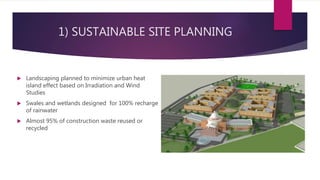
1) SUSTAINABLE SITE PLANNING
 Landscaping planned to minimize urban heat
island effect based on Irradiation and Wind
Studies
 Swales and wetlands designed for 100% recharge
of rainwater
 Almost 95% of construction waste reused or
recycled
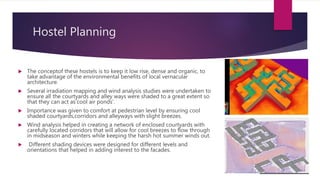
Hostel Planning
 The conceptof these hostels is to keep it low rise, dense and organic, to
take advantage of the environmental benefits of local vernacular
architecture.
 Several irradiation mapping and wind analysis studies were undertaken to
ensure all the courtyards and alley ways were shaded to a great extent so
that they can act as‘cool air ponds’.
 Importance was given to comfort at pedestrian level by ensuring cool
shaded courtyards,corridors and alleyways with slight breezes.
 Wind analysis helped in creating a network of enclosed courtyards with
carefully located corridors that will allow for cool breezes to flow through
in midseason and winters while keeping the harsh hot summer winds out.
 Different shading devices were designed for different levels and
orientations that helped in adding interest to the facades.
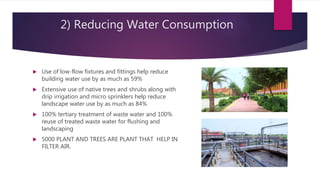
2) Reducing Water Consumption
 Use of low-flow fixtures and fittings help reduce
building water use by as much as 59%
 Extensive use of native trees and shrubs along with
drip irrigation and micro sprinklers help reduce
landscape water use by as much as 84%
 100% tertiary treatment of waste water and 100%
reuse of treated waste water for flushing and
landscaping
 5000 PLANT AND TREES ARE PLANT THAT HELP IN
FILTER AIR.
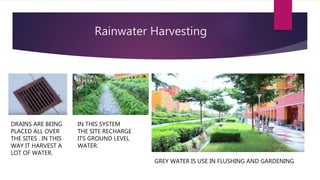
Rainwater Harvesting
GREY WATER IS USE IN FLUSHING AND GARDENING
DRAINS ARE BEING
PLACED ALL OVER
THE SITES . IN THIS
WAY IT HARVEST A
LOT OF WATER.
IN THIS SYSTEM
THE SITE RECHARGE
ITS GROUND LEVEL
WATER.
3) Reducing energy consumption
 It Reduce consumption of energy(compared to GRIHA benchmarks) while
maintaining occupant comfort.
For Achieving Visual Comfort:
 All fenestration designed to provide glare free usable daylight in most areas
 As this is a daytime use building, it has been designed to run only on daylight.
Most of the spaces run on daylight throughout the year. (Spaces designed to
achieve daylight levels of about 150lux)
 Projectors in the classroom have been selected to work with the available daylight
so that blinds could be avoided.
For achieving thermal comfort
 All rooms have buffer spaces outside in form of corridors or jalis in order to reduce
solar gains into the rooms and maximise comfort
 Optimized shading based on orientation in order to provide complete shading in all
spaces throughout the year while maximizing daylight.
 GRC jalis used on the East and West facades to maximize shading
 High performance selective used to reduce solar gains further
 Different types of glazing used in different sections based on shading and
to ensure a balance between daylight and solar gains
 Number of openable windows calculated based on use and orientation of each
Low level and high level openable windows provided on both sides of the rooms to
both cross ventilation and stack ventilation
 Double wall with insulation in the cavity provides both thermal mass and insulation
maximize thermal lag
Reducing energy consumption
For energy efficiency
 Designed for Mixed mode ventilation, with natural ventilation in winters, and
evaporative cooling in summer (in academic block)
 HVAC system designed to provide free cooling in winter
 Chiller efficiency further improved by providing evaporative cooling pads
them
 100% LED lighting across campus » Occupancy and daylight sensors provided in
all classrooms and faculty rooms.
Reducing energy consumption
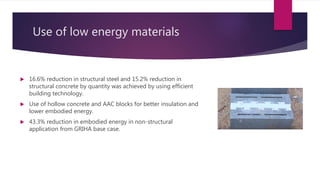
Use of low energy materials
 16.6% reduction in structural steel and 15.2% reduction in
structural concrete by quantity was achieved by using efficient
building technology.
 Use of hollow concrete and AAC blocks for better insulation and
lower embodied energy.
 43.3% reduction in embodied energy in non-structural
application from GRIHA base case.
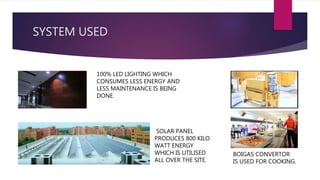
SYSTEM USED
BOIGAS CONVERTOR
IS USED FOR COOKING.
100% LED LIGHTING WHICH
CONSUMES LESS ENERGY AND
LESS MAINTENANCE IS BEING
DONE.
SOLAR PANEL
PRODUCES 800 KILO
WATT ENERGY
WHICH IS UTILISED
ALL OVER THE SITE.
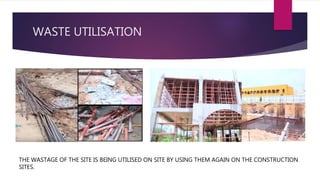
WASTE UTILISATION
THE WASTAGE OF THE SITE IS BEING UTILISED ON SITE BY USING THEM AGAIN ON THE CONSTRUCTION
SITES.
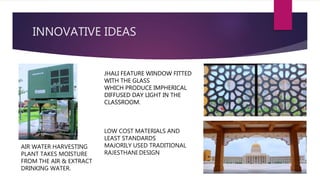
INNOVATIVE IDEAS
AIR WATER HARVESTING
PLANT TAKES MOISTURE
FROM THE AIR & EXTRACT
DRINKING WATER.
JHALI FEATURE WINDOW FITTED
WITH THE GLASS
WHICH PRODUCE IMPHERICAL
DIFFUSED DAY LIGHT IN THE
CLASSROOM.
JHALI FEATURE WINDOW FITTED
WITH THE GLASS
WHICH PRODUCE IMPHERICAL
DIFFUSED DAY LIGHT IN THE
CLASSROOM.
LOW COST MATERIALS AND
LEAST STANDARDS
MAJORILY USED TRADITIONAL
RAJESTHANI DESIGN

Green building Manipal University

  • 1.
    GREEN BUILDING CASE STUDY– MANIPAL UNIVERSITY, JAIPUR MADE BY : RAHUL JANGID ARCHIT JAIN AAKANSHA MEHTA JAISHVI NANWANA AYUSH KHENDELWAL MD. SIDDIQ SALIM BATCH 2015-20 B-ARCH POORNIMA UNIVERSITY, JAIPUR
  • 2.
  • 3.
    INTRODUCTION Manipal University’s Jaipurcampus is being designed to be a LEED Platinum and GRIHA 5 star rated project. When completed, the campus will accommodate 20,000 students and will have an engineering college,a medical college and facilities for postgraduate studies. It will also house administrative buildings, state of the art research facilities, workshops, labs, library, and residential facilities. Terra Viridis is working on this project as green building consultants assisting the architects in integrating passive design strategies such as improved day lighting, optimizing external shading solutions, better natural ventilation, maximizing mixed mode ventilation and night cooling, etc. with the objective of making the campus significantly comfortable in the otherwise harsh weather of Jaipur while ensuring maximum energy reduction.
  • 4.
    ABOUT MANIPAL UNIVERSITY,JAIPUR  Location : Dehmi Kalan, Jaipur  Site Area : 20 Acres (Total 66 Acres)  Built up Area : Admin. Block – 21,113.1 m2; Academic Block – 35,668.6 m2  Air-conditioned Area : Admin. Block – 10,060 m2; Academic Block – 16764.6 m2  Non Air- conditioned Area : Admin. Block – 11,053.1 m2; Academic Block – 18904.0 m2  Energy Consumption Reduction : Admin. Block – 81.5%, Academic Block – 72.9% , Campus – 76.14% (Compared to GRIHA benc mark)  Water Consumption Reduction : 88.7% (Compared to GRIHA base case)  EPI : Administration Block – 20.9 KWh/ m2/year; Academic Block – 30.58 KWh/ m2/year; Campus – 26.99 KWh/ m2/year  Renewable Energy : Rated capacity of solar PV installed on site is 270.0 KW  GRIHA provisional rating : 5 Stars  Year of completion : October 2014
  • 5.
    1) SUSTAINABLE SITEPLANNING  Landscaping planned to minimize urban heat island effect based on Irradiation and Wind Studies  Swales and wetlands designed for 100% recharge of rainwater  Almost 95% of construction waste reused or recycled
  • 6.
    Hostel Planning  Theconceptof these hostels is to keep it low rise, dense and organic, to take advantage of the environmental benefits of local vernacular architecture.  Several irradiation mapping and wind analysis studies were undertaken to ensure all the courtyards and alley ways were shaded to a great extent so that they can act as‘cool air ponds’.  Importance was given to comfort at pedestrian level by ensuring cool shaded courtyards,corridors and alleyways with slight breezes.  Wind analysis helped in creating a network of enclosed courtyards with carefully located corridors that will allow for cool breezes to flow through in midseason and winters while keeping the harsh hot summer winds out.  Different shading devices were designed for different levels and orientations that helped in adding interest to the facades.
  • 7.
    2) Reducing WaterConsumption  Use of low-flow fixtures and fittings help reduce building water use by as much as 59%  Extensive use of native trees and shrubs along with drip irrigation and micro sprinklers help reduce landscape water use by as much as 84%  100% tertiary treatment of waste water and 100% reuse of treated waste water for flushing and landscaping  5000 PLANT AND TREES ARE PLANT THAT HELP IN FILTER AIR.
  • 8.
    Rainwater Harvesting GREY WATERIS USE IN FLUSHING AND GARDENING DRAINS ARE BEING PLACED ALL OVER THE SITES . IN THIS WAY IT HARVEST A LOT OF WATER. IN THIS SYSTEM THE SITE RECHARGE ITS GROUND LEVEL WATER.
  • 9.
    3) Reducing energyconsumption  It Reduce consumption of energy(compared to GRIHA benchmarks) while maintaining occupant comfort. For Achieving Visual Comfort:  All fenestration designed to provide glare free usable daylight in most areas  As this is a daytime use building, it has been designed to run only on daylight. Most of the spaces run on daylight throughout the year. (Spaces designed to achieve daylight levels of about 150lux)  Projectors in the classroom have been selected to work with the available daylight so that blinds could be avoided.
  • 10.
    For achieving thermalcomfort  All rooms have buffer spaces outside in form of corridors or jalis in order to reduce solar gains into the rooms and maximise comfort  Optimized shading based on orientation in order to provide complete shading in all spaces throughout the year while maximizing daylight.  GRC jalis used on the East and West facades to maximize shading  High performance selective used to reduce solar gains further  Different types of glazing used in different sections based on shading and to ensure a balance between daylight and solar gains  Number of openable windows calculated based on use and orientation of each Low level and high level openable windows provided on both sides of the rooms to both cross ventilation and stack ventilation  Double wall with insulation in the cavity provides both thermal mass and insulation maximize thermal lag Reducing energy consumption
  • 11.
    For energy efficiency Designed for Mixed mode ventilation, with natural ventilation in winters, and evaporative cooling in summer (in academic block)  HVAC system designed to provide free cooling in winter  Chiller efficiency further improved by providing evaporative cooling pads them  100% LED lighting across campus » Occupancy and daylight sensors provided in all classrooms and faculty rooms. Reducing energy consumption
  • 12.
    Use of lowenergy materials  16.6% reduction in structural steel and 15.2% reduction in structural concrete by quantity was achieved by using efficient building technology.  Use of hollow concrete and AAC blocks for better insulation and lower embodied energy.  43.3% reduction in embodied energy in non-structural application from GRIHA base case.
  • 13.
    SYSTEM USED BOIGAS CONVERTOR ISUSED FOR COOKING. 100% LED LIGHTING WHICH CONSUMES LESS ENERGY AND LESS MAINTENANCE IS BEING DONE. SOLAR PANEL PRODUCES 800 KILO WATT ENERGY WHICH IS UTILISED ALL OVER THE SITE.
  • 14.
    WASTE UTILISATION THE WASTAGEOF THE SITE IS BEING UTILISED ON SITE BY USING THEM AGAIN ON THE CONSTRUCTION SITES.
  • 15.
    INNOVATIVE IDEAS AIR WATERHARVESTING PLANT TAKES MOISTURE FROM THE AIR & EXTRACT DRINKING WATER. JHALI FEATURE WINDOW FITTED WITH THE GLASS WHICH PRODUCE IMPHERICAL DIFFUSED DAY LIGHT IN THE CLASSROOM. JHALI FEATURE WINDOW FITTED WITH THE GLASS WHICH PRODUCE IMPHERICAL DIFFUSED DAY LIGHT IN THE CLASSROOM. LOW COST MATERIALS AND LEAST STANDARDS MAJORILY USED TRADITIONAL RAJESTHANI DESIGN