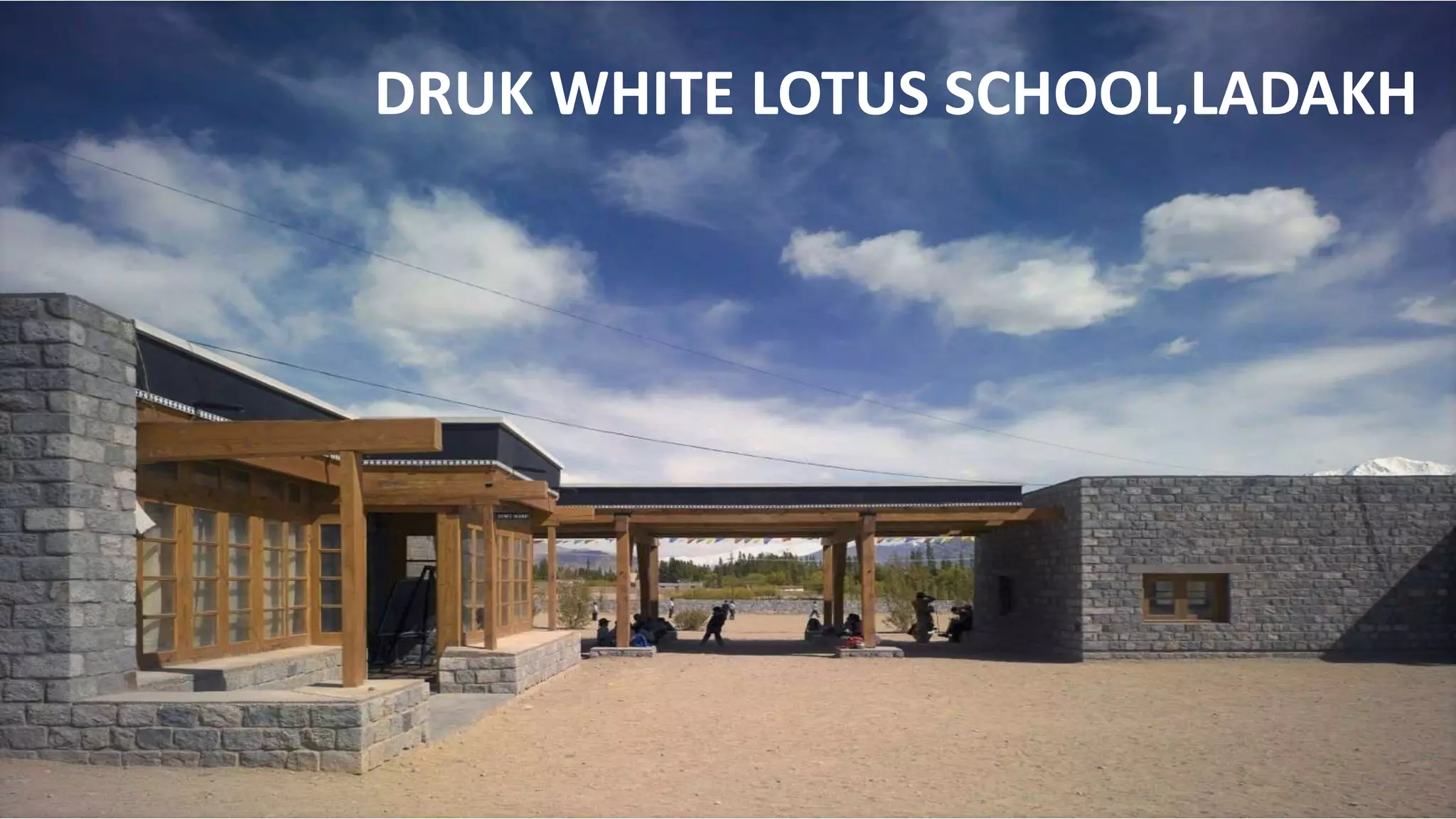
DRUK WHITE LOTUS SCHOOL,LADAKH
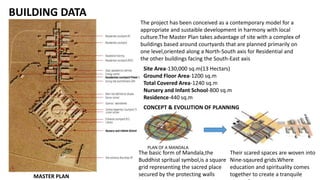
BUILDING DATA
The project has been conceived as a contemporary model for a
appropriate and sustaible development in harmony with local
culture.The Master Plan takes advantage of site with a complex of
buildings based around courtyards that are planned primarily on
one level,oriented along a North-South axis for Residential and
the other buildings facing the South-East axis
MASTER PLAN
Site Area-130,000 sq.m(13 Hectars)
Ground Floor Area-1200 sq.m
Total Covered Area-1240 sq.m
Nursery and Infant School-800 sq.m
Residence-440 sq.m
CONCEPT & EVOLUTION OF PLANNING
PLAN OF A MANDALA
The basic form of Mandala,the
Buddhist spritual symbol,is a square
grid representing the sacred place
secured by the protecting walls
Their scared spaces are woven into
Nine-sqaured grids.Where
education and spirituality comes
together to create a tranquile
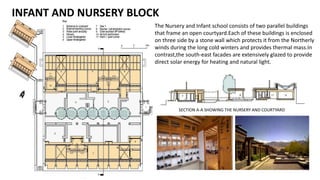
The Nursery and Infant school consists of two parallel buildings
that frame an open courtyard.Each of these buildings is enclosed
on three side by a stone wall which protects it from the Northerly
winds during the long cold winters and provides thermal mass.In
contrast,the south-east facades are extensively glazed to provide
direct solar energy for heating and natural light.
SECTION A-A SHOWING THE NURSERY AND COURTYARD
INFANT AND NURSERY BLOCK
INTRODUCTION
Ladakh, the Persian transliteration of the Tibetan
societies, is a district which is located in the state of
Jammu & Kashmir which presently extends from Kunlun
mountain range to the main great Himalayas to the
south includes the upper Indus River Valley.
The school was started at the request of the people of
Ladakh who wanted a school that would help maintain
their rich cultural traditions, based on Tibetan
Buddhism, while equipping their children for a life in the
21st century
Druk White Lotus School is locally known as Druk Padma
Karpo School where Padma stands for Lotus and Karpo
means white in their Bodhi language.
The school initially started with only 20 students focusing
to maintain their rich cultural tradition based on Tibetan
Buddhism.
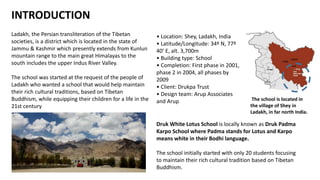
• Location: Shey, Ladakh, India
• Latitude/Longitude: 34º N, 77º
40’ E, alt. 3,700m
• Building type: School
• Completion: First phase in 2001,
phase 2 in 2004, all phases by
2009
• Client: Drukpa Trust
• Design team: Arup Associates
and Arup The school is located in
the village of Shey in
Ladakh, in far north India.
KEY DESIGN STRATERGIES
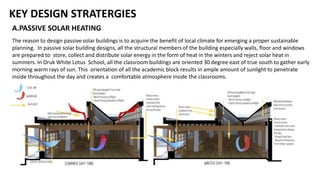
A.PASSIVE SOLAR HEATING
The reason to design passive solar buildings is to acquire the benefit of local climate for emerging a proper sustainable
planning. In passive solar building designs, all the structural members of the building especially walls, floor and windows
are prepared to store, collect and distribute solar energy in the form of heat in the winters and reject solar heat in
summers. In Druk White Lotus School, all the classroom buildings are oriented 30 degree east of true south to gather early
morning warm rays of sun. This orientation of all the academic block results in ample amount of sunlight to penetrate
inside throughout the day and creates a comfortable atmosphere inside the classrooms.
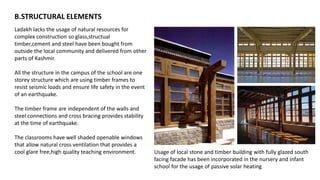
Ladakh lacks the usage of natural resources for
complex construction so glass,structual
timber,cement and steel have been bought from
outside the local community and delivered from other
parts of Kashmir.
All the structure in the campus of the school are one
storey structure which are using timber frames to
resist seismic loads and ensure life safety in the event
of an earthquake.
The timber frame are independent of the walls and
steel connections and cross bracing provides stability
at the time of earthquake.
The classrooms have well shaded openable windows
that allow natural cross ventilation that provides a
cool glare free,high quality teaching environment. Usage of local stone and timber building with fully glazed south
facing facade has been incorporated in the nursery and infant
school for the usage of passive solar heating
B.STRUCTURAL ELEMENTS
C.SUPERINSULTATION
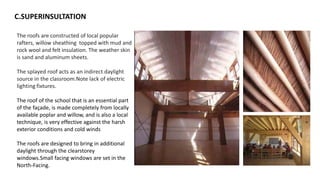
The roofs are constructed of local popular
rafters, willow sheathing topped with mud and
rock wool and felt insulation. The weather skin
is sand and aluminum sheets.
The splayed roof acts as an indirect daylight
source in the classroom.Note lack of electric
lighting fixtures.
The roof of the school that is an essential part
of the façade, is made completely from locally
available poplar and willow, and is also a local
technique, is very effective against the harsh
exterior conditions and cold winds
The roofs are designed to bring in additional
daylight through the clearstorey
windows.Small facing windows are set in the
North-Facing.
The campus of Druk White Lotus School in
located in the desert of ladakh region. The whole
campus and the habitation of the nearby areas
are dependent on glaciers, surface water sources
and even on springs for their survival as water is
required for living.
The ground water is also extracted from deep
wells and are pumped to 16,000 gallon tank
which is further located on a higher ground than
the buildings it serves.
As far as the planning of campus is concern, all
the toilets adjacent to the buildings are working
on the principles of Waterless Ventilated
Improved Pit (VIP) toilets.
These toilets were designed to use solar assisted
stack ventilators which helps to create odourless
compost and becomes an excellent fertilizers and
used for many other agricultural activities.
D.WATERUSE
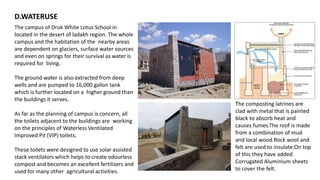
The composting latrines are
clad with metal that is painted
black to absorb heat and
causes fumes.The roof is made
from a combination of mud
and local wood.Rock wool and
felt are used to insulate.On top
of this they have added
Corrugated Aluminium sheets
to cover the felt.
E.ELECTRICAL POWER
The use of photovoltaic panels and inverters to
generate electricity from sunlight fulfils the need of
campus in abundance. Photovoltaic (PV) covers the
conversion of light into electricity using semiconducting
materials that exhibit the photovoltaic effect a
phenomenon studied in physics,photochemistry and
electrochemistry.
A typical photovoltaic system employs solar panels,
each comprising a number of solar cells, which
generate electrical power. The first step is the
photoelectric effect followed by an electrochemical
process where crystallized atoms, ionized in a series,
generate an electric current.
PV Installations may be ground-mounted,rootop
mounted or wall mounted. Around half of the initial
investment in solar energy was co-financed by carbon
offset funds.
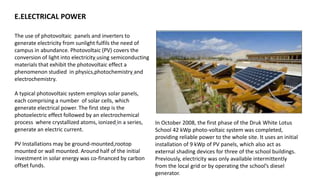
In October 2008, the first phase of the Druk White Lotus
School 42 kWp photo-voltaic system was completed,
providing reliable power to the whole site. It uses an initial
installation of 9 kWp of PV panels, which also act as
external shading devices for three of the school buildings.
Previously, electricity was only available intermittently
from the local grid or by operating the school’s diesel
generator.
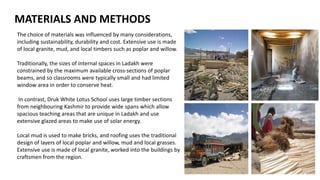
The choice of materials was influenced by many considerations,
including sustainability, durability and cost. Extensive use is made
of local granite, mud, and local timbers such as poplar and willow.
Traditionally, the sizes of internal spaces in Ladakh were
constrained by the maximum available cross-sections of poplar
beams, and so classrooms were typically small and had limited
window area in order to conserve heat.
In contrast, Druk White Lotus School uses large timber sections
from neighbouring Kashmir to provide wide spans which allow
spacious teaching areas that are unique in Ladakh and use
extensive glazed areas to make use of solar energy.
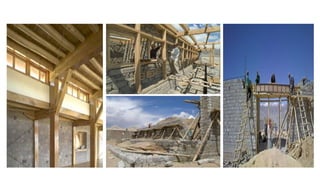
Local mud is used to make bricks, and roofing uses the traditional
design of layers of local poplar and willow, mud and local grasses.
Extensive use is made of local granite, worked into the buildings by
craftsmen from the region.
MATERIALS AND METHODS
druk white lotus school study for material.pptx

druk white lotus school study for material.pptx

  • 1.
    DRUK WHITE LOTUSSCHOOL,LADAKH
  • 2.
    BUILDING DATA The projecthas been conceived as a contemporary model for a appropriate and sustaible development in harmony with local culture.The Master Plan takes advantage of site with a complex of buildings based around courtyards that are planned primarily on one level,oriented along a North-South axis for Residential and the other buildings facing the South-East axis MASTER PLAN Site Area-130,000 sq.m(13 Hectars) Ground Floor Area-1200 sq.m Total Covered Area-1240 sq.m Nursery and Infant School-800 sq.m Residence-440 sq.m CONCEPT & EVOLUTION OF PLANNING PLAN OF A MANDALA The basic form of Mandala,the Buddhist spritual symbol,is a square grid representing the sacred place secured by the protecting walls Their scared spaces are woven into Nine-sqaured grids.Where education and spirituality comes together to create a tranquile
  • 3.
    The Nursery andInfant school consists of two parallel buildings that frame an open courtyard.Each of these buildings is enclosed on three side by a stone wall which protects it from the Northerly winds during the long cold winters and provides thermal mass.In contrast,the south-east facades are extensively glazed to provide direct solar energy for heating and natural light. SECTION A-A SHOWING THE NURSERY AND COURTYARD INFANT AND NURSERY BLOCK
  • 4.
    INTRODUCTION Ladakh, the Persiantransliteration of the Tibetan societies, is a district which is located in the state of Jammu & Kashmir which presently extends from Kunlun mountain range to the main great Himalayas to the south includes the upper Indus River Valley. The school was started at the request of the people of Ladakh who wanted a school that would help maintain their rich cultural traditions, based on Tibetan Buddhism, while equipping their children for a life in the 21st century Druk White Lotus School is locally known as Druk Padma Karpo School where Padma stands for Lotus and Karpo means white in their Bodhi language. The school initially started with only 20 students focusing to maintain their rich cultural tradition based on Tibetan Buddhism. • Location: Shey, Ladakh, India • Latitude/Longitude: 34º N, 77º 40’ E, alt. 3,700m • Building type: School • Completion: First phase in 2001, phase 2 in 2004, all phases by 2009 • Client: Drukpa Trust • Design team: Arup Associates and Arup The school is located in the village of Shey in Ladakh, in far north India.
  • 5.
    KEY DESIGN STRATERGIES A.PASSIVESOLAR HEATING The reason to design passive solar buildings is to acquire the benefit of local climate for emerging a proper sustainable planning. In passive solar building designs, all the structural members of the building especially walls, floor and windows are prepared to store, collect and distribute solar energy in the form of heat in the winters and reject solar heat in summers. In Druk White Lotus School, all the classroom buildings are oriented 30 degree east of true south to gather early morning warm rays of sun. This orientation of all the academic block results in ample amount of sunlight to penetrate inside throughout the day and creates a comfortable atmosphere inside the classrooms.
  • 6.
    Ladakh lacks theusage of natural resources for complex construction so glass,structual timber,cement and steel have been bought from outside the local community and delivered from other parts of Kashmir. All the structure in the campus of the school are one storey structure which are using timber frames to resist seismic loads and ensure life safety in the event of an earthquake. The timber frame are independent of the walls and steel connections and cross bracing provides stability at the time of earthquake. The classrooms have well shaded openable windows that allow natural cross ventilation that provides a cool glare free,high quality teaching environment. Usage of local stone and timber building with fully glazed south facing facade has been incorporated in the nursery and infant school for the usage of passive solar heating B.STRUCTURAL ELEMENTS
  • 7.
    C.SUPERINSULTATION The roofs areconstructed of local popular rafters, willow sheathing topped with mud and rock wool and felt insulation. The weather skin is sand and aluminum sheets. The splayed roof acts as an indirect daylight source in the classroom.Note lack of electric lighting fixtures. The roof of the school that is an essential part of the façade, is made completely from locally available poplar and willow, and is also a local technique, is very effective against the harsh exterior conditions and cold winds The roofs are designed to bring in additional daylight through the clearstorey windows.Small facing windows are set in the North-Facing.
  • 8.
    The campus ofDruk White Lotus School in located in the desert of ladakh region. The whole campus and the habitation of the nearby areas are dependent on glaciers, surface water sources and even on springs for their survival as water is required for living. The ground water is also extracted from deep wells and are pumped to 16,000 gallon tank which is further located on a higher ground than the buildings it serves. As far as the planning of campus is concern, all the toilets adjacent to the buildings are working on the principles of Waterless Ventilated Improved Pit (VIP) toilets. These toilets were designed to use solar assisted stack ventilators which helps to create odourless compost and becomes an excellent fertilizers and used for many other agricultural activities. D.WATERUSE The composting latrines are clad with metal that is painted black to absorb heat and causes fumes.The roof is made from a combination of mud and local wood.Rock wool and felt are used to insulate.On top of this they have added Corrugated Aluminium sheets to cover the felt.
  • 9.
    E.ELECTRICAL POWER The useof photovoltaic panels and inverters to generate electricity from sunlight fulfils the need of campus in abundance. Photovoltaic (PV) covers the conversion of light into electricity using semiconducting materials that exhibit the photovoltaic effect a phenomenon studied in physics,photochemistry and electrochemistry. A typical photovoltaic system employs solar panels, each comprising a number of solar cells, which generate electrical power. The first step is the photoelectric effect followed by an electrochemical process where crystallized atoms, ionized in a series, generate an electric current. PV Installations may be ground-mounted,rootop mounted or wall mounted. Around half of the initial investment in solar energy was co-financed by carbon offset funds. In October 2008, the first phase of the Druk White Lotus School 42 kWp photo-voltaic system was completed, providing reliable power to the whole site. It uses an initial installation of 9 kWp of PV panels, which also act as external shading devices for three of the school buildings. Previously, electricity was only available intermittently from the local grid or by operating the school’s diesel generator.
  • 10.
    The choice ofmaterials was influenced by many considerations, including sustainability, durability and cost. Extensive use is made of local granite, mud, and local timbers such as poplar and willow. Traditionally, the sizes of internal spaces in Ladakh were constrained by the maximum available cross-sections of poplar beams, and so classrooms were typically small and had limited window area in order to conserve heat. In contrast, Druk White Lotus School uses large timber sections from neighbouring Kashmir to provide wide spans which allow spacious teaching areas that are unique in Ladakh and use extensive glazed areas to make use of solar energy. Local mud is used to make bricks, and roofing uses the traditional design of layers of local poplar and willow, mud and local grasses. Extensive use is made of local granite, worked into the buildings by craftsmen from the region. MATERIALS AND METHODS