LOCATION : GT Road at
Kalyanpur on the outskirts of Kanpur
SITE : 1,055 acres(426.9 ha.).
• total ground coverage is 3.7%,
• area under road is 8.8%
• open space amount to 87.5%.
academic area is located in the
centre surrounded by residential
area on three sides, with the staff
and faculty housing located to the
south, east and west and the
hostels towards
the south-west and west.
Total ug students: 3938
Total pg students: 2540
Research associates: 500
Master plan
To encourage meeting and interaction among students and
faculty, all activities in IITK Campus are grouped around Lecture
Halls, Library and Faculty Buildings and Laboratories,
other specialized services are organized and planned as
decentralized activities and are connected by the
walkway, which allows the students to walk at two levels of the
buildings that are designed to receive a two level circulation.
• The Campus was originally designed
for a student strength of 2,400.
• enough space left as open
space to meet the future requirements
of the campus.
• interwoven with the pedestrian /
cycle movement
1959 – 1996
MATERIALS: brick and concrete
STYLE: exposed brick and concrete
1996 – 2011
• today the student strength including postgraduates is around
4500 with 325 faculty and 750 supporting staff.
• The Academic Core has experienced several completed and ongoing
expansions.
• CSE, Lecture Halls, Samtel, SIDBI, BSBE, Alumni Centre,
Pseudo Dynamic Lab, Nano Lab, JEE GATE, Helicopter Lab, CESE, New Core
Labs, IME, CSE Expansion and Research Labs are part of the Phase II
expansion.
• Almost all of these buildings characterized as energy efficient and sustainable.
PHASE 3
Current development that includes hostels, pathways, cycle
stands, expansion of academic area
2011 – 2021
MATERIALS: brick, concrete and tiles
STYLE: cladding disguised as exposed brick and concrete
Sr. Strength Phase – I Phase – II Phase – III
(2011-2021)
1. Students 2400 4500 10000
2. Faculty 280 325 800
3. Staff 500 750 1000
Total 3180 5575 11800
faculty student ratio of approximately 1:10 to 1:12
Total no. of gates: 6
Admin area: Faculty building
Total ground coverage of academic
Block: 79695.00
Total floor area: 144944.48
Maximum number of floors:
Faculty building- 4 floors along
with a ground floor
Library: 4 floors including ground
And basement
Avg. number of floors –: g+2
Total number of lecture halls: 17
System of IIT Kanpur: lectures halls are booked by different professors for lectures of different departments.
These lectures can be scheduled during any hour of the day between 8 AM – 6PM( or 8 PM sometimes).
There are 17 lecture halls in academic area, out of which 7 lecture halls are in old complex and 10 are in the new
Lecture hall complex. All the lecture halls have projector rooms, podium, Projector screens and green boards
and are completely packed with acoustic Materials. Ground coverage area of old lecture hall complex: 3500.00 sq.m.
Ground coverage area of old lecture hall complex :4553.00 sq.m.
Minimum capacity of a lecture hall: 400
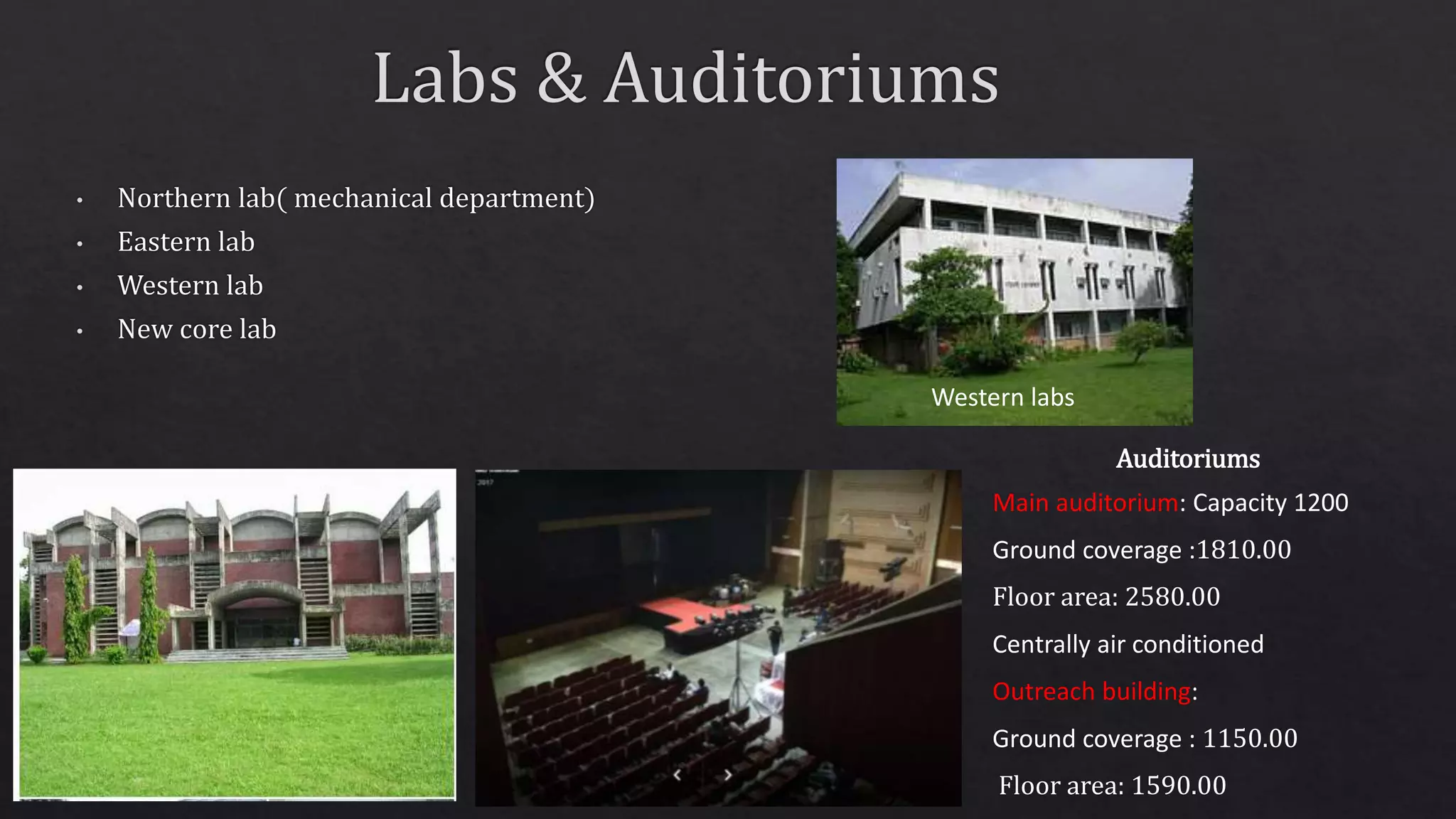
Western labs
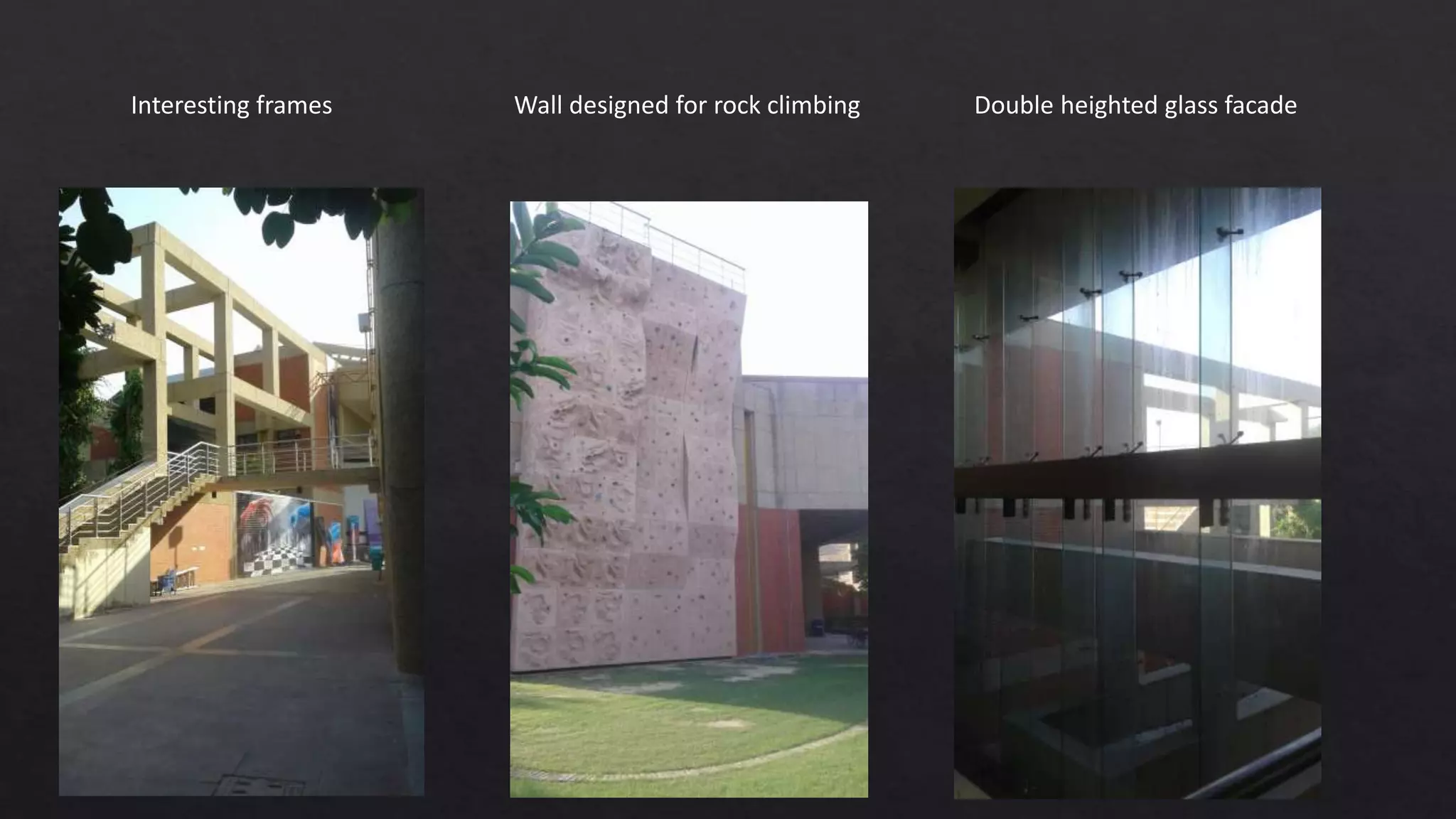
Auditoriums
Main auditorium: Capacity 1200
Ground coverage :1810.00
Floor area: 2580.00
Centrally air conditioned
Outreach building:
Ground coverage : 1150.00
Floor area: 1590.00
• Basement is used as a storage for books.
• Ground floor has reception and a reading
Section.
• First floor: reading section
• Second floor : journal section along with
reading section.
Each floor has 1 toilet for male and female
each.
year of ground floor
construction coverage area
1. SAC 2009 -2010 1568.00 2350.00
2. Open
Air Theatre 2009 -2010 1280.00 1280.00
Entrance of new sac Open air theatre Food zone below oat
Hostels ground
coverage :73388.00 sq.m.
Floor area: 155584.00 sq.m.
boys hostel: 10
Girls hostel:3
1 P.G. (co-ed)
3 hostels for research
scholars
No vehicles are allowed inside academic area except the
four wheelers of staff and faculty. Cycle stands are
provided near each building for students. Other mode
of transportation used in campus are buses, auto, taxi
And rickshaws. Bus stands are provided at various
Junctions.
8m wide entrance road( excluding pathways)
Use of waffle slab on
ceiling
Cladding done
in new phase
Use of textured tiles
In new phase
Use of brick and concrete
Pavement for cycle stands
And pathways
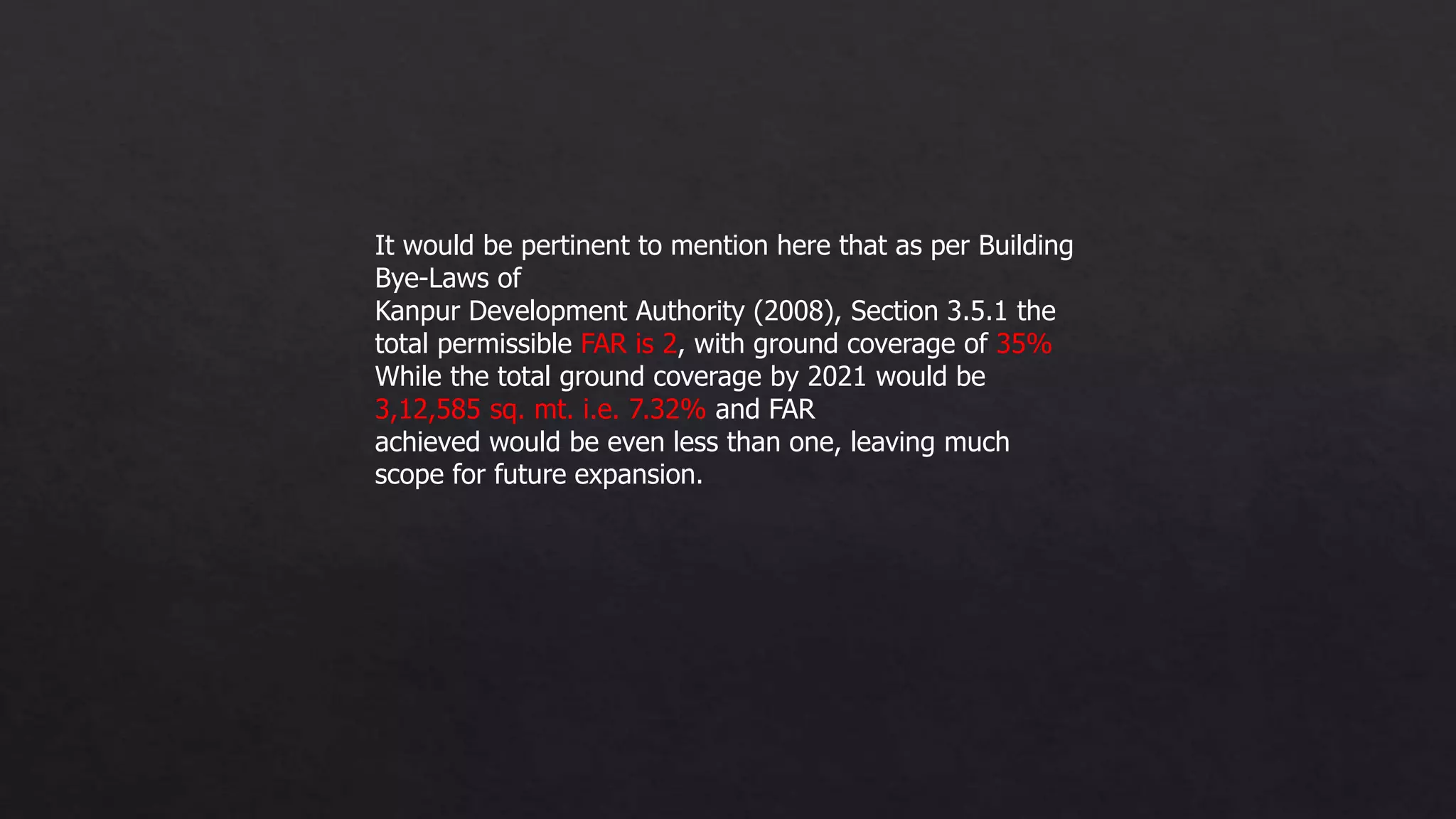
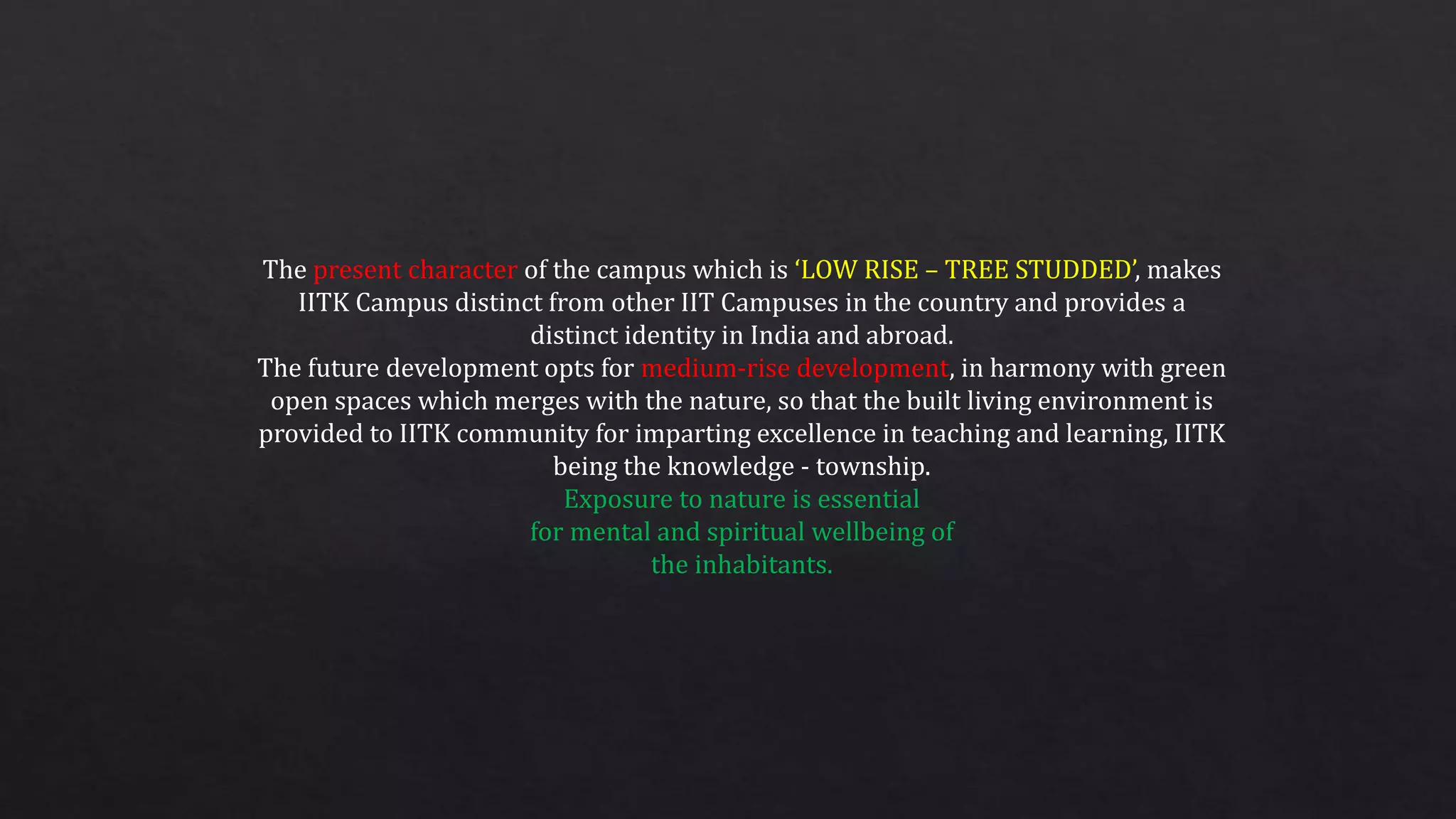
Interesting frames Wall designed for rock climbing Double heighted glass facade
It would be pertinent to mention here that as per Building
Bye-Laws of
Kanpur Development Authority (2008), Section 3.5.1 the
total permissible FAR is 2, with ground coverage of 35%
While the total ground coverage by 2021 would be
3,12,585 sq. mt. i.e. 7.32% and FAR
achieved would be even less than one, leaving much
scope for future expansion.
The present character of the campus which is ‘LOW RISE – TREE STUDDED’, makes
IITK Campus distinct from other IIT Campuses in the country and provides a
distinct identity in India and abroad.
The future development opts for medium-rise development, in harmony with green
open spaces which merges with the nature, so that the built living environment is
provided to IITK community for imparting excellence in teaching and learning, IITK
being the knowledge - township.
Exposure to nature is essential
for mental and spiritual wellbeing of
the inhabitants.
IIT Kanpur case study

IIT Kanpur case study

  • 2.
    LOCATION : GTRoad at Kalyanpur on the outskirts of Kanpur SITE : 1,055 acres(426.9 ha.). • total ground coverage is 3.7%, • area under road is 8.8% • open space amount to 87.5%. academic area is located in the centre surrounded by residential area on three sides, with the staff and faculty housing located to the south, east and west and the hostels towards the south-west and west. Total ug students: 3938 Total pg students: 2540 Research associates: 500
  • 3.
  • 4.
    To encourage meetingand interaction among students and faculty, all activities in IITK Campus are grouped around Lecture Halls, Library and Faculty Buildings and Laboratories, other specialized services are organized and planned as decentralized activities and are connected by the walkway, which allows the students to walk at two levels of the buildings that are designed to receive a two level circulation. • The Campus was originally designed for a student strength of 2,400. • enough space left as open space to meet the future requirements of the campus. • interwoven with the pedestrian / cycle movement 1959 – 1996 MATERIALS: brick and concrete STYLE: exposed brick and concrete
  • 5.
    1996 – 2011 •today the student strength including postgraduates is around 4500 with 325 faculty and 750 supporting staff. • The Academic Core has experienced several completed and ongoing expansions. • CSE, Lecture Halls, Samtel, SIDBI, BSBE, Alumni Centre, Pseudo Dynamic Lab, Nano Lab, JEE GATE, Helicopter Lab, CESE, New Core Labs, IME, CSE Expansion and Research Labs are part of the Phase II expansion. • Almost all of these buildings characterized as energy efficient and sustainable. PHASE 3 Current development that includes hostels, pathways, cycle stands, expansion of academic area 2011 – 2021 MATERIALS: brick, concrete and tiles STYLE: cladding disguised as exposed brick and concrete
  • 6.
    Sr. Strength Phase– I Phase – II Phase – III (2011-2021) 1. Students 2400 4500 10000 2. Faculty 280 325 800 3. Staff 500 750 1000 Total 3180 5575 11800 faculty student ratio of approximately 1:10 to 1:12
  • 7.
    Total no. ofgates: 6 Admin area: Faculty building Total ground coverage of academic Block: 79695.00 Total floor area: 144944.48 Maximum number of floors: Faculty building- 4 floors along with a ground floor Library: 4 floors including ground And basement Avg. number of floors –: g+2 Total number of lecture halls: 17
  • 9.
    System of IITKanpur: lectures halls are booked by different professors for lectures of different departments. These lectures can be scheduled during any hour of the day between 8 AM – 6PM( or 8 PM sometimes). There are 17 lecture halls in academic area, out of which 7 lecture halls are in old complex and 10 are in the new Lecture hall complex. All the lecture halls have projector rooms, podium, Projector screens and green boards and are completely packed with acoustic Materials. Ground coverage area of old lecture hall complex: 3500.00 sq.m. Ground coverage area of old lecture hall complex :4553.00 sq.m. Minimum capacity of a lecture hall: 400
  • 10.
    Western labs Auditoriums Main auditorium:Capacity 1200 Ground coverage :1810.00 Floor area: 2580.00 Centrally air conditioned Outreach building: Ground coverage : 1150.00 Floor area: 1590.00
  • 12.
    • Basement isused as a storage for books. • Ground floor has reception and a reading Section. • First floor: reading section • Second floor : journal section along with reading section. Each floor has 1 toilet for male and female each.
  • 14.
    year of groundfloor construction coverage area 1. SAC 2009 -2010 1568.00 2350.00 2. Open Air Theatre 2009 -2010 1280.00 1280.00
  • 15.
    Entrance of newsac Open air theatre Food zone below oat
  • 16.
    Hostels ground coverage :73388.00sq.m. Floor area: 155584.00 sq.m. boys hostel: 10 Girls hostel:3 1 P.G. (co-ed) 3 hostels for research scholars
  • 17.
    No vehicles areallowed inside academic area except the four wheelers of staff and faculty. Cycle stands are provided near each building for students. Other mode of transportation used in campus are buses, auto, taxi And rickshaws. Bus stands are provided at various Junctions. 8m wide entrance road( excluding pathways)
  • 18.
    Use of waffleslab on ceiling Cladding done in new phase Use of textured tiles In new phase Use of brick and concrete Pavement for cycle stands And pathways
  • 19.
    Interesting frames Walldesigned for rock climbing Double heighted glass facade
  • 21.
    It would bepertinent to mention here that as per Building Bye-Laws of Kanpur Development Authority (2008), Section 3.5.1 the total permissible FAR is 2, with ground coverage of 35% While the total ground coverage by 2021 would be 3,12,585 sq. mt. i.e. 7.32% and FAR achieved would be even less than one, leaving much scope for future expansion.
  • 22.
    The present characterof the campus which is ‘LOW RISE – TREE STUDDED’, makes IITK Campus distinct from other IIT Campuses in the country and provides a distinct identity in India and abroad. The future development opts for medium-rise development, in harmony with green open spaces which merges with the nature, so that the built living environment is provided to IITK community for imparting excellence in teaching and learning, IITK being the knowledge - township. Exposure to nature is essential for mental and spiritual wellbeing of the inhabitants.