A Project Presentation on the Topic
Green Building
(7th sem B.E. Civil)
R. K. College of Engineering & Technology
By:-
Mr. Manthan I. Shah (090380106013)
Mr. Keshav N. Jayaswal (090380106053)
Mr. Sumit S. Punjabi (090380106043)
Guided By:-
Mr. Apurva Dave
Asst. Professor
R.K.C.E.T.
Project Statement
“Modification of R.K. COLLEGE BUILDING to
improve rating as per guidelines of Green
Rating for Integrated Habitat Assessment
(GRIHA)”
Introduction to Green Building
• Definition:“A Green Building is one which uses less water, optimises
energy efficiency, conserves natural resources, generates less waste and
provides healthier spaces for occupants, as compared to a conventional
building.“
• Green Building refers to a structure and building process that is
environmentally responsible and resource-efficient throughout a building's
life-cycle: from sitting to design, construction, operation, maintenance,
renovation, and demolition. This requires close cooperation of the design
team, the architects, the engineers, and the client at all project stages. The
Green Building practice expands and complements the classical building
design concerns of economy, utility, durability, and comfort.
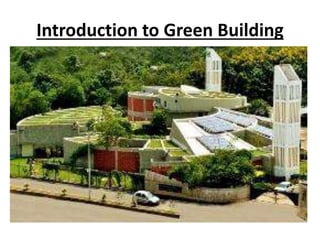
Introduction to Green Building
• “Green building is a sustainable or high
performance building.”
• It increases efficiently in use of energy, water,
and other resources.
• It Protects occupant health.
• It Reduces waste, pollution and energy
consumption.
Introduction to Green Building
Goals of Green Building:
• It includes environmental, economic, and social
benefits.
• However, modern sustainability initiatives call for an
integrated and synergistic design to both new
construction and in the retrofitting of existing
structures.
• It often emphasizes taking advantage of renewable
resources, e.g., using sunlight through passive solar,
active solar, and photovoltaic techniques and using
plants and trees through green roofs, rain gardens,
and reduction of rainwater run-off.
Introduction to Green Building
Economic benefits of Green building:
• A green building may cost more up front, but saves
through lower operating costs over the life of the
building.
• Some benefits, such as improving occupant health,
comfort, productivity, reducing pollution and landfill
waste are not easily quantified.
• Even with a tight budget, many green building
measures can be incorporated with minimal or zero
increased up-front costs and they can yield enormous
savings.
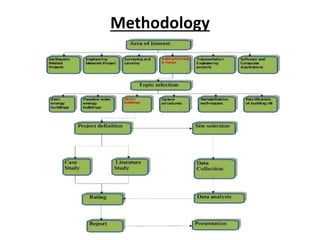
Methodology
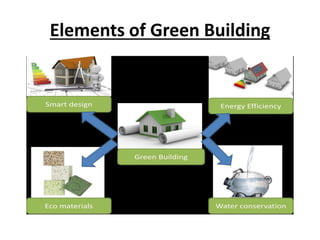
Elements of Green Building
Rating systems and Councils
• Some of the Indian system for Green Building rating:
1) GRIHA: Green Rating for Integrated Habitat
Assessment
2)LEED-India: Leadership in Energy Environmental and
Design - India
3) BEE: Bureau of Energy Efficiency
• Some of the international counsel’s for Green Building:
1) Indian Green Building Council (IGBC), India
2) U.S. Green Building Council (USGBC), USA
3) Building Research Establishment (BRE), UK
4) Green Building Council of Australia (GBCA), Australia
Rating systems and Councils
Some of the successful international rating programmers:
1) BREEAM: Building Research Establishment‘s Environmental
Assessment Method
2) CASBEE: Comprehensive Assessment System for Building
Environmental Efficiency
3) GBTool
4) LEED®:Leadership in Energy and Environmental Design
5)HK–Beam: The Hong Kong Building Environmental Assessment
Method
6) GRIHA : Green Rating for Integrated Habitat Assessment
History of GRIHA
• The Energy and Resource Institute (TERI) conceived
GRIHA and developed it jointly with The Ministry of
New and Renewable Energy (MNRE), Govt. of India.
• GRIHA is a system developed for “Green Building
Evaluation”.
• It gives rating to a building as per its guidelines mainly
covering following aspects.
• Evaluation criteria though somehow differ for New
Construction and existing construction.
• In this project existing building is taken for evaluation
and rating is given as per GRIHA.
Introduction to GRIHA
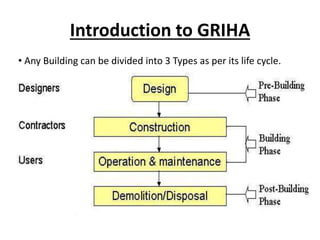
• Any Building can be divided into 3 Types as per its life cycle.
Benefits of GRIHA
• Reduced energy consumption without sacrificing the
comfort levels
• Reduced destruction of natural areas, habitats, and
biodiversity, and reduced soil loss from erosion etc.
• Reduced air and water pollution
• Reduced water consumption
• Limited waste generation due to recycling and reuse
• Reduced pollution loads
• Increased user productivity
• Enhanced image and marketability
Fulfilled Criteria
• Criteria 1: Site Selection
• The site is not in an URBAN area so, UDPFI Guidelines cannot be
implemented.
• There is no eco-sensitive zone, coastal zone, heritage areas and
water body zones.
• The site is located within ½ km radius of an existing bus stop.(1/1)
• Total Points Given: 1
Fulfilled Criteria
Criteria 2: Preserve and protect landscape during
construction/compensatory depository forestation:
• There did exist several mature trees on site that can be preserved.
• Construction was planned in a way that excavation/basement
work, up to plinth level is not coinciding with rainy season and the
site disruption is restricted to pre designated areas. (1/1)
• Site was not devoid of trees, but was having less numbers of trees.
• So, trees are preserved and protected properly (1/1)
• In college campus, trees, plants are grown in ratio exceeding 1:3
and lawn, gardening is done.
• So, compensatory forestation is done on site.(1/1)
• Total Points Given: 3
Fulfilled Criteria
Criteria 3: Soil conservation (post construction):
• Top soil quality should meet the quality standard of top preservation
criteria as per, NBC 2005 Part10.
• Top soil is fertile and properly laid for vegetative growth (1/1)
• No need to take measures for proper stabilization top soil (0/1)
• Total Point Givens: 1
Criteria 4: Design to include existing site features:
• Zoning of areas on-site is appropriate to existing site features .
• The natural ground slops are maintained after the construction.
• There was no accountable vegetation, in compare to that, the campus has
more greenery.
• Existing water well is kept as it is and is steel in use.
• There were no identical natural formations that could be preserved.
• Total point Given: 3
Fulfilled Criteria
Criteria 5: Reduce hard paving on site:
• Net Paved area on site under parking, roads etc. is maximum of
20% of the site area (0/1)
• Total surface parking is not exceeding as permitted by the local
building by-laws.
• All most whole of the total paved area is having pervious paving
(Parking Blocks).(1/1)
• Total Points Given: 1
Fulfilled Criteria
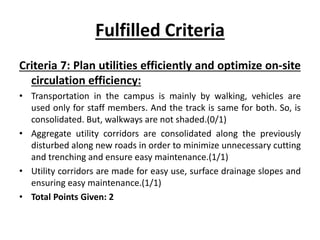
Criteria 7: Plan utilities efficiently and optimize on-site
circulation efficiency:
• Transportation in the campus is mainly by walking, vehicles are
used only for staff members. And the track is same for both. So, is
consolidated. But, walkways are not shaded.(0/1)
• Aggregate utility corridors are consolidated along the previously
disturbed along new roads in order to minimize unnecessary cutting
and trenching and ensure easy maintenance.(1/1)
• Utility corridors are made for easy use, surface drainage slopes and
ensuring easy maintenance.(1/1)
• Total Points Given: 2
Fulfilled Criteria
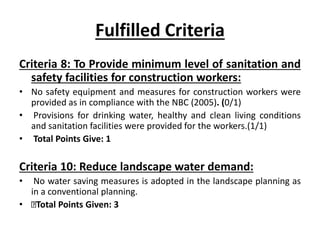
Criteria 8: To Provide minimum level of sanitation and
safety facilities for construction workers:
• No safety equipment and measures for construction workers were
provided as in compliance with the NBC (2005). (0/1)
• Provisions for drinking water, healthy and clean living conditions
and sanitation facilities were provided for the workers.(1/1)
• Total Points Give: 1
Criteria 10: Reduce landscape water demand:
• No water saving measures is adopted in the landscape planning as
in a conventional planning.
• Total Points Given: 3
Fulfilled Criteria
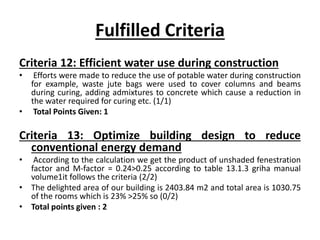
Criteria 12: Efficient water use during construction
• Efforts were made to reduce the use of potable water during construction
for example, waste jute bags were used to cover columns and beams
during curing, adding admixtures to concrete which cause a reduction in
the water required for curing etc. (1/1)
• Total Points Given: 1
Criteria 13: Optimize building design to reduce
conventional energy demand
• According to the calculation we get the product of unshaded fenestration
factor and M-factor = 0.24>0.25 according to table 13.1.3 griha manual
volume1it follows the criteria (2/2)
• The delighted area of our building is 2403.84 m2 and total area is 1030.75
of the rooms which is 23% >25% so (0/2)
• Total points given : 2
Fulfilled Criteria
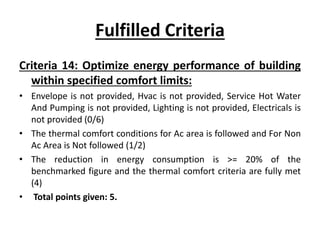
Criteria 14: Optimize energy performance of building
within specified comfort limits:
• Envelope is not provided, Hvac is not provided, Service Hot Water
And Pumping is not provided, Lighting is not provided, Electricals is
not provided (0/6)
• The thermal comfort conditions for Ac area is followed and For Non
Ac Area is Not followed (1/2)
• The reduction in energy consumption is >= 20% of the
benchmarked figure and the thermal comfort criteria are fully met
(4)
• Total points given: 5.
Fulfilled Criteria
Criteria 15: Utilization of fly-ash in building structures:
• In structural concrete, OPC is used and no fly-ash is used. (0/2)
• About 25-30 % of building blocks (by volume) used in the structure are of
fly-ash. (1/2)
• For masonry or plaster mortar, fly-ash is not used instead of OPC. (0/2)
• Total Points Given: 1
Criteria 19: Renewable energy based hot water
system:
• Total hot water requirement is more than 500 liters per day.
• The renewable hot water system saves about 50% of the annual energy
required for hot water, as solar water heaters are installed in most of (4
out of 7) hostel buildings and staff quarters. Elsewhere, generally no hot
water is required. (2/3)
• Total Points Given: 2
Fulfilled Criteria
Criteria 20: Waste water treatment:
• The total waste water generation on site is more than 10kL per day.
• The treated waste water meets the disposal/reuse application
standards. (1/2)
• Total Points Given: 1
Criteria 21: Water recycle and reuse (including
rainwater)
• The project demonstrates 30-35% annual water reuse. (2/3)
• Ground water table is very deep so, ground water recharge is
advisable. The surplus rainwater is not recharged in to the ground.
(0/2)
• Total points given:2
Fulfilled Criteria
Criteria 26: Use of low-VOC paints /adhesives
/sealants:
• Paints used in building interior are not low/zero-VOC. (0/1)
• Adhesives and sealants used are not low/zero-VOC. (0/1)
• Composite wood products are not containing urea-formaldehyde.
(1/1)
• Total Point given: 1
Criteria 27: Minimize ozone depleting substances
• All insulation used in the building are CFC and HCFC free.
• As all the appliances produced after 2008, are CFC or HCFC free and
not damaging ozone layer as per Government norms, and all the
appliances are installed in or after the year 2010.
• All HVAC and refrigeration equipment are CFC free. (1/1)
• Total Points Given; 1
Fulfilled Criteria
Criteria 28: Ensure water quality
• Water used for various purposes like drinking, irrigation etc. are
conforming to the BIS standards. (2/2)
• Total Points given: 2
Criteria 30: Tobacco and smoke control
• Smoking is prohibited on site. (1/1)
• Total Points Given: 1
Criteria 31: Provide at least the minimum level of
accessibility for persons with disabilities
• Slope is provided to access the ground floor from ground level for
physically disabilities. (1/1)
• Total Points Given: 1
Refrences
1) UDPFI GUIDELINES
2) NBC 2005
3) ECBC 2007 GUIDELINES
4) BIS MANUAL
5) GRIHA HOME (www.grihaindia.org/)
6) GRIHA SELF EVALUATION
(www.grihaindia.org/index.php?option)
7) GRIHA_Self_Evaluation)
8) GRIHA MANUAL (www.grihaindia.org/files/Manual_VolI.pdf)
9) GREEN BUILDING- WIKIPEDIA, the free encyclopedia
(en.wikipedia.org/wiki/Green_building)
Green building

Green building

  • 1.
    A Project Presentationon the Topic Green Building (7th sem B.E. Civil) R. K. College of Engineering & Technology By:- Mr. Manthan I. Shah (090380106013) Mr. Keshav N. Jayaswal (090380106053) Mr. Sumit S. Punjabi (090380106043) Guided By:- Mr. Apurva Dave Asst. Professor R.K.C.E.T.
  • 2.
    Project Statement “Modification ofR.K. COLLEGE BUILDING to improve rating as per guidelines of Green Rating for Integrated Habitat Assessment (GRIHA)”
  • 3.
    Introduction to GreenBuilding • Definition:“A Green Building is one which uses less water, optimises energy efficiency, conserves natural resources, generates less waste and provides healthier spaces for occupants, as compared to a conventional building.“ • Green Building refers to a structure and building process that is environmentally responsible and resource-efficient throughout a building's life-cycle: from sitting to design, construction, operation, maintenance, renovation, and demolition. This requires close cooperation of the design team, the architects, the engineers, and the client at all project stages. The Green Building practice expands and complements the classical building design concerns of economy, utility, durability, and comfort.
  • 4.
    Introduction to GreenBuilding • “Green building is a sustainable or high performance building.” • It increases efficiently in use of energy, water, and other resources. • It Protects occupant health. • It Reduces waste, pollution and energy consumption.
  • 5.
  • 6.
    Introduction to GreenBuilding Goals of Green Building: • It includes environmental, economic, and social benefits. • However, modern sustainability initiatives call for an integrated and synergistic design to both new construction and in the retrofitting of existing structures. • It often emphasizes taking advantage of renewable resources, e.g., using sunlight through passive solar, active solar, and photovoltaic techniques and using plants and trees through green roofs, rain gardens, and reduction of rainwater run-off.
  • 7.
    Introduction to GreenBuilding Economic benefits of Green building: • A green building may cost more up front, but saves through lower operating costs over the life of the building. • Some benefits, such as improving occupant health, comfort, productivity, reducing pollution and landfill waste are not easily quantified. • Even with a tight budget, many green building measures can be incorporated with minimal or zero increased up-front costs and they can yield enormous savings.
  • 8.
  • 9.
  • 10.
    Rating systems andCouncils • Some of the Indian system for Green Building rating: 1) GRIHA: Green Rating for Integrated Habitat Assessment 2)LEED-India: Leadership in Energy Environmental and Design - India 3) BEE: Bureau of Energy Efficiency • Some of the international counsel’s for Green Building: 1) Indian Green Building Council (IGBC), India 2) U.S. Green Building Council (USGBC), USA 3) Building Research Establishment (BRE), UK 4) Green Building Council of Australia (GBCA), Australia
  • 11.
    Rating systems andCouncils Some of the successful international rating programmers: 1) BREEAM: Building Research Establishment‘s Environmental Assessment Method 2) CASBEE: Comprehensive Assessment System for Building Environmental Efficiency 3) GBTool 4) LEED®:Leadership in Energy and Environmental Design 5)HK–Beam: The Hong Kong Building Environmental Assessment Method 6) GRIHA : Green Rating for Integrated Habitat Assessment
  • 12.
    History of GRIHA •The Energy and Resource Institute (TERI) conceived GRIHA and developed it jointly with The Ministry of New and Renewable Energy (MNRE), Govt. of India. • GRIHA is a system developed for “Green Building Evaluation”. • It gives rating to a building as per its guidelines mainly covering following aspects. • Evaluation criteria though somehow differ for New Construction and existing construction. • In this project existing building is taken for evaluation and rating is given as per GRIHA.
  • 13.
    Introduction to GRIHA •Any Building can be divided into 3 Types as per its life cycle.
  • 14.
    Benefits of GRIHA •Reduced energy consumption without sacrificing the comfort levels • Reduced destruction of natural areas, habitats, and biodiversity, and reduced soil loss from erosion etc. • Reduced air and water pollution • Reduced water consumption • Limited waste generation due to recycling and reuse • Reduced pollution loads • Increased user productivity • Enhanced image and marketability
  • 15.
    Fulfilled Criteria • Criteria1: Site Selection • The site is not in an URBAN area so, UDPFI Guidelines cannot be implemented. • There is no eco-sensitive zone, coastal zone, heritage areas and water body zones. • The site is located within ½ km radius of an existing bus stop.(1/1) • Total Points Given: 1
  • 16.
    Fulfilled Criteria Criteria 2:Preserve and protect landscape during construction/compensatory depository forestation: • There did exist several mature trees on site that can be preserved. • Construction was planned in a way that excavation/basement work, up to plinth level is not coinciding with rainy season and the site disruption is restricted to pre designated areas. (1/1) • Site was not devoid of trees, but was having less numbers of trees. • So, trees are preserved and protected properly (1/1) • In college campus, trees, plants are grown in ratio exceeding 1:3 and lawn, gardening is done. • So, compensatory forestation is done on site.(1/1) • Total Points Given: 3
  • 17.
    Fulfilled Criteria Criteria 3:Soil conservation (post construction): • Top soil quality should meet the quality standard of top preservation criteria as per, NBC 2005 Part10. • Top soil is fertile and properly laid for vegetative growth (1/1) • No need to take measures for proper stabilization top soil (0/1) • Total Point Givens: 1 Criteria 4: Design to include existing site features: • Zoning of areas on-site is appropriate to existing site features . • The natural ground slops are maintained after the construction. • There was no accountable vegetation, in compare to that, the campus has more greenery. • Existing water well is kept as it is and is steel in use. • There were no identical natural formations that could be preserved. • Total point Given: 3
  • 18.
    Fulfilled Criteria Criteria 5:Reduce hard paving on site: • Net Paved area on site under parking, roads etc. is maximum of 20% of the site area (0/1) • Total surface parking is not exceeding as permitted by the local building by-laws. • All most whole of the total paved area is having pervious paving (Parking Blocks).(1/1) • Total Points Given: 1
  • 19.
    Fulfilled Criteria Criteria 7:Plan utilities efficiently and optimize on-site circulation efficiency: • Transportation in the campus is mainly by walking, vehicles are used only for staff members. And the track is same for both. So, is consolidated. But, walkways are not shaded.(0/1) • Aggregate utility corridors are consolidated along the previously disturbed along new roads in order to minimize unnecessary cutting and trenching and ensure easy maintenance.(1/1) • Utility corridors are made for easy use, surface drainage slopes and ensuring easy maintenance.(1/1) • Total Points Given: 2
  • 20.
    Fulfilled Criteria Criteria 8:To Provide minimum level of sanitation and safety facilities for construction workers: • No safety equipment and measures for construction workers were provided as in compliance with the NBC (2005). (0/1) • Provisions for drinking water, healthy and clean living conditions and sanitation facilities were provided for the workers.(1/1) • Total Points Give: 1 Criteria 10: Reduce landscape water demand: • No water saving measures is adopted in the landscape planning as in a conventional planning. • Total Points Given: 3
  • 21.
    Fulfilled Criteria Criteria 12:Efficient water use during construction • Efforts were made to reduce the use of potable water during construction for example, waste jute bags were used to cover columns and beams during curing, adding admixtures to concrete which cause a reduction in the water required for curing etc. (1/1) • Total Points Given: 1 Criteria 13: Optimize building design to reduce conventional energy demand • According to the calculation we get the product of unshaded fenestration factor and M-factor = 0.24>0.25 according to table 13.1.3 griha manual volume1it follows the criteria (2/2) • The delighted area of our building is 2403.84 m2 and total area is 1030.75 of the rooms which is 23% >25% so (0/2) • Total points given : 2
  • 22.
    Fulfilled Criteria Criteria 14:Optimize energy performance of building within specified comfort limits: • Envelope is not provided, Hvac is not provided, Service Hot Water And Pumping is not provided, Lighting is not provided, Electricals is not provided (0/6) • The thermal comfort conditions for Ac area is followed and For Non Ac Area is Not followed (1/2) • The reduction in energy consumption is >= 20% of the benchmarked figure and the thermal comfort criteria are fully met (4) • Total points given: 5.
  • 23.
    Fulfilled Criteria Criteria 15:Utilization of fly-ash in building structures: • In structural concrete, OPC is used and no fly-ash is used. (0/2) • About 25-30 % of building blocks (by volume) used in the structure are of fly-ash. (1/2) • For masonry or plaster mortar, fly-ash is not used instead of OPC. (0/2) • Total Points Given: 1 Criteria 19: Renewable energy based hot water system: • Total hot water requirement is more than 500 liters per day. • The renewable hot water system saves about 50% of the annual energy required for hot water, as solar water heaters are installed in most of (4 out of 7) hostel buildings and staff quarters. Elsewhere, generally no hot water is required. (2/3) • Total Points Given: 2
  • 24.
    Fulfilled Criteria Criteria 20:Waste water treatment: • The total waste water generation on site is more than 10kL per day. • The treated waste water meets the disposal/reuse application standards. (1/2) • Total Points Given: 1 Criteria 21: Water recycle and reuse (including rainwater) • The project demonstrates 30-35% annual water reuse. (2/3) • Ground water table is very deep so, ground water recharge is advisable. The surplus rainwater is not recharged in to the ground. (0/2) • Total points given:2
  • 25.
    Fulfilled Criteria Criteria 26:Use of low-VOC paints /adhesives /sealants: • Paints used in building interior are not low/zero-VOC. (0/1) • Adhesives and sealants used are not low/zero-VOC. (0/1) • Composite wood products are not containing urea-formaldehyde. (1/1) • Total Point given: 1 Criteria 27: Minimize ozone depleting substances • All insulation used in the building are CFC and HCFC free. • As all the appliances produced after 2008, are CFC or HCFC free and not damaging ozone layer as per Government norms, and all the appliances are installed in or after the year 2010. • All HVAC and refrigeration equipment are CFC free. (1/1) • Total Points Given; 1
  • 26.
    Fulfilled Criteria Criteria 28:Ensure water quality • Water used for various purposes like drinking, irrigation etc. are conforming to the BIS standards. (2/2) • Total Points given: 2 Criteria 30: Tobacco and smoke control • Smoking is prohibited on site. (1/1) • Total Points Given: 1 Criteria 31: Provide at least the minimum level of accessibility for persons with disabilities • Slope is provided to access the ground floor from ground level for physically disabilities. (1/1) • Total Points Given: 1
  • 27.
    Refrences 1) UDPFI GUIDELINES 2)NBC 2005 3) ECBC 2007 GUIDELINES 4) BIS MANUAL 5) GRIHA HOME (www.grihaindia.org/) 6) GRIHA SELF EVALUATION (www.grihaindia.org/index.php?option) 7) GRIHA_Self_Evaluation) 8) GRIHA MANUAL (www.grihaindia.org/files/Manual_VolI.pdf) 9) GREEN BUILDING- WIKIPEDIA, the free encyclopedia (en.wikipedia.org/wiki/Green_building)