IIT, NEW DELHI
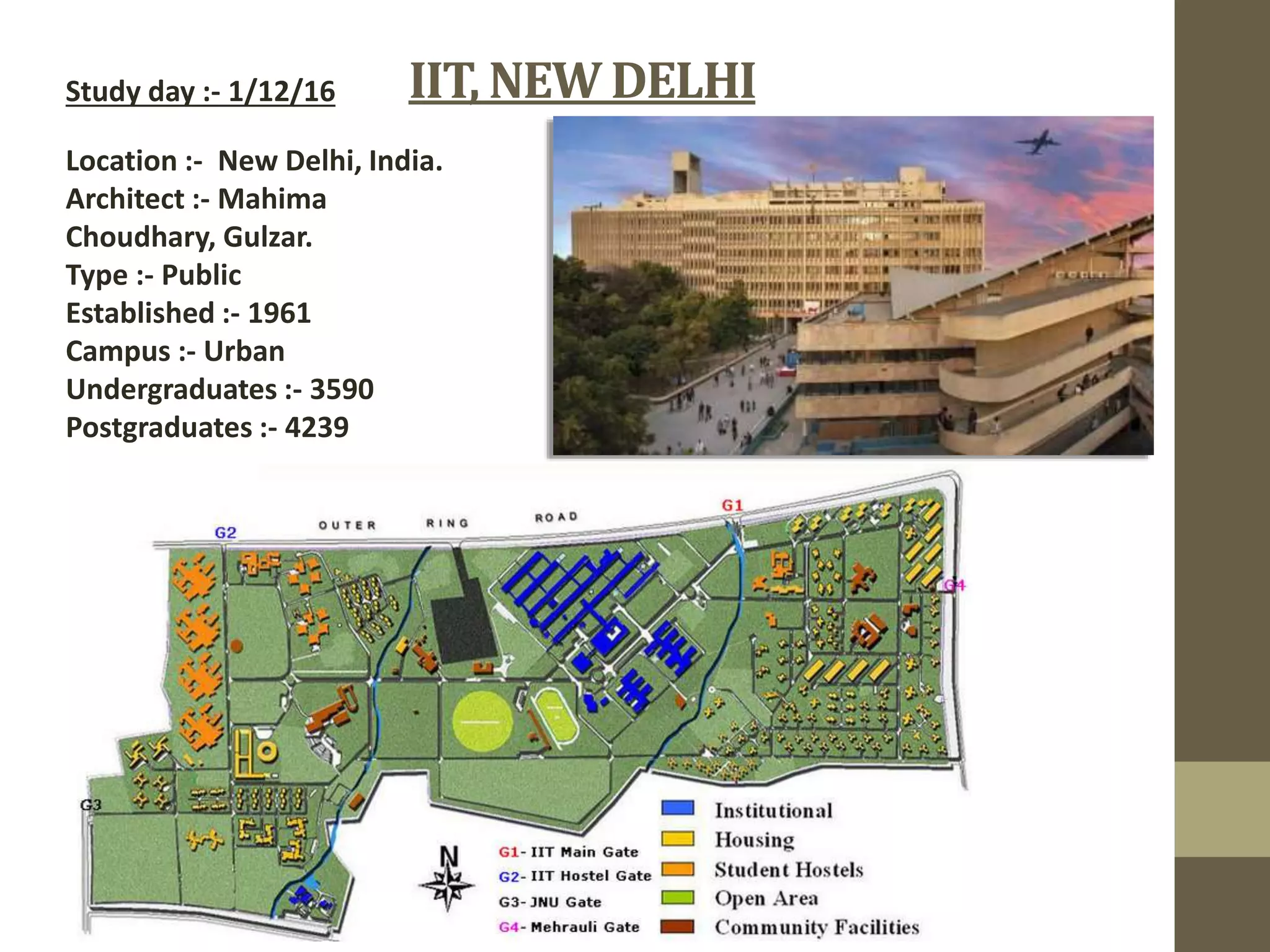
Location :- New Delhi, India.
Architect :- Mahima
Choudhary, Gulzar.
Type :- Public
Established :- 1961
Campus :- Urban
Undergraduates :- 3590
Postgraduates :- 4239
Study day :- 1/12/16
INTRODUCTION
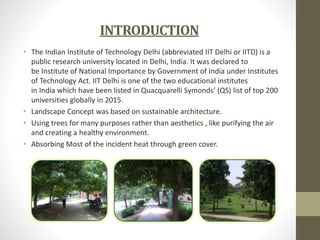
• The Indian Institute of Technology Delhi (abbreviated IIT Delhi or IITD) is a
public research university located in Delhi, India. It was declared to
be Institute of National Importance by Government of India under Institutes
of Technology Act. IIT Delhi is one of the two educational institutes
in India which have been listed in Quacquarelli Symonds’ (QS) list of top 200
universities globally in 2015.
• Landscape Concept was based on sustainable architecture.
• Using trees for many purposes rather than aesthetics , like purifying the air
and creating a healthy environment.
• Absorbing Most of the incident heat through green cover.
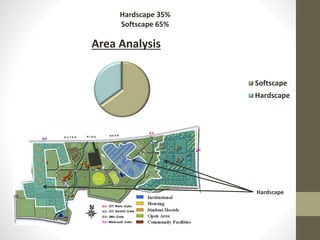
Area Analysis
Softscape
Hardscape
Hardscape 35%
Softscape 65%
Hardscape
LandscapingCharacteristics
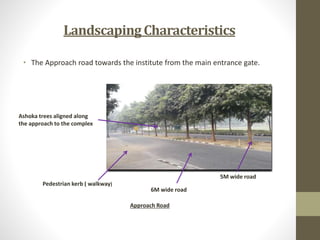
• The Approach road towards the institute from the main entrance gate.
Ashoka trees aligned along
the approach to the complex
Pedestrian kerb ( walkway)
6M wide road
5M wide road
Approach Road
LandscapingCharacteristics
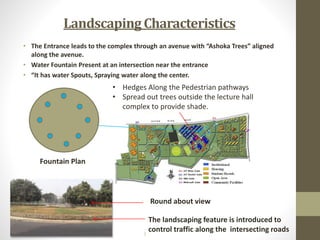
• The Entrance leads to the complex through an avenue with “Ashoka Trees” aligned
along the avenue.
• Water Fountain Present at an intersection near the entrance
• “It has water Spouts, Spraying water along the center.
Fountain Plan
• Hedges Along the Pedestrian pathways
• Spread out trees outside the lecture hall
complex to provide shade.
Round about view
The landscaping feature is introduced to
control traffic along the intersecting roads
HARDSCAPE
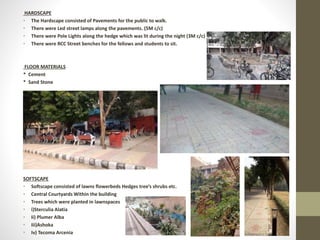
• The Hardscape consisted of Pavements for the public to walk.
• There were Led street lamps along the pavements. (5M c/c)
• There were Pole Lights along the hedge which was lit during the night (3M c/c)
• There were RCC Street benches for the fellows and students to sit.
FLOOR MATERIALS
* Cement
* Sand Stone
SOFTSCAPE
• Softscape consisted of lawns flowerbeds Hedges tree’s shrubs etc.
• Central Courtyards Within the building
• Trees which were planted in lawnspaces
• i)Sterculia Alatia
• Ii) Plumer Alba
• Iii)Ashoka
• Iv) Tecoma Arcenia
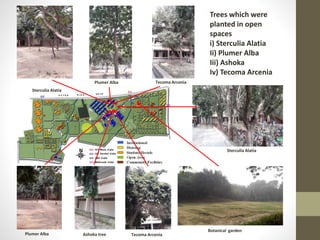
Trees which were
planted in open
spaces
i) Sterculia Alatia
Ii) Plumer Alba
Iii) Ashoka
Iv) Tecoma Arcenia
Botanical garden
Plumer Alba Tecoma Arcenia
Sterculia Alatia
Ashoka tree
Sterculia Alatia
Plumer Alba Tecoma Arcenia
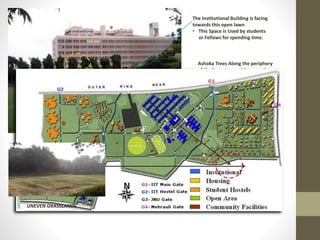
The Institutional Building is facing
towards this open lawn
• This Space is Used by students
or Fellows for spending time.
Ashoka Trees Along the periphery
of the lawn to provide screening
# This is the northeast face of the
building
# Which gets most the morning
sun rays can be used for yoga by
students and fellows.
# recreational activities.
UNEVEN GRASSLANDS
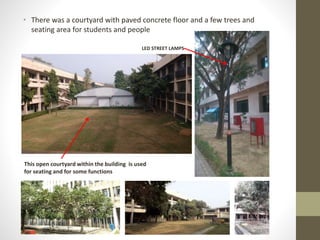
• There was a courtyard with paved concrete floor and a few trees and
seating area for students and people
LED STREET LAMPS
This open courtyard within the building is used
for seating and for some functions
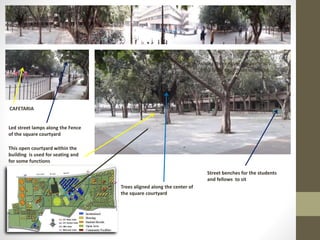
Ashoka Trees Along the periphery
of the lawn to provide screening
Street benches for the students
and fellows to sit
This open courtyard within the
building is used for seating and
for some functions
Trees aligned along the center of
the square courtyard
Led street lamps along the Fence
of the square courtyard
CAFETARIA
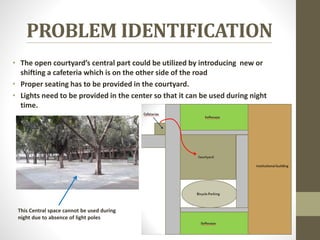
PROBLEM IDENTIFICATION
• The open courtyard’s central part could be utilized by introducing new or
shifting a cafeteria which is on the other side of the road
• Proper seating has to be provided in the courtyard.
• Lights need to be provided in the center so that it can be used during night
time.
This Central space cannot be used during
night due to absence of light poles
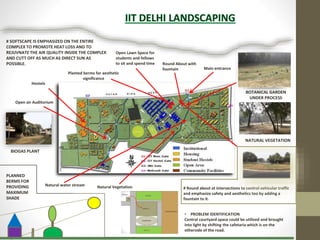
Main entrance
Round About with
fountain
Open Lawn Space for
students and fellows
to sit and spend time
Hostels
Open air Auditorium
# Round about at intersections to control vehicular traffic
and emphasize safety and aesthetics too by adding a
fountain to it.
Natural VegetationNatural water stream
# SOFTSCAPE IS EMPHASIZED ON THE ENTIRE
COMPLEX TO PROMOTE HEAT LOSS AND TO
REJUVNATE THE AIR QUALITY INSIDE THE COMPLEX
AND CUTT OFF AS MUCH AS DIRECT SUN AS
POSSIBLE.
Planted berms for aesthetic
significance
• PROBLEM IDENTIFICATION
Central courtyard space could be utilized and brought
into light by shifting the cafetaria which is on the
otherside of the road.
BOTANICAL GARDEN
UNDER PROCESS
PLANNED
BERMS FOR
PROVIDING
MAXIMUM
SHADE
BIOGAS PLANT
NATURAL VEGETATION
OBSERVATIONS
• Concept of the Institute is based on sustainable architecture.
• The as compared to the surrounding area of the
IIT Delhi. and other plants. The trees grown
here are mainly , , , , , , ,
, etc. Other than these many flowering plants as well as the ground covers have been planted.
• The landscape has been planned keeping in mind the central or the primary circulation path. The
trees have been planted along the road side shading the pathways as well as the road.
. This shields the building
blocks that have been planned near to the road.
• Similarly, the plantation along the secondary circulation follows the same pattern.
• Other than this, all the department buildings as well as other administrative buildings are
surrounded by the lush green vegetation.
• .
• Other than these the roads’ intersections have been well maintained and landscaped using round-
abouts. To hide a few buildings like the Director’s residence, artificial mound has been created. Even
the sports facilities like the ground, pavilion etc. have been punctuated with trees and proper plant
materials.
• Materials used: The material used predominantly is brick work and (locally available
stone). The academic area has brick work cladded with Dhaulpur stone for no or less maintenance.
The departments are a mix of , cladding as well as a proportionate use of concrete.
The material used in housing as well as the hostel blocks is mainly brick with a considerable and
necessary amount of concrete.

IIT, New Delhi Landscape Architecture

  • 1.
    IIT, NEW DELHI Location:- New Delhi, India. Architect :- Mahima Choudhary, Gulzar. Type :- Public Established :- 1961 Campus :- Urban Undergraduates :- 3590 Postgraduates :- 4239 Study day :- 1/12/16
  • 2.
    INTRODUCTION • The IndianInstitute of Technology Delhi (abbreviated IIT Delhi or IITD) is a public research university located in Delhi, India. It was declared to be Institute of National Importance by Government of India under Institutes of Technology Act. IIT Delhi is one of the two educational institutes in India which have been listed in Quacquarelli Symonds’ (QS) list of top 200 universities globally in 2015. • Landscape Concept was based on sustainable architecture. • Using trees for many purposes rather than aesthetics , like purifying the air and creating a healthy environment. • Absorbing Most of the incident heat through green cover.
  • 3.
  • 4.
    LandscapingCharacteristics • The Approachroad towards the institute from the main entrance gate. Ashoka trees aligned along the approach to the complex Pedestrian kerb ( walkway) 6M wide road 5M wide road Approach Road
  • 5.
    LandscapingCharacteristics • The Entranceleads to the complex through an avenue with “Ashoka Trees” aligned along the avenue. • Water Fountain Present at an intersection near the entrance • “It has water Spouts, Spraying water along the center. Fountain Plan • Hedges Along the Pedestrian pathways • Spread out trees outside the lecture hall complex to provide shade. Round about view The landscaping feature is introduced to control traffic along the intersecting roads
  • 6.
    HARDSCAPE • The Hardscapeconsisted of Pavements for the public to walk. • There were Led street lamps along the pavements. (5M c/c) • There were Pole Lights along the hedge which was lit during the night (3M c/c) • There were RCC Street benches for the fellows and students to sit. FLOOR MATERIALS * Cement * Sand Stone SOFTSCAPE • Softscape consisted of lawns flowerbeds Hedges tree’s shrubs etc. • Central Courtyards Within the building • Trees which were planted in lawnspaces • i)Sterculia Alatia • Ii) Plumer Alba • Iii)Ashoka • Iv) Tecoma Arcenia
  • 7.
    Trees which were plantedin open spaces i) Sterculia Alatia Ii) Plumer Alba Iii) Ashoka Iv) Tecoma Arcenia Botanical garden Plumer Alba Tecoma Arcenia Sterculia Alatia Ashoka tree Sterculia Alatia Plumer Alba Tecoma Arcenia
  • 8.
    The Institutional Buildingis facing towards this open lawn • This Space is Used by students or Fellows for spending time. Ashoka Trees Along the periphery of the lawn to provide screening # This is the northeast face of the building # Which gets most the morning sun rays can be used for yoga by students and fellows. # recreational activities. UNEVEN GRASSLANDS
  • 9.
    • There wasa courtyard with paved concrete floor and a few trees and seating area for students and people LED STREET LAMPS This open courtyard within the building is used for seating and for some functions
  • 10.
    Ashoka Trees Alongthe periphery of the lawn to provide screening Street benches for the students and fellows to sit This open courtyard within the building is used for seating and for some functions Trees aligned along the center of the square courtyard Led street lamps along the Fence of the square courtyard CAFETARIA
  • 11.
    PROBLEM IDENTIFICATION • Theopen courtyard’s central part could be utilized by introducing new or shifting a cafeteria which is on the other side of the road • Proper seating has to be provided in the courtyard. • Lights need to be provided in the center so that it can be used during night time. This Central space cannot be used during night due to absence of light poles
  • 12.
    Main entrance Round Aboutwith fountain Open Lawn Space for students and fellows to sit and spend time Hostels Open air Auditorium # Round about at intersections to control vehicular traffic and emphasize safety and aesthetics too by adding a fountain to it. Natural VegetationNatural water stream # SOFTSCAPE IS EMPHASIZED ON THE ENTIRE COMPLEX TO PROMOTE HEAT LOSS AND TO REJUVNATE THE AIR QUALITY INSIDE THE COMPLEX AND CUTT OFF AS MUCH AS DIRECT SUN AS POSSIBLE. Planted berms for aesthetic significance • PROBLEM IDENTIFICATION Central courtyard space could be utilized and brought into light by shifting the cafetaria which is on the otherside of the road. BOTANICAL GARDEN UNDER PROCESS PLANNED BERMS FOR PROVIDING MAXIMUM SHADE BIOGAS PLANT NATURAL VEGETATION
  • 13.
    OBSERVATIONS • Concept ofthe Institute is based on sustainable architecture. • The as compared to the surrounding area of the IIT Delhi. and other plants. The trees grown here are mainly , , , , , , , , etc. Other than these many flowering plants as well as the ground covers have been planted. • The landscape has been planned keeping in mind the central or the primary circulation path. The trees have been planted along the road side shading the pathways as well as the road. . This shields the building blocks that have been planned near to the road. • Similarly, the plantation along the secondary circulation follows the same pattern. • Other than this, all the department buildings as well as other administrative buildings are surrounded by the lush green vegetation. • . • Other than these the roads’ intersections have been well maintained and landscaped using round- abouts. To hide a few buildings like the Director’s residence, artificial mound has been created. Even the sports facilities like the ground, pavilion etc. have been punctuated with trees and proper plant materials. • Materials used: The material used predominantly is brick work and (locally available stone). The academic area has brick work cladded with Dhaulpur stone for no or less maintenance. The departments are a mix of , cladding as well as a proportionate use of concrete. The material used in housing as well as the hostel blocks is mainly brick with a considerable and necessary amount of concrete.