L I T E R A T U R E S T U D Y AD- VI H O T E L & R E S O R T D E S I G N
UTKARSH ANAND
BARCH/10014/20
SHUBHASHISH KUMAR
BARCH/10002/20
DEEPSHIKA DEBBARMA
BARCH/10034/20
ANNU TIGGA
BARCH/10037/20
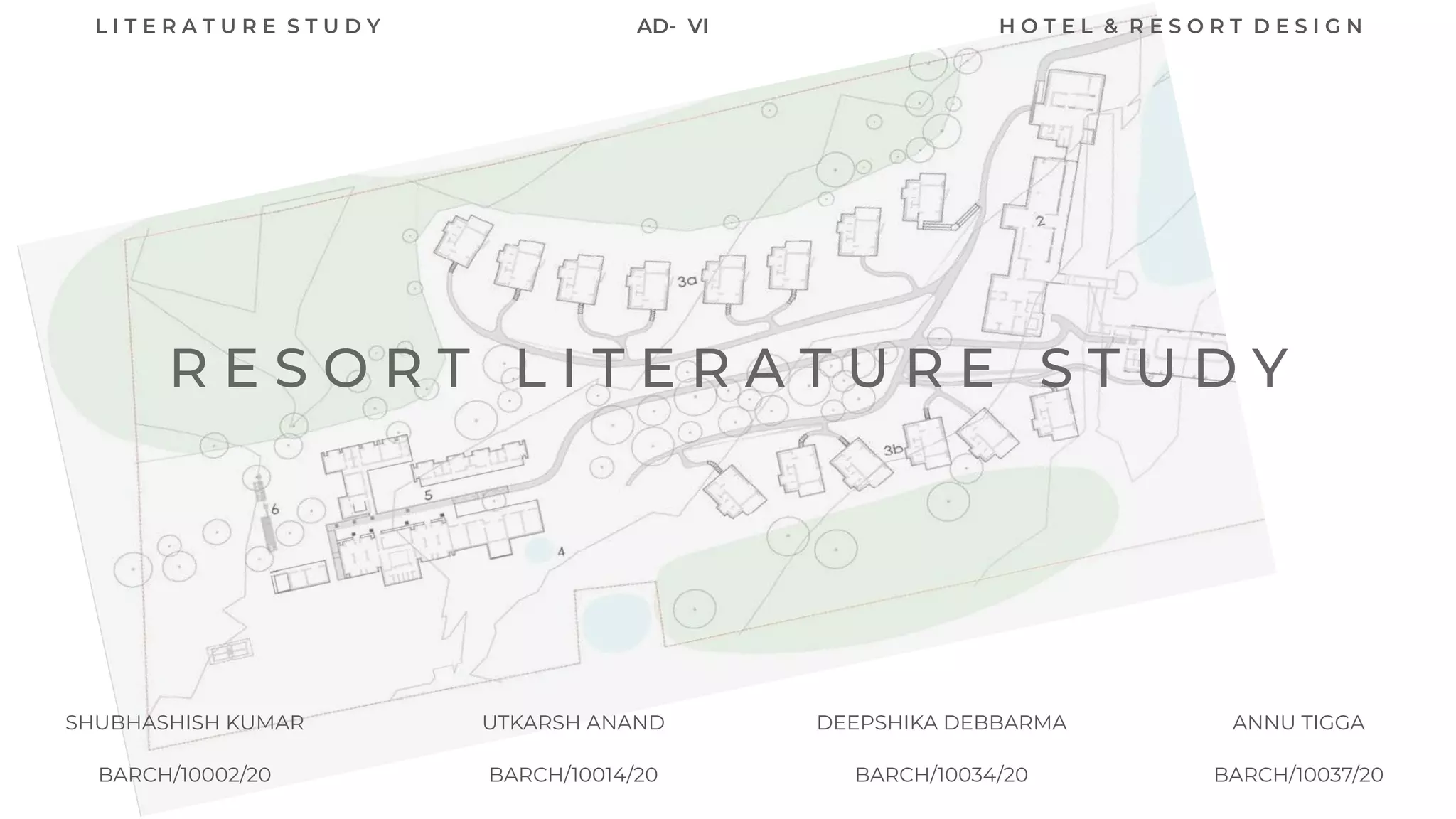
R E S O R T L I T E R A T U R E S T U D Y
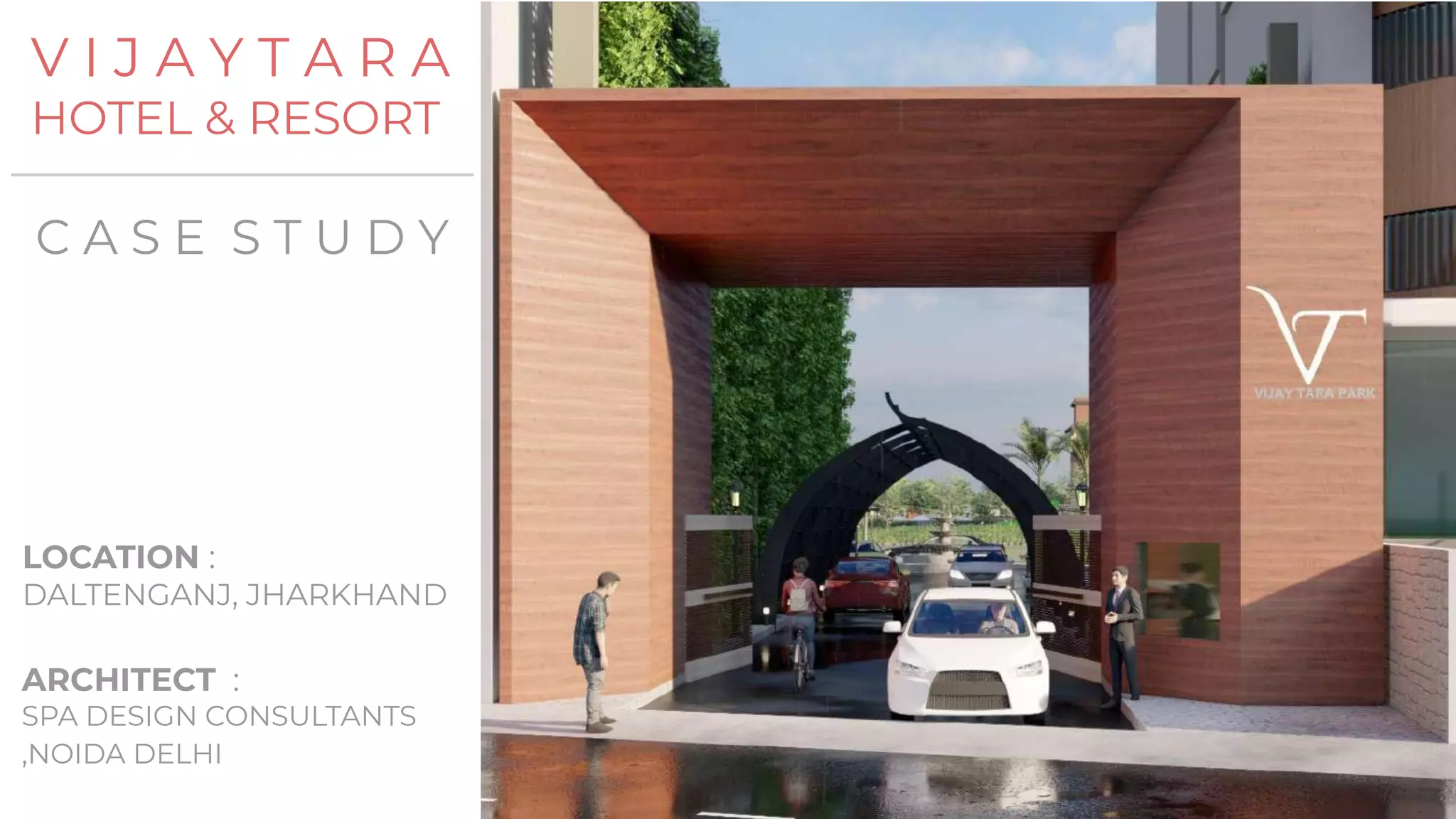
V I J A Y T A R A
HOTEL & RESORT
C A S E S T U D Y
ARCHITECT :
SPA DESIGN CONSULTANTS
,NOIDA DELHI
LOCATION :
DALTENGANJ, JHARKHAND
HOTEL ENTRANCE
ENTRY TO HOTEL
RECEPTION
ENTRY TO
COMMERCIAL AREA
PARKING ENTRY
PARKING ENTRY
ENTRY TO HOTEL
RECEPTION
ADMINISTRATIVE
OFFICES
CONFERENCE ROOM OFFICE OFFICE
OFFICE
BULLPEN SPACE BULLPEN SPACE OFFICE
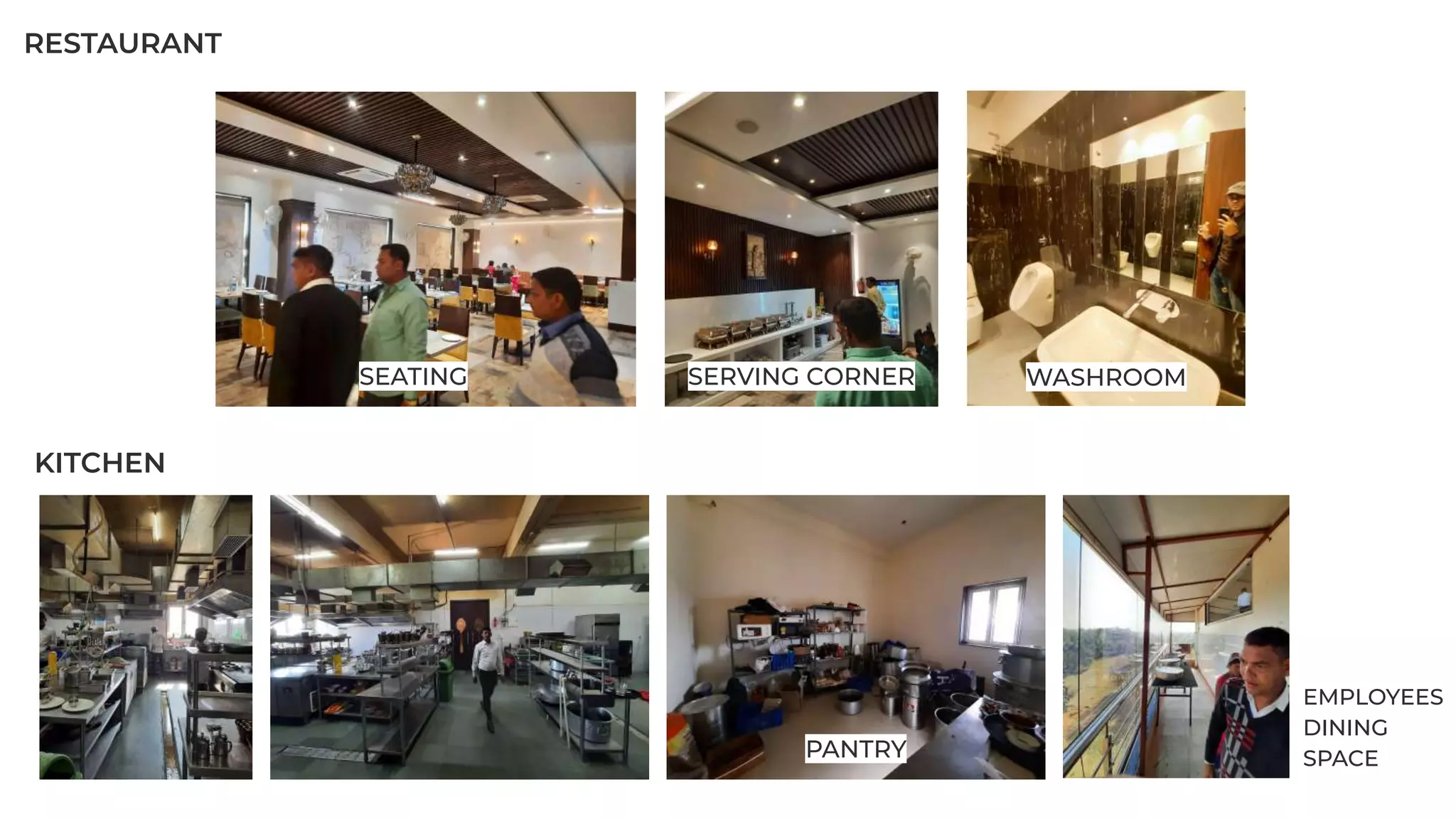
RESTAURANT
KITCHEN
SEATING SERVING CORNER
PANTRY
EMPLOYEES
DINING
SPACE
WASHROOM
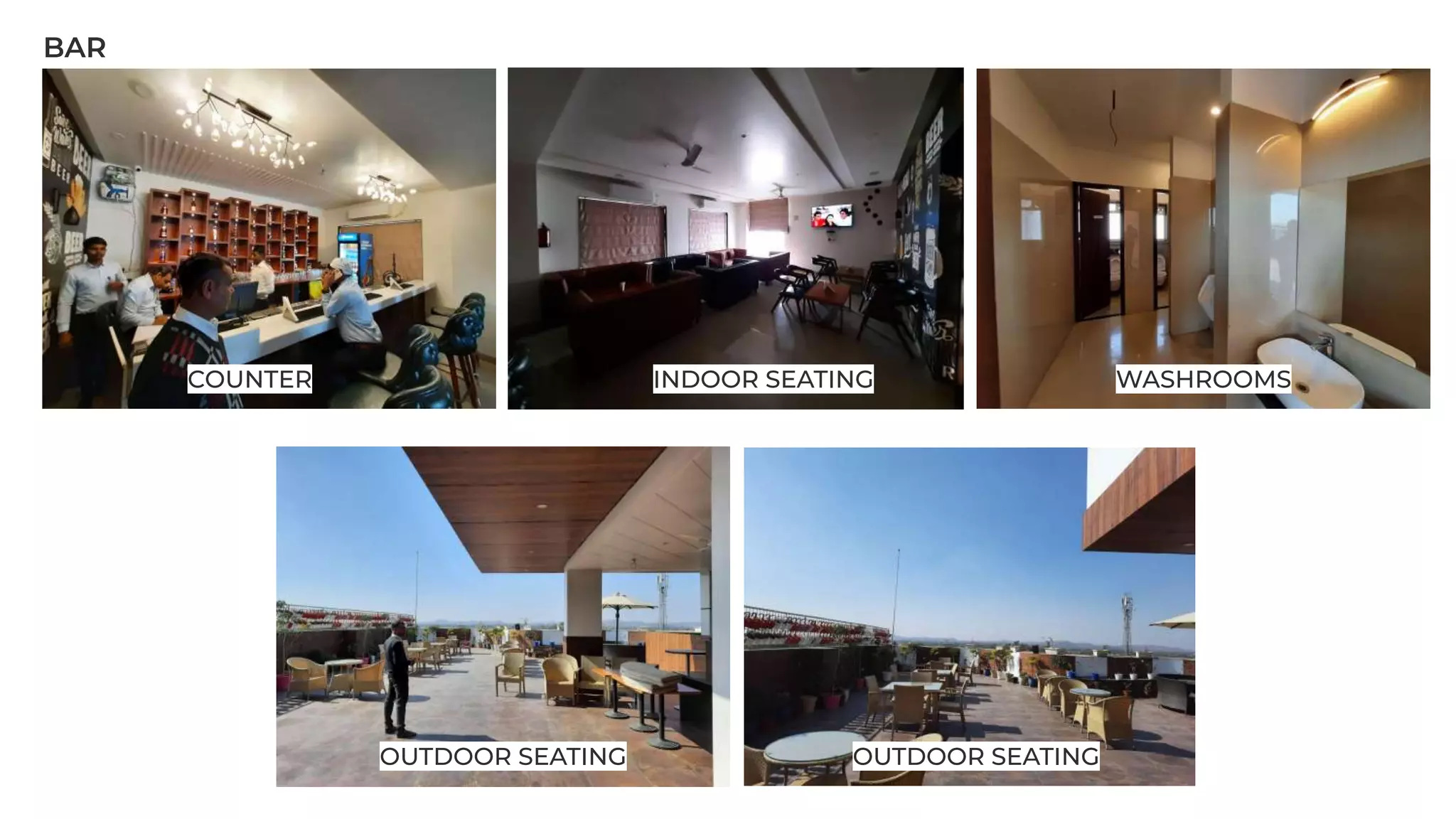
BAR
COUNTER INDOOR SEATING WASHROOMS
OUTDOOR SEATING OUTDOOR SEATING
ROOMS
UTILITY SPACE
HOTEL BANQUET HALL
ROOMS
RESORT BANQUET HALL
COMMERCIAL
AREA FOR RENT
ENTRY
BANQUET +
KITCHEN +
GYM
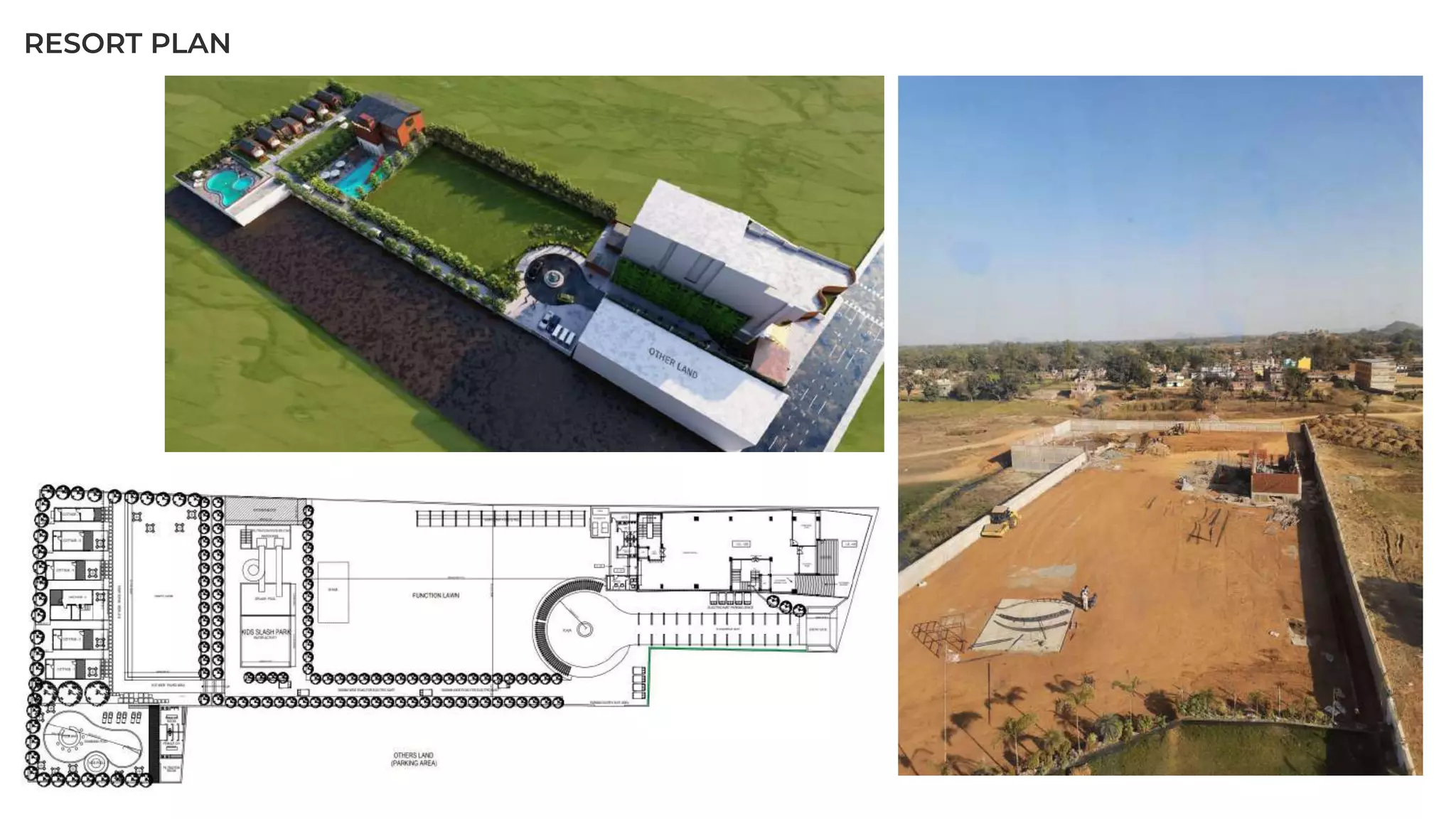
RESORT PLAN
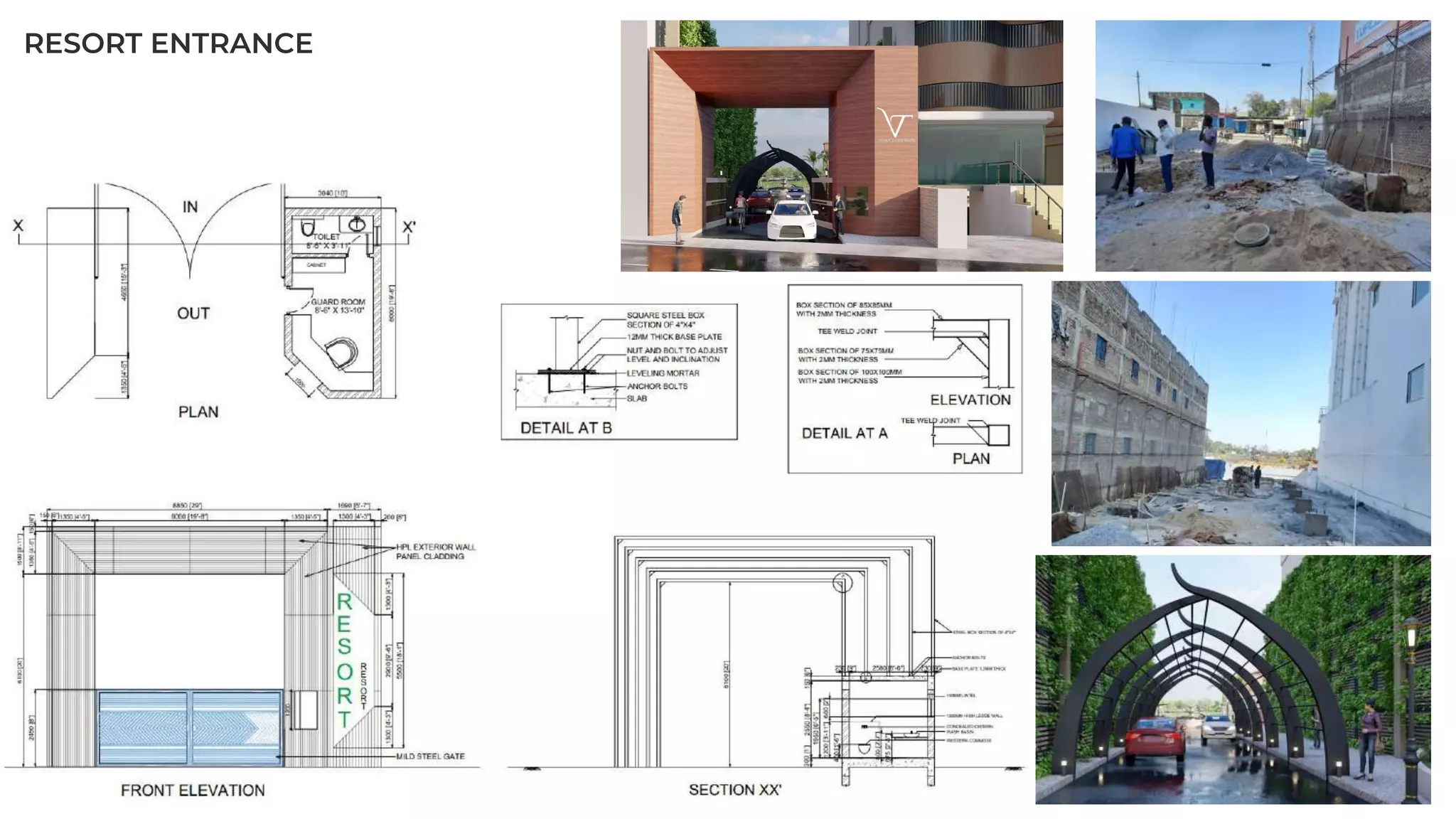
RESORT ENTRANCE
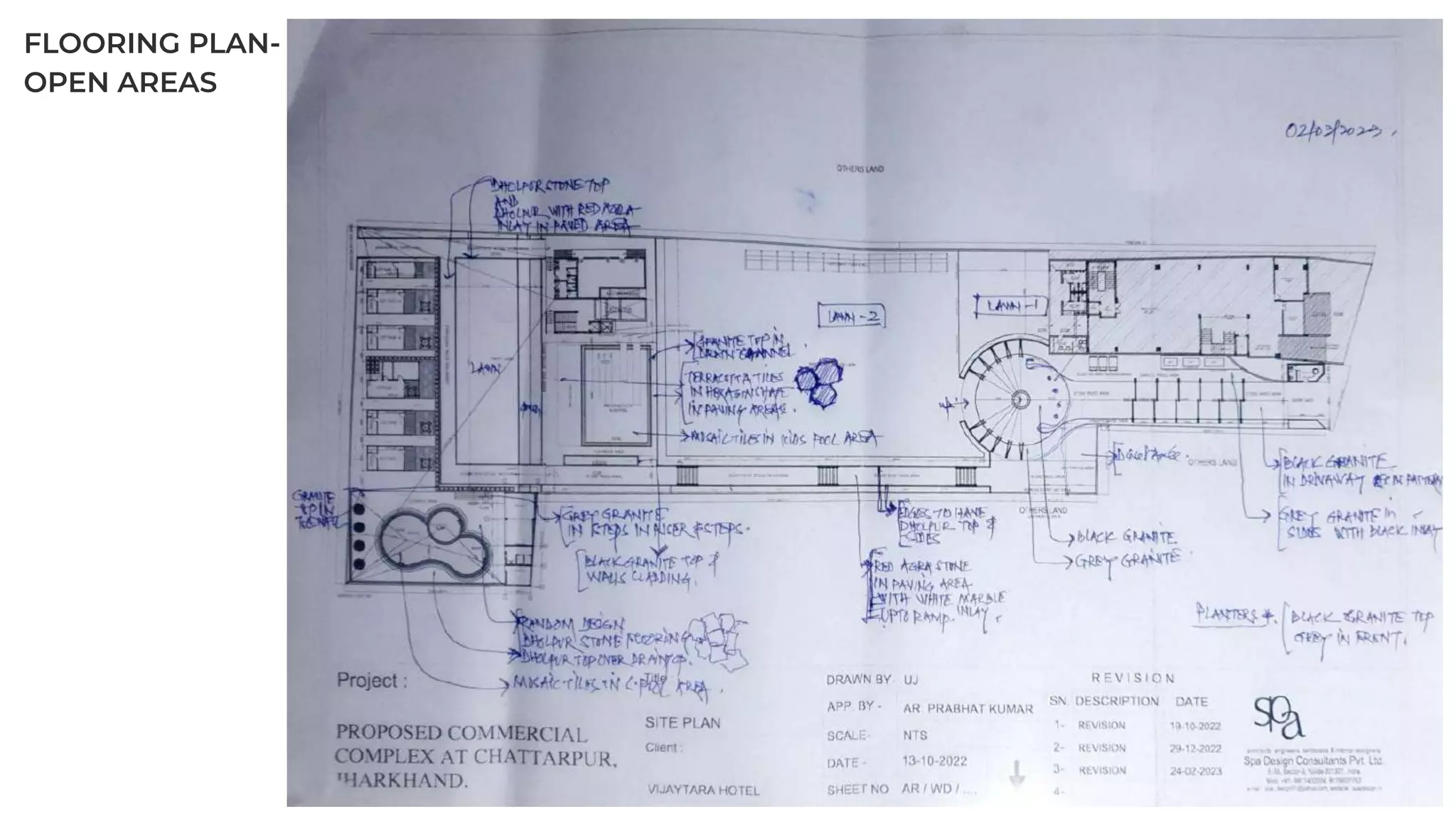
FLOORING PLAN-
OPEN AREAS
SWIMMING POOL
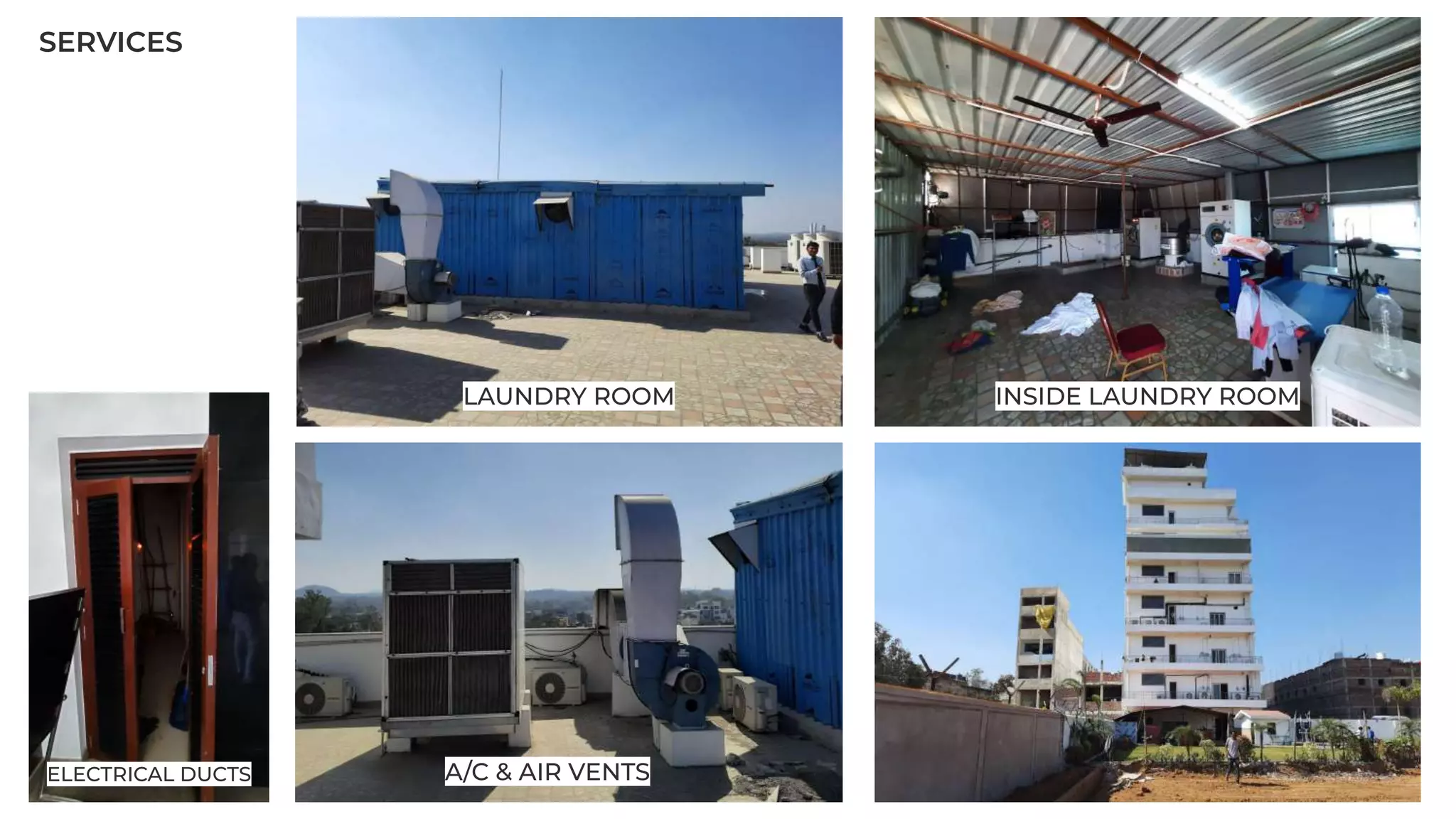
SERVICES
ELECTRICAL DUCTS
LAUNDRY ROOM INSIDE LAUNDRY ROOM
A/C & AIR VENTS
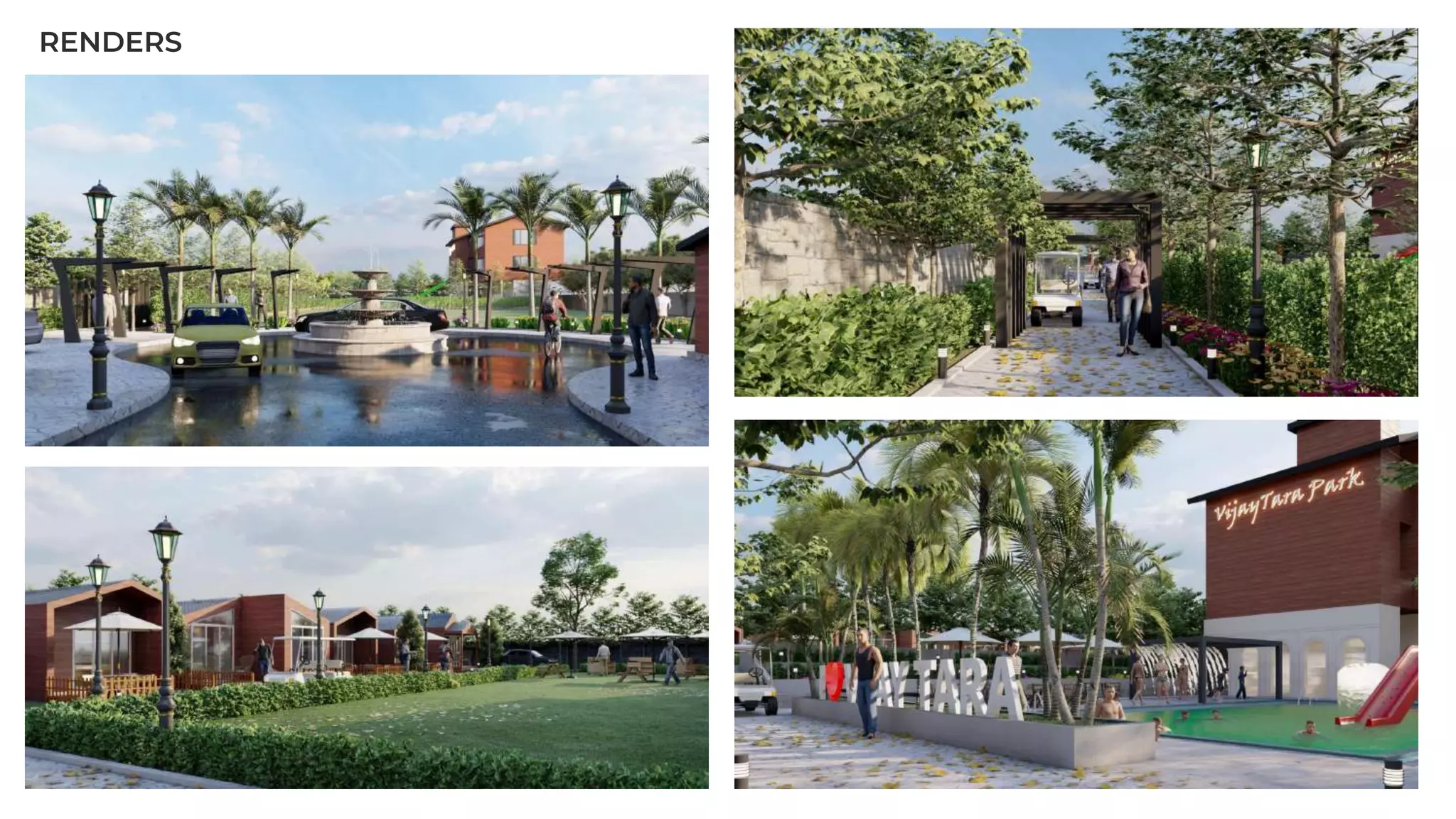
RENDERS
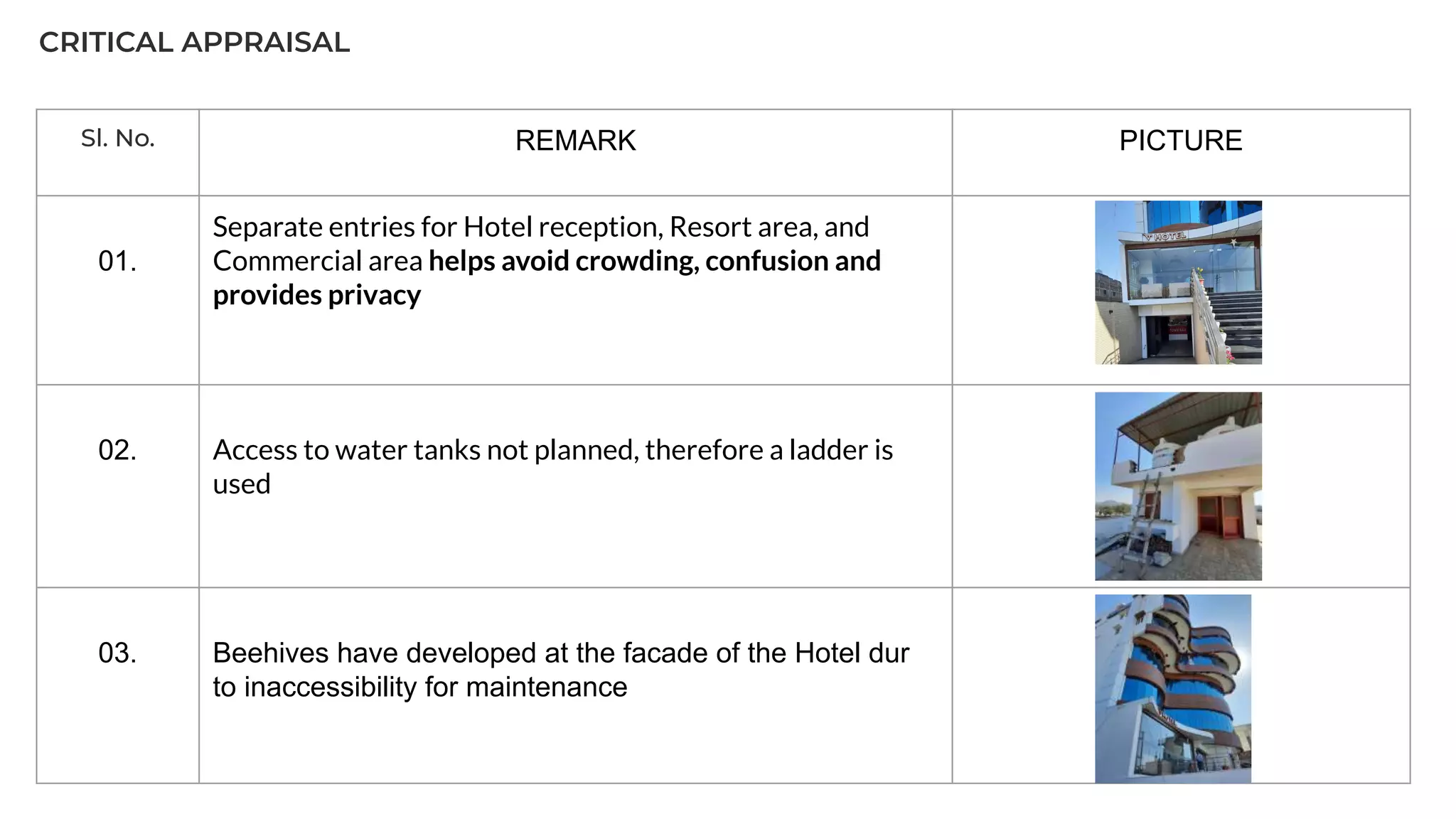
Sl. No. REMARK PICTURE
01.
Separate entries for Hotel reception, Resort area, and
Commercial area helps avoid crowding, confusion and
provides privacy
02. Access to water tanks not planned, therefore a ladder is
used
03. Beehives have developed at the facade of the Hotel dur
to inaccessibility for maintenance
CRITICAL APPRAISAL
L I T E R A T U R E S T U D Y
W A G H O B A E C O L O D G E R E S O R T
Architects: Biome Environmental Solutions
Area : 3085 m² Year : 2021 City : Bengaluru
Waghoba ecolodge is a resort
contiguous to the forest buffer
of Tadoba wildlife sanctuary in
the state of Maharashtra India.
❏ The target clientele for
the property is wildlife
enthusiasts and
conservationists.
❏ 16-cottage resort with
responsible tourism at its
core.
AIM
❏ Developers sought to restore the previously cultivated land to its original state of being a deciduous forest
as part of their ecological intentions.
❏ Required interventions in the landscape to enhance biodiversity. By observing the land around and through
a biodiversity survey local flora and fauna were identified.
INTRO
PROBLEMS
❏ For biodiversity to flourish it was essential to incorporate a
water body in the semi-arid climate of this region.
❏ In the summer temperature here rises to 48-degree C.
SOLUTION IDEAS
❏ By identifying the existing bund and desilting the channels
a lake was made at the entrance of the resort.
❏ This lake stored the rainwater and treated wastewater.
❏ Additional afforestation with indigenous plant species
provides a green corridor for the fauna to approach the
lake. This lake now is home to a plethora of birds and
animals.
❏ A lookout hide has been introduced in the design for
enthusiasts and professional wildlife photographers to
watch the fauna in its own habitat.
❏ The material palette is a
combination of local
sandstone and stabilized
adobes made at the site
using local soil.
❏ Capturing of the gold to
brown hue has been done
in the material palette of
the architectural
interventions.
❏ Lake becomes the loci of the
project.
❏ The travelers also enjoy the rising
sun when they are getting ready
to leave for the forest tour.
❏ Belvederes along the dining area
and the lounge enjoy views of the
lake, forest, and the evening
skies.
FEATURES
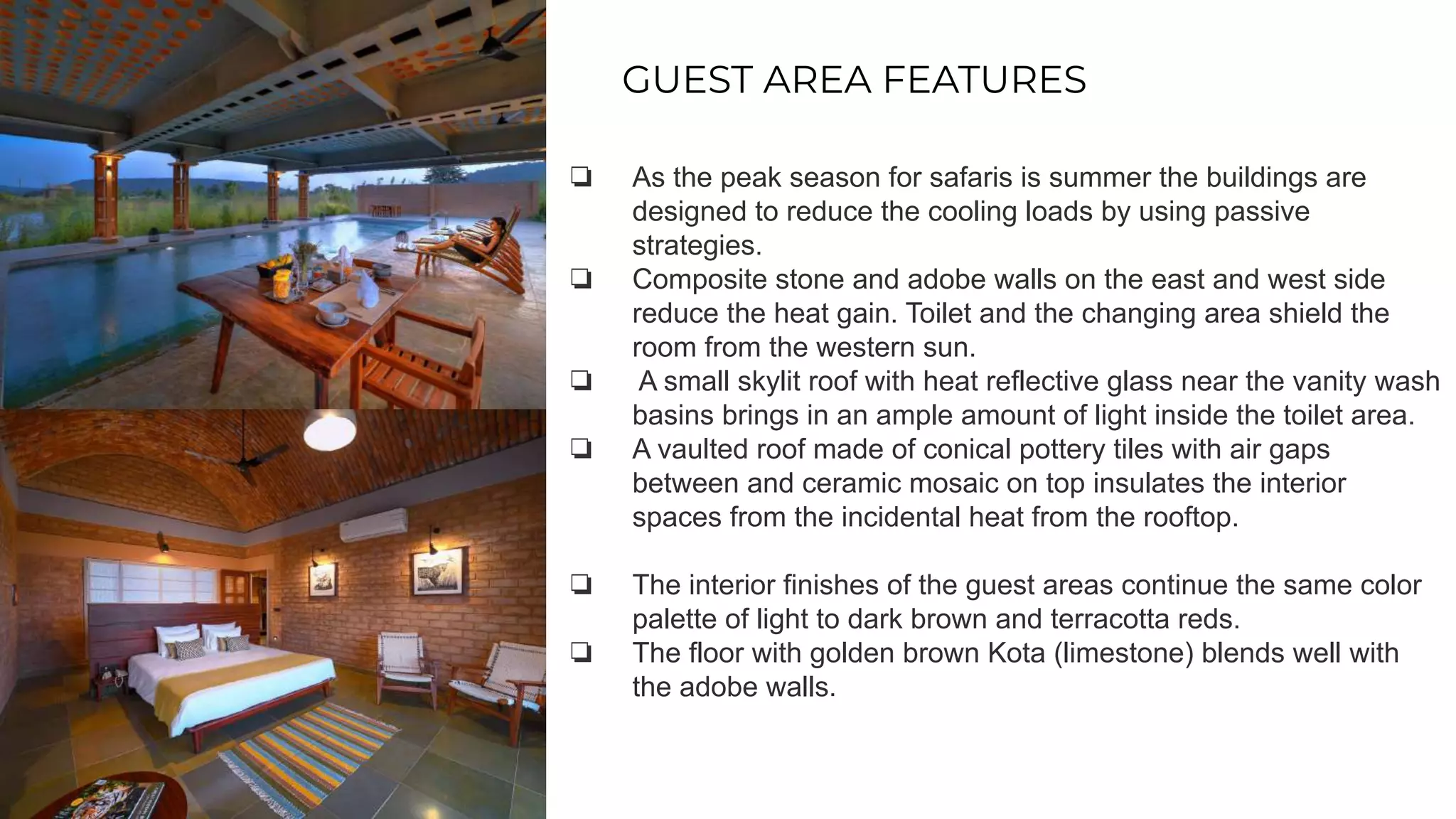
GUEST AREA FEATURES
❏ As the peak season for safaris is summer the buildings are
designed to reduce the cooling loads by using passive
strategies.
❏ Composite stone and adobe walls on the east and west side
reduce the heat gain. Toilet and the changing area shield the
room from the western sun.
❏ A small skylit roof with heat reflective glass near the vanity wash
basins brings in an ample amount of light inside the toilet area.
❏ A vaulted roof made of conical pottery tiles with air gaps
between and ceramic mosaic on top insulates the interior
spaces from the incidental heat from the rooftop.
❏ The interior finishes of the guest areas continue the same color
palette of light to dark brown and terracotta reds.
❏ The floor with golden brown Kota (limestone) blends well with
the adobe walls.
GUEST AREA FEATURES
❏ All the sewage water from the property is treated
using a plant-based water treatment system and
is subsequently used for growing the organic
vegetables and the forest on the property.
❏ The use of terracotta either as filler in the RCC
slabs or roofs and are produced in the village and
local areas and use the desilted soil from the
lakes.
CONCLUSION
❏ Since most buildings even in the rural area are adopting
RCC construction these skills are dying out.
❏ used terracotta consciously to make the facility part of a
virtual cycle.
❏ The vaulted roofs were done in collaboration with the Centre
for Science for Villages Wardha.
❏ This is an organization that works on Gandhian principles
and values.
SITE PLAN
PLAN OF GUEST
FACILITY AREA
ELEVATION
SOUTH ELEVATION &
SECTION CC
SECTIONS
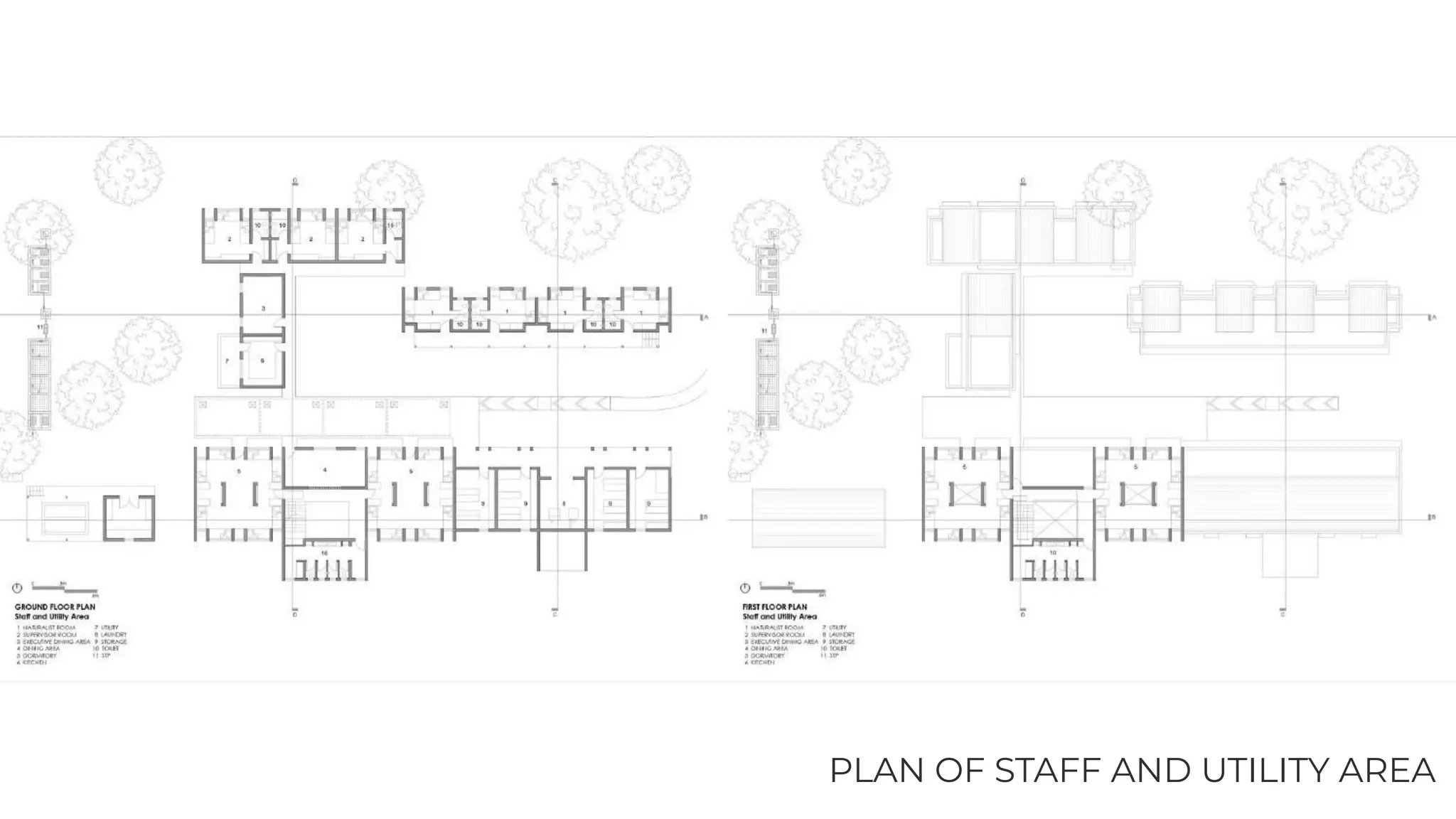
PLAN OF STAFF AND UTILITY AREA
ELEVATION
SECTIONS
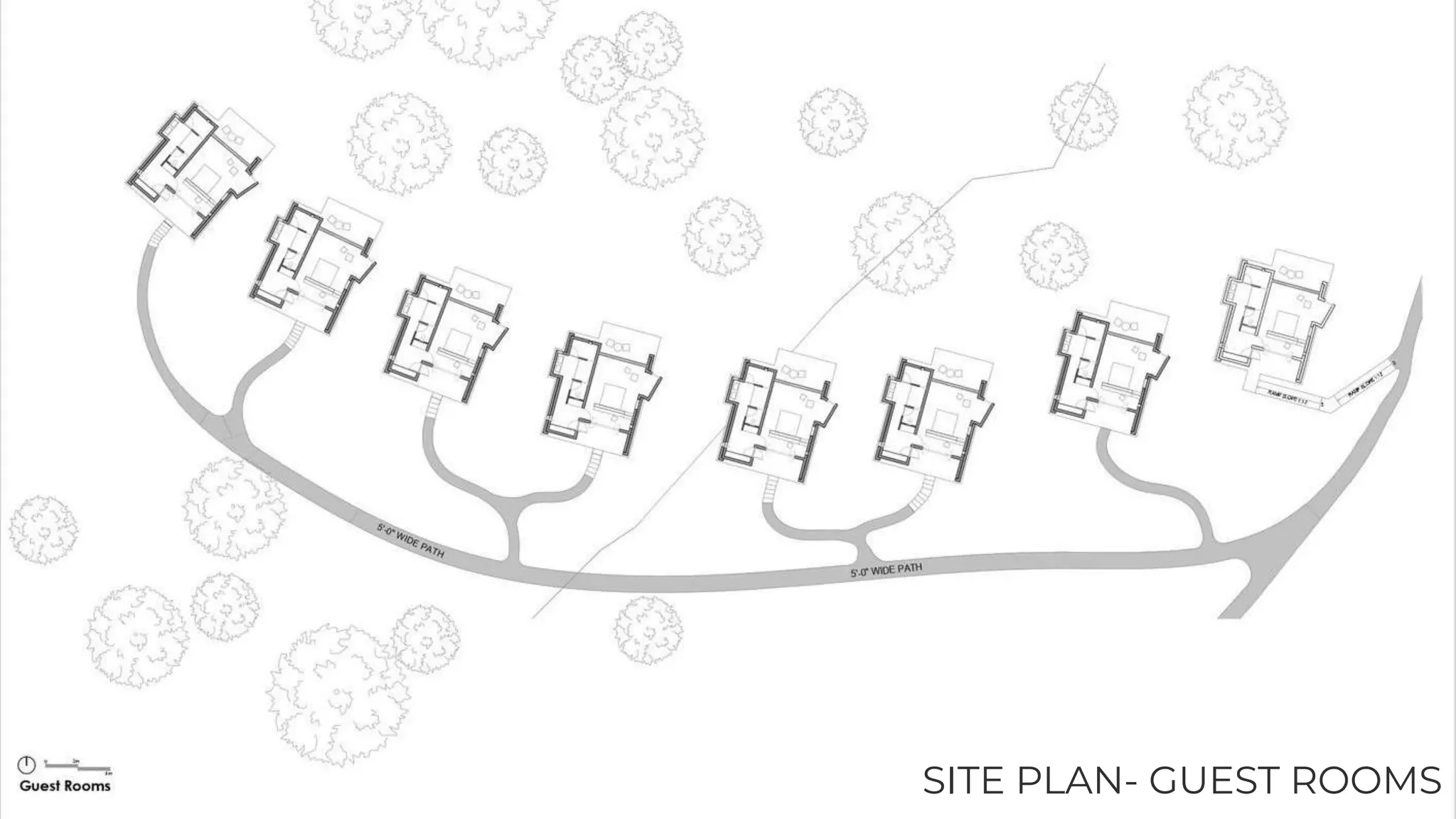
SITE PLAN- GUEST ROOMS
ELEVATION &SECTIONS
PLAN
L I T E R A T U R E S T U D Y
G . R . I . H . A . R A T E D 5 - S T A R H O T E L
M A J O R
G R E E N
A R C H I T E C T U R A L
P R A C T I C E S
G . R . I . H . A .
R A T I N G
(AS PER V.2019 MANUAL)
S U Z L O N - O N E E A R T H , P U N E
PROJECT DESCRIPTION
LOCATION: Pune, Maharashtra
YEAR: 2010
ARCHITECT: Christopher Charles Benninger
Architects
SITE AREA: 820,000 sq.ft
NO. OF STOREYS: 4
PROGRAMME: HQ LEED rated (57 points)
GRIHA (Five Star rating with 96 points).
INTRODUCTION
Suzlon is India’s largest and one of the world’s
biggest producers of “clean” wind energy.The
name “One Earth” signifies recognition of the
Earth as a unique eco-system whose resources
must be managed responsibly. It also signifies
the effort made to create such an
environmentally responsible corporate home. In
keeping with the theme, the corporate buildings
at One Earth have been named after the key
elements of nature as Aqua, Tree, Sky and Sun.
PLANNING AND DESIGN
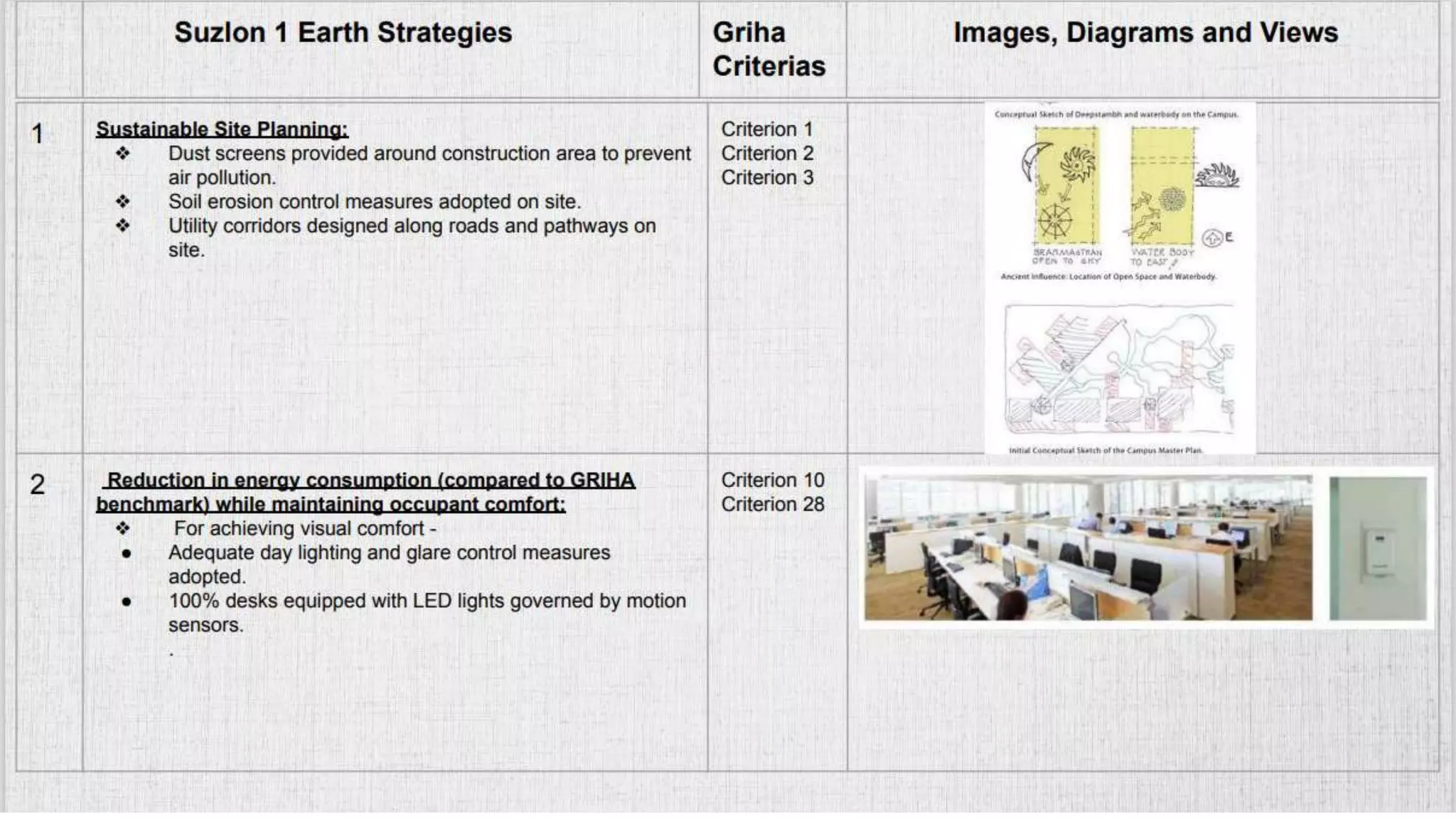
➢ Sustainability principles have been scrupulously adhered to, right from site selection and design to
engineering, construction, materials and operations. This includes usage of native flora, minimizing both
environmental impact and reducing the need for landscaping water, low-energy/green materials, appropriate
orientation of the building facades that ensures adequate day lighting and minimizes glare etc.
STRATEGIES
➢ Energy Efficiency A hybrid wind (80%) – solar (20%; through photovoltaic panels) energy system located
on-site and off-site generates 155 kW of power, making One Earth India’s first 100% renewable energy campus.
Smart solutions like motion/occupancy sensors, Low-E glass for the buildings, low energy LED lighting, aluminum
louvres that shade the interiors while providing ample natural illumination, HVAC systems that filter and cool air
before resupplying them to ACs to reduce the load on ACs etc., optimize energy consumption.
➢ Water Efficient 100% rainwater is harvested, 100% of grey water is recycled via an on-site sewage
treatment plant into flushing, air-cooling and landscaping systems attesting to One Earth’s water-efficiency. Water
fixtures including low flow fixtures that reduce in-building water consumption by 65% and touchless urinals with
hytronik sensors all help reduce water consumption and make One Earth water efficient .
STRATEGIES
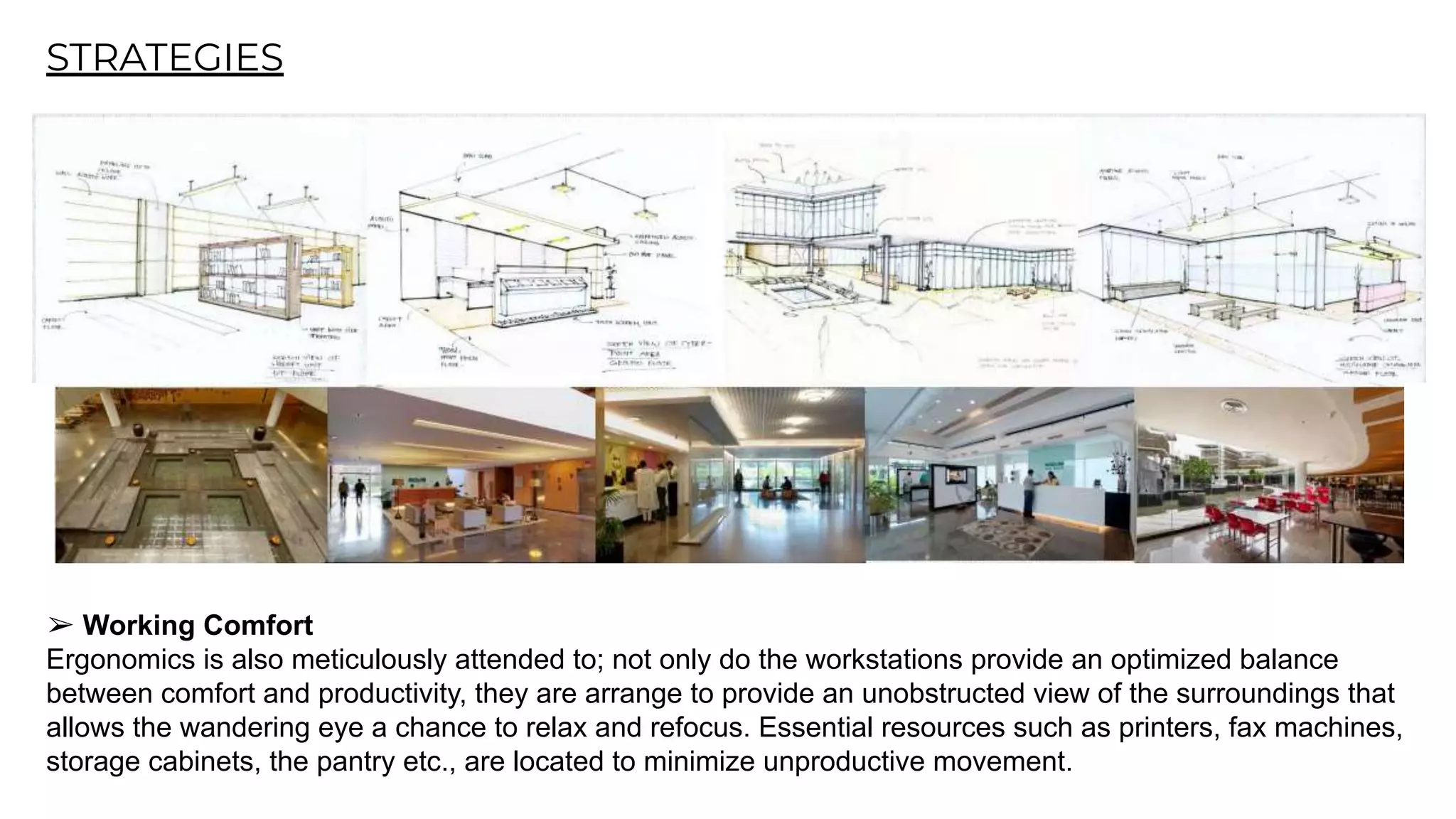
➢ Working Comfort
Ergonomics is also meticulously attended to; not only do the workstations provide an optimized balance
between comfort and productivity, they are arrange to provide an unobstructed view of the surroundings that
allows the wandering eye a chance to relax and refocus. Essential resources such as printers, fax machines,
storage cabinets, the pantry etc., are located to minimize unproductive movement.
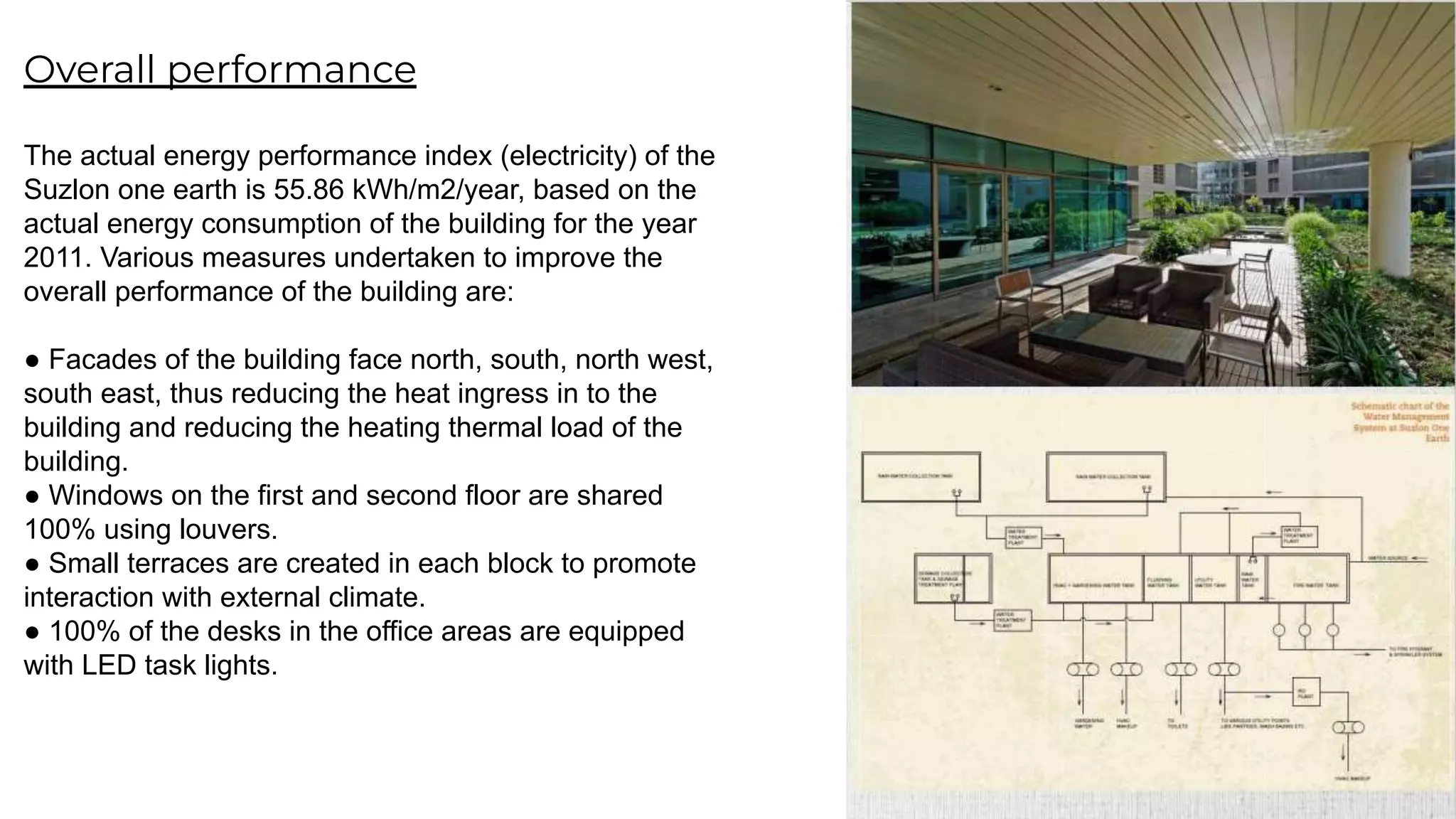
Overall performance
The actual energy performance index (electricity) of the
Suzlon one earth is 55.86 kWh/m2/year, based on the
actual energy consumption of the building for the year
2011. Various measures undertaken to improve the
overall performance of the building are:
● Facades of the building face north, south, north west,
south east, thus reducing the heat ingress in to the
building and reducing the heating thermal load of the
building.
● Windows on the first and second floor are shared
100% using louvers.
● Small terraces are created in each block to promote
interaction with external climate.
● 100% of the desks in the office areas are equipped
with LED task lights.
S E R V I C E
S T U D Y
E A R T H Q U A K E
R E S I S T A N T M E A S U R E S
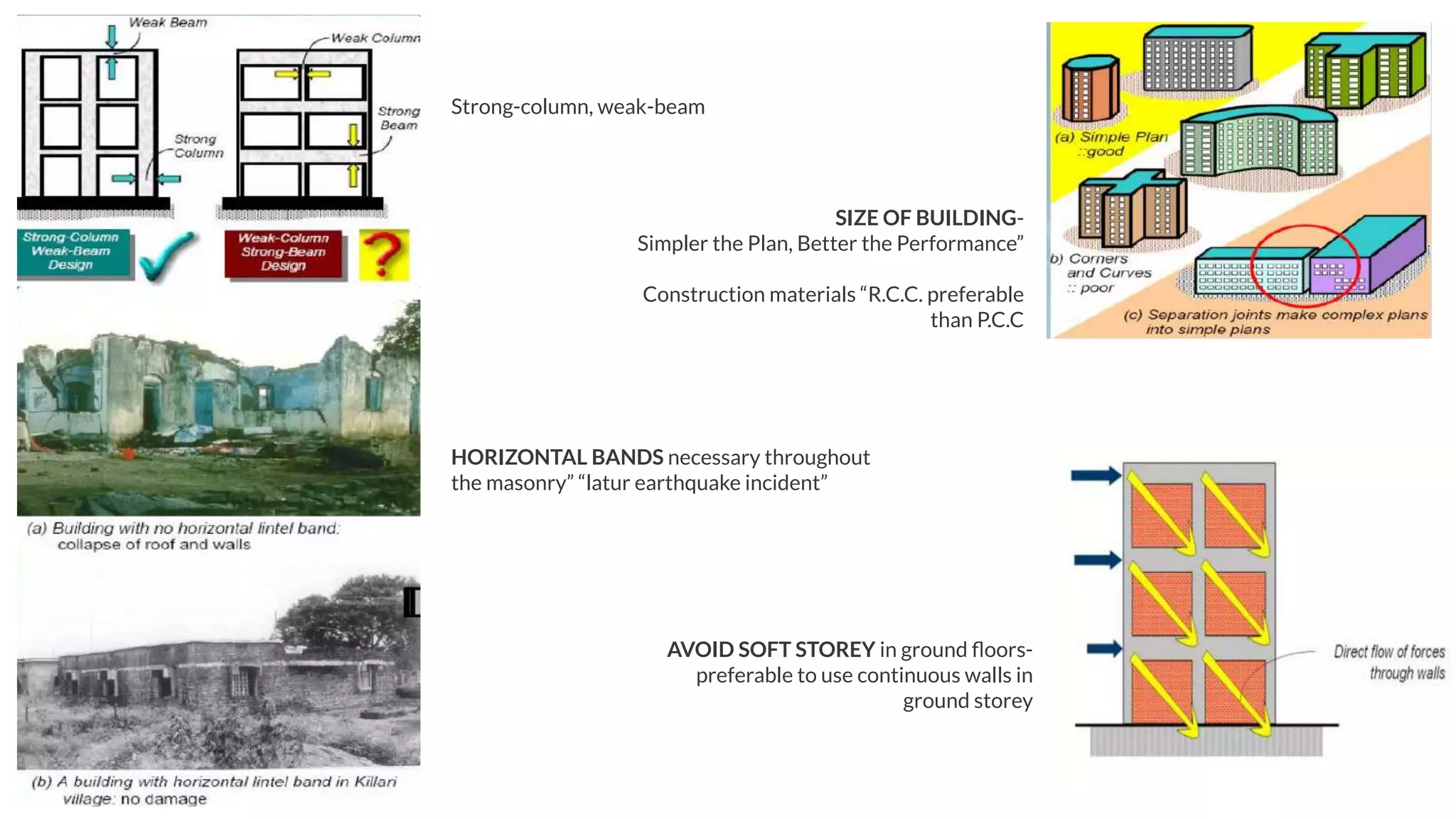
SIZE OF BUILDING-
Simpler the Plan, Better the Performance”
Construction materials “R.C.C. preferable
than P.C.C
Strong-column, weak-beam
AVOID SOFT STOREY in ground floors-
preferable to use continuous walls in
ground storey
HORIZONTAL BANDS necessary throughout
the masonry” “latur earthquake incident”
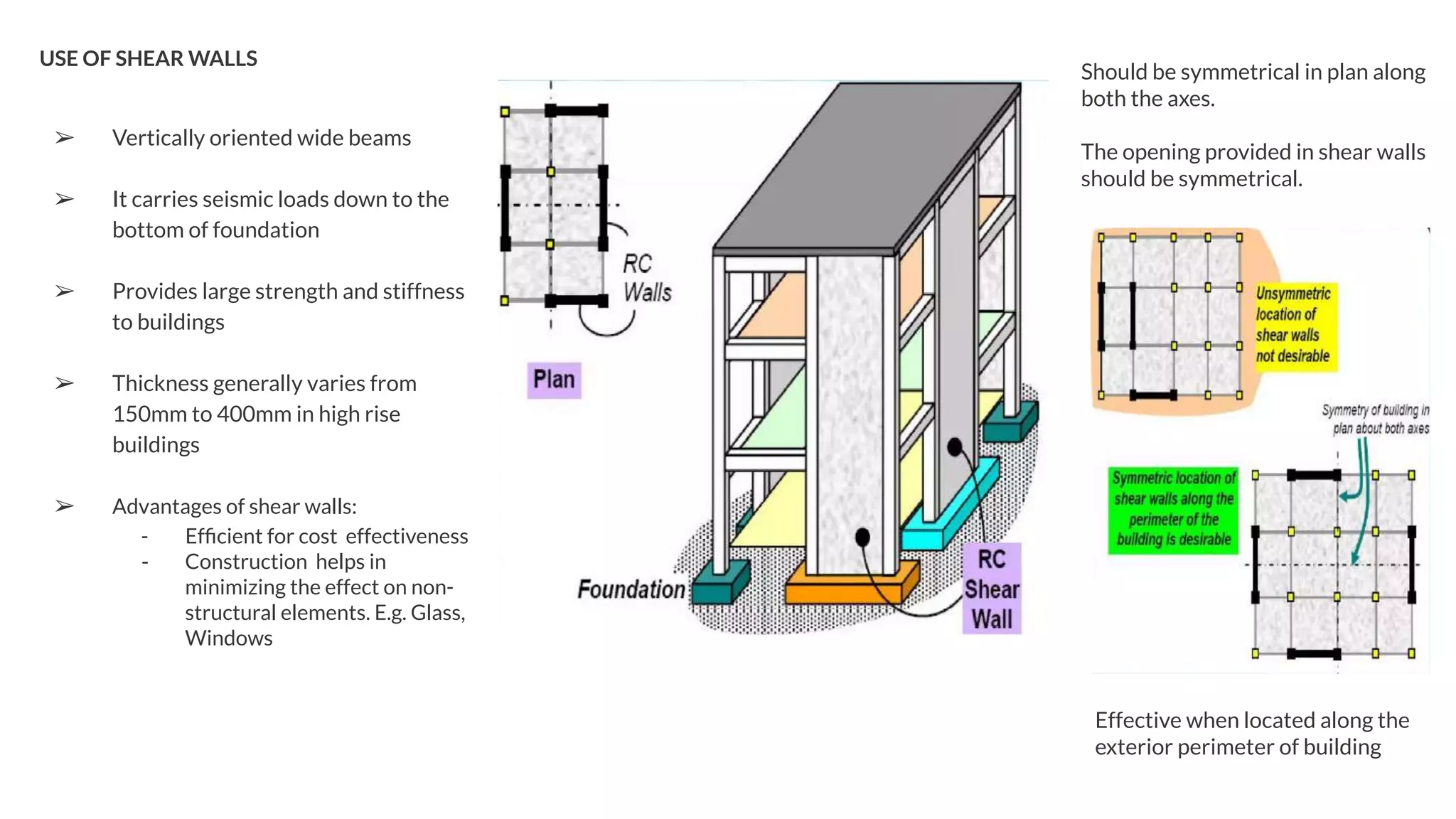
➢ Vertically oriented wide beams
➢ It carries seismic loads down to the
bottom of foundation
➢ Provides large strength and stiffness
to buildings
➢ Thickness generally varies from
150mm to 400mm in high rise
buildings
➢ Advantages of shear walls:
- Efficient for cost effectiveness
- Construction helps in
minimizing the effect on non-
structural elements. E.g. Glass,
Windows
Effective when located along the
exterior perimeter of building
USE OF SHEAR WALLS
Should be symmetrical in plan along
both the axes.
The opening provided in shear walls
should be symmetrical.
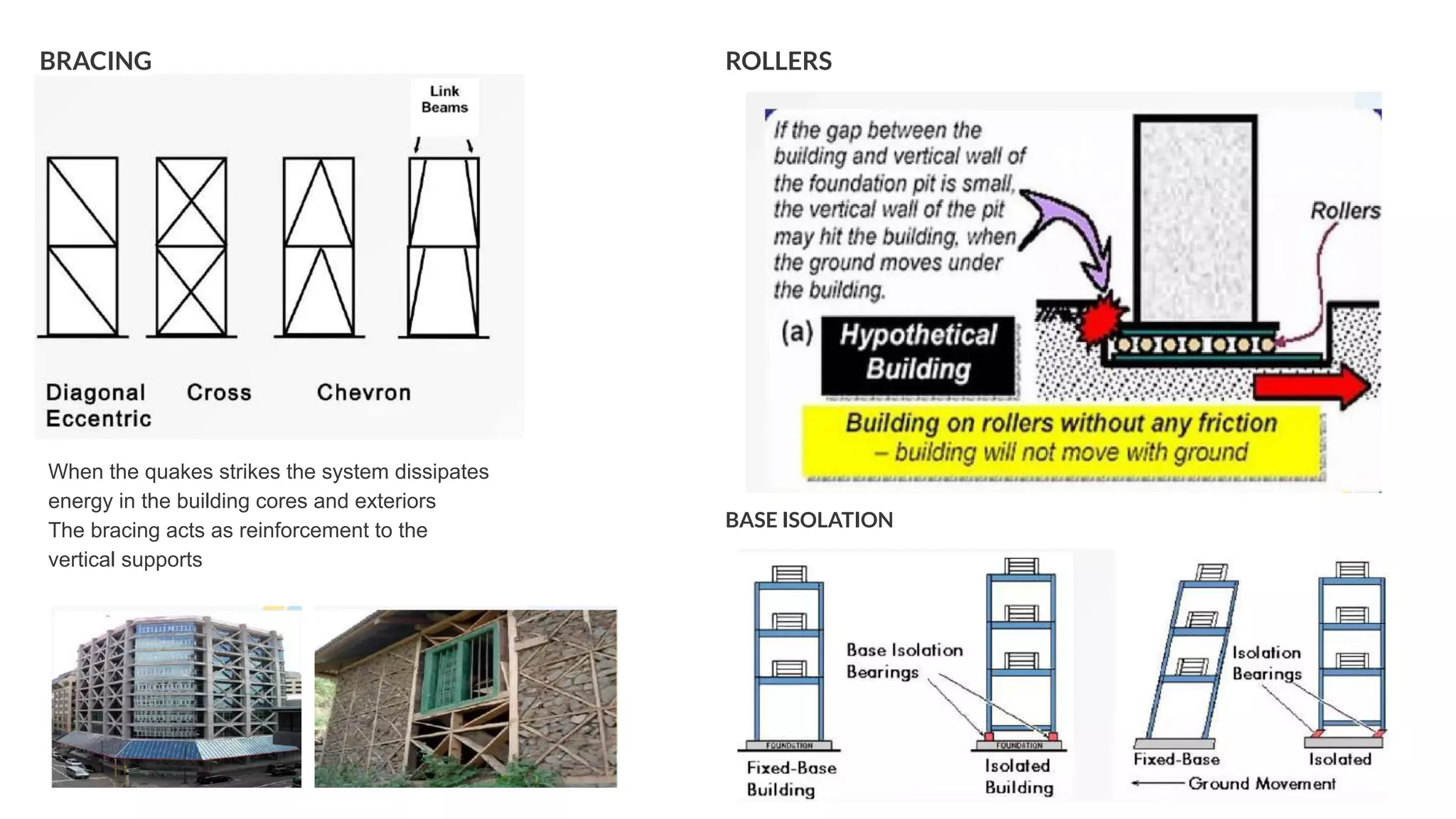
BRACING
When the quakes strikes the system dissipates
energy in the building cores and exteriors
The bracing acts as reinforcement to the
vertical supports
ROLLERS
BASE ISOLATION
➢ Energy Dissipation Device – (Seismic Dampers)
- These are used in place of structural elements such
as diagonal braces
- Acts like the hydraulic shock absorbers in cars
- When seismic energy is transmitted through them,
dampers absorb part of it, and thus damp the motion
of the building.
EARTHQUAKE RESISTANT FOUNDATION MEASURES:
➢ Keeping Building Up Thrust
- When the quakes strikes the system
dissipates energy in the building cores
and exteriors
- The frames are free to rock up and
down within fittings fixed at their bases
➢ Base Isolation Method
- Introduces flexibility to the
structures
- Building is rested on flexible pads
(Base Isolators)
- When earthquake strikes the
building does not moves
- It is suitable for hard soil only
S T A N D A R D S
N E U F E R T S &
T I M E S A V E R S
T E N T A T I V E
A R E A S T A T E M E N T
https://www.slideshare.net/vikskyn/earthquake-resistant-structure
https://www.archdaily.com/983422/waghoba-ecolodge-resort-biome-environmental-solutions?ad_source=se
arch&ad_medium=projects_tab
BIBLIOGRAPHY
Suzlon-one-Earth-final-rating-1May2013.pdf (grihaindia.org)
https://www.grihaindia.org/sites/default/files/sites/default/files/pdf/case-studies/Govardhan.pdf
https://www.slideshare.net/Ishan_163/design-steps-for-earthquake-resistant-structures
https://issuu.com/ankit_pokar/docs/architectural_programming_-_suzlon_one_earth

AD-VI_RESORT LIT STUDY.pdf

  • 1.
    L I TE R A T U R E S T U D Y AD- VI H O T E L & R E S O R T D E S I G N UTKARSH ANAND BARCH/10014/20 SHUBHASHISH KUMAR BARCH/10002/20 DEEPSHIKA DEBBARMA BARCH/10034/20 ANNU TIGGA BARCH/10037/20 R E S O R T L I T E R A T U R E S T U D Y
  • 2.
    V I JA Y T A R A HOTEL & RESORT C A S E S T U D Y ARCHITECT : SPA DESIGN CONSULTANTS ,NOIDA DELHI LOCATION : DALTENGANJ, JHARKHAND
  • 3.
    HOTEL ENTRANCE ENTRY TOHOTEL RECEPTION ENTRY TO COMMERCIAL AREA PARKING ENTRY PARKING ENTRY ENTRY TO HOTEL RECEPTION
  • 4.
    ADMINISTRATIVE OFFICES CONFERENCE ROOM OFFICEOFFICE OFFICE BULLPEN SPACE BULLPEN SPACE OFFICE
  • 5.
  • 6.
    BAR COUNTER INDOOR SEATINGWASHROOMS OUTDOOR SEATING OUTDOOR SEATING
  • 7.
  • 8.
    RESORT BANQUET HALL COMMERCIAL AREAFOR RENT ENTRY BANQUET + KITCHEN + GYM
  • 9.
  • 10.
  • 11.
  • 12.
  • 13.
    SERVICES ELECTRICAL DUCTS LAUNDRY ROOMINSIDE LAUNDRY ROOM A/C & AIR VENTS
  • 14.
  • 15.
    Sl. No. REMARKPICTURE 01. Separate entries for Hotel reception, Resort area, and Commercial area helps avoid crowding, confusion and provides privacy 02. Access to water tanks not planned, therefore a ladder is used 03. Beehives have developed at the facade of the Hotel dur to inaccessibility for maintenance CRITICAL APPRAISAL
  • 16.
    L I TE R A T U R E S T U D Y W A G H O B A E C O L O D G E R E S O R T
  • 17.
    Architects: Biome EnvironmentalSolutions Area : 3085 m² Year : 2021 City : Bengaluru
  • 18.
    Waghoba ecolodge isa resort contiguous to the forest buffer of Tadoba wildlife sanctuary in the state of Maharashtra India. ❏ The target clientele for the property is wildlife enthusiasts and conservationists. ❏ 16-cottage resort with responsible tourism at its core. AIM ❏ Developers sought to restore the previously cultivated land to its original state of being a deciduous forest as part of their ecological intentions. ❏ Required interventions in the landscape to enhance biodiversity. By observing the land around and through a biodiversity survey local flora and fauna were identified. INTRO
  • 19.
    PROBLEMS ❏ For biodiversityto flourish it was essential to incorporate a water body in the semi-arid climate of this region. ❏ In the summer temperature here rises to 48-degree C. SOLUTION IDEAS ❏ By identifying the existing bund and desilting the channels a lake was made at the entrance of the resort. ❏ This lake stored the rainwater and treated wastewater. ❏ Additional afforestation with indigenous plant species provides a green corridor for the fauna to approach the lake. This lake now is home to a plethora of birds and animals. ❏ A lookout hide has been introduced in the design for enthusiasts and professional wildlife photographers to watch the fauna in its own habitat.
  • 20.
    ❏ The materialpalette is a combination of local sandstone and stabilized adobes made at the site using local soil. ❏ Capturing of the gold to brown hue has been done in the material palette of the architectural interventions. ❏ Lake becomes the loci of the project. ❏ The travelers also enjoy the rising sun when they are getting ready to leave for the forest tour. ❏ Belvederes along the dining area and the lounge enjoy views of the lake, forest, and the evening skies. FEATURES
  • 21.
    GUEST AREA FEATURES ❏As the peak season for safaris is summer the buildings are designed to reduce the cooling loads by using passive strategies. ❏ Composite stone and adobe walls on the east and west side reduce the heat gain. Toilet and the changing area shield the room from the western sun. ❏ A small skylit roof with heat reflective glass near the vanity wash basins brings in an ample amount of light inside the toilet area. ❏ A vaulted roof made of conical pottery tiles with air gaps between and ceramic mosaic on top insulates the interior spaces from the incidental heat from the rooftop. ❏ The interior finishes of the guest areas continue the same color palette of light to dark brown and terracotta reds. ❏ The floor with golden brown Kota (limestone) blends well with the adobe walls.
  • 22.
    GUEST AREA FEATURES ❏All the sewage water from the property is treated using a plant-based water treatment system and is subsequently used for growing the organic vegetables and the forest on the property. ❏ The use of terracotta either as filler in the RCC slabs or roofs and are produced in the village and local areas and use the desilted soil from the lakes. CONCLUSION ❏ Since most buildings even in the rural area are adopting RCC construction these skills are dying out. ❏ used terracotta consciously to make the facility part of a virtual cycle. ❏ The vaulted roofs were done in collaboration with the Centre for Science for Villages Wardha. ❏ This is an organization that works on Gandhian principles and values.
  • 23.
  • 24.
  • 25.
  • 26.
  • 27.
    PLAN OF STAFFAND UTILITY AREA
  • 28.
  • 29.
  • 30.
  • 31.
  • 32.
    L I TE R A T U R E S T U D Y G . R . I . H . A . R A T E D 5 - S T A R H O T E L
  • 33.
    M A JO R G R E E N A R C H I T E C T U R A L P R A C T I C E S
  • 34.
    G . R. I . H . A . R A T I N G (AS PER V.2019 MANUAL)
  • 35.
    S U ZL O N - O N E E A R T H , P U N E
  • 36.
    PROJECT DESCRIPTION LOCATION: Pune,Maharashtra YEAR: 2010 ARCHITECT: Christopher Charles Benninger Architects SITE AREA: 820,000 sq.ft NO. OF STOREYS: 4 PROGRAMME: HQ LEED rated (57 points) GRIHA (Five Star rating with 96 points). INTRODUCTION Suzlon is India’s largest and one of the world’s biggest producers of “clean” wind energy.The name “One Earth” signifies recognition of the Earth as a unique eco-system whose resources must be managed responsibly. It also signifies the effort made to create such an environmentally responsible corporate home. In keeping with the theme, the corporate buildings at One Earth have been named after the key elements of nature as Aqua, Tree, Sky and Sun.
  • 38.
    PLANNING AND DESIGN ➢Sustainability principles have been scrupulously adhered to, right from site selection and design to engineering, construction, materials and operations. This includes usage of native flora, minimizing both environmental impact and reducing the need for landscaping water, low-energy/green materials, appropriate orientation of the building facades that ensures adequate day lighting and minimizes glare etc.
  • 39.
    STRATEGIES ➢ Energy EfficiencyA hybrid wind (80%) – solar (20%; through photovoltaic panels) energy system located on-site and off-site generates 155 kW of power, making One Earth India’s first 100% renewable energy campus. Smart solutions like motion/occupancy sensors, Low-E glass for the buildings, low energy LED lighting, aluminum louvres that shade the interiors while providing ample natural illumination, HVAC systems that filter and cool air before resupplying them to ACs to reduce the load on ACs etc., optimize energy consumption. ➢ Water Efficient 100% rainwater is harvested, 100% of grey water is recycled via an on-site sewage treatment plant into flushing, air-cooling and landscaping systems attesting to One Earth’s water-efficiency. Water fixtures including low flow fixtures that reduce in-building water consumption by 65% and touchless urinals with hytronik sensors all help reduce water consumption and make One Earth water efficient .
  • 40.
    STRATEGIES ➢ Working Comfort Ergonomicsis also meticulously attended to; not only do the workstations provide an optimized balance between comfort and productivity, they are arrange to provide an unobstructed view of the surroundings that allows the wandering eye a chance to relax and refocus. Essential resources such as printers, fax machines, storage cabinets, the pantry etc., are located to minimize unproductive movement.
  • 41.
    Overall performance The actualenergy performance index (electricity) of the Suzlon one earth is 55.86 kWh/m2/year, based on the actual energy consumption of the building for the year 2011. Various measures undertaken to improve the overall performance of the building are: ● Facades of the building face north, south, north west, south east, thus reducing the heat ingress in to the building and reducing the heating thermal load of the building. ● Windows on the first and second floor are shared 100% using louvers. ● Small terraces are created in each block to promote interaction with external climate. ● 100% of the desks in the office areas are equipped with LED task lights.
  • 46.
    S E RV I C E S T U D Y
  • 50.
    E A RT H Q U A K E R E S I S T A N T M E A S U R E S
  • 51.
    SIZE OF BUILDING- Simplerthe Plan, Better the Performance” Construction materials “R.C.C. preferable than P.C.C Strong-column, weak-beam AVOID SOFT STOREY in ground floors- preferable to use continuous walls in ground storey HORIZONTAL BANDS necessary throughout the masonry” “latur earthquake incident”
  • 52.
    ➢ Vertically orientedwide beams ➢ It carries seismic loads down to the bottom of foundation ➢ Provides large strength and stiffness to buildings ➢ Thickness generally varies from 150mm to 400mm in high rise buildings ➢ Advantages of shear walls: - Efficient for cost effectiveness - Construction helps in minimizing the effect on non- structural elements. E.g. Glass, Windows Effective when located along the exterior perimeter of building USE OF SHEAR WALLS Should be symmetrical in plan along both the axes. The opening provided in shear walls should be symmetrical.
  • 53.
    BRACING When the quakesstrikes the system dissipates energy in the building cores and exteriors The bracing acts as reinforcement to the vertical supports ROLLERS BASE ISOLATION
  • 54.
    ➢ Energy DissipationDevice – (Seismic Dampers) - These are used in place of structural elements such as diagonal braces - Acts like the hydraulic shock absorbers in cars - When seismic energy is transmitted through them, dampers absorb part of it, and thus damp the motion of the building. EARTHQUAKE RESISTANT FOUNDATION MEASURES: ➢ Keeping Building Up Thrust - When the quakes strikes the system dissipates energy in the building cores and exteriors - The frames are free to rock up and down within fittings fixed at their bases ➢ Base Isolation Method - Introduces flexibility to the structures - Building is rested on flexible pads (Base Isolators) - When earthquake strikes the building does not moves - It is suitable for hard soil only
  • 55.
    S T AN D A R D S N E U F E R T S & T I M E S A V E R S
  • 61.
    T E NT A T I V E A R E A S T A T E M E N T
  • 70.