CASE STUDIES
(TERI & UGBC)
9th Semester
Subject: Green Architecture
Bhagwan Mahavir College of
Architecture
TERI - GRIHA
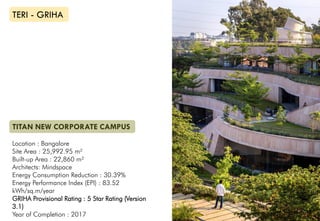
TITAN NEW CORPORATE CAMPUS
Location : Bangalore
Site Area : 25,992.95 m²
Built-up Area : 22,860 m²
Architects: Mindspace
Energy Consumption Reduction : 30.39%
Energy Performance Index (EPI) : 83.52
kWh/sq.m/year
GRIHA Provisional Rating : 5 Star Rating (Version
3.1)
Year of Completion : 2017
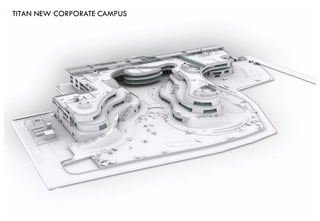
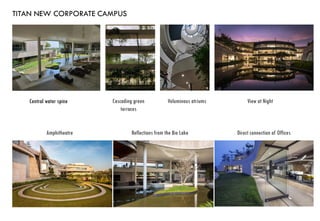
TITAN NEW CORPORATE CAMPUS
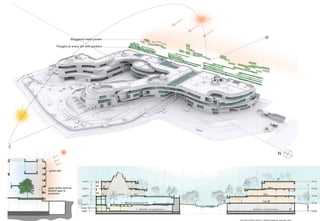
Central water spine Cascading green
terraces
Voluminous atriums View at Night
Amphitheatre Reflections from the Bio Lake Direct connection of Offices
Sustainable Site
Planning
Water
Management
Energy Optimization
& Occupant Comfort
Sustainable
Building Materials
Innovation
BIO LAKE
TERI-
GRIHA
TITAN NEW
CORPORATE
CAMPUS
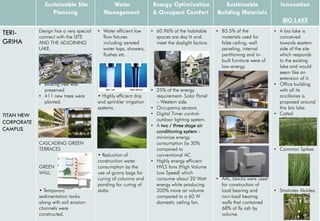
Design has a very special
connect with the SITE
AND THE ADJOINING
LAKE.
• existing tree was
preserved
• 411 new trees were
planted.
CASCADING GREEN
TERRACES
GREEN
WALL
• Temporary
sedimentation tanks
along with soil erosion
channels were
constructed.
• Water efficient low
flow fixtures
including aerated
water taps, showers,
flushes etc.
• Highly efficient drip
and sprinkler irrigation
systems.
• Reduction of
construction water
consumption by the
use of gunny bags for
curing of columns and
ponding for curing of
slabs.
• 60.96% of the habitable
spaces are day lit and
meet the daylight factors.
• 25% of the energy
requirement- Solar Panel
– Western side.
• Occupancy sensors.
• Digital Timer control-
outdoor lighting system.
• A two / three stage air
conditioning system -
minimize energy
consumption by 30%
compared to
conventional AC.
• Highly energy efficient
HVLS fans (High Volume
Low Speed) which
consume about 20 Watt
energy while producing
200% more air volume
compared to a 60 W
domestic ceiling fan.
• 83.5% of the
materials used for
false ceiling, wall
paneling, internal
partitioning and in-
built furniture were of
low-energy.
• AAC blocks were used
for construction of
load bearing and
non-load bearing
walls that contained
68% of fly ash by
volume.
• A bio lake is
conceived
towards eastern
side of the site
which responds
to the existing
lake and would
seem like an
extension of it.
• Office building
with all its
ancillaries is
proposed around
this bio lake.
• Cattail
• Common Spikes
• Stratiotes Aloides.
TERI - GRIHA
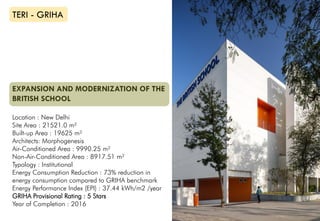
EXPANSION AND MODERNIZATION OF THE
BRITISH SCHOOL
Location : New Delhi
Site Area : 21521.0 m²
Built-up Area : 19625 m²
Architects: Morphogenesis
Air-Conditioned Area : 9990.25 m²
Non-Air-Conditioned Area : 8917.51 m²
Typology : Institutional
Energy Consumption Reduction : 73% reduction in
energy consumption compared to GRIHA benchmark
Energy Performance Index (EPI) : 37.44 kWh/m2 /year
GRIHA Provisional Rating : 5 Stars
Year of Completion : 2016
THE BRITISH SCHOOL
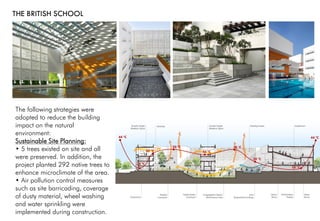
The following strategies were
adopted to reduce the building
impact on the natural
environment:
Sustainable Site Planning:
• 5 trees existed on site and all
were preserved. In addition, the
project planted 292 native trees to
enhance microclimate of the area.
• Air pollution control measures
such as site barricading, coverage
of dusty material, wheel washing
and water sprinkling were
implemented during construction.
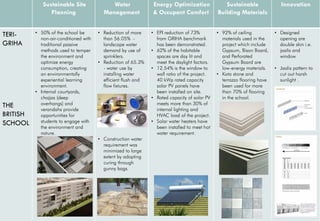
Sustainable Site
Planning
Water
Management
Energy Optimization
& Occupant Comfort
Sustainable
Building Materials
Innovation
TERI-
GRIHA
THE
BRITISH
SCHOOL
• 50% of the school be
non-air-conditioned with
traditional passive
methods used to temper
the environment and
optimize energy
consumption, creating
an environmentally
experiential learning
environment.
• Internal courtyards,
chajjas (deep
overhangs) and
verandahs provide
opportunities for
students to engage with
the environment and
nature.
• Reduction of more
than 56.05% -
landscape water
demand by use of
sprinklers.
• Reduction of 65.3%
- water use by
installing water
efficient flush and
flow fixtures.
• Construction water
requirement was
minimized to large
extent by adopting
curing through
gunny bags.
• EPI reduction of 73%
from GRIHA benchmark
has been demonstrated.
• 62% of the habitable
spaces are day lit and
meet the daylight factors.
• 12.54% is the window to
wall ratio of the project.
40 kWp rated capacity
solar PV panels have
been installed on site.
• Rated capacity of solar PV
meets more than 30% of
internal lighting and
HVAC load of the project.
• Solar water heaters have
been installed to meet hot
water requirement.
• 92% of ceiling
materials used in the
project which include
Gypsum, Bison Board,
and Perforated
Gypsum Board are
low-energy materials.
• Kota stone and
terrazzo flooring have
been used for more
than 70% of flooring
in the school.
• Designed
opening are
double skin i.e.
jaalis and
window.
• Jaalis pattern to
cut out harsh
sunlight .
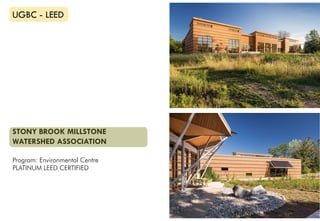
STONY BROOK MILLSTONE
WATERSHED ASSOCIATION
Program: Environmental Centre
PLATINUM LEED CERTIFIED
UGBC - LEED
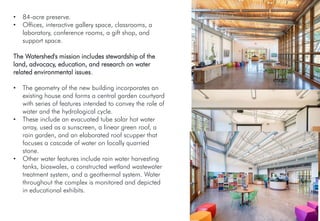
• 84-acre preserve.
• Offices, interactive gallery space, classrooms, a
laboratory, conference rooms, a gift shop, and
support space.
The Watershed's mission includes stewardship of the
land, advocacy, education, and research on water
related environmental issues.
• The geometry of the new building incorporates an
existing house and forms a central garden courtyard
with series of features intended to convey the role of
water and the hydrological cycle.
• These include an evacuated tube solar hot water
array, used as a sunscreen, a linear green roof, a
rain garden, and an elaborated roof scupper that
focuses a cascade of water on locally quarried
stone.
• Other water features include rain water harvesting
tanks, bioswales, a constructed wetland wastewater
treatment system, and a geothermal system. Water
throughout the complex is monitored and depicted
in educational exhibits.
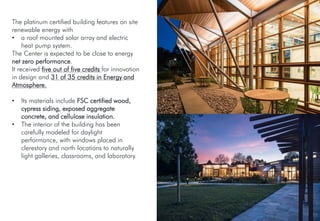
The platinum certified building features on site
renewable energy with
• a roof mounted solar array and electric
heat pump system.
The Center is expected to be close to energy
net zero performance.
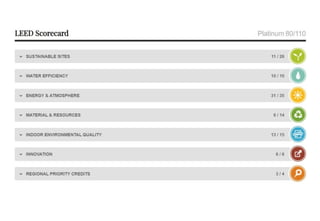
It received five out of five credits for innovation
in design and 31 of 35 credits in Energy and
Atmosphere.
• Its materials include FSC certified wood,
cypress siding, exposed aggregate
concrete, and cellulose insulation.
• The interior of the building has been
carefully modeled for daylight
performance, with windows placed in
clerestory and north locations to naturally
light galleries, classrooms, and laboratory.
Sustainable Site
Planning
Water
Management
Energy Optimization
& Occupant Comfort
Sustainable
Building Materials
Innovation
UGBC -
LEED
STONY
BROOK
MILLSTONE
WATERSHED
ASSOCIATION
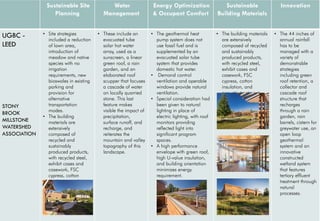
• Site strategies
included a reduction
of lawn area,
introduction of
meadow and native
species with no
irrigation
requirements, new
bioswales in existing
parking and
provision for
alternative
transportation
modes.
• The building
materials are
extensively
composed of
recycled and
sustainably
produced products,
with recycled steel,
exhibit cases and
casework, FSC
cypress, cotton
insulation, and
acoustic treatment.
• These include an
evacuated tube
solar hot water
array, used as a
sunscreen, a linear
green roof, a rain
garden, and an
elaborated roof
scupper that focuses
a cascade of water
on locally quarried
stone. This last
feature makes
visible the impact of
precipitation,
surface runoff, and
recharge, and
reiterates the
mountain and valley
topography of this
landscape.
• The geothermal heat
pump system does not
use fossil fuel and is
supplemented by an
evacuated solar tube
system that provides
domestic hot water.
• Demand control
ventilation and operable
windows provide natural
ventilation.
• Special consideration had
been given to natural
lighting in place of
electric lighting, with roof
monitors providing
reflected light into
significant program
spaces.
• A high performance
envelope with green roof,
high U-value insulation,
and building orientation
minimizes energy
requirement.
• The building materials
are extensively
composed of recycled
and sustainably
produced products,
with recycled steel,
exhibit cases and
casework, FSC
cypress, cotton
insulation, and
acoustic treatment.
• The 44 inches of
annual rainfall
has to be
managed with a
variety of
demonstrable
strategies
including green
roof retention, a
collector and
cascade roof
structure that
recharges
through a rain
garden, rain
barrels, cistern for
greywater use, an
open loop
geothermal
system and an
innovative
constructed
wetland system
that features
tertiary effluent
treatment through
natural
processes.
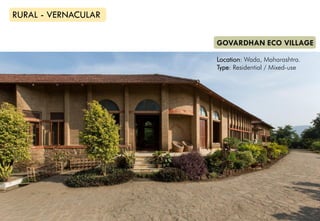
GOVARDHAN ECO VILLAGE
Location: Wada, Maharashtra.
Type: Residential / Mixed-use
RURAL - VERNACULAR
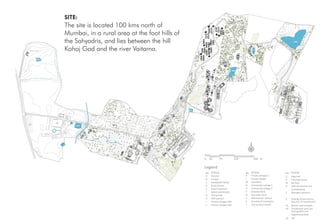
SITE:
The site is located 100 kms north of
Mumbai, in a rural area at the foot hills of
the Sahyadris, and lies between the hill
Kohoj Gad and the river Vaitarna.
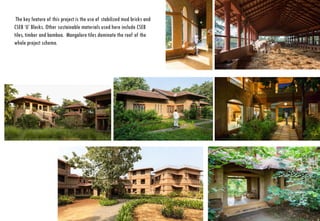
The key feature of this project is the use of stabilized mud bricks and
CSEB ‘U’ Blocks. Other sustainable materials used here include CSEB
tiles, timber and bamboo. Mangalore tiles dominate the roof of the
whole project scheme.
Water
Management
Sustainable Building
Materials
Innovation
RURAL-
VERNACULAR
GOVARDHAN
ECO VILLAGE
• Hydrogeological study provided
us with clear recharge and
discharge zones suggesting the
extraction pattern with respect to
quantity available. This was the
basis for the overall site planning
with respect to buildings, services
and roads.
• With on-site treatment of waste
water, nutrient rich water is now
available throughout the year and
food is grown even in summer
months.
• As the location was far from
manufacturing base the site was
mapped for availability of earth
for making of buildings and
through expert skill transfer the
future constructions are
possible.
• The ponds and water bodies
were made in the areas where
soil was suitable for earth
construction.
• The key feature of this project is
the use of stabilized mud bricks
and CSEB ‘U’ Blocks. Other
sustainable materials used here
include CSEB tiles, timber and
bamboo. Mangalore tiles
dominate the roof of the whole
project scheme.
• Various approaches to
use of earth as
construction material has
been tried here and
different techniques are
employed depending
upon the use of the space
and the skill of the
builder.
• Through introduction of
precast construction, U-
Block lintels, and
standardization of
building elements like
arches and windows
speeded the construction
process thereby reducing
the of construction.
• The first phase was built
using skilled masons from
Bangalore. In the
subsequent phases, the
local mason’s picked up
the skills of using
alternate technologies
and are now working on
projects outside of GEV,
using these technologies.
BY: MITIKSHA JAIN Guided By:
Cheitali Shroff

Green Architecture.pdf

  • 1.
    CASE STUDIES (TERI &UGBC) 9th Semester Subject: Green Architecture Bhagwan Mahavir College of Architecture
  • 2.
    TERI - GRIHA TITANNEW CORPORATE CAMPUS Location : Bangalore Site Area : 25,992.95 m² Built-up Area : 22,860 m² Architects: Mindspace Energy Consumption Reduction : 30.39% Energy Performance Index (EPI) : 83.52 kWh/sq.m/year GRIHA Provisional Rating : 5 Star Rating (Version 3.1) Year of Completion : 2017
  • 3.
  • 5.
    TITAN NEW CORPORATECAMPUS Central water spine Cascading green terraces Voluminous atriums View at Night Amphitheatre Reflections from the Bio Lake Direct connection of Offices
  • 6.
    Sustainable Site Planning Water Management Energy Optimization &Occupant Comfort Sustainable Building Materials Innovation BIO LAKE TERI- GRIHA TITAN NEW CORPORATE CAMPUS Design has a very special connect with the SITE AND THE ADJOINING LAKE. • existing tree was preserved • 411 new trees were planted. CASCADING GREEN TERRACES GREEN WALL • Temporary sedimentation tanks along with soil erosion channels were constructed. • Water efficient low flow fixtures including aerated water taps, showers, flushes etc. • Highly efficient drip and sprinkler irrigation systems. • Reduction of construction water consumption by the use of gunny bags for curing of columns and ponding for curing of slabs. • 60.96% of the habitable spaces are day lit and meet the daylight factors. • 25% of the energy requirement- Solar Panel – Western side. • Occupancy sensors. • Digital Timer control- outdoor lighting system. • A two / three stage air conditioning system - minimize energy consumption by 30% compared to conventional AC. • Highly energy efficient HVLS fans (High Volume Low Speed) which consume about 20 Watt energy while producing 200% more air volume compared to a 60 W domestic ceiling fan. • 83.5% of the materials used for false ceiling, wall paneling, internal partitioning and in- built furniture were of low-energy. • AAC blocks were used for construction of load bearing and non-load bearing walls that contained 68% of fly ash by volume. • A bio lake is conceived towards eastern side of the site which responds to the existing lake and would seem like an extension of it. • Office building with all its ancillaries is proposed around this bio lake. • Cattail • Common Spikes • Stratiotes Aloides.
  • 7.
    TERI - GRIHA EXPANSIONAND MODERNIZATION OF THE BRITISH SCHOOL Location : New Delhi Site Area : 21521.0 m² Built-up Area : 19625 m² Architects: Morphogenesis Air-Conditioned Area : 9990.25 m² Non-Air-Conditioned Area : 8917.51 m² Typology : Institutional Energy Consumption Reduction : 73% reduction in energy consumption compared to GRIHA benchmark Energy Performance Index (EPI) : 37.44 kWh/m2 /year GRIHA Provisional Rating : 5 Stars Year of Completion : 2016
  • 8.
    THE BRITISH SCHOOL Thefollowing strategies were adopted to reduce the building impact on the natural environment: Sustainable Site Planning: • 5 trees existed on site and all were preserved. In addition, the project planted 292 native trees to enhance microclimate of the area. • Air pollution control measures such as site barricading, coverage of dusty material, wheel washing and water sprinkling were implemented during construction.
  • 9.
    Sustainable Site Planning Water Management Energy Optimization &Occupant Comfort Sustainable Building Materials Innovation TERI- GRIHA THE BRITISH SCHOOL • 50% of the school be non-air-conditioned with traditional passive methods used to temper the environment and optimize energy consumption, creating an environmentally experiential learning environment. • Internal courtyards, chajjas (deep overhangs) and verandahs provide opportunities for students to engage with the environment and nature. • Reduction of more than 56.05% - landscape water demand by use of sprinklers. • Reduction of 65.3% - water use by installing water efficient flush and flow fixtures. • Construction water requirement was minimized to large extent by adopting curing through gunny bags. • EPI reduction of 73% from GRIHA benchmark has been demonstrated. • 62% of the habitable spaces are day lit and meet the daylight factors. • 12.54% is the window to wall ratio of the project. 40 kWp rated capacity solar PV panels have been installed on site. • Rated capacity of solar PV meets more than 30% of internal lighting and HVAC load of the project. • Solar water heaters have been installed to meet hot water requirement. • 92% of ceiling materials used in the project which include Gypsum, Bison Board, and Perforated Gypsum Board are low-energy materials. • Kota stone and terrazzo flooring have been used for more than 70% of flooring in the school. • Designed opening are double skin i.e. jaalis and window. • Jaalis pattern to cut out harsh sunlight .
  • 10.
    STONY BROOK MILLSTONE WATERSHEDASSOCIATION Program: Environmental Centre PLATINUM LEED CERTIFIED UGBC - LEED
  • 11.
    • 84-acre preserve. •Offices, interactive gallery space, classrooms, a laboratory, conference rooms, a gift shop, and support space. The Watershed's mission includes stewardship of the land, advocacy, education, and research on water related environmental issues. • The geometry of the new building incorporates an existing house and forms a central garden courtyard with series of features intended to convey the role of water and the hydrological cycle. • These include an evacuated tube solar hot water array, used as a sunscreen, a linear green roof, a rain garden, and an elaborated roof scupper that focuses a cascade of water on locally quarried stone. • Other water features include rain water harvesting tanks, bioswales, a constructed wetland wastewater treatment system, and a geothermal system. Water throughout the complex is monitored and depicted in educational exhibits.
  • 12.
    The platinum certifiedbuilding features on site renewable energy with • a roof mounted solar array and electric heat pump system. The Center is expected to be close to energy net zero performance. It received five out of five credits for innovation in design and 31 of 35 credits in Energy and Atmosphere. • Its materials include FSC certified wood, cypress siding, exposed aggregate concrete, and cellulose insulation. • The interior of the building has been carefully modeled for daylight performance, with windows placed in clerestory and north locations to naturally light galleries, classrooms, and laboratory.
  • 14.
    Sustainable Site Planning Water Management Energy Optimization &Occupant Comfort Sustainable Building Materials Innovation UGBC - LEED STONY BROOK MILLSTONE WATERSHED ASSOCIATION • Site strategies included a reduction of lawn area, introduction of meadow and native species with no irrigation requirements, new bioswales in existing parking and provision for alternative transportation modes. • The building materials are extensively composed of recycled and sustainably produced products, with recycled steel, exhibit cases and casework, FSC cypress, cotton insulation, and acoustic treatment. • These include an evacuated tube solar hot water array, used as a sunscreen, a linear green roof, a rain garden, and an elaborated roof scupper that focuses a cascade of water on locally quarried stone. This last feature makes visible the impact of precipitation, surface runoff, and recharge, and reiterates the mountain and valley topography of this landscape. • The geothermal heat pump system does not use fossil fuel and is supplemented by an evacuated solar tube system that provides domestic hot water. • Demand control ventilation and operable windows provide natural ventilation. • Special consideration had been given to natural lighting in place of electric lighting, with roof monitors providing reflected light into significant program spaces. • A high performance envelope with green roof, high U-value insulation, and building orientation minimizes energy requirement. • The building materials are extensively composed of recycled and sustainably produced products, with recycled steel, exhibit cases and casework, FSC cypress, cotton insulation, and acoustic treatment. • The 44 inches of annual rainfall has to be managed with a variety of demonstrable strategies including green roof retention, a collector and cascade roof structure that recharges through a rain garden, rain barrels, cistern for greywater use, an open loop geothermal system and an innovative constructed wetland system that features tertiary effluent treatment through natural processes.
  • 15.
    GOVARDHAN ECO VILLAGE Location:Wada, Maharashtra. Type: Residential / Mixed-use RURAL - VERNACULAR
  • 16.
    SITE: The site islocated 100 kms north of Mumbai, in a rural area at the foot hills of the Sahyadris, and lies between the hill Kohoj Gad and the river Vaitarna.
  • 17.
    The key featureof this project is the use of stabilized mud bricks and CSEB ‘U’ Blocks. Other sustainable materials used here include CSEB tiles, timber and bamboo. Mangalore tiles dominate the roof of the whole project scheme.
  • 18.
    Water Management Sustainable Building Materials Innovation RURAL- VERNACULAR GOVARDHAN ECO VILLAGE •Hydrogeological study provided us with clear recharge and discharge zones suggesting the extraction pattern with respect to quantity available. This was the basis for the overall site planning with respect to buildings, services and roads. • With on-site treatment of waste water, nutrient rich water is now available throughout the year and food is grown even in summer months. • As the location was far from manufacturing base the site was mapped for availability of earth for making of buildings and through expert skill transfer the future constructions are possible. • The ponds and water bodies were made in the areas where soil was suitable for earth construction. • The key feature of this project is the use of stabilized mud bricks and CSEB ‘U’ Blocks. Other sustainable materials used here include CSEB tiles, timber and bamboo. Mangalore tiles dominate the roof of the whole project scheme. • Various approaches to use of earth as construction material has been tried here and different techniques are employed depending upon the use of the space and the skill of the builder. • Through introduction of precast construction, U- Block lintels, and standardization of building elements like arches and windows speeded the construction process thereby reducing the of construction. • The first phase was built using skilled masons from Bangalore. In the subsequent phases, the local mason’s picked up the skills of using alternate technologies and are now working on projects outside of GEV, using these technologies.
  • 19.
    BY: MITIKSHA JAINGuided By: Cheitali Shroff