

CASE STUDY ON GREEN
BUILDINGS
THE ENERGY RESEARCH INSTITUTE
BANGALORE
&
BCIL’s TZED HOMES
VINAY M
M.Tech - Building Science & Technology
Dept. Of Civil Engineering
School of Engineering & Technology
Jain University
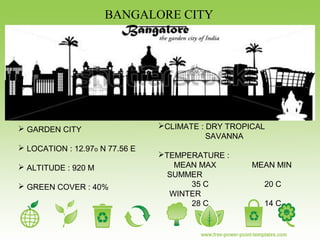
BANGALORE CITY
 GARDEN CITY
 LOCATION : 12.97o N 77.56 E
 ALTITUDE : 920 M
 GREEN COVER : 40%
CLIMATE : DRY TROPICAL
SAVANNA
TEMPERATURE :
MEAN MAX MEAN MIN
SUMMER
35 C 20 C
WINTER
28 C 14 C
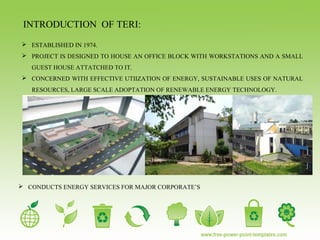
INTRODUCTION OF TERI:
 CONDUCTS ENERGY SERVICES FOR MAJOR CORPORATE’S
 ESTABLISHED IN 1974.
 PROJECT IS DESIGNED TO HOUSE AN OFFICE BLOCK WITH WORKSTATIONS AND A SMALL
GUEST HOUSE ATTATCHED TO IT.
 CONCERNED WITH EFFECTIVE UTIIZATION OF ENERGY, SUSTAINABLE USES OF NATURAL
RESOURCES, LARGE SCALE ADOPTATION OF RENEWABLE ENERGY TECHNOLOGY.
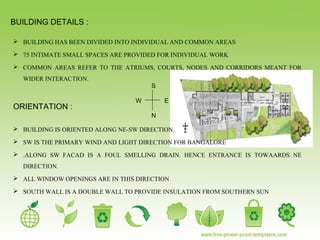
 BUILDING IS ORIENTED ALONG NE-SW DIRECTION.
 SW IS THE PRIMARY WIND AND LIGHT DIRECTION FOR BANGALORE
 .ALONG SW FACAD IS A FOUL SMELLING DRAIN. HENCE ENTRANCE IS TOWAARDS NE
DIRECTION.
 ALL WINDOW OPENINGS ARE IN THIS DIRECTION
 SOUTH WALL IS A DOUBLE WALL TO PROVIDE INSULATION FROM SOUTHERN SUN
ORIENTATION :
BUILDING DETAILS :
 BUILDING HAS BEEN DIVIDED INTO INDIVIDUAL AND COMMON AREAS
 75 INTIMATE SMALL SPACES ARE PROVIDED FOR INDIVIDUAL WORK
 COMMON AREAS REFER TO THE ATRIUMS, COURTS, NODES AND CORRIDORS MEANT FOR
WIDER INTERACTION.
S
W E
N
DESIGN WITH A SUSTAINABLE
CONCEPT
WORKING OF
BUILDING SYSTEM
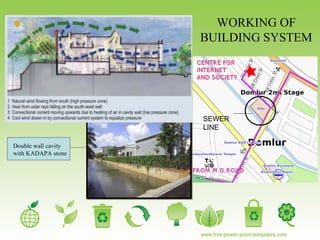
SEWER
LINE
Double wall cavity
with KADAPA stone
GREEN DESIGN TECHNIQUES
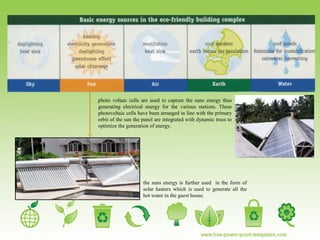
photo voltaic cells are used to capture the suns energy thus
generating electrical energy for the various stations. These
photovoltaic cells have been arranged in line with the primary
orbit of the sun the panel are integrated with dynamic truss to
optimize the generation of energy.
the suns energy is further used in the form of
solar heaters which is used to generate all the
hot water in the guest house.
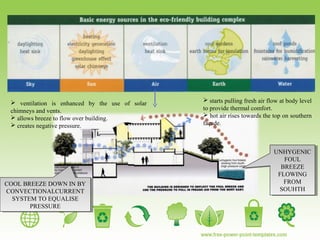
UNHYGENIC
FOUL
BREEZE
FLOWING
FROM
SOUHTH
UNHYGENIC
FOUL
BREEZE
FLOWING
FROM
SOUHTH
COOL BREEZE DOWN IN BY
CONVECTIONALCURRENT
SYSTEM TO EQUALISE
PRESSURE
COOL BREEZE DOWN IN BY
CONVECTIONALCURRENT
SYSTEM TO EQUALISE
PRESSURE
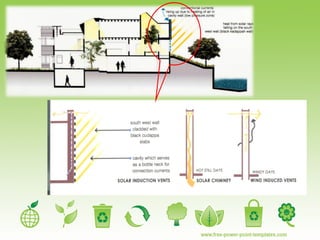
 ventilation is enhanced by the use of solar
chimneys and vents.
 allows breeze to flow over building.
 creates negative pressure.
 starts pulling fresh air flow at body level
to provide thermal comfort.
 hot air rises towards the top on southern
façade.
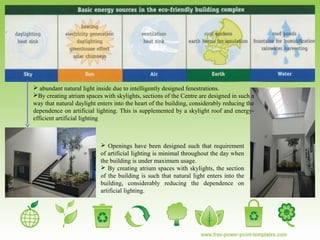
 Openings have been designed such that requirement
of artificial lighting is minimal throughout the day when
the building is under maximum usage.
 By creating atrium spaces with skylights, the section
of the building is such that natural light enters into the
building, considerably reducing the dependence on
artificial lighting.
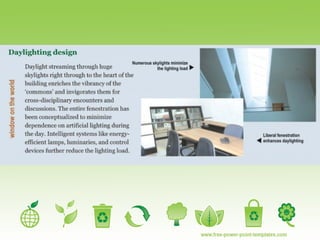
 abundant natural light inside due to intelligently designed fenestrations.
By creating atrium spaces with skylights, sections of the Centre are designed in such a
way that natural daylight enters into the heart of the building, considerably reducing the
dependence on artificial lighting. This is supplemented by a skylight roof and energy-
efficient artificial lighting
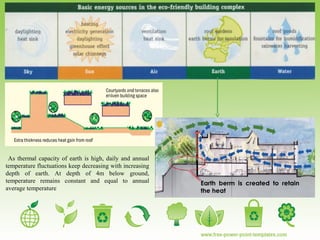
As thermal capacity of earth is high, daily and annual
temperature fluctuations keep decreasing with increasing
depth of earth. At depth of 4m below ground,
temperature remains constant and equal to annual
average temperature
Earth berm is created to retain
the heat
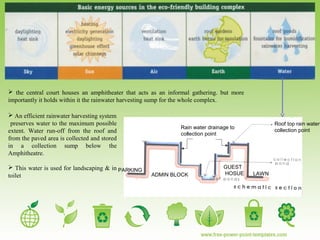
 the central court houses an amphitheater that acts as an informal gathering. but more
importantly it holds within it the rainwater harvesting sump for the whole complex.
Roof top rain water
collection point
Rain water drainage to
collection point
ADMIN BLOCK
GUEST
HOSUE LAWN
PARKING
 An efficient rainwater harvesting system
preserves water to the maximum possible
extent. Water run-off from the roof and
from the paved area is collected and stored
in a collection sump below the
Amphitheatre.
 This water is used for landscaping & in
toilet
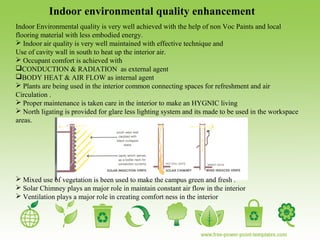
Indoor environmental quality enhancement
Indoor Environmental quality is very well achieved with the help of non Voc Paints and local
flooring material with less embodied energy.
 Indoor air quality is very well maintained with effective technique and
Use of cavity wall in south to heat up the interior air.
 Occupant comfort is achieved with
CONDUCTION & RADIATION as external agent
BODY HEAT & AIR FLOW as internal agent
 Plants are being used in the interior common connecting spaces for refreshment and air
Circulation .
 Proper maintenance is taken care in the interior to make an HYGNIC living
 North ligating is provided for glare less lighting system and its made to be used in the workspace
areas.
 Mixed use of vegetation is been used to make the campus green and fresh .
 Solar Chimney plays an major role in maintain constant air flow in the interior
 Ventilation plays a major role in creating comfort ness in the interior
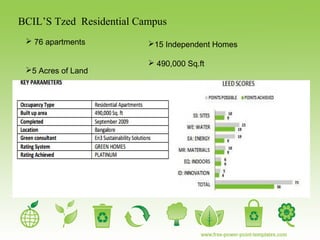
BCIL’S Tzed Residential Campus
 76 apartments
5 Acres of Land
15 Independent Homes
 490,000 Sq.ft
The project has been worked out towards achieving this
collective goal, by addressing the following six main areas.
 Design
 Building material
 Water
 Waste
 Quality of air
 Energy management through innovative interventions
DESIGN :
• The master plan consists in two parallel four-floor buildings containing a
street for pedestrian and vehicles movements along it. The south-facing
buildings are segmented into blocks in order to provide maximum natural
light to the street and homes located in the second row of buildings. These
cavities called “e-zone” are treated as garden for recreation.
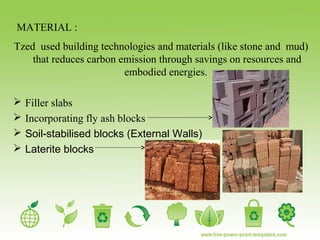
MATERIAL :
Tzed used building technologies and materials (like stone and mud)
that reduces carbon emission through savings on resources and
embodied energies.
 Filler slabs
 Incorporating fly ash blocks
 Soil-stabilised blocks (External Walls)
 Laterite blocks
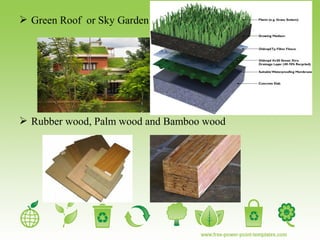
 Green Roof or Sky Garden
 Rubber wood, Palm wood and Bamboo wood
WATER :
 Rain Water Harvesting
 Solar Water Heaters
 Grey Water Recycling
ENERGY:
 Centralized district refrigeration system and air conditioning
system using an ammonia-based chilling unit.
 Intelligent lighting systems blend motion sensors, ambient
light sensors and timers
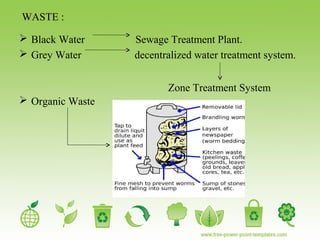
WASTE :
 Black Water Sewage Treatment Plant.
 Grey Water decentralized water treatment system.
 Organic Waste
Zone Treatment System
 TZed is a campus that has no water supply connection from the outside.
 There is no sewerage connection for this campus. All wastewater is treated and
reused for gardens in a way that such water eventually percolates into the open
wells and so completes the loop of use and generation.
 This is India’s first centrally air-conditioned (with no CFC and HCFC) residential
campus.
 The Capital savings of approx 20,000 tonnes of Carbon emissions.
 The Revenue savings of approx 1500 tonnes of Carbon emissions.
 Tzed consumes only 60 per cent of energy demand of a 100 houses anywhere else.
Residents pay 30 % less on power and 20 % less on monthly maintenance.
 Every resident gains Rs. 12,000/- on an annual basis, thanks to carbon credit
savings in T-Zed.
ACHIEVMENTS
 Prestigious Ryutaro Hashimoto Award
 CII conferred a special jury award
 Platinum rating from Indian Green Building Council
(IGBC)
AWARDS
Green Building Case Study on TERI,bangalore.

Green Building Case Study on TERI,bangalore.

  • 1.
    CASE STUDY ONGREEN BUILDINGS THE ENERGY RESEARCH INSTITUTE BANGALORE & BCIL’s TZED HOMES VINAY M M.Tech - Building Science & Technology Dept. Of Civil Engineering School of Engineering & Technology Jain University
  • 2.
    BANGALORE CITY  GARDENCITY  LOCATION : 12.97o N 77.56 E  ALTITUDE : 920 M  GREEN COVER : 40% CLIMATE : DRY TROPICAL SAVANNA TEMPERATURE : MEAN MAX MEAN MIN SUMMER 35 C 20 C WINTER 28 C 14 C
  • 3.
    INTRODUCTION OF TERI: CONDUCTS ENERGY SERVICES FOR MAJOR CORPORATE’S  ESTABLISHED IN 1974.  PROJECT IS DESIGNED TO HOUSE AN OFFICE BLOCK WITH WORKSTATIONS AND A SMALL GUEST HOUSE ATTATCHED TO IT.  CONCERNED WITH EFFECTIVE UTIIZATION OF ENERGY, SUSTAINABLE USES OF NATURAL RESOURCES, LARGE SCALE ADOPTATION OF RENEWABLE ENERGY TECHNOLOGY.
  • 4.
     BUILDING ISORIENTED ALONG NE-SW DIRECTION.  SW IS THE PRIMARY WIND AND LIGHT DIRECTION FOR BANGALORE  .ALONG SW FACAD IS A FOUL SMELLING DRAIN. HENCE ENTRANCE IS TOWAARDS NE DIRECTION.  ALL WINDOW OPENINGS ARE IN THIS DIRECTION  SOUTH WALL IS A DOUBLE WALL TO PROVIDE INSULATION FROM SOUTHERN SUN ORIENTATION : BUILDING DETAILS :  BUILDING HAS BEEN DIVIDED INTO INDIVIDUAL AND COMMON AREAS  75 INTIMATE SMALL SPACES ARE PROVIDED FOR INDIVIDUAL WORK  COMMON AREAS REFER TO THE ATRIUMS, COURTS, NODES AND CORRIDORS MEANT FOR WIDER INTERACTION. S W E N
  • 5.
    DESIGN WITH ASUSTAINABLE CONCEPT
  • 6.
    WORKING OF BUILDING SYSTEM SEWER LINE Doublewall cavity with KADAPA stone
  • 7.
  • 8.
    photo voltaic cellsare used to capture the suns energy thus generating electrical energy for the various stations. These photovoltaic cells have been arranged in line with the primary orbit of the sun the panel are integrated with dynamic truss to optimize the generation of energy. the suns energy is further used in the form of solar heaters which is used to generate all the hot water in the guest house.
  • 9.
    UNHYGENIC FOUL BREEZE FLOWING FROM SOUHTH UNHYGENIC FOUL BREEZE FLOWING FROM SOUHTH COOL BREEZE DOWNIN BY CONVECTIONALCURRENT SYSTEM TO EQUALISE PRESSURE COOL BREEZE DOWN IN BY CONVECTIONALCURRENT SYSTEM TO EQUALISE PRESSURE  ventilation is enhanced by the use of solar chimneys and vents.  allows breeze to flow over building.  creates negative pressure.  starts pulling fresh air flow at body level to provide thermal comfort.  hot air rises towards the top on southern façade.
  • 11.
     Openings havebeen designed such that requirement of artificial lighting is minimal throughout the day when the building is under maximum usage.  By creating atrium spaces with skylights, the section of the building is such that natural light enters into the building, considerably reducing the dependence on artificial lighting.  abundant natural light inside due to intelligently designed fenestrations. By creating atrium spaces with skylights, sections of the Centre are designed in such a way that natural daylight enters into the heart of the building, considerably reducing the dependence on artificial lighting. This is supplemented by a skylight roof and energy- efficient artificial lighting
  • 13.
    As thermal capacityof earth is high, daily and annual temperature fluctuations keep decreasing with increasing depth of earth. At depth of 4m below ground, temperature remains constant and equal to annual average temperature Earth berm is created to retain the heat
  • 14.
     the centralcourt houses an amphitheater that acts as an informal gathering. but more importantly it holds within it the rainwater harvesting sump for the whole complex. Roof top rain water collection point Rain water drainage to collection point ADMIN BLOCK GUEST HOSUE LAWN PARKING  An efficient rainwater harvesting system preserves water to the maximum possible extent. Water run-off from the roof and from the paved area is collected and stored in a collection sump below the Amphitheatre.  This water is used for landscaping & in toilet
  • 15.
    Indoor environmental qualityenhancement Indoor Environmental quality is very well achieved with the help of non Voc Paints and local flooring material with less embodied energy.  Indoor air quality is very well maintained with effective technique and Use of cavity wall in south to heat up the interior air.  Occupant comfort is achieved with CONDUCTION & RADIATION as external agent BODY HEAT & AIR FLOW as internal agent  Plants are being used in the interior common connecting spaces for refreshment and air Circulation .  Proper maintenance is taken care in the interior to make an HYGNIC living  North ligating is provided for glare less lighting system and its made to be used in the workspace areas.  Mixed use of vegetation is been used to make the campus green and fresh .  Solar Chimney plays an major role in maintain constant air flow in the interior  Ventilation plays a major role in creating comfort ness in the interior
  • 16.
    BCIL’S Tzed ResidentialCampus  76 apartments 5 Acres of Land 15 Independent Homes  490,000 Sq.ft
  • 17.
    The project hasbeen worked out towards achieving this collective goal, by addressing the following six main areas.  Design  Building material  Water  Waste  Quality of air  Energy management through innovative interventions
  • 18.
    DESIGN : • Themaster plan consists in two parallel four-floor buildings containing a street for pedestrian and vehicles movements along it. The south-facing buildings are segmented into blocks in order to provide maximum natural light to the street and homes located in the second row of buildings. These cavities called “e-zone” are treated as garden for recreation.
  • 19.
    MATERIAL : Tzed usedbuilding technologies and materials (like stone and mud) that reduces carbon emission through savings on resources and embodied energies.  Filler slabs  Incorporating fly ash blocks  Soil-stabilised blocks (External Walls)  Laterite blocks
  • 20.
     Green Roofor Sky Garden  Rubber wood, Palm wood and Bamboo wood
  • 21.
    WATER :  RainWater Harvesting  Solar Water Heaters  Grey Water Recycling ENERGY:  Centralized district refrigeration system and air conditioning system using an ammonia-based chilling unit.  Intelligent lighting systems blend motion sensors, ambient light sensors and timers
  • 22.
    WASTE :  BlackWater Sewage Treatment Plant.  Grey Water decentralized water treatment system.  Organic Waste Zone Treatment System
  • 23.
     TZed isa campus that has no water supply connection from the outside.  There is no sewerage connection for this campus. All wastewater is treated and reused for gardens in a way that such water eventually percolates into the open wells and so completes the loop of use and generation.  This is India’s first centrally air-conditioned (with no CFC and HCFC) residential campus.  The Capital savings of approx 20,000 tonnes of Carbon emissions.  The Revenue savings of approx 1500 tonnes of Carbon emissions.  Tzed consumes only 60 per cent of energy demand of a 100 houses anywhere else. Residents pay 30 % less on power and 20 % less on monthly maintenance.  Every resident gains Rs. 12,000/- on an annual basis, thanks to carbon credit savings in T-Zed. ACHIEVMENTS
  • 24.
     Prestigious RyutaroHashimoto Award  CII conferred a special jury award  Platinum rating from Indian Green Building Council (IGBC) AWARDS