INDIRA
PARAYAVARAN
BHAWAN,
NEW DELHI
SUBMITTED BY :
AKSHITA GARG
18/AR/003
GREEN ARCHITECTURE
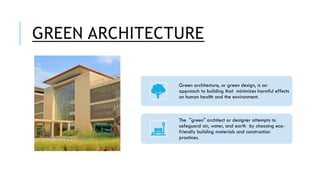
Green architecture, or green design, is an
approach to building that minimizes harmful effects
on human health and the environment.
The "green" architect or designer attempts to
safeguard air, water, and earth by choosing eco-
friendly building materials and construction
practices.
PRINCIPLES OF
GREEN BUILDING
• The green building design process begins
with an intimate understanding of the site in
all its beauties and complexities. Designers
can create features in their buildings that
mimic the functions of particular eco-
systems. Creating new habitat on structures
in urbanized areas is especially important
to support bio-diversity and a healthy
ecosystem.
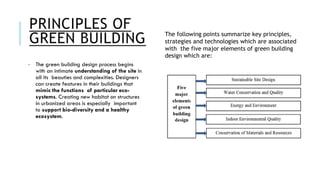
The following points summarize key principles,
strategies and technologies which are associated
with the five major elements of green building
design which are:
INDIRA PARYAVARAN
BHAWAN, NEW DELHI
➢ Project of ministry of environment and forests for construction of new
office building at New Delhi.
➢The basic design concept of the project is to make the net zero energy
green building.
➢PLOT AREA : 9565sq m
➢MAXIMUM GROUND COVERAGE : 30%
➢F.A.R : 200
➢HEIGHT : 35m
➢Built-up area : 3,1400 m2(18726 m2 – superstructure & 12675 m2- Basement)
➢Year of completion : 2013
➢India’s first net zero building
➢This means that this is a building with zero net energy consumption where
the total amount of energy used in the premises on an annual basis is
more or less equal to the amount of renewable energy created on the site.
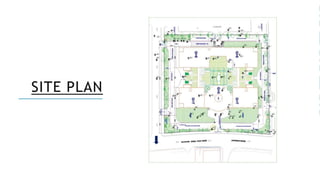
SITE PLAN
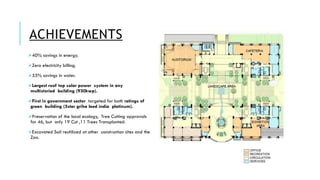
ACHIEVEMENTS
➢40% savings in energy.
➢Zero electricity billing.
➢55% savings in water.
➢Largest roof top solar power system in any
multistoried building (930kwp).
➢First in government sector targeted for both ratings of
green building (5star griha leed india platinum).
➢Preservation of the local ecology, Tree Cutting approvals
for 46, but only 19 Cut ,11 Trees Transplanted.
➢Excavated Soil reutilized at other construction sites and the
Zoo.
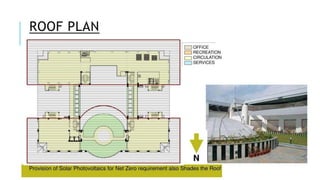
ROOF PLAN
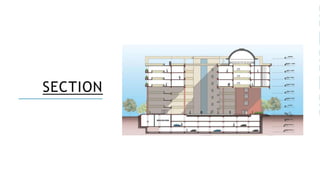
SECTION
ARCHITECTURAL
DESIGN
STRATEGIES
➢Building form wrapped around a pedestrian-friendly shaded green
open courtyard.
➢A continuous green axis from front of site across the atrium.
➢Eco park within the courtyard shall contain a self sustaining low.
➢Large openings in building form on South and North sides.
➢Conservation of natural soil and trees.
➢Orientation of building has been planned reduce ingress of solar
radiation.
➢Large openings North and South faces.
➢Green areas have been developed on smaller terraces.
➢Shaded landscape areas to reduce ambient temperature.
➢Provision of barrier free access .
➢Surrounding open area parking free by providing adequate parking in
the basement.
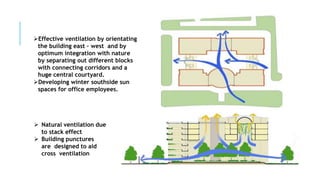
➢Effective ventilation by orientating
the building east – west and by
optimum integration with nature
by separating out different blocks
with connecting corridors and a
huge central courtyard.
➢Developing winter southside sun
spaces for office employees.
➢ Natural ventilation due
to stack effect
➢ Building punctures
are designed to aid
cross ventilation
•More than 50% area outside the building issoft
with plantation and grassing.
circulation roads and pathways
soft with grass paverblocks
to enable ground water recharge
BUILDING
PLANNING AND
CONSTRUCTION
MEASURES
Reduce landscape water requirement-
•Drip irrigation
•Use of native species of shrubs and trees having low water demand in landscaping
•Low lawn area so as to reduce water demand.
•Reuse of treated water for irrigation
Reduce water use in the building-
55% reduction in overall use of water. This was achieved by using:
•Low discharge fixtures
•Dual Flushing cistern
•Waste water treatment
•Reuse of treated water for irrigation and cooling towers for HVAC
•Rain water harvesting
Efficient water use during construction-
•Use of curing compound
SITE AND WATER
MANAGEMENT STRATEGIES
APPROPRIATE SHADING
FROM SUMMER SUN, WHILE
ALLOWING IN WINTER SUN
ENERGY
CONSERVATION
MEASURES
MATERIALS
➢Stone available in nearby area for flooring.
➢Terrazzo flooring with locally available stone materials.
➢Jute bamboo composite for door frames & shutters.
➢UPVC windows with hermetically sealed double using.
➢low heat transmittance index glass.
➢Use of high reflectance terrace tiles for low heat ingress.
➢Avoided aluminum as it has high embedded energy.
➢Sandstone Jalis.
➢Stone and Ferrocement Jalis.
➢FALG (Fly Ash Lime Gypsum) bricks and AAC blocks are
used in the construction. Instead of clay bricks.
➢High Efficiency Glass, high VLT, low SHGC & Low U-value.
GREEN BUILDING.pdf

GREEN BUILDING.pdf

  • 1.
  • 2.
    GREEN ARCHITECTURE Green architecture,or green design, is an approach to building that minimizes harmful effects on human health and the environment. The "green" architect or designer attempts to safeguard air, water, and earth by choosing eco- friendly building materials and construction practices.
  • 3.
    PRINCIPLES OF GREEN BUILDING •The green building design process begins with an intimate understanding of the site in all its beauties and complexities. Designers can create features in their buildings that mimic the functions of particular eco- systems. Creating new habitat on structures in urbanized areas is especially important to support bio-diversity and a healthy ecosystem. The following points summarize key principles, strategies and technologies which are associated with the five major elements of green building design which are:
  • 4.
    INDIRA PARYAVARAN BHAWAN, NEWDELHI ➢ Project of ministry of environment and forests for construction of new office building at New Delhi. ➢The basic design concept of the project is to make the net zero energy green building. ➢PLOT AREA : 9565sq m ➢MAXIMUM GROUND COVERAGE : 30% ➢F.A.R : 200 ➢HEIGHT : 35m ➢Built-up area : 3,1400 m2(18726 m2 – superstructure & 12675 m2- Basement) ➢Year of completion : 2013 ➢India’s first net zero building ➢This means that this is a building with zero net energy consumption where the total amount of energy used in the premises on an annual basis is more or less equal to the amount of renewable energy created on the site.
  • 5.
  • 6.
    ACHIEVEMENTS ➢40% savings inenergy. ➢Zero electricity billing. ➢55% savings in water. ➢Largest roof top solar power system in any multistoried building (930kwp). ➢First in government sector targeted for both ratings of green building (5star griha leed india platinum). ➢Preservation of the local ecology, Tree Cutting approvals for 46, but only 19 Cut ,11 Trees Transplanted. ➢Excavated Soil reutilized at other construction sites and the Zoo.
  • 8.
  • 9.
  • 10.
    ARCHITECTURAL DESIGN STRATEGIES ➢Building form wrappedaround a pedestrian-friendly shaded green open courtyard. ➢A continuous green axis from front of site across the atrium. ➢Eco park within the courtyard shall contain a self sustaining low. ➢Large openings in building form on South and North sides. ➢Conservation of natural soil and trees. ➢Orientation of building has been planned reduce ingress of solar radiation. ➢Large openings North and South faces. ➢Green areas have been developed on smaller terraces. ➢Shaded landscape areas to reduce ambient temperature. ➢Provision of barrier free access . ➢Surrounding open area parking free by providing adequate parking in the basement.
  • 11.
    ➢Effective ventilation byorientating the building east – west and by optimum integration with nature by separating out different blocks with connecting corridors and a huge central courtyard. ➢Developing winter southside sun spaces for office employees. ➢ Natural ventilation due to stack effect ➢ Building punctures are designed to aid cross ventilation
  • 12.
    •More than 50%area outside the building issoft with plantation and grassing. circulation roads and pathways soft with grass paverblocks to enable ground water recharge
  • 13.
    BUILDING PLANNING AND CONSTRUCTION MEASURES Reduce landscapewater requirement- •Drip irrigation •Use of native species of shrubs and trees having low water demand in landscaping •Low lawn area so as to reduce water demand. •Reuse of treated water for irrigation Reduce water use in the building- 55% reduction in overall use of water. This was achieved by using: •Low discharge fixtures •Dual Flushing cistern •Waste water treatment •Reuse of treated water for irrigation and cooling towers for HVAC •Rain water harvesting Efficient water use during construction- •Use of curing compound
  • 14.
    SITE AND WATER MANAGEMENTSTRATEGIES APPROPRIATE SHADING FROM SUMMER SUN, WHILE ALLOWING IN WINTER SUN
  • 15.
  • 16.
    MATERIALS ➢Stone available innearby area for flooring. ➢Terrazzo flooring with locally available stone materials. ➢Jute bamboo composite for door frames & shutters. ➢UPVC windows with hermetically sealed double using. ➢low heat transmittance index glass. ➢Use of high reflectance terrace tiles for low heat ingress. ➢Avoided aluminum as it has high embedded energy. ➢Sandstone Jalis. ➢Stone and Ferrocement Jalis. ➢FALG (Fly Ash Lime Gypsum) bricks and AAC blocks are used in the construction. Instead of clay bricks. ➢High Efficiency Glass, high VLT, low SHGC & Low U-value.