CASE STUDIED
SUSTAINABLE AND GREEN ARCHITECTURE
Resource Person: MAAM ARSALA HASMI
Semester: SUMMER 2023​
Program: B.Arch.
Course Title: SUSTAINABLE AND GREEN ARCHITECTURE
GROUP MEMBERS
AQIN IMRAN
ABDULLAH TARIQ
MOHAMMAD ALI
MARIYAM TARIQ
AHMAD WALEED
AYESHA
INTERNATIONAL CASE STUDY
LINKAGE
The design of individual
buildings, which are
conceived primarily in
terms of the design
parameters of
artificially Controlled
environments.
ARCHITECTURE:
SUSTAINABILITY:
GREEN ARCHITECTURE :
Sustainability consists of fulfilling the needs of
current generations without compromising the
needs of future generations, while ensuring a
balance between economic growth,
environmental care and social well-being
Green building refers to both a structure
and the application of processes that are
environmentally responsible and
resource-efficient throughout a building's
life-cycle: from planning to design,
construction, operation, maintenance,
renovation, and demolition.
 Sustainability was the back bone of the entire design concept and it was communicated to the architect that the
building should incorporate all possible elements of Passive Solar Architecture and Low Energy Cooling systems"
says Mili Majumdar.
✔ The linear geometry of the site with a narrow frontage and an aspect ratio of almost 1:3
dictated the strong linear axis in the design.
✔ The logical sequence of positioning the three distinct functioning zones in a hierarchy of public
access to restricted entry formed the other key consideration in design development.
✔ Placing the commercial block at the front was the most logical choice in exploiting the
commercial potential of the frontage of the site
.
✔ The functional core also coincides with the geometric central part of the linear site. The
residential zone comes up from the rear forming the last zone in the linear sequence.
✔ That the design responds to orientation and climatic factors, is but an obvious fact.
✔ The north line is at a slight angle to the linear axis of the site and the design takes full
advantage of this orientation in the composition of the built and open spaces and in creating
wind flows through the complex as also lighting and shading of the spaces.
 GEOMETRY / SHAPE
❑ SITE AND DESIGN
 The Sun, Sky, Air, Water and Earth shape the nature
of architecture which emerges on this site.
 The process of continuous dialogue between the
architect and TERI and the engagement of TERI in
the design process augmented the thrust on climate
responsive design in a large way.
Open drain on the southern edge of TERI Bangalore
Natural Features Positives and Negatives:
The drain on the southern side is a major feature
which influences the design.
Wind coming from the south over the drain brings in
the foul smell into the site.
 ELEMENTS OF DESIGN
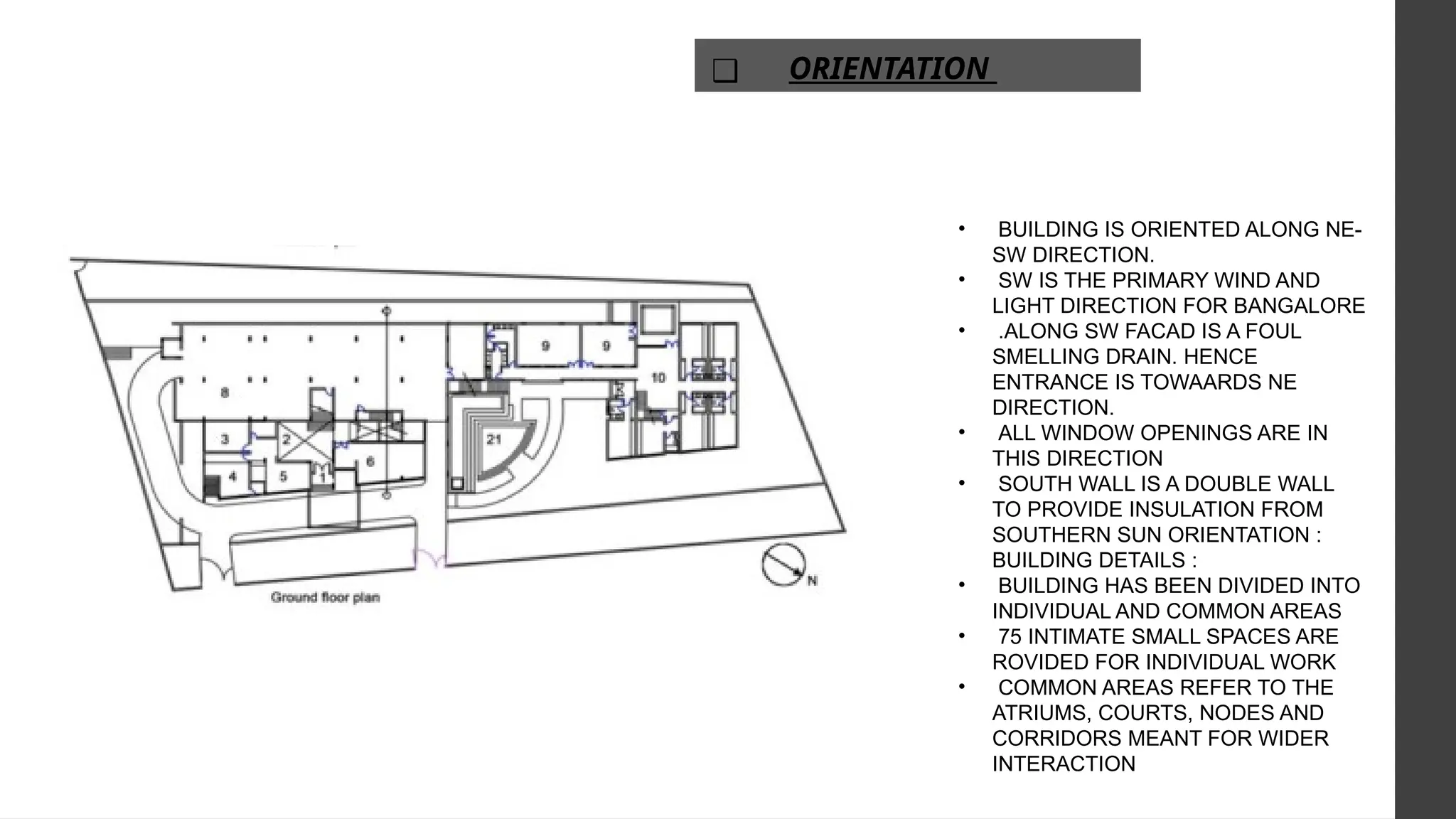
❑ ORIENTATION
• BUILDING IS ORIENTED ALONG NE-
SW DIRECTION.
• SW IS THE PRIMARY WIND AND
LIGHT DIRECTION FOR BANGALORE
• .ALONG SW FACAD IS A FOUL
SMELLING DRAIN. HENCE
ENTRANCE IS TOWAARDS NE
DIRECTION.
• ALL WINDOW OPENINGS ARE IN
THIS DIRECTION
• SOUTH WALL IS A DOUBLE WALL
TO PROVIDE INSULATION FROM
SOUTHERN SUN ORIENTATION :
BUILDING DETAILS :
• BUILDING HAS BEEN DIVIDED INTO
INDIVIDUAL AND COMMON AREAS
• 75 INTIMATE SMALL SPACES ARE
ROVIDED FOR INDIVIDUAL WORK
• COMMON AREAS REFER TO THE
ATRIUMS, COURTS, NODES AND
CORRIDORS MEANT FOR WIDER
INTERACTION
❑ ORIENTATION
❑ HEAT GAIN
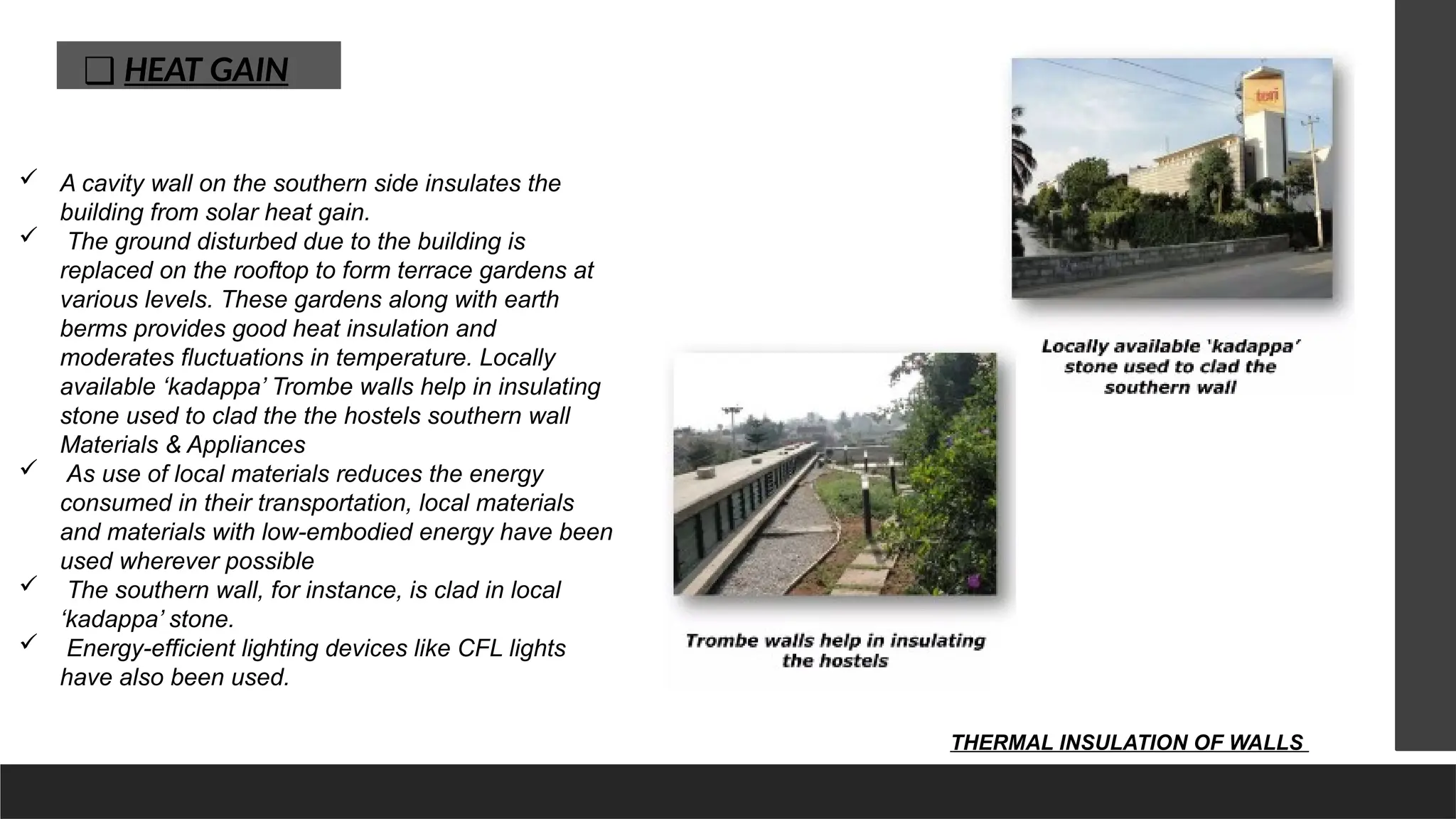
 A cavity wall on the southern side insulates the
building from solar heat gain.
 The ground disturbed due to the building is
replaced on the rooftop to form terrace gardens at
various levels. These gardens along with earth
berms provides good heat insulation and
moderates fluctuations in temperature. Locally
available ‘kadappa’ Trombe walls help in insulating
stone used to clad the the hostels southern wall
Materials & Appliances
 As use of local materials reduces the energy
consumed in their transportation, local materials
and materials with low-embodied energy have been
used wherever possible
 The southern wall, for instance, is clad in local
‘kadappa’ stone.
 Energy-efficient lighting devices like CFL lights
have also been used.
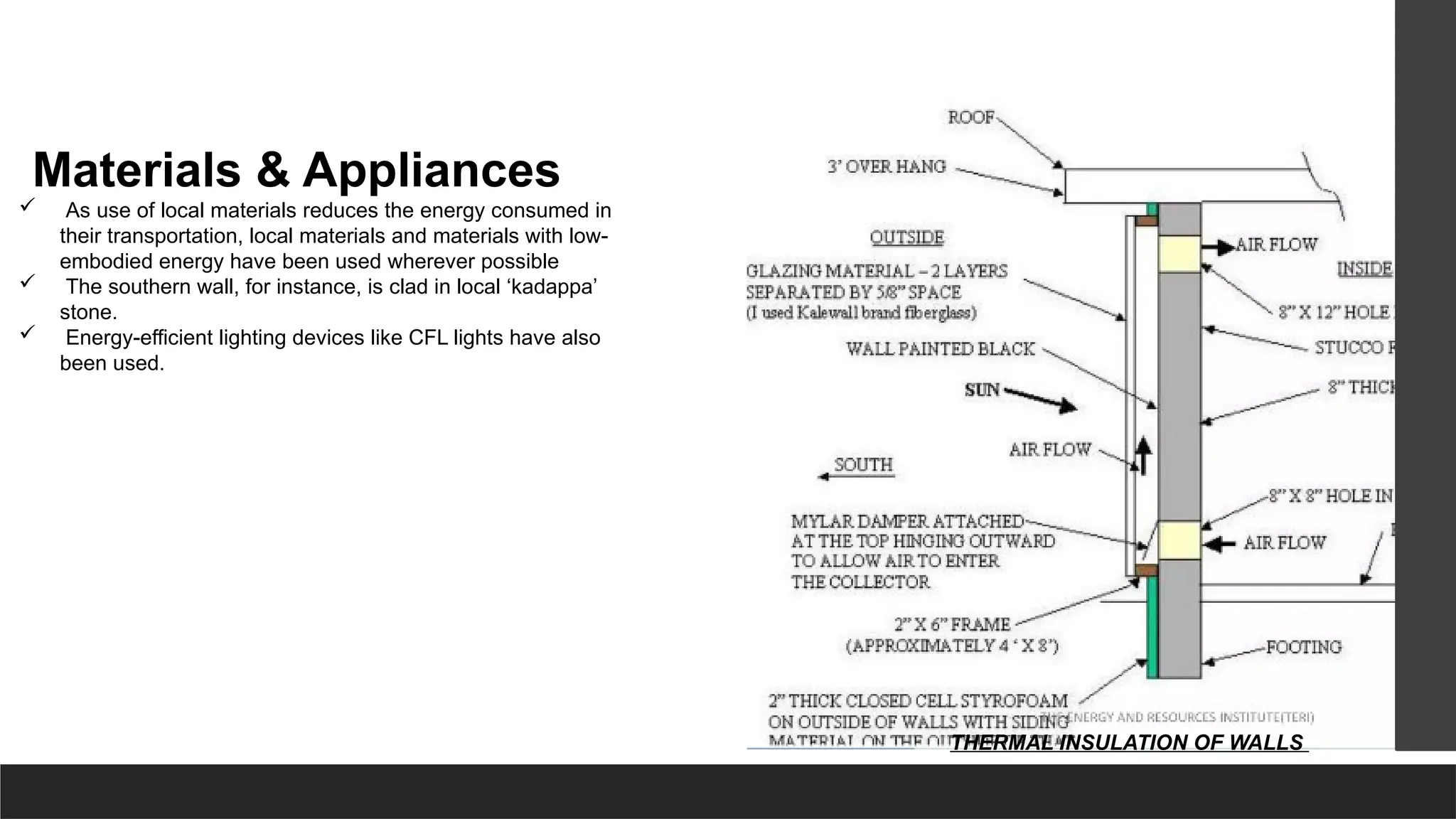
THERMAL INSULATION OF WALLS
Materials & Appliances
 As use of local materials reduces the energy consumed in
their transportation, local materials and materials with low-
embodied energy have been used wherever possible
 The southern wall, for instance, is clad in local ‘kadappa’
stone.
 Energy-efficient lighting devices like CFL lights have also
been used.
❑ SKY and
DAYLIGHT
 Maximum use of daylight and use of light sensors to regulate the use of artificial
lighting in the interiors is another key design strategy.
 These fixtures are controlled by light sensors which respond to available light
conditions and automatically regulate the connected fixtures to achieve the desired
level of uniform illumination required.
 This kind of a lighting system has a potential of saving 70% lighting energy
demand.
 Daylighting integration using light fixtures fitted with
electronic ballasts regulating the level of illumination
responding to available natural light and adjustable aero
screen louvres to regulate summer and winter sunlight entry
 Double glazed facades reduce heat gain without affecting the
level of illumination Concept Poster on 'Air' by Mind space
❑ AIR
❑ VENTILATION
 The predominant wind direction is taken into account in designing
the open spaces. The central atrium acts as an air funnel defined by
the other buildings.
 The opening oriented in the prevailing wind direction catches the
outside air and channelizes it through a narrow stretch of the block
before releasing it into the central court area.
 A blank wall towards the south (facing the drain)
allows the breeze to flow over the building. This
creates a negative pressure which pulls fresh air
from the north into the building.
 The sections are designed such that hot air rises
to the top and make the building breathe.
 Air in the cavity in the south wall on the south
creates negative pressure, thereby enhancing the
convection currents in the building.
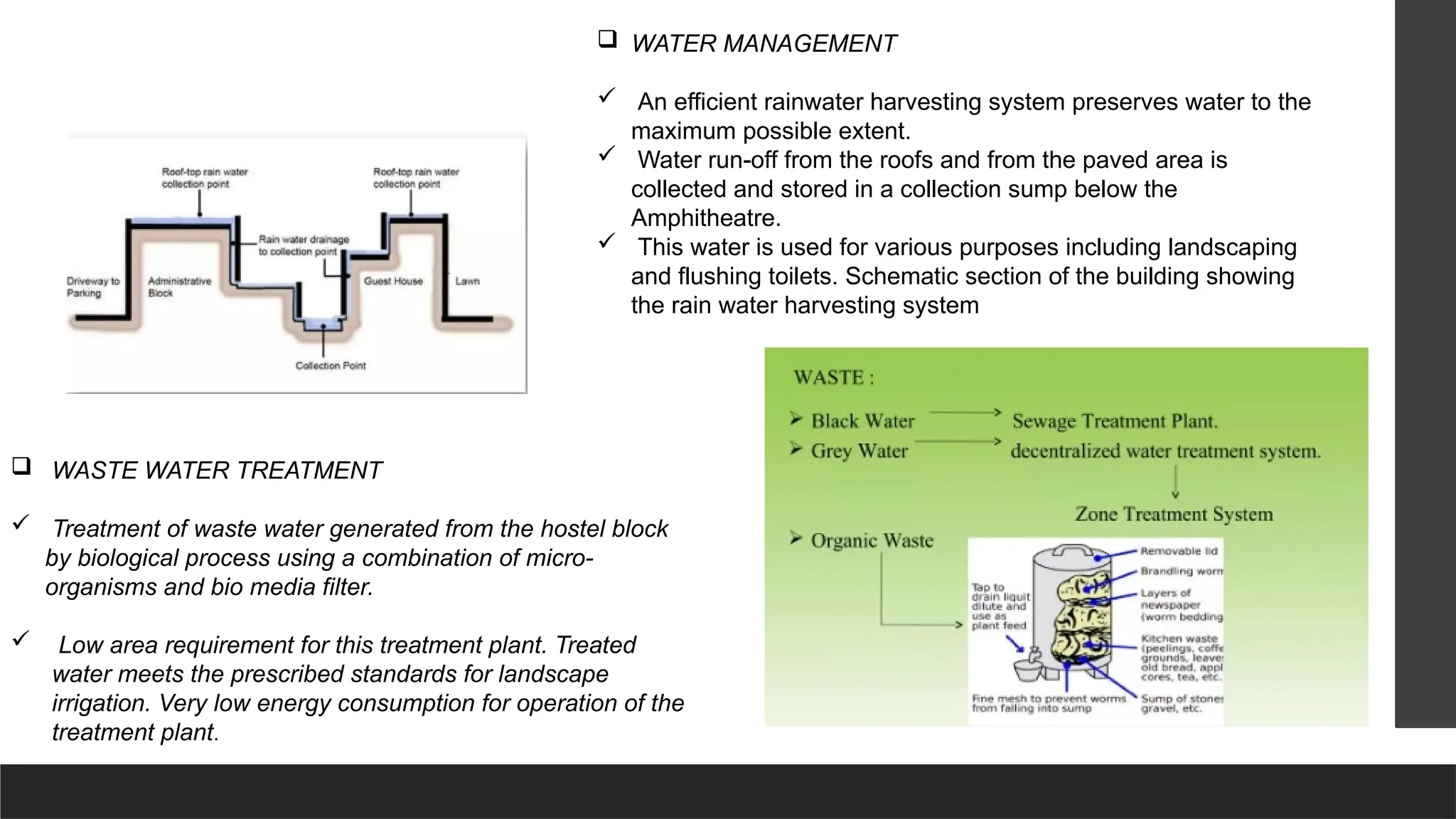
 WASTE WATER TREATMENT
 Treatment of waste water generated from the hostel block
by biological process using a combination of micro-
organisms and bio media filter.
 Low area requirement for this treatment plant. Treated
water meets the prescribed standards for landscape
irrigation. Very low energy consumption for operation of the
treatment plant.
 WATER MANAGEMENT
 An efficient rainwater harvesting system preserves water to the
maximum possible extent.
 Water run-off from the roofs and from the paved area is
collected and stored in a collection sump below the
Amphitheatre.
 This water is used for various purposes including landscaping
and flushing toilets. Schematic section of the building showing
the rain water harvesting system
• Rooftop gardens are
also beneficial in
reducing rain run off.
A roof garden can
delay run off; reduce
the rate and volume
of run off.
• Plants have the
ability to reduce the
overall heat
absorption of the
building which then
reduces energy
consumption
❑ Renewable
Energy
• A 5-kW peak solar photovoltaic system
integrated with the roof skylights provides
day-light and also generates electricity.
Solar water heaters which meet the Solar
Photovoltaic integrated with the hot-water
requirements of the roof provide natural
light and campus electricity
• A solar water heating system meets the
hot water requirements of the kitchen and
the guest rooms.
• Other energy conservation systems
include an effective waste and water
management system, a centralized
uninterrupted power supply, and a kitchen
that reduces internal heat
❑ POST
CONSTRUCTION
• The monthly energy consumption is about Rs.
30,000 for the entire complex
• This works out to be around Rs. 1.12 per square
foot which is about one-tenth of a conventional
building with air conditioning in Bangalore, thus
proving the energy-efficiency of the complex.
• As and when the drain to the south gets
cleaned, the complex can also open out towards
it. This would provide the complex with its own
water-front.
Conclusion:
 Reuse Material
 Energy Efficient Building
 Roof Garden
 Cross Ventilation
 Water Harvesting
 Stack Effect
 Use of Air Funnels
 Solar Panels
INTERNATIONAL CASE STUDY - 2
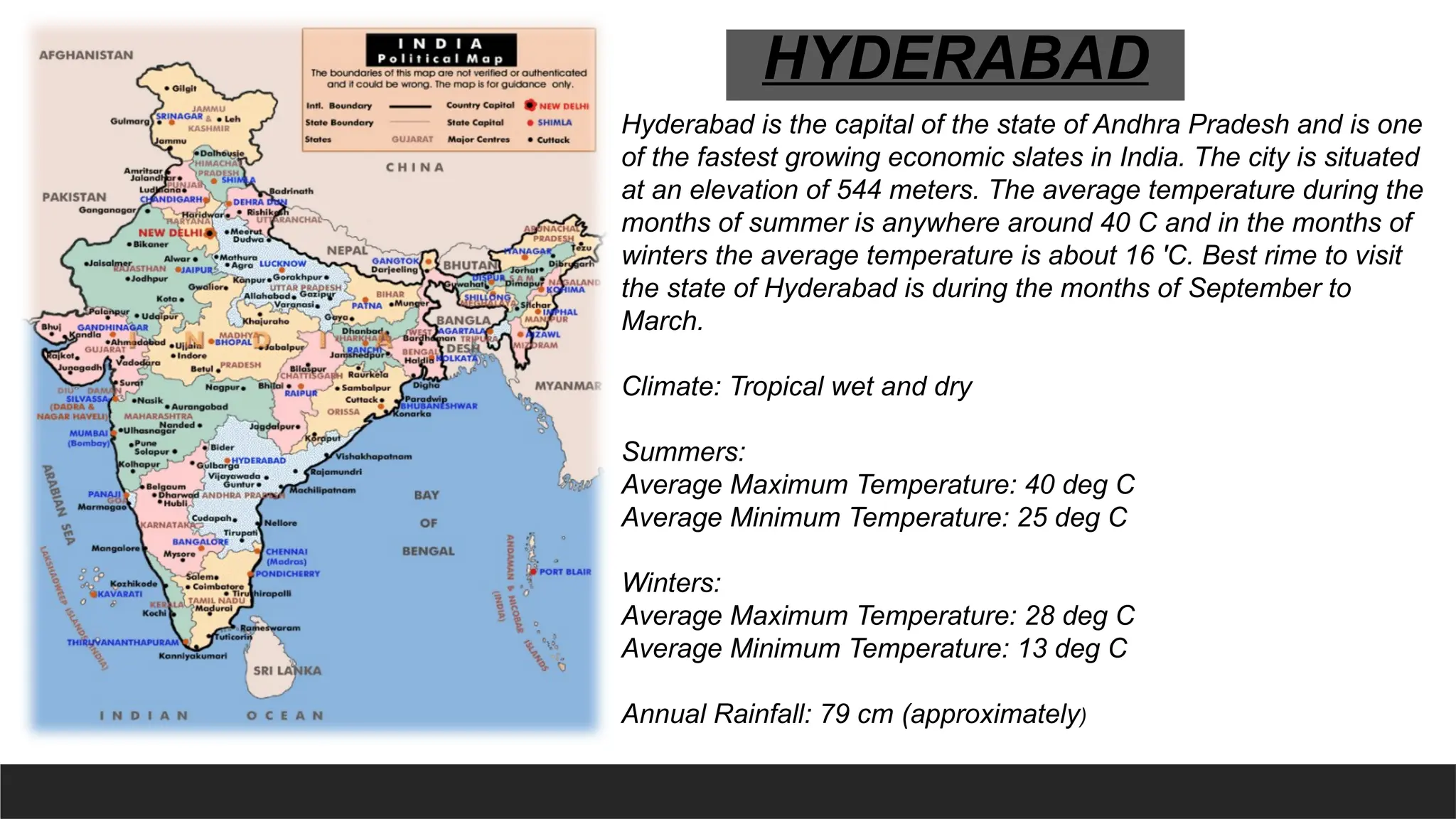
Hyderabad is the capital of the state of Andhra Pradesh and is one
of the fastest growing economic slates in India. The city is situated
at an elevation of 544 meters. The average temperature during the
months of summer is anywhere around 40 C and in the months of
winters the average temperature is about 16 'C. Best rime to visit
the state of Hyderabad is during the months of September to
March.
Climate: Tropical wet and dry
Summers:
Average Maximum Temperature: 40 deg C
Average Minimum Temperature: 25 deg C
Winters:
Average Maximum Temperature: 28 deg C
Average Minimum Temperature: 13 deg C
Annual Rainfall: 79 cm (approximately)
HYDERABAD
 It remains fairly warm most of the year.
 Receive less rainfall in the monsoon.
 Temperatures come down in the months of December and January and
the nights become quite cool in and around the Hyderabad city.
 During the summer months, the mercury goes as high as 42°C while in
winters the minimum temperature may come down to as low as 12°C.
 June to November are the months of monsoons and temperature goes
down at times.
 Thus, for most parts of the year the weather and climate of Hyderabad
remains fairly moderate.
 During the summer months, the mercury goes as
high as 42°C while in winters the minimum
temperature may come down to as low as 12°C
 CLIMATE:
 Temperature
 Economical
 Energy-saving
 Environmentally-
Friendly
 Sustainable development
 Sohrabji Godrej Green Business
Centre in Hyderabad. It's
commercial building which consist
of office buildings, research labs
and conference rooms.
 Green Architecture
Green Business House
 Water Efficiency
 Sustainable Site
 Energy Efficiency Materials
 Resources Indoor Environmental
Quality
 Central courtyard.
 Roof garden – Protects heat penetration,
cuts down heat-island effects.
 High performance glazing to bring in
natural light while minimizing heat
ingress.
 Usage of light glazing and vision glazing.
 Jali (Perforated) wall for bringing in
natural light as well as ventilation.
 Energy saving system.
 Green Building Tour
 The courtyards act as "light wells, illuminating
adjacent work areas.
 When this light is not sufficient, sensors trigger
the deployment of efficient electric lights.
Dimmers automatically control the illumination
levels, turning the lights off when they're
unnecessary.
 Also,occupancy sensors prevent a light from
being switched on at an unoccupied work
statiot.
 Courtyards
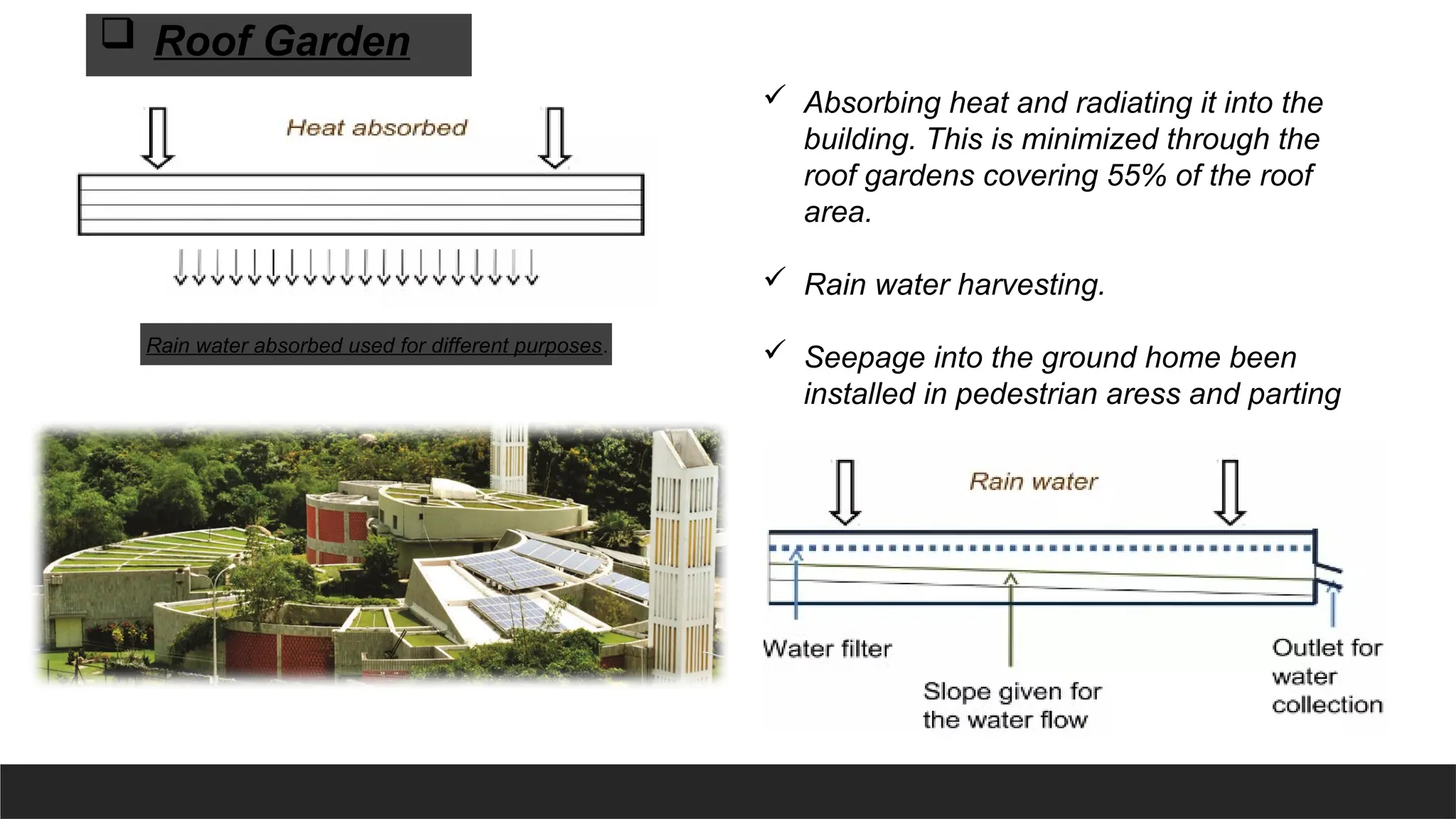
 Absorbing heat and radiating it into the
building. This is minimized through the
roof gardens covering 55% of the roof
area.
 Rain water harvesting.
 Seepage into the ground home been
installed in pedestrian aress and parting
 Roof Garden
Rain water absorbed used for different purposes.
Natural light deflection systems can direct light deep into
the room and ensure better natural lighting provisions.
 Natural Lighting
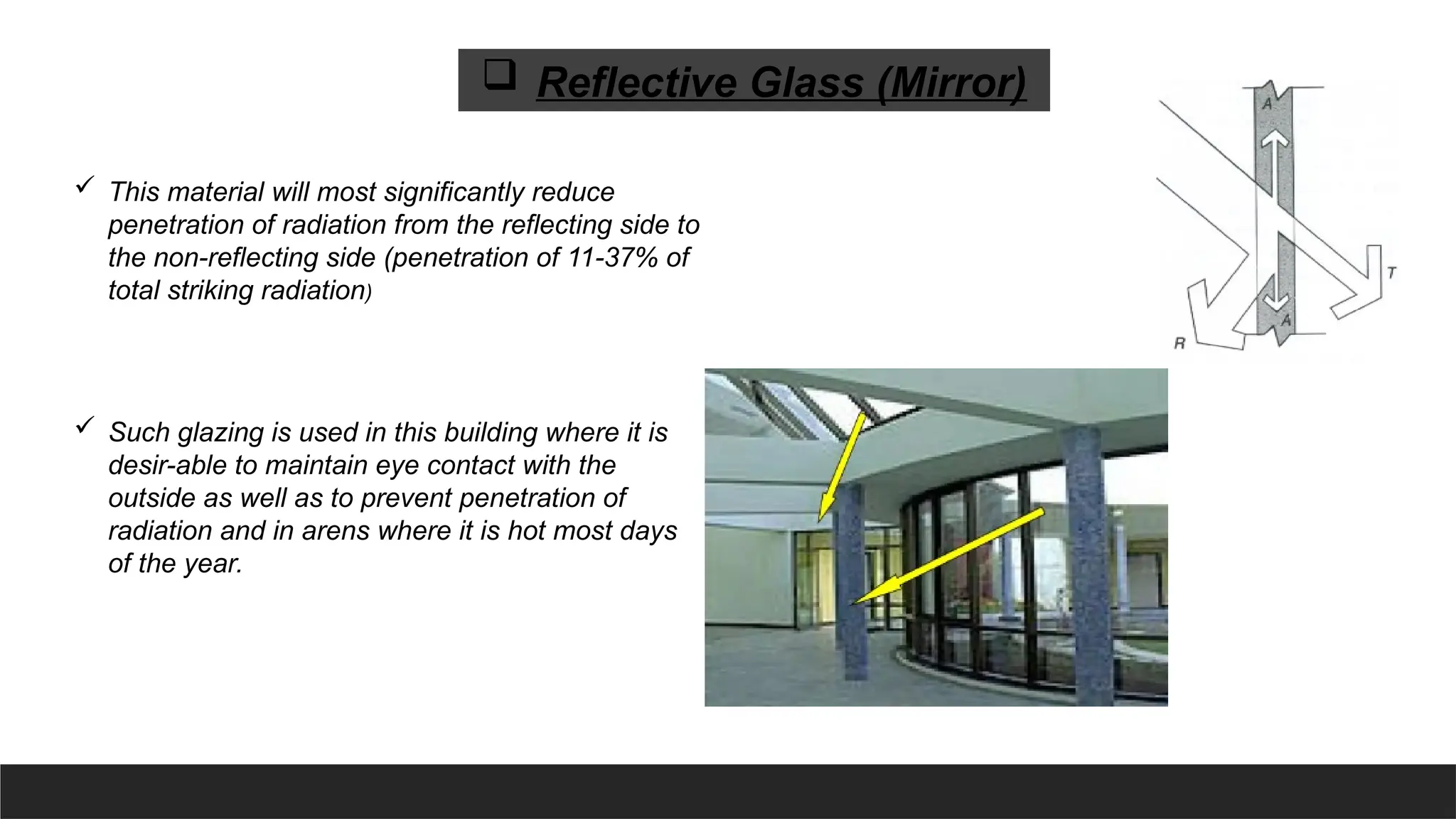
 This material will most significantly reduce
penetration of radiation from the reflecting side to
the non-reflecting side (penetration of 11-37% of
total striking radiation)
 Such glazing is used in this building where it is
desir-able to maintain eye contact with the
outside as well as to prevent penetration of
radiation and in arens where it is hot most days
of the year.
 Reflective Glass (Mirror)
 DOUBLE GLAZED GLASS
 This consists of two sheets of glass with space in between,
sometimes filled with air or other gases, or vacuum.
 Variations in thickness have a certain effect, up to a certain limit,
on the percentage of radiation allowed to penetrate and on
thermal conductance of the composition.
 The main advantage of this type of cross- section is its ability to
reduce heat transfer from one pane to the other, both by
conduction and by radiation.
 (TRADITIONAL JALI)
 Jalis or Lattice walls are used to prevent glare
and heat gain while ensuring adequate day
lighting and views.
 The jali, used in many historic buildings such as
the Taj Mahal, gives definition and an aesthetic
appeal to a space.
Jali [Perforated] for bringing in Natural
Light and also Ventilation
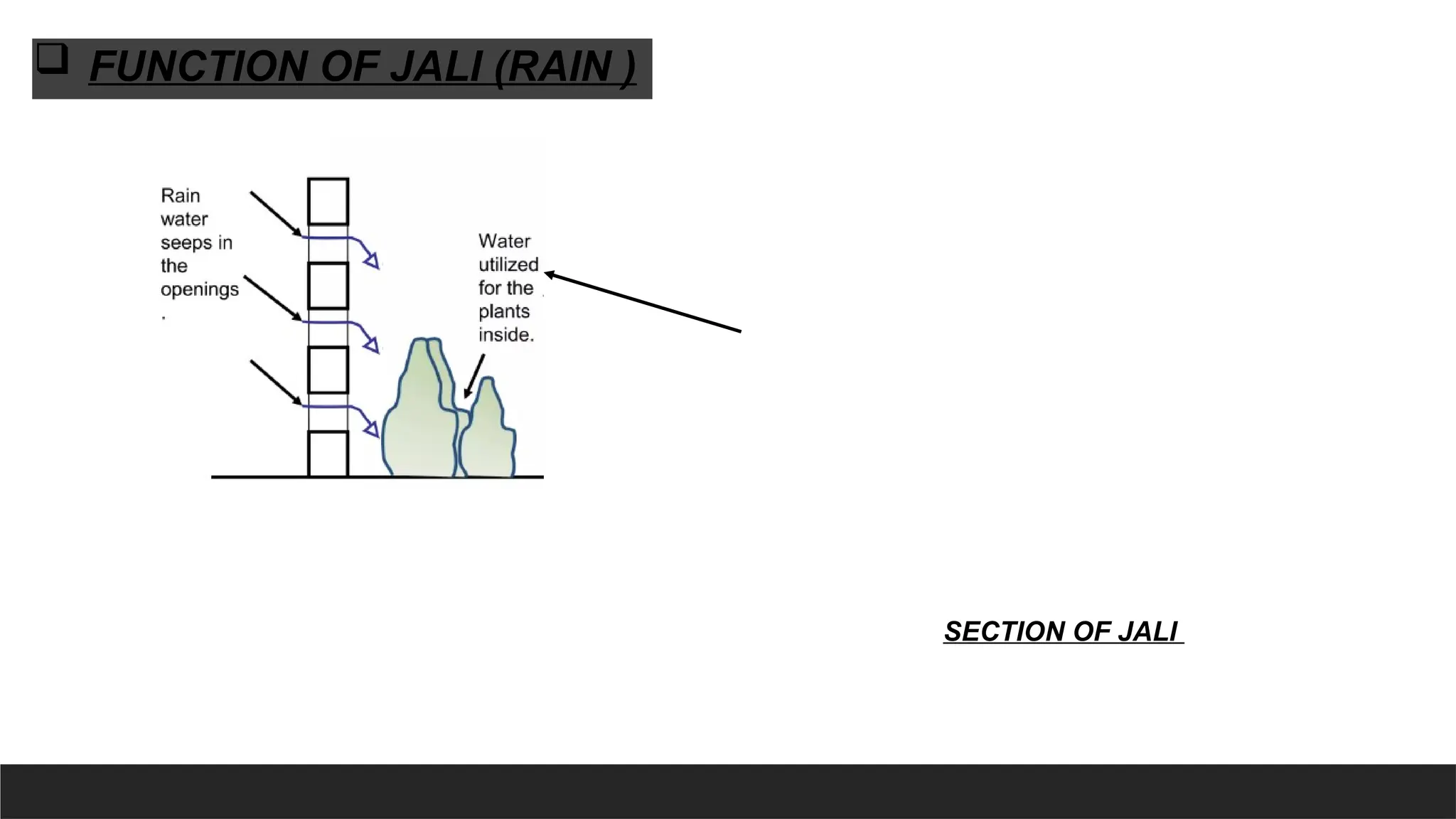
(JALI)
 FUNCTION OF JALI (RAIN )
SECTION OF JALI
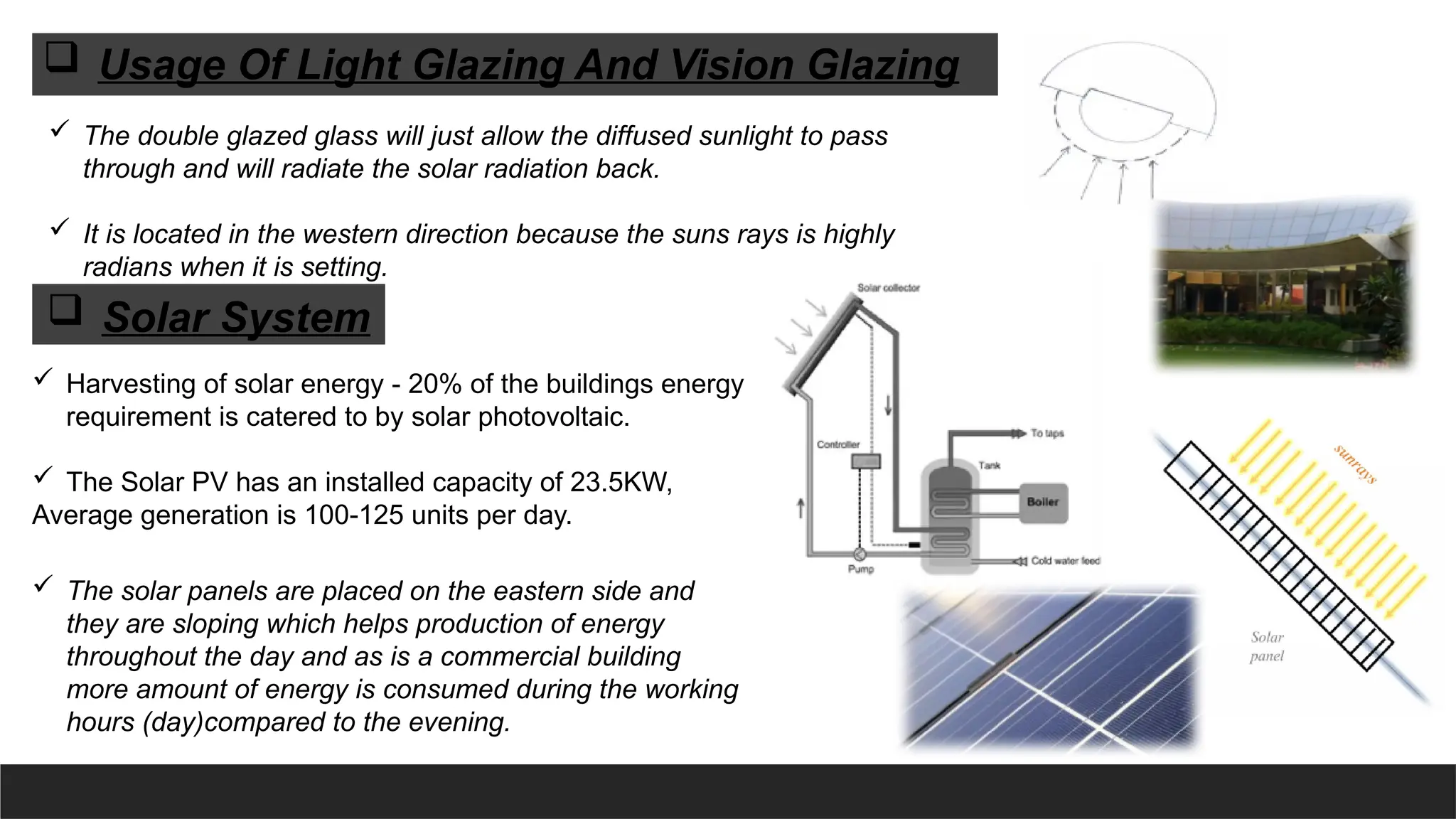
 The double glazed glass will just allow the diffused sunlight to pass
through and will radiate the solar radiation back.
 It is located in the western direction because the suns rays is highly
radians when it is setting.
 Harvesting of solar energy - 20% of the buildings energy
requirement is catered to by solar photovoltaic.
 The Solar PV has an installed capacity of 23.5KW,
Average generation is 100-125 units per day.
 Usage Of Light Glazing And Vision Glazing
 Solar System
 The solar panels are placed on the eastern side and
they are sloping which helps production of energy
throughout the day and as is a commercial building
more amount of energy is consumed during the working
hours (day)compared to the evening.
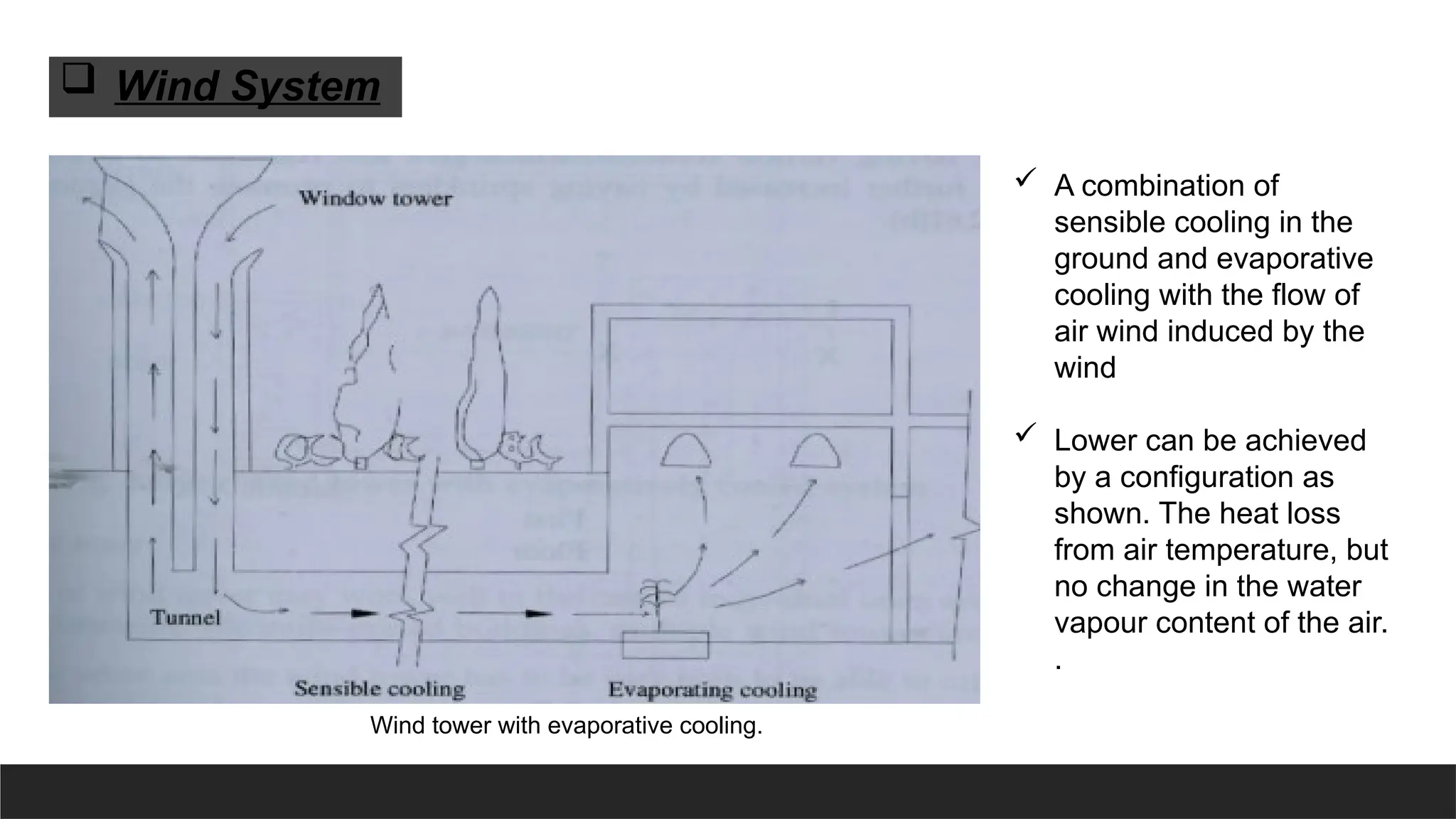
Wind tower with evaporative cooling.
 A combination of
sensible cooling in the
ground and evaporative
cooling with the flow of
air wind induced by the
wind
 Lower can be achieved
by a configuration as
shown. The heat loss
from air temperature, but
no change in the water
vapour content of the air.
.
 Wind System
 The hot ambient air enters the tower
through the openings in the tower and is
cooled, when it comes in contact with
the cool tower and thus becomes
heavier and sinks down. When an inter
is provided to the rooms with an butler
on the other side. there is a draft of cool
lair: After a whole of heat exchange. the
wind towers become wart in the evening.  During night the reverse happens; due to
warm surface of wind tower and drop in
temperature of ambient air due to
buoyancy effect warm air arises
upwards. As a result, cooler ambient air
is sucked into the room through the
window. As a bro-product of this process.
wind tower loses the heat that was
collected during the day time and it
becomes ready for use in cold condition
up to the morning
 Interior partitions are provided in the building
for various purposes of privacy which may not
allow openings in the partition.
 In this region due to the warn and humid
climate ventilation becomes very essential,
cross – ventilation becomes the major
solution.
 This can be overcome by providing ridge
ventilation or ventilating ducts or shaft for
deeper rooms.
 Wind Deflectors
 Inter and outer are high. Airflow
Count near ceiling. No air current at
Good for removing hot season.
Lavers of still air of low levels.
 Inlet higher than outlet. Good
interaction of air lavers. Current body
level. Pocket of warm over the outlet
 The effect of positioning the apertures at various heights above the floor influences efficiency of
the natural ventilation in a given space.
 Collet rain water for external use lie, garden/washing car.
 Use water conserving appliances including toilers, shower, tops,
washing machine and dish washe eg. Low flow faucets, water
saving dual flush tanks.
 Reduce irrigation and surface water run-off.
 Zero water discharge building
 System35% reduction in potable water use
 Slope given for the collection
 Low flow water fixtures
 Waterless urinals
 Use of storm water & recycled water for irrigation.
 Entire waste water in the building is treated biologically
through a process called the 'Root Zone Treatment
Root Way Water Treatment Facility; Natural Way Of Treating The
Black And Grey Water
 Water System
 A large amount of energy and pollution reduced through choices in
the production and transportation of building materials
 An impressive 77 percent of she building materials use recycled
content in the form of fly ash, broken glass, broken tiles, recycled
paper, recycled aluminum, cinder from industrial furnaces,
bagasse (an agricultural waste from sugar cane), mineral fibers,
cellulose fibers, and quarry dust.
 The building reuses a significant amount of material salvaged from
other construction sites like toilet doors, interlocking pavement
blocks, stone slabs, scrap steel, scrap glazed tiles, shuttering
material and, interestingly, the furniture in the cafeteria. A waste
management plan ensured that 96 percent of construction waste
was recycled.
 Sustainable Materials
Waste Reduction
 Select materials using recycled components.
 Design for re-use and recycling.
 Control and reduce waste and packaging.
 Reduce resource consumption
Health and Wellbeing
 Meet the basic physical, emotional and spiritual needs of the occupants.
 Consider healthy lighting, color and sound, controlled temperature and humidity
and good indoor air quality to enhance the living environment.
 Reduce formaldehyde emissions and use pollution fighing Indoor plents
 Apply an integrated wiring seven for lighting. power, security, fire aloo and audio
facilities.
 Design a safe and user friendly space.
 Principles Followed
 Design-Orientation for maximum day
light.
 Avoiding Green wall and Green roof.
 Use of neutral glass to reduce heat
gain.
 Usage of energy efficient white good
 Use of Zero CFG refrigerators in
refrigerators and air condition
 Online monitoring system to monitor the
energy performance.
 Establishing baseline data for energy
consumption.
 Energy Efficiency
THANKS
❑ REFFERENCES
 https://www.google.com/search?
q=what+is+green+architecture&bih=763&biw=1381&hl=en-GB
 https://lh3.googleusercontent.com/pfbjX6Vmr00nKuuclQcUZJO7F-3UOx36fZ1ssIqx--
sD7Msq2oRNlsTjh02PNVQ5gIE-7gaSooBLc1NgP6VkM6fzwEnzMlOM0Cq16Co
 https://thefactfactor.com/wp-content/uploads/2019/04/Sustainable-
Development-02.png
 https://makewealthhistory.files.wordpress.com/2019/10/cii.jpg

CENTRAL DESIGN ARCHITECTURAL DETAILING STRUCTURE

  • 2.
    CASE STUDIED SUSTAINABLE ANDGREEN ARCHITECTURE Resource Person: MAAM ARSALA HASMI Semester: SUMMER 2023​ Program: B.Arch. Course Title: SUSTAINABLE AND GREEN ARCHITECTURE GROUP MEMBERS AQIN IMRAN ABDULLAH TARIQ MOHAMMAD ALI MARIYAM TARIQ AHMAD WALEED AYESHA
  • 3.
  • 4.
    LINKAGE The design ofindividual buildings, which are conceived primarily in terms of the design parameters of artificially Controlled environments. ARCHITECTURE: SUSTAINABILITY: GREEN ARCHITECTURE : Sustainability consists of fulfilling the needs of current generations without compromising the needs of future generations, while ensuring a balance between economic growth, environmental care and social well-being Green building refers to both a structure and the application of processes that are environmentally responsible and resource-efficient throughout a building's life-cycle: from planning to design, construction, operation, maintenance, renovation, and demolition.
  • 5.
     Sustainability wasthe back bone of the entire design concept and it was communicated to the architect that the building should incorporate all possible elements of Passive Solar Architecture and Low Energy Cooling systems" says Mili Majumdar.
  • 6.
    ✔ The lineargeometry of the site with a narrow frontage and an aspect ratio of almost 1:3 dictated the strong linear axis in the design. ✔ The logical sequence of positioning the three distinct functioning zones in a hierarchy of public access to restricted entry formed the other key consideration in design development. ✔ Placing the commercial block at the front was the most logical choice in exploiting the commercial potential of the frontage of the site . ✔ The functional core also coincides with the geometric central part of the linear site. The residential zone comes up from the rear forming the last zone in the linear sequence. ✔ That the design responds to orientation and climatic factors, is but an obvious fact. ✔ The north line is at a slight angle to the linear axis of the site and the design takes full advantage of this orientation in the composition of the built and open spaces and in creating wind flows through the complex as also lighting and shading of the spaces.  GEOMETRY / SHAPE
  • 7.
    ❑ SITE ANDDESIGN  The Sun, Sky, Air, Water and Earth shape the nature of architecture which emerges on this site.  The process of continuous dialogue between the architect and TERI and the engagement of TERI in the design process augmented the thrust on climate responsive design in a large way. Open drain on the southern edge of TERI Bangalore Natural Features Positives and Negatives: The drain on the southern side is a major feature which influences the design. Wind coming from the south over the drain brings in the foul smell into the site.  ELEMENTS OF DESIGN
  • 8.
    ❑ ORIENTATION • BUILDINGIS ORIENTED ALONG NE- SW DIRECTION. • SW IS THE PRIMARY WIND AND LIGHT DIRECTION FOR BANGALORE • .ALONG SW FACAD IS A FOUL SMELLING DRAIN. HENCE ENTRANCE IS TOWAARDS NE DIRECTION. • ALL WINDOW OPENINGS ARE IN THIS DIRECTION • SOUTH WALL IS A DOUBLE WALL TO PROVIDE INSULATION FROM SOUTHERN SUN ORIENTATION : BUILDING DETAILS : • BUILDING HAS BEEN DIVIDED INTO INDIVIDUAL AND COMMON AREAS • 75 INTIMATE SMALL SPACES ARE ROVIDED FOR INDIVIDUAL WORK • COMMON AREAS REFER TO THE ATRIUMS, COURTS, NODES AND CORRIDORS MEANT FOR WIDER INTERACTION
  • 9.
  • 10.
    ❑ HEAT GAIN A cavity wall on the southern side insulates the building from solar heat gain.  The ground disturbed due to the building is replaced on the rooftop to form terrace gardens at various levels. These gardens along with earth berms provides good heat insulation and moderates fluctuations in temperature. Locally available ‘kadappa’ Trombe walls help in insulating stone used to clad the the hostels southern wall Materials & Appliances  As use of local materials reduces the energy consumed in their transportation, local materials and materials with low-embodied energy have been used wherever possible  The southern wall, for instance, is clad in local ‘kadappa’ stone.  Energy-efficient lighting devices like CFL lights have also been used. THERMAL INSULATION OF WALLS
  • 11.
    THERMAL INSULATION OFWALLS Materials & Appliances  As use of local materials reduces the energy consumed in their transportation, local materials and materials with low- embodied energy have been used wherever possible  The southern wall, for instance, is clad in local ‘kadappa’ stone.  Energy-efficient lighting devices like CFL lights have also been used.
  • 12.
    ❑ SKY and DAYLIGHT Maximum use of daylight and use of light sensors to regulate the use of artificial lighting in the interiors is another key design strategy.  These fixtures are controlled by light sensors which respond to available light conditions and automatically regulate the connected fixtures to achieve the desired level of uniform illumination required.  This kind of a lighting system has a potential of saving 70% lighting energy demand.  Daylighting integration using light fixtures fitted with electronic ballasts regulating the level of illumination responding to available natural light and adjustable aero screen louvres to regulate summer and winter sunlight entry  Double glazed facades reduce heat gain without affecting the level of illumination Concept Poster on 'Air' by Mind space
  • 13.
    ❑ AIR ❑ VENTILATION The predominant wind direction is taken into account in designing the open spaces. The central atrium acts as an air funnel defined by the other buildings.  The opening oriented in the prevailing wind direction catches the outside air and channelizes it through a narrow stretch of the block before releasing it into the central court area.  A blank wall towards the south (facing the drain) allows the breeze to flow over the building. This creates a negative pressure which pulls fresh air from the north into the building.  The sections are designed such that hot air rises to the top and make the building breathe.  Air in the cavity in the south wall on the south creates negative pressure, thereby enhancing the convection currents in the building.
  • 14.
     WASTE WATERTREATMENT  Treatment of waste water generated from the hostel block by biological process using a combination of micro- organisms and bio media filter.  Low area requirement for this treatment plant. Treated water meets the prescribed standards for landscape irrigation. Very low energy consumption for operation of the treatment plant.  WATER MANAGEMENT  An efficient rainwater harvesting system preserves water to the maximum possible extent.  Water run-off from the roofs and from the paved area is collected and stored in a collection sump below the Amphitheatre.  This water is used for various purposes including landscaping and flushing toilets. Schematic section of the building showing the rain water harvesting system
  • 15.
    • Rooftop gardensare also beneficial in reducing rain run off. A roof garden can delay run off; reduce the rate and volume of run off. • Plants have the ability to reduce the overall heat absorption of the building which then reduces energy consumption
  • 16.
    ❑ Renewable Energy • A5-kW peak solar photovoltaic system integrated with the roof skylights provides day-light and also generates electricity. Solar water heaters which meet the Solar Photovoltaic integrated with the hot-water requirements of the roof provide natural light and campus electricity • A solar water heating system meets the hot water requirements of the kitchen and the guest rooms. • Other energy conservation systems include an effective waste and water management system, a centralized uninterrupted power supply, and a kitchen that reduces internal heat
  • 17.
    ❑ POST CONSTRUCTION • Themonthly energy consumption is about Rs. 30,000 for the entire complex • This works out to be around Rs. 1.12 per square foot which is about one-tenth of a conventional building with air conditioning in Bangalore, thus proving the energy-efficiency of the complex. • As and when the drain to the south gets cleaned, the complex can also open out towards it. This would provide the complex with its own water-front.
  • 18.
    Conclusion:  Reuse Material Energy Efficient Building  Roof Garden  Cross Ventilation  Water Harvesting  Stack Effect  Use of Air Funnels  Solar Panels
  • 19.
  • 20.
    Hyderabad is thecapital of the state of Andhra Pradesh and is one of the fastest growing economic slates in India. The city is situated at an elevation of 544 meters. The average temperature during the months of summer is anywhere around 40 C and in the months of winters the average temperature is about 16 'C. Best rime to visit the state of Hyderabad is during the months of September to March. Climate: Tropical wet and dry Summers: Average Maximum Temperature: 40 deg C Average Minimum Temperature: 25 deg C Winters: Average Maximum Temperature: 28 deg C Average Minimum Temperature: 13 deg C Annual Rainfall: 79 cm (approximately) HYDERABAD
  • 21.
     It remainsfairly warm most of the year.  Receive less rainfall in the monsoon.  Temperatures come down in the months of December and January and the nights become quite cool in and around the Hyderabad city.  During the summer months, the mercury goes as high as 42°C while in winters the minimum temperature may come down to as low as 12°C.  June to November are the months of monsoons and temperature goes down at times.  Thus, for most parts of the year the weather and climate of Hyderabad remains fairly moderate.  During the summer months, the mercury goes as high as 42°C while in winters the minimum temperature may come down to as low as 12°C  CLIMATE:  Temperature
  • 22.
     Economical  Energy-saving Environmentally- Friendly  Sustainable development  Sohrabji Godrej Green Business Centre in Hyderabad. It's commercial building which consist of office buildings, research labs and conference rooms.  Green Architecture
  • 23.
    Green Business House Water Efficiency  Sustainable Site  Energy Efficiency Materials  Resources Indoor Environmental Quality
  • 24.
     Central courtyard. Roof garden – Protects heat penetration, cuts down heat-island effects.  High performance glazing to bring in natural light while minimizing heat ingress.  Usage of light glazing and vision glazing.  Jali (Perforated) wall for bringing in natural light as well as ventilation.  Energy saving system.  Green Building Tour
  • 25.
     The courtyardsact as "light wells, illuminating adjacent work areas.  When this light is not sufficient, sensors trigger the deployment of efficient electric lights. Dimmers automatically control the illumination levels, turning the lights off when they're unnecessary.  Also,occupancy sensors prevent a light from being switched on at an unoccupied work statiot.  Courtyards
  • 26.
     Absorbing heatand radiating it into the building. This is minimized through the roof gardens covering 55% of the roof area.  Rain water harvesting.  Seepage into the ground home been installed in pedestrian aress and parting  Roof Garden Rain water absorbed used for different purposes.
  • 27.
    Natural light deflectionsystems can direct light deep into the room and ensure better natural lighting provisions.  Natural Lighting
  • 28.
     This materialwill most significantly reduce penetration of radiation from the reflecting side to the non-reflecting side (penetration of 11-37% of total striking radiation)  Such glazing is used in this building where it is desir-able to maintain eye contact with the outside as well as to prevent penetration of radiation and in arens where it is hot most days of the year.  Reflective Glass (Mirror)
  • 29.
     DOUBLE GLAZEDGLASS  This consists of two sheets of glass with space in between, sometimes filled with air or other gases, or vacuum.  Variations in thickness have a certain effect, up to a certain limit, on the percentage of radiation allowed to penetrate and on thermal conductance of the composition.  The main advantage of this type of cross- section is its ability to reduce heat transfer from one pane to the other, both by conduction and by radiation.
  • 30.
     (TRADITIONAL JALI) Jalis or Lattice walls are used to prevent glare and heat gain while ensuring adequate day lighting and views.  The jali, used in many historic buildings such as the Taj Mahal, gives definition and an aesthetic appeal to a space. Jali [Perforated] for bringing in Natural Light and also Ventilation (JALI)
  • 31.
     FUNCTION OFJALI (RAIN ) SECTION OF JALI
  • 32.
     The doubleglazed glass will just allow the diffused sunlight to pass through and will radiate the solar radiation back.  It is located in the western direction because the suns rays is highly radians when it is setting.  Harvesting of solar energy - 20% of the buildings energy requirement is catered to by solar photovoltaic.  The Solar PV has an installed capacity of 23.5KW, Average generation is 100-125 units per day.  Usage Of Light Glazing And Vision Glazing  Solar System  The solar panels are placed on the eastern side and they are sloping which helps production of energy throughout the day and as is a commercial building more amount of energy is consumed during the working hours (day)compared to the evening.
  • 33.
    Wind tower withevaporative cooling.  A combination of sensible cooling in the ground and evaporative cooling with the flow of air wind induced by the wind  Lower can be achieved by a configuration as shown. The heat loss from air temperature, but no change in the water vapour content of the air. .  Wind System
  • 34.
     The hotambient air enters the tower through the openings in the tower and is cooled, when it comes in contact with the cool tower and thus becomes heavier and sinks down. When an inter is provided to the rooms with an butler on the other side. there is a draft of cool lair: After a whole of heat exchange. the wind towers become wart in the evening.  During night the reverse happens; due to warm surface of wind tower and drop in temperature of ambient air due to buoyancy effect warm air arises upwards. As a result, cooler ambient air is sucked into the room through the window. As a bro-product of this process. wind tower loses the heat that was collected during the day time and it becomes ready for use in cold condition up to the morning
  • 35.
     Interior partitionsare provided in the building for various purposes of privacy which may not allow openings in the partition.  In this region due to the warn and humid climate ventilation becomes very essential, cross – ventilation becomes the major solution.  This can be overcome by providing ridge ventilation or ventilating ducts or shaft for deeper rooms.  Wind Deflectors
  • 36.
     Inter andouter are high. Airflow Count near ceiling. No air current at Good for removing hot season. Lavers of still air of low levels.  Inlet higher than outlet. Good interaction of air lavers. Current body level. Pocket of warm over the outlet  The effect of positioning the apertures at various heights above the floor influences efficiency of the natural ventilation in a given space.
  • 37.
     Collet rainwater for external use lie, garden/washing car.  Use water conserving appliances including toilers, shower, tops, washing machine and dish washe eg. Low flow faucets, water saving dual flush tanks.  Reduce irrigation and surface water run-off.  Zero water discharge building  System35% reduction in potable water use  Slope given for the collection  Low flow water fixtures  Waterless urinals  Use of storm water & recycled water for irrigation.  Entire waste water in the building is treated biologically through a process called the 'Root Zone Treatment Root Way Water Treatment Facility; Natural Way Of Treating The Black And Grey Water  Water System
  • 38.
     A largeamount of energy and pollution reduced through choices in the production and transportation of building materials  An impressive 77 percent of she building materials use recycled content in the form of fly ash, broken glass, broken tiles, recycled paper, recycled aluminum, cinder from industrial furnaces, bagasse (an agricultural waste from sugar cane), mineral fibers, cellulose fibers, and quarry dust.  The building reuses a significant amount of material salvaged from other construction sites like toilet doors, interlocking pavement blocks, stone slabs, scrap steel, scrap glazed tiles, shuttering material and, interestingly, the furniture in the cafeteria. A waste management plan ensured that 96 percent of construction waste was recycled.  Sustainable Materials
  • 39.
    Waste Reduction  Selectmaterials using recycled components.  Design for re-use and recycling.  Control and reduce waste and packaging.  Reduce resource consumption Health and Wellbeing  Meet the basic physical, emotional and spiritual needs of the occupants.  Consider healthy lighting, color and sound, controlled temperature and humidity and good indoor air quality to enhance the living environment.  Reduce formaldehyde emissions and use pollution fighing Indoor plents  Apply an integrated wiring seven for lighting. power, security, fire aloo and audio facilities.  Design a safe and user friendly space.  Principles Followed
  • 40.
     Design-Orientation formaximum day light.  Avoiding Green wall and Green roof.  Use of neutral glass to reduce heat gain.  Usage of energy efficient white good  Use of Zero CFG refrigerators in refrigerators and air condition  Online monitoring system to monitor the energy performance.  Establishing baseline data for energy consumption.  Energy Efficiency
  • 41.
  • 42.
    ❑ REFFERENCES  https://www.google.com/search? q=what+is+green+architecture&bih=763&biw=1381&hl=en-GB https://lh3.googleusercontent.com/pfbjX6Vmr00nKuuclQcUZJO7F-3UOx36fZ1ssIqx-- sD7Msq2oRNlsTjh02PNVQ5gIE-7gaSooBLc1NgP6VkM6fzwEnzMlOM0Cq16Co  https://thefactfactor.com/wp-content/uploads/2019/04/Sustainable- Development-02.png  https://makewealthhistory.files.wordpress.com/2019/10/cii.jpg