FACILITY PLANNING STUDIO
Green building materials (Bamboo)


                          By:
                          Vinay. M
                          (080532)
INTRODUCTION…

               Bamboo is one of the most amazingly
versatile and sustainable building materials available.
Ecologically viable alternative to timber for construction.
           Materials that are used in green design are always
assessed for their environmental impact. Bamboo can
replace concrete, steel or wood, depending on the situation
and the application.
WHAT IS BAMBOO?
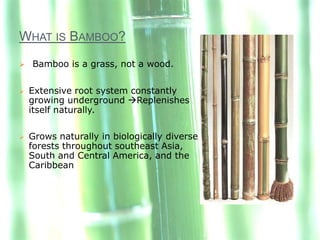
 Bamboo is a grass, not a wood.


   Extensive root system constantly
    growing underground Replenishes
    itself naturally.

   Grows naturally in biologically diverse
    forests throughout southeast Asia,
    South and Central America, and the
    Caribbean
WHY USE BAMBOO?
   Bamboo stands release 35% more oxygen
    than equivalent stands of trees.

   Some bamboo even sequester up to 12 tons
    of carbon dioxide from the air per hectare.

   Bamboo can also lower light intensity and
    protects against ultraviolet rays.

   It is very easy, affordable, and profitable for low
    income communities to grow and use bamboo. That
    is why sometimes it is known as
    "poor man's timber"
CHARACTERISTICS…

   Bamboo is one of the strongest building
    materials, tensile strength is 28,000 pounds
    per square inch versus 23,000 pounds per
    square inch for steel.

   Diverse species makes bamboo adaptable to
    many environments.

   Bamboo tolerates extremes of precipitation,
    from 30-250 inches of annual rainfall.
   Growing with strength and speed

   Protects the environment

   Saving rainforests

   Renewable resource

   Exquisite component of design
BAMBOO IN INDIA…
   The major user of bamboo in India is paper industry, which
    consumes sizeable proportion of the total annual bamboo
    production.

   Bamboo as Building Materials.

   Bamboo Composite & engineered structure.

   Bamboo textiles.

   Home accessories.

   In asia india second richest country in production of
    bamboo after china.
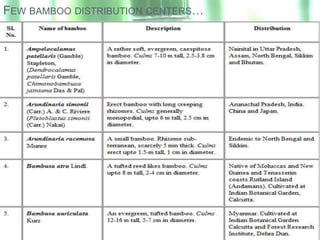
FEW BAMBOO DISTRIBUTION CENTERS…
BAMBOO-ITS ROLE….


   Impact on environment and society.


   Future scenarios of global bamboo.


   Bamboo as structural usage.
ROLE OF BAMBOO IN GREEN BUILDING…

   Bamboo in green design

   Structural bamboo

   Cost-effective

   Housing with bamboo
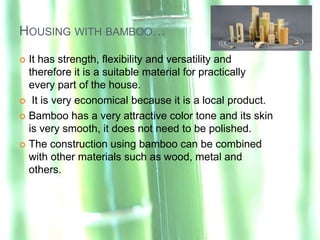
HOUSING WITH BAMBOO…

 It has strength, flexibility and versatility and
  therefore it is a suitable material for practically
  every part of the house.
 It is very economical because it is a local product.

 Bamboo has a very attractive color tone and its skin
  is very smooth, it does not need to be polished.
 The construction using bamboo can be combined
  with other materials such as wood, metal and
  others.
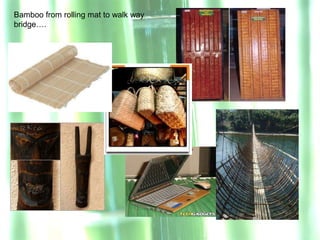
Bamboo from rolling mat to walk way
bridge….
Flooring, fencing, shoe rack,
furniture made of bamboo.
ADVANTAGES…
 Bamboo is a light material.
 Easy to store and transport.

 Bamboo has fibers which helps to cut it with very
  simple tools.
 Bamboo continues as the top material for
  construction because of its price.
 It does not need to be polished.

 The construction using bamboo can be combined
  with other materials such as wood, metal and
  others.
DISADVANTAGE S:

   One major disadvantage of bamboo is its poor
    resistance to fungi and bacteria.

   Without preservative treatment and proper use, the
    material has a very short life.

Presentation11

  • 1.
    FACILITY PLANNING STUDIO Greenbuilding materials (Bamboo) By: Vinay. M (080532)
  • 2.
    INTRODUCTION… Bamboo is one of the most amazingly versatile and sustainable building materials available. Ecologically viable alternative to timber for construction. Materials that are used in green design are always assessed for their environmental impact. Bamboo can replace concrete, steel or wood, depending on the situation and the application.
  • 3.
    WHAT IS BAMBOO? Bamboo is a grass, not a wood.  Extensive root system constantly growing underground Replenishes itself naturally.  Grows naturally in biologically diverse forests throughout southeast Asia, South and Central America, and the Caribbean
  • 4.
    WHY USE BAMBOO?  Bamboo stands release 35% more oxygen than equivalent stands of trees.  Some bamboo even sequester up to 12 tons of carbon dioxide from the air per hectare.  Bamboo can also lower light intensity and protects against ultraviolet rays.  It is very easy, affordable, and profitable for low income communities to grow and use bamboo. That is why sometimes it is known as "poor man's timber"
  • 5.
    CHARACTERISTICS…  Bamboo is one of the strongest building materials, tensile strength is 28,000 pounds per square inch versus 23,000 pounds per square inch for steel.  Diverse species makes bamboo adaptable to many environments.  Bamboo tolerates extremes of precipitation, from 30-250 inches of annual rainfall.
  • 6.
    Growing with strength and speed  Protects the environment  Saving rainforests  Renewable resource  Exquisite component of design
  • 7.
    BAMBOO IN INDIA…  The major user of bamboo in India is paper industry, which consumes sizeable proportion of the total annual bamboo production.  Bamboo as Building Materials.  Bamboo Composite & engineered structure.  Bamboo textiles.  Home accessories.  In asia india second richest country in production of bamboo after china.
  • 8.
  • 9.
    BAMBOO-ITS ROLE….  Impact on environment and society.  Future scenarios of global bamboo.  Bamboo as structural usage.
  • 10.
    ROLE OF BAMBOOIN GREEN BUILDING…  Bamboo in green design  Structural bamboo  Cost-effective  Housing with bamboo
  • 11.
    HOUSING WITH BAMBOO… It has strength, flexibility and versatility and therefore it is a suitable material for practically every part of the house.  It is very economical because it is a local product.  Bamboo has a very attractive color tone and its skin is very smooth, it does not need to be polished.  The construction using bamboo can be combined with other materials such as wood, metal and others.
  • 12.
    Bamboo from rollingmat to walk way bridge….
  • 13.
    Flooring, fencing, shoerack, furniture made of bamboo.
  • 14.
    ADVANTAGES…  Bamboo isa light material.  Easy to store and transport.  Bamboo has fibers which helps to cut it with very simple tools.  Bamboo continues as the top material for construction because of its price.  It does not need to be polished.  The construction using bamboo can be combined with other materials such as wood, metal and others.
  • 15.
    DISADVANTAGE S:  One major disadvantage of bamboo is its poor resistance to fungi and bacteria.  Without preservative treatment and proper use, the material has a very short life.