GREEN BUILDINGS
INTRODECTION:-GREEN
Building Industry is producing second largest amount of Demolition Waste and GHG (almost 40%).
Buildings have major environmental impacts over their entire life cycle.
•Resources such as ground cover, forests, water, and energy are depleted to construct and operate buildings.
•Resource-intensive materials provide the building envelope and landscaping add beauty to it – in turn using up water and
pesticides to maintain it.
•Energy-consuming systems for lighting, space conditioning and water heating provide comfort to its occupants
• Hi-tech controls add intelligence to ‘inanimate' buildings so that they can respond to varying conditions, and intelligently
monitor and control resource use, security, and usage of fire systems etc. in the building.
•Water is another vital resource which gets consumed continuously during building construction and operation.
•Several building processes and occupant function generate large amount of waste.
FOR SOLVING THESE ROBLEMS THE CONCEPT OF GREEN ARCHITECTURE WAS FORMED.
Green building (also known as green construction or sustainable building) refers to both a structure and the using of
processes that are environmentally responsible and resource-efficient throughout a building's life-cycle: from siting to
design, construction, operation, maintenance, renovation, and demolition. In other words, green building design involves
finding the balance between homebuilding and the sustainable environment.
GREEN BUILDING DESIGN CONCEPT:-
TO HAVE A GREEN BUILDING DESIGN CONCEPY WE MUST FOLLOW THE FOLLOWING POINTS:-
To have Green Building Concept, we should look after the following: Optimum use of Energy or power
•Water conservation
•Solid and Water Waste management, its treatment and reuse
•Energy efficient transport systems
•Efficient Building System Planning etc.
If all Buildings in urban areas were made to adopt green Building concepts, India could save more than 8400 MW of power
which is enough to light half of Delhi or 5.5 lakh homes a year according to estimates by TERI A green building depletes very
little of the natural resources during its construction and operation. The aim of a green building design is to minimize the
demand on non-renewable resources and maximize the utilization efficiency of these resources when in use and utilization of
renewable resources.
CHARACTERISTICS OF A GREEN BUILDING:-
•Green Building i.e. energy efficient building is the one which can reduce energy consumption by at least 40% as compared to
conventional building.
•The cost of constructing energy efficient building is estimated to be 15 – 20% higher as compared to conventional building
without energy efficiency. This is more than compensated over the period of time i.e during life cycle cost and operation &
living.
•Using green building materials and products, promotes conservation of non renewable resources internationally.
•In addition, integrating green building materials into building projects can help reduce the environmental impacts associated
with the extraction, transport, processing, fabrication, installation, reuse, recycling, and disposal of these building industry
source materials.
GREEN BUILDING MATERIALS:-
MATERIAL CHOOSING PARAMETERS-
•Resource efficiency
•Energy efficiency
•Affordability
•Possible Recycling of Material and Waste generation
•Water conservation
•Effective Indoor air quality
ADVANTAGES OF GREEN BUILDING MATERIALS:
•Reduced maintenance/ replacement costs over the life of the building
•Energy conservation
•Improved occupant health and productivity
•Life cycle cost savings
•Lower costs associated with changing space configurations.
•Greater design flexibility
BENEFITS OF GREEN BUILDING CONCEP:-
•Green buildings are designed to be healthier and having more enjoyable working environment. Workplace
qualities that improve the environment and which help in developing the knowledge of workers and may also
reduce stress and lead to longer lives for multidisciplinary teams.
•Reduced energy and water consumption without sacrificing the comfort level.
•Significantly, better lighting quality including more day lighting, better daylight harvesting and use of shading,
greater occupancy control over light levels and less glare.
•Improved thermal comfort and better ventilation.
•Limited waste generation due to recycling process and reuse.
•Increase productivity of workers and machines. It is reported that productivity can be increased by about
25% while following such green house norms.
•Attracting and retaining the best employees, can be linked to the benefits and qualities of workers receive,
including the physical, environmental and technological aspects.
•Green building activities result in reduction of operating costs by 25-30%
KEY POINTS TO BE REMEMBERED:-
1. Sustainable Site Design
2. Water Quality & Conservation
3. Energy & Environment (MINIMIZING THE USE)
4. Indoor Environmental Quality
5. Materials and Resources
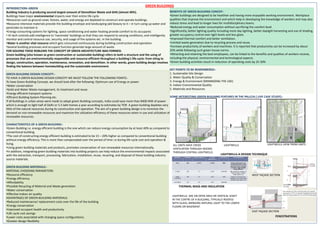
SOME INTERESTING GREEN BUILDING FEATURES IN THE PALLCIA ( LIVE CASE STUDY):-
ALL UNITS HAVE CROSS
VENTILATION THROUGH ROOMS
THROUGH CENTRAL LIGHTWELLS
LIGHTWELLS LIGHTWELLS VIEW FROM UNITS
LIGHTWELLS-A DESIGN TECHNIQUE
THERMAL MASS AND INSULATION
WEST FAÇADE SECTION
EAST FAÇADE SECTION
FENESTRATIONS
LIGHTWELLS ARE AN OPEN AREA OR VERTICAL SHAFT
IN THE CENTRE OF A BUILDING, TYPICALLY ROOFED
WITH GLASS, BRINGING NATURAL LIGHT TO THE LOWER
FLOORS OR BASEMENT.
Sr.No PARAMETERS DESCRIPTION ANALYSIS PRESENTATION
1 LOCATION NH-8, Bandar Sindri, Dist. Ajmer, Kishangarh, Rajasthan 305817 Site is well connected to NH-8.
But too far from nearby major cities Jaipur
& Kishangah.
2 APPROACH •16km from Birla International School towards West
•93km from 200ft Bypass Jaipur.
•21km from Kishangarh Bus Depot towards east.
12Mwide road access to apartment to
make easy and feasible approach
Radial road patterns planned to maintain
traffic and separation between buildings .
signage were used.
3 TEMPERATURE •Average temp.:-25 degree Celsius.
•Max Temp.:-44 degree Celsius. (in the month of May)
•Min temp.:-10.6 degree Celsius. (in the month of January)
•Precipitation:-473 mm per sq.m.
4 WIND DIRECTION North-East to South-West. For proper ventilation sandstone Jalis were
provided on south & north
No provision was made to control wind
flow during winter resulting no thermal
comfort during winters.
5 TOPOGRAPHY AND SOIL
CONDITIONS
Flat land
Rocky bed can be observed, deformation of which has caused the regional soil to be sandy in
nature with percentages of clay and is comparatively good.
Easy to construct.
The land had to be dug for catchment area
and its services.
6 VEGETATION Eaucalyptus, Kikar, Neem, Babool, Ashoka , Gulmohar, Peepal All trees are planted by CPWD itself .
All the non seasonal plants planted in
polyhouse.
Huge vegetation increases the rain around.
7 AMENITIES Bank, general store, canteen , proposed school, college, polyhouse,gardens No nearby worshipping area
Proposed school – 25.1 M
Proposed Hospital- 185 M
Bank of India- 40.0 M
Playground – 65 M
8 BUILT FABRIC AROUND
SITE
Site is surrounded with apartments and institutional building around North- E.S.S.
South- Proposed Apartments
West- G+5 Apartments
East- Leftover space
9 ORIENTATION Site is oriented in North South direction
CENTRAL UNIVERSITY OF RAJASTHAN
E
N
S
W
SHADED COURTYARDS SANDSTONE JAALI DETAIL VAULTED JAALIS
Apartments
SUPPLY
STORAGE AND
CONTROL
SURROUNDINGS OF TYPE C APPARTMENTS
TYPE C APPARTMENTS
PARKING
TYPE B APPARTMENTS
G+2
PLAN OF CATCHMENT AREA AND SERVICE HOUSES
PLAN OF SERVICE HOUSES
GREEN SPACES
CIRCULATION AND
PARKING
BEDROOMS
TOILETS
KITCHENS
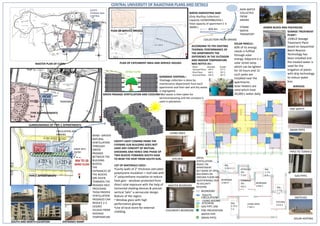
SOUTH AND NORTH ELEVATION ENTRANCE RAMP
ADMIN BLOCK AND POLYHOUSE
CENTRAL UNIVERSITY OF RAJASTHAN PLANS AND DETAILS
MASTER PLAN OF CURAJ
WATER HARVESTING MAP
(Only Rooftop Collection)
Capacity-10296599862456 L
Total capacity of apartment C is
38400 L
RAIN WATER
COLLECTED
FROM
DRAINS
STORM
WATER
TRANSPORT
BEDROOM
3.9x4.9
LIVING AREA
7.3x4.1
BEDROOM
4.4x4.1
KITCHEN
2.9 X 3
COMMON
TOI.
2x2.5
ATTACHED
TOI.
2.1x3
BAL.
2.75 X
1.2
BAL.
2.26 X 1.5
BAL.
1.7 X
1.7
LIVING AREA
KITCHEN
MASTER BEDROOM
CHILDREN’S BEDROOM
SERVICES
FIRE SAFETY
DRAIN PIPES
PIPES TO TERRACE
GAS PIPES
SWITCHES
SOLAR HEATING
894.4m
BAL.
1.7 X
1.7
COLLECTION FROM DRAINS
DROP OFF/
ENTRY
WIND –DRIVEN
NATURAL
VENTILLATION
THROUGH
GREEN
PASSAGE
BETWEEN THE
BUILDING
BLOCKS.
THE
ENTRANCES OF
THE BLOCKS
ARE GIVEN
TOWARDS THE
PASSAGE FACE
PROVIDING
THEM PROPER
VENTILLATION.
PASSAGES CAN
REDUCE 2-3
DEGREE
CELSIUS FROM
AVERAGE
TEMPERATURE
GAS PIPE LINE
FIRE PREVENTION
WATER PIPE
DRAIN PIPES
W
WIND FLOW
GREEN PASSAGE VENTILLATION AND COOLING
D
A
C
B
EXCEPT LIGHT COMING FROM THE
EVENING SUN BUILDING DOES NOT
HAVE ANY CONCEPT OF MUTUAL
SHEDDING AND HENCE ONE PHASE OF
TWO BLOCKS TOWARDS SOUTH HASE
TO BEAR THE HEAT FROM SOUTH SUN.
WIND FLOW
CIRCULATION
LIVING ROOMS
SEWAGE TREATMENT
PLANT:-
120KLD Sewage
Treatment Plant
based on Sequential
Batch Reactor
Technology has
been installed and
the treated water is
used for the
irrigation of plants
with drip technology
to reduce water
loss.
CROSS
VENTILLATION
INSIDE THE
APPARTMENT.
BUT MORE OF OPEN
BALCONIES ON
GROUND FLOOR ARE
QUESTIONABLE DUE
TO SECURITY
REASONS
SOLAR PANELS:-
60% of its energy
needs is fulfiled
through solar
energy. Adjacent is a
solar street lamp
which can be lighten
for 16 hours and 12
such poles are
installed near the
apartments.
Solar heaters are
used which heat
20,000 L water daily.
ACCORDING TO THE EXISTING
THERMAL PERFORMANCE OF
THE APARTMENTS THE
DIFFERENCE IN THE OUTDOOR
AND INDOOR TEMPERATURE
WAS NOTED AS:-
LIST OF MATERIALS USED:-
•Cavity walls of 2” thickness extruded
polystyrene insulation + roof slab with
3” polyurethane insulation to reduce
heat gain - windows protected from
direct solar exposure with the help of
horizontal shading devices & precast
vertical ‘Jalis’’ a vernacular design
feature of the region.
• Window glass with high
performance glazing.
•Use of local stone for external
cladding.
GARMAGE DISPOSAL:-
•Garbage collection is done by
maintenance department from each
apartments and then wet and dry waste
is segregated.
•Wet waste is then taken for
vermicomposting and the compost is
used in plantation.

Case study

  • 1.
    GREEN BUILDINGS INTRODECTION:-GREEN Building Industryis producing second largest amount of Demolition Waste and GHG (almost 40%). Buildings have major environmental impacts over their entire life cycle. •Resources such as ground cover, forests, water, and energy are depleted to construct and operate buildings. •Resource-intensive materials provide the building envelope and landscaping add beauty to it – in turn using up water and pesticides to maintain it. •Energy-consuming systems for lighting, space conditioning and water heating provide comfort to its occupants • Hi-tech controls add intelligence to ‘inanimate' buildings so that they can respond to varying conditions, and intelligently monitor and control resource use, security, and usage of fire systems etc. in the building. •Water is another vital resource which gets consumed continuously during building construction and operation. •Several building processes and occupant function generate large amount of waste. FOR SOLVING THESE ROBLEMS THE CONCEPT OF GREEN ARCHITECTURE WAS FORMED. Green building (also known as green construction or sustainable building) refers to both a structure and the using of processes that are environmentally responsible and resource-efficient throughout a building's life-cycle: from siting to design, construction, operation, maintenance, renovation, and demolition. In other words, green building design involves finding the balance between homebuilding and the sustainable environment. GREEN BUILDING DESIGN CONCEPT:- TO HAVE A GREEN BUILDING DESIGN CONCEPY WE MUST FOLLOW THE FOLLOWING POINTS:- To have Green Building Concept, we should look after the following: Optimum use of Energy or power •Water conservation •Solid and Water Waste management, its treatment and reuse •Energy efficient transport systems •Efficient Building System Planning etc. If all Buildings in urban areas were made to adopt green Building concepts, India could save more than 8400 MW of power which is enough to light half of Delhi or 5.5 lakh homes a year according to estimates by TERI A green building depletes very little of the natural resources during its construction and operation. The aim of a green building design is to minimize the demand on non-renewable resources and maximize the utilization efficiency of these resources when in use and utilization of renewable resources. CHARACTERISTICS OF A GREEN BUILDING:- •Green Building i.e. energy efficient building is the one which can reduce energy consumption by at least 40% as compared to conventional building. •The cost of constructing energy efficient building is estimated to be 15 – 20% higher as compared to conventional building without energy efficiency. This is more than compensated over the period of time i.e during life cycle cost and operation & living. •Using green building materials and products, promotes conservation of non renewable resources internationally. •In addition, integrating green building materials into building projects can help reduce the environmental impacts associated with the extraction, transport, processing, fabrication, installation, reuse, recycling, and disposal of these building industry source materials. GREEN BUILDING MATERIALS:- MATERIAL CHOOSING PARAMETERS- •Resource efficiency •Energy efficiency •Affordability •Possible Recycling of Material and Waste generation •Water conservation •Effective Indoor air quality ADVANTAGES OF GREEN BUILDING MATERIALS: •Reduced maintenance/ replacement costs over the life of the building •Energy conservation •Improved occupant health and productivity •Life cycle cost savings •Lower costs associated with changing space configurations. •Greater design flexibility BENEFITS OF GREEN BUILDING CONCEP:- •Green buildings are designed to be healthier and having more enjoyable working environment. Workplace qualities that improve the environment and which help in developing the knowledge of workers and may also reduce stress and lead to longer lives for multidisciplinary teams. •Reduced energy and water consumption without sacrificing the comfort level. •Significantly, better lighting quality including more day lighting, better daylight harvesting and use of shading, greater occupancy control over light levels and less glare. •Improved thermal comfort and better ventilation. •Limited waste generation due to recycling process and reuse. •Increase productivity of workers and machines. It is reported that productivity can be increased by about 25% while following such green house norms. •Attracting and retaining the best employees, can be linked to the benefits and qualities of workers receive, including the physical, environmental and technological aspects. •Green building activities result in reduction of operating costs by 25-30% KEY POINTS TO BE REMEMBERED:- 1. Sustainable Site Design 2. Water Quality & Conservation 3. Energy & Environment (MINIMIZING THE USE) 4. Indoor Environmental Quality 5. Materials and Resources SOME INTERESTING GREEN BUILDING FEATURES IN THE PALLCIA ( LIVE CASE STUDY):- ALL UNITS HAVE CROSS VENTILATION THROUGH ROOMS THROUGH CENTRAL LIGHTWELLS LIGHTWELLS LIGHTWELLS VIEW FROM UNITS LIGHTWELLS-A DESIGN TECHNIQUE THERMAL MASS AND INSULATION WEST FAÇADE SECTION EAST FAÇADE SECTION FENESTRATIONS LIGHTWELLS ARE AN OPEN AREA OR VERTICAL SHAFT IN THE CENTRE OF A BUILDING, TYPICALLY ROOFED WITH GLASS, BRINGING NATURAL LIGHT TO THE LOWER FLOORS OR BASEMENT.
  • 2.
    Sr.No PARAMETERS DESCRIPTIONANALYSIS PRESENTATION 1 LOCATION NH-8, Bandar Sindri, Dist. Ajmer, Kishangarh, Rajasthan 305817 Site is well connected to NH-8. But too far from nearby major cities Jaipur & Kishangah. 2 APPROACH •16km from Birla International School towards West •93km from 200ft Bypass Jaipur. •21km from Kishangarh Bus Depot towards east. 12Mwide road access to apartment to make easy and feasible approach Radial road patterns planned to maintain traffic and separation between buildings . signage were used. 3 TEMPERATURE •Average temp.:-25 degree Celsius. •Max Temp.:-44 degree Celsius. (in the month of May) •Min temp.:-10.6 degree Celsius. (in the month of January) •Precipitation:-473 mm per sq.m. 4 WIND DIRECTION North-East to South-West. For proper ventilation sandstone Jalis were provided on south & north No provision was made to control wind flow during winter resulting no thermal comfort during winters. 5 TOPOGRAPHY AND SOIL CONDITIONS Flat land Rocky bed can be observed, deformation of which has caused the regional soil to be sandy in nature with percentages of clay and is comparatively good. Easy to construct. The land had to be dug for catchment area and its services. 6 VEGETATION Eaucalyptus, Kikar, Neem, Babool, Ashoka , Gulmohar, Peepal All trees are planted by CPWD itself . All the non seasonal plants planted in polyhouse. Huge vegetation increases the rain around. 7 AMENITIES Bank, general store, canteen , proposed school, college, polyhouse,gardens No nearby worshipping area Proposed school – 25.1 M Proposed Hospital- 185 M Bank of India- 40.0 M Playground – 65 M 8 BUILT FABRIC AROUND SITE Site is surrounded with apartments and institutional building around North- E.S.S. South- Proposed Apartments West- G+5 Apartments East- Leftover space 9 ORIENTATION Site is oriented in North South direction CENTRAL UNIVERSITY OF RAJASTHAN E N S W SHADED COURTYARDS SANDSTONE JAALI DETAIL VAULTED JAALIS
  • 3.
    Apartments SUPPLY STORAGE AND CONTROL SURROUNDINGS OFTYPE C APPARTMENTS TYPE C APPARTMENTS PARKING TYPE B APPARTMENTS G+2 PLAN OF CATCHMENT AREA AND SERVICE HOUSES PLAN OF SERVICE HOUSES GREEN SPACES CIRCULATION AND PARKING BEDROOMS TOILETS KITCHENS SOUTH AND NORTH ELEVATION ENTRANCE RAMP ADMIN BLOCK AND POLYHOUSE CENTRAL UNIVERSITY OF RAJASTHAN PLANS AND DETAILS MASTER PLAN OF CURAJ WATER HARVESTING MAP (Only Rooftop Collection) Capacity-10296599862456 L Total capacity of apartment C is 38400 L RAIN WATER COLLECTED FROM DRAINS STORM WATER TRANSPORT BEDROOM 3.9x4.9 LIVING AREA 7.3x4.1 BEDROOM 4.4x4.1 KITCHEN 2.9 X 3 COMMON TOI. 2x2.5 ATTACHED TOI. 2.1x3 BAL. 2.75 X 1.2 BAL. 2.26 X 1.5 BAL. 1.7 X 1.7 LIVING AREA KITCHEN MASTER BEDROOM CHILDREN’S BEDROOM SERVICES FIRE SAFETY DRAIN PIPES PIPES TO TERRACE GAS PIPES SWITCHES SOLAR HEATING 894.4m BAL. 1.7 X 1.7 COLLECTION FROM DRAINS DROP OFF/ ENTRY WIND –DRIVEN NATURAL VENTILLATION THROUGH GREEN PASSAGE BETWEEN THE BUILDING BLOCKS. THE ENTRANCES OF THE BLOCKS ARE GIVEN TOWARDS THE PASSAGE FACE PROVIDING THEM PROPER VENTILLATION. PASSAGES CAN REDUCE 2-3 DEGREE CELSIUS FROM AVERAGE TEMPERATURE GAS PIPE LINE FIRE PREVENTION WATER PIPE DRAIN PIPES W WIND FLOW GREEN PASSAGE VENTILLATION AND COOLING D A C B EXCEPT LIGHT COMING FROM THE EVENING SUN BUILDING DOES NOT HAVE ANY CONCEPT OF MUTUAL SHEDDING AND HENCE ONE PHASE OF TWO BLOCKS TOWARDS SOUTH HASE TO BEAR THE HEAT FROM SOUTH SUN. WIND FLOW CIRCULATION LIVING ROOMS SEWAGE TREATMENT PLANT:- 120KLD Sewage Treatment Plant based on Sequential Batch Reactor Technology has been installed and the treated water is used for the irrigation of plants with drip technology to reduce water loss. CROSS VENTILLATION INSIDE THE APPARTMENT. BUT MORE OF OPEN BALCONIES ON GROUND FLOOR ARE QUESTIONABLE DUE TO SECURITY REASONS SOLAR PANELS:- 60% of its energy needs is fulfiled through solar energy. Adjacent is a solar street lamp which can be lighten for 16 hours and 12 such poles are installed near the apartments. Solar heaters are used which heat 20,000 L water daily. ACCORDING TO THE EXISTING THERMAL PERFORMANCE OF THE APARTMENTS THE DIFFERENCE IN THE OUTDOOR AND INDOOR TEMPERATURE WAS NOTED AS:- LIST OF MATERIALS USED:- •Cavity walls of 2” thickness extruded polystyrene insulation + roof slab with 3” polyurethane insulation to reduce heat gain - windows protected from direct solar exposure with the help of horizontal shading devices & precast vertical ‘Jalis’’ a vernacular design feature of the region. • Window glass with high performance glazing. •Use of local stone for external cladding. GARMAGE DISPOSAL:- •Garbage collection is done by maintenance department from each apartments and then wet and dry waste is segregated. •Wet waste is then taken for vermicomposting and the compost is used in plantation.