INTRODUCTION
WHAT?
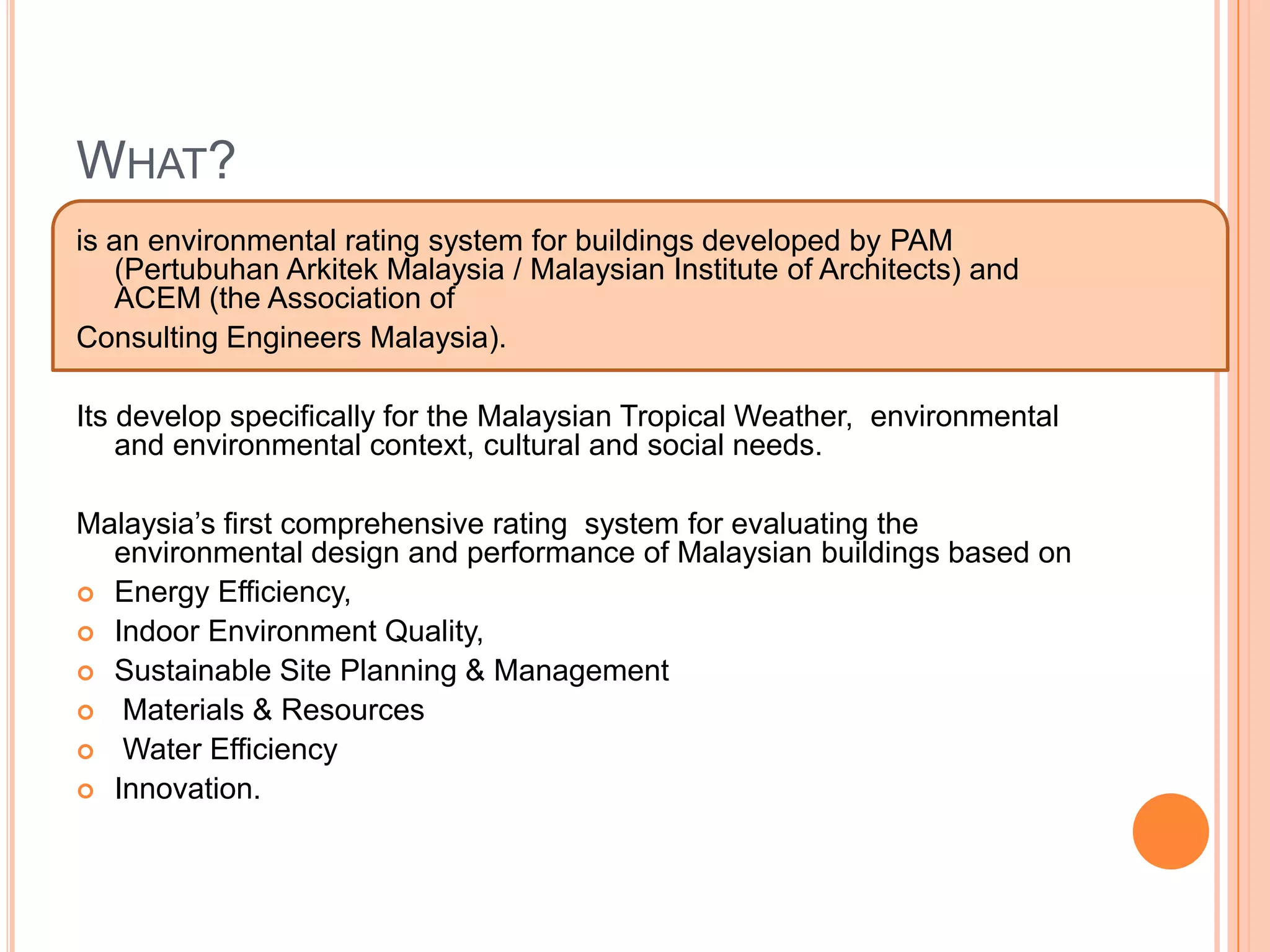
is an environmental rating system for buildings developed by PAM
   (Pertubuhan Arkitek Malaysia / Malaysian Institute of Architects) and
   ACEM (the Association of
Consulting Engineers Malaysia).

Its develop specifically for the Malaysian Tropical Weather, environmental
    and environmental context, cultural and social needs.

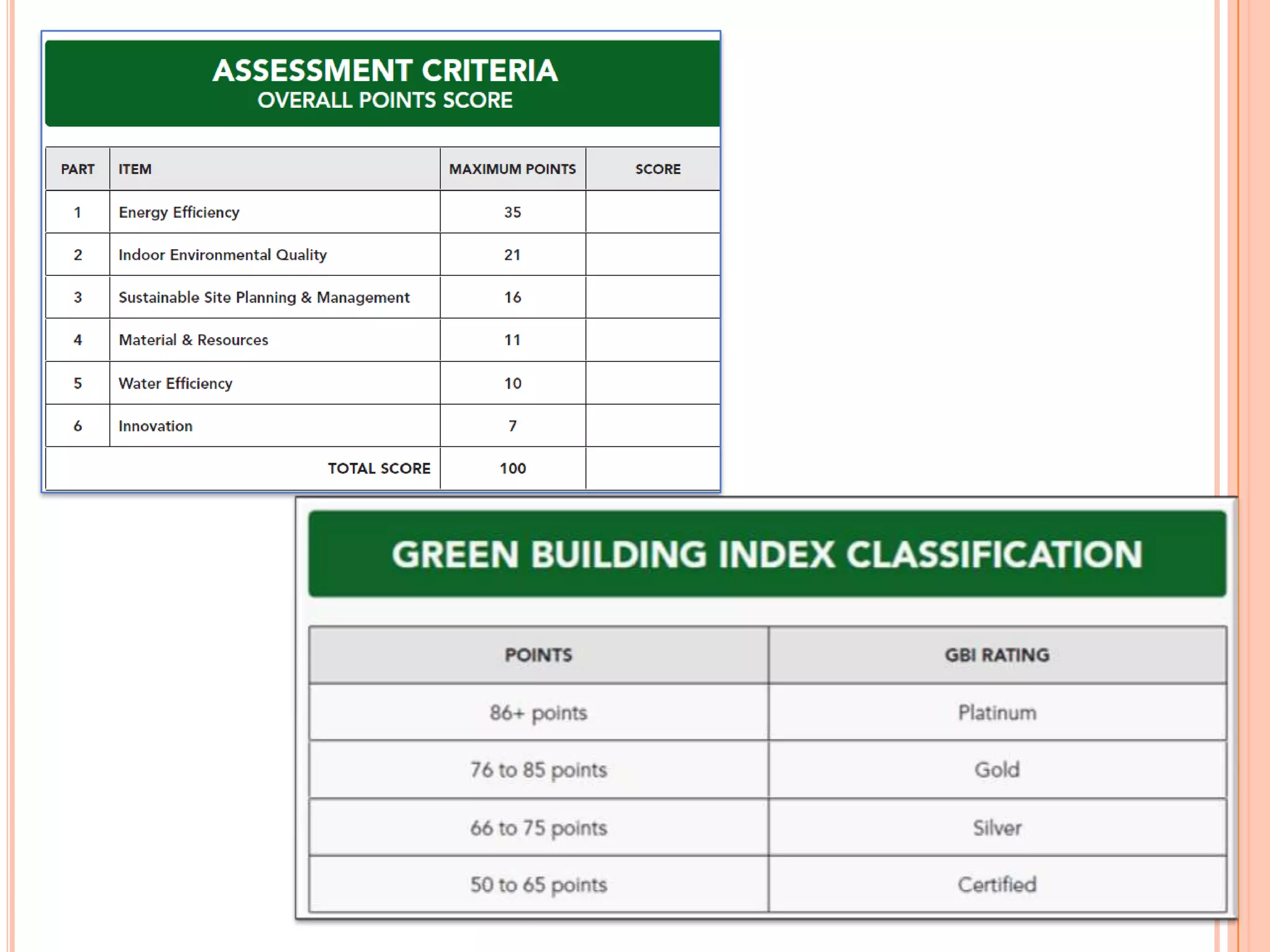
Malaysia’s first comprehensive rating system for evaluating the
  environmental design and performance of Malaysian buildings based on
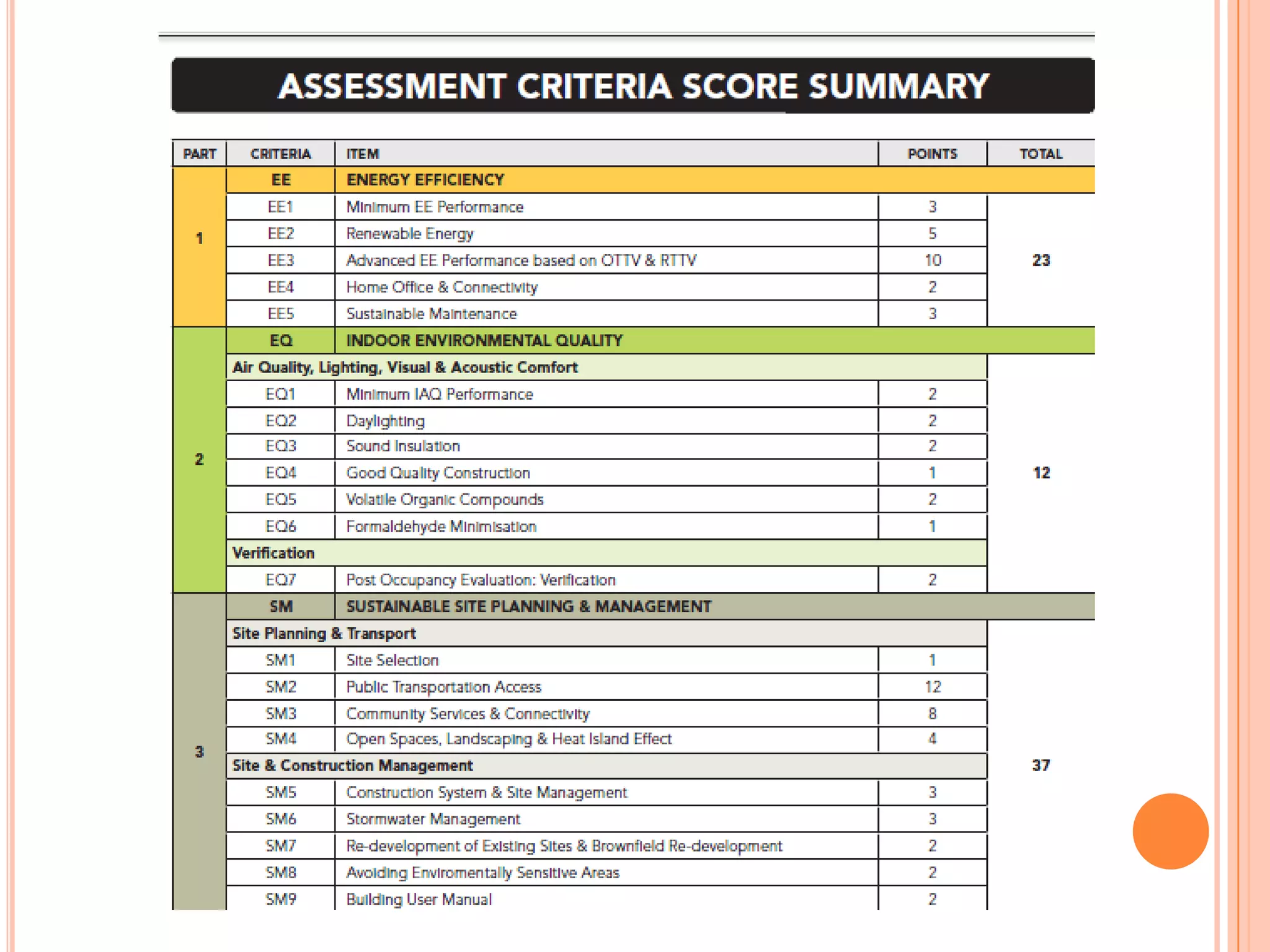
 Energy Efficiency,
 Indoor Environment Quality,
 Sustainable Site Planning & Management
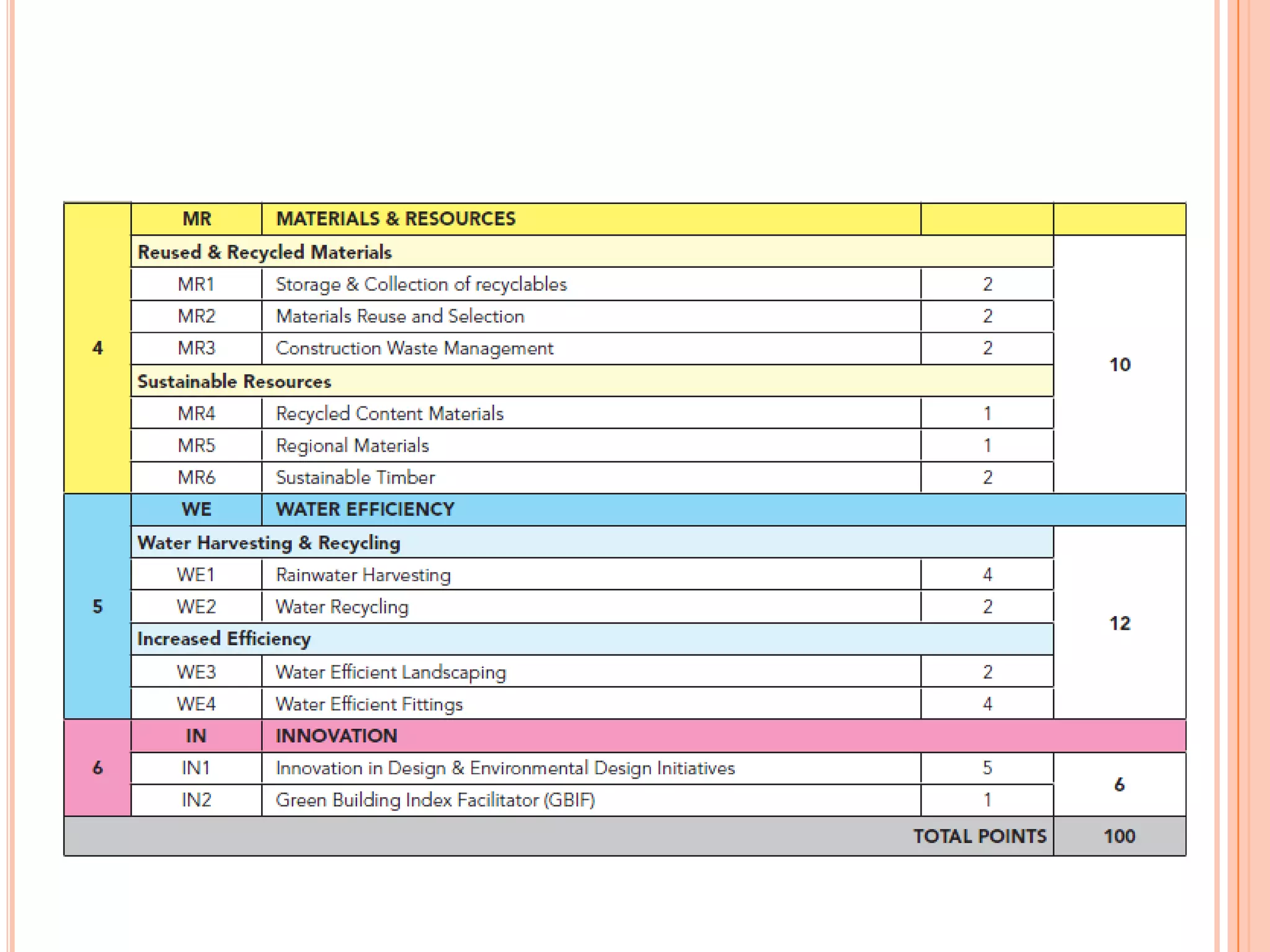
 Materials & Resources
 Water Efficiency
 Innovation.
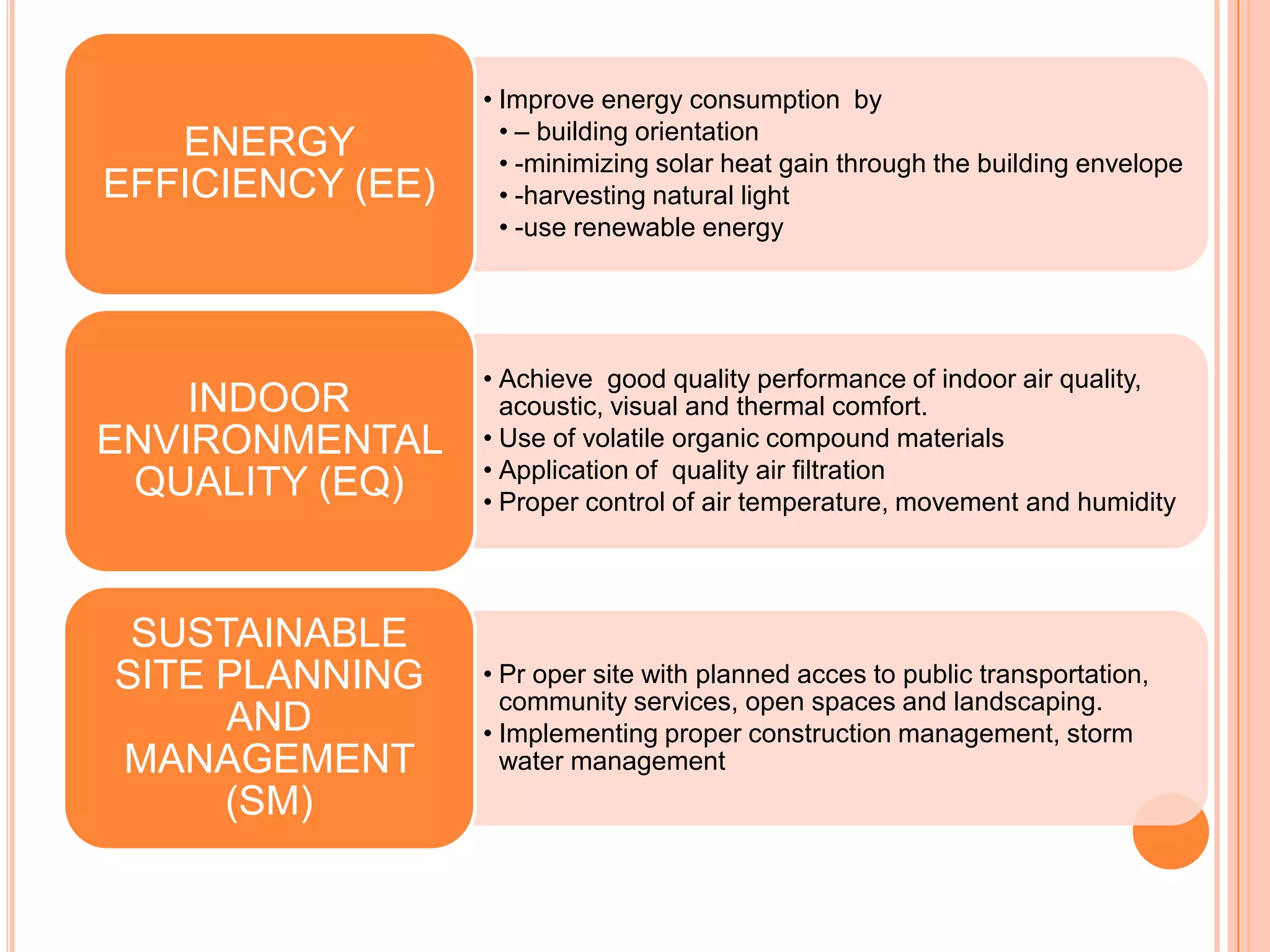
• Improve energy consumption by
                    • – building orientation
   ENERGY           • -minimizing solar heat gain through the building envelope
EFFICIENCY (EE)     • -harvesting natural light
                    • -use renewable energy


                  • Achieve good quality performance of indoor air quality,
    INDOOR          acoustic, visual and thermal comfort.
ENVIRONMENTAL     • Use of volatile organic compound materials
                  • Application of quality air filtration
 QUALITY (EQ)     • Proper control of air temperature, movement and humidity


 SUSTAINABLE
SITE PLANNING     • Pr oper site with planned acces to public transportation,
                    community services, open spaces and landscaping.
     AND          • Implementing proper construction management, storm
MANAGEMENT          water management
     (SM)
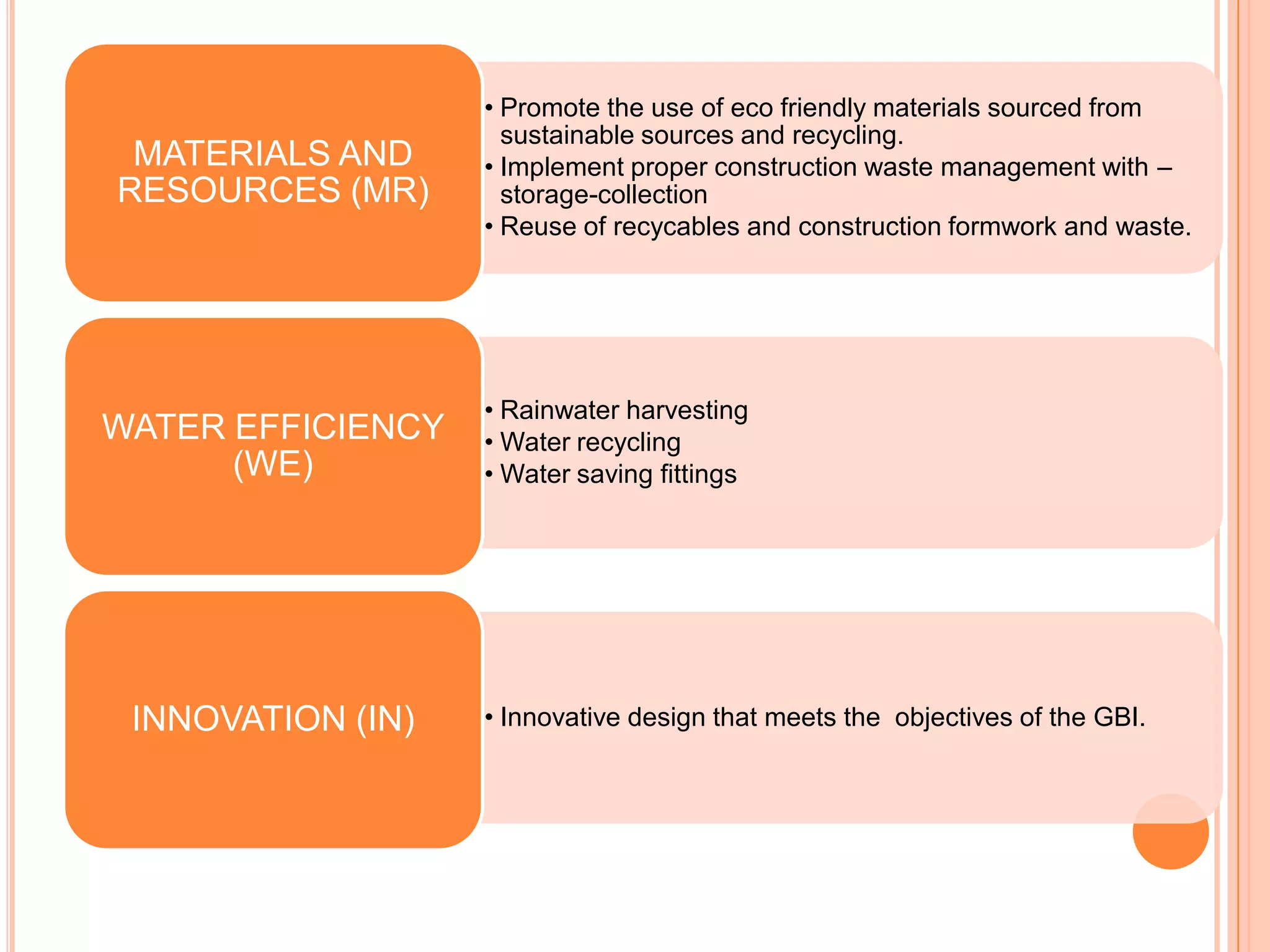
• Promote the use of eco friendly materials sourced from
                     sustainable sources and recycling.
 MATERIALS AND     • Implement proper construction waste management with –
RESOURCES (MR)       storage-collection
                   • Reuse of recycables and construction formwork and waste.


                   • Rainwater harvesting
WATER EFFICIENCY   • Water recycling
      (WE)         • Water saving fittings


 INNOVATION (IN)   • Innovative design that meets the objectives of the GBI.
GBI IS CREATED TO?
• Define green buildings by establishing a common language and
   standard of
   measurement;
• Promote integrated, whole-building design;
• Recognise and reward environmental leadership;
• Transform the built environment to reduce it’s environmental impact;
   and
• Ensure new buildings remain relevant in the future and existing
   buildings are
refurbished and upgraded properly to remain relevant.
 The developers will be able to plan more sustainable and green
   projects.
 Allow us to undertake development in a more environmental –friendly
   way
 To get better siting, design, construction, operation, maintenance and
   removal
WHO CAN USE THE GBI?


All members of Project Teams, Building owners, Developers and other
   interested
parties (including Contractors, Government and Design & Build
  Contractors)


   To validate environmental initiatives at the design phase of new
    construction
   encouraged on all such projects to assess and improve their
    environmental attributes.
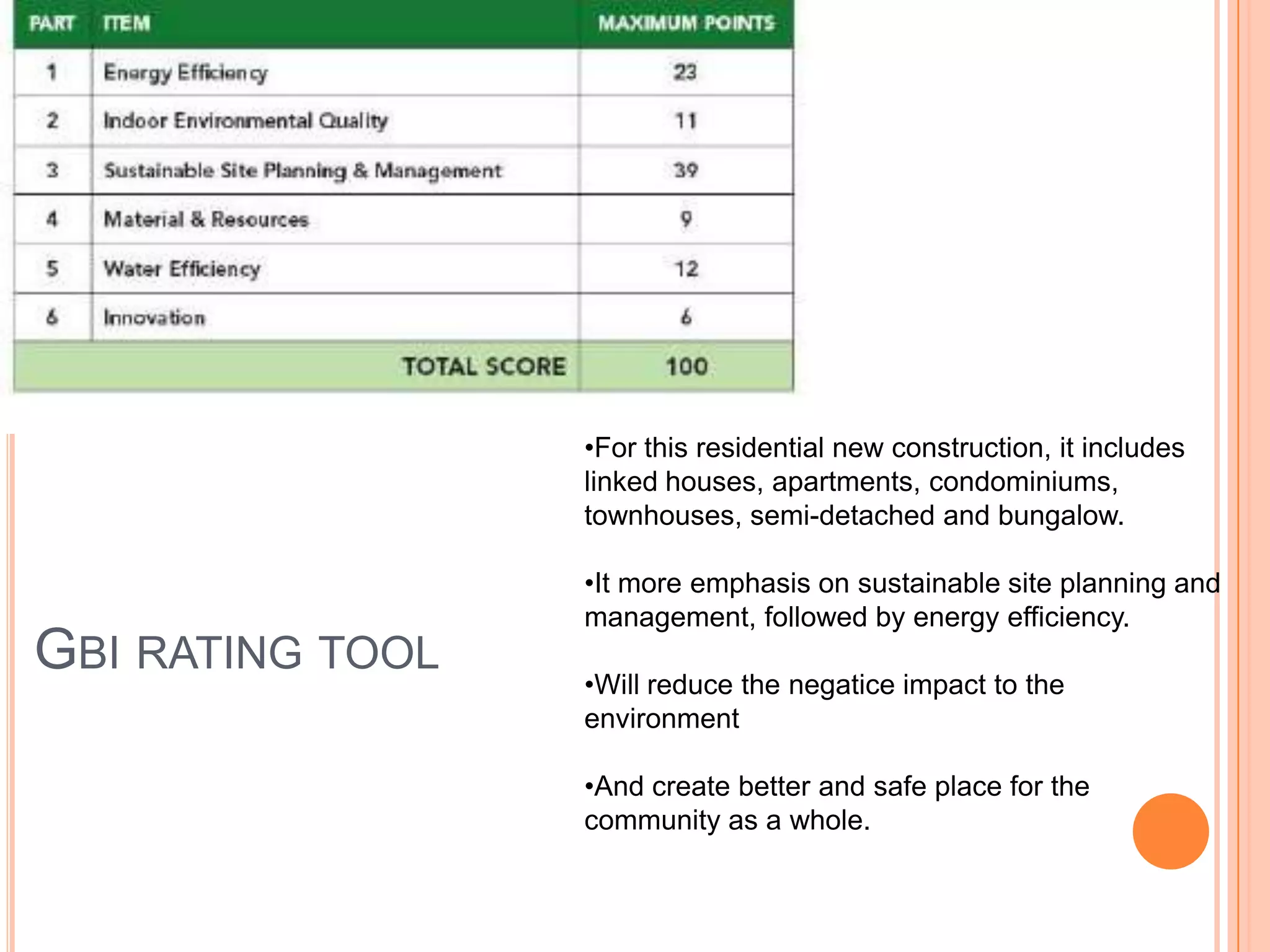
•For this residential new construction, it includes
                  linked houses, apartments, condominiums,
                  townhouses, semi-detached and bungalow.

                  •It more emphasis on sustainable site planning and
                  management, followed by energy efficiency.
GBI RATING TOOL   •Will reduce the negatice impact to the
                  environment

                  •And create better and safe place for the
                  community as a whole.
DESIGN REFERENCE GUIDE
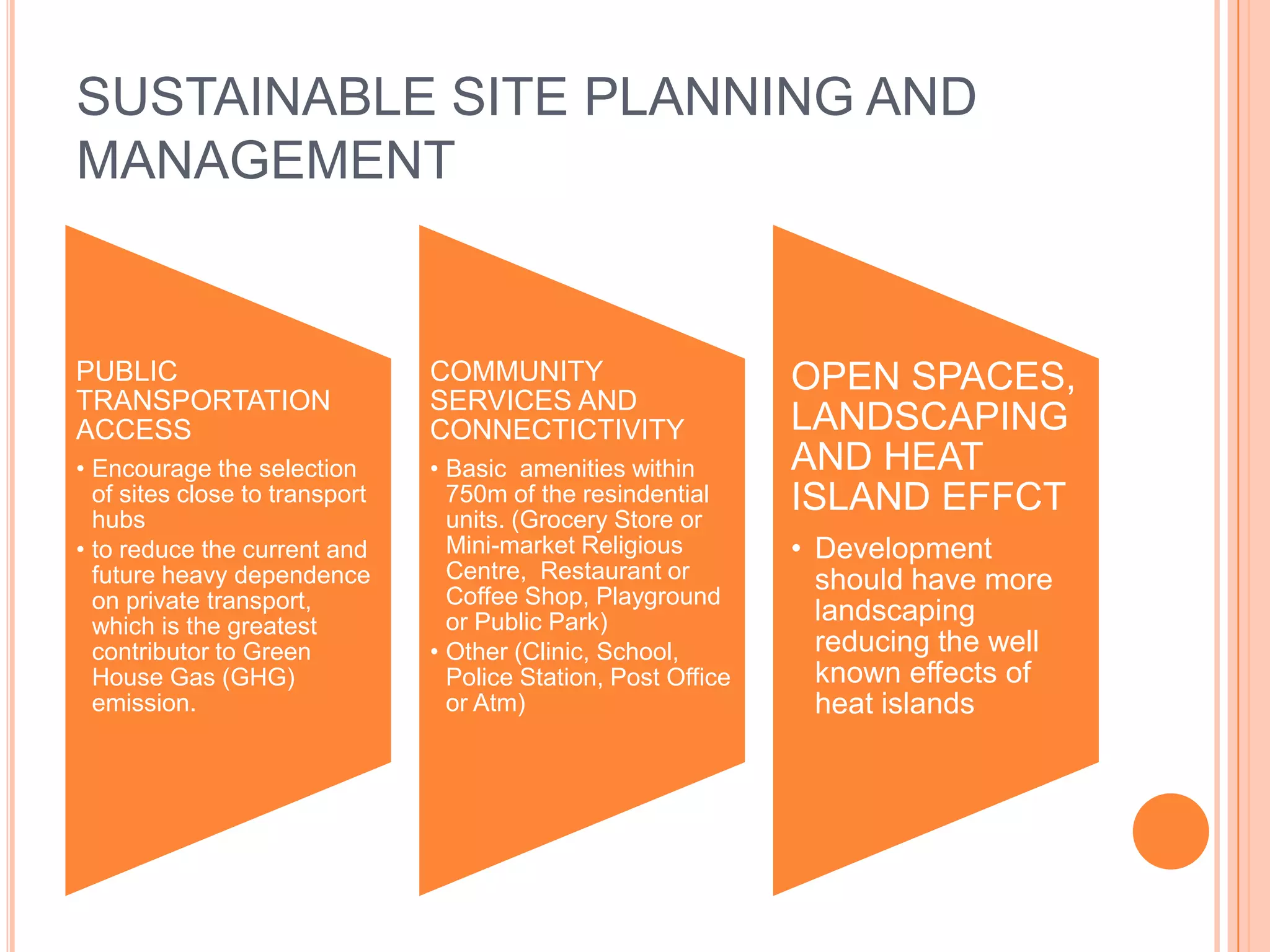
SUSTAINABLE SITE PLANNING AND
MANAGEMENT


PUBLIC                          COMMUNITY                       OPEN SPACES,
TRANSPORTATION                  SERVICES AND
ACCESS                          CONNECTICTIVITY                 LANDSCAPING
• Encourage the selection       • Basic amenities within        AND HEAT
  of sites close to transport
  hubs
                                  750m of the resindential
                                  units. (Grocery Store or
                                                                ISLAND EFFCT
• to reduce the current and       Mini-market Religious         • Development
  future heavy dependence         Centre, Restaurant or           should have more
  on private transport,           Coffee Shop, Playground
  which is the greatest           or Public Park)                 landscaping
  contributor to Green          • Other (Clinic, School,          reducing the well
  House Gas (GHG)                 Police Station, Post Office     known effects of
  emission.                       or Atm)                         heat islands
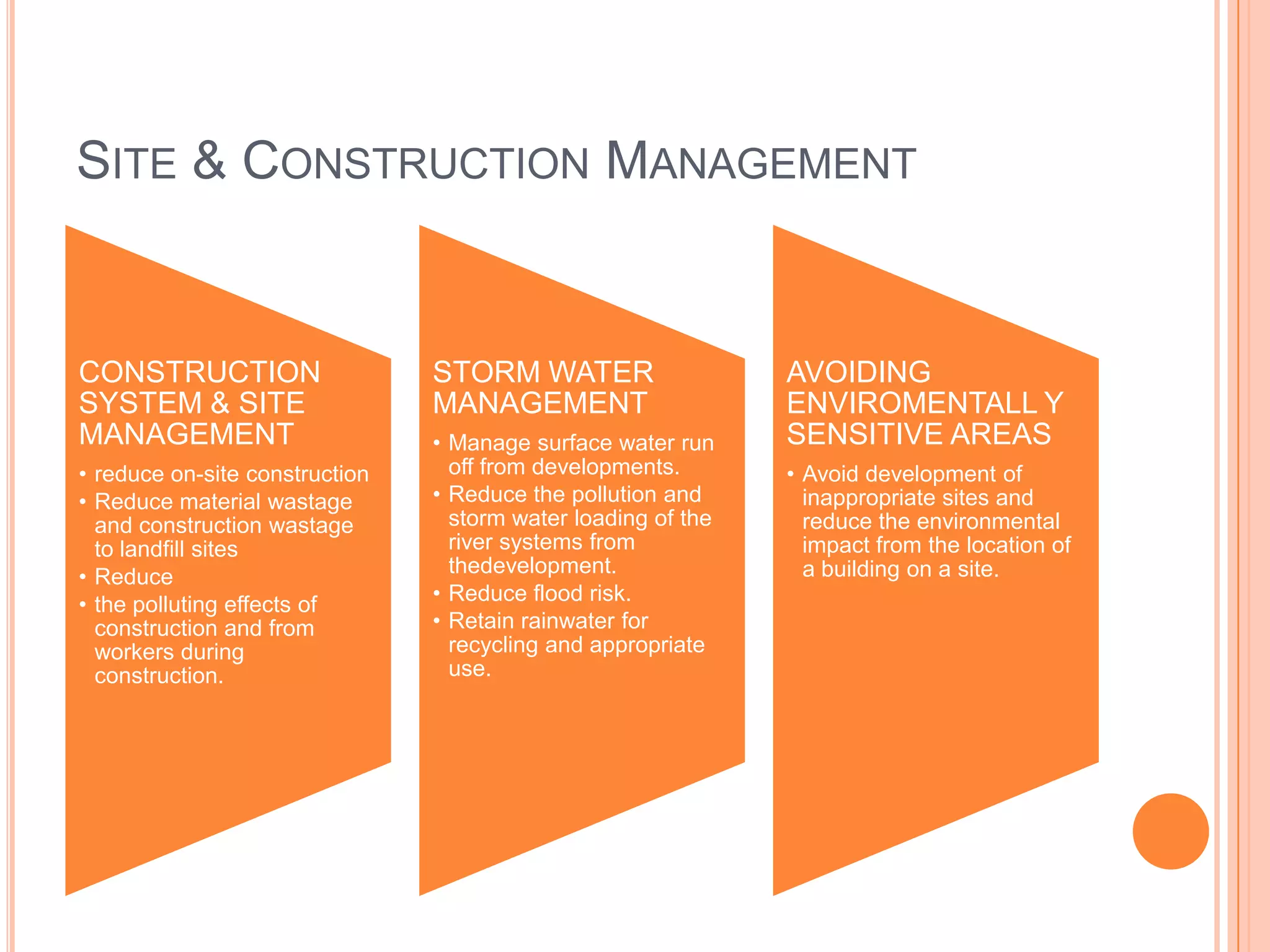
SITE & CONSTRUCTION MANAGEMENT


CONSTRUCTION                    STORM WATER                    AVOIDING
SYSTEM & SITE                   MANAGEMENT                     ENVIROMENTALL Y
MANAGEMENT                      • Manage surface water run     SENSITIVE AREAS
• reduce on-site construction     off from developments.       • Avoid development of
• Reduce material wastage       • Reduce the pollution and       inappropriate sites and
  and construction wastage        storm water loading of the     reduce the environmental
  to landfill sites               river systems from             impact from the location of
• Reduce                          thedevelopment.                a building on a site.
• the polluting effects of      • Reduce flood risk.
  construction and from         • Retain rainwater for
  workers during                  recycling and appropriate
  construction.                   use.
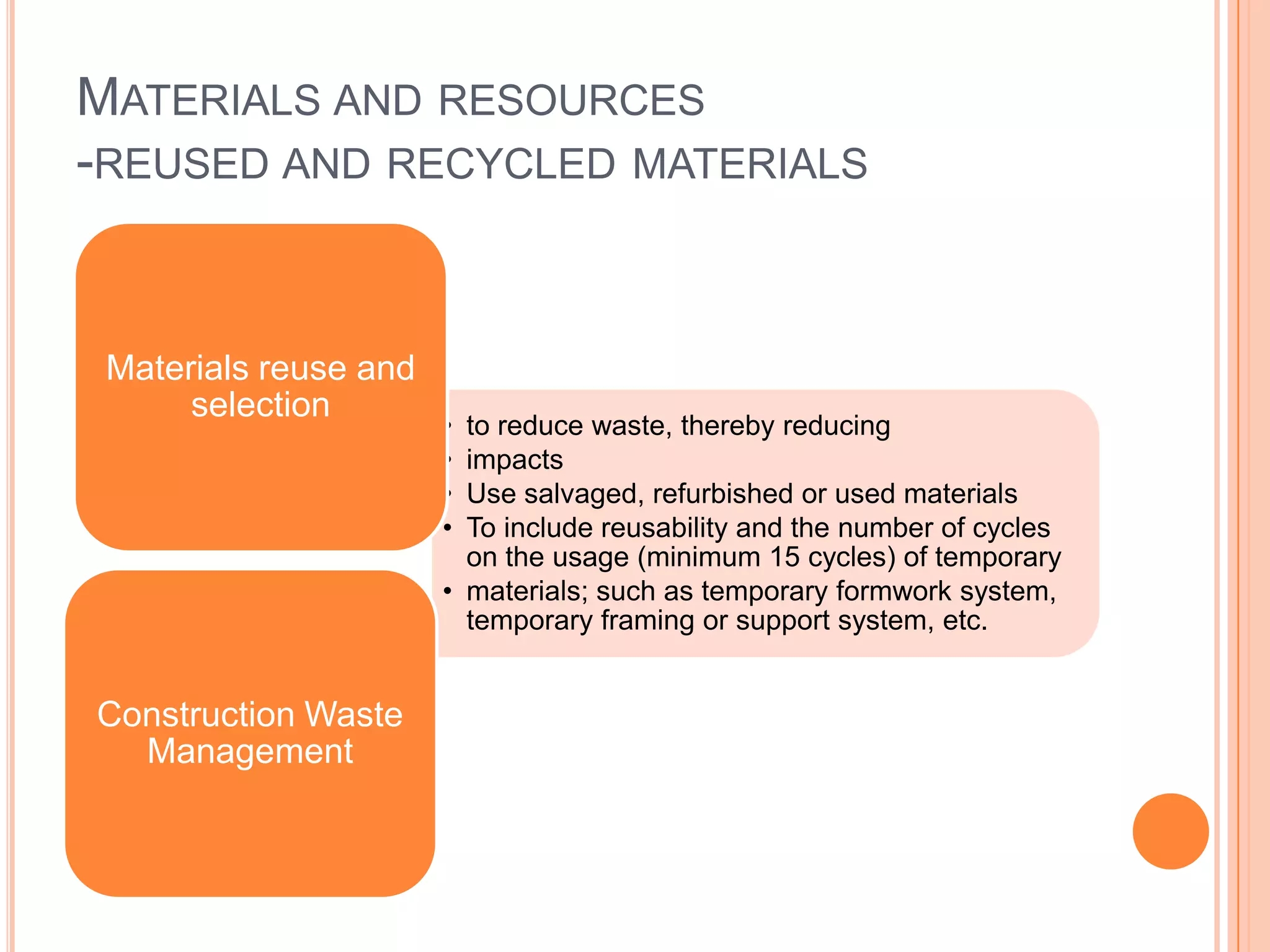
MATERIALS AND RESOURCES
-REUSED AND RECYCLED MATERIALS


 Materials reuse and
      selection
                       • to reduce waste, thereby reducing
                       • impacts
                       • Use salvaged, refurbished or used materials
                       • To include reusability and the number of cycles
                         on the usage (minimum 15 cycles) of temporary
                       • materials; such as temporary formwork system,
                         temporary framing or support system, etc.


Construction Waste
  Management
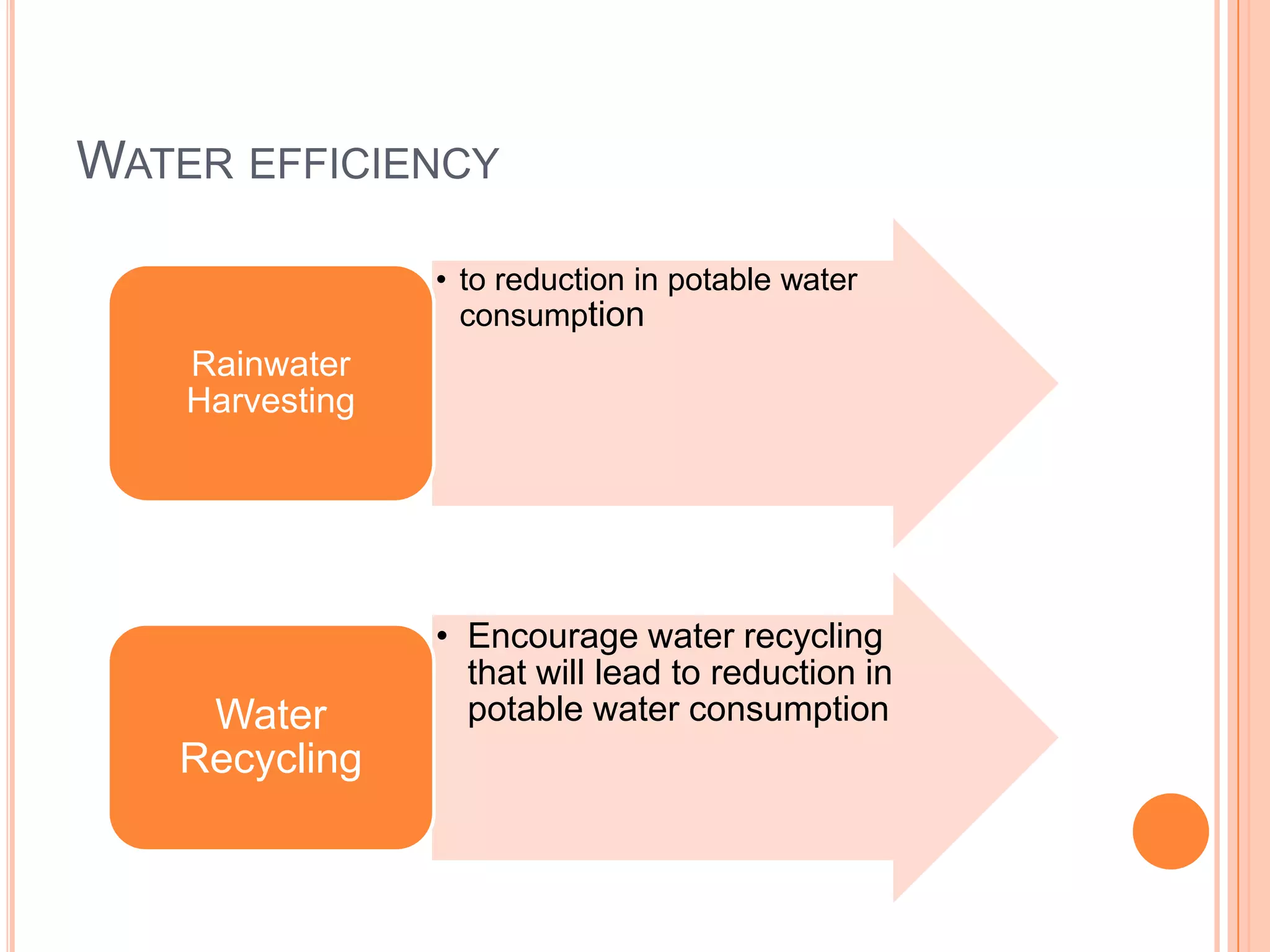
WATER EFFICIENCY

                 • to reduction in potable water
                   consumption
    Rainwater
    Harvesting


                 • Encourage water recycling
                   that will lead to reduction in
    Water          potable water consumption
   Recycling
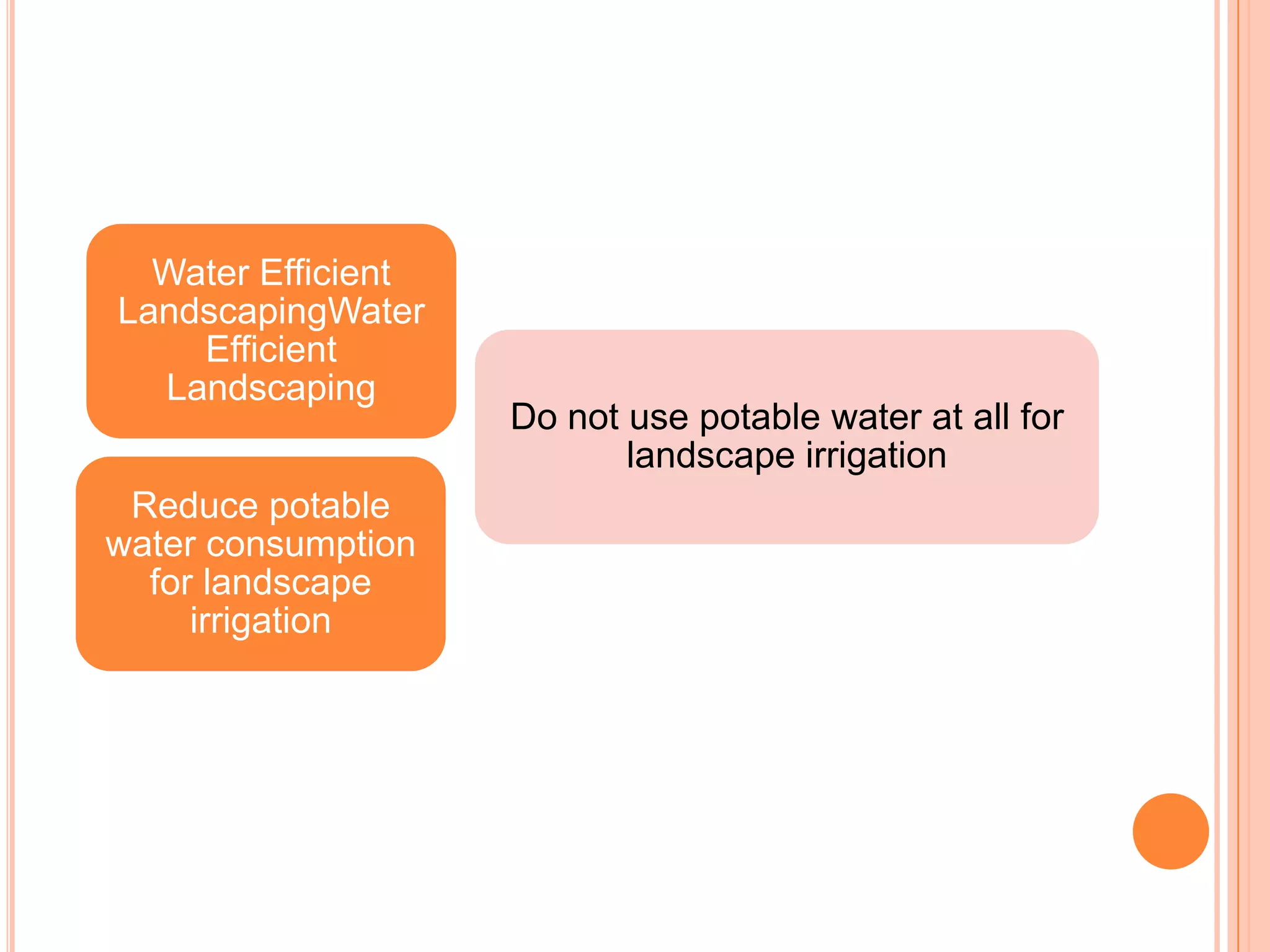
Water Efficient
LandscapingWater
    Efficient
  Landscaping
                    Do not use potable water at all for
                           landscape irrigation
 Reduce potable
water consumption
  for landscape
     irrigation
ENERGY EFFICIENCY
(EE)
RESIDENTIAL NEW CONSTRUCTION (RNC)
EE1 : MINIMUM EE PERFORMANCE [3 POINTS]


                    • To create EE awareness
                    • Promote the use of MS 1525
      INTENT
                    • To provide a thermally comfortable environment
                      to reduce the use of air-conditioning


                    • Establish minimum EE performance to reduce
      DESCRIPTION     energy consumption in building
                    • Reducing CO2 emission to the atmosphere


   APPROACH &       •Wall insulation
 IMPLEMENTATION     •Glazing
                    •Solar shading devices
EE2 : RENEWABLE ENERGY [5 POINTS ]


                   • To promote the use of renewable energy in
     INTENT          residential buildings for self supply in order to reduce
                     environmental impact due to emission of CO2


                   • To offset energy cost
  DESCRIPTION      • Promote green energy use


   APPROACH &              Solar hot water and building
 IMPLEMENTATION              intergrated photovoltaic
EE3 : ADVANCED EE PERFORMANCE BASED ON OTTV & RTTV [10 POINTS]


                    • To encourage enhancement to building to
                      provide a thermally comfortable environment to
 INTENT               reduce the use of air-conditioning in residential
                      building, thereby reducing CO2 emission


                     • Glazing
     APPROACH &      • Insulated roof
   IMPLEMENTATION    • Wall insulation
EE4 : HOME OFFICE & CONNETIVITY [2 POINTS]


                      • To encourage dual use spaces and working from
      INTENT            home, thereby discouraging commuting and
                        reducing CO2 emission


                      • Design residential homes with spaces for
    APPROACH &          home-like
  IMPLEMENTATION      • Provide high speed internet connection to
                        homes
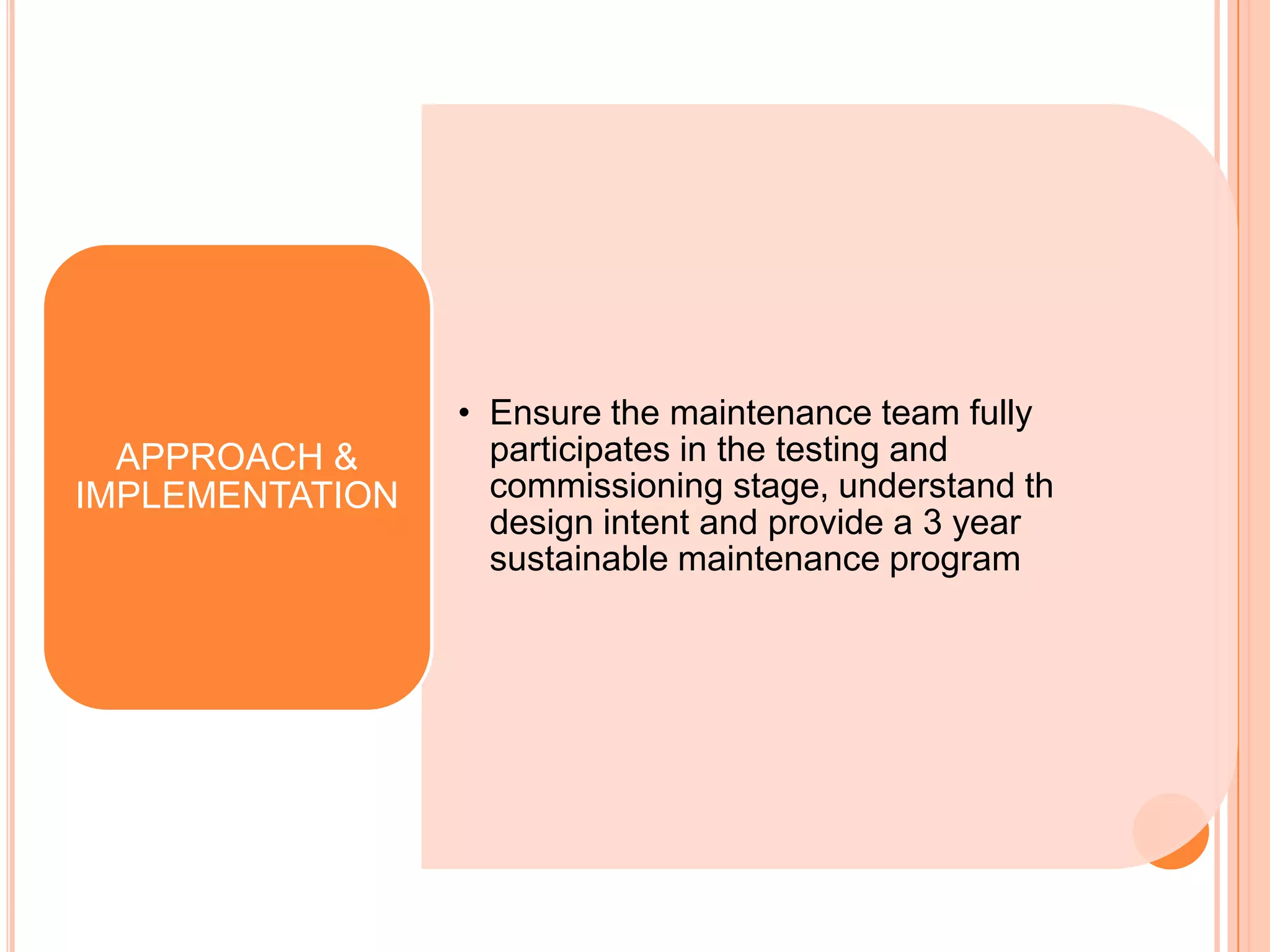
• Ensure the maintenance team fully
  APPROACH &       participates in the testing and
IMPLEMENTATION     commissioning stage, understand th
                   design intent and provide a 3 year
                   sustainable maintenance program
INDOOR EVIRONMENTAL
QUALITY (EQ)
RESIDENTIAL NEW CONSTRUCTION (RNC)
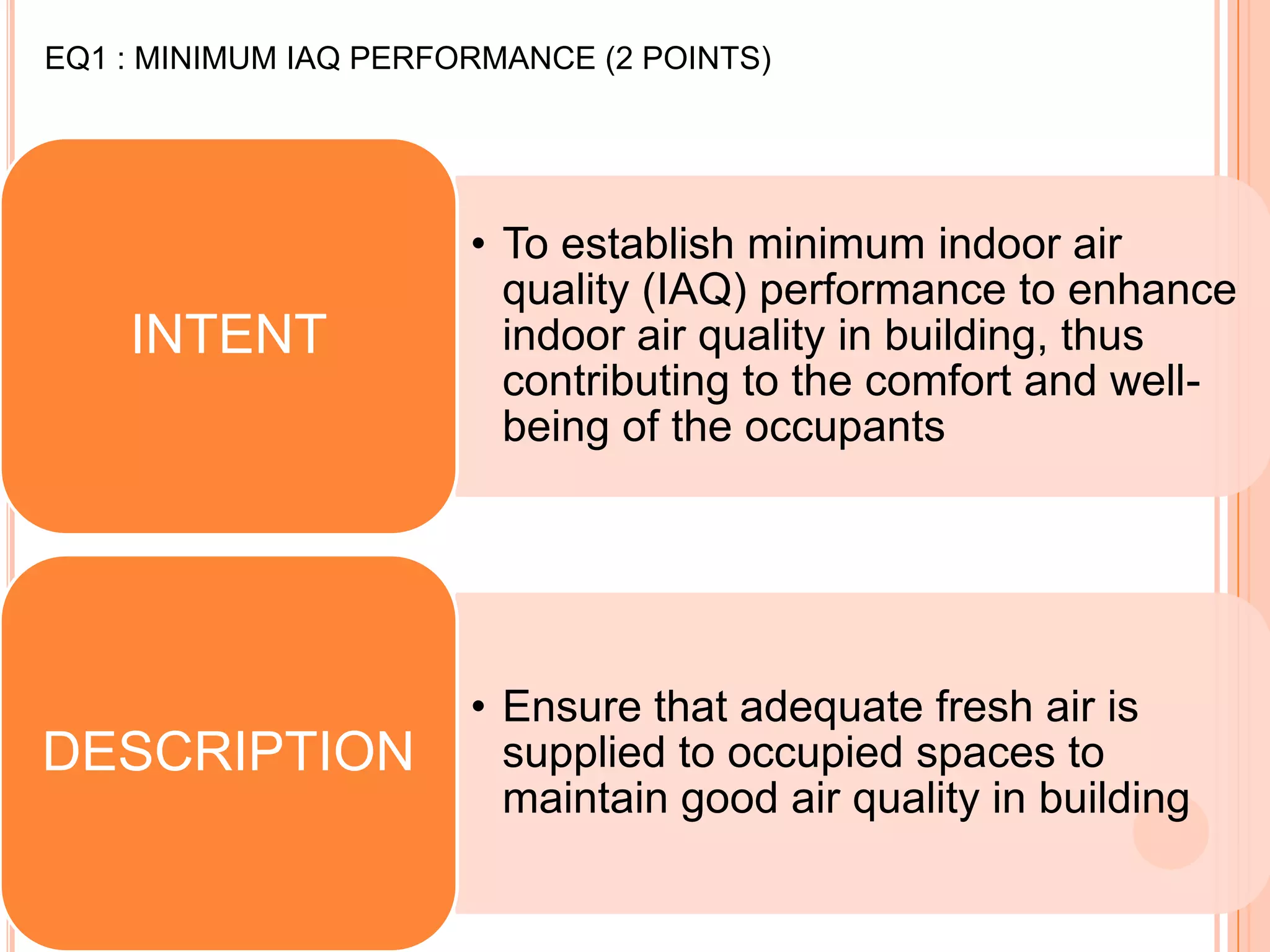
EQ1 : MINIMUM IAQ PERFORMANCE (2 POINTS)


                       • To establish minimum indoor air
                         quality (IAQ) performance to enhance
    INTENT               indoor air quality in building, thus
                         contributing to the comfort and well-
                         being of the occupants


                       • Ensure that adequate fresh air is
DESCRIPTION              supplied to occupied spaces to
                         maintain good air quality in building
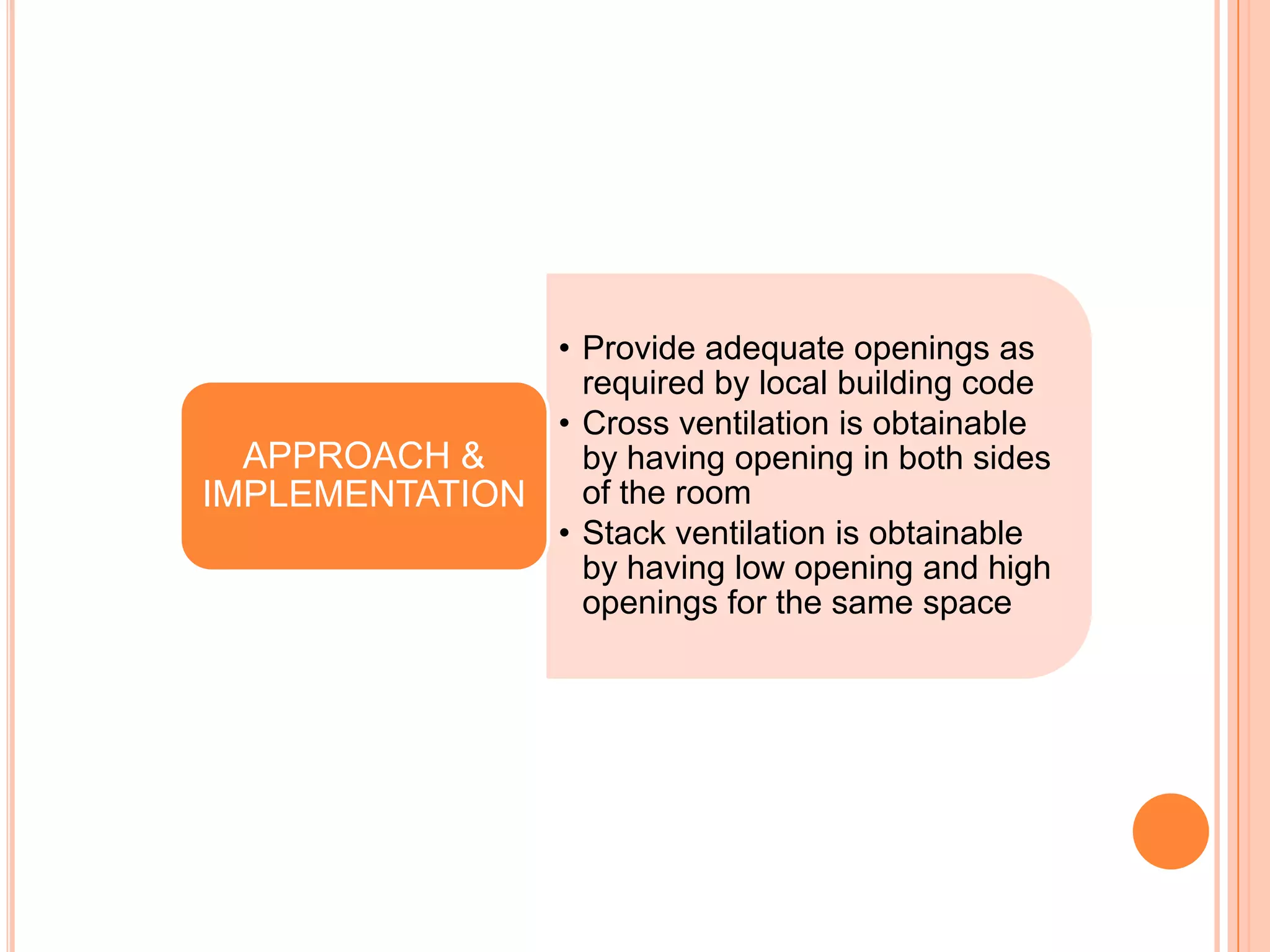
• Provide adequate openings as
                 required by local building code
               • Cross ventilation is obtainable
  APPROACH &     by having opening in both sides
IMPLEMENTATION   of the room
               • Stack ventilation is obtainable
                 by having low opening and high
                 openings for the same space
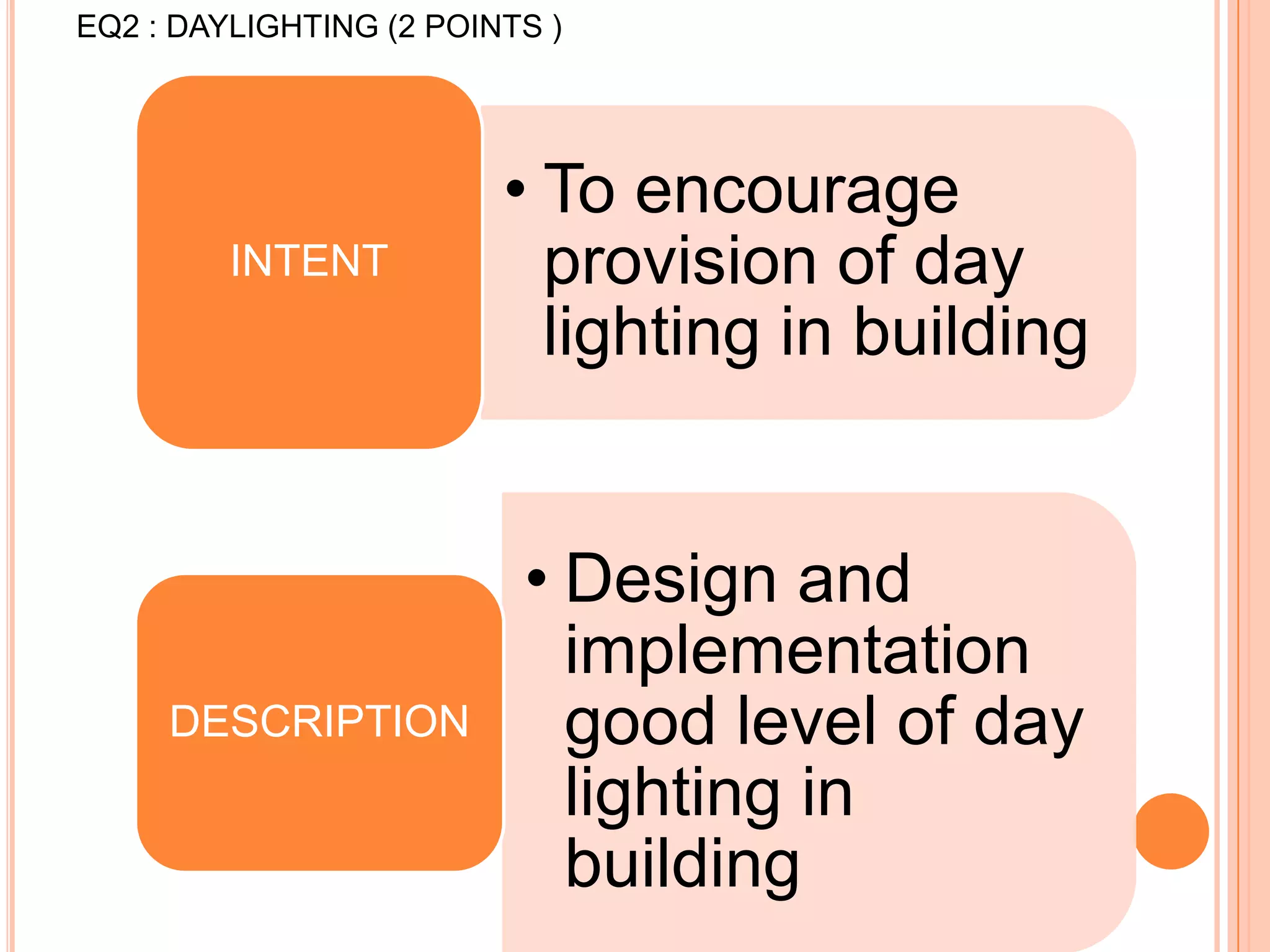
EQ2 : DAYLIGHTING (2 POINTS )


                         • To encourage
         INTENT            provision of day
                           lighting in building


                          • Design and
                            implementation
     DESCRIPTION            good level of day
                            lighting in
                            building
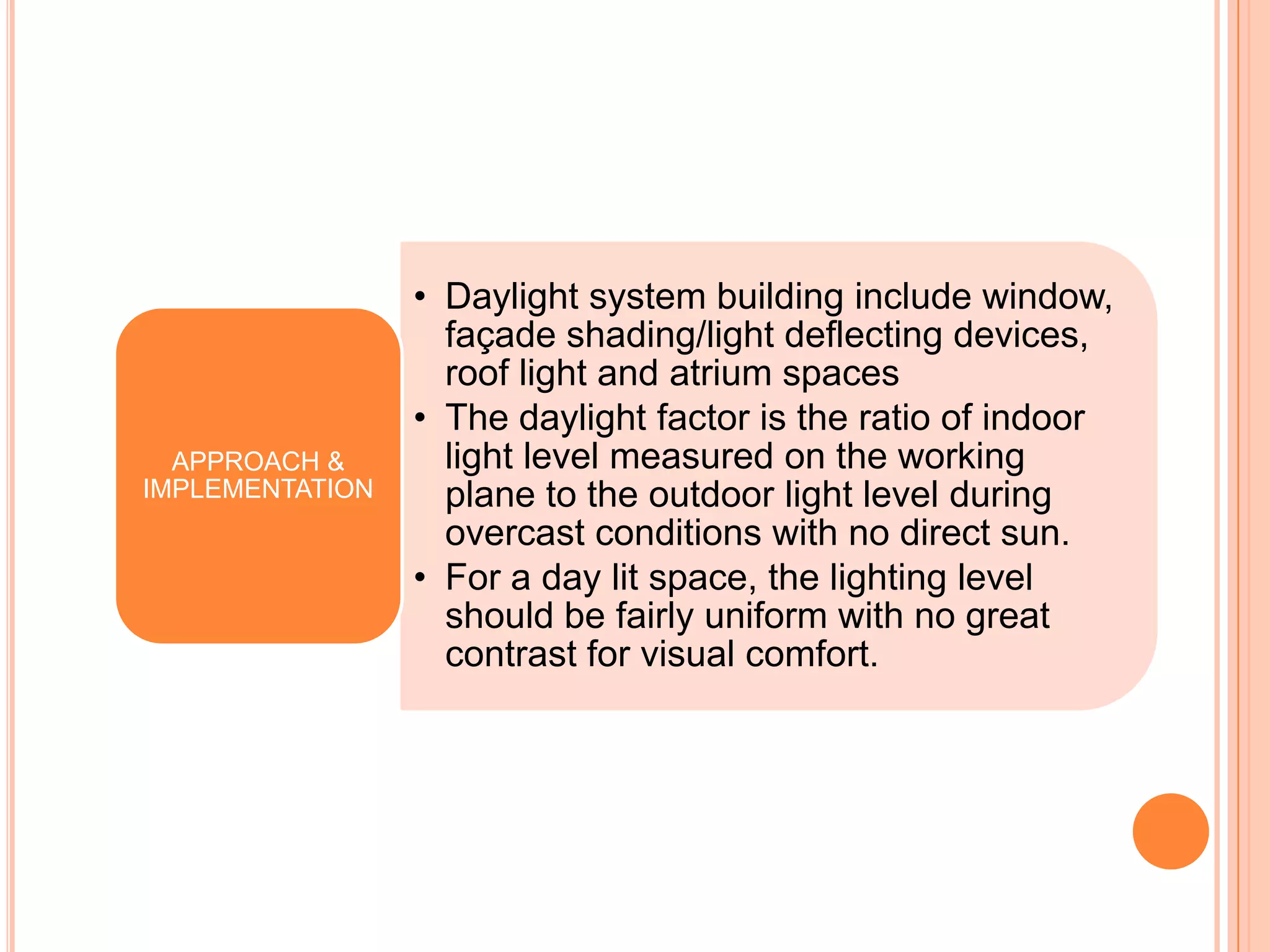
• Daylight system building include window,
                   façade shading/light deflecting devices,
                   roof light and atrium spaces
                 • The daylight factor is the ratio of indoor
  APPROACH &       light level measured on the working
IMPLEMENTATION     plane to the outdoor light level during
                   overcast conditions with no direct sun.
                 • For a day lit space, the lighting level
                   should be fairly uniform with no great
                   contrast for visual comfort.
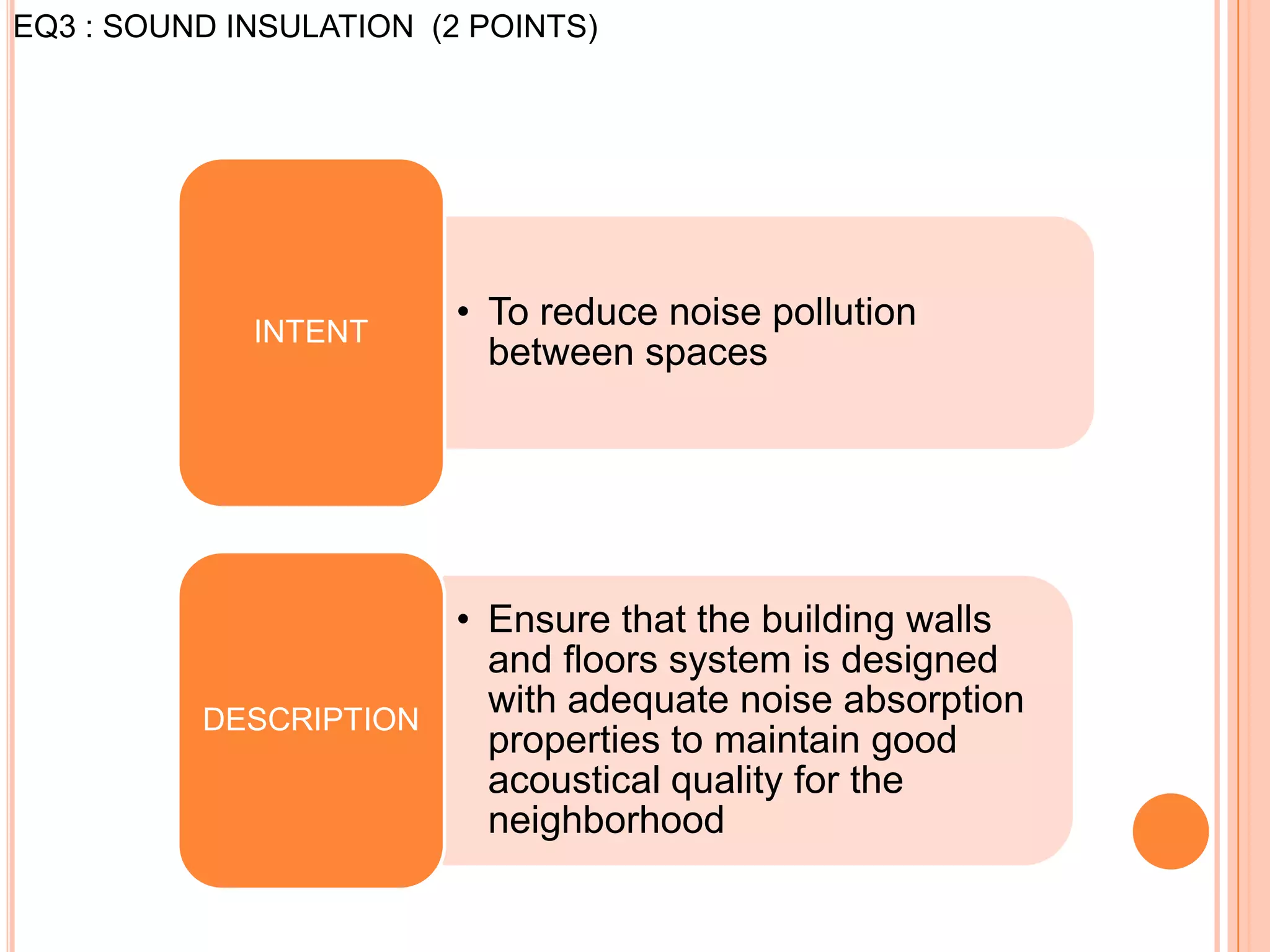
EQ3 : SOUND INSULATION (2 POINTS)


             INTENT
                         • To reduce noise pollution
                           between spaces


                      • Ensure that the building walls
                        and floors system is designed
          DESCRIPTION
                        with adequate noise absorption
                        properties to maintain good
                        acoustical quality for the
                        neighborhood
• Wall- heavy
                 mass or sound
  APPROACH &     insulation
IMPLEMENTATION
               • Floor-
                 underlayments
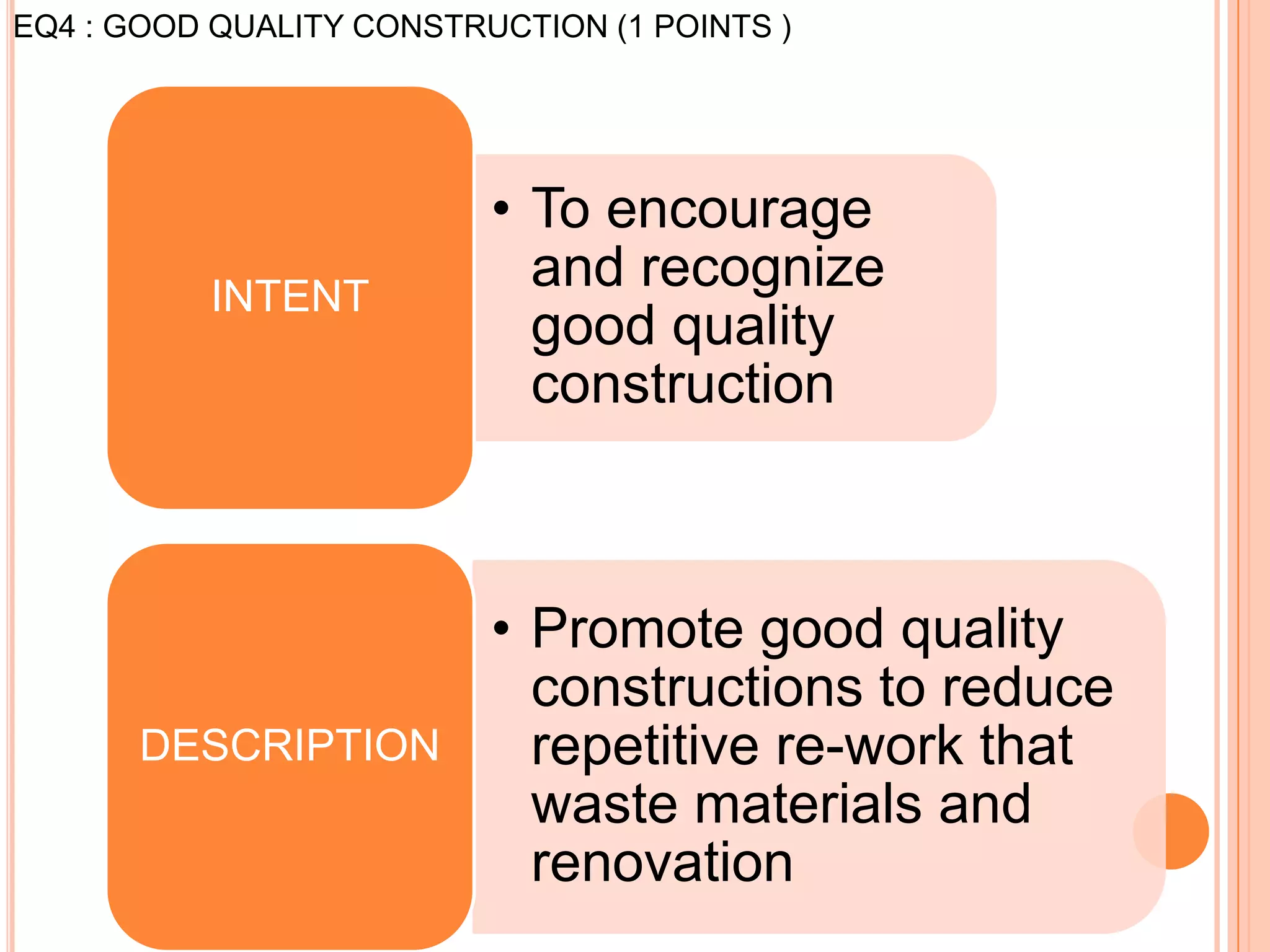
EQ4 : GOOD QUALITY CONSTRUCTION (1 POINTS )


                          • To encourage
          INTENT
                            and recognize
                            good quality
                            construction


                          • Promote good quality
                            constructions to reduce
      DESCRIPTION           repetitive re-work that
                            waste materials and
                            renovation
INNOVATION- INNOVATION IN DESIGN & ENVIRONMENTAL
DESIGN INITIATIVES

   • Innovative planning that displays “less is more” and “small is
    beautiful”;
   • Rehabilitation of existing buildings for re-use in innovative ways;
   • Innovative use of building features to passively cool the building
   • Heat recovery system (contributing to at least 10% of total required
    capacity);
   • Mixed mode / low energy ventilation system;
   • Waterless urinals (fitted to all male toilets);
   • Central waste conveyance system;
   • Central vacuum system
Green Building Index

Green Building Index

  • 2.
  • 3.
    WHAT? is an environmentalrating system for buildings developed by PAM (Pertubuhan Arkitek Malaysia / Malaysian Institute of Architects) and ACEM (the Association of Consulting Engineers Malaysia). Its develop specifically for the Malaysian Tropical Weather, environmental and environmental context, cultural and social needs. Malaysia’s first comprehensive rating system for evaluating the environmental design and performance of Malaysian buildings based on  Energy Efficiency,  Indoor Environment Quality,  Sustainable Site Planning & Management  Materials & Resources  Water Efficiency  Innovation.
  • 4.
    • Improve energyconsumption by • – building orientation ENERGY • -minimizing solar heat gain through the building envelope EFFICIENCY (EE) • -harvesting natural light • -use renewable energy • Achieve good quality performance of indoor air quality, INDOOR acoustic, visual and thermal comfort. ENVIRONMENTAL • Use of volatile organic compound materials • Application of quality air filtration QUALITY (EQ) • Proper control of air temperature, movement and humidity SUSTAINABLE SITE PLANNING • Pr oper site with planned acces to public transportation, community services, open spaces and landscaping. AND • Implementing proper construction management, storm MANAGEMENT water management (SM)
  • 5.
    • Promote theuse of eco friendly materials sourced from sustainable sources and recycling. MATERIALS AND • Implement proper construction waste management with – RESOURCES (MR) storage-collection • Reuse of recycables and construction formwork and waste. • Rainwater harvesting WATER EFFICIENCY • Water recycling (WE) • Water saving fittings INNOVATION (IN) • Innovative design that meets the objectives of the GBI.
  • 6.
    GBI IS CREATEDTO? • Define green buildings by establishing a common language and standard of measurement; • Promote integrated, whole-building design; • Recognise and reward environmental leadership; • Transform the built environment to reduce it’s environmental impact; and • Ensure new buildings remain relevant in the future and existing buildings are refurbished and upgraded properly to remain relevant.  The developers will be able to plan more sustainable and green projects.  Allow us to undertake development in a more environmental –friendly way  To get better siting, design, construction, operation, maintenance and removal
  • 8.
    WHO CAN USETHE GBI? All members of Project Teams, Building owners, Developers and other interested parties (including Contractors, Government and Design & Build Contractors)  To validate environmental initiatives at the design phase of new construction  encouraged on all such projects to assess and improve their environmental attributes.
  • 12.
    •For this residentialnew construction, it includes linked houses, apartments, condominiums, townhouses, semi-detached and bungalow. •It more emphasis on sustainable site planning and management, followed by energy efficiency. GBI RATING TOOL •Will reduce the negatice impact to the environment •And create better and safe place for the community as a whole.
  • 13.
  • 14.
    SUSTAINABLE SITE PLANNINGAND MANAGEMENT PUBLIC COMMUNITY OPEN SPACES, TRANSPORTATION SERVICES AND ACCESS CONNECTICTIVITY LANDSCAPING • Encourage the selection • Basic amenities within AND HEAT of sites close to transport hubs 750m of the resindential units. (Grocery Store or ISLAND EFFCT • to reduce the current and Mini-market Religious • Development future heavy dependence Centre, Restaurant or should have more on private transport, Coffee Shop, Playground which is the greatest or Public Park) landscaping contributor to Green • Other (Clinic, School, reducing the well House Gas (GHG) Police Station, Post Office known effects of emission. or Atm) heat islands
  • 15.
    SITE & CONSTRUCTIONMANAGEMENT CONSTRUCTION STORM WATER AVOIDING SYSTEM & SITE MANAGEMENT ENVIROMENTALL Y MANAGEMENT • Manage surface water run SENSITIVE AREAS • reduce on-site construction off from developments. • Avoid development of • Reduce material wastage • Reduce the pollution and inappropriate sites and and construction wastage storm water loading of the reduce the environmental to landfill sites river systems from impact from the location of • Reduce thedevelopment. a building on a site. • the polluting effects of • Reduce flood risk. construction and from • Retain rainwater for workers during recycling and appropriate construction. use.
  • 16.
    MATERIALS AND RESOURCES -REUSEDAND RECYCLED MATERIALS Materials reuse and selection • to reduce waste, thereby reducing • impacts • Use salvaged, refurbished or used materials • To include reusability and the number of cycles on the usage (minimum 15 cycles) of temporary • materials; such as temporary formwork system, temporary framing or support system, etc. Construction Waste Management
  • 17.
    WATER EFFICIENCY • to reduction in potable water consumption Rainwater Harvesting • Encourage water recycling that will lead to reduction in Water potable water consumption Recycling
  • 18.
    Water Efficient LandscapingWater Efficient Landscaping Do not use potable water at all for landscape irrigation Reduce potable water consumption for landscape irrigation
  • 19.
  • 20.
    EE1 : MINIMUMEE PERFORMANCE [3 POINTS] • To create EE awareness • Promote the use of MS 1525 INTENT • To provide a thermally comfortable environment to reduce the use of air-conditioning • Establish minimum EE performance to reduce DESCRIPTION energy consumption in building • Reducing CO2 emission to the atmosphere APPROACH & •Wall insulation IMPLEMENTATION •Glazing •Solar shading devices
  • 21.
    EE2 : RENEWABLEENERGY [5 POINTS ] • To promote the use of renewable energy in INTENT residential buildings for self supply in order to reduce environmental impact due to emission of CO2 • To offset energy cost DESCRIPTION • Promote green energy use APPROACH & Solar hot water and building IMPLEMENTATION intergrated photovoltaic
  • 22.
    EE3 : ADVANCEDEE PERFORMANCE BASED ON OTTV & RTTV [10 POINTS] • To encourage enhancement to building to provide a thermally comfortable environment to INTENT reduce the use of air-conditioning in residential building, thereby reducing CO2 emission • Glazing APPROACH & • Insulated roof IMPLEMENTATION • Wall insulation
  • 23.
    EE4 : HOMEOFFICE & CONNETIVITY [2 POINTS] • To encourage dual use spaces and working from INTENT home, thereby discouraging commuting and reducing CO2 emission • Design residential homes with spaces for APPROACH & home-like IMPLEMENTATION • Provide high speed internet connection to homes
  • 24.
    • Ensure themaintenance team fully APPROACH & participates in the testing and IMPLEMENTATION commissioning stage, understand th design intent and provide a 3 year sustainable maintenance program
  • 25.
  • 26.
    EQ1 : MINIMUMIAQ PERFORMANCE (2 POINTS) • To establish minimum indoor air quality (IAQ) performance to enhance INTENT indoor air quality in building, thus contributing to the comfort and well- being of the occupants • Ensure that adequate fresh air is DESCRIPTION supplied to occupied spaces to maintain good air quality in building
  • 27.
    • Provide adequateopenings as required by local building code • Cross ventilation is obtainable APPROACH & by having opening in both sides IMPLEMENTATION of the room • Stack ventilation is obtainable by having low opening and high openings for the same space
  • 28.
    EQ2 : DAYLIGHTING(2 POINTS ) • To encourage INTENT provision of day lighting in building • Design and implementation DESCRIPTION good level of day lighting in building
  • 29.
    • Daylight systembuilding include window, façade shading/light deflecting devices, roof light and atrium spaces • The daylight factor is the ratio of indoor APPROACH & light level measured on the working IMPLEMENTATION plane to the outdoor light level during overcast conditions with no direct sun. • For a day lit space, the lighting level should be fairly uniform with no great contrast for visual comfort.
  • 30.
    EQ3 : SOUNDINSULATION (2 POINTS) INTENT • To reduce noise pollution between spaces • Ensure that the building walls and floors system is designed DESCRIPTION with adequate noise absorption properties to maintain good acoustical quality for the neighborhood
  • 31.
    • Wall- heavy mass or sound APPROACH & insulation IMPLEMENTATION • Floor- underlayments
  • 32.
    EQ4 : GOODQUALITY CONSTRUCTION (1 POINTS ) • To encourage INTENT and recognize good quality construction • Promote good quality constructions to reduce DESCRIPTION repetitive re-work that waste materials and renovation
  • 33.
    INNOVATION- INNOVATION INDESIGN & ENVIRONMENTAL DESIGN INITIATIVES  • Innovative planning that displays “less is more” and “small is beautiful”;  • Rehabilitation of existing buildings for re-use in innovative ways;  • Innovative use of building features to passively cool the building  • Heat recovery system (contributing to at least 10% of total required capacity);  • Mixed mode / low energy ventilation system;  • Waterless urinals (fitted to all male toilets);  • Central waste conveyance system;  • Central vacuum system