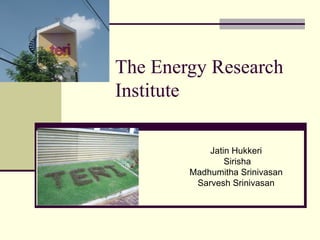
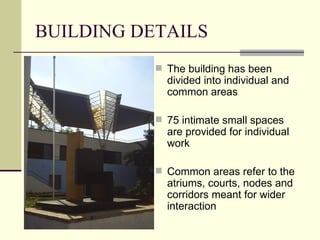
The Energy Research
Institute

            Jatin Hukkeri
                Sirisha
        Madhumitha Srinivasan
         Sarvesh Srinivasan
INTRODUCTION
          Established in 1974
          Project is designed to house an
           office block with approx. 75
           workstations & a small guest
           house attached to it
          Conducts energy services for
           major corporate’s
          Concerned with effective
           utilization of energy,
           sustainable uses of natural
           resources, large scale adoption
           of renewable energy
           technology.
BANGALORE
               Garden city
               Location: 12* 58’ N 177* 35’ E
               Altitude: 919 m
               Green cover: 40 %
               Rainfall: 97 cm
               Climate: moderate temperature
               Temperature:
                   mean max       mean min
                summer
                      35*c            20*c
                 winter
                       28*c          14*c
LOCATION
 Located at domlur bus stop
( 3 kms from Bangalore airport rd) ,
amidst a residential area, park and temple

 Long narrow site with roads on the eastern and
   northern sides

 Western side has an open ground

 Southern side has an open drain ( 9m wide)

 Site located adjacent to a foul smelling drain on
   south which dictates design development as wind
   comes from south.
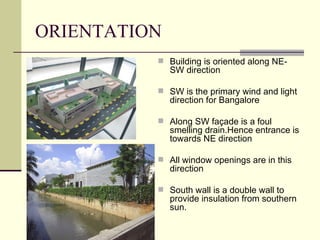
BUILDING DETAILS
            The building has been
             divided into individual and
             common areas

            75 intimate small spaces
             are provided for individual
             work

            Common areas refer to the
             atriums, courts, nodes and
             corridors meant for wider
             interaction
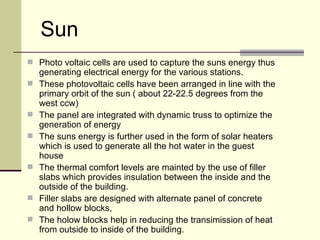
ORIENTATION
           Building is oriented along NE-
              SW direction

           SW is the primary wind and light
              direction for Bangalore

           Along SW façade is a foul
              smelling drain.Hence entrance is
              towards NE direction

           All window openings are in this
              direction

           South wall is a double wall to
              provide insulation from southern
              sun.
Floor Plans
LIGHT

         Main source of light- SUN

         Building opens on northern side to
           take advantage of glare free light
           ( north light)

         Atrium spaces and sky lights
           ensure enough lighting

         Presence of light shafts to transmit
           light from skylight above into
           meeting rooms and parking below
           through a photo sensitive glass

         Artificial lighting used only for work
           stations
Light
Sun
 Photo voltaic cells are used to capture the suns energy thus
    generating electrical energy for the various stations.
   These photovoltaic cells have been arranged in line with the
    primary orbit of the sun ( about 22-22.5 degrees from the
    west ccw)
   The panel are integrated with dynamic truss to optimize the
    generation of energy
   The suns energy is further used in the form of solar heaters
    which is used to generate all the hot water in the guest
    house
   The thermal comfort levels are mainted by the use of filler
    slabs which provides insulation between the inside and the
    outside of the building.
   Filler slabs are designed with alternate panel of concrete
    and hollow blocks,
   The holow blocks help in reducing the transimission of heat
    from outside to inside of the building.
RADIATION
 Use of double glazed windows with
   coating

 Use of cavity wall construction with
   kadappa stone which is a heat
   retentive material

 Terrace garden helps in insulation ,
   reducing radiation as well as
   moderating temperature fluctuations

 Roof consists of a hollow loft space
   which reduces conduction of heat to
   work areas
AIR
 Primary wind direction along SW
 A long SW façade is a foul smelling drain
 Wall towards south is blank allowing the breeze to flow over the
    building which in turn creates negative pressure and pulls in
    fresh air from the north.
   South wall is a double wall so as to heat up the void between
    the two walls creating negative pressure thereby enhancing
    convection currents
   Ventilation is enhanced by the use of solar chimneys and vents
   Allows breeze to flow over building
   Creates negative pressure
   Starts pulling fresh air flow at body level to provide thermal
    comfort
   Hot air rises towards the top on southern façade
Ventilation - analysis
 The primary winds blow from the south to north over the
 nallah, hence the building needs to react to this if,the foul
 unhygienic air has to be prevented from entering the
 building .
 Thus the development of the south wall was a prime
 design factor in achieving this purpose.
 Here the south wall has was treated as an independent
 system linking the rear walls of the building over a cavity
 This cavity creates a negative pressure setting up the
 convectional currents. The entire systems works very
 effectively in generating the desired reverse wind
 circulation.
 The blank wall carries a system of cudappa.The colour
 black was deliberately chosen because of its heat
 absorptive power which is the highest among all colours.
•The working of the system is very
simple
•The sun’s rays heat the black south wall
increasing the temperature of the
immediate environment around.
•This causes the air in the cavity to rise
upwards naturally. These convectional
currents are blown away by the winds
blowing south to north.
•This creates a vacuum at the at the top
core structure. To fill this vacuum, air
from inside is drawn up.
•This system of hot air rising and
drawing in of cool fresh air is a
continuous process.
Hence reverse wind circulation is
established by bringing in the fresh air
from the north open face of the building,
and drawing it through the entire section
of the structure and removing it by
convectional means up through solar
wind vents.
Water
The central court which connects the
office complex and the guest house
section plays an important role as a
space generator .
 The spaces around it follow the age old
concept of the verandah that are outside
but are shaded, hence giving a feel of
‘withinness’ to it .
The central court houses an amphitheatre
that’s acts as an informal gathering … but
more importantly it holds within it the
rainwater harvesting sump for the whole
complex.
the rainwater is collected through
downtake pipes at the various levels of
terraces. Thus rain water harvesting plays
an effective role in water management
Earth
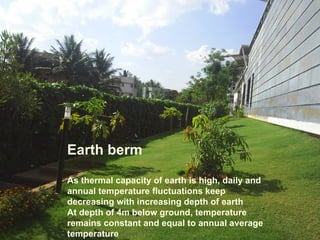
Earth berm

As thermal capacity of earth is high, daily and
annual temperature fluctuations keep
decreasing with increasing depth of earth
At depth of 4m below ground, temperature
remains constant and equal to annual average
temperature
CONCLUSION

 Sets a new standard of energy efficient,
  environmentally conscious office space


 Building conveys skillful interplay of natural
  elements with the building form to reduce
  energy demand

Teri

  • 1.
    The Energy Research Institute Jatin Hukkeri Sirisha Madhumitha Srinivasan Sarvesh Srinivasan
  • 2.
    INTRODUCTION  Established in 1974  Project is designed to house an office block with approx. 75 workstations & a small guest house attached to it  Conducts energy services for major corporate’s  Concerned with effective utilization of energy, sustainable uses of natural resources, large scale adoption of renewable energy technology.
  • 3.
    BANGALORE  Garden city  Location: 12* 58’ N 177* 35’ E  Altitude: 919 m  Green cover: 40 %  Rainfall: 97 cm  Climate: moderate temperature  Temperature: mean max mean min summer 35*c 20*c winter 28*c 14*c
  • 4.
    LOCATION  Located atdomlur bus stop ( 3 kms from Bangalore airport rd) , amidst a residential area, park and temple  Long narrow site with roads on the eastern and northern sides  Western side has an open ground  Southern side has an open drain ( 9m wide)  Site located adjacent to a foul smelling drain on south which dictates design development as wind comes from south.
  • 5.
    BUILDING DETAILS  The building has been divided into individual and common areas  75 intimate small spaces are provided for individual work  Common areas refer to the atriums, courts, nodes and corridors meant for wider interaction
  • 6.
    ORIENTATION  Building is oriented along NE- SW direction  SW is the primary wind and light direction for Bangalore  Along SW façade is a foul smelling drain.Hence entrance is towards NE direction  All window openings are in this direction  South wall is a double wall to provide insulation from southern sun.
  • 7.
  • 9.
    LIGHT  Main source of light- SUN  Building opens on northern side to take advantage of glare free light ( north light)  Atrium spaces and sky lights ensure enough lighting  Presence of light shafts to transmit light from skylight above into meeting rooms and parking below through a photo sensitive glass  Artificial lighting used only for work stations
  • 10.
  • 11.
    Sun  Photo voltaiccells are used to capture the suns energy thus generating electrical energy for the various stations.  These photovoltaic cells have been arranged in line with the primary orbit of the sun ( about 22-22.5 degrees from the west ccw)  The panel are integrated with dynamic truss to optimize the generation of energy  The suns energy is further used in the form of solar heaters which is used to generate all the hot water in the guest house  The thermal comfort levels are mainted by the use of filler slabs which provides insulation between the inside and the outside of the building.  Filler slabs are designed with alternate panel of concrete and hollow blocks,  The holow blocks help in reducing the transimission of heat from outside to inside of the building.
  • 12.
    RADIATION  Use ofdouble glazed windows with coating  Use of cavity wall construction with kadappa stone which is a heat retentive material  Terrace garden helps in insulation , reducing radiation as well as moderating temperature fluctuations  Roof consists of a hollow loft space which reduces conduction of heat to work areas
  • 13.
    AIR  Primary winddirection along SW  A long SW façade is a foul smelling drain  Wall towards south is blank allowing the breeze to flow over the building which in turn creates negative pressure and pulls in fresh air from the north.  South wall is a double wall so as to heat up the void between the two walls creating negative pressure thereby enhancing convection currents  Ventilation is enhanced by the use of solar chimneys and vents  Allows breeze to flow over building  Creates negative pressure  Starts pulling fresh air flow at body level to provide thermal comfort  Hot air rises towards the top on southern façade
  • 14.
    Ventilation - analysis The primary winds blow from the south to north over the nallah, hence the building needs to react to this if,the foul unhygienic air has to be prevented from entering the building . Thus the development of the south wall was a prime design factor in achieving this purpose. Here the south wall has was treated as an independent system linking the rear walls of the building over a cavity This cavity creates a negative pressure setting up the convectional currents. The entire systems works very effectively in generating the desired reverse wind circulation. The blank wall carries a system of cudappa.The colour black was deliberately chosen because of its heat absorptive power which is the highest among all colours.
  • 15.
    •The working ofthe system is very simple •The sun’s rays heat the black south wall increasing the temperature of the immediate environment around. •This causes the air in the cavity to rise upwards naturally. These convectional currents are blown away by the winds blowing south to north. •This creates a vacuum at the at the top core structure. To fill this vacuum, air from inside is drawn up. •This system of hot air rising and drawing in of cool fresh air is a continuous process.
  • 16.
    Hence reverse windcirculation is established by bringing in the fresh air from the north open face of the building, and drawing it through the entire section of the structure and removing it by convectional means up through solar wind vents.
  • 17.
    Water The central courtwhich connects the office complex and the guest house section plays an important role as a space generator . The spaces around it follow the age old concept of the verandah that are outside but are shaded, hence giving a feel of ‘withinness’ to it . The central court houses an amphitheatre that’s acts as an informal gathering … but more importantly it holds within it the rainwater harvesting sump for the whole complex. the rainwater is collected through downtake pipes at the various levels of terraces. Thus rain water harvesting plays an effective role in water management
  • 18.
  • 19.
    Earth berm As thermalcapacity of earth is high, daily and annual temperature fluctuations keep decreasing with increasing depth of earth At depth of 4m below ground, temperature remains constant and equal to annual average temperature
  • 20.
    CONCLUSION  Sets anew standard of energy efficient, environmentally conscious office space  Building conveys skillful interplay of natural elements with the building form to reduce energy demand