WASTE WATER AND REUSE
Serra Koz
--
--
OUTLINE
• Hillcrest Housing Association HQ
• The Architect’s House, Gokhle Marg
• PTC Industries LTD. HQ (Upcoming Project)
• Mamak Recycling Centre
CASE STUDY I
HILLCREST HOUSING ASSOCIATION
HEADQUARTERS
Project Data
Project
Type
Commerical
Location
1 Explorer Road,
Technology Park,
Dundee, DD2 1EG
Client
Hillcrest Housing
Association
Date
Completed
December 2010
Project
Value
£5.3m
Architect Nicoll Russell Studios
Main
Contractor
W H Brown
Construction (Dundee)
Ltd
Services
Engineer
Buro Happold
Quantity
Surveyor
KLM Partnership
Specialist
Consultant
CDM Co-ordinator –
Hardies LLP
Gross
Internal
Floor Area
2190 sq. m
Structural
Engineer
Arup Scotland
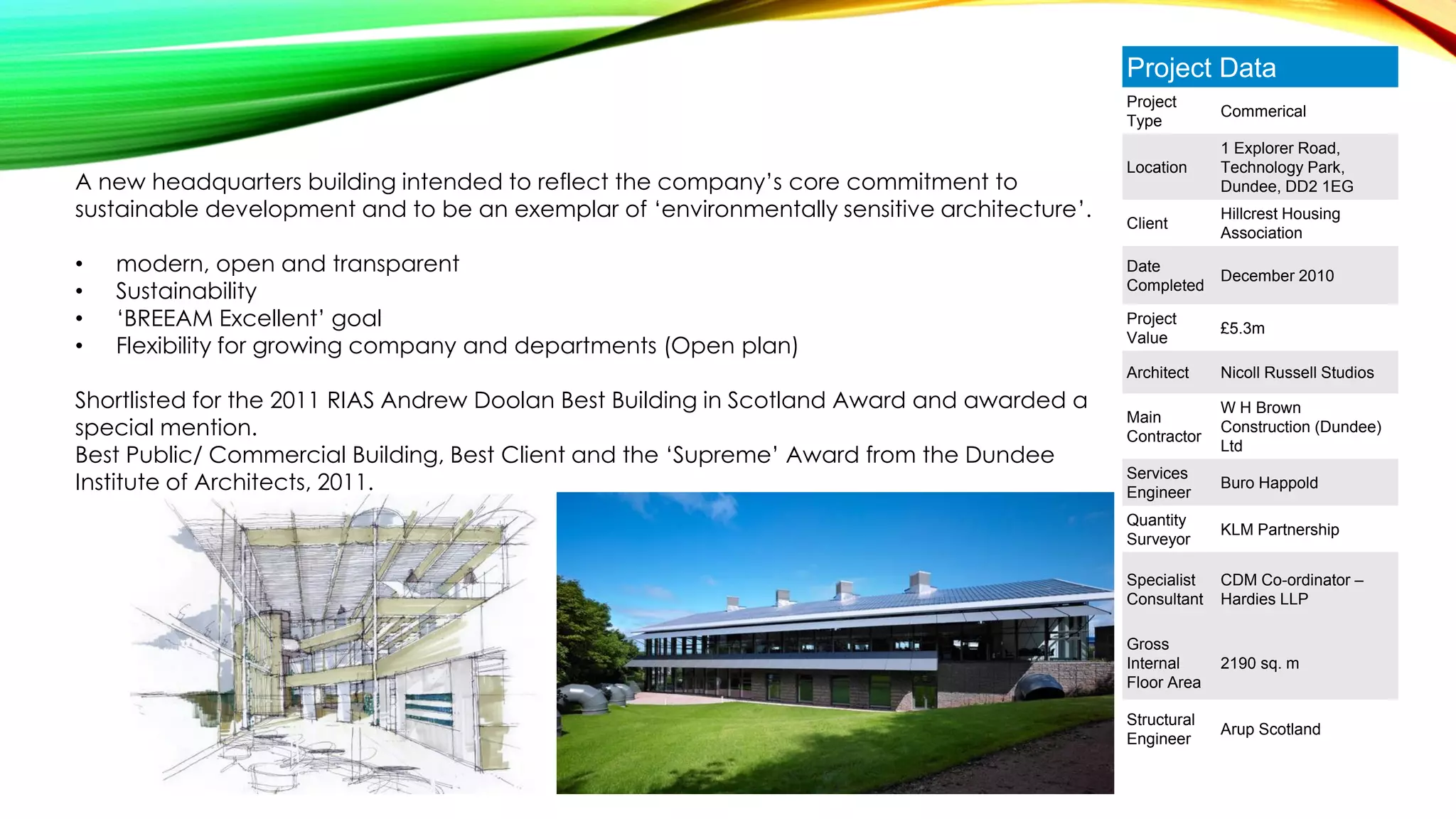
A new headquarters building intended to reflect the company’s core commitment to
sustainable development and to be an exemplar of ‘environmentally sensitive architecture’.
• modern, open and transparent
• Sustainability
• ‘BREEAM Excellent’ goal
• Flexibility for growing company and departments (Open plan)
Shortlisted for the 2011 RIAS Andrew Doolan Best Building in Scotland Award and awarded a
special mention.
Best Public/ Commercial Building, Best Client and the ‘Supreme’ Award from the Dundee
Institute of Architects, 2011.
LOCATION
• The location was on two separate bus routes, near a cycle route, and with
easy access to the Dundee Freeway for staff coming from the company’s
offices in other parts of Scotland. This way, low-carbon building became
even stronger.
• The proximity of Dundee Freeway caused a noise problem, so ventilation
with opening windows had to be reconsidered.
While office buildings might normally be expected to present a gable end to the south to avoid
over-heating from solar gain, the architects decided after much discussion to orientate the
building on an East-West axis to maximize solar gain in winter, knowing that they could provide
shade from summer sun by simply incorporating fixed external louvers. Manually operated
internal blinds provide occupant control to minimize glare.
ORIENTATION
HEATING AND ELECTRICITY
• A biomass boiler was identified as the main heating
source early on.
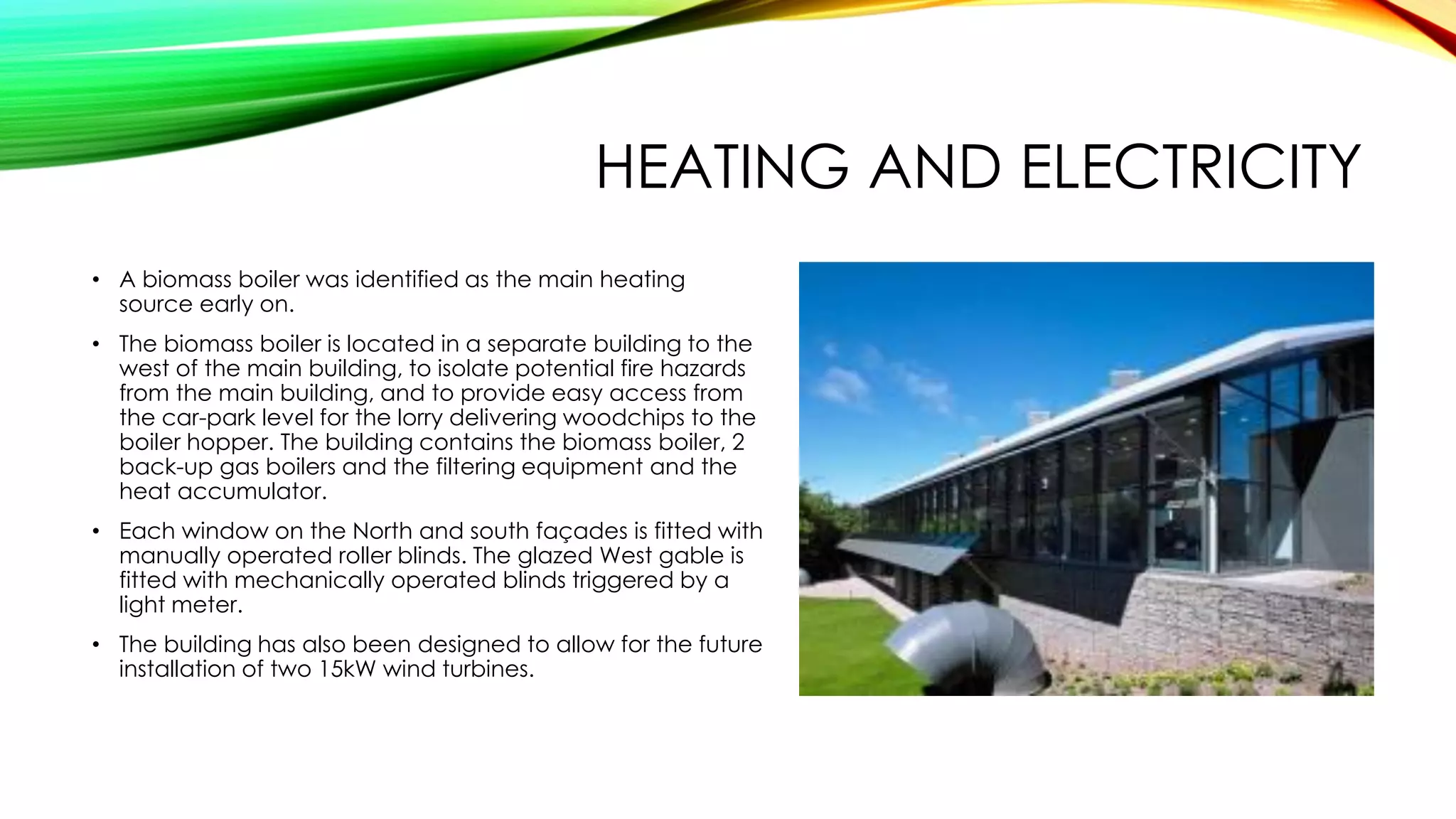
• The biomass boiler is located in a separate building to the
west of the main building, to isolate potential fire hazards
from the main building, and to provide easy access from
the car-park level for the lorry delivering woodchips to the
boiler hopper. The building contains the biomass boiler, 2
back-up gas boilers and the filtering equipment and the
heat accumulator.
• Each window on the North and south façades is fitted with
manually operated roller blinds. The glazed West gable is
fitted with mechanically operated blinds triggered by a
light meter.
• The building has also been designed to allow for the future
installation of two 15kW wind turbines.
VENTILATION
• Dynamic energy modelling was carried out to compare the energy consumption for an
air tight mechanically ventilated solution with a naturally ventilated solution.
• The mechanically ventilated solution was found to have lower annual energy
consumption when coupled with an earth tube, natural air conditioning system.
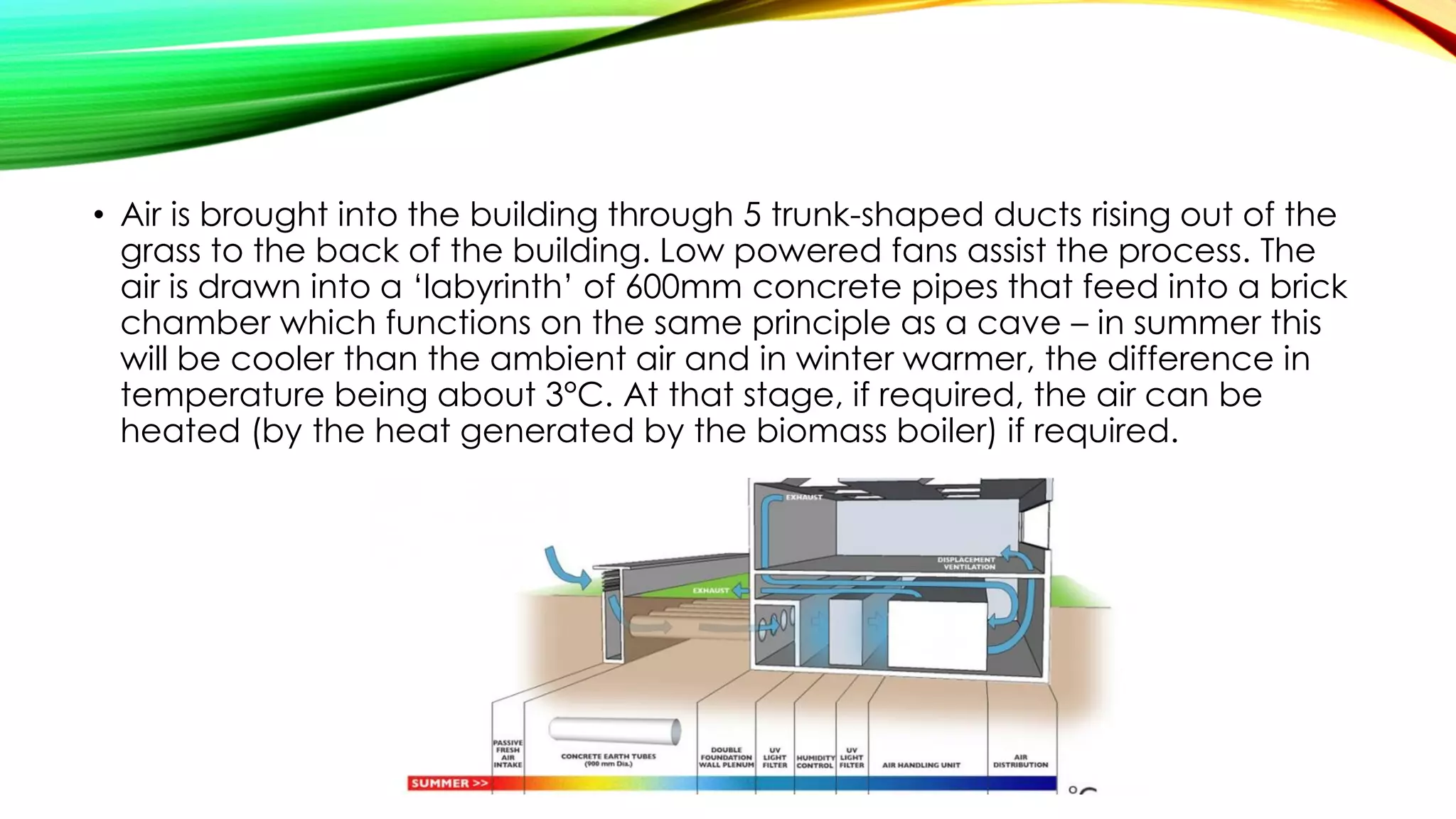
• Earth tubes are a series of buried concrete pipes which pre-heat or cool (depending on
the temperature difference between the external air and ground temperature) the
building’s incoming fresh air before it reaches the building’s air handling unit.
Building Emission Rate of 20.4 kgCO2/m2/year
The design emission rate was 21.7kgCO2/m2/year
• Air is brought into the building through 5 trunk-shaped ducts rising out of the
grass to the back of the building. Low powered fans assist the process. The
air is drawn into a ‘labyrinth’ of 600mm concrete pipes that feed into a brick
chamber which functions on the same principle as a cave – in summer this
will be cooler than the ambient air and in winter warmer, the difference in
temperature being about 3°C. At that stage, if required, the air can be
heated (by the heat generated by the biomass boiler) if required.
ALSO:
• Lamp units throughout the building are low-energy, with daylight control and
occupancy detection to minimize energy consumption.
• Showers, taps and WC’s are designed for low water-consumption. Rain
water is collected from the roof and recycled for use in flushing the toilets.
• SUDS (Sustainable Drainage System) is installed externally.
• The whole building was detailed in order to be demountable for re-use or
recycling.
• The aim of increasing biodiversity helped guide the site planting and
landscaping of the site, with attention paid to choice of native species and
the planting of wildflowers.
• The majority of materials used in the building were Green Guide ‘A’ rated.
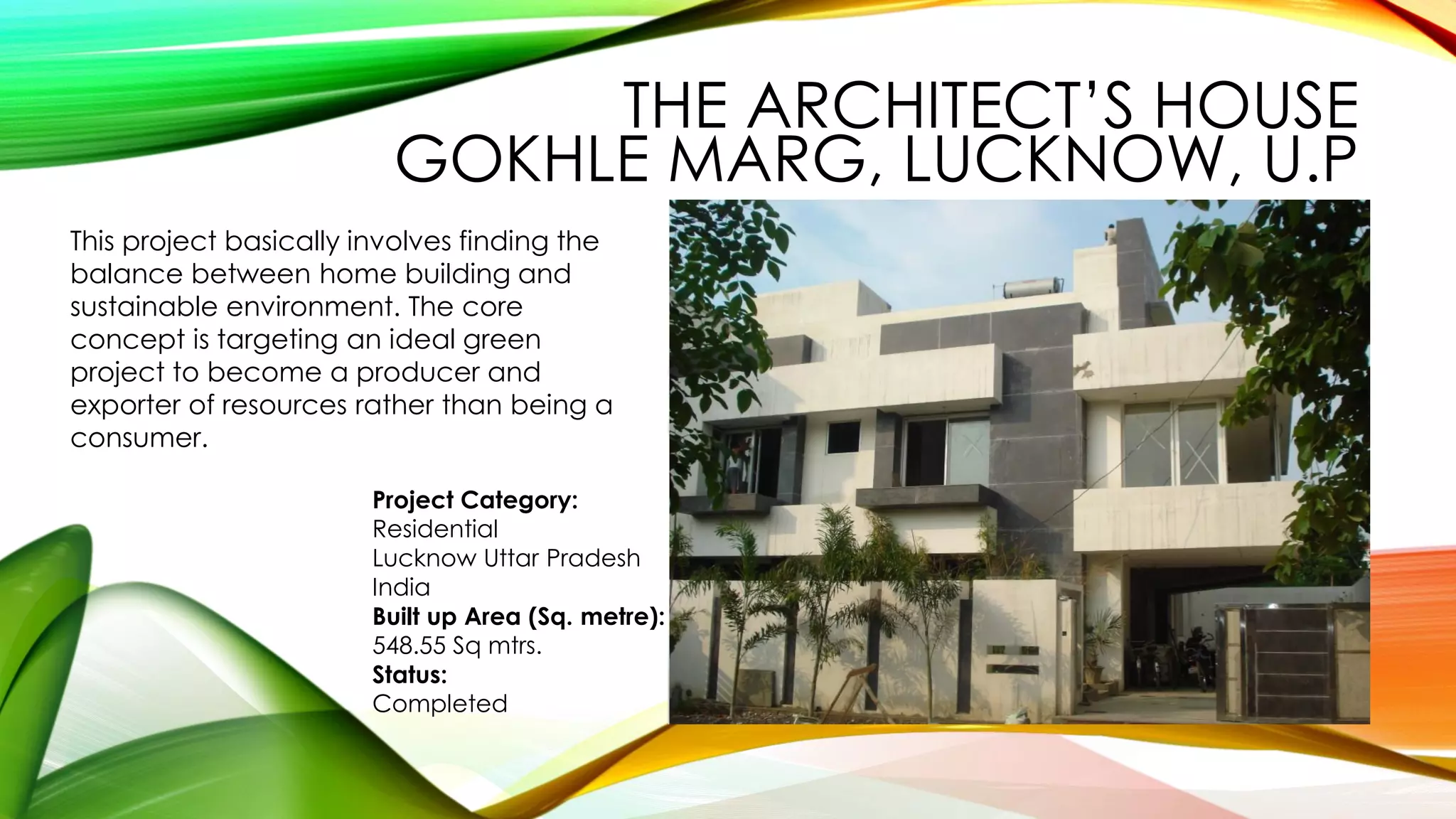
This project basically involves finding the
balance between home building and
sustainable environment. The core
concept is targeting an ideal green
project to become a producer and
exporter of resources rather than being a
consumer.
Project Category:
Residential
Lucknow Uttar Pradesh
India
Built up Area (Sq. metre):
548.55 Sq mtrs.
Status:
Completed
THE ARCHITECT’S HOUSE
GOKHLE MARG, LUCKNOW, U.P
Evaluation of self defined spaces – The Zoning
The central circulation core comprising of
staircase and lift automatically defines the public
and private layering of spaces inside the house.
The central core divides the plan into self
containing but interactive spaces.
Enhancing Visual Perception
There are no interior walls except for the
purpose of Toilet/Staircase. Unnecessary
enclosures are eliminated and where
necessary, glass doors are provided to
maintain the visual connection of the
observer.
Living room
Central Staircase
SITE PLANNING
FAÇADE
•South facade with air gap and stone
cladding.
•Reduces solar heat gain from south.
CENTRAL STAIR
•Central stair well acting as
lungs for the entire house.
•Keeps the lower floors of the
house cooler.
Green Roof
•Entire terrace covered with natural grass.
•Restores the green cover and provides insulation.
Sewage Treatment Plant
•Phytorid based technology
Phytorid technology
https://www.youtube.com/watch?v=
O2HGx9fHPA0
•Capacity - 2400 L
Recycled water used for gardening
and washing purposes.
WATER CONSERVATION
WATER CONSERVATION
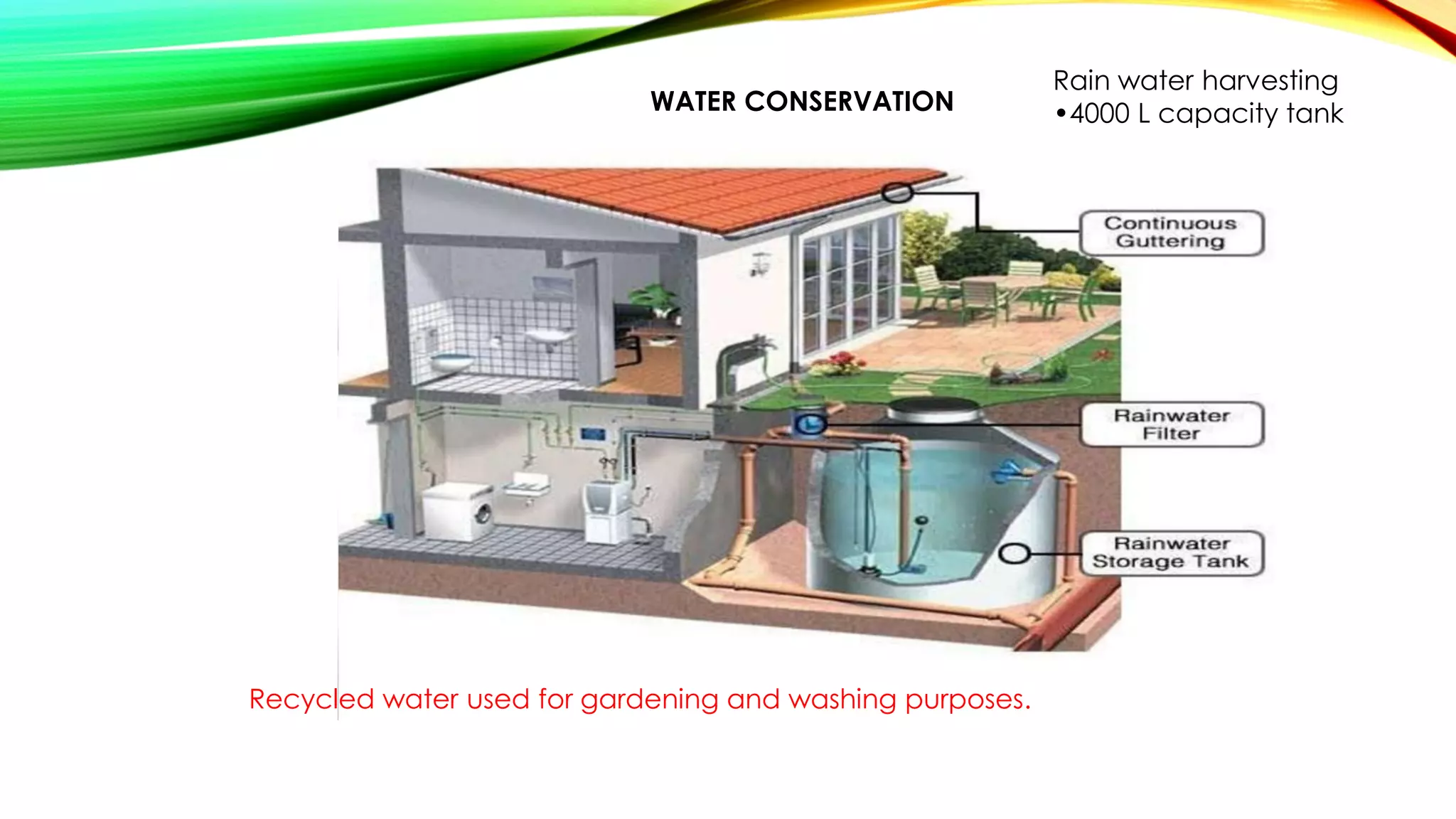
Rain water harvesting
•4000 L capacity tank
Recycled water used for gardening and washing purposes.
ENERGY CONSERVATION
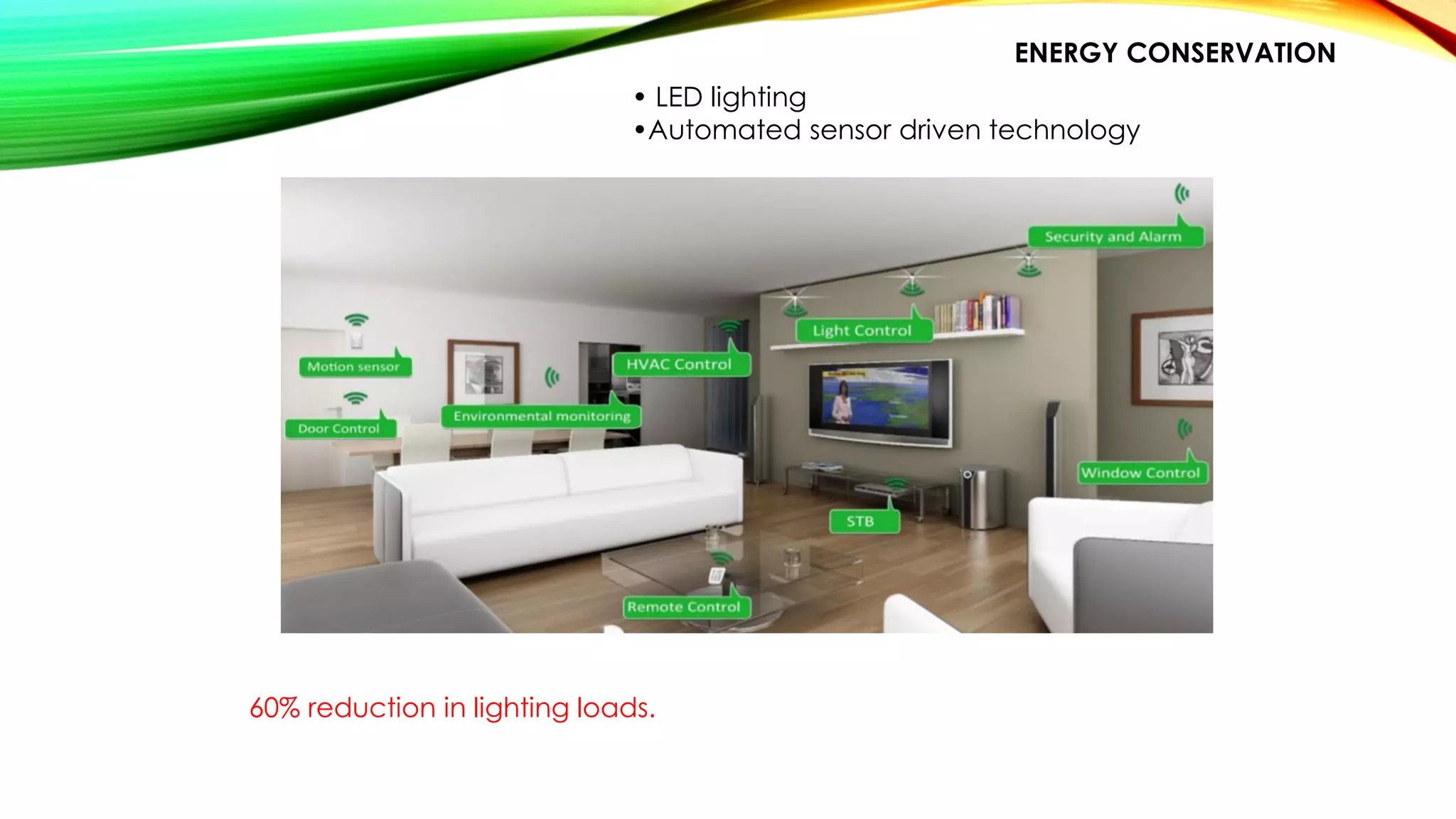
• LED lighting
•Automated sensor driven technology
60% reduction in lighting loads.
ENERGY CONSERVATION
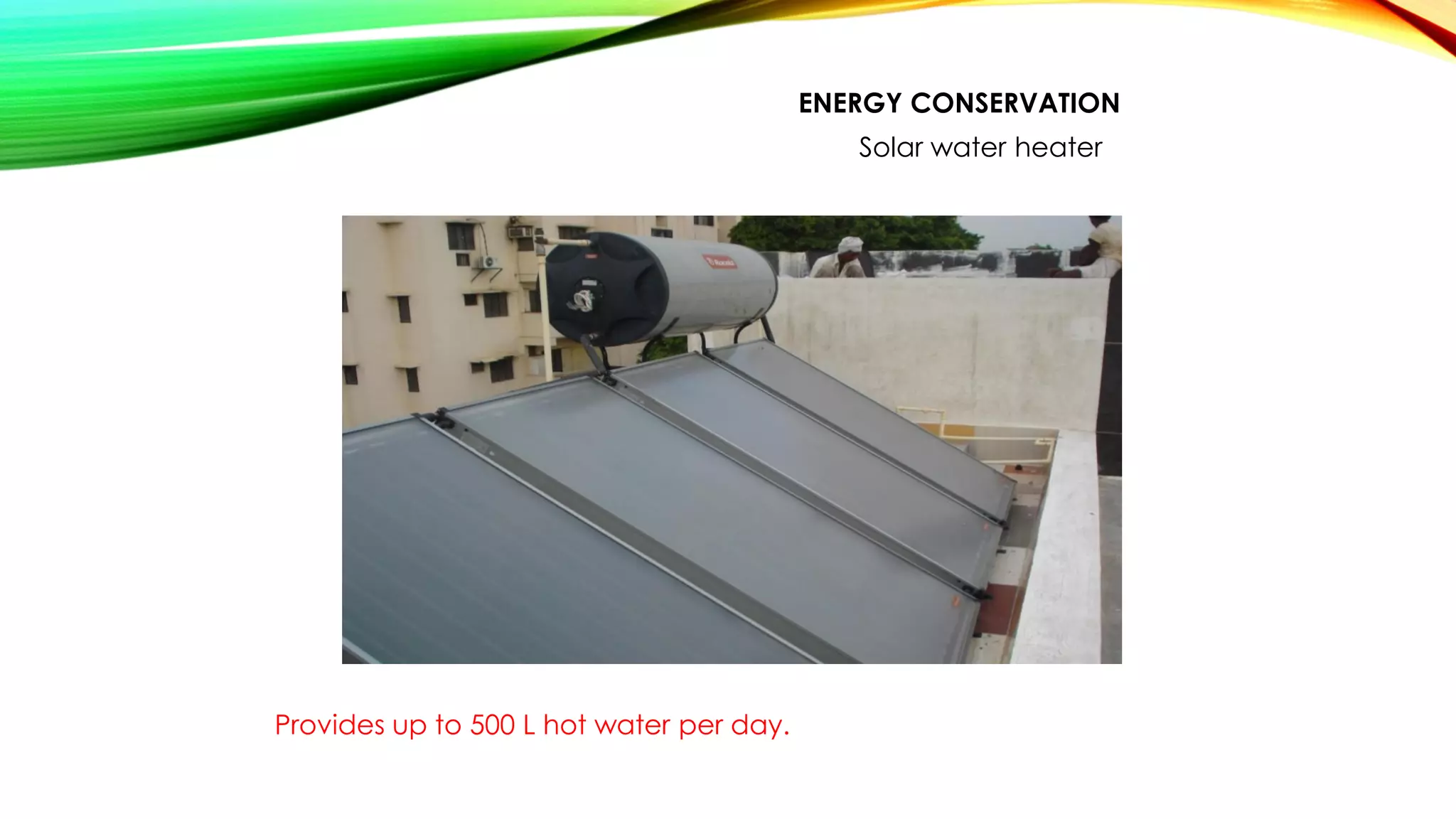
Solar water heater
Provides up to 500 L hot water per day.
ENERGY CONSERVATION
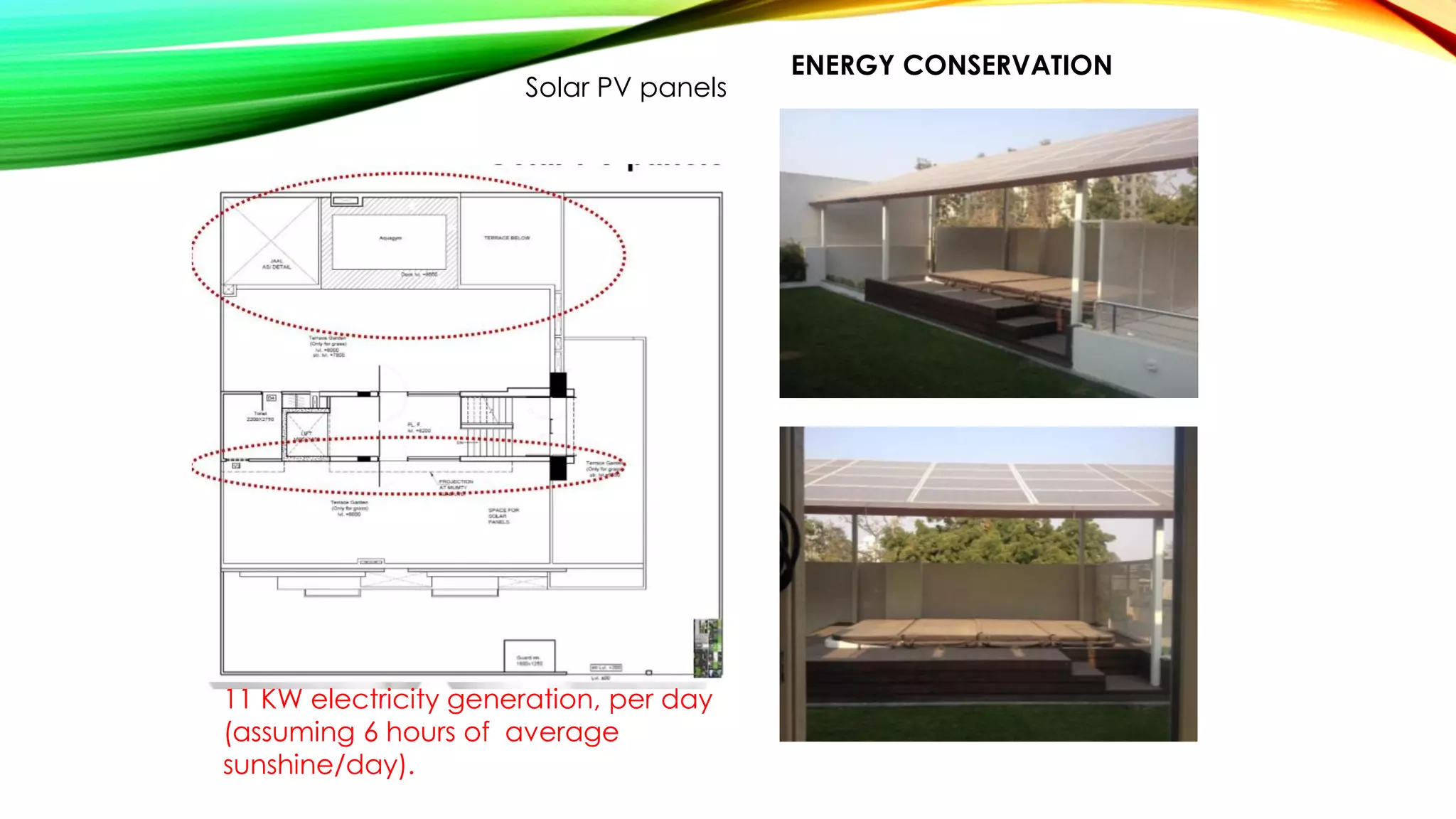
Solar PV panels
11 KW electricity generation, per day
(assuming 6 hours of average
sunshine/day).
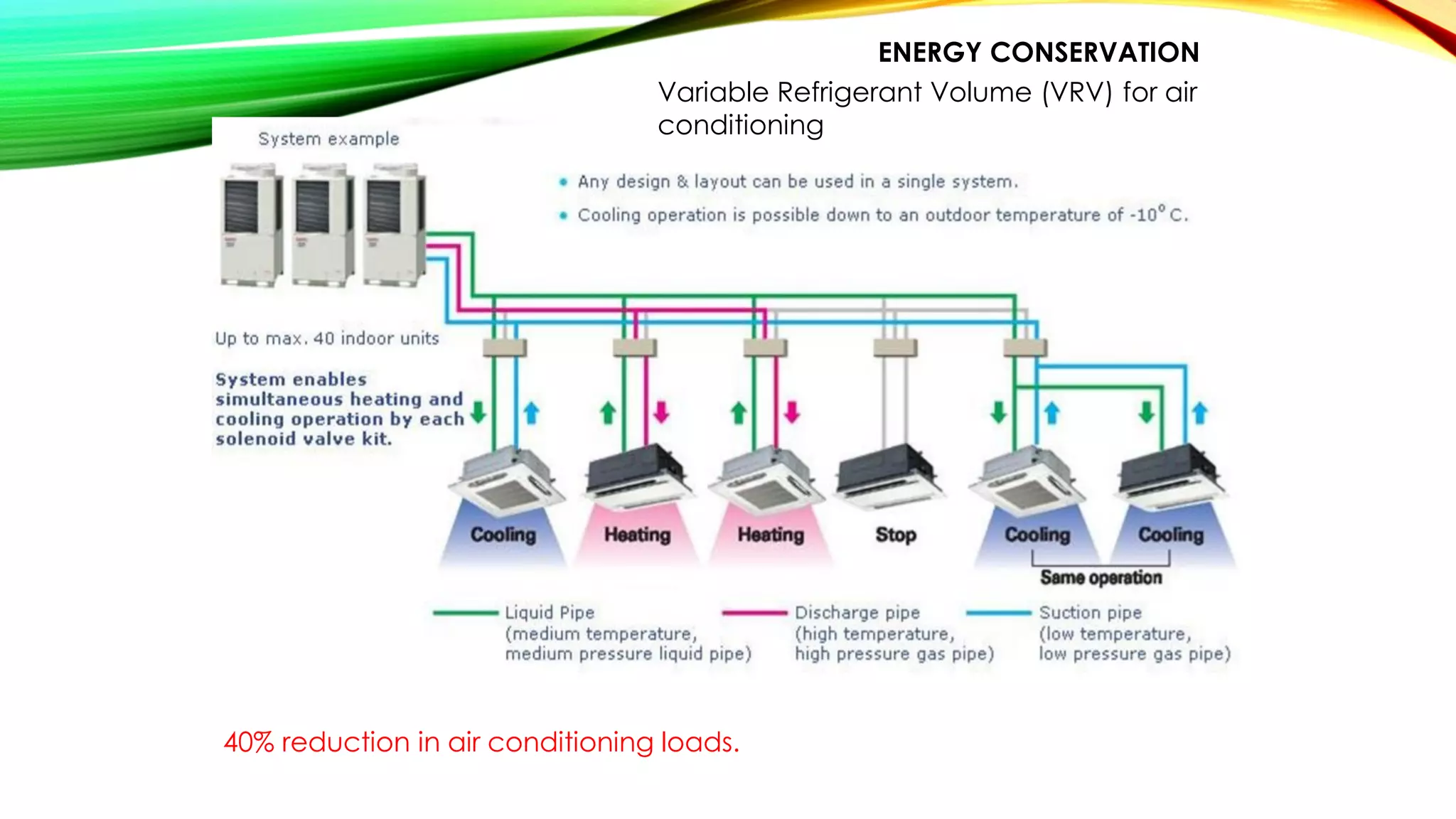
ENERGY CONSERVATION
Variable Refrigerant Volume (VRV) for air
conditioning
40% reduction in air conditioning loads.
ENERGY CONSERVATION
Low e- glass for glazing
Reduces solar heat gain and keeps the interiors cool.
Use of foam concrete blocks (AAC blocks)
MATERIAL CONSERVATION
Eliminates the use of conventional fire burnt
bricks.
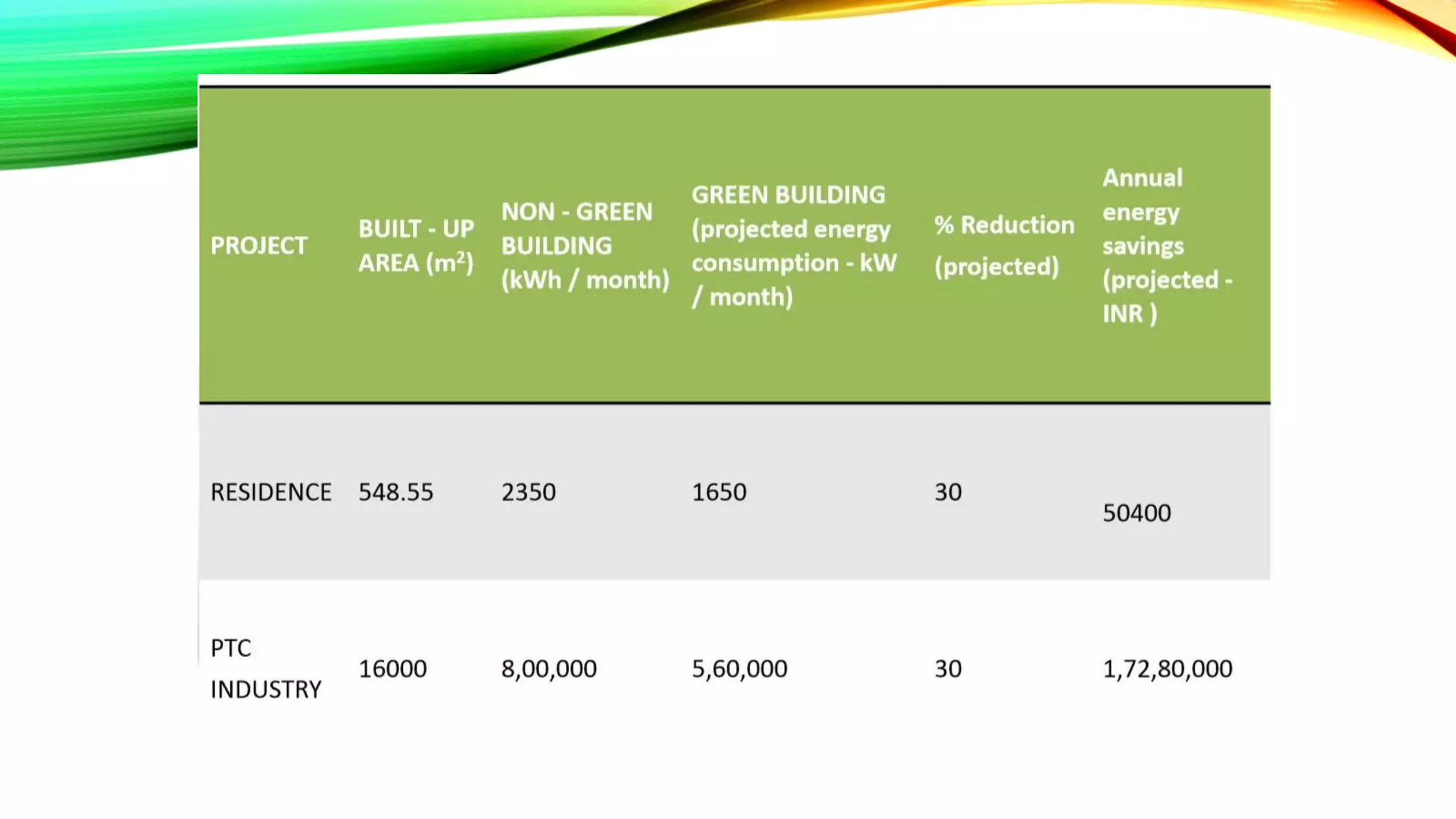
PROJECTED SAVINGS
Pocharam campus in Hyderabad, India
April 19, 2012
Types: Public
Awarded Highest LEED Rating: Fourth LEED Platinum rated building at Infosys
PTC INDUSTRIES LTD.
IGBC PLATINUM RATED (APPLIED)
Preserved maximum number of trees, possible.
SITE PLANNING
Cut and Fill
•Earth obtained from excavation of water bodies reused for raising the level as per need, within
the site.
Landscaping
•Top soil stock piled and reused for landscaping. Reduces long term negative effects to the site.
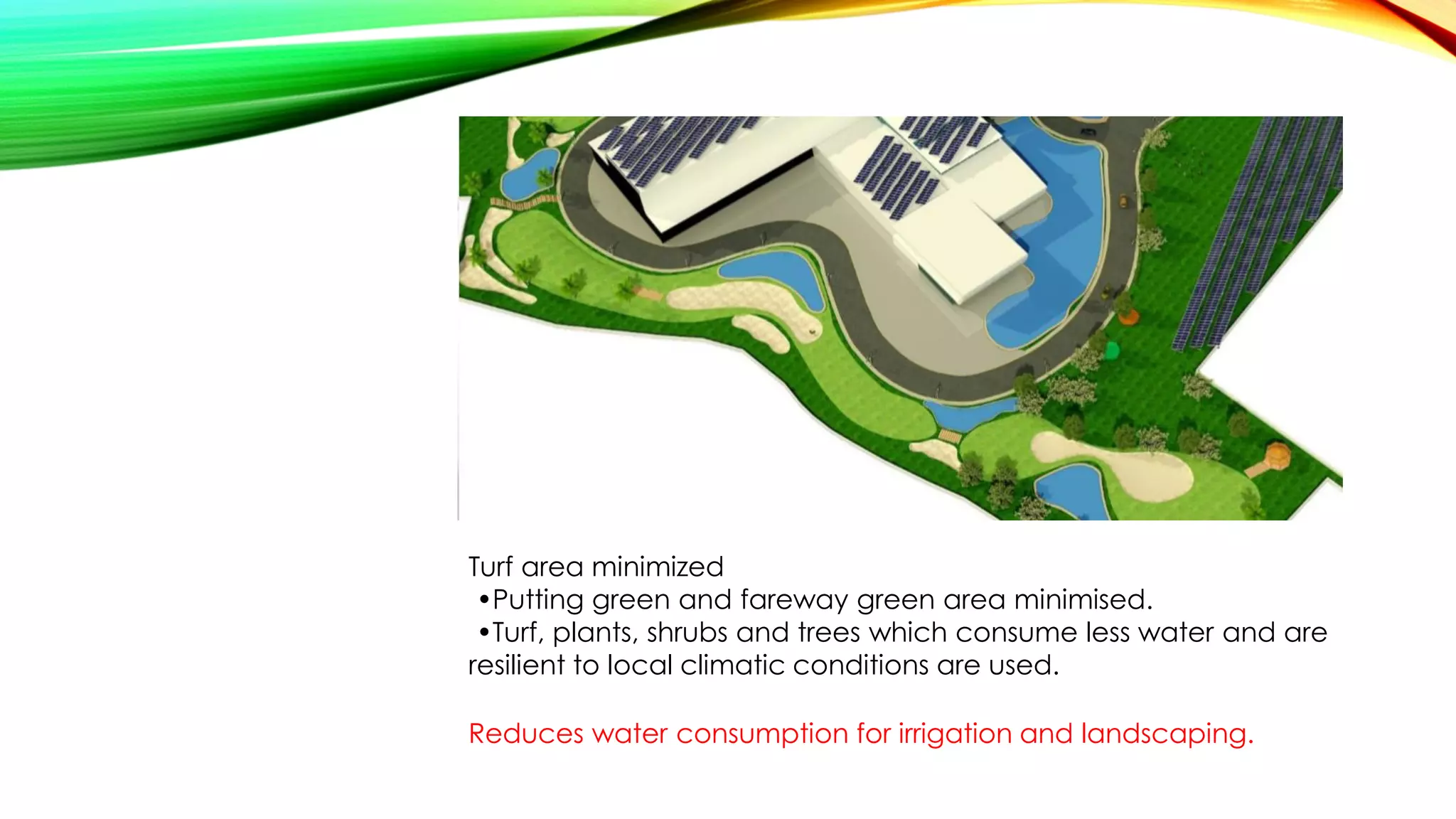
Turf area minimized
•Putting green and fareway green area minimised.
•Turf, plants, shrubs and trees which consume less water and are
resilient to local climatic conditions are used.
Reduces water consumption for irrigation and landscaping.
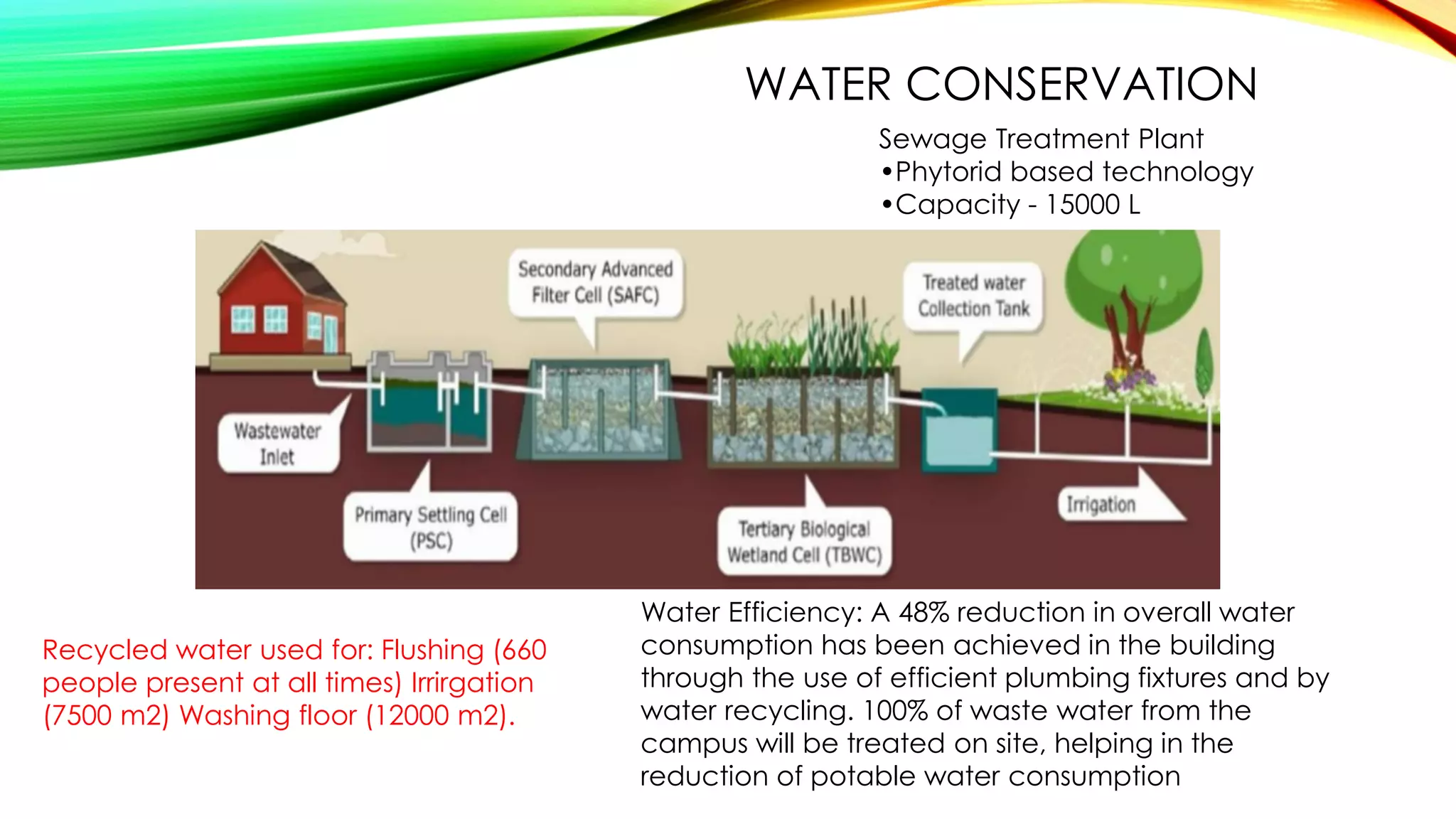
WATER CONSERVATION
Sewage Treatment Plant
•Phytorid based technology
•Capacity - 15000 L
Recycled water used for: Flushing (660
people present at all times) Irrirgation
(7500 m2) Washing floor (12000 m2).
Water Efficiency: A 48% reduction in overall water
consumption has been achieved in the building
through the use of efficient plumbing fixtures and by
water recycling. 100% of waste water from the
campus will be treated on site, helping in the
reduction of potable water consumption
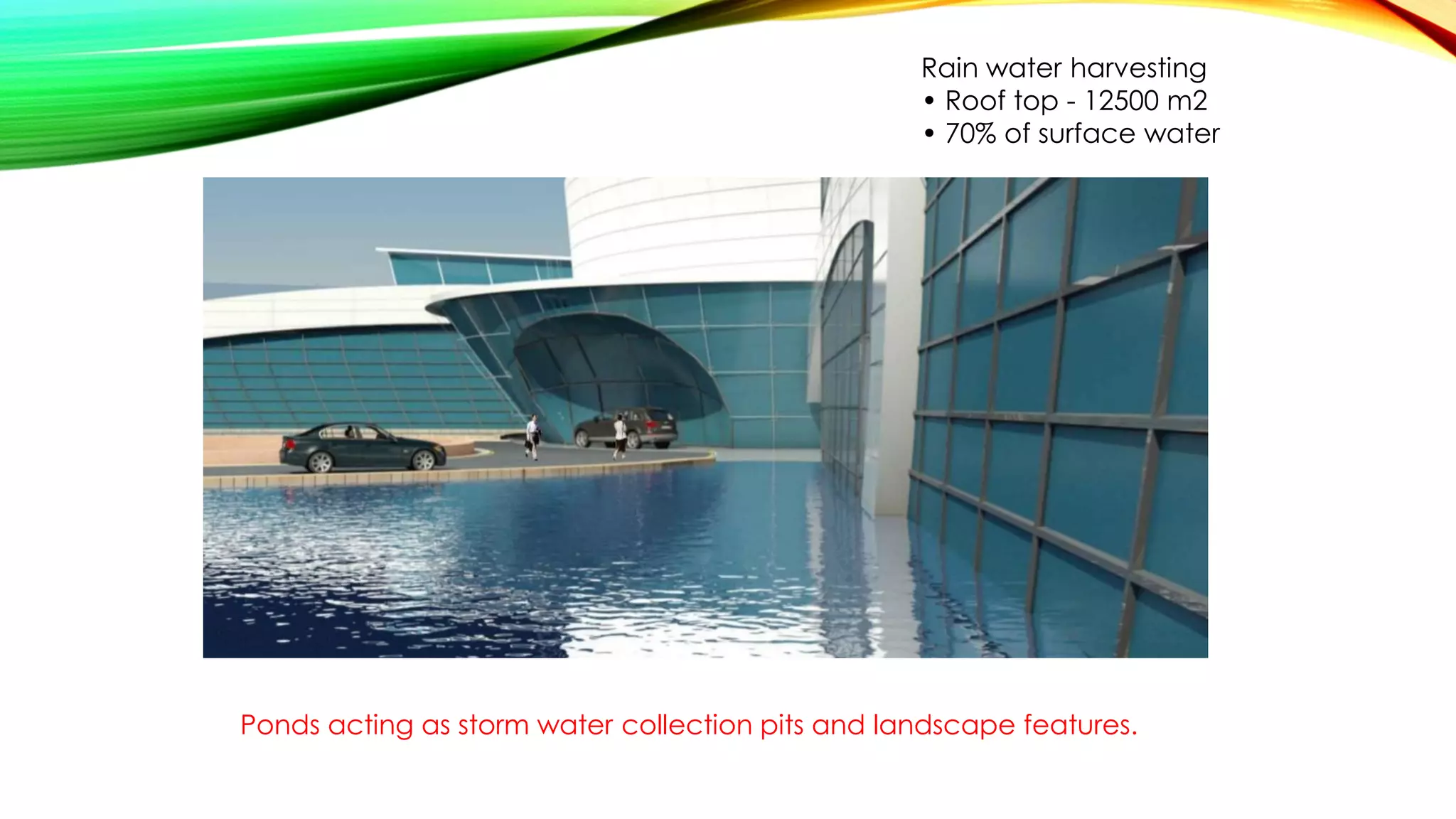
Rain water harvesting
• Roof top - 12500 m2
• 70% of surface water
Ponds acting as storm water collection pits and landscape features.
ENERGY CONSERVATION
Solar PV panels
•Roof top = 1 MW
•Parking covers = 30 Kw
Self - sufficiency in energy for on- site power generation
and use within the factory building( except heavy
machinery).
Reduces Solar Heat Gain
Reduces Cooling Load
Low e- glass
•AIS geosense - green glass
Insulated sheets to reduce solar heat gain.
Surface sheeting
designed to provide
maximum daylight inside
the workshop.
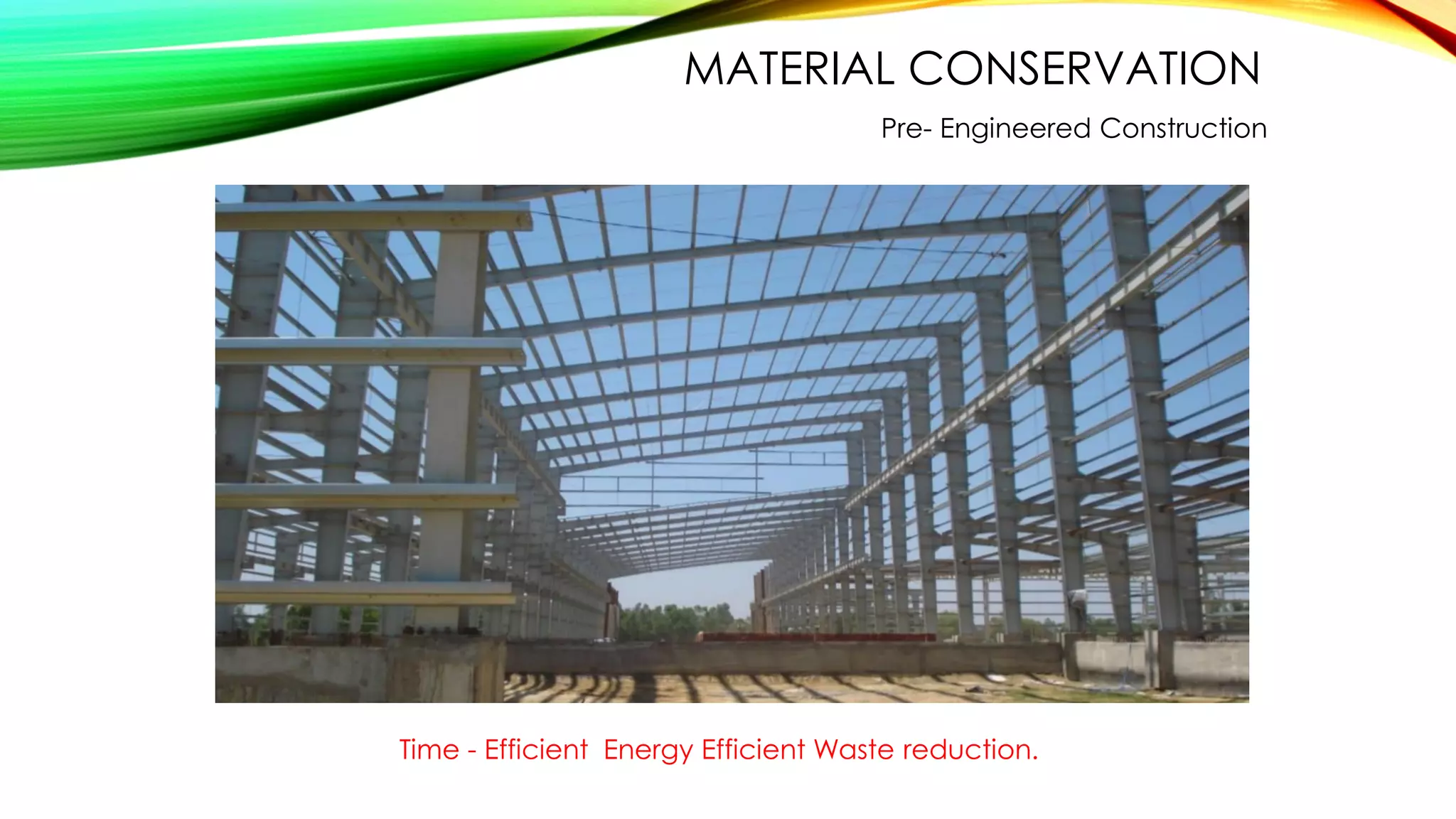
MATERIAL CONSERVATION
Pre- Engineered Construction
Time - Efficient Energy Efficient Waste reduction.
MAMAK RECYCLING CENTER
BACKGROUND INFORMATION
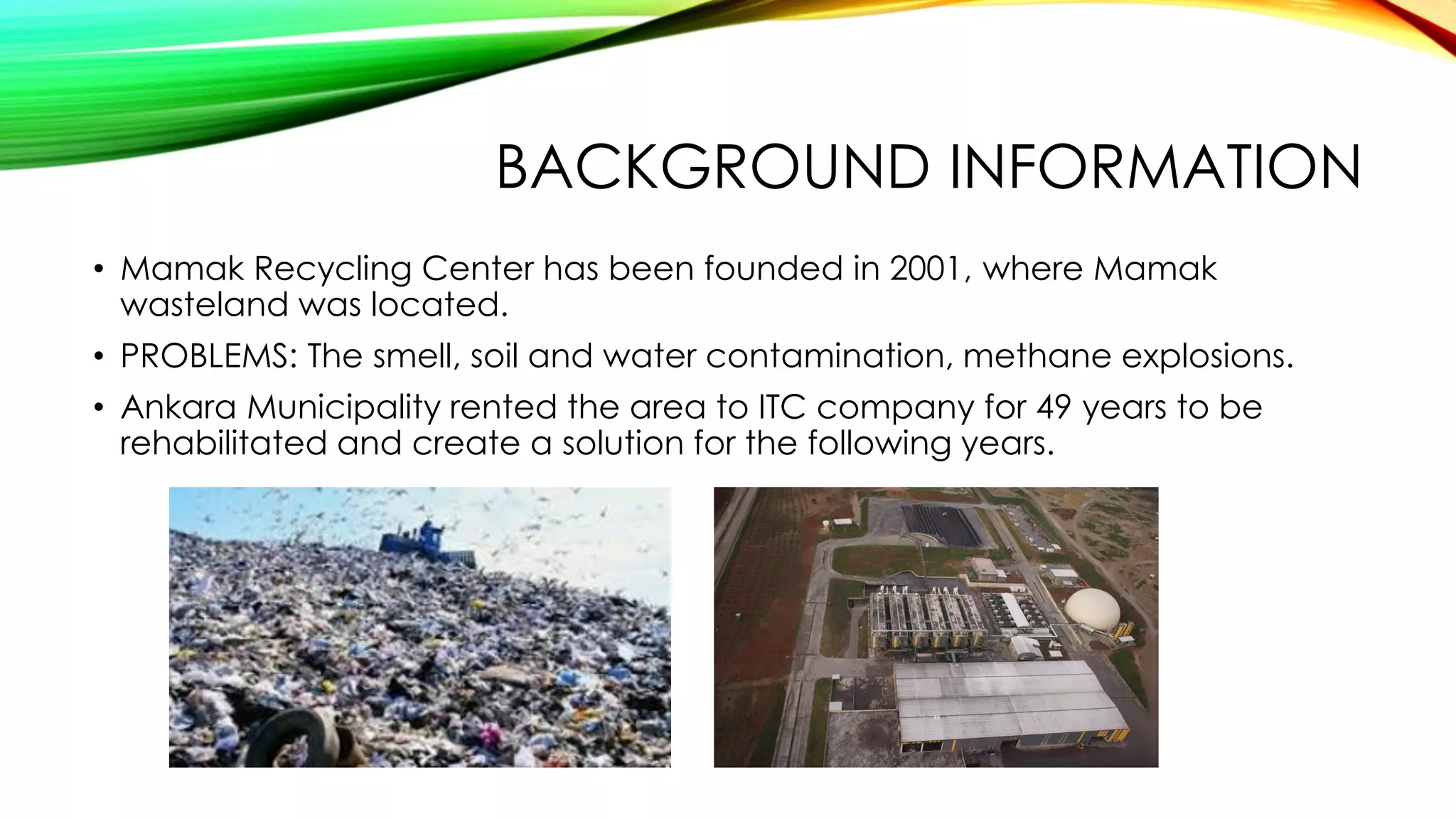
• Mamak Recycling Center has been founded in 2001, where Mamak
wasteland was located.
• PROBLEMS: The smell, soil and water contamination, methane explosions.
• Ankara Municipality rented the area to ITC company for 49 years to be
rehabilitated and create a solution for the following years.
PROCESS
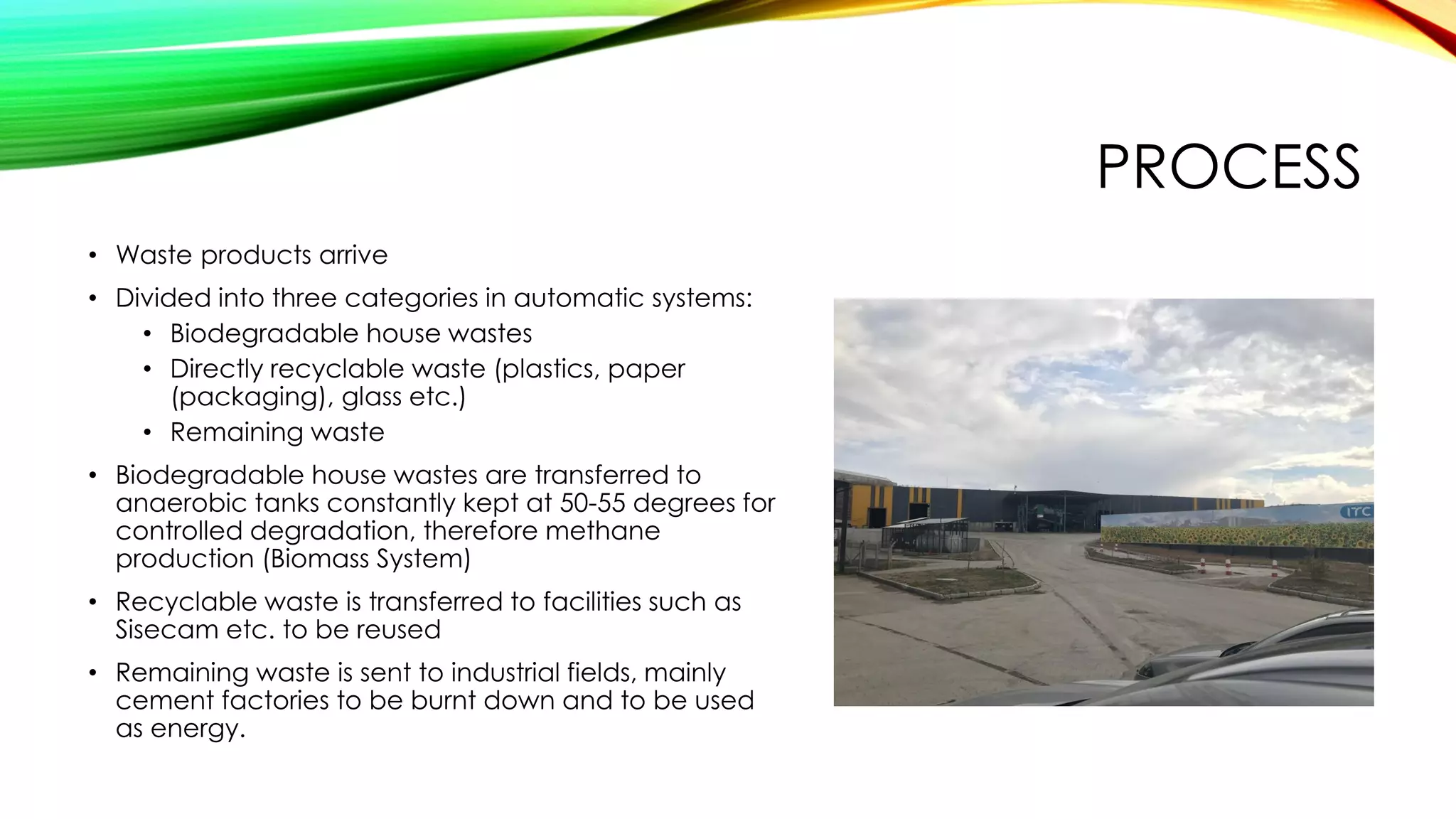
• Waste products arrive
• Divided into three categories in automatic systems:
• Biodegradable house wastes
• Directly recyclable waste (plastics, paper
(packaging), glass etc.)
• Remaining waste
• Biodegradable house wastes are transferred to
anaerobic tanks constantly kept at 50-55 degrees for
controlled degradation, therefore methane
production (Biomass System)
• Recyclable waste is transferred to facilities such as
Sisecam etc. to be reused
• Remaining waste is sent to industrial fields, mainly
cement factories to be burnt down and to be used
as energy.
• Methane produced by biodegrading waste is burnt and the energy is used
for producing electricity.
• A fraction of this energy is used for maintaining the tanks’ temperature.
• Biodegrading waste is sold as compost and fertilizer for agricultural purposes.
• The burning motors’ excess energy and overheating is solved by running
cold water through pipes around motors. This hot water is used around the
site for heating personnel facilities and greenhouses, also transferred to Nata
Vega shopping centre and some parts of Yenimahalle for heating.
WHAT IS 53 MEGAWATT?
• It is the energy that can used by 200.000-350.000 people for a year.
• The produced energy used for Ankara electricity mainly for Yenimahalle
region becuase of the location of Mamak Recycling Center.
• Mamak and Sincan Recycling Centers are produced 5% of Ankara
Electricity. Mamak (25.4 mW) Sincan (23.8 mW)
GREENHOUSES
• No-soil agriculture is practiced
• Plants are hanging in canals and getting their
nutritional needs from mineralized water
• Recycled shredded coconut shells are used to trap
water, they serve as soil substitute
• Greenhouse is heated by the methane burning
motors’ cooling water.
• The products are organic and free from pesticides.
There is a beehive for natural pollination.
• Turkey’s only orchid breeding laboratory is located
here.
• https://www.youtube.com/watch?v=6HOgBvTXu3w
REFERENCES
• https://www.ads.org.uk/hillcrest-housing-association-headquarters/
• http://www.nrsarchitects.com/_Hillcrest-HQ.html
• http://www.beepindia.org/sites/default/files/Energy%20efficient
• %20building%20in%20Uttar%20Pradesh%20-%20Arinem.pdf
• http://www.arinem.com/content/architects-house
• http://www.4-traders.com/INFOSYS-LTD-9743342/news/Infosys-Ltd-Infosys-
Hyderabad-Building-Awarded-Highest-LEED-Rating-14281293/
• http://www.itcturkiye.com/tr/mamak-ankara/11920

IAED 342-Research Presentation

  • 1.
    WASTE WATER ANDREUSE Serra Koz -- --
  • 2.
    OUTLINE • Hillcrest HousingAssociation HQ • The Architect’s House, Gokhle Marg • PTC Industries LTD. HQ (Upcoming Project) • Mamak Recycling Centre
  • 3.
    CASE STUDY I HILLCRESTHOUSING ASSOCIATION HEADQUARTERS
  • 4.
    Project Data Project Type Commerical Location 1 ExplorerRoad, Technology Park, Dundee, DD2 1EG Client Hillcrest Housing Association Date Completed December 2010 Project Value £5.3m Architect Nicoll Russell Studios Main Contractor W H Brown Construction (Dundee) Ltd Services Engineer Buro Happold Quantity Surveyor KLM Partnership Specialist Consultant CDM Co-ordinator – Hardies LLP Gross Internal Floor Area 2190 sq. m Structural Engineer Arup Scotland A new headquarters building intended to reflect the company’s core commitment to sustainable development and to be an exemplar of ‘environmentally sensitive architecture’. • modern, open and transparent • Sustainability • ‘BREEAM Excellent’ goal • Flexibility for growing company and departments (Open plan) Shortlisted for the 2011 RIAS Andrew Doolan Best Building in Scotland Award and awarded a special mention. Best Public/ Commercial Building, Best Client and the ‘Supreme’ Award from the Dundee Institute of Architects, 2011.
  • 6.
    LOCATION • The locationwas on two separate bus routes, near a cycle route, and with easy access to the Dundee Freeway for staff coming from the company’s offices in other parts of Scotland. This way, low-carbon building became even stronger. • The proximity of Dundee Freeway caused a noise problem, so ventilation with opening windows had to be reconsidered. While office buildings might normally be expected to present a gable end to the south to avoid over-heating from solar gain, the architects decided after much discussion to orientate the building on an East-West axis to maximize solar gain in winter, knowing that they could provide shade from summer sun by simply incorporating fixed external louvers. Manually operated internal blinds provide occupant control to minimize glare. ORIENTATION
  • 7.
    HEATING AND ELECTRICITY •A biomass boiler was identified as the main heating source early on. • The biomass boiler is located in a separate building to the west of the main building, to isolate potential fire hazards from the main building, and to provide easy access from the car-park level for the lorry delivering woodchips to the boiler hopper. The building contains the biomass boiler, 2 back-up gas boilers and the filtering equipment and the heat accumulator. • Each window on the North and south façades is fitted with manually operated roller blinds. The glazed West gable is fitted with mechanically operated blinds triggered by a light meter. • The building has also been designed to allow for the future installation of two 15kW wind turbines.
  • 8.
    VENTILATION • Dynamic energymodelling was carried out to compare the energy consumption for an air tight mechanically ventilated solution with a naturally ventilated solution. • The mechanically ventilated solution was found to have lower annual energy consumption when coupled with an earth tube, natural air conditioning system. • Earth tubes are a series of buried concrete pipes which pre-heat or cool (depending on the temperature difference between the external air and ground temperature) the building’s incoming fresh air before it reaches the building’s air handling unit. Building Emission Rate of 20.4 kgCO2/m2/year The design emission rate was 21.7kgCO2/m2/year
  • 9.
    • Air isbrought into the building through 5 trunk-shaped ducts rising out of the grass to the back of the building. Low powered fans assist the process. The air is drawn into a ‘labyrinth’ of 600mm concrete pipes that feed into a brick chamber which functions on the same principle as a cave – in summer this will be cooler than the ambient air and in winter warmer, the difference in temperature being about 3°C. At that stage, if required, the air can be heated (by the heat generated by the biomass boiler) if required.
  • 10.
    ALSO: • Lamp unitsthroughout the building are low-energy, with daylight control and occupancy detection to minimize energy consumption. • Showers, taps and WC’s are designed for low water-consumption. Rain water is collected from the roof and recycled for use in flushing the toilets. • SUDS (Sustainable Drainage System) is installed externally. • The whole building was detailed in order to be demountable for re-use or recycling. • The aim of increasing biodiversity helped guide the site planting and landscaping of the site, with attention paid to choice of native species and the planting of wildflowers. • The majority of materials used in the building were Green Guide ‘A’ rated.
  • 11.
    This project basicallyinvolves finding the balance between home building and sustainable environment. The core concept is targeting an ideal green project to become a producer and exporter of resources rather than being a consumer. Project Category: Residential Lucknow Uttar Pradesh India Built up Area (Sq. metre): 548.55 Sq mtrs. Status: Completed THE ARCHITECT’S HOUSE GOKHLE MARG, LUCKNOW, U.P
  • 13.
    Evaluation of selfdefined spaces – The Zoning The central circulation core comprising of staircase and lift automatically defines the public and private layering of spaces inside the house. The central core divides the plan into self containing but interactive spaces. Enhancing Visual Perception There are no interior walls except for the purpose of Toilet/Staircase. Unnecessary enclosures are eliminated and where necessary, glass doors are provided to maintain the visual connection of the observer. Living room Central Staircase SITE PLANNING
  • 14.
    FAÇADE •South facade withair gap and stone cladding. •Reduces solar heat gain from south. CENTRAL STAIR •Central stair well acting as lungs for the entire house. •Keeps the lower floors of the house cooler.
  • 15.
    Green Roof •Entire terracecovered with natural grass. •Restores the green cover and provides insulation. Sewage Treatment Plant •Phytorid based technology Phytorid technology https://www.youtube.com/watch?v= O2HGx9fHPA0 •Capacity - 2400 L Recycled water used for gardening and washing purposes. WATER CONSERVATION
  • 16.
    WATER CONSERVATION Rain waterharvesting •4000 L capacity tank Recycled water used for gardening and washing purposes.
  • 17.
    ENERGY CONSERVATION • LEDlighting •Automated sensor driven technology 60% reduction in lighting loads.
  • 18.
    ENERGY CONSERVATION Solar waterheater Provides up to 500 L hot water per day.
  • 19.
    ENERGY CONSERVATION Solar PVpanels 11 KW electricity generation, per day (assuming 6 hours of average sunshine/day).
  • 20.
    ENERGY CONSERVATION Variable RefrigerantVolume (VRV) for air conditioning 40% reduction in air conditioning loads.
  • 21.
    ENERGY CONSERVATION Low e-glass for glazing Reduces solar heat gain and keeps the interiors cool.
  • 22.
    Use of foamconcrete blocks (AAC blocks) MATERIAL CONSERVATION Eliminates the use of conventional fire burnt bricks.
  • 23.
  • 24.
    Pocharam campus inHyderabad, India April 19, 2012 Types: Public Awarded Highest LEED Rating: Fourth LEED Platinum rated building at Infosys PTC INDUSTRIES LTD. IGBC PLATINUM RATED (APPLIED)
  • 25.
    Preserved maximum numberof trees, possible. SITE PLANNING Cut and Fill •Earth obtained from excavation of water bodies reused for raising the level as per need, within the site. Landscaping •Top soil stock piled and reused for landscaping. Reduces long term negative effects to the site.
  • 26.
    Turf area minimized •Puttinggreen and fareway green area minimised. •Turf, plants, shrubs and trees which consume less water and are resilient to local climatic conditions are used. Reduces water consumption for irrigation and landscaping.
  • 27.
    WATER CONSERVATION Sewage TreatmentPlant •Phytorid based technology •Capacity - 15000 L Recycled water used for: Flushing (660 people present at all times) Irrirgation (7500 m2) Washing floor (12000 m2). Water Efficiency: A 48% reduction in overall water consumption has been achieved in the building through the use of efficient plumbing fixtures and by water recycling. 100% of waste water from the campus will be treated on site, helping in the reduction of potable water consumption
  • 28.
    Rain water harvesting •Roof top - 12500 m2 • 70% of surface water Ponds acting as storm water collection pits and landscape features.
  • 30.
    ENERGY CONSERVATION Solar PVpanels •Roof top = 1 MW •Parking covers = 30 Kw Self - sufficiency in energy for on- site power generation and use within the factory building( except heavy machinery).
  • 31.
    Reduces Solar HeatGain Reduces Cooling Load Low e- glass •AIS geosense - green glass
  • 32.
    Insulated sheets toreduce solar heat gain. Surface sheeting designed to provide maximum daylight inside the workshop.
  • 33.
    MATERIAL CONSERVATION Pre- EngineeredConstruction Time - Efficient Energy Efficient Waste reduction.
  • 35.
  • 36.
    BACKGROUND INFORMATION • MamakRecycling Center has been founded in 2001, where Mamak wasteland was located. • PROBLEMS: The smell, soil and water contamination, methane explosions. • Ankara Municipality rented the area to ITC company for 49 years to be rehabilitated and create a solution for the following years.
  • 37.
    PROCESS • Waste productsarrive • Divided into three categories in automatic systems: • Biodegradable house wastes • Directly recyclable waste (plastics, paper (packaging), glass etc.) • Remaining waste • Biodegradable house wastes are transferred to anaerobic tanks constantly kept at 50-55 degrees for controlled degradation, therefore methane production (Biomass System) • Recyclable waste is transferred to facilities such as Sisecam etc. to be reused • Remaining waste is sent to industrial fields, mainly cement factories to be burnt down and to be used as energy.
  • 38.
    • Methane producedby biodegrading waste is burnt and the energy is used for producing electricity. • A fraction of this energy is used for maintaining the tanks’ temperature. • Biodegrading waste is sold as compost and fertilizer for agricultural purposes. • The burning motors’ excess energy and overheating is solved by running cold water through pipes around motors. This hot water is used around the site for heating personnel facilities and greenhouses, also transferred to Nata Vega shopping centre and some parts of Yenimahalle for heating.
  • 40.
    WHAT IS 53MEGAWATT? • It is the energy that can used by 200.000-350.000 people for a year. • The produced energy used for Ankara electricity mainly for Yenimahalle region becuase of the location of Mamak Recycling Center. • Mamak and Sincan Recycling Centers are produced 5% of Ankara Electricity. Mamak (25.4 mW) Sincan (23.8 mW)
  • 41.
    GREENHOUSES • No-soil agricultureis practiced • Plants are hanging in canals and getting their nutritional needs from mineralized water • Recycled shredded coconut shells are used to trap water, they serve as soil substitute • Greenhouse is heated by the methane burning motors’ cooling water. • The products are organic and free from pesticides. There is a beehive for natural pollination. • Turkey’s only orchid breeding laboratory is located here. • https://www.youtube.com/watch?v=6HOgBvTXu3w
  • 43.
    REFERENCES • https://www.ads.org.uk/hillcrest-housing-association-headquarters/ • http://www.nrsarchitects.com/_Hillcrest-HQ.html •http://www.beepindia.org/sites/default/files/Energy%20efficient • %20building%20in%20Uttar%20Pradesh%20-%20Arinem.pdf • http://www.arinem.com/content/architects-house • http://www.4-traders.com/INFOSYS-LTD-9743342/news/Infosys-Ltd-Infosys- Hyderabad-Building-Awarded-Highest-LEED-Rating-14281293/ • http://www.itcturkiye.com/tr/mamak-ankara/11920