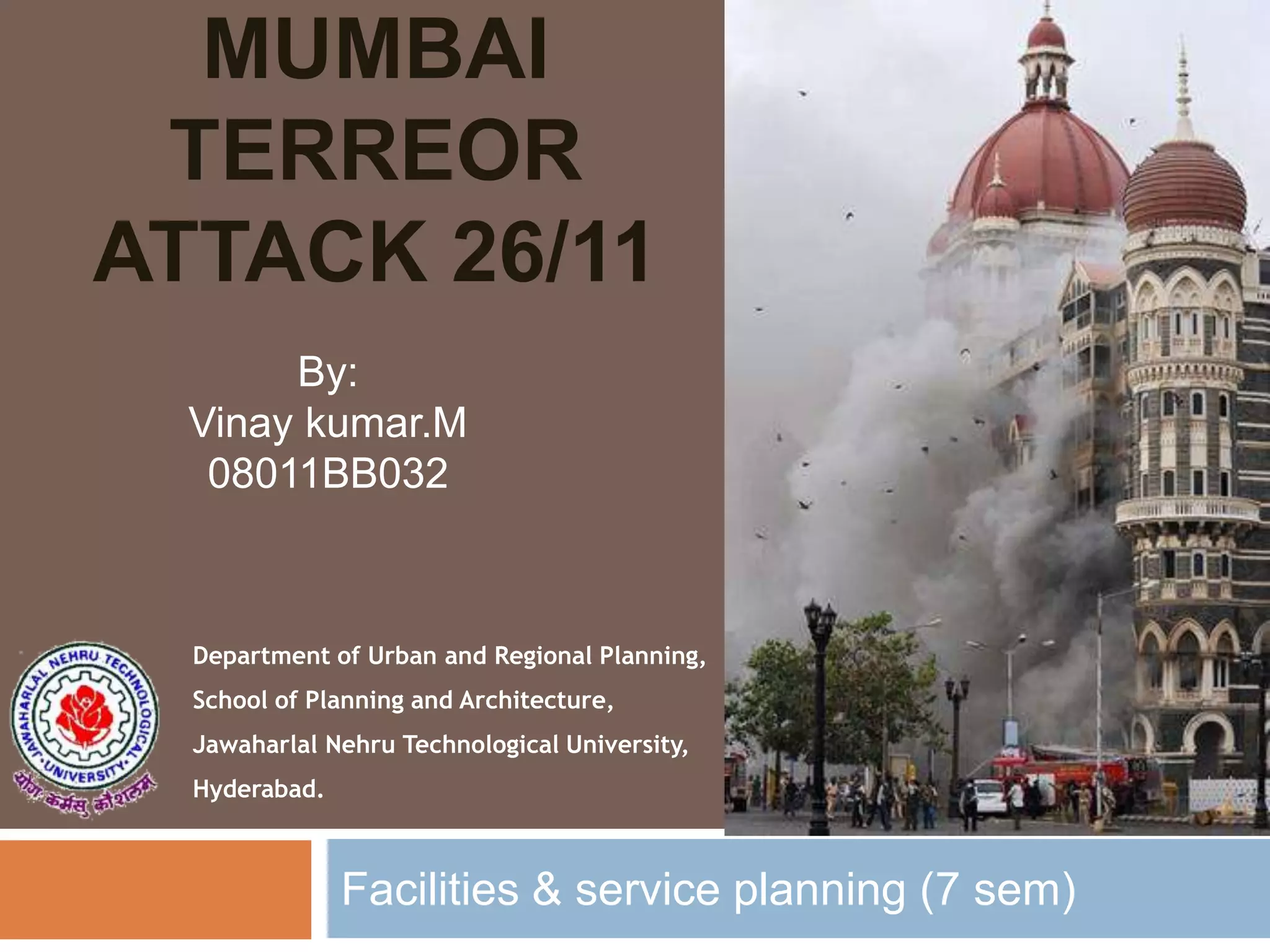
MUMBAI
 TERREOR
ATTACK 26/11
       By:
  Vinay kumar.M
   08011BB032


  Department of Urban and Regional Planning,
  School of Planning and Architecture,
  Jawaharlal Nehru Technological University,
  Hyderabad.


               Facilities & service planning (7 sem)
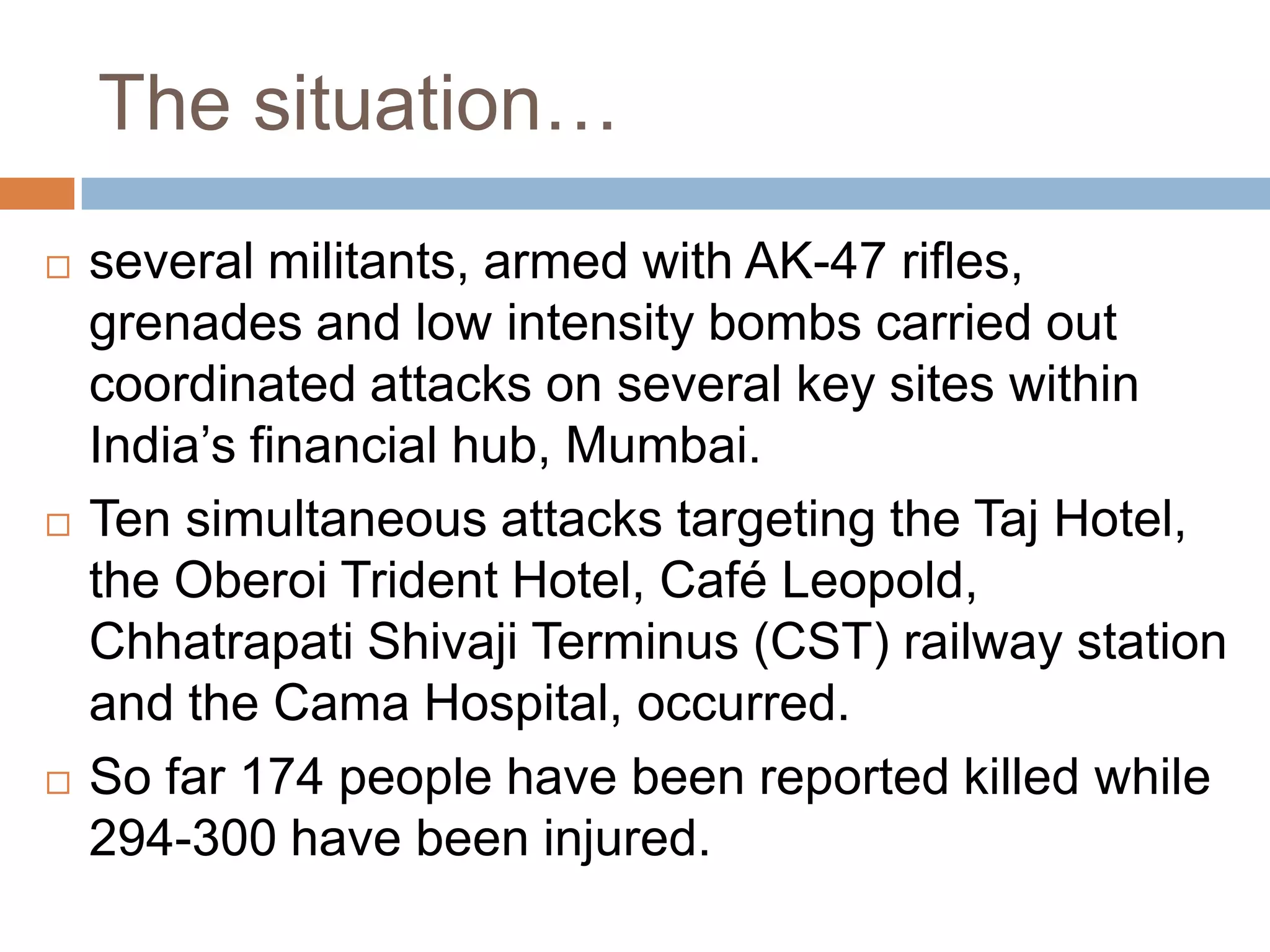
The situation…
   several militants, armed with AK-47 rifles,
    grenades and low intensity bombs carried out
    coordinated attacks on several key sites within
    India’s financial hub, Mumbai.
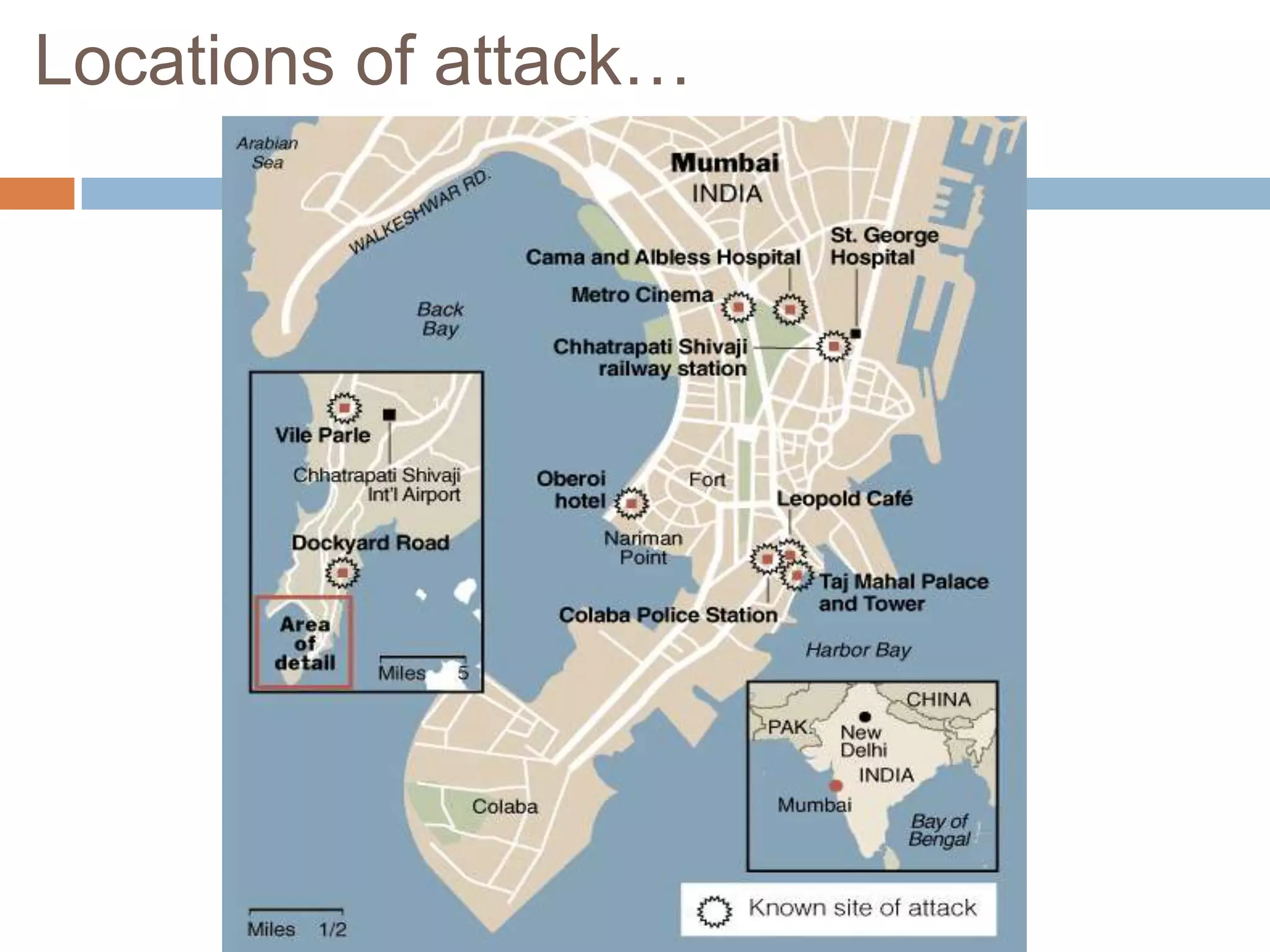
   Ten simultaneous attacks targeting the Taj Hotel,
    the Oberoi Trident Hotel, Café Leopold,
    Chhatrapati Shivaji Terminus (CST) railway station
    and the Cama Hospital, occurred.
   So far 174 people have been reported killed while
    294-300 have been injured.
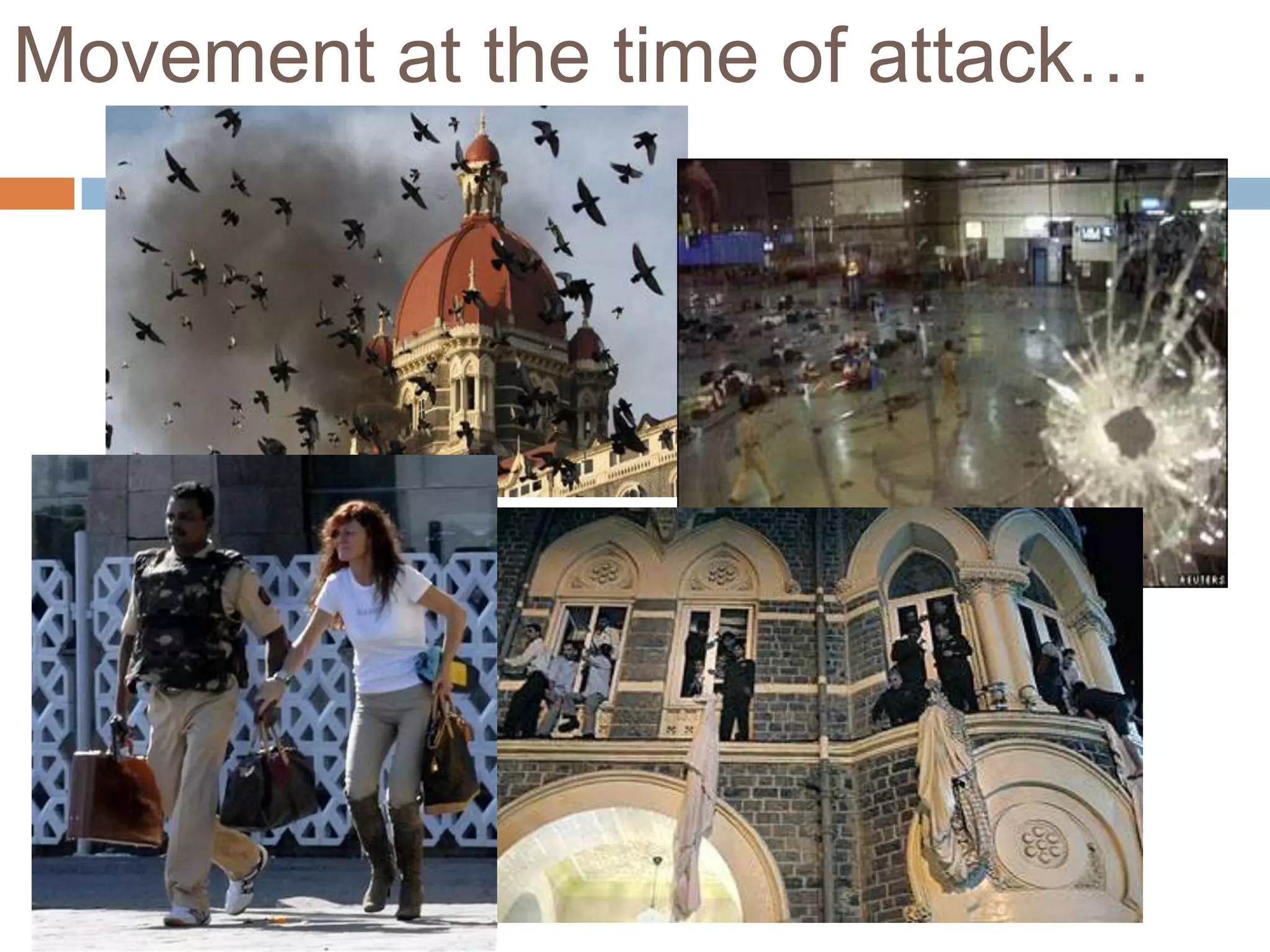
Movement at the time of attack…
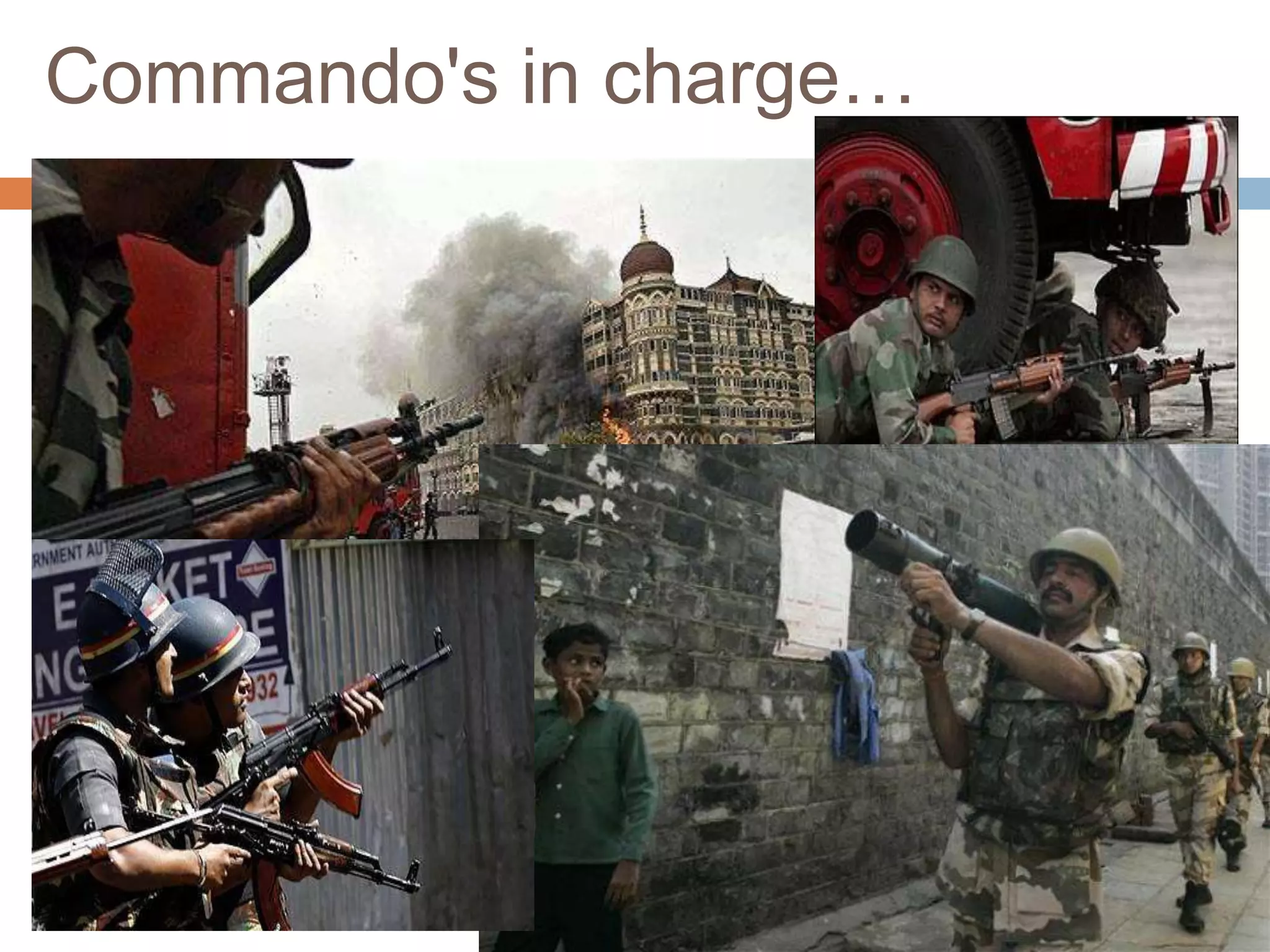
Commando's in charge…
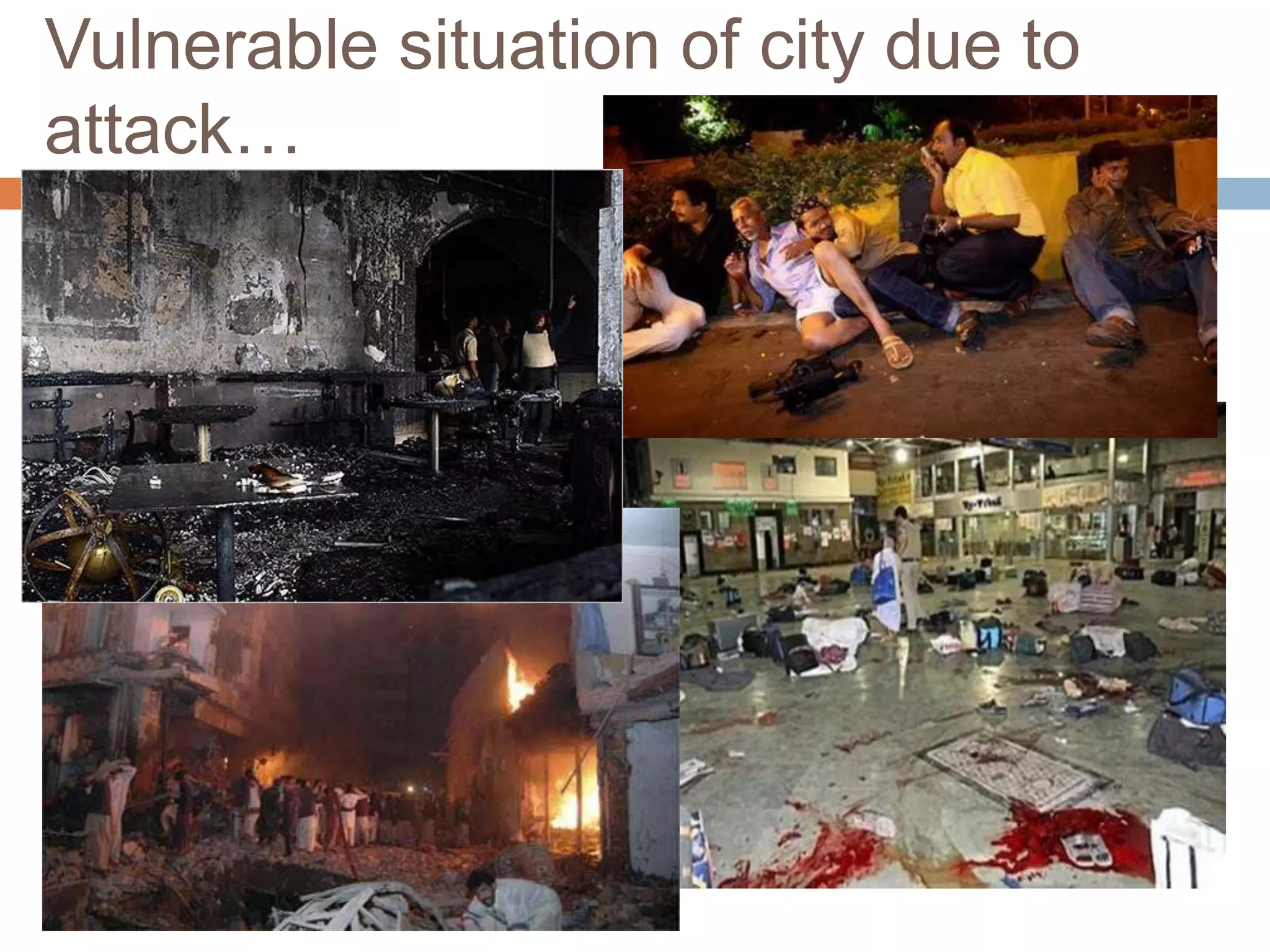
Vulnerable situation of city due to
attack…
Locations of attack…
Public and International
Reactions
   United Nations (UN) spokesman calls for the
    militants to be brought to justice immediately.
   The government of the United States Obama
    urged the United States to continue to strengthen
    its partnerships with India and other nations
    worldwide in the efforts to eliminate terrorist
    networks.
   British Prime Minister Gordon Brow has stated
    thatUK stands strongly with the Indian
    government and will offer “necessary help”
The Indian government’s response to the Mumbai attacks highlighted
several key weaknesses in the country’s general counterterrorism and
threat-mitigation structure.


   Intelligence failure
   Gaps in coastal surveillance
   Inadequate “target hardening”
   Incomplete execution of response protocols
   Response time problems
   Inadequate counterterrorism training & equipment
    for local police
   Limitations of municipal fire & emergency services
   Poor strategic communication & information
    management
Indian local &national body
reaction…
   Criticism of politicians and resignations
     Indians criticised their political leaders after the attacks,
    saying their bickering and ineptness was at least partly
    responsible.
   Criticism of the rescue operation
    The NSG commandos based in Mehram Nagar, Palam
    Airport,Delhitook 10 hours to reach the terrorists.
   Demand for self-defense
    The war on Mumbai has left the corporate sector of
    India angry; vulnerable sectors want to be armed.
   Tribute to victims
International
support…
   Australia – Australia had sent a team of Federal Police to
    Mumbai. A group of seven officers have arrived to study the
    terror attack and the modus operandi used by the terrorists.
   Israel – Israel had offered a forty-strong team of special
    operation forces and assistance in investigations.
   Malaysia – Malaysian authorities had investigated reports
    related to Malaysian-issued credit cards found in the
    belongings of the terrorists involved in the Mumbai attacks.
   United Kingdom – United Kingdom had sent 15 forensic
    experts from the intelligence services to Mumbai to help with
    the investigations on the attacks on India’s financial capital.
Contd…
   US – President of the United States George W. Bush told
    Prime Minister Manmohan Singh that American agencies
    will "throw their weight" behind India's investigation into the
    Mumbai terror attacks and demonstrate a "shared
    commitment" to combat terrorism.
Improvement in security
arrengments after the attack
   Force One, Maharashtra’s “elite security force designed on
    the lines of the National Security Guard (NSG)” has been
    commissioned.
    Arms purchase has increased in India. Not just in
    Maharashtra but by the central government, and the Army
    too.
   The Navy is also beefing up on infrastructure to protect India
    from the sea. From aircraft to boats, to the numerical
    strength of personnel is all being increased.
    A 20 per cent increase in the budget for Coast Guard
    vessels. Manpower is also being increased.
   The government has opened four NSG hubs in Mumbai,
    Kolkata, Hyderabad and Chennai, each having a strength of
The government have strengthen the
following…
   Border Security Force
   Central Industrial Security Force
   Central Reserve Police Force
   National Security Guards
   Special Protection Group
   State police
   Metropolitan police
   State Armed Police Forces
Contd…
   Selection and Training
    selection levels of the position and direct entry (where an
    applicant does not have to start at the lowest level) is
    possible. The educational requirements increase with
    recruitments for higher posts.
   Encounter Squads
    The Mumbai Encounter Squad is an unofficial group within
    the police force of Mumbai, India. It consists of several high-
    profile officers from the Detection Unit. The squad primarily
    deals with members of the Mumbai underworld and other
    criminal gangs and carries out the elimination of criminals.
contd…
   Mumbai government planned to buy 36 speed boats to
    patrol the coastal areas and several helicopters for the
    same purpose.
    to create an anti-terror force called "Force One" and
    upgrade all the weapons that Mumbai police currently
    have.
   The government strengthened anti-terror laws
    with UAPA 2008, and the federal National Investigation
    Agency was formed.
Conclusion…

Indian government failed in mitigating the attack
  effect and could have done better then it have…
 Intelligence analysis & sharing

 Emergency preparedness & rapid response

 Investigation management

 Consequence management

 Advocacy and research roles

 Ensuring greater coordination on more regular
  basis between the police & the vulnerable private
  sector targets.
disaster of Mumbai terror attack by vinay

disaster of Mumbai terror attack by vinay

  • 1.
    MUMBAI TERREOR ATTACK 26/11 By: Vinay kumar.M 08011BB032 Department of Urban and Regional Planning, School of Planning and Architecture, Jawaharlal Nehru Technological University, Hyderabad. Facilities & service planning (7 sem)
  • 2.
    The situation…  several militants, armed with AK-47 rifles, grenades and low intensity bombs carried out coordinated attacks on several key sites within India’s financial hub, Mumbai.  Ten simultaneous attacks targeting the Taj Hotel, the Oberoi Trident Hotel, Café Leopold, Chhatrapati Shivaji Terminus (CST) railway station and the Cama Hospital, occurred.  So far 174 people have been reported killed while 294-300 have been injured.
  • 3.
    Movement at thetime of attack…
  • 4.
  • 5.
    Vulnerable situation ofcity due to attack…
  • 6.
  • 7.
    Public and International Reactions  United Nations (UN) spokesman calls for the militants to be brought to justice immediately.  The government of the United States Obama urged the United States to continue to strengthen its partnerships with India and other nations worldwide in the efforts to eliminate terrorist networks.  British Prime Minister Gordon Brow has stated thatUK stands strongly with the Indian government and will offer “necessary help”
  • 8.
    The Indian government’sresponse to the Mumbai attacks highlighted several key weaknesses in the country’s general counterterrorism and threat-mitigation structure.  Intelligence failure  Gaps in coastal surveillance  Inadequate “target hardening”  Incomplete execution of response protocols  Response time problems  Inadequate counterterrorism training & equipment for local police  Limitations of municipal fire & emergency services  Poor strategic communication & information management
  • 9.
    Indian local &nationalbody reaction…  Criticism of politicians and resignations Indians criticised their political leaders after the attacks, saying their bickering and ineptness was at least partly responsible.  Criticism of the rescue operation The NSG commandos based in Mehram Nagar, Palam Airport,Delhitook 10 hours to reach the terrorists.  Demand for self-defense The war on Mumbai has left the corporate sector of India angry; vulnerable sectors want to be armed.  Tribute to victims
  • 10.
    International support…  Australia – Australia had sent a team of Federal Police to Mumbai. A group of seven officers have arrived to study the terror attack and the modus operandi used by the terrorists.  Israel – Israel had offered a forty-strong team of special operation forces and assistance in investigations.  Malaysia – Malaysian authorities had investigated reports related to Malaysian-issued credit cards found in the belongings of the terrorists involved in the Mumbai attacks.  United Kingdom – United Kingdom had sent 15 forensic experts from the intelligence services to Mumbai to help with the investigations on the attacks on India’s financial capital.
  • 11.
    Contd…  US – President of the United States George W. Bush told Prime Minister Manmohan Singh that American agencies will "throw their weight" behind India's investigation into the Mumbai terror attacks and demonstrate a "shared commitment" to combat terrorism.
  • 12.
    Improvement in security arrengmentsafter the attack  Force One, Maharashtra’s “elite security force designed on the lines of the National Security Guard (NSG)” has been commissioned.  Arms purchase has increased in India. Not just in Maharashtra but by the central government, and the Army too.  The Navy is also beefing up on infrastructure to protect India from the sea. From aircraft to boats, to the numerical strength of personnel is all being increased.  A 20 per cent increase in the budget for Coast Guard vessels. Manpower is also being increased.  The government has opened four NSG hubs in Mumbai, Kolkata, Hyderabad and Chennai, each having a strength of
  • 13.
    The government havestrengthen the following…  Border Security Force  Central Industrial Security Force  Central Reserve Police Force  National Security Guards  Special Protection Group  State police  Metropolitan police  State Armed Police Forces
  • 14.
    Contd…  Selection and Training selection levels of the position and direct entry (where an applicant does not have to start at the lowest level) is possible. The educational requirements increase with recruitments for higher posts.  Encounter Squads The Mumbai Encounter Squad is an unofficial group within the police force of Mumbai, India. It consists of several high- profile officers from the Detection Unit. The squad primarily deals with members of the Mumbai underworld and other criminal gangs and carries out the elimination of criminals.
  • 15.
    contd…  Mumbai government planned to buy 36 speed boats to patrol the coastal areas and several helicopters for the same purpose.  to create an anti-terror force called "Force One" and upgrade all the weapons that Mumbai police currently have.  The government strengthened anti-terror laws with UAPA 2008, and the federal National Investigation Agency was formed.
  • 16.
    Conclusion… Indian government failedin mitigating the attack effect and could have done better then it have…  Intelligence analysis & sharing  Emergency preparedness & rapid response  Investigation management  Consequence management  Advocacy and research roles  Ensuring greater coordination on more regular basis between the police & the vulnerable private sector targets.