0/1 KNAPSACK PROBLEM 
CH.KARTHIK 
13MSN0083 
VIT UNIVERSITY
Greedy Method 
 It is a design technique applied to those 
problems having n inputs and requires us 
to obtain a subset that satisfies some 
constraints. 
 Any subset that satisfies these constraints 
is called a feasible solution. 
Ultimate goal is to find a feasible solution 
that minimizes [or maximizes] an 
objective function; this solution is known 
as optimal solution.
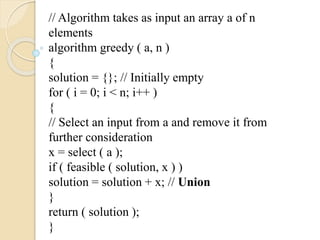
// Algorithm takes as input an array a of n 
elements 
algorithm greedy ( a, n ) 
{ 
solution = {}; // Initially empty 
for ( i = 0; i < n; i++ ) 
{ 
// Select an input from a and remove it from 
further consideration 
x = select ( a ); 
if ( feasible ( solution, x ) ) 
solution = solution + x; // Union 
} 
return ( solution ); 
}
Knapsack 
 A 1998 study of the Stony Brook 
University Algorithm Repository showed 
that, out of 75 algorithmic problems, the 
knapsack problem was the 18th most 
popular and the 4th most needed after kd-trees, 
suffix trees, and the bin packing 
problem
Knapsack problem 
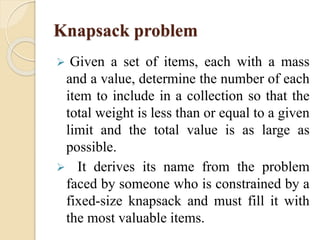
 Given a set of items, each with a mass 
and a value, determine the number of each 
item to include in a collection so that the 
total weight is less than or equal to a given 
limit and the total value is as large as 
possible. 
 It derives its name from the problem 
faced by someone who is constrained by a 
fixed-size knapsack and must fill it with 
the most valuable items.
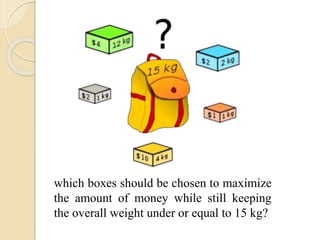
which boxes should be chosen to maximize 
the amount of money while still keeping 
the overall weight under or equal to 15 kg?
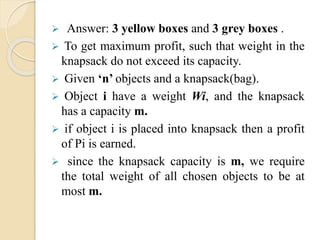
 Answer: 3 yellow boxes and 3 grey boxes . 
 To get maximum profit, such that weight in the 
knapsack do not exceed its capacity. 
 Given ‘n’ objects and a knapsack(bag). 
 Object i have a weight Wi, and the knapsack 
has a capacity m. 
 if object i is placed into knapsack then a profit 
of Pi is earned. 
 since the knapsack capacity is m, we require 
the total weight of all chosen objects to be at 
most m.
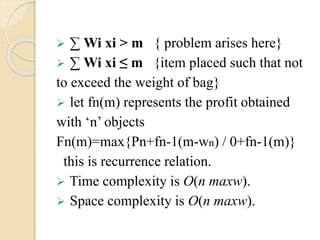
 Σ Wi xi > m { problem arises here} 
 Σ Wi xi ≤ m {item placed such that not 
to exceed the weight of bag} 
 let fn(m) represents the profit obtained 
with ‘n’ objects 
Fn(m)=max{Pn+fn-1(m-wn) / 0+fn-1(m)} 
this is recurrence relation. 
 Time complexity is O(n maxw). 
 Space complexity is O(n maxw).
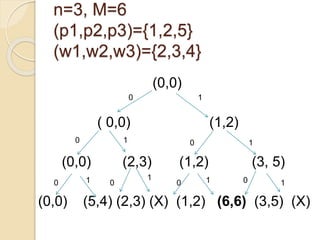
n=3, M=6 
(p1,p2,p3)={1,2,5} 
(w1,w2,w3)={2,3,4} 
(0,0) 
0 1 
( 0,0) (1,2) 
0 
1 
0 1 
(0,0) (2,3) (1,2) (3, 5) 
0 
1 
1 0 0 1 0 1 
(0,0) (5,4) (2,3) (X) (1,2) (6,6) (3,5) (X)
Than’Q’ 


Knapsack

  • 1.
    0/1 KNAPSACK PROBLEM CH.KARTHIK 13MSN0083 VIT UNIVERSITY
  • 2.
    Greedy Method It is a design technique applied to those problems having n inputs and requires us to obtain a subset that satisfies some constraints.  Any subset that satisfies these constraints is called a feasible solution. Ultimate goal is to find a feasible solution that minimizes [or maximizes] an objective function; this solution is known as optimal solution.
  • 3.
    // Algorithm takesas input an array a of n elements algorithm greedy ( a, n ) { solution = {}; // Initially empty for ( i = 0; i < n; i++ ) { // Select an input from a and remove it from further consideration x = select ( a ); if ( feasible ( solution, x ) ) solution = solution + x; // Union } return ( solution ); }
  • 4.
    Knapsack  A1998 study of the Stony Brook University Algorithm Repository showed that, out of 75 algorithmic problems, the knapsack problem was the 18th most popular and the 4th most needed after kd-trees, suffix trees, and the bin packing problem
  • 5.
    Knapsack problem Given a set of items, each with a mass and a value, determine the number of each item to include in a collection so that the total weight is less than or equal to a given limit and the total value is as large as possible.  It derives its name from the problem faced by someone who is constrained by a fixed-size knapsack and must fill it with the most valuable items.
  • 6.
    which boxes shouldbe chosen to maximize the amount of money while still keeping the overall weight under or equal to 15 kg?
  • 7.
     Answer: 3yellow boxes and 3 grey boxes .  To get maximum profit, such that weight in the knapsack do not exceed its capacity.  Given ‘n’ objects and a knapsack(bag).  Object i have a weight Wi, and the knapsack has a capacity m.  if object i is placed into knapsack then a profit of Pi is earned.  since the knapsack capacity is m, we require the total weight of all chosen objects to be at most m.
  • 8.
     Σ Wixi > m { problem arises here}  Σ Wi xi ≤ m {item placed such that not to exceed the weight of bag}  let fn(m) represents the profit obtained with ‘n’ objects Fn(m)=max{Pn+fn-1(m-wn) / 0+fn-1(m)} this is recurrence relation.  Time complexity is O(n maxw).  Space complexity is O(n maxw).
  • 9.
    n=3, M=6 (p1,p2,p3)={1,2,5} (w1,w2,w3)={2,3,4} (0,0) 0 1 ( 0,0) (1,2) 0 1 0 1 (0,0) (2,3) (1,2) (3, 5) 0 1 1 0 0 1 0 1 (0,0) (5,4) (2,3) (X) (1,2) (6,6) (3,5) (X)
  • 10.