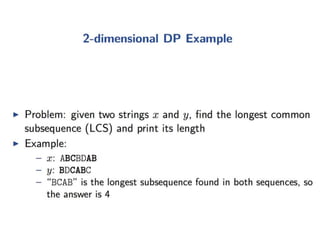
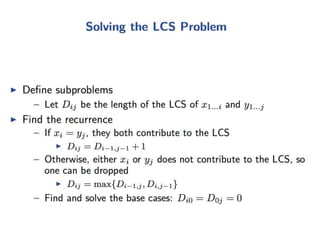
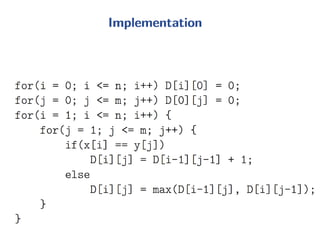
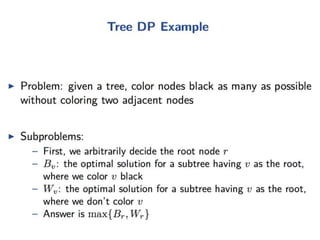
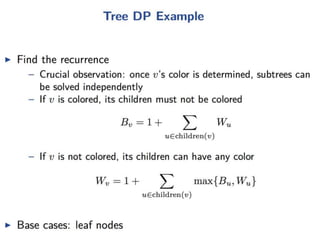
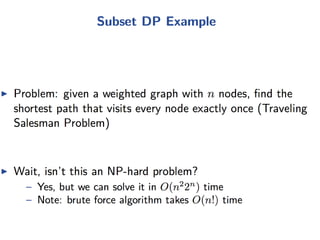
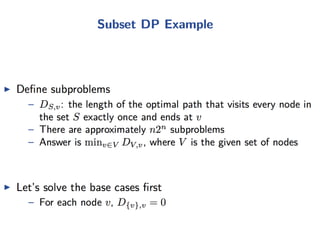
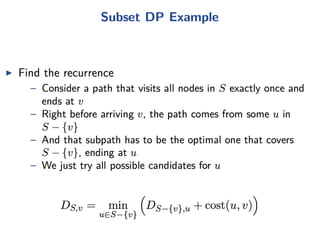
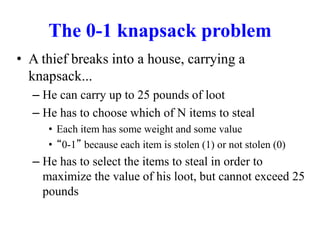
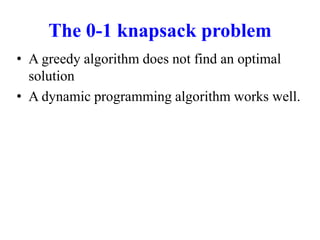
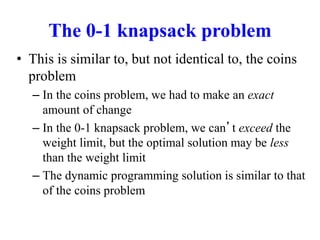
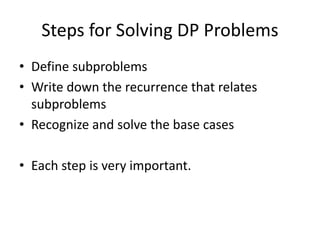
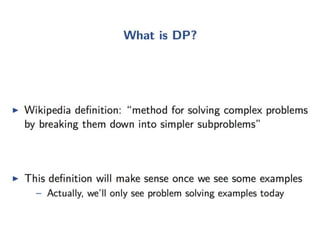
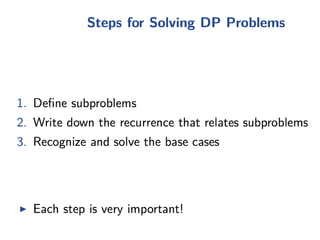
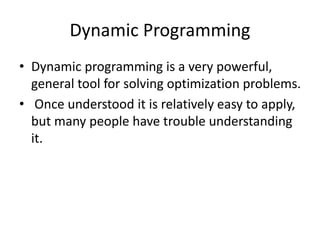
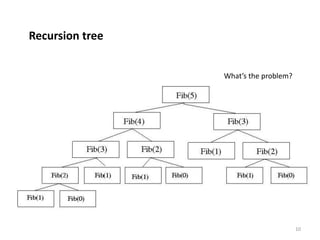
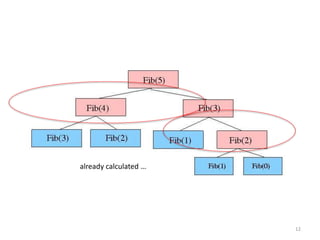
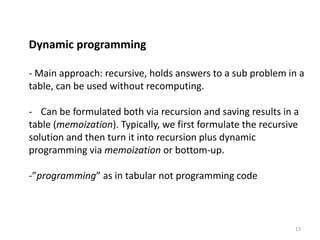
Dynamic programming is a powerful technique for solving optimization problems by breaking them down into overlapping subproblems. It works by storing solutions to already solved subproblems and building up to a solution for the overall problem. Three key aspects are defining the subproblems, writing the recurrence relation, and solving base cases to build up solutions bottom-up rather than top-down. The principle of optimality must also hold for a problem to be suitable for a dynamic programming approach. Examples discussed include shortest paths, coin change, knapsack problems, and calculating Fibonacci numbers.
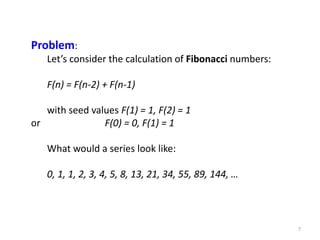
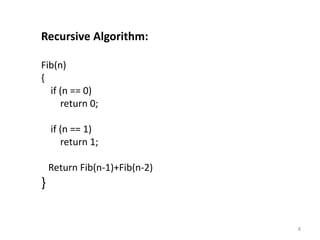
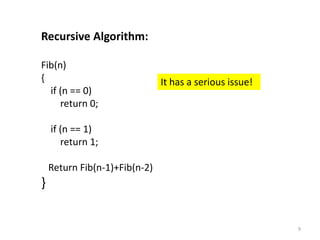
![11
Memoization:
Fib(n)
{
if (n == 0)
return M[0];
if (n == 1)
return M[1];
if (Fib(n-2) is not already calculated)
call Fib(n-2);
if(Fib(n-1) is already calculated)
call Fib(n-1);
//Store the ${n}^{th}$ Fibonacci no. in memory & use previous results.
M[n] = M[n-1] + M[n-2]
Return M[n];
}](https://image.slidesharecdn.com/dynamicprogramming-220817043419-20e95fa9/85/DynamicProgramming-pptx-11-320.jpg)

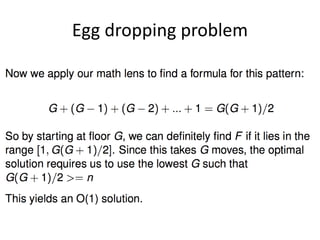
![Egg dropping problem(n eggs)
Dynamic Programming Approach
• D[j,m] : There are j floors and m eggs. Like to find the
floors with the largest value from which an egg, when
dropped doesn’t crack.
Here the egg cracked
when dropped from
floor g.](https://image.slidesharecdn.com/dynamicprogramming-220817043419-20e95fa9/85/DynamicProgramming-pptx-37-320.jpg)
![Egg dropping problem(n eggs)
Dynamic Programming Approach
• DP[j,m] : There are j floors and m eggs. Like to find the
floors with the largest value from which an egg, when
dropped doesn’t crack.
Here the egg cracked
when dropped from
floor g.
Here the egg didn’t
crack when dropped
from floor g.](https://image.slidesharecdn.com/dynamicprogramming-220817043419-20e95fa9/85/DynamicProgramming-pptx-38-320.jpg)
![Egg dropping problem(n eggs)
Dynamic Programming Approach
• DP[j,m] : There are j floors and m eggs. Like to find the
floors with the largest value from which an egg, when
dropped doesn’t crack.
DP[1,e] = 0 for all e (Base case)](https://image.slidesharecdn.com/dynamicprogramming-220817043419-20e95fa9/85/DynamicProgramming-pptx-39-320.jpg)