The Greedy Method The Greedy Method
Outline and Reading The Greedy Method Technique ( §5.1 ) Fractional Knapsack Problem ( §5.1.1 ) Task Scheduling ( §5.1.2 ) Minimum Spanning Trees ( §7.3 ) [future lecture] The Greedy Method
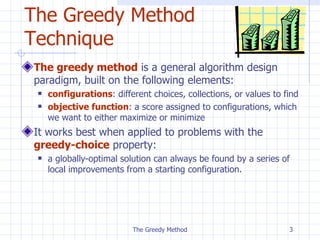
The Greedy Method Technique The greedy method  is a general algorithm design paradigm, built on the following elements: configurations : different choices, collections, or values to find objective function : a score assigned to configurations, which we want to either maximize or minimize It works best when applied to problems with the  greedy-choice  property:  a globally-optimal solution can always be found by a series of local improvements from a starting configuration. The Greedy Method
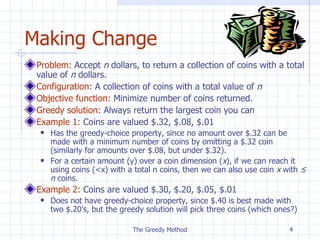
Making Change Problem:   Accept  n  dollar s,  to  return a collection of coins with a total value of  n  dollars . Configuration:  A  collection of  coins  with a total value of  n Objective function:  Minimize number of coins returned. Greedy solution:  Always return the largest coin you can Example 1:  Coins are valued $.32, $.08, $.01 Has the greedy-choice property, since no amount over $.32 can be made with a minimum number of coins by omitting a $.32 coin (similarly for amounts over $.08, but under $.32). For a certain amount (y) over a coin dimension ( x ), if we can reach it using coins (<x) with a total n coins, then we can also use coin  x  with  ≤ n  coins. Example 2:  Coins are valued $.30, $.20, $.05, $.01 Does not have greedy-choice property, since $.40 is best made with two $.20’s, but the greedy solution will pick three coins (which ones?) The Greedy Method
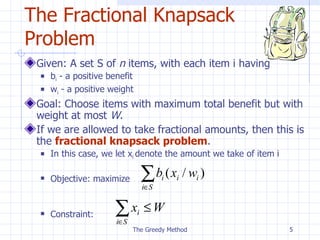
The Fractional Knapsack Problem Given: A set S of  n  items, with each item i having b i  - a positive benefit w i  - a positive weight Goal: Choose items with maximum total benefit but with weight at most  W . If we are allowed to take fractional amounts, then this is the  fractional knapsack problem . In this case, we let x i  denote the amount we take of item i Objective: maximize Constraint: The Greedy Method
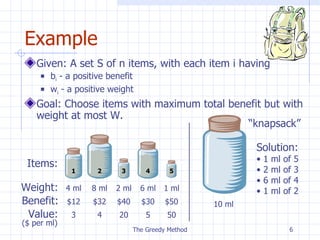
Example Given: A set S of n items, with each item i having b i  - a positive benefit w i  - a positive weight Goal: Choose items with maximum total benefit but with weight at most W. The Greedy Method Weight: Benefit: 1 2 3 4 5 4 ml 8 ml 2 ml 6 ml 1 ml $12 $32 $40 $30 $50 Items: Value: 3 ($ per ml) 4 20 5 50 Solution: 1 ml of 5 2 ml of 3 6 ml of 4 1 ml of 2 “ knapsack” 10 ml
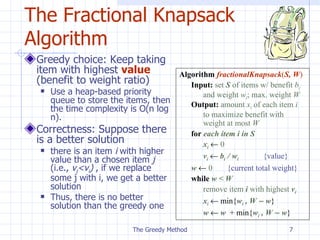
The Fractional Knapsack Algorithm Greedy choice: Keep taking item with highest  value  (benefit to weight ratio) Use a heap-based priority queue to store the items, then   the  time  complexity is  O(n log n). Correctness: Suppose there is a better solution there is an item  i  with higher value than a chosen item  j  (i.e.,  v j < v i )   , i f we  replace  some  j  with  i , we get a better solution Thus, there is no better solution than the greedy one The Greedy Method Algorithm   fractionalKnapsack ( S,   W ) Input:   set  S  of items w/ benefit  b i   and weight  w i ; max. weight  W Output:   amount  x i  of each item  i  to maximize benefit with  weight at most  W for  each item i in S x i      0 v i      b i  / w i   {value} w      0 { current  total weight} while   w < W  remove item  i  with highest  v i x i     min{ w i  , W    w } w     w   + min{ w i  , W    w }
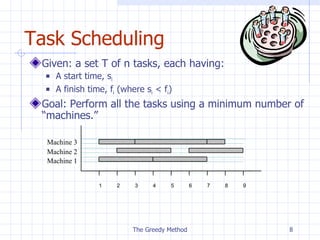
Task Scheduling Given: a set T of n tasks, each having: A start time, s i A finish time, f i  (where s i  < f i ) Goal: Perform all the tasks using a minimum number of “machines.” The Greedy Method 1 9 8 7 6 5 4 3 2 Machine 1 Machine 3 Machine 2
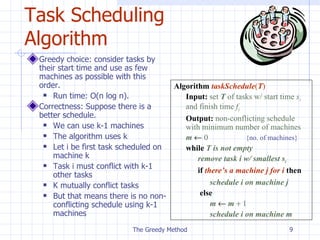
Task Scheduling Algorithm Greedy choice: consider tasks by their start time and use as few machines as possible with this order. Run time: O(n log n).  Correctness: Suppose there is a better schedule. We can use k-1 machines The algorithm uses k Let i be first task scheduled on machine k Task  i must conflict with k-1 other tasks K mutually conflict tasks But that means there is no non-conflicting schedule using k-1 machines The Greedy Method Algorithm   taskSchedule ( T ) Input:   set  T  of tasks w/ start time  s i   and finish time  f i Output:   non-conflicting schedule  with minimum number of machines m      0 {no. of machines} while   T is not empty remove task i w/ smallest s i if  there’s a machine j for i  then schedule i on machine j   else   m      m     1 schedule i on machine m
Example Given: a set T of n tasks, each having: A start time, s i A finish time, f i  (where s i  < f i ) [1,4], [1,3], [2,5], [3,7], [4,7], [6,9], [7,8] (ordered by start) Goal: Perform all tasks on min. number of machines The Greedy Method 1 9 8 7 6 5 4 3 2 Machine 1 Machine 3 Machine 2

Greedy

  • 1.
    The Greedy MethodThe Greedy Method
  • 2.
    Outline and ReadingThe Greedy Method Technique ( §5.1 ) Fractional Knapsack Problem ( §5.1.1 ) Task Scheduling ( §5.1.2 ) Minimum Spanning Trees ( §7.3 ) [future lecture] The Greedy Method
  • 3.
    The Greedy MethodTechnique The greedy method is a general algorithm design paradigm, built on the following elements: configurations : different choices, collections, or values to find objective function : a score assigned to configurations, which we want to either maximize or minimize It works best when applied to problems with the greedy-choice property: a globally-optimal solution can always be found by a series of local improvements from a starting configuration. The Greedy Method
  • 4.
    Making Change Problem: Accept n dollar s, to return a collection of coins with a total value of n dollars . Configuration: A collection of coins with a total value of n Objective function: Minimize number of coins returned. Greedy solution: Always return the largest coin you can Example 1: Coins are valued $.32, $.08, $.01 Has the greedy-choice property, since no amount over $.32 can be made with a minimum number of coins by omitting a $.32 coin (similarly for amounts over $.08, but under $.32). For a certain amount (y) over a coin dimension ( x ), if we can reach it using coins (<x) with a total n coins, then we can also use coin x with ≤ n coins. Example 2: Coins are valued $.30, $.20, $.05, $.01 Does not have greedy-choice property, since $.40 is best made with two $.20’s, but the greedy solution will pick three coins (which ones?) The Greedy Method
  • 5.
    The Fractional KnapsackProblem Given: A set S of n items, with each item i having b i - a positive benefit w i - a positive weight Goal: Choose items with maximum total benefit but with weight at most W . If we are allowed to take fractional amounts, then this is the fractional knapsack problem . In this case, we let x i denote the amount we take of item i Objective: maximize Constraint: The Greedy Method
  • 6.
    Example Given: Aset S of n items, with each item i having b i - a positive benefit w i - a positive weight Goal: Choose items with maximum total benefit but with weight at most W. The Greedy Method Weight: Benefit: 1 2 3 4 5 4 ml 8 ml 2 ml 6 ml 1 ml $12 $32 $40 $30 $50 Items: Value: 3 ($ per ml) 4 20 5 50 Solution: 1 ml of 5 2 ml of 3 6 ml of 4 1 ml of 2 “ knapsack” 10 ml
  • 7.
    The Fractional KnapsackAlgorithm Greedy choice: Keep taking item with highest value (benefit to weight ratio) Use a heap-based priority queue to store the items, then the time complexity is O(n log n). Correctness: Suppose there is a better solution there is an item i with higher value than a chosen item j (i.e., v j < v i ) , i f we replace some j with i , we get a better solution Thus, there is no better solution than the greedy one The Greedy Method Algorithm fractionalKnapsack ( S, W ) Input: set S of items w/ benefit b i and weight w i ; max. weight W Output: amount x i of each item i to maximize benefit with weight at most W for each item i in S x i  0 v i  b i / w i {value} w  0 { current total weight} while w < W remove item i with highest v i x i  min{ w i , W  w } w  w + min{ w i , W  w }
  • 8.
    Task Scheduling Given:a set T of n tasks, each having: A start time, s i A finish time, f i (where s i < f i ) Goal: Perform all the tasks using a minimum number of “machines.” The Greedy Method 1 9 8 7 6 5 4 3 2 Machine 1 Machine 3 Machine 2
  • 9.
    Task Scheduling AlgorithmGreedy choice: consider tasks by their start time and use as few machines as possible with this order. Run time: O(n log n). Correctness: Suppose there is a better schedule. We can use k-1 machines The algorithm uses k Let i be first task scheduled on machine k Task i must conflict with k-1 other tasks K mutually conflict tasks But that means there is no non-conflicting schedule using k-1 machines The Greedy Method Algorithm taskSchedule ( T ) Input: set T of tasks w/ start time s i and finish time f i Output: non-conflicting schedule with minimum number of machines m  0 {no. of machines} while T is not empty remove task i w/ smallest s i if there’s a machine j for i then schedule i on machine j else m  m  1 schedule i on machine m
  • 10.
    Example Given: aset T of n tasks, each having: A start time, s i A finish time, f i (where s i < f i ) [1,4], [1,3], [2,5], [3,7], [4,7], [6,9], [7,8] (ordered by start) Goal: Perform all tasks on min. number of machines The Greedy Method 1 9 8 7 6 5 4 3 2 Machine 1 Machine 3 Machine 2

Editor's Notes

  • #2 Merge Sort 09/08/11 04:52