Early Greeks and the Rise of
     City-States and Government

Geography
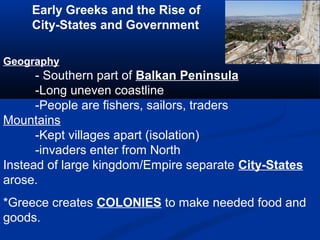
      - Southern part of Balkan Peninsula
      -Long uneven coastline
      -People are fishers, sailors, traders
Mountains
      -Kept villages apart (isolation)
      -invaders enter from North
Instead of large kingdom/Empire separate City-States
arose.
*Greece creates COLONIES to make needed food and
goods.
Minoans (1st Greeks on Crete)
 -Named after King Minos
 -Palace in city of Knossos. Had running water.
 -Walls covered in Frescoes  paintings made on wet
      plaster walls. Carvings in bronze, gold, ivory, silver, stone.
 -Sailors and Traders. Poor soil on Crete  Trade for food.
 -1620BCE Volcano causes tidal waves and weakens Minoans.
  -Wrote in Linear B. Bull jumping as religious ritual.
Mycenaeans – controlled mainland Greece from 1600-1200BCE
 -warlike people grouped together into clans/tribes.
* Tribe (headed by chief) clan (headed by warrior)  family
  -carried out raids
  -Fort like cities in Peloponnesus (hand shaped)
  - Adopt Linear B from Minoans to record info
  - 1200BCE earthquakes/warfare destroyed most of Mycenaean
       cities.
City-States of Greece  Polis = fort, city, and lands and small
farming villages that surrounded the city and supplied food
  -Polis  represented the center of Greek identity and its
inhabitants were intensely loyal to the Polis. Fight and Die for it
City-States – small area and people. Most <10,000 people
 -Most people were slaves and non-citizens
 -Free adult males had citizenship rights
 - Fort build on Acropolis – atop of the hill
 - Agora – marketplace and public speaking place
 - Each had  gov’t, laws, calendar, money,
              weights and measures
 - Shared  Greek Language, Religious ideas, festivals
Government – landowners who had money to pay for armies and
      weapons gained power.
Aristocrats – “Best Men” became the Noble Class
Aristocracy – “Ruled by the Best” take control from chiefs and
      control Greek society
- 600 BCE wealthy non-aristocrats could afford the weapons
too.
  - Hoplites – non-aristocratic soldiers
       -carried long spears and fought in tight rows PHALANX
       - very important for defense  demand more say in Gov’t
       - poor citizens and farmers also wanted a better life
Tyrants  were people who took power illegally and has support
        of people
  - In some cases powerful rulers became unjust. “Tyrant”
became        known as ruling brutally and with absolute power.
  - Some city-states overthrew their tyrant. The idea of
        Popular Government took hold. People could rule
themselves.
Athens  democracy  - people take part in Gov’t. However,
still only a small percentage of the people could participate.  No
women or slaves could participate.
Greek Culture and the Homeric Age
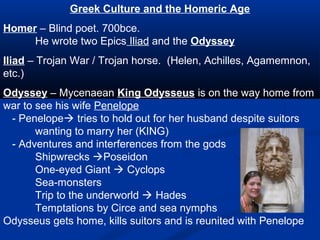
Homer – Blind poet. 700bce.
     He wrote two Epics Iliad and the Odyssey
Iliad – Trojan War / Trojan horse. (Helen, Achilles, Agamemnon,
etc.)
Odyssey – Mycenaean King Odysseus is on the way home from
war to see his wife Penelope
 - Penelope tries to hold out for her husband despite suitors
       wanting to marry her (KING)
 - Adventures and interferences from the gods
       Shipwrecks Poseidon
       One-eyed Giant  Cyclops
       Sea-monsters
       Trip to the underworld  Hades
       Temptations by Circe and sea nymphs
Odysseus gets home, kills suitors and is reunited with Penelope
Religion – Polytheism. No emphasis on morality
        Religion Looks to explain:
               1- nature (seasons  Persephone - pomegranate)
               2 – human emotions, lose of self control
               3 – bring benefits  luck, harvest, children, long
life…
Afterlife  souls go to underworld  Hades
To explain things (“unexplainable”) Greeks used MYTHS
Gods lived on Mt. Olympus. Interfered in humans lives.
Zeus – Father                           Aphrodite – Love
Hera – Queen                    Hades – underworld
Athena – war, wisdom            Poseidon – water
Artemis – hunting, moon         Ares – war
Apollo – light, poetry, music           Hermes – Messenger
Demeter – harvest

Oracles – the way in which gods speak to humans  travel to get
messages or predictions from priests.
Olympic Games – to honor Zeus
     -Winner received wreaths made of olive leaves.
     -No runner up prizes.
          Daily Life in Athens
Economy – trade
     Imports – goods brought in
     Exports – goods sent out
Terracing – cutting flat layers into the hills to farm. (Olives,
grapes, figs.)
Young boys were taught grammar, music, athletics, gov’t, math,
ethics, rhetoric (public speaking)
Age 18 – year of military training
 - Young men who could afford weapons became Hoplites for a
yr.
  - Poor soldiers served in the Flanks or rowmen on boats
Greece -Geo + Culture NOTES #1

Greece -Geo + Culture NOTES #1

  • 3.
    Early Greeks andthe Rise of City-States and Government Geography - Southern part of Balkan Peninsula -Long uneven coastline -People are fishers, sailors, traders Mountains -Kept villages apart (isolation) -invaders enter from North Instead of large kingdom/Empire separate City-States arose. *Greece creates COLONIES to make needed food and goods.
  • 4.
    Minoans (1st Greekson Crete) -Named after King Minos -Palace in city of Knossos. Had running water. -Walls covered in Frescoes  paintings made on wet plaster walls. Carvings in bronze, gold, ivory, silver, stone. -Sailors and Traders. Poor soil on Crete  Trade for food. -1620BCE Volcano causes tidal waves and weakens Minoans. -Wrote in Linear B. Bull jumping as religious ritual. Mycenaeans – controlled mainland Greece from 1600-1200BCE -warlike people grouped together into clans/tribes. * Tribe (headed by chief) clan (headed by warrior)  family -carried out raids -Fort like cities in Peloponnesus (hand shaped) - Adopt Linear B from Minoans to record info - 1200BCE earthquakes/warfare destroyed most of Mycenaean cities.
  • 5.
    City-States of Greece Polis = fort, city, and lands and small farming villages that surrounded the city and supplied food -Polis  represented the center of Greek identity and its inhabitants were intensely loyal to the Polis. Fight and Die for it City-States – small area and people. Most <10,000 people -Most people were slaves and non-citizens -Free adult males had citizenship rights - Fort build on Acropolis – atop of the hill - Agora – marketplace and public speaking place - Each had  gov’t, laws, calendar, money, weights and measures - Shared  Greek Language, Religious ideas, festivals Government – landowners who had money to pay for armies and weapons gained power. Aristocrats – “Best Men” became the Noble Class Aristocracy – “Ruled by the Best” take control from chiefs and control Greek society
  • 6.
    - 600 BCEwealthy non-aristocrats could afford the weapons too. - Hoplites – non-aristocratic soldiers -carried long spears and fought in tight rows PHALANX - very important for defense  demand more say in Gov’t - poor citizens and farmers also wanted a better life Tyrants  were people who took power illegally and has support of people - In some cases powerful rulers became unjust. “Tyrant” became known as ruling brutally and with absolute power. - Some city-states overthrew their tyrant. The idea of Popular Government took hold. People could rule themselves. Athens  democracy  - people take part in Gov’t. However, still only a small percentage of the people could participate.  No women or slaves could participate.
  • 7.
    Greek Culture andthe Homeric Age Homer – Blind poet. 700bce. He wrote two Epics Iliad and the Odyssey Iliad – Trojan War / Trojan horse. (Helen, Achilles, Agamemnon, etc.) Odyssey – Mycenaean King Odysseus is on the way home from war to see his wife Penelope - Penelope tries to hold out for her husband despite suitors wanting to marry her (KING) - Adventures and interferences from the gods Shipwrecks Poseidon One-eyed Giant  Cyclops Sea-monsters Trip to the underworld  Hades Temptations by Circe and sea nymphs Odysseus gets home, kills suitors and is reunited with Penelope
  • 8.
    Religion – Polytheism.No emphasis on morality Religion Looks to explain: 1- nature (seasons  Persephone - pomegranate) 2 – human emotions, lose of self control 3 – bring benefits  luck, harvest, children, long life… Afterlife  souls go to underworld  Hades To explain things (“unexplainable”) Greeks used MYTHS Gods lived on Mt. Olympus. Interfered in humans lives. Zeus – Father Aphrodite – Love Hera – Queen Hades – underworld Athena – war, wisdom Poseidon – water Artemis – hunting, moon Ares – war Apollo – light, poetry, music Hermes – Messenger Demeter – harvest Oracles – the way in which gods speak to humans  travel to get messages or predictions from priests.
  • 9.
    Olympic Games –to honor Zeus -Winner received wreaths made of olive leaves. -No runner up prizes. Daily Life in Athens Economy – trade Imports – goods brought in Exports – goods sent out Terracing – cutting flat layers into the hills to farm. (Olives, grapes, figs.) Young boys were taught grammar, music, athletics, gov’t, math, ethics, rhetoric (public speaking) Age 18 – year of military training - Young men who could afford weapons became Hoplites for a yr. - Poor soldiers served in the Flanks or rowmen on boats