EGIPT AND MESOPOTAMIA 
Education in the ancient Egipt, in Mesopotamia, and the importance of 
libraries. 
JUNE 7TH, 2014 
INSTITUTO TECNOLÓGICO DE MORELIA SPMETH1A 
Mónica Herrera García
1 
INDEX 
1. EGIPT ............................................................................................................................. 2 
a. TIME LOCATION .................................................................................................... 3 
b. GEOGRAPHIC LOCATION .................................................................................. 4 
c. NATURAL RESOURCES ...................................................................................... 5 
d. ECONOMIC ACTIVITIES ...................................................................................... 6 
e. HEALTH ................................................................................................................... 7 
f. FOOD........................................................................................................................ 8 
g. LINGUISTIC HERITAGE ....................................................................................... 9 
h. GOVERNMENT AND RELIGION.......................................................................10 
i. WAR CONFLICTS ................................................................................................11 
j. INTELLECTUAL ACTIVITIES .............................................................................12 
k. IMPORTANT EDUCATORS OR PEDAGOGIST OF THE PERIOD ............13 
l. EDUCATIONAL APPROACHES ........................................................................14 
2. MESOPOTAMIA .........................................................................................................15 
a. TIME LOCATION ..................................................................................................16 
b. GEOGRAPHIC LOCATION ................................................................................17 
c. NATURAL RESOURCES ....................................................................................18 
d. ECONOMIC ACTIVITIES ....................................................................................19 
e. HEALTH .................................................................................................................20 
f. FOOD......................................................................................................................21 
g. LINGUISTIC HERITAGE .....................................................................................22 
h. GOVERNMENT AND RELIGION.......................................................................23 
i. WAR CONFLICTS ................................................................................................24 
j. INTELLECTUAL ACTIVITIES .............................................................................25 
k. IMPORTANT PEDAGOGISTS OR EDUCATORS DURING THE PERIOD26 
l. EDUCATIONAL APPROACHES ........................................................................27 
3. THE IMPORTANCE OF THE LIBRARIES..............................................................28 
4. BIBLIOGRAPHY. ........................................................................................................29
2 
1. EGIPT
3 
a. TIME LOCATION 
Egypt began its march to civilization rather late compared with some regions of the 
Near East. Yet once it had taken root, the great civilization of the Nile proved to be 
most durable of all, spanning more than three thousand years from the appearance 
of the first unified kingdom to the final eclipse of ancient Egyptian culture in the 
early Christian era. 
For most of its ancient history, Egypt was ruled by kings, or pharaohs, who in 
ancient times were grouped into thirty-one dynasties. Egyptologists now tend to 
count the Macedonian and Ptolemaic dynasties as numbers thirty-two and thirty-three, 
and they have also added a thirty-fourth, the so-called Dynasty “0”, to 
account for a handful of very early kings. The dynasties in turn are subdivided into 
several periods, three of which are regarded as the peaks of Egyptian civilization: 
the “Old Kingdom” (the earliest pyramid age); the “Middle Kingdom”(virtually 
synonymous with a single great dynasty, the Twelfth) and the “New Kingdom”(the 
age of the great warrior-pharaohs, such as Thutmose III and Ramesses II). 
Features of civilized life, such as agriculture and towns, only appear in Egypt in the 
sixth millennium BC, some two thousand years later than in Anatolia, Mesopotamia
4 
and Syria-Palestine. This may be owning to Egypt’s rich natural resources rather 
than any cultural retardedness: the savannas adjoining the Nile Valley remained 
home to an abundance of plants and animals until these areas became desert, by 
approximately 2000BC. The seeds of Egyptian civilization lie in a number of late 
Neolithic cultures that emerged approximately 5000 BC and, over the next 
thousand years or so, developed into distinctive regional cultures in Upper and 
Lower Egypt. In the late fourth millennium BC, the autonomy of the northern culture 
was eroded by the rise of an aggressive rival in Upper Egypt. The development of 
this southern culture is traced through a number of stages named after 
archaeological sites: Badarian, Naqada I, Naqada II and Naqada III. Collectively 
these make up the “Predynastic” and “Protodynastic” periods. 
The Naqada II period saw the growth of a prosperous and unified culture in Upper 
Egypt, with political power consolidated in towns such as Hierakonopolis, Naqada 
and This. Classic Egyptian concepts of divine authority began to evolve, including 
the ruler’s identification with the sky god Horus. By the later Predynastic Period, 
the southern kingdom’s cultural penetration of Lower Egypt would be followed, 
gradually but inevitably, by a political takeover of the north.
5 
b. GEOGRAPHIC LOCATION 
Egypt lies at the 
northern end of the 
longest river in the 
world: the Nile, which 
rises in the East 
African highlands and 
flows into the 
Mediterranean more 
than four thousand 
miles away. 
The Nile in Egypt has 
two main parts: the 
Valley and the Delta, 
corresponding to the 
ancient divisions of 
the country into 
Upper and Lower 
Egypt. The Valley, 
some 660 miles long, 
is a remarkable 
canyon that is an offshoot of the African Great Rift Valley. The floodplain occupies 
4250 square miles and ranges in width from just one and a quarter miles at Aswan 
to eleven miles at el-Amarna. 
The silt left by the branches formed a broad triangle of fertile land that covers some 
8500 square miles. The Greeks called this land the “Delta”, because its shape 
reminded them of the inverted fourth letter of their alphabet. The Delta is fifty-seven 
feet above sea level near Cairo and is fringed in the coastal regions by lagoons, 
wetlands, lakes and sand dunes. In parts of the eastern Delta there are 
conspicuous low hills known as “turtle backs”. These sandy “islands” in the 
surrounding silty plain were rarely submerged by the annual inundation and in 
Predynastic times (to approximately 4000BC) villages and burial grounds became 
established on their slopes. From the Old Kingdom (approximately 2625-2130BC) 
onward, the apex of the Delta was close to Memphis, the ancient capital. It is now 
fifteen miles north of Cairo.
6 
The Nile divides the eastern margin of the Sahara into the Western Desert and the 
Eastern Desert. The Western Desert covers about two-thirds of Egypt, and its most 
striking features are a series of rocky desert plateau and sandy depressions, in 
which nestle lush 
oases. The Eastern 
Desert, 
characterized by the 
prominent Red Sea 
Hills, was important 
in pharaonic times 
for its minerals. The 
Sinai, essentially an 
extension of the 
Eastern Desert 
across the Gulf of 
Suez, was also a 
major source of 
minerals, especially 
copper. Wheat, 
barley, sheep and 
goats were 
domesticated in the 
Near East at least 
two thousand years 
before they appeared in the Nile Valley. 
The Western Desert, which was not as dry as it is today, has yielded the oldest 
evidence of humankind in Egypt.
7 
c. NATURAL RESOURCES 
As well as benefiting 
from a rich agriculture, 
Egypt provided its 
inhabitants with fine 
quality stone for 
building monuments 
and carving statues 
and with supplies of 
gold from Nubia and 
the Eastern Desert. 
Stone came from a 
variety of sources. 
White limestone was 
carefully cut from 
special quarries such 
as Tura near 
Memphis. The 
limestone was 
specially used to cover 
the walls of temples 
and mastaba tombs as 
it was good surface for 
bas-relief carvings. 
Yellow sandstone 
came from Gebel es- 
Silsila, and red and 
yellow quartzite (often 
used for statuary) from 
Gebel el-Ahmar. There was schist for statues from Waldi Hammamat. Alabaster, 
used in buildings and for small objects, was found in the Eastern Desert were the 
main quarry was at Hat-nub.Granite from the Aswan area provided material for 
buildings, sarcophagi, and statuary. 
The quarries and mines were a royal monopoly. Some were situated in remote 
parts of the desert. None was worked continuously; when the king decided that he 
wished to build or adorn a temple, an expedition was organized and dispatched to 
the quarry. 
Even by the New Kingdom their only tools were copper or bronze. In earliest times 
only stone had provided tools and weapons. Stone continued as the most 
important material for these purposes for many years, and even in the Middle 
Kingdom, it was retained, whenever appropriate, alongside metal. Flint was the 
traditional stone used for many of these items.
8 
They also searched in the deserts for the semiprecious stones used by the 
jewelers. Some as turquoise, malachite, and emerald, came from the eastern 
mines, while carnelian, amethyst, and jasper came from Nubia or the Eastern 
Desert. Other natural stones included garnets, green feldspar, and obsidian. Lapis 
lazuli was imported from the region known today as Afghanistan via the Euphrates 
River region. 
The Egyptians regarded gold as one of their most 
precious substances, a divine metal that ensured 
eternal life. Used for royal and noble burial goods 
as well as for jewelry, gold also became a form of 
currency by the New Kingdom. Gold was found 
both in Egypt and Nubia in the quartz present in 
the eastern and southeastern mountains. Wadi 
Hammamat and the area to the east of Edfu were 
both important gold working areas. The Royal 
Treasury owned all the mines, and the mining 
expeditions were directed by officers and 
soldiers; only state workers were allowed to mine 
and handle the gold. Pure silver, regarded as a 
type of gold, did not occur in Egypt and was 
imported from the north or east. Following their 
conquests in Asia the Egyptians had greater 
access to it, but silver never became as popular 
as gold. 
The country was also not particularly rich in 
copper. In predynastic times little use was made 
of ti except for small decorative objects, but by 
Dynasty 2 copper was used for statues of kings 
and gods. Gradually it became an increasingly 
popular metal in the Old and Middle Kingdoms for 
objects such as weapons, tools for carpentry and stoneworking, statuary, jewelry, 
mirrors, razors, vases and furniture fittings.
9 
d. ECONOMIC ACTIVITIES 
From earliest times people were aware that in order to control and regulate the Nile 
waters and to organize an efficient irrigation system to benefit all the communities 
in the Delta and Nile Valley they would have to act communally. 
This need gave people a common goal and was an important incentive for the 
unification of Egypt as a state, despite the geographical problems of controlling 
such a long, narrow, inhabited area. King Menes unified Egypt in approximately 
3100BC, but it is evident that an earlier southern ruler, Scorpion, had started this 
process. 
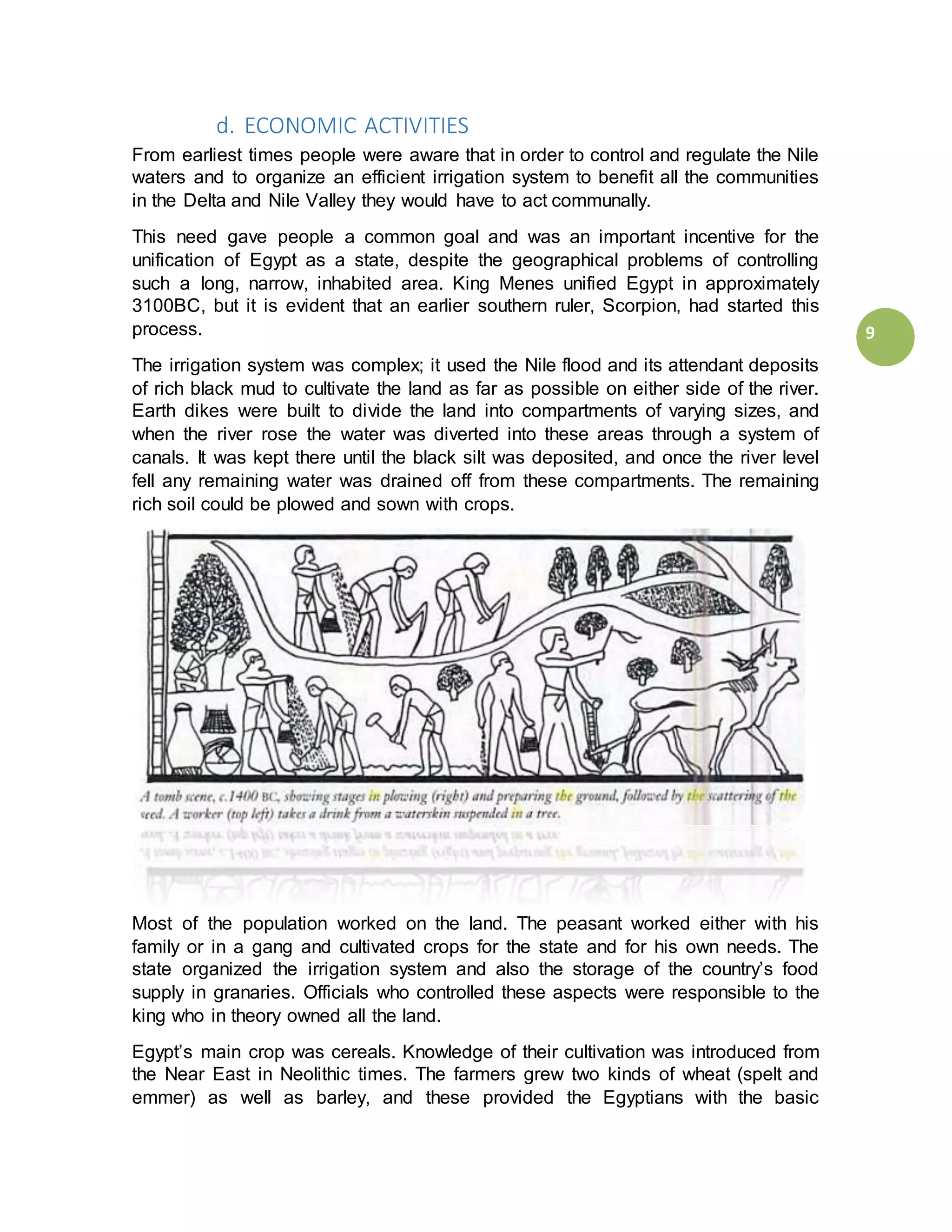
The irrigation system was complex; it used the Nile flood and its attendant deposits 
of rich black mud to cultivate the land as far as possible on either side of the river. 
Earth dikes were built to divide the land into compartments of varying sizes, and 
when the river rose the water was diverted into these areas through a system of 
canals. It was kept there until the black silt was deposited, and once the river level 
fell any remaining water was drained off from these compartments. The remaining 
rich soil could be plowed and sown with crops. 
Most of the population worked on the land. The peasant worked either with his 
family or in a gang and cultivated crops for the state and for his own needs. The 
state organized the irrigation system and also the storage of the country’s food 
supply in granaries. Officials who controlled these aspects were responsible to the 
king who in theory owned all the land. 
Egypt’s main crop was cereals. Knowledge of their cultivation was introduced from 
the Near East in Neolithic times. The farmers grew two kinds of wheat (spelt and 
emmer) as well as barley, and these provided the Egyptians with the basic
10 
requirements for their staple diet of bread and beer. Stages in the production of 
these cereals are depicted in many tomb scenes to ensure an ample food supply 
for the deceased in the next life. 
Once the Nile waters had receded in the autumn, seed was scattered on the earth 
and the plowed into the soil by a peasant who either used a wooden hoe or 
followed a plow dragged by two cows. Next, sheep and pigs were set loose on the 
plowed area to trample the ground. The harvest was gathered in the spring. The 
men worked together in a group and cut the stalks with wooden sickles fitted with 
flint blades. Once the short sheaves had been made into bundles, donkeys carried 
them to the threshing floor where animals trampled the stalks and separated the 
ripe grain from the husks. It was then further separated with a brush and winnowed 
by using a wooden scoop to throw it into a high wind before it was sieved. The 
byproduct, straw, was set aside for making brick while the corn itself was 
measured and kept in sacks in large silos. 
The other major product of Egypt was linen. This textile was widely used for 
clothing and other domestic purposes as well as for mummy badges. It was 
produced from flax, and tomb scenes often show this being gathered. Peasants 
worked together in the fields to pull the flax fibers before they bundled them; then 
they prepared the material for spinning and weaving. 
Cotton cultivation was introduced into Egypt from Nubia during the Coptic Period, 
and from the nineteenth century AD it became one of Egypt’s major industries. 
Cereals and lien (which was produced to an extremely high quality) were Egypt’s 
main exports in antiquity. 
The Egyptians were also market gardeners. Whereas irrigation was carried out 
only once a year in antiquity (it is now continuous), allowing the fields to be 
watered and cultivated, the orchards and gardens near the cultivated basins or 
compartments could be used all the time because the river regularly fed them with
11 
water. The gardeners were assiduous in transporting water to these areas, either 
bringing it from the Nile in two large pots suspended from a yoke or using a shaduf. 
The shaduf, introduced in the New Kingdom, had a bucket on one end of a rope 
that was lowered into the river; this was counterbalanced by a weight at the other 
end of the device. 
In the gardens near their houses and on the mud dikes the peasants grew beans, 
lentils, chickpeas, fenugreek, radishes, onions, cucumbers, lettuces and herbs. 
Plants also produced perfumes, dyes, and medicines; oil came from castor oil 
plants, Arabian moringa, and the olive tree. Flowers, including cornflowers, 
chrysanthemums, and lotus, were also grown in gardens for the production of 
bouquets and garlands. Fruits that added variety to their diet included figs, grapes, 
sycamore figs and dates, and pomegranates. 
Wine production was another major industry. The vine may have been introduced 
to Egypt from Asia before 3000BC. Grapes could be picked throughout the year to 
provide table grapes and grape juice, but there were regular heavy vintages when
12 
the grapes were picked and processed before the wine was poured into amphorae 
(tall jars with pointed bases) where it was left to age. 
The production of papyrus was also important. It was used for writing paper, ropes, 
sails, baskets, mats, and sandals. There had always been huge thickets of papyrus 
in the marshlands, particularly in the Delta, and later it was grown in cultivated 
fields. Laborers cut down the papyrus stems and transported them to workshops 
where they were turned into the required products. 
In earliest times there was 
abundance of animal life in Egypt. 
Once hunting had given way to 
farming, people began to 
domesticate animals. In predynastic 
times dogs were trained to hunt and 
guard the herds. By the time of the 
Old Kingdom donkeys, cows, oxen 
and sheep were used for a variety of 
agricultural and other tasks, and pigs 
were later introduced for trampling 
the sown fields. 
There were two breeds of oxen in 
ancient Egypt, and cows and bulls 
roamed the grasslands. Other 
animals, kept for meat, milk, and 
leather or as sacrificial beasts, 
included goats, gazelles and oryx. By
13 
selection of the animals in temple herds the Egyptians were able to improve breeds 
of sheep and cattle. Birds were also specially bred and fattened for the table. They 
included geese, ducks, cranes and pigeons. 
Although land cultivation was very important, the population was small enough to 
ensure that they were not forced to overwork the land. Large areas of marsh were 
left for hunting and fishing. Fishermen used traps and nets to take a wide variety of 
fish and nobles made their catches with harpoons. Birds were hunted with 
boomerangs and with civets, mongooses, and wold cats; large clap nets were used 
to trap quantities of geese and wild duck.
14 
e. HEALTH 
For Egyptians, good health meant wholeness, integration and preservation. 
Healing, for them, was the search of wholeness, not just for our bodies, but for our 
souls, our minds, our spirits, our relationships, and for the environment around us. 
Today’s familiar sign for prescription, Rx, was originated in Ancient Egypt. In the 
2nd century, Galen used mystic symbols to impress his patients. Accordingly, he 
borrowed the eye of Heru (Horus) from the Egyptian allegory. 
The eye symbol has gradually evolved into today’s familiar sign for prescription, 
Rx, which is used throughout the world no matter which language is used. 
Many of the Egyptian remedies and prescriptions have been passed on to Europe 
via the writings of Pliny, Dioscorides, Galen and other Greek writers. 
It is evident that the medical science of the Egyptians was sought and appreciated 
in foreign countries. Herodotus told us that Cyrus and Darius both sent to Egypt for 
medical men. In later times too, they continued to be celebrated for their skill: 
Ammianus says it was enough for a doctor to say he had studied in Egypt, to 
recommend him. Pliny also mentioned medical men going from Egypt to Rome. 
The care which the Egyptians 
took of their health was a 
source of astonishment for 
foreign observed, particularly 
Greeks and Romans. Pliny 
thought that the large number 
of doctors meant that the 
population of Egypt suffered 
from a great number of 
diseases. Herodotus, on the 
other land, reported that there 
were no healthier people than 
the Egyptians. 
Ancient sources refer to the 
Egyptians, as the healthiest 
race of the ancient world. 
Herodotus wrote, in the 5th 
century BC: 
“Of all the nations of the world, Egyptians are the happiest, healthiest and 
most religious”. 
To heal a person, is to bring that person back into tune, by the deliberate 
summoning-up of the specific harmonic phenomena pertinent to the case. Magic
15 
for Ancient Egyptians was the profound understanding of cosmic resonance, as 
opposed to the current shallow notion, tat magic is a synonym for superstition. 
The Ancient Egyptians were reputed to be the cleanest people in the ancient world. 
The squalid appearance and unrefined habits of Asiatic Greeks and Romans, with 
their long beards, were often the subject of ridicule to the Egyptians. Their 
abhorrence of the bearded and long-haired Greeks was so great, that, according to 
Herodotus, “no Egyptian of either sex would on any account kiss the lips of a 
Greek, make use of his knife, his spit and cauldron, or taste the meat of an animal 
which has been slaughtered by his hand”. 
Warm as well as cold baths were used by the Egyptians. Egyptians felt obliged to 
wash their hands several times a day, but most importantly before and after each 
meal. It is common knowledge now that hand washing is an essential preventative 
measure. Even the most modest of Ancient Egyptian dwellings had a bathroom of 
sorts; these could vary from a very simple installation all the way to the extreme 
refinements of the richest villas. 
The Egyptians priests took several complete baths every day. They also shaved 
their whole body, including eyelashes and eyebrows. It was the same concern for 
purity that inspired them to observe chastity. A healthy soul could hardly develop in 
a body that was not clean.
16 
Circumcision of male children was originated in Ancient Egypt, prior to any other 
country. The procedure signifies cleanliness as being holiness. This Ancient 
Egyptian practice was adopted later by other “religions” and races. 
The names and titles of more than a hundred doctors were determined from 
archeological findings, with sufficient detail to uncover an overall picture of the 
medical practice. The name of Imhotep has become forever linked with Egyptian 
medicine, who was later deified and identified with Asklepios, the Greek god of 
healing. 
As far back as the Old Kingdom, the medical profession was highly organized, with 
doctors holding a variety of ranks and specialties. The ordinary doctor was 
outranked by the Overseer of doctors, the Chief of doctors, the Eldest of doctors 
and the Inspector of doctors. A distinction was made between physicians and 
surgeons. 
There were eye doctors, bowel specialists (Guardians of the Anus), physicians who 
specialized in internal diseases who know the secret and specialize in the body 
fluids, nose doctors, sickness of the upper air passages, doctors of the abdomen, 
and dentists. 
Childbirth was basically the province of the midwives. Herodotus saw in that a sign 
of scientific advancement, and the result of truly profound knowledge. 
Ta-urt is the Egyptian patroness of women in pregnancy, childbirth, and after birth. 
She represents much more than our common understanding of a midwife. 
Midwives, among the Ancient and Baladi Egyptians, possess the physical and 
metaphysical knowledge of bringing a new baby into the world –body and soul, and 
the impact on the mother throughout the entire process. 
Some surgical tools and instruments are depicted in tombs and temples, such as: 
- The Tomb of Ankh-mahor at Saqqara. Which contains several unique 
medical and surgical reliefs. Among them was a flint knife which some 
considered as evidence of its remote origin. The most recent surgical 
research is vindicating the flint instruments of antiquity. It has been found 
that for certain neurological and optical operations, obsidian possesses 
qualities that cannot be matched by the finest steel, and an updated version 
of the old flint knife is coming back into use. 
- On the outer corridor wall of the temple at Kom Ombo, a box of surgical 
instruments is carved in relief. The box includes metal shears, surgical 
knives, saws, probes, spatulas, small hooks and forceps. 
Surgical operations were performed by the Ancient Egyptians, even in predynastic 
times. Mummies were found having very neatly cut parts of their skulls, indicating 
the nature of the operations; and sometimes the severed section of the skull had 
knit to the parent bone, proving that the patient had survived to the operation.
17 
Although no surgical scars have been reported in mummies (apart from 
embalmers’ incisions=, there are thirteen references in the Smith Papyrus to 
“stitching”. 
The short life span of the ancient Egyptian was due to such diseases as 
tuberculosis and respiratory ailments as bronchitis and pneumonia. They also 
suffered from parasites absorbed through unclean waters, the dangers of 
childbirth, snake bites, polio, rheumatism, scoliosis, appendicitis, meningitis, small 
pox, malaria, measles and cholera. 
Aspiring doctors underwent many years of hard training at the temple schools, 
where they were taught how to cure illnesses and set broken bones. The latter 
were treated with rational, medical methods such as plant, animal, mineral 
substances and surgical techniques, although the unfamiliar or unknown was 
remedied with magic or Heka. Intricate surgery, dream analysis, faith healing, 
amulets, herbs and recipes consisting of the most ghastly ingredients were used in 
curing illnesses.
18 
From funerary work, the process of mummification, first-hand knowledge of human 
anatomy was acquired, and autopsies were performed as part of the learning 
process of the healers. Doctors were trained and specialized in particular fields, 
such as the head, internal maladies, gynecology and ophthalmology; texts were 
consulted and observations made. 
Female doctors exercised their skills and knowledge under the supervision of Lady 
Pesheshet, the earliest female physician in history (5th Dynasty). Perhaps the 
earliest ophthalmologist was named Iry; he was an oculist and physician to royalty 
during the 6th Dynasty. 
Dentists filled teeth with mineral cement or a mixture of resin and malachite. Loose 
teeth were bound with silver of gold wire as examined mummies have proven. It 
appears that silver wire was used during the Late Period. Dentists were in high 
demand –tooth decay was a great problem as a result of consuming bread and 
cakes mixed with sand from the grinding process. Studies of mummies dated to the 
4th Dynasty show surgically-produced holes under a molar that was used to drain 
an abscess. 
Surgery was successful in the treatment of broken bones as well as in the brain
19 
area, where intricate operations were practiced. The pulse was referred to as “the 
voice of the heart”, as the ancient Egyptians were cognizant of the fact that the 
heart and pulse were synchronized. 
Papyrus records of antidotes and cures have been discovered which give a pretty 
good picture of the medical beliefs and practices of the times. These texts were 
frequently consulted as reference material for treatments which demonstrated the 
ancient Egyptian knowledge of medicine, healing, anatomy and autopsy. 
One such papyrus, dated 3600 years ago, tells of 100 remedies and antidotes. 
Over half involved the use of smoothing honey which cleansed, drid wounds and 
accelerated the healing process. The “Ebers Papyrus” contains nearly 900 
prescriptions, charms, spells and invocations for any aliment, this papyrus 
discusses twelve cases with the relevant spells and has an entire section devoted 
to diseases of the eye. 
The “Edwin Smith Papyrus” was written in 1700BC and contains 48 surgical 
operations, scientific diagnosis and treatments for wounds, fractures, dislocated 
and broken bones. These injuries were understood and treated with clinical 
methods. Magic was almost exclusively absent in this papyrus. However, it is 
believed that the data contained is also based on older texts written during the 3rd 
Dynasty. Some scholars believe that Imhotep himself authored this text. 
The “London Papyrus” includes medical and magical wisdom believed to have 
belonged to the Paraoh Khufu of the 4th Dynaty. The “Gynecological Papyrus”, 
dated 1825BC, deals with such treatments as contraception, detecting 
pregnancies, evaluating fertility, determining a baby’s gender, bladder problems 
and all medical cases related to pregnancy and the female reproductive system. 
Many of the ancient Egyptian herbal treatments were highly prized and soon 
spread throughout the Mediterranean area as they were practiced with successful 
results. Belladonna, poppy and thyme were effective pain relievers and sedatives. 
Powdered root of the mandrake plant was used to calm an upset stomach, cure 
insomnia, control fear and depression. Henbane was not only used as calming 
antidote but like mandrake, was also used in love potions as an aphrodisiac. 
Herbs such as myrrh, frankincense, cassia, thyme, opium, juniper, aloe, castor oil 
and fennel are mentioned in medical papyri. Garlic was very popular as it helped in 
the digestive process, induced vitality and strength while dispelling evil spirits. 
Garlic and onions were believed to induce endurance and were consumed 
regularly. Raw garlic was taken as a remedy for respiratory ailments. Honey and 
milk were prescribed for respiratory and throat ailments. To calm a persistent 
cough and moisten dry lungs, a very common problem in the dry climate of the 
desert, a concoction of dried figs, dates, aniseed, honey and water was simmered 
into a thick mixture and taken as an effective remedy. Tannic acid from the acacia 
nut helped heal burns and coriander was prescribed for stomach illnesses as it was
20 
thought to contain digestive properties. Henna and saffron were used to mend 
small wounds. 
The medical potions included such ingredients as blood and fat of an animal, 
powdered bones, hooves and horns dissolved in water, milk, beer or wine. Milk and 
wine were specifically thought to contain medicinal qualities on their own. 
Treatments were inserted into a body cavity and ointments made of honey or fats 
along with special diets were often prescribed. Natron was used as an effective 
cleanser, disinfectant and healing agent. 
The mud of the Nile was incorporated into potions which was believed to rapidly 
had wounds. The Nile River was believed to possess healing and rejuvenating 
properties. However, one must wonder about the hygienic properties of the Nile.
21 
f. FOOD 
The kitchen was located at the back of the house and would be covered by a roof 
of straw or branches to simultaneously block out the scorching Egyptian heat and 
allow the escape of cooking fumes. In villas, the kitchen was located entirely 
outside the house. A grain storehouse would serve the kitchen, sometimes being 
located alongside it or on the roof where it could be reached by stairs. 
Tools used by the ancient Egyptians were fairly basic. If there was no fixed oven, a 
portable one would be used. This would take the shape of a circular pottery disc 
with a hole in the bottom where the fire was lit. If that was not available, ancient 
Egyptians would simply use a canon, a small campfire surrounded by a few stones 
used to hold the cooking vessel. 
Although there is much that we do not know about ancient Egyptian ways of 
cooking, the depictions, wall paintings, tools, and cooking vessels discovered over 
the years left us a general picture of the methods used. In addition to ovens and 
burners, there were also various pots with two handles for cooking, as well as 
plates, pans, pitchers, stone and clay urns, baskets to hold food, sieves, and 
pestles for grinding. Other implements used included knives to cut meat and 
butcher hooks. 
Fertile Egyptian soil and the Nile River were main factors in helping the ancient 
Egyptians to cultivate a variety of plants and rear livestock. Food sources were 
diverse, and ancient Egyptians made good use of the different kinds of fish, 
vegetables, poultry, and fruits. 
The staple diet of 
most Egyptians 
consisted of bread 
and beer in addition 
to what produce the 
land yielded, such 
as onions, garlic, 
lentils, leeks, turnips, 
radish, lettuce, and 
cucumbers. 
Since the 
Predynastic period, 
ancient Egyptians, 
rich or poor, 
consumed various 
breads made from 
different grains. 
Flour would
22 
generally be mixed with a yeasting agent, salt, and spices, and sometimes with 
eggs and butter. The bread could also be filled with legumes of vegetables or 
sweetened with honey or dates. The ancient Egyptians also used a fair share of 
legumes such as beans, chickpeas, and lentils as well as vegetables such as peas, 
lettuce, garlic, onions, and leeks. Dates were the most common fruit, in addition to 
figs, grapes, pomegranates, watermelon and plums, all of which appear in 
depictions of daily life dating back to the New Kingdom. 
Depictions of daily life show the process of making dairy products such as cheese 
and butter as well as the extraction of oils like sesame, castor, and radish. The 
pharaohs frequently used herbs and spices such as aniseed, thyme, cumin, 
cinnamon, fennel, fenugreek, and mustard. 
Types of food eaten give a clearer picture of the different social levels in the 
ancient Egyptian hierarchy. In the poorest stratum fell the peasants whose staple 
diet was bread and beer, and a few simple dishes of vegetables the land 
generously yielded to them. When they had meat, it was mainly that of smaller 
farm animals since larger livestock were used in agriculture. 
Members of the middle or working classes like construction workers, ship-builders, 
and laborers were one rung higher in the social ladder, and their professions 
entitled them to daily rations. Their food varied between meat and fish with plates 
of vegetables, fruit, as well as the common factor of bread and beer. 
Egyptians lucky enough to be born into the upper class lived a life of luxury. This 
tables were weighed down with various dishes of meat, fish, and game besides all 
they desired of vegetables, fruit, breads, and pies. The drink of choice was wine. 
The pharaohs were in many senses, gourmets, and the abundance of food sources 
in Egypt allowed them to vary their dishes in kind and amount, particularly on 
special occasions and al feasts and banquets. But while the ancient Egyptians 
loved luxury, when it came to food they were apparently inclined toward 
moderation, a prime indication being the lithe bodies depicted in wall paintings and 
statues. 
Ancient Egyptians ate while seated at small tables laden with different kinds of 
meat, poultry, vegetables, fruits, and loaves of bread. Peasants would sit on a 
straw mat while the nobles would generally sin on stools or chairs, both eating with 
their fingers. Ladies and children would sit on cushions placed on the ground. 
Although pharaohs, too, are commonly depicted eating with their fingers, here are 
depictions of utensils such as different-shaped plates and bowls for soups and 
other foods including sweet goulash, compote, appetizers and cream, as well as 
cutting knives, spoons and forks. Forks were used for cooking, not for eating. 
Members of the family would probably not meet at breakfast. When the lord of the 
house finished washing and dressing, he would be offered a piece of bread and a
23 
glass of beer and perhaps a slice of meat and a piece of pie. Main meals were 
taken at noon and in the evening, with a lighter meal consumed in the afternoon, 
between four and five. 
As an agricultural society, ancient Egyptians held celebrations in honor or 
Renenutet, the goddess of harvest, and Min, the god of fertility, both of which were 
held in the summer. During the month of Keihak, feasts for the ploughing of the 
land were held, and the god Osiris was celebrated for being resurrected after death 
like the land which dies and then is reborn every season. 
Other special occasions that included food were royal feasts like coronations and 
anniversaries as well as the feasts of the dead in which families brought food to the 
burial places of the deceased. Annual feasts to 
honor the gods were also held as well as other 
local celebrations specific to each region. 
One of the most important religious 
celebrations was the New Kingdom Beautiful 
Feast of Opet. The feast, which was 
important because it renewed the legitimacy of 
Opet, would continue for almost a month, and the 
king would present many sacrificial offerings 
including meat, poultry, fruit, milk, bread, and beer 
as well as flowers and perfume. 
A celebration generally associated with the 
Ancient Egyptians is the Feast of the Harvest, 
commonly known today as Sham al-Nessim. 
Sham al-Nessim symbolized rebirth, and the 
ancient Egyptians believed that this day 
marked the beginning of creation. This 
particular celebration was famous for its 
variety of foods which included full, ripe green 
chickpeas that symbolized the coming of 
spring, and lettuce, which was popular because of its connection to the Min, god of 
fertility and reproduction.
24 
g. LINGUISTIC HERITAGE 
Ancient Egyptian is the 
oldest and longest 
continually attested of the 
world’s languages. Recent 
discoveries have 
demonstrated the 
existence of Egyptian 
hieroglyphic writing with 
phonograms as well as 
ideograms around 
3250BC, roughly 
contemporary with the 
comparable development 
in Mesopotamian 
cuneiform, and the last 
documents composed in 
Coptic, the final stage of 
the language, date to the 
18th century AD. This extraordinary lifespan of five thousand years is preserved in 
a wealth of written material, making it possible to trace the development of the 
language through at least three millennia of its history. 
Egyptian belongs to the Hamito-Semitic family of languages. It has affinities with 
Hamitic languages such as Beja, Berber, and Oromo, and with all the Semitic 
languages, including Akkadian, Arabic, and Hebrew. Common Hamito-Semitic 
features include consonantal root structures; lexical morphology; two genders, 
masculine and feminine; plural; independent and suffix forms of the personal 
pronouns; the stative verb form; and non-verbal sentences. 
Ancient Egyptian is commonly divided into five historical stages, known as Old, 
Middle, and Late Egyptian, Demotic, and Coptic. Significant differences in grammar 
separate the first two of these from the last three, so that the stages can be 
grouped into two major historical phases, Egyptian I and Egyptian II. 
Old Egyptian can be said to begin with the first known instance of a complete 
sentence, from a cylinder seal of the pharaoh Peribsen, near the end of the 2nd 
Dynasty. 
Prior to this, the language is represented solely by proper names, titles, and labels. 
Some of the latter, however, contain phrases, demonstrating the existence of 
several grammatical features that characterize the later language: in this case, 
nisbe formation, adjectival modification, nominal verb forms, and genitival 
relationships expressed by direct juxtaposition, including that between a verb and 
its subject and consequent vs word order.
25 
The first extensive Egyptian texts are inscriptions in the tomb of Methen, whose 
career spanned the end of Dynasty III and the beginning of Dynasty IV. Early old 
Egyptian is represented by secular texts of Dynasty IV and early Dynasty V and the 
Pyramid Texts of late Dynasty V to Dynasty VI; late Old Egyptian is distinguished 
from its predecessor mostly by the appearance of the “pseudo-verbal” 
constructions subject –hr-stp and subject –r-stp. 
The transition between Old and Middle Egyptian is gradual rather than sharp. 
Some late Old Egyptian texts contain Middle Egyptian features; conversely, some 
of the Coffin Texts and other early Middle Egyptian documents are marked by the 
retention of Old Egyptian morphological and grammatical features largely absent 
from later texts. Middle Egyptian proper exhibits three major sub-stages: classical, 
late and traditional. Classical Middle Egyptian is the language of most texts of the 
Middle Kingdom, including the classical literature of ancient Egypt. Late Middle 
Egyptian, in use from the Second Intermediate Period through the New Kingdom, 
exhibits some features of its successor, Late Egyptian. By the time the latter 
appeared in writing, Middle Egyptian had ceased to be a living language. Middle 
Egyptian was retained for monumental inscriptions and some religious texts until 
the end of hieroglyphic writing, in the form known as Traditional Middle Egyptian, 
which is primarily an artificial construct whose grammar was influenced by that of 
the contemporary language. 
Late Egyptian began to 
appear in texts from the 
time of Akhenaten 
(Dynasty XVIII) and 
became the standard 
written language in the 
succeeding dynasty. It 
is attested in two forms, 
literary (retaining some 
features of Middle 
Egyptian) and 
colloquial. The latter 
exhibits some changes 
between its earlier and 
later stages, essentially 
Dynasties XIX-XX and 
Dynasties XX-XXVI, 
respectively. 
Demotic, first attested in 
its distinctive written 
form about 650BC, developed directly out of Late Egyptian. It has three major sub-stages: 
early, Ptolemaic, and Roman. For the last three centuries of its existence,
26 
until the mid-fifth century AD, it existed alongside Coptic, essentially two different 
written forms of the same language.
27 
h. GOVERNMENT AND RELIGION 
Although it had a brief flirtation with monotheism, ancient Egyptian religion was 
centered on many gods. There were gods of fertility, gods of the sun, gods of 
creation and pretty much everything else that affected the everyday lives of ancient 
Egyptians. But apparently the gods were not static. They changed names, merged 
with other gods and took on a variety of roles in their long existence. 
To please the gods and to ensure a safe and successful journey to the afterlife, the 
Egyptians had many spells, prayers and practices to follow. They had trained 
priests in glorious temples and pharaohs who were closer to the gods than any 
other mortal. 
There is no doubt that the pharaoh was the gods’ favorite mortal. Only the king of 
all Egypt could be sent to the afterlife from the specially designed and much-labored- 
on pyramid. 
In many cases, such as Khufu, their entire life was spent overseeing the 
construction of their final resting place. He would have priests design a tomb that 
aligned with certain stars and spells and prayers carved into the walls. The 
Pharaoh would be laid in the burial chamber with many valuable treasures, so he 
could take them on his journey. Ramesses II, served long enough as leader of 
Egypt to transform from man to god. He professed to have harnessed the power of 
Set, Horus, Re and Amun. 
The priests were very important in carrying out all the important funerary spells, 
documenting the Pharaoh's relationship with the gods and all other forms of 
worship. They were the middle man between the Earth and the heavens. 
With money, came the ability to pay for safe passage to the afterlife. Government 
officials and military leaders were among the nobility group that could afford the 
expense of a proper tomb and funeral practices such as embalming. 
Commoners may not have received the same privileges, but they paid tribute to the 
gods and worshipped them all the same. For fishermen and farmers, keeping the 
gods happy was essential to a decent catch or crop. 
Egyptians were in awe of the gods and paid their respects diligently. Common 
households could contain the statues of protective gods and goddesses. Also a 
family wishing to have children sometimes had small statues of fertility gods. 
Farmers, being under control of the temples, paid tribute by taking some of their 
harvest to the temple of their town.
28 
The close association between ancient Egyptian religion and government meant 
that schools were attached to temples and those attending were educated by 
priests. 
Festivals were another way for people to celebrate the Gods. During a festival for a 
particular god or goddess a procession was held with a statue carried through the 
streets. 
Some temples were more than just a place of worship or education in religious 
matters, they were literally a home on earth for the appropriate god or goddess. No 
one but the highest priest or pharaoh was allowed into the inner sanctums. 
By far the most important part of Egyptian religious belief, was that of the afterlife. 
Rituals such as mummification and being buried with protective spells and prayers 
were treated very seriously. It was considered essential that the body be preserved 
so that it could reunite with the soul and maintain the individual’s identity in the 
afterlife.
29 
Proof of how seriously the Egyptians took their own death can be seen in the 
construction of the pyramids. Never has such effort been applied to a construction 
that will serve no purpose other than to house the dead. 
The highest priest in ancient Egypt and the man closest to the gods was the 
pharaoh. The temples reflected his bond with the otherworldly in the forms of 
statues and reliefs depicting him larger than life; greater than just a man. 
The priests of ancient Egypt had a variety of roles: 
- Temple worship - Ancient Egyptian priests were guardians and caretakers of 
their temples. It was there job to appease the gods and goddesses that 
resided there. Reading prayers and anointing statues were two of the main 
rituals. 
- Administration - Everyone from overseers, soldiers and scribes reported to 
the priests of their respective temple. They would know the facts and figures 
for all important aspects of Egyptian economy in their region. 
- Education - Because they had to read important prayers and spells it was 
essential they were educated in reading and writing. This also qualified them 
to teach and the temple was a place of education for those able to afford it. 
- Festivals - When celebrating a festival, a priest carried the temple statue in 
a public procession. 
Daily rituals: 
* Break of dawn - As the sun first appeared in the morning, priests sung the 
morning hymn in tribute to the gods. The most senior priest would draw back the 
bolt on the doors which housed the gods. Incense was lit at this stage. 
* Purification - Priests were required to be cleaned before temple work began. 
Gods were also symbolically purified before being dressed and cosmetics applied. 
* Offerings - Meat, bread, fruit, vegetables and beer were all laid before the gods. 
All produce came from surrounding landowners and farmers and was premium 
produce, fit for a god. 
After the pyramids, Egyptian temples were the next most impressive of ancient 
Egypt's architecture. It was the place that represented a god on Earth. They played 
diverse roles.
30 
 Priests: Temples were Egyptian priest central. The walls were adorned with 
hieroglyphs of spells and prayers honoring gods and pharaohs. These were written 
by the priests. 
Schools: Education was expensive but for those who could afford to have their 
boys educated, they would be sent to a temple where they were instructed by a 
priest. 
Administration: The Egyptian temples owned the land and farmers were required 
to pay tribute in the form of part of their harvest. 
Egyptian temples were sacred to the point that only a select few saw the inner 
sanctum. The deeper into the temple, the less access was granted. The Egyptians 
believed that the gods resided in the deepest chambers. It was their home on 
Earth. It was this innermost chamber that housed a statue of the god, or goddess, 
for that particular temple. 
The outer courtyards however were frequented by priests and commoners alike. 
This is where the general population left their tributes. 
The hypostyle halls were the next stage beyond the courtyards. They were a forest 
of columns. The columns were of differing styles and designed to hold up large 
sandstone-slab ceilings, as well as provide decoration. 
The decorative reliefs on the walls were not reserved for the gods. They were 
equally represented by images of the Pharaoh. This demonstrated his closeness to 
the gods and god-like stature of his own position. 
Light was used in temples to illuminate reliefs, writings and architectural design 
with very deliberate engineering. If the building was built to face a particular 
direction the light would shine through gaps in the ceiling at a particular time of 
day, creating a desired effect. 
These are some of the Egyptian temples: 
♥ Temple of Karnak: Located near Luxor, this large complex is unique for its 
diversity. Temples were built there from the Middle Kingdom right through to 
Ptolemaic times. Approximately thirty pharaohs contributed to build it, giving 
it many different styles. While a temple represents a particular god, Karnak 
represents the triad of Amun-Re, his consort Mut and their son Khons. The 
Amun-Re precinct of the temple complex is open to the public. 
♥ Cave of Artemis - This name was given during the Greek rule for the below 
ground temple. It sits behind a series of tombs and is a monument to the 
goddess Pakhet. 
♥ Kom Ombo - This temple has been divided into two halves in terms of 
worship. One half worships the god Horus, while the other worships Sobek,
31 
who was represented by a crocodile. Inside the temple are mummified 
crocodiles. 
♥ Deir el-Bahri - Another series of mortuary temples that are nestled in cliff 
faces. It was here that the successful queen-pharaoh Hatshepsut has her 
temple. 
♥ Dendra Temple Complex - The 40,000 square meter complex is surrounded 
by a thick mud brick wall. The main temple of Hathor was originally 
constructed in the Middle Kingdom of ancient Egypt but influenced by many 
generations all the way up to the Romans. 
The ancient Egyptians believed in the body having a Ka, or spirit and after death 
the body would be reunited with the Ka. But only with the right procedures and 
spells in place. 
After death the deceased faces a panel of judges where they will account for their 
time on earth. He is then led by Anubis, the jackal-faced god, to the scales where 
his heart will be weighed against the feather of Maat, the Goddess of Truth and 
Justice. This is perhaps the most important trial in the deceased journey and is well 
documented in illustrations in Ancient texts. 
If the heart outweighs the feather, it is heavy with the evil doings of the deceased. 
This outcome is not a good one and it will be devoured in the jaws of Amuut and he 
will face an eternity of oblivion. 
If the heart does not outweigh the feather, the deceased will be able to pass 
through to Osiris. Illustrations on funerary scenes show that an Ibis-headed god, 
Thoth, is recording the results. 
It is Horus that leads the deceased through to Osiris. Osiris waits with Isis and 
Nephthys and greets the deceased into the afterlife. 
The deceased would now continue to live in the afterworld as they did in life. Their 
possessions would make the journey too, which is why the tombs were full of items 
important for the individual. Food would be provided to provide nourishment to the 
deceased. 
Spells were needed from the Book of the Dead. These were essential to pass 
through the many obstacles sent to test the deceased as they transitioned from life 
to death and then back to life again. 
Eventually, they could continue to enjoy life as an invisible spirit moving among the 
living, but without the pain and hardships of the living world.
32 
What we call the Egyptian Book of the Dead was known to the Egyptians as Reu 
nu pert em hru translated that means The Chapters of coming forth by day. It is a 
collection of chapters made up of magic spells and formulas. It was illustrated and 
written on papyrus. These papyri were commissioned by the deceased before their 
death. Like most products these text came in different qualities. 
This collection of funerary chapters began to appear in Egyptian tombs around 
1600 BC. It can be thought of as the deceased's guidebook to a happy afterlife. 
The text was intended to be read by the deceased during their journey into the 
Underworld. It enabled the deceased to overcome obstacles and not lose their 
way. It did this by teaching passwords, giving clues, and revealing routes that 
would allow the deceased to answer questions and navigate around hazards. It 
would grant the help and protection of the gods while proclaiming the deceased's 
identity with the gods. The Papyrus of Ani is one of the finest and most complete 
examples of this type of Egyptian funerary text to survive. 
Some brief excerpts from the Book of the Dead are: 
1-The funeral procession of the royal scribe Ani (from the papyrus of Ani 
c.1400BC). The Egyptians believed that the human soul used the first night after 
death to travel into the afterlife. However, the body, which the Egyptians believed 
was an essential element to the afterlife had to be mummified to preserve it for 
eternity. The mummification process took 72 days to perform properly. This was 
the time to put finishing touches on the tomb and to pack all the deceased's worldly 
possessions, which surely would be needed in the afterlife. 
In this picture we see servants or hired hands carrying Ani's home furnishings, 
Servants are dragging a chest on which Anubis is sitting, inside the chest is more 
of Ani's worldly possessions or perhaps his canopic jars. All of these objects will be 
placed in the tomb for his use in the afterlife. In front of them are eight male 
mourners dressed in white. Ani's mummy rides on a funerary boat which is being
33 
drawn by oxen. Very hard to see in this picture are the 
goddesses Isis and Nephthys who are usually shown in this scene protecting the 
dead. Ani's wife mourns at his side. The man wearing a leopard skin and turned 
back towards Ani's mummy is a priest, he is burning incense. 
There are men carrying more of Ani's belongings. The group of women in clothed 
in blue are a party of paid, professional mourners who wail and pat dirt on their 
heads. This was an Egyptian show of mourning. The cow and calf are food 
offerings that will be used for the funeral feast. Ani's mummy stands before 
the entrance of his tomb, in the protective embrace of Anubis. His wife mourns at 
his feet. Behind her are offerings and three priests. One reads from a papyrus, 
while the other two are about to perform an important ceremony called the 
"opening of the mouth and eyes." This ceremony was thought to restore the 
mummy's ability to see, breathe, eat and drink. 
2-Entering the afterlife (from the 
papyrus of Hunefer c.1370BC). 
Hunefer's mummy stands before the 
entrance of his tomb, in the 
protective embrace of Anubis. The 
two women are probably family 
members, they are patting dirt on 
their heads, and this was a sign of 
mourning. Behind them are three 
priests. The priest wearing the 
leopard skin (a sign of priesthood) 
burns incense and presents offerings 
of food and drink, while the other two 
are about to perform the important 
ceremony of "opening of the mouth". This ceremony was thought to restore the 
mummy's ability to see, breathe, eat and drink.
34 
3-The hall of Maat (from the papyrus of Hunefer c.1370BC). The Hall of Maat is 
where the judgment of the dead was performed. This was done by weighing 
one's heart (conscience) against the feather of Maat (truth and justice). Here we 
see Anubis leading Hunefer to the scales of Maat. Anubis weights Hunefer's heart 
against the feather to see if he is worthy of joining the gods in the Fields of 
Peace. Ammut is also present, as a demon waiting to devour Hunefer's heart 
should he prove unworthy. Thoth stands to the right of the scales recording the 
results. Having passed this test Hunefer is now lead by Horus to meet the King of 
the dead, Osiris. The throne of Osiris rests on a pool of water from which a lotus 
flower is growing, upon the lotus stand the four sons of Horus. Behind the throne of 
Osiris stands Isis and her sister Nephthys. 
4-“Sekhet-Hetepet” The fields of 
peace (from the papyrus of Ani 
c.1400BC). Ani pays his respects 
to the gods who dwell in Sekhet- 
Hetepet (Fields of Peace) and asks 
the gods to help him to enter into 
Sekhet-Hetepet so that he may 
"become a khu, drink, plow, reap, 
fight, make love, never be in a 
state of servitude and always be in 
a position of authority therein". 
The main use for ancient Egyptian 
masks was in a funerary sense. It 
is believed that the preservation of 
the individuals face was important
35 
for a successful journey to the afterlife. In case of physical damage, the mask 
would protect the person's image and create immortality for them. This was an 
important factor in gaining acceptance into their afterworld existence. 
Government and religion were inseparable in ancient Egypt. The pharaoh was the 
head of state and 
the divine 
representative of 
the gods on earth. 
Religion and 
government brought 
order to society 
through the 
construction of 
temples, the 
creation of laws, 
taxation, the 
organization of 
labor, trade with 
neighbors and the 
defense of the 
country's interests. 
The pharaoh was 
assisted by a 
hierarchy of 
advisors, priests, 
officials and 
administrators, who 
were responsible for 
the affairs of the 
state and the 
welfare of the 
people. 
Ancient Egypt could 
not have achieved 
such stability and 
grandeur without 
the co-operation of all levels of the population. The pharaoh was at the top of the 
social hierarchy. Next to him, the most powerful officers were the viziers, the 
executive heads of the bureaucracy. Under them were the high priests, followed by 
royal overseers (administrators) who ensured that the 42 district governors carried 
out the pharaoh's orders. At the bottom of the hierarchy were the scribes, artisans, 
farmers and laborers.
36 
The pharaohs began ruling Egypt in 3000 B.C., when Upper and Lower Egypt were 
united. During the Old Kingdom (2575-2134 B.C.), they considered themselves to 
be living gods who ruled with absolute power. They built pyramids as testimony of 
their greatness but left no official records of their achievements. 
By the Middle Kingdom, the pharaohs no longer considered themselves to be living 
gods, but rather the representatives of the gods on earth. They left records of their 
deeds, but these were no more than a string of titles and laudatory epithets. 
To reinforce their image as powerful divine rulers, the pharaohs represented 
themselves in writings and sculptured reliefs on temple walls. They often depicted 
themselves as warriors who single-handedly killed scores of enemies and 
slaughtered a whole pride of lions. Similar depictions were repeated by one 
pharaoh after another, which leads one to question the validity of the scenes. 
Not all the pharaohs were men, nor were they all Egyptian. Before the Greco- 
Roman Period, at least three women ascended the throne, the most important 
being Queen Hatshepsut. Over several periods, Egypt was dominated by foreign 
powers that appointed a king from their own ranks. Exactly how successive 
pharaohs were chosen is not entirely clear. Sometimes a son of the pharaoh, or a 
powerful vizier (head priest) or feudal lord assumed the leadership, or an entirely 
new line of pharaohs arose following the collapse of the former monarchy. 
Bureaucracy is not a modern invention; it was conceived by the Egyptians over 
5,000 years ago. The creation of a bureaucracy in the Old Kingdom was a key 
factor in the inception of the Egyptian civilization. The king was the supreme head 
of state. Next to him, the most powerful officer in the hierarchy was the vizier, the 
executive head of the bureaucracy. The position of vizier was filled by a prince or a 
person of exceptional ability. His title is translated as "superintendent of all works of 
the king". 
As the supreme judge of the state, the vizier ruled on all petitions and grievances 
brought to the court. All royal commands passed through his hands before being 
transmitted to the scribes in his office. They in turn dispatched orders to the heads 
of distant towns and villages, and dictated the rules and regulations related to the 
collection of taxes. 
The king was surrounded by the court, friends and favored people who attained 
higher administrative positions. The tendency was to fill these positions on the 
basis of heredity.
37 
i. WAR CONFLICTS 
Throughout most of its history, ancient Egypt was unified under one government. 
The main military concern for the nation was to keep enemies out. The arid plains 
and deserts surrounding Egypt were inhabited by nomadic tribes who occasionally 
tried to raid or settle in the fertile Nile river valley. The Egyptians built fortresses 
and outposts along the borders east and west of the Nile Delta, in the Eastern 
Desert, and in Nubia to the south. Small garrisons could prevent minor incursions, 
but if a large force was detected a message was sent for the main army corps. 
Most Egyptian cities lacked city walls and other defenses. 
The first 
Egyptian 
soldiers carried 
a simple 
armament 
consisting of a 
spear with a 
copper 
spearhead and 
a large wooden 
shield covered 
by leather hides. 
A stone mace 
was also carried 
in the Archaic 
period, though 
later this 
weapon was 
probably only in 
ceremonial use, 
and was 
replaced with 
the bronze battle 
axe. The spearmen were supported by archers carrying a composite bow and 
arrows with arrowheads made of flint or copper. No armour was used during the 
3rd and early 2nd Millennium BC. The major advance in weapons technology and 
warfare began around 1600 BC when the Egyptians fought and defeated the 
Hyksos people, who ruled Lower Egypt at the time. It was during this period the 
horse and chariot were introduced into Egypt. Other new technologies included the 
sickle sword, body armour and improved bronze casting. In the New Kingdom, the 
Egyptian military changed from levy troops into a firm organization of professional 
soldiers. Conquests of foreign territories, like Nubia, required a permanent force to 
be garrisoned abroad. The Egyptians were mostly used to slowly defeating a much
38 
weaker enemy, town by town, until beaten into submission. The preferred tactic 
was to subdue a weaker city or kingdom one at a time resulting in surrender of 
each fraction until complete domination was achieved. The encounter with other 
powerful Near Eastern kingdoms like Mitanni, the Hittites, and later the Assyrians 
and Babylonians, made it necessary for the Egyptians to conduct campaigns far 
from home. The next leap forwards came in the Late Period (712-332 BC), when 
mounted troops and weapons made of iron came into use. After the conquest by 
Alexander the Great, Egypt was heavily Hellenized and the main military force 
became the infantry phalanx. The ancient Egyptians were not great innovators in 
weapons technology, and most weapons technology innovation came from 
Western Asia and the Greek world. 
These soldiers were paid with a plot of land for the provision of their families. After 
fulfilment of their service, the veterans were allowed retirement to these estates. 
Generals could become quite influential at the court, but unlike other feudal states, 
the Egyptian military was completely controlled by the king. Foreign mercenaries 
were also recruited; first Nubians (Medjay), and later also Libyans and Sherdens in 
the New Kingdom. By the Persian period Greek mercenaries entered service into 
the armies of the rebellious pharaohs. The Jewish mercenaries at Elephantine 
served the Persian overlords of Egypt in the 5th century BC. Although, they might 
also have served the Egyptian Pharaohs of the 6th century BC. 
As far as had been seen from the royal propaganda of the time, the king or the 
crown prince personally headed the Egyptian troops into battle. The army could 
number tens of thousands of soldiers, so the smaller battalions consisting of 250 
men, led by an officer, may have been the key of command. The tactics involved a 
massive strike by archery followed by an infantry and/or chariot attacking the 
broken enemy lines. The enemies could, however, try to surprise the large 
Egyptian force with ambushes and by blocking the road as the Egyptian campaign 
records informs us. 
Within the Nile valley itself, ships and barges were important military elements. 
Ships were vital for providing supplies for the troops. The Nile river had no fords so 
barges had to be used for river crossings. Dominating the river often proved 
necessary for prosecuting sieges, like the Egyptian conquest of the Hyksos capital 
Avaris. Egypt had no navy to fight naval battles at sea before the Late Period. 
However, a battle involving ships took place at the Egyptian coast in the 12th 
century BC between Ramesses III and seafaring raiders
39 
j. INTELLECTUAL ACTIVITIES 
The characteristics of ancient Egyptian technology are indicated by a set of 
artifacts and customs that lasted for thousands of years. The Egyptians invented 
and used many simple machines, such as the ramp and the lever, to aid 
construction processes. They used rope trusses to stiffen the beam of ships. 
Egyptian paper, made from papyrus, and pottery were mass-produced and 
exported throughout the Mediterranean basin. The wheel, however, did not arrive 
until foreign influence introduced the chariot in the 16th century BC. The Egyptians 
also played an important role in developing Mediterranean maritime technology 
including ships and lighthouses. 
The word paper comes 
from the Greek term for 
the ancient Egyptian 
writing material called 
papyrus, which was 
formed from beaten strips 
of papyrus plants. 
Papyrus was produced as 
early as 3000 BC in 
Egypt, and sold to ancient 
Greece and Rome. The 
establishment of the 
Library of Alexandria 
limited the supply of 
papyrus for others. As a 
result, according to the 
Roman historian Pliny, 
parchment was invented 
under the patronage of 
Eumenes II of Pergamon 
to build his rival library at 
Pergamon. 
Egyptian hieroglyphs, a phonetic writing system, served as the basis for the 
Phoenician alphabet from which later alphabets were derived. With this ability, 
writing and record keeping, the Egyptians developed one of the —if not the— first 
decimal system. 
The Ancient Egyptians had knowledge to some extent of sail construction. This is 
governed by the science of aerodynamics. The earliest Egyptian sails were simply 
placed to catch the wind and push a vessel. Later Egyptian sails dating to 2400 
BCE were built with the recognition that ships could sail against the wind using the 
side wind. Queen Hatshepsut oversaw the preparations and funding of an
40 
expedition of five ships, each measuring seventy feet long, and with several sails. 
Various others exist, also. 
Egyptian knowledge of glassmaking was advanced. The earliest known glass 
beads from Egypt were made during the New Kingdom around 1500 BC and were 
produced in a variety of colors. They were made by winding molten glass around a 
metal bar and were highly prized as a trading commodity, especially blue beads, 
which were believed to have magical powers. The Egyptians made small jars and 
bottles using the core-formed method. Glass threads were wound around a bag of 
sand tied to a rod. The glass was continually reheated to fuse the threads together. 
The glass-covered sand bag was kept in motion until the required shape and 
thickness was achieved. The rod was allowed to cool, then finally the bag was 
punctured and the rod removed. The Egyptians also created the first colored glass 
rods which they used to create colorful beads and decorations. They also worked 
with cast glass, which was produced by pouring molten glass into a mold, much 
like iron and the more modern crucible steel. 
The Egyptians were a 
practical people and this 
is reflected in their 
astronomy, in contrast to 
Babylonia where the first 
astronomical texts were 
written in astrological 
terms. Even before 
Upper and Lower Egypt 
were unified in 3000 
BCE, observations of 
the night sky had 
influenced the 
development of a 
religion in which many of 
its principal deities were 
heavenly bodies. In 
Lower Egypt, priests 
built circular mud-brick 
walls with which to make 
a false horizon where 
they could mark the 
position of the sun as it 
rose at dawn, and then with a plumb-bob note the northern or southern turning 
points (solstices). This allowed them to discover that the sun disc, personified as 
Ra, took 365 days to travel from his birthplace at the winter solstice and back to it. 
Meanwhile in Upper Egypt a lunar calendar was being developed based on the
41 
behavior of the moon and the reappearance of Sirius in its heliacal rising after its 
annual absence of about 70 days. 
After unification, problems with trying to work with two calendars led to a merged, 
simplified civil calendar with twelve 30 day months, three seasons of four months 
each, plus an extra five days, giving a 365 year day but with no way of accounting 
for the extra quarter day each year. Day and night were split into 24 units, each 
personified by a deity. A sundial found on Seti I's cenotaph with instructions for its 
use shows us that the daylight hours were at one time split into 10 units, with 12 
hours for the night and an hour for the morning and evening twilights. However, by 
Seti I's time day and night were normally divided into 12 hours each, the length of 
which would vary according to the time of year. 
Key to much of this was the motion of the sun god Ra and his annual movement 
along the horizon at sunrise. Out of Egyptian myths such as those around Ra and 
the sky goddess Nut came the development of the Egyptian calendar, time 
keeping, and even concepts of royalty. An astronomical ceiling in the burial 
chamber of Ramesses VI shows the sun being born from Nut in the morning, 
traveling along her body during the day and being swallowed at night. 
During the Fifth Dynasty six kings built sun temples in honor of Ra. The temple 
complexes built by Niuserre at Abu Gurab and Userkaf at Abusir have been 
excavated and have astronomical alignments, and the roofs of some of the 
buildings could have been used by observers to view the stars, calculate the hours 
at night and predict the sunrise for religious festivals.
42 
k. IMPORTANT EDUCATORS OR PEDAGOGIST OF THE 
PERIOD 
Education in Egypt was largely vocational an apprenticeship served within the 
family trade or craft usually under the boy's father. We know something of the 
system from the craftsman's community of Dier el-Medina. Boys were taught skills 
by their father in the hope of at least on son winning a place in the official corps of 
tomb-builders. Those youths who were most likely to be accepted were designated 
children of the tomb. They were attached to one of the gangs to do odd jobs and 
run, but no doubt primarily to watch and learn until such time as a place became 
available for them. Offspring who failed to achieve one of these coveted, lucrative 
positions had to leave the village, either to set up as craftsmen elsewhere or to 
seek a different type of job. 
A more formal, academic education was reserved for those who trained to be 
scribes. Elementary schooling for these privileged children, mostly boys, began at 
about five years of age and consisted of repeated recitation of lessons as well as 
the copying of standard texts. The basic proper may have been a book called 
Kemty, which means' completion. The form and style of the surviving copies of this 
work indicate that it was composed in the Middle Kingdom, although it was still 
used a thousand years later. The reason for its continued popularity as a teaching 
book was the simplicity of its language and the fact that the text was set out in 
vertical columns rather than horizontal lines, so that the signs were easier for 
young children to copy. The contents of the Kemty consisted of model letters 
phrases and expressions useful to scribes assorted wisdom texts giving advice to 
would be scholars.
43 
Having mastered the basics, the student could progress to more advanced text. 
The majority of these were classics of Egyptian literature; in particular the wisdom 
texts full of pronouncements on morals and behavior for young men who hoped to 
achieve some position in life. sage Imhotep wrote such a work, now lost, in the 
Third Dynasty and the latest surviving example, the instructions of 
Onkhsheshongy, is probably Ptolemaic. These wisdom texts are couched in the 
form of a discourse from a learned master, father or teacher to his pupil, A fair 
amount of the advice they contained inspired the scholar to diligence. In the words 
of the scribe Amenemope, pass on day in idleness or you will be beaten. The ear 
of a boy is on his back. He listens when he is beaten. 
The final years of scribal training were probably vocational, wither working with a 
master or attending on of the specialized schools run by the major employers of 
scribes such as the royal palace, government departments, the army or temples, In 
these schools the trainee would receive knowledge applicable to jobs future 
employment: mathematics surviving for tax assessors, ritual practices or medicine 
for future priests, and so on. 
At the other end of the social scale and at the lowest level of an Egyptian 
household were the servants and salves who performed all the mundane duties, 
but who received little reward. To a certain extent the whole of Egypt was in a state 
of servitude, for the structure of society was hierarchical and everyone owned duty 
to someone at a higher level, and ultimately to Pharaoh, who was the embodiment 
of the State, Nevertheless. At the bottom of the heap it becomes difficult to 
differentiate be teen the oppressed peasant laborer and those officially designated 
as slaves. 
Unskilled peasant farmer were attached to an estate belonging to Pharaoh, the 
government, a temple or a rich landowner. Their pay was barely more than 
subsistence or, they cultivated land, a large percentage of the harvest was taken in 
rent and taxes, and this group of people was the main target of Corvee duty. 
Forced labor raised specific tasks such as the upkeep of irrigation system 
construction of public buildings and cultivation of land, for this work no pay at all 
was received, only keep. All but the official classes were obliged to undertaker the 
Corvee, but anyone who cloud afford to do so would pay for exemption this 
ensuring that the weight of the burden fell on the poor. If, however, the Corvee 
workers attempted to run away from their labour, they were classed as fugitives 
and, if caught sentenced to permanent servitude spending the time between jobs 
on prison, their children then seem to have inherited the parents' status as State 
servants. 
The Prince's School was the most respected of all of the schools and gave the very 
best Ancient Egyptian education. There the sons of the Pharaoh, members of the 
royal family, nobles and high officials, would receive education. There was also a 
scheme which allowed recommendations when young boys who showed great
44 
promise were also allowed in the Prince's school. The Vizier had overall control of 
the Prince's school and therefore the education of the next Pharaoh, nobles and 
court officials. Curriculum included: 
Religious Training 
Music and Ceremonial Dance 
Reading and Writing and Hieroglyphs 
Mathematics and Geometry 
History, Geography and Cartography 
Science, Astronomy, Astrology, and Medicine
45 
l. EDUCATIONAL APPROACHES 
The ancient educational system in Egypt was administered and controlled by the 
intellectual priests in the theocratic form of government who prevent the multiplicity 
of culture. The core curriculum comprised of science, mathematics, medicine, 
geometry, and humanities that were in the hands of the Egyptian priests who 
taught in formal schools. 
There were two types of formal schools for the privileged youth: one for the 
scribes, the other for the priest trainees. When a child reached the age of five, he 
enters the learning center for writing and continues his studies in reading until he 
reach the age of sixteen or seventeen. The learner, at the age of thirteen or 
fourteen, would undergo practical training in offices for which they were being 
prepared. Methods of instruction and discipline were very strict in order to achieve 
the same cultural formation and transmission. Any willful deviation from the 
Egyptian culture was strictly forbidden. Exercises and rote memorization were the 
typical methods of instruction. 
In previous years the Egyptian priests taught their students in temple schools 
concerning rudiments of writing, sciences, mathematics, and architecture aside 
from religion. 
Children would 
more and more 
frequently were 
found lending a 
hand with the less 
onerous tasks and 
gradually acquiring 
practical skills and 
knowledge from 
their elders. 
By precept and 
example, parents 
would instill into 
them various 
educational 
principles, moral 
attitudes and views 
of life. Thus from a 
tender age they 
would receive their basic education in the bosom of the family. For girls, this was 
usually all the schooling they would get, but for boys it would be supplemented by 
proper training in whatever line they chose, or was chosen for them.
46 
Education, of course, covers both the general upbringing of a child and its training 
for a particular vocation. The upbringing of boys was left largely in the hands of 
their fathers, that of girls was entrusted to their mothers. Parents familiarized their 
children with their ideas about the world, with their religious outlook, with their 
ethical principles, with correct behavior toward others and toward the super-natural 
beings in whom everyone believed. They taught them about folk rituals and so 
forth. 
Educational principles are summarized in a number of ancient Egyptian treatises 
now commonly called the Books of Instruction. The advice given in them was 
designed to ensure personal success consonant with the needs of the state and 
the moral norms of the day. 
Truth-telling and fair dealing were enjoined not on any absolute grounds, but as 
socially desirable and at the same time more advantageous to the individual than 
lying and injustice, whose consequences would rebound against their perpetrator. 
The Books of Instruction contain rules for the well-ordered life and elements of 
morality that include justice, wisdom, obedience, humanity and restraint. 
They mostly took the form of verses addressed by a father to his son as he 
stepped into his shoes or started to help his aging parent. Similar admonitions 
were delivered by a king to his heir. Most of these books were compiled by senior 
officials: humbler scribes, like Ant, only played a part in later times. 
Many copies were made of these Books of Instruction, since they also served as 
teaching texts in the schools for scribes. Seven complete and five partial texts have 
survived, while the existence of others is known from fragments. The one which 
appears to be the oldest is by the celebrated, vizier, architect and physician to the 
3rd-dynasty pharaoh Djoser. 
This text has not survived, but is mentioned in the Harper's Song in the tomb of 
King lnyotef. Another is the Instruction Compiled by the Noble and Royal Prince 
Hordjedef for His Son. The two authors of these very ancient books were held in 
such esteem as to be deified. Of other educational treatises perhaps 3 the most 
important is the Instruction of Ptahhotep, City Administrator and First Minister 
during the reign of His Majesty Djedkare Isesi, Ruler of Upper and Lower Egypt 
during the 5th dynasty. The following passages deal with the art of 'elegant and 
effective speech'. 
You should only talk when you are sure you know your subject. He who would 
speak in council must he a word-smith. Speaking is harder than any other task and 
only does credit to the man with perfect mastery. 
Be prudent whenever you open your mouth. Your every utterance should be 
outstanding, so that the mighty men who listen to you will say: "How beautiful are 
the words that fly from his lips"
47 
Nevertheless Ptahhotep rates fair dealing higher than learning: You may tell a wise 
man from the extent of his knowledge, a noble man by his good deeds. 
In contrast to the hierarchic structure of Egyptian society in those days, this 
injunction to respect the opinions and knowledge of simple folk has quite a 
democratic ring: 
Do not boast of your knowledge, but seek the advice of the untutored as much as 
the well-educated. 
Wise words are rarer than precious stones and may come even from slave-girls 
grinding the corn. 
Ptahhotep urges his readers to exercise justice and warns against intriguing for 
self-aggrandizement, bribery, extortion of debts from those unable to pay and 
insatiable accumulation of property. His manual abounds in concrete advice on 
how to behave in various situations - at banquets, in the exercise of high office, 
towards friends, wives, petitioners, paupers and so on. 
The spiritual high-point in this 
genre is reached in the 
Instruction of Amenemope at 
the end of the 2nd 
millennium BC, some of 
which is closely comparable 
with passages in the Old 
Testament Book of Proverbs. 
It includes, for example, this 
call for justice and 
forbearance toward the poor 
and widows: 
Do not covet the boundary-stone 
in the field nor shift the 
surveyor's rope; do not covet 
a cubit of your neighbor's 
land nor tamper with the 
widow's land-bounds. 
Covet neither the poor farmer’s property nor hunger after his bread; the peasant's 
morsel will surely gag in the throat and revolt the gullet. 
If the poor man is found to owe you a great debt, divide it three ways; remit two 
parts and let the third stand. That, you will see, is the best way in this life; 
thereafter you will sleep sound and in the morning it will seem like good tidings; for 
it is better to be praised for neighborly love than to have riches in your storeroom;
48 
better to enjoy your bread with a good conscience than to have wealth weighed 
down by reproaches. 
Never let a powerful man bribe you to oppress a weak one for his own benefit. 
There is a similar foretaste of Christian morality where Amenemope urges 
consideration toward the afflicted: 
Mock not the blind nor deride the dwarf nor block the cripple's path; don't tease a 
man made ill by a god nor make outcry when he blunders. 
In the surprisingly developed moral code revealed by these excerpts, virtue will be 
rewarded for reasons that can be summarized as follows: behave justly toward 
your god, your king, your superiors and your inferiors too; in return you will enjoy 
health, long life and respect. 
When judging the dead, god will deal with you in accordance with your past 
conduct. Those you leave behind, too, will be glad to acknowledge your good 
deeds by reciting life-giving words and by bringing gifts to ensure your life eternal 
... The supreme aim of the Egyptian moral system was to help maintain harmony 
and order in the world created by god and maintained by the king. 
Alongside the inculcation of general rules of morality there was, of course, formal 
vocational training. Young men did not usually choose their own careers. 
Herodotus and Diodorus refer explicitly to hereditary callings in ancient Egypt. 
This was not in fact a system of rigid inheritance but an endeavor, as one Middle 
Kingdom stele puts it, to pass on a father's function to his children. Several other 
sources confirm that this happened with the consent of the king or his 
plenipotentiaries. Thus we find throughout Egyptian history a tendency for even the 
highest offices to remain in the same families. 
Towards the end of the Middle Kingdom, for example, there was a virtually dynastic 
line of viziers, and in the Ramessid period the offices of the supreme priests of 
Amun were passed on from father to son. It was in any case common practice for 
an official to take on his son as an assistant. so that the succession became more 
or less automatic. This was also the implication of joint rule at the royal level. A son 
was commonly referred to as 'the staff of his father's old age', designed to assist 
him in the performance of his duties and finally to succeed him. Even if the 
Instructions of Ant declare that 'offices have no offspring. 
From an early age they would be going out to the fields, boys and girls alike, to 
lend a hand in simple tasks like gathering and winnowing the corn, tending poultry 
and in time cattle, and so forth. Fishermen, boatmen and others would also take 
their young folk along with them for practical experience. 
Pictures of craftsmen at work, on the other hand, rarely show children present. 
There is one of a boy handing a leg of meat to a butcher; other examples show a
49 
lad helping an older man to smooth down a ceramic vessel, and a boy playing in a 
row of musicians. In the army youngsters were used as grooms and batmen. 
Writings of the Roman Period contain some interesting data about the training of 
weavers and spinning-girls. A test was probably given at the end of the 
apprenticeship. At this time weavers usually sent their children to be taught by 
colleagues in the same trade. The master undertook, if he failed to get his pupil 
through the whole course, to return whatever payment the father had advanced for 
the apprenticeship. 
Kingdom each scribe taught his successor - usually his son - individually. From the 
First Intermediate Period onwards there is evidence of whole classes run for 
trainees in this field. In the New Kingdom they existed in the capital city of Thebes 
(there was one in the Ramesseum, for example, and a second purportedly at Deir 
el-Medina) and in later times such institutions were run at other centers too. These 
were not of course true schools in the sense of independent bodies with full-time 
teachers. All major offices such as the royal chancelleries, military headquarters 
and the 
The ancient Egyptians nevertheless held education in high regard and saw it as a 
privilege. A few talented individuals without formal schooling still managed to 
acquire sufficient knowledge to shine in their own field. And there were of course 
plenty who tried, as everywhere, to compensate for their lack of education by 
intriguing or currying favor in high places - sometimes as high as royalty.
50 
2. MESOPOTAMIA
51 
a. TIME LOCATION 
Mesopotamia 
is one of the 
cradles of 
human 
civilization. 
Here, the 
earliest cities 
in world 
history 
appeared, 
about 3500 
BC. 
Mesopotamia 
was not only 
the oldest 
urban 
civilization, 
but also the 
most 
urbanized 
society of 
antiquity. 
Form the mid-fourth 
millennium 
BC onwards, 
cities were in 
existence in 
Babylonia 
(southern 
Mesopotamia 
), and despite 
many 
vicissitudes 
they never 
disappeared entirely from the landscape. Urbanism may have emerged only later 
in Assyria (northern Mesopotamia), but soon some Assyrian cities became gigantic 
in extent. At their most flourishing, the most important Mesopotamian cities 
dwarfed their contemporaries in the rest of the ancient world, to the amazement of 
Greeks, such as Aristotle, who could not consider Babylon to be a city, but only as 
the equivalent of a nation because of its enormous dimensions.
52 
b. GEOGRAPHIC LOCATION 
"Mesopotamia" is a Greek word meaning, "land between the Rivers". The region is 
a vast, dry plain through which two great rivers, the Euphrates and Tigris, flow. 
These rivers rise in mountain ranges to the north before flowing through 
Mesopotamia to the sea. As they approach the sea, the land becomes marshy, 
with lagoons, mud flats, and reed banks. Today, the rivers unite before they empty 
into the Persian Gulf, but in ancient times the sea came much further inland, and 
they flowed into it as two separate streams. 
The land is too dry to grow many crops on. As a result, much of it has been - and is 
still - home to herders of sheep and goat. These nomads move from the river 
pastures in the summer to the desert fringes in the winter, which get some rain at 
this time of year. At various times they have had a large impact on Mesopotamian 
history.
53 
Near the rivers themselves, the soil is extremely fertile. It is made up of rich mud 
brought down by the rivers from the mountains, and deposited over a wide area 
during the spring floods. When watered by means of irrigation channels, it makes 
some of the best farmland in the world. 
The marshy land near the sea also makes very productive farmland, once it had 
been drained. Here, the diet is enriched by the plentiful supply of fish to had from 
the lagoons and ponds. 
It is this geography which gave rise to the earliest civilization in world 
history. Agriculture is only possible in the dry climate of Mesopotamia by means of 
irrigation. With irrigation, however, farming is very productive indeed. A dense 
population grew up here along the Tigris and Euphrates and their branches in the 
centuries after 5000 BC. By 3500 BC, cities had appeared. The surplus food grown 
in this fertile landscape enabled the farming societies to feed a class of people who 
did not need to devote their lives to agriculture. These were the craftsmen, priests, 
scribes, administrators, rulers and soldiers who made civilization possible. 
Surrounded by mountains in the north and east and desert in the west and 
bounded in the south by the Persian Gulf, ancient Mesopotamia was shaped by its 
two rivers, the Tigris and Euphrates. These provided water for agriculture and daily 
life and were the main highways for communication. Major environmental 
differences divided Mesopotamia unto two distinct regions, the northern plains of 
Assyria and the southern Babylonian alluvium. Further differences split Babylonia 
into a northern river plain (Akkad) and a more southerly delta plain (Sumer). These 
geographical contrasts were mirrored by cultural, political, and economic 
distinctions. Marshes divides Babylonia from Elam, the eastern alluvial plain and 
adjacent Zagros Mountains, a land whose history frequently intertwined with that of 
Mesopotamia. At times, cities and states beyond the desert and the mountains 
were also involved with Mesopotamia, while mountain and desert fringes were 
home to tribal groups who frequently raided their settled neighbors.
54 
c. NATURAL RESOURCES 
Mesopotamia soon became a very powerful and a resource which filled area for 
these people. In the beginning, natural wildlife and vegetation kept them fed while 
they began to build their new world. They wove baskets from the weeds that grew 
on the riverbanks, since their land was in between two rivers, and made pottery 
from the wet clay or mud they found. Even though it did not rain much, the settlers 
soon learned that if you irrigated land correctly, crops grew quite quickly. They 
were very intelligent and built canals to bring water to the land from the rivers. This 
is how they got their drinking and bathing water. They also used it to help grow 
crops. Sumerians were able to use timber, metals and stones they found from the 
nearby mountains for building. They used what they had, and used the resources 
available to them as best they could. Being friendly and trading with neighboring 
lands was also very important because there were resources that were not 
available to them, that were in countries close by. 
The fertile land along the rivers 
was used for producing such 
crops as wheat, barley, 
sesame, and flax. They also 
planted dates, cucumbers, 
apples, onions, and a variety of 
spices. They raised sheep, 
goats, and cows. They 
slaughtered many of their 
animals, but also knew how to 
use the wool from sheep, and 
took milk from their cows. 
People soon learned how to 
pound wool and goat hair into 
felt, or weave it into cloth. Even 
though they were able to stay in 
one place and farm, hunting 
was still a very important food source. Sumerians hunted wild birds and kinds of 
deer and gazelle for food. Some other creatures living in Mesopotamia were fish, 
duck, goats, sheep and pigs. They were able to tame these animals, to eat. 
The land is too dry to grow many crops on. As a result, much of it has been - and is 
still - home to herders of sheep and goat. These nomads move from the river 
pastures in the summer to the desert fringes in the winter, which get some rain at 
this time of year. At various times they have had a large impact on Mesopotamian 
history.
55 
Near the rivers themselves, the soil is extremely fertile. It is made up of rich mud 
brought down by the rivers from the mountains, and deposited over a wide area 
during the spring floods. When watered by means of irrigation channels, it makes 
some of the best farmland in the world. 
The marshy land near the sea also makes very productive farmland, once it had 
been drained. Here, the diet is enriched by the plentiful supply of fish to had from 
the lagoons and ponds. 
It is this geography which gave rise to the earliest civilization in world 
history. Agriculture is only possible in the dry climate of Mesopotamia by means of 
irrigation. With irrigation, however, farming is very productive indeed. A dense 
population grew up here along the Tigris and Euphrates and their branches in the 
centuries after 5000 BC. By 3500 BC, cities had appeared. The surplus food grown 
in this fertile landscape enabled the farming societies to feed a class of people who 
did not need to devote their lives to agriculture. These were the craftsmen, priests, 
scribes, administrators, rulers and soldiers who made civilization possible. 
The vast herds 
of sheep which 
constituted such 
a large segment 
of the herding 
sector in the 
ancient 
Mesopotamian 
economy 
provided the 
bulk of the raw 
material needed 
for the textile 
industry. In 
contrast to this 
relatively 
unpromising 
situation, a 
wealth of 
information exists in cuneiform sources on the Mesopotamian textile industry 
during the Ur III period. With linen playing a quantitatively small if elite role and 
cotton unknown until the late periods, wool was by far the most important material 
used for the manufacture of textiles in Mesopotamia. 
Animal bone was used throughout the Old World for making a wide variety of tools 
and non-utilitarian objects from the Paleolithic era onwards. For the most part
56 
studies of bone objects in Mesopotamia give no indication of which animals were 
most exploited. However, it is most likely that sheep/goat, followed by cattle, 
equids and swine provided the bulk of the bone used to fashion implements and 
decorative fixtures. 
Clay is a major constituent of the sediment deposited whenever the Tigris and 
Euphrates flood their banks. A wide range of other utilitarian items, including 
spindle whorls, sling balls, mullers, hammers, hoes, axes and sickles, as well as 
figurines, beads and cones for wall decoration were made of clay. 
Alongside baked mudbrick and limestone, the most durable material available in 
ancient Mesopotamia was without doubt bitumen or asphalt. Various sources of 
bitumen were exploited in antiquity, principally in the area of modern Khuzistan on 
either side of the Karun River, in the east Tigris region heading towards the Zagros 
Mountains, around Ur, near Mosul and in the Hit-Ramadi area on the Middle 
Euphrates. One of the domains for which we have the most information concerns 
the use of bitumen in boatbuilding and repair. Given the importance of water 
transport in a area like southern Mesopotamia this is certainly one of the most 
significant contexts in which bitumen was put to use. 
A wide variety of pendants, seals, beads, vessels and architectural elements were 
made of limestone throughout southern Mesopotamia’s ling history. During the 
Uruk and Jamdat Nasr periods most of the important religious buildings at Uruk, 
including the Limestone Temple, the Stone Cone Temple, the Riemchengebäude, 
Temple-Palace E and the Stone Building incorporated important elements of white, 
grey-white and yellow-white limestone in their fabric.
57 
d. ECONOMIC ACTIVITIES 
In agriculture, the 
Mesopotamians 
grew a variety of 
crops, including 
wheat, barley, 
onions, grapes, 
turnips, and apples. 
They kept cattle, 
sheep and goats; 
they made beer and 
wine. 
The rivers Tigris 
and Euphrates, and 
their branches, 
made life possible 
for the 
Mesopotamians. 
However, they 
could be wild rivers, 
and floods were 
frequent. The 
Mesopotamians 
were the first 
people to attempt to 
control water on a 
large scale by the 
use of an integrated 
system of dams, 
reservoirs, canals, 
drainage channels 
and aqueducts. Maintaining, repairing and extending this system was seen as one 
of the prime duties of a king. The water control system was built up generation by 
generation, covering an ever wider area and involving an ever denser network of 
waterways. 
Farming was still important, but other jobs became important too. Bakers made 
bread from many families. Weavers spun wool and wove it into cloth. Leather 
crafters made sandals. At least 12 of the towns grew into true cities where 
thousands of people lived and worked. 
As a result of the large and concentrated population which grew up in 
Mesopotamia, farming was carried out by peasants rather than by slaves (mass 
slavery tends to be a response to a shortage of labor). In early times these were
58 
bound to the land as serfs; later, most became free farmers, able to buy and sell 
their plots. 
Farming in Mesopotamia depended on a lot on The Tigris and Euphrates Rivers. 
These people also depended on the two rivers for fresh water or places to bathe 
and water their livestock. The Tigris River was rough and flew fast; on the other 
hand, the Euphrates could easily be used by ships to get across the lands. This 
was important for trading and travelling purposes. 
The plain of Mesopotamia was created in comparatively recent times by the mud 
brought down by the rivers. This means that the region is very short of useful 
minerals such as stone for building, precious metals and timber. 
This had the effect of stimulating trade with neighboring regions, and beyond. Early 
in Mesopotamia's history food surpluses and craft goods were exchanged for 
mineral resources. Later, Mesopotamian merchants ventured further afield, with 
trading contacts being developed with peoples in Syria and Asia Minor in the west, 
and in Iran and the Indus civilization, in the east. 
With the coming of the Bronze Age, in about 3000 BC, an added incentive to trade 
was the desire to acquire the copper and tin needed to make this valuable metal. 
Once Mesopotamian states started to equip their soldiers with bronze armor and 
weapons, this hunger intensified. However, these minerals are only found in widely 
scattered locations, so the search for them involved developing long distance trade 
routes. 
The Bronze Age came to an end in the centuries after 1000 BC; Mesopotamian 
trade, however, continued to expand. By this date urban civilizations had become 
established in north Africa, southern Europe, Asia Minor, Syria and the Levant, 
Arabia, Iran and India. Their increasing demand for sophisticated and exotic trade 
goods stimulated international commerce. The only land through which all trade 
routes could cross from Europe to Asia, and from Africa to Asia, was Mesopotamia. 
Major long-distance trade routes now traversed the region. 
Furthermore, the first millennium BC saw the rise of great empires, with 
Mesopotamia at their heart. These fostered trade by building roads for military 
purposes, and encouraging the spread of an international language throughout the 
region, Aramean. 
The tax was a payment for the privilege of working the land, which belonged to the 
god or goddess of the city (each urban center being the home of specific deity). 
The representatives of the local god or goddess were the city's ruler, its priests, 
and its palace authorities. Although private ownership of land did exist, many of the 
fields and pastures were in the hands of the temple and the palace. Both the 
religious and secular authorities increased their holdings by purchasing land or by 
confiscating it from those who failed to pay their taxes.
59 
By around 3000 BCE an established system of distribution existed in the city-states 
of Sumer. As goods came into temples and palaces, they were placed in jars, 
baskets, or rooms, to which were affixed clay seals. Records of amounts were kept 
by placing clay counters or tokens into spherical clay containers, known as bullae, 
much as paper records today are placed in file folders. With the invention of writing 
at the end of the fourth millennium, a written record of the content of each bulla 
was incised or impressed onto its surface. Eventually, the written record, incised on 
a clay tablet, replaced the bullae. 
Sumerian priests and palace officials oversaw the use to which the food and goods 
collected as tax were put. Some of the yield was stockpiled for times of famine, 
while some was reserved as seed for the next year's crop. A portion of the tax was 
used as offerings in religious ritual. Taxes also went toward financing the 
construction and maintenance of irrigation canals and public buildings. They paid 
for wars, which in turn brought back booty and tribute as additional revenues for 
each Sumerian city-state. 
Additionally, some of the 
goods were used for 
trade, an important part of 
the economy of each 
Sumerian city-state. Food, 
which was sent to other, 
less productive regions of 
the Near East; pottery; 
and textiles were all 
important trade goods. In 
exchange, the Sumerian 
cities received stone and 
timber for building and 
metal for tools and 
weapons, as well as 
jewelry, perfumes, exotic 
animals, and other luxury items that became part of the personal wealth of religious 
and government officials or were given out as gifts to others to buy their support. 
Finally, although many of the city's households produced enough food, clothing, 
and other goods to feed their members even after paying their taxes, others did not 
and depended on the collected tax to meet their needs. Among those dependent 
upon tax stores were a city-state's ruler, its priests and priestesses, and its 
government bureaucrats, along with their families. Others were craftspeople who 
produced cloth, pottery, and metal tools and weapons. The tax freed both the 
Sumerian elite and the craftspeople from the necessity of providing for at least 
some of their own needs and thus gave them the time to perform their duties and 
work.
60 
Payment in kind was not the only method of settling a tax bill in ancient Sumer. 
There was also a labor tax. Known in modern times as a corvée, the labor 
obligation meant that the members of a household had to work a certain number of 
days in the fields controlled by its temple and palace, in digging or cleaning out 
irrigation canals, and in constructing public buildings. Of all the taxes, the corvée 
was the most burdensome. Farmers found themselves bringing in the harvest of 
the temple and the palace while their own crops languished in the fields. Worse still 
was military service that sometimes sent men away from their farms for months at 
a time, sometimes never to return if they were killed in battle. 
Women and children, on the other hand, were employed in large weaving factories, 
in addition to performing agricultural labor. Textiles were a Sumerian economic 
mainstay, used for gifts, religious offerings, and trade items. Thus hundreds and 
sometimes thousands of women and children in each city-state plucked the wool 
from sheep and spun it, wove it, and washed the final cloth product. Women were 
also responsible for brewing beer from stores of grain. 
The Sumerian tax burden had the beneficial effect of improving production 
efficiency so that the number of items a worker could produce increased. For 
instance, in order to turn out more ceramic bowls and pots faster, craftspeople 
moved from forming pottery solely by hand to using molds and potter's wheels. The 
rise of centers that specialized in making particular goods, such as pottery, metals, 
or textiles, contributed to increased production efficiency. Such centers, for 
example, appeared toward the end of the fourth millennium BCE in the southern 
city-state of Uruk. To what extent these centers were set up and run by the priests 
and bureaucrats remains unknown. It is possible that the centers came into 
existence not because of official sponsorship but because they were located in 
areas that, unlike other regions, had access to the resources necessary for the 
items they produced. 
By the middle of the third millennium BCE the distributive economy of the 
Sumerian city-states centered on the great household, often referred to by the 
Greek term oikos. A great household could be a temple, a palace, or a large, 
wealthy estate. Each oikos controlled the production, labor, and consumption of its 
members, who unlike those of the traditional small household were not kinfolk. 
Small kin-based households still existed, but most of the economic activity was 
now in the hands of the oikoi. 
The head of an oikos could be a man or a woman. These oikoi leaders were 
among the highest-ranking members of Sumerian society, and thus Sumerian 
kings and queens headed their own oikoi, as did prominent government officials 
and wealthy merchants. Each oikos had its own fields, pastures, herds, orchards, 
workshops, and storage depots. Each also had managers and a labor force. The 
latter were recruited from the large pool of city residents; by the third millennium 
BCE some 80 percent of southern Mesopotamians are estimated to have lived in
61 
the cities. Oikos laborers were often specialists—farmhands, animal handlers, 
cooks, gardeners, brewers, potters, weavers, and metalworkers. With such 
material and human resources, an oikos was able to meet most of the needs of its 
members. 
In exchange for 
this labor the 
oikos provided 
its members with 
certain basics— 
oil, beer, wool, 
and flour and, on 
special 
occasions, milk, 
fruit, salt, and 
fish. Age, 
gender, and the 
type of work 
determined how 
much an oikos 
member 
received. 
Generally, oikos 
members had to 
process these 
distributions further: thus they had to make the flour into bread and the wool into 
cloth. Each oikos also gave out plots of land to its highest-ranking members; the 
higher the rank, the larger the land grant. Among those eligible for land were 
political leaders, priests and priestesses, scribes, canal inspectors, managers, 
soldiers, and skilled artisans. In addition to these grants, an oikos also rented out 
land to nonmembers of the household for a share of the plot's crops. 
In order to manage the finances of the empire, the Akkadians introduced a 
common accounting practice in all their conquered territories. Accounting had to be 
done using the same cuneiform signs and tablets having the same shape and 
layout. Additionally, since payment was in kind, the Akkadians standardized 
weights and measures by introducing the gur. One gur was equal to about 43 
gallons of barley. Valuing goods by comparing them to a quantity of barley, the 
most common grain that was grown in Mesopotamia, had been a longtime practice 
of the Sumerians. The gur would continue to be used, at least in Mesopotamia, for 
the next two millennia. 
The Akkadians were succeeded by other states, such as the Third Dynasty of Ur 
and the Old Babylonian kingdom, who each in turn ruled much of Mesopotamia, 
north and south. No matter the state, the old Sumerian distributive economy
62 
remained in place in each Mesopotamian city. Payment in kind likewise survived, 
though it was supplemented by occasional payments in silver; along with weights 
of barley, weights of silver were used to determine the value of goods. The corvée 
still operated, though labor obligations were eased by the presence of slaves, who 
were either those captured in war or those enslaved when they failed to meet their 
tax payments. The oikoi continued to be the managers of at least local economies. 
To the north of Mesopotamia were Anatolia and the Hittites, who appeared around 
1800 BCE and lasted until around 1200 BCE Beginning in about 1650 BCE the 
Hittite kingdom expanded from its central Anatolian homeland to conquer all of 
Anatolia, including Armenia in the west and part of the Levant. Unlike the 
Mesopotamians, the Hittites had few cities, and their domestic economy revolved 
around small, self-sufficient farming communities that provided most of their own 
needs and owned all farmland in common. Hittite agriculture, however, did not 
produce surpluses; indeed, the Hittites often had food shortages, which they made 
up either through tribute collected from those that they had conquered or through 
trade. 
If the Hittites did not have food to trade, they did have metals. Mining of tin, silver, 
and iron were lucrative. Tin was important in the manufacture of bronze, and thus 
there was always a ready market for it. Enough silver was produced that the 
Hittites used it as a medium of exchange. Iron was a novelty item because it was 
almost as rare as gold, whose only source at this time was Egypt. Iron was also 
more for show than utility. Weapons and tools made from it at this period were no 
stronger than those made from bronze, and thus it was more often used to make 
jewelry and statutes, both of which were prized trade goods. 
The Hittites acquired copper for manufacturing bronze in the same way that they 
acquired many of their resources: They conquered those who had it, in this case 
Isuwa in western Anatolia, Maintaining the army was a major expense for the 
Hittites, but as with other military states, an army allowed the Hittite kingdom to 
bring in loot from successful campaigns and to ensure that those conquered paid 
regular tribute, either in silver or as payment in kind. Additionally, the army could 
protect essential Hittite trade routes from others who might try to charge Hittite 
merchants a toll for use of these routes. Instead, any tolls exacted were collected 
by the Hittite kingdom. 
The waning of the Hittites around 1200 BCE saw the emergence in Armenia of the 
kingdom of Urartu, which reached its height during the eighth century BCE Like 
other ancient Near Eastern societies, Urartu had an economy that depended on 
agricultural production, with part of the harvest from its rich farmlands going to 
trade. Additionally, the mining and export of copper, silver, and iron was an 
essential part of the Urartu economy. Besides unworked metal, Urartu traded metal 
tools, weapons, and jewelry, which were esteemed for their craftsmanship as far 
away as northern Italy. The kingdom's economy also benefited from its geographic
63 
position, which allowed it to control the trade routes that connected northern 
Mesopotamia and Elam to the Mediterranean. Urartu exacted a toll in payment of 
kind from the traders who used these routes. 
Urartu may have had a distributive economy, since its administration centers, 
fortresses located in a mountainous region of the kingdom, held large storage 
facilities for grain and wine. Conversely, rather than being redistributed, these 
stored goods may have been meant to feed the inhabitants of a fortress during the 
occasional siege by Urartu enemies. The kingdom also probably had a labor tax, 
since it undertook the construction of aqueducts and other large works projects 
using workforces, most likely made up of corvée draftees. 
The most persistent attackers of the Urartu mountain fortresses were the 
Assyrians, for whom loot and tribute played an extremely important role in the 
economy. From their northern Mesopotamian home the Assyrians conquered the 
remainder of Mesopotamia and much of the Near East in the 11th century BCE For 
400 years they would exact tribute from their subject peoples. Like previous 
conquerors, the Assyrians appear to have left much of the economic structure of 
their conquests in place, demanding an annual tribute, which was paid in silver or 
in kind and which was sent to the Assyrian capital. In some cases the collection of 
the tribute was in the hands of a native ruling family; the Assyrians then sent 
expeditions to bring the tribute to Assyria. In other instances, perhaps where the 
original ruling family proved resistant to paying the tribute, the Assyrians placed 
one of their own in charge. This governor then saw to the collection and delivery of 
the tribute. 
Trade also was important to Assyria and may have dictated some of its expansion. 
More directly, through military control of much of the Near East, Assyria controlled 
almost all the trade routes and thus the flow of the majority of Near Eastern trade. 
It thus had ready access to copper, silver, wood, and other valuable resources as 
well as much of the luxury trade enjoyed by the Phoenician cities, which paid 
Assyria a handsome tribute. Proceeds from tribute and trade had to be large in 
order to make up for the Assyrian policy of exempting from taxation their home 
cities, such as Nineveh. The corvée also did not apply to the Assyrian homeland. 
Instead, conquered cities had to supply laborers when required as well as soldiers 
for the army. 
Among the most lucrative tributes collected by the Assyrians was that from the 
Phoenician city-states, such as Tyre, Sidon, Byblos, and Arvad. Of all the ancient 
Near Eastern economies, that of the Phoenicians was the most dominated by 
trade. The stretch of the Levant coast on which the Phoenicians lived was narrow, 
mountains rising not far inland. Thus there was little arable land for agriculture. 
Importing food became a top priority of the Phoenicians in order to sustain the 
populations of their cities.
64 
With several natural ports, which became the sites of their cities, and an 
abundance of cedar and other trees for lumber, the Phoenicians began seafaring 
early. With their freedom from Egyptian rule in the 12th century, they built one of 
the largest trading empires in history over the next five centuries. Their goods were 
shipped all over the Mediterranean and even into the Atlantic to the Canary Islands 
and Britain. To what extent these commercial ventures were private enterprises 
and or were state-financed is unknown. Luxury items, such as jewelry, fine cloth, 
and perfumes, were among their trade items, but the most highly prized were 
metals. Thus they brought copper from Cyprus, iron from Crete, gold and lead from 
Morocco, and possibly tin from Britain. All of these imports were used in trade for 
food and other goods, many of which were traded in their turn. 
Around 950 BCE Tyre bought a large agricultural area from Israel, freeing the 
Phoenician city from having to import food. As a result, Tyre could use its full range 
of trading stock to enrich itself. It quickly became the wealthiest of the Phoenician 
city-states and, indeed, one of the wealthiest cities in the ancient Near East. The 
collapse of the Assyrian state around 600 BCE freed the Phoenician city-states 
from having to pay tribute. The respite was temporary, for within a century the 
Phoenicians found themselves paying tribute to a new state, Persia. 
Among the most lucrative tributes collected by the Assyrians was that from the 
Phoenician city-states, such as Tyre, Sidon, Byblos, and Arvad. Of all the ancient 
Near Eastern economies, that of the Phoenicians was the most dominated by 
trade. The stretch of the Levant coast on which the Phoenicians lived was narrow, 
mountains rising not far inland. Thus there was little arable land for agriculture. 
Importing food became a top priority of the Phoenicians in order to sustain the 
populations of their cities. 
With several natural ports, which became the sites of their cities, and an 
abundance of cedar and other trees for lumber, the Phoenicians began seafaring 
early. With their freedom from Egyptian rule in the 12th century, they built one of 
the largest trading empires in history over the next five centuries. Their goods were 
shipped all over the Mediterranean and even into the Atlantic to the Canary Islands 
and Britain. To what extent these commercial ventures were private enterprises 
and or were state-financed is unknown. Luxury items, such as jewelry, fine cloth, 
and perfumes, were among their trade items, but the most highly prized were 
metals. Thus they brought copper from Cyprus, iron from Crete, gold and lead from 
Morocco, and possibly tin from Britain. All of these imports were used in trade for 
food and other goods, many of which were traded in their turn. 
Around 950 BCE Tyre bought a large agricultural area from Israel, freeing the 
Phoenician city from having to import food. As a result, Tyre could use its full range 
of trading stock to enrich itself. It quickly became the wealthiest of the Phoenician 
city-states and, indeed, one of the wealthiest cities in the ancient Near East. The 
collapse of the Assyrian state around 600 BCE freed the Phoenician city-states
65 
from having to pay tribute. The respite was temporary, for within a century the 
Phoenicians found themselves paying tribute to a new state, Persia. 
In the early sixth century BCE, under the Achaemenid Dynasty, Persia subjugated 
an even larger area than the Assyrians, ruling over the region from Asia Minor and 
the Mediterranean to India. Initially, as with the Assyrians, local economic 
institutions of the Persian Near East remained unchanged. Indeed, in 
Mesopotamia, for example, the distributive economy remained unchanged, and the 
labor tax remained in force; likewise, the Phoenician city-states continued their 
profitable trading. Throughout the entire Persian domain, payment in kind for taxes 
continued, even though currency in the form of coinage began to appear. 
The Achaemenids divided their empire into provinces, called satrapies. The 
governor (satrap) of each was responsible for collecting taxes, some of which were 
sent to the Achaemenid capitals (Susa, Ecbatana, and Persepolis) as tribute. The 
tribute payment was partially in silver and partially in kind and was calculated on 
the basis of the affluence of the people and the agricultural yield of each satrapy. 
During the reign of Xerxes I (519–465 BCE), for instance, the eastern satrapy of 
Media was assessed a tribute of 100,000 sheep in addition to a large sum of silver. 
The province also had to provide enough pasture for 50,000 royal horses. The king 
exempted the Persian heartland from this taxation, although Persians, like 
residents in the satrapies, were subject to a military corvée. 
Trade was also an 
important part of the 
Persian economy, 
and since the state 
contained many 
important trade 
routes, the Persians 
controlled much of 
Near Eastern trade. 
To make it easier for 
traders and their 
goods to move 
along these routes, 
the Persian king 
Darius I (r. 522–486 
BCE) improved the 
roads by 
straightening and 
maintaining them, 
thus increasing the 
amount of trade traffic. He also posted soldiers along the roads to deter bandits 
who preyed on trade caravans.
66 
Agriculture saw innovations that increased productivity and thus brought in more 
taxes to the royal treasury. The construction of underground channels brought 
water from the mountains to dry regions, thus enlarging the amount of arable land. 
Rice, imported from India, was planted in wet areas that previously had not been 
usable for agriculture. 
Another important economic innovation during the sixth and fifth centuries BCE 
was banking, which now appeared for the first time in the Near East. Two banking 
houses, Egibi and Sons and Murashu and Sons, operated in Babylonia at this time. 
These and other banks extended credit in the form of loans to individuals and to 
businesses that needed capital to pay taxes or to finance new commercial 
enterprises. Loans per se were nothing new. In both northern and southern 
Mesopotamia, oikoi, particularly temples, had always loaned barley, dates, or other 
food to their own members when necessary. The borrower would then repay the 
loan in kind at the next harvest. Most of these loans had no interest, though if a 
borrower failed to repay a loan, the lender might add a penalty of up to 25 percent 
to the loan. 
The banks that appeared in the Persian-controlled Near East were private 
organizations that operated as profit-making businesses. They not only issued 
loans but also engaged in real estate transactions and underwrote promising 
business ventures. Still, loans were at the heart of this banking business, and 
these loans often carried high interest rates, sometimes 20 percent a month. With 
such high interest, the amount of a debt could rise quickly beyond an individual's 
ability to repay. When a borrower defaulted on a loan, a lender could take 
possession of the person's property. The banker could also seize the borrower and 
sometimes his or her family and sell them into slavery to help recoup the loan. 
Loans became a necessity for many under Xerxes I, who raised taxes steeply. The 
Persian king also demanded that more of each year's tribute be paid not in kind but 
in gold and silver. The result of these royal measures was that merchants and 
landowners had to take out loans to pay their taxes. Often, in order to pay the 
exorbitant interest rates, borrowers had to allow lenders the right to work their land 
or run their businesses. It was then the lenders who reaped the profits and often 
gained possession of their clients' assets. 
With the conquest of Persia by Alexander the Great (356–323 BCE), Near Eastern 
economies, especially those along the Mediterranean coast, came increasingly 
under the influence of first the Greeks and eventually the Romans. But through the 
last centuries BCE and the first centuries CE ancient Near Eastern economies 
retained much that had emerged from the Sumerian cities of the fourth millennium 
BCE.
67 
e. HEALTH 
Mesopotamian 
medicine is 
above all known 
from a text 
called the 
Diagnostic 
Handbook, 
dated to 11th 
century BC 
Babylon. This 
shows that 
Mesopotamian 
doctors had 
developed 
rational 
techniques of 
diagnosis, 
prognosis, 
physical 
examination, 
and 
prescriptions. 
Diagnosis and 
prognosis were 
based on rules 
of empirical 
observation and 
logical reasoning (as in modern medicine). 
Doctors used bandages, creams and pills in their treatments. As in all ancient 
societies, medicine and religion went hand in hand, and exorcism was also 
regularly resorted to. 
The people Babylonian people of ancient Mesopotamia were highly religious with 
all of their sciences structured as a part of theology. The primary function of the 
practitioners of Babylonian science was to placate the Gods and gain their favor for 
their people. In the medical branch of Babylonian medicine, persons who dealt with 
diseases were exclusively priests, and originally trained as such. Because of the 
religious nature of medical knowledge, it was kept from the mind of the ordinary 
citizen. Many religious texts containing medical knowledge from this culture are 
inscribed with warnings such as: "May he who knows instruct him who knows. And
68 
may he who knows not, not read this." and "he who does not keep the secret will 
not remain in health. His days will be shortened." 
In addition to being trained in their specialty. Physician priests belonged to a very 
high level of Babylonian society. Because they were also priests, the physi cians 
belonged to the most highly educated class of society. They could read and write, 
were aware of art and tradition. 
Three types of priests dealing with sick people. The first, was the baru ö a seer, a 
priest specializing in divination. Knowledgeable of omens and how to interpret 
them. The baru would make a diagnosis and prognosis of sick people in addition to 
his other tasks foretelling the future. He would interpret omens such as a flickering 
flame, a drop of oil in water or the organs of a sacrificed animal in order to foretell 
the fate of a patient. One of the most important omens read was that of a sacrificed 
sheep’s liver. Models were made of livers. With any abnormality in the surface of 
the sacrificed animal’s organ interpreted by the baru to hold a particular meaning. It 
was felt that a patient’s fate depended largely on the baru’s conclusions. 
The second class of Babylonian physician was the ashipu ö the exorcist or 
incantation priest. An ashipu performed rights intended to drive evil spirits out of a 
patient and reconcile the patient with his or her God. Again, sick people were note 
the ashipu’s only realm of professional concern, but represented a large portion of 
his daily work. The final kind of physician was the asu ö physicians in the strictest 
sense of the word. Asus were knowledgeable of charms, drugs and surgical 
procedures. 
Like other priests, physician priests were members of the King’s court and also 
those of high officials such as the governors of provinces. We know that the 
number of physician priests was very small, as there are records of constant 
requests for physicians to be sent from the court to a remote ill person of high 
status. Poorer ill people of lower status had to find other means with which to 
obtain medical experience, as even though there was a scarce amount of 
practitioners for the general public, their services were expensive and therefore 
unobtainable for most of the population. One of these ways (which is still practiced 
today in poor countries) was to bring to the sick to a public market place or place 
them in front of their homes and people who would pass by would ask the sick 
person about their condition. If the passerby knew of someone with the same 
problems or of a possible diagnosis, they would advise the ill of a remedy. 
The fees that Babylonian physicians were paid were determined by his success, 
the type of operation as well as the social status of the patient. Very early on 
priests were perceived as being very powerful because of their high social status, 
knowledge of medicines and poisons, and because of their ability to interpret 
omens. People were afraid of them, and as a result the Code of Hammurabi was 
written around 2000 B.C. This set of laws formulates the earliest known system of 
medical ethics as well as rules for payment and medical malpractice:
69 
If a physician has treated a nobleman for a severe wound and has cured him, or 
opened an eye-abscess of a nobleman and has cured it, he shall take ten shekels 
of silver. 
If he has treated a nobleman for a severe wound and has caused him to die, or 
opened an eye-abscess of a nobleman and has caused the loss of the eye, the 
physician’s hands shall be cut off. 
If a physician has treated the severe wound 
of a slave of a poor man and has caused 
his death, he shall render slave for slave. 
If a physician has cured a shattered limb, or 
has cured a diseased bowel, the patient 
shall give the doctor five shekels of silver. 
Given these laws, it might seem surprising 
that any physicians practiced at all given the 
primitive state of medicine, but evidence 
suggests that these laws were merely on 
paper and rarely if ever enforced. This is not 
to say that physicians were not concerned 
about the possibility of their failure. 
Physicians did not work on the 7th, 14th, 
19th, 21st, and 28th days of the month 
because these dates were considered 
unlucky. In addition, it was considered 
unethical for a physician to attend to a 
hopeless case. From the evidence that we 
have, we know that surgery was rarely 
performed in Mesopotamia, possibly due to 
the Code of Hammurabi. Drugs were tested on slaves before they would be given 
to members of the royal family. It is possible that this was done because of the high 
political involvement of priests in Babylonian society, in order to prevent the 
poisoning of the King or his family. Another interpretation of this is simply that 
slaves were used for medical testing because medical practitioners were well 
aware of the narrow limits of their knowledge.
70 
f. FOOD 
Mesopotamians ate a lot of barley. 
Mesopotamian cooks ground barley 
seeds into flour. They mixed the flour 
with other ingredients to make flat 
bread, which they served with olive 
and sesame oil. Sometimes they 
boiled the grain to make gruel or 
mush. 
Farmers also grew grapes, peas, 
garlic, beans, lettuce, cucumbers, 
apples, and figs. Groves of date 
palms provided sweet fruit. 
Large herds of sheep and goats 
contributed milk and cheese. There 
were also pigs, chickens, and cows, 
but meat was considered a special 
treat. 
Mesopotamians hunted wild creatures 
including dives, ducks, geese, 
gazelles, oryx, ibex, wild bulls, boars, 
hares, wild sheep and onagers, a kind 
of donkey. They fished in the rivers 
and in the Persian Gulf. In addition to 
using hooks and lines, they trained 
pelicans to catch fish. Some farmers 
raised fish in ponds. Since there were 
no refrigerators, fishermen dried, 
salted, or pickled their catch. 
Mesopotamians used many spices including mustard, coriander, and cumin to 
flavor their food. They loved garlic and onions. 
As in most cultures, the rich and powerful were served the most interesting dishes. 
Most middle and lower class people ate simply. Beer was a favorite drink. People 
The staple crop of ancient farmers around the world was always grain: wheat, 
barley, rice, or corn. In Mesopotamia, the chief crop was barley. Rice and corn 
were unknown, and wheat flourished on a soil less saline than exists in most of 
Mesopotamia. Thus barley, and the bread baked from its flour, became the staff of 
life. 
Mesopotamian bread was ordinarily coarse, flat, and unleavened, but a more 
expensive bread could be baked from finer flour. Pieces of just such a bread were,
71 
in fact, found in the tomb of Queen Puabi of Ur, stored there to provide her spirit 
with sustenance in the afterlife. Bread could also be enriched with animal and 
vegetable fat; milk, butter, and cheese; fruit and fruit juice; and sesame seeds. 
Though bread was basic to the Mesopotamian diet, botanist Jonathan D. Sauer 
has suggested the making of it may not have been the original incentive for raising 
barley. Instead, he has argued, the real incentive was beer, first discovered when 
kernels of barley were found sprouting and fermenting in storage. 
Whether or not Sauer is right, beer soon became the ancient Mesopotamian’s 
favorite drink. As a Sumerian proverb has it: “He who does not know beer, does 
not know what good.” The Babylonians had some 70 varieties, and beer was 
enjoyed by both gods and humans who, as art shows, drank it from long straws to 
avoid the barley hulls that tended to float to the surface. 
There was even a goddess of brewing, named Ninkasi, who was celebrated in a 
Sumerian hymn that dates to about 1800 B.C.E. Using the details of the brewing 
process recorded in this hymn; in 1989 the Anchor Brewing Company of San 
Francisco duplicated the recipe. According to one expert, the beer dubbed 
“Ninkasi” “had the smoothness and effervescence of champagne and a slight 
aroma of dates,” which had been added as an ancient sweetening agent of all 
classes enjoyed it with their meals. 
The gardens of 
Mesopotamia, 
watered by 
irrigation canals, 
were lush with 
fruits and 
vegetables, whose 
ancient names 
survive in 
cuneiform 
dictionaries and 
commercial 
records. Among 
the fruits were 
apples, apricots, 
cherries, figs, 
melons, 
mulberries, pears, 
plums, 
pomegranates, and 
quinces. The most 
important fruit crop,
72 
especially in southern Mesopotamia, was the date. Rich in sugar and iron, dates 
were easily preserved. Like barley, the date-palm thrived on relatively saline soil 
and was one of the first plants farmers domesticated. 
Should you wish to sample a fruitcake fit for a Sumerian king or queen, the recipe 
survives: one cup butter, one-third cup white cheese, three cups first-quality dates, 
and one-third cup raisins, all blended with fine flour. As for vegetables, the onion 
was king, along with its cousin, garlic. Other vegetables included lettuce, cabbage, 
and cucumbers; carrots and radishes; beets and turnips; and a variety of legumes, 
including beans, peas, and chickpeas, that could be dried for storage and later use. 
Together, the vegetables served as the basic ingredients for soup. Cooking oil, for 
its part, came from sesame seeds. 
Curiously, two mainstays of the Mediterranean diet—olives and grapes (as well as 
wine)—were seldom found in Mesopotamian cuisine, largely because of the salinity 
of the river-valley soil and the absence of significant rainfall needed for their 
growth. Even honey was a luxury item since the Mesopotamians, unlike the 
Egyptians, did not keep bees but relied on hives found in the wild. 
Our contact with ancient Mesopotamia mostly takes place in the rarified 
atmosphere of museums, but to appreciate Mesopotamian daily life our 
imagination must breathe in the pungent aroma of the seasonings that once rose 
from ancient stoves and filled the air of once-populous cities. Coriander, cress, and 
cumin; fennel, fenugreek, and leek; marjoram, mint, and mustard; rosemary and 
rue; saffron and thyme once comprised the odoriferous litany of the Mesopotamian 
cook. Cumin, in fact, still echoes the Babylonian name, kamu¯nu, by which it was 
known 4,000 years ago. 
According to legend, prosperity came to Mesopotamia when the gods “made ewes 
give birth to lambs, and grain grow in furrows.” Sheep played an important role in 
the Mesopotamian economy. Shepherds tending their flocks are among the earliest 
images on seal-stones, and woolly rams are proudly pictured on the Royal 
Standard of Ur. The Sumerians, in fact, used 200 different words to describe 
sheep. Like goats and cows, ewes produced milk that was converted into butter 
and cheese, but sheep were also slaughtered for meat. 
Beef was in short supply because meadowlands for grazing large herds were 
limited. The meat supply, however, was augmented by pork from pigs that foraged 
in marshlands. Game birds, deer, and gazelle were hunted as well. On farms, 
domesticated geese and ducks supplied eggs, while from the rivers and the sea, 
and from canals and private ponds, came some 50 types of fish, a staple of the 
Mesopotamian diet. 
Generally, meats were dried, smoked, or salted for safekeeping, or they were 
cooked by roasting, boiling, broiling, or barbecuing. Housed at Yale University in 
New Haven, Connecticut, are the Yale Culinary Tablets, a collection of 35 recipes
73 
that seem to have survived from a “cordon bleu” cooking school that operated in 
Babylonia around 1700 B.C.E. Among the more exotic recipes is one for partridge 
sprinkled with vinegar and rubbed with salt and crushed mint.
74 
g. LINGUISTIC HERITAGE 
At the time when civilization first arose in Mesopotamia, the population was divided 
into two distinct groups: those who spoke Sumerian (a language unrelated to any 
modern language), and those who spoke Semitic dialects (related to modern 
Arabic and Hebrew). It was the Sumerian-speakers who lived near the great rivers, 
and it was they who built the first cities. Their language therefore became the first 
to be written down in world history. 
The first script to be used was cuneiform, developed at the time of the early cities 
in the centuries after 3500 BC. Cuneiform ("wedge-shaped" writing) was written on 
clay tablets. with triangular-tipped stylus tools being pressed onto wet clay. 
Cuneiform symbols 
probably originated as 
pictograms, though by 
3000 BC they had already 
become highly stylized. 
There were thousands of 
these symbols, and 
learning to write in 
cuneiform was a long and 
rigorous process. 
In the centuries after 2000 
BC, Sumerian increasingly 
fell out of everyday use. In 
its place, a succession of 
Semitic dialects became 
the dominant language of 
the region: Akkadian, 
Aramaic and Aramean. 
The waxing and waning of 
these languages reflected population movements within Mesopotamia, as well as 
the rise and fall of ruling dynasties to which they gave rise. For a while, Sumerian 
retained importance as the language of administration, religion and high culture, 
but gradually it became confined to the courtyards of the temples - much like Latin 
was used in the monasteries of Medieval Europe long after the rest of society had 
abandoned it. 
In the first millennium, the cuneiform script fell out of use, apart from in the 
temples. It was replaced by the alphabetical Aramean script. This was far easier to 
learn than cuneiform, and literacy became much more widespread. Aramean 
became the international medium of communication in the region, and well beyond. 
The peoples who inhabited the southern portion of ancient Mesopotamia, Sumeria, 
developed the earliest forms of writing in the world. The languages spoken and
75 
written in this region revolutionized human communication and forever changed 
civilization. The earliest forms of writing, first pictograms and then cuneiform, 
facilitated communication between the common languages of the day. Much like in 
today's society, language was nearly as powerful back than as it is now, but 
perhaps even more profoundly. True complex civilization, as we know it, began 
once language and writing developed, which then spread throughout the world. It is 
therefore imperative that we examine the beginnings of language and its major 
impact on civilization. This analytical essay will focus on two of the 15 known 
languages of the Southern areas of Mesopotamia, but also incorporate material 
culture information of the Mesopotamian region in an endeavor to demonstrate 
that, more than anything else in history, the invention of writing was definitely one 
of the most compelling forms of evidence for complexity. Let us now explore the 
language and communication of the southern Mesopotamian people. 
The most-spoken 
languages were 
Sumerian in Sumeria 
and Akkadian in Akkad. 
When the Semitic 
peoples known as the 
Arameans later moved 
into the Mesopotamian 
valley, new languages 
were also introduced 
such as Aramaic. 
Akkadian, also known 
as Babylonian-Assyrian, 
is the oldest Semitic 
language in the world. 
While this language 
was predominantly 
used in the Northern 
portion of Mesopotamia, 
it has an approximate 
three dialects. Elamite 
comes from Elam, the 
area in Southeast 
Mesopotamia, which 
you can locate on the 
map above, and Hittite 
was from the peoples 
north of Akkad. For the 
purposes of this 
analysis, we shall be focusing on the language and writings from 3500 to 2000 BC.
76 
The peoples who inhabited the land at the southernmost area in between the Tigris 
and Euphrates rivers were known as the Sumerians. The Sumerian or eme-ĝir 
language can be classified into five time categories, but the following three shall be 
our focus: Archaic Sumerian from 3100-2500 BC; Classical Sumerian from 2500- 
2200 BC; Neo-Sumerian of 2300-2000 BC The Sumerians were the dominant 
cultural group for the majority of the aforementioned years. 
The Akkadians were the peoples who inhabited the Northern portion of 
Mesopotamia and who were the minority for some time under the Sumerians. This 
Akkadian or lišānum akkadītum language is also divided into different periods in 
time. For the purposes of this examination, we will focus on: Old Akkadian, which 
was used from approximately 2500 to 1950 BC Around the year 2000 BC it 
became the dominant language of Mesopotamia, around the time when the 
Akkadian people also seized political power in the region. 
The ramifications of the invention of writing have had a profound impact on 
civilization. Archaeologists have uncovered a prodigious amount of material 
culture, that is, physical evidence found at sites that can shed further light about a 
culture. The archaeological and antiquarian research conducted in Mesopotamia 
yielded many important material culture finds; pictographs and cuneiform. 
Pictographs were the earliest writing form invented in which everyday objects are 
depicted through signs. These were made by writing on wet clay tablets with an 
instrument, a calamus, probably made out of a reed. This calamus was a pointed 
stylus, and this is important to remember for the tip of the stylus changes with the 
development of script. The clay would then harden and the imprint would remain. 
Barley, a very important crop was given this symbol shown in the image below. 
This writing had a few drawbacks, however, mainly that it was not useful for 
representing more abstract thoughts, and therefore scribes would use pictographs 
like ideograms, in a similar vein to that of modern Chinese character. Perhaps you 
may wonder why clay was being used instead of paper. Clay and mud were 
available in abundance in Mesopotamia, whereas trees were not. Clay has the 
added benefit of great preservation and materials made from wood decay with 
time, leaving little to no evidence of their existence. 
Evolving from the pictographs, which were not very user-friendly, the Sumerians 
created a new writing form which was also comprised of writing on clay tablets. 
The tip of the calamus was now first triangular in shape and then finally blunt and 
wedge-shaped, and as they were described by Roman writers as being cuneus or 
"wedge-shaped," the name stuck. The earliest form of cuneiform emerged circa 
3200 BC. By around 2,800 BC, the early usage of symbols had developed into the 
standard cuneiform script to record Sumerian. According to some researchers, 
cuneiform was, and is, a "very complicated system comprising signs for words, 
syllables and vowels. On linguistic grounds, it cannot be linked to any other known 
language". Although Sumerian was the dominant language spoken and written 
during the time, cuneiform was also used to write Akkadian, the other widely-
77 
spoken language and lesser used languages like Elamite, Hittite, and Urartian. 
Akkadian cuneiform used both syllabograms and ideograms (that were favoured by 
the Sumerian writers). The other languages used the Akkadian cuneiform as a 
reference point for their writings (Durand, 25). That was the beauty of cuneiform- it 
was a sort of universal writing system for all the languages of the region. Most 
Sumerian myths were written in cuneiform, and we shall go into further detail later 
on. Cuneiform was used so widely that it survived even into the first century of the 
Common Era. 
As is evident from the material culture from areas such as Uruk; physical 
communication in Mesopotamia began with the use of bullae and tokens. Tokens 
indicated a certain idea to another person in relation to an economic exchange and 
they were placed inside bullae which were vessels used to transport the tokens. A 
bulla was often sent with characters on the side which depicted a bull or an item of 
food. Also, cylinder seals were used on vessels, doors and also receipts. After 
using these methods of imparting information, it appears that people found it more 
convenient to write the characters depicting the objects instead of using bullae and 
tokens. The majority of early writings focused on accounts, receipts and other 
forms of documentation about the economy. These included marriage settlements, 
inheritance deeds, loan agreements, court decisions et cetera. Archaeologists 
have discovered hundreds of these types of ancient writing, but they are not 
exactly what many would call extremely interesting reads. The scribes that wrote 
administrative documents began to write numerous types of literature. Scribes, 
using cuneiform to write in usually either Sumerian or Akkadian, also began to 
write for educational purposes and eventually, historical accounts. Cuneiform 
writing began to document astrological examinations and medical procedures. 
Mesopotamia is also known for having had numerous myths and legends including: 
Splendid Storm King, Enuma Elish, and the well-known Epic of Gilgamesh. 
Although this was written as a Babylonian myth, it was nevertheless written in 
Sumerian cuneiform. 
The epic was written on clay tablets, a photo of one of these many tablets is shown 
below in the Akkadian language and in the cuneiform script. There is debate 
amongst some scholars about the time in which these writings were made. Some 
believe that this epic was written during the Third Dynasty of Ur, which was from 
around 2119 to 2004 B.C.E. The goddess Inanna and other gods of the 
Mesopotamian pantheon are present in the stories. The story of Utnapishtim and 
the Flood may remind many of the Judeo-Christian myth of Noah and the Flood.
78 
h. GOVERNMENT AND RELIGION 
Cities such as Ur, Uruk, and Nippur were similar. They spoke the same language 
(Sumerian). They worshiped many of the same gods. Each one had a temple in the 
center of town. Orchards and fields stretched out beyond the city walls. These 
cities did not all belong to one nation, however. Each one was a city-state, a 
separate country. 
The ruling classes of these city-states 
were rivals. They argued 
over trade, land, and water 
rights. Armies marched out to 
fight against their neighbors. The 
middle and lower classes did not 
always support these battles. 
Politically, the early Sumerian 
cities each formed its own city-state, 
composed of the city itself 
and the farmland for several 
miles around. These city-states 
were fiercely independent from 
one another, and warfare 
between them was frequent. 
The king was held to be the 
earthly representative of the 
patron god of the city. To disobey him was to disobey the god. One of the chief 
roles of the king was as high priest of the patron god. He was seen as the 
shepherd of his people, and his duty was to provide justice and order, to protect 
property, and of course to defend the people from attack. 
From time to time, one of these city-states would succeed in conquering its 
neighbors. Powerful and extensive states would thus be formed, which endured for 
a generation or two. However, holding such conquests together was hard, in the 
face of invasions from the surrounding mountains or deserts, or from rebellions 
from within. Mesopotamia would soon fall back into its normal patchwork of small 
states. 
As time went by, however, a simpler pattern of larger states gradually evolved. 
From the early 2nd millennium, southern Mesopotamia was usually unified under 
the control of various dynasties ruling from the large city of Babylon. As a result, 
this region came to be called Babylonia. Sometime later, northern Mesopotamia 
came to be dominated by the Assyrians. 
In the first millennium BC, Mesopotamian civilization pioneered the first true 
multinational empires in world history. The Assyrian empire was the earliest of
79 
these. Such was the ferocity of its rule - using, amongst other instruments of policy, 
the uprooting of entire populations and settling them hundreds of miles away - that 
it seems to have successfully weakened local feelings of independence. This 
paved the way for other empires to follow in its wake: first, Babylon, under its 
famous king Nebuchadnezzar, and then the huge Persian empire, which ruled a 
realm far wider than Mesopotamia. In fact, the rise of the Persian empire marked 
the end of Mesopotamian self-rule in the Ancient World; from now on it would be 
governed by foreigners. 
One of the governing innovations which the Assyrians introduced was the division 
of their empire into provinces. Previously, defeated kings had tended to keep their 
thrones, so long as they were loyal to the conqueror. If the king was not to be 
trusted, his place would be taken by a rival likely to be more loyal. However, such 
subordinate kings could never be truly trusted. The Assyrians therefore developed 
the practice of appointing one of their own officials as governors of a province. He 
had the job of seeing that the province remained peaceful; of raising taxes and 
forwarding them to the capital; of making sure the province met its military 
obligations, and so on. The provincial system thus established was taken over by 
the Babylonian empire, then by the Persians. From them it was adopted by 
Alexander the Great and his successors, and then by the Romans and all later 
empires. 
One of the major contributions of ancient Mesopotamia to government practice was 
the development of written law codes. The most famous of these is the Code of 
Hammurabi, written about 1780 BC. However, this code drew on earlier codes 
going back to the Sumerian city-states of the 3rd millennium BC. 
The role of the king was established at some point after 3600 BCE and, unlike the 
priest-rulers who came before, the king dealt directly with the people and made his 
will clear through laws of his own devising. Prior to the concept of a king, the 
priestly rulers are believed to have dictated the law according to religious precepts 
and received divine messages through signs and omens; the king, while still 
honoring and placating the gods, was considered a powerful enough 
representative of those gods to be able to speak their will through his own dictates, 
using his own voice. 
This is most clearly seen in the famous laws of Hammurabi of Babylon, but a ruler 
claiming direct contact with the gods was quite common throughout Mesopotamian 
history, most notably in the Akkadian king Naram-Sin who went so far as to 
proclaim himself a god incarnate. The king was responsible for the welfare of his 
people and a good king, who ruled in accordance with divine will, was recognized 
by the prosperity of the region he reigned over. Still, even very efficient rulers, such 
as Sargon of Akkad, had to deal with perpetual uprisings and revolts by factions, or 
whole regions, contesting his legitimacy. As Mesopotamia was so vast a region, 
with so many different cultures and ethnicities within its borders, a single ruler
80 
attempting to enforce the laws of a central government would invariably be met 
with resistance from some quarter. 
Mesopotamian religion was polytheistic; more than 2,000 gods and goddesses 
have been identified. The chief of the gods varied from period to period. For the 
Sumerians, it was Enlin, the Sky God. For the Babylonians, it was Marduk. For the 
Assyrians, Ashur was the supreme god. Other notable gods and goddesses were 
Ishtar, goddess of love and fertility, Tiamat, god of the sea and chaos, and Sin, the 
moon god. 
Mesopotamian cosmology viewed the world as a flat disc, with a canopy of air 
above, and beyond that, surrounding water above and below. The universe was 
held to have come out of this water. 
The Mesopotamians had a rich store of myths and legends. The most famous of 
these today is the epic of Gilgamesh, due to the fact that it contains a legend of the 
flood which has various similarities with the Biblical account of Noah's Ark. 
In ancient Mesopotamia, the meaning of life was for one to live in concert with the 
gods. Humans were created as co-laborers with their gods to hold off the forces of 
chaos and to keep the community running smoothly. According to the 
Mesopotamian creation myth, the Enuma Elish, life began after an epic struggle 
between the elder gods and the younger. In the beginning there was only water 
swirling in chaos and undifferentiated between fresh and bitter. These waters 
separated into two distinct principles: the male principle, Apsu, which was fresh 
water and the female principle, Tiamat, salt water. From the union of these two 
principles all the other gods came into being. 
These younger gods were so loud in their daily concourse with each other that they 
came to annoy the elders, especially Apsu and, on the advice of his Vizier, he 
decided to kill them. Tiamat, however, was shocked at Apsu's plot and warned one 
of her sons, Ea, the god of wisdom and intelligence. With the help of his brothers 
and sisters, Ea put Apsu to sleep and then killed him. Out of the corpse of Apsu, 
Ea created the earth and built his home (though, in later myths 'the Apsu’ came to 
mean the watery home of the gods or the realm of the gods). Tiamat, upset now 
over Apsu's death, raised the forces of chaos to destroy her children herself. Ea 
and his siblings fought against Tiamat and her allies, her champion, Quingu, the 
forces of chaos and Tiamat's creatures, without success until, from among them, 
rose the great storm god Marduk. Marduk swore he would defeat Tiamat if the 
gods would proclaim him their king. This agreed to, he entered into battle with 
Tiamat, killed her and, from her body, created the sky. He then continued on with 
the act of creation to make human beings from the remains of Quingu as help-mates 
to the gods. 
The gods, in turn, took care of their human helpers in every aspect of their lives. 
From the most serious concerns of praying for continued health and prosperity to
81 
the simplest, the lives of the Mesopotamians revolved around their gods and so, 
naturally, the homes of the gods on earth: the temples. 
Every city had, 
as its center, the 
temple of the 
patron god of that 
city. The most 
famous holy city 
was Nippur 
where the god 
Enlil legitimized 
the rule of kings 
and presided 
over pacts. The 
patron god or 
goddess of a city 
had the largest 
temple in the city, 
but there were 
smaller temples 
and shrines to 
other gods 
throughout. The 
god of a 
particular temple 
was thought to literally inhabit that building and most temples were designed with 
three rooms, all heavily ornamented, the innermost being the room of the god or 
goddess where that deity resided in the form of his or her statue. Every day the 
priests of the temple were required to tend to the needs of the god. 
The gods of every city were accorded this respect and, it was believed, they 
needed to make the rounds of the city at least once a year in the same way a good 
ruler would ride out from his palace to inspect his city regularly. 
The gods could even visit each other on occasion as in the case of the god Nabu 
whose statue was carried once a year from Borsippa to Babylon to visit his father 
Marduk. Marduk, himself, was honored greatly in this same way at the New Year 
Festival in Babylon when his statue was carried out of the temple, through the city, 
and to a special little house outside the city walls where he could relax and enjoy 
some different scenery. Throughout this procession, the people would chant the 
Enuma Elish in honor of Marduk’s great victory over the forces of chaos. 
The Mesopotamians not only revered their gods but also the souls of those who 
had gone on to the underworld. The Mesopotamian paradise was the land of the 
immortal gods and was not given the same sort of attention the underworld
82 
received. The Mesopotamian underworld, where the souls of departed humans 
went, was a dark and dreary land from which no one ever returned but, even so, a 
spirit who had not been honored properly in burial could still find ways to inflict 
misery on the living. As the dead were often buried under or near the home, each 
house had a small shrine to the dead inside where daily sacrifices of food and drink 
were made to the spirits of the departed. If one had done one’s duty to the gods 
and others in the community, but still suffered some unfortunate fate, a 
Necromancer was consulted to see if perhaps one had offended the spirits of the 
dead in some way. The famous Sumerian poem Ludlul bēl nēmeqi of 1700 BCE 
makes mention of this when the speaker, Tabu-Utul-Bel in questioning the cause of 
his suffering, says how he consulted the Necromancer, “but he opened not my 
understanding.” Like the Book of Job, the Ludlul bēl nēmeqi asks why bad things 
happen to good people and, in Laluralim’s case, asserts that he did nothing to 
offend fellow man, gods or spirits to merit the misfortune he is suffering. 
Divination was another important aspect of Mesopotamian religion and was 
developed to a high degree. A clay model of a sheep’s liver, found at Mari, 
indicates in great detail how a Diviner was to go about interpreting the messages 
found in that organ of the sheep. To the Mesopotamians, divination was a scientific 
method of interpreting and understanding the messages from the gods in earthly 
contexts. If a certain type of bird acted in an unusual way it could mean one thing, 
while if it acted in another, the gods were saying something different. A man 
suffering with certain symptoms would be diagnosed by a diviner in one way while 
a woman with those same symptoms in another, depending on how the diviner 
read the signs presented. The great rulers of the land had their own special 
diviners while the less affluent had to rely on the care provided by the local diviner. 
The people of Mesopotamia relied on their gods for every aspect of their lives, from 
calling on Kulla, the god of bricks, to help in the laying of the foundation of a house, 
to petitioning the goddess Lama for protection, and so developed many tales 
concerning these deities. The myths, legends, hymns, prayers and poems 
surrounding the Mesopotamian gods and their interaction with the people 
introduced many of the plots, symbols and characters which modern-day readers 
are acquainted with such as the story of the Fall of Man (The Myth of Adapa) the 
tale of the Great Flood (The Atrahasis) the Tree of Life (Inanna and the Hulappu 
Tree) the tale of a wise man/prophet taken up to heaven (The Myth of Etana) the 
story of creation (The Enuma Elish) the quest for immortality (The Epic of 
Gilgamesh) and, perhaps best known, the Dying and Reviving god figure who is 
famously depicted through Inanna's Descent to the Underworld. These tales, 
among many others, became the basis for later myths in the regions the 
Mesopotamians traded and interacted with, most notably the land of Canaan 
(Phoenicia) whose people, in time, would produce the narratives which now 
comprise the scriptures known as the Old and New Testaments of the Bible.
83 
i. WAR CONFLICTS 
Warfare was endemic in early Mesopotamian society, as cities quarrelled over land 
and water rights. The Sumerian city-states organized the first true armies (as 
opposed to warrior bands) in history. Their elite soldiers were armed with bronze 
armour and weapons, and less-well armed but more mobile troops were deployed 
slings and bows and arrows. 
In the 2nd millennium BC, Mesopotamian armies adopted a new piece of military 
technology, the horse-drawn chariot. This was an innovation imported from the 
nomads of the steppes to the north. 
Ancient Mesopotamian warfare reached its peak with the great empires of the first 
millennium. Military state that it was, Assyria was the pioneer of a new era of large-scale 
warfare. By then, iron was coming into common use in weaponry and 
armour, and Assyria was the first state to develop a true standing army, manned by 
full-time professional soldiers. Siege warfare was developed, and for the first time 
incorporated such engines of war as battering rams, mining and even siege towers. 
The Assyrians also introduced mounted cavalry on a large scale, demoting chariots 
to a secondary role. 
The empires of Babylon and Persia adopted Assyrian military practices en masse. 
The first war in recorded history took place in Mesopotamia in 2700 BCE between 
Sumer and Elam. The Sumerians, under command of the King of Kish, 
Enembaragesi, defeated the Elamites in this war and, it is recorded, “carried away 
as spoils the weapons of Elam.” At approximately the same time as this campaign, 
King Gilgamesh of Uruk marched on his neighbors in order to procure cedar for
84 
construction of a temple. While it has been argued that Gilgamesh is a 
mythological character, the archaeological evidence of a historical King 
Enembaragesi, who is mentioned in the Epic of Gilgamesh, lends weight to the 
claim that the latter was also a real historical figure. The region of Sumer 
traditionally looked upon Elam as `the other' to the point where, in the Ur III Period 
of Sumer's history (2047-1750 BCE) King Shulgi of Ur constructed a great wall to 
keep the Elamites and Amorites at bay. 
Warfare certainly did not begin in 2700 BCE, however. The earliest pictographs of 
armies at war come from the kingdom of Kish, dated to about 3500 BCE. Jericho, 
which, along with Uruk, has a claim to the title of the world’s oldest city, has 
provided archaeologists with solid evidence that a fortified city stood on the site 
before 7000 BCE. The walls of the fortress were 10 feet thick and 13 feet high 
surrounded by a moat 30 feet wide and 10 feet deep. The simple bow was in use in 
Mesopotamia as early as 10,000 BCE and cemeteries from northern Mesopotamia 
to Egypt attest to early warfare on a fairly significant scale. War in ancient 
Mesopotamia was waged by infantry shock troops until the introduction of the 
composite bow from Egypt. 
By 1720 BCE, Egypt had been conquered by the Hyksos, a Semitic people of 
unknown origin, who introduced superior technological advances into Egypt. Along 
with the war chariot, bronze weapons, and new tactics, the Hyksos brought the 
advance of the composite bow. Prior to the coming of the Hyksos, the Egyptian 
army had used "simple bows of wood or cane with a range of around 33 feet while 
the composite bow was "capable of delivering a mighty blow out to 656 feet". The 
development of the composite bow would change the way in which war was waged 
in that shock troops who were massed closely together made easy targets for 
archers while looser formations invited decimation by opposing shock troops. This 
led to changes in battle formations generally and the development of military 
tactics.
85 
j. INTELLECTUAL ACTIVITIES 
Numerous technological advances can be attributed to the Mesopotamians: 
irrigation, the plough, the sail, clay bricks, the potters wheel, metal-working 
(including metal armour and weaponry), writing, accounting, filing, glass and lamp 
making, weaving and much more. 
The Mesopotamians 
developed 
mathematics to a more 
advanced level than 
any contemporary 
people, and in so 
doing laid many of the 
foundations for modern 
mathematics. They 
developed a number 
system based on base 
60, which has given us 
the 60-minute hour, 
the 24-hour day, and 
the 360-degree circle. 
The Sumerian 
calendar was based on 
the seven-day week. 
They developed 
theorems on how to 
measure the area of 
several shapes and solids, and came close to an accurate measure of the 
circumference of circles. 
The Mesopotamians used a number system with the base 60. They divided time up 
by 60s including a 60 second minute and a 60 minute hour, which we still use 
today. They also divided up the circle into 360 degrees. 
They had a wide knowledge of mathematics including addition, subtraction, 
multiplication, division, quadratic and cubic equations, and fractions. This was 
important in keeping track of records as well as in some of their large building 
projects. 
The Mesopotamians had formulas for figuring out the circumference and area for 
different geometric shapes like rectangles, circles, and triangles. Some evidence 
suggests that they even knew the Pythagorean Theorem long before Pythagoras 
wrote it down. They may have even discovered the number for pi in figuring the 
circumference of a circle.
86 
A major branch of Mesopotamian science was astronomy. Mesopotamian priests 
could predict eclipses and solstices, and worked out a 12-month calendar based 
on the cycles of the moon. Mesopotamian astronomical knowledge was later to 
have a major influence on Greek astronomy. 
As with most pre-modern cultures, astronomy and astrology were inextricably 
bound together: the movement of the heavenly bodies was seen as having a direct 
influence on the affairs of men. This was a powerful stimulus for priests to work out 
as exactly as they could the movement of the planets and stars. 
Using their advanced math, the Mesopotamian astronomers were able to follow the 
movements of the stars, planets, and the Moon. One major achievement was the 
ability to predict the movements of several planets. This took logic, mathematics, 
and a scientific process. 
By studying the phases of the Moon, the Mesopotamians created the first calendar. 
It had 12 lunar months and was the predecessor for both the Jewish and Greek 
calendars. 
The main forms of Mesopotamian 
art which have come down to us 
are sculptured figures in stone 
and clay. Few paintings have 
survived, though most sculpture 
was also painted. 
Mesopotamian sculpture comes 
in all sizes, and appears in the 
round or as reliefs. It often 
depicts animals, such as goats, 
rams, bulls and lions, as well as 
mythical creatures such as lions 
and bulls with men's heads. 
Others show gods and 
goddesses, as well as priests and 
worshippers. Most human figures 
from the early period have large, 
staring eyes, and, on men, long 
beards. As time goes by the 
figures become increasingly 
realistic. Under the Assyrian and 
Babylonian empires, sculpture 
takes on a colossal form, with 
giant statues guarding the royal 
palaces.
87 
On a smaller scale, cylinder seals come from all periods of Mesopotamian history. 
Many are beautifully executed, with highly complex and sophisticated designs. 
Mesopotamian temples were designed to a rectangular plan. Early examples were 
constructed atop a small earthen platform; as time went by, these platforms 
became taller and taller, giving rise to the classic Mesopotamian ziggurat. 
Ziggurats probably represented the sacred mountain where gods and men could 
meet. They were brick-built temple-mounds, taking the form of a layered platform. 
They resembled step pyramids with a flat roof, on which a shrine would be built. 
Access to this shrine was by a broad staircase or ramp. 
Surrounding the central temple building was a complex of ceremonial courtyards, 
shrines, burial chambers for the priests and priestesses, ceremonial banqueting 
halls, along with workshops, storehouse and administrative buildings, as temples 
were main centres of economic and administrative activity in ancient Mesopotamia. 
The palaces of even the early Mesopotamian rulers were large and lavishly 
decorated. Along with the royal family and its domestic servants, these complexes 
housed craftsmen's workshops, food storehouses, ceremonial courtyards and 
shrines. 
In later Mesopotamian history, the palaces of the Assyrian and Babylonian 
monarchs were truly awe-inspiring. Like their predecessors, they were laid out 
around a series of large and small courtyards. The largest of these led off to the 
throne room, of a size and majesty designed to stun visitors. The palace walls were 
decorated with carved stone slabs on which pictorial and textual depictions of 
cultural scenes or the the Kings' deeds. Gates and important passageways were 
flanked with massive stone sculptures of mythological figures. Outside, these 
palaces were often adjoined to expansive gardens and parks, stocked with wild 
animals for hunting. 
The materials used to build a Mesopotamian house were the same as those used 
today: mud brick, mud plaster and wooden doors. These all used materials 
naturally available in the locality. 
Most large houses had a square centre room with other rooms leading off it. There 
were great variations in the size and materials used, which may suggest they many 
were built by the inhabitants themselves. 
The homes of the poor were probably built of materials such as mud and reeds, 
which have long since perished. They may have been situated in the ancient 
equivalent of shanty towns outside of the city walls, but there is very little 
archaeological evidence for this.
88 
About 3500 BC, the Sumerians moved into Mesopotamia. These people, who may 
have come from the area around the Caspian Sea, had some good ideas. They 
built better roads. They created wheels and put them on carts. They improved the 
canal system and introduced new farming methods. 
With improved irrigation, farmers produced more food than townspeople could eat. 
In their new carts, they carried the harvest to storehouses to be saved from one 
season to the next. Traveling over new roads, they exchanged extra food with 
neighboring peoples for 
wood, metal, and stone. 
Mesopotamian traders built 
rafts out of cedar logs, 
loaded them with cargo and 
floated downstream. 
Carrying grain, pottery, and 
woolen cloth up into the 
mountains was hard. 
The flat sledges they tried 
first would not carry much. 
Around 3500BC Sumerians 
put logs under the sledges. 
That made them easier to 
pull. Next they attached 
runners to the loads, which 
helped even more. Over 
time the runners wore 
notches in the logs. When 
someone carved away the 
wood between the notches, the first cart was created. 
Next someone thought of cutting holes through the sides of carts. When an axle 
was threaded between the holes, it turned with the wheels. Later, axles were 
fastened to the bottoms of carts and only the wheels turned. 
With carts farmers could harvest and store large amounts of grain more quickly 
and easily. Traders could carry more goods and travel farther. Soldiers, in chariots, 
could carry more weapons. 
The Mesopotamians made many technological discoveries. They were the first to 
use the potter's wheel to make better pottery, they used irrigation to get water to 
their crops, they used bronze metal (and later iron metal) to make strong tools and 
weapons, and used looms to weave cloth from wool.
89 
k. IMPORTANT PEDAGOGISTS OR EDUCATORS DURING THE 
PERIOD 
Schools were run by the priests and school was very tough. Only boys could go to 
school. (If a girl wanted to learn to read and write that was ok, but she had to be 
taught by her parents or a tutor hired for that purpose.) In school if a student 
messed up they would be whipped. The Sumerians believed that you only learned 
something if the lesson was reinforced with a beating. 
The students 
were not 
maimed or 
crippled, but 
they were 
certainly sore. 
Even with this 
punishment, 
children 
wanted to go 
to school. 
After all, if you 
knew how to 
read and write 
you could 
always get a 
job, and 
maybe even 
get to be a 
priest. 
Few people in 
Mesopotamia 
could read or write. Schooling was provided at temples or academies or at the 
homes of priests and bureaucrats. Students studied languages, arithmetic, 
accounting and Sumerian literature. Textbooks were cuneiform tablets. 
The elders of Mesopotamia knew the importance of their civilization and wanted to 
pass along its history to future generations and other cultures. Because of this, 
record-keeping was one of the first signs of education. Boys attended schools, 
which were normally attached to temples, and learned how to perfect cuneiform by 
"writing" the history of the land. Girls were not allowed to go to school, and that 
educational flaw led to a less-detailed history than might have otherwise been 
recorded.
90 
Starting a practice that would continue throughout the early Egyptian civilizations, 
priests dominated the educational landscape in Mesopotamia. The education of 
young boys at the time was designed to lead them either to a calling as a scribe or 
a priest. The library was the center of the schooling atmosphere, and many records 
of the time were created under the supervision of priests and kept in libraries.
91 
l. EDUCATIONAL APPROACHES 
A large amount of ancient 
Mesopotamian literature 
has come down to us, 
much of it found in royal 
libraries dating from 
Assyria and late 
Babylonian times. The 
literature is written in 
cuneiform script, and 
contains prayers, hymns, 
myths, epic poetry, 
collections of proverbs, 
works on theology, 
philosophy, politics and 
astrology, books of spells, 
historical records and 
many other kinds of texts. 
In Ancient Mesopotamia 
there were 4 classes of 
people. The Kings and 
Priests were at the top of 
the class. The Upper 
Class were the wealthy. 
The Lower Class were 
paid for their work. The 
Slaves were at the bottom of the class system. 
The Kings and Priests. The kings and priests, also known as the amelu class, were 
very powerful. The priests controlled the society because they owned most of the 
land, and a lot of business, including shipping fleets. They were also the doctors 
and they ran the schools and the libraries in their temples. 
The Upper Class. The upper class were known as the mushkina class. They were 
mostly business people who owned land or manufacturing companies. They wore 
lots of jewellery. The men grew long hair and had beards and moustaches. The 
women wore their hair braided or up in a fancy way. 
The Lower Class. The lower class worked for a living. They were farmers, skilled 
workers who made such things as pottery and spun thread, and merchants who 
sold goods.
92 
The Slaves. Priests owned slaves who worked for them in the temples, and 
wealthy families owned slaves who worked for their family. Slaves worked to pay 
off debts. People became slaves if their parents or husbands sent them, or they 
could be born into slavery. They could also buy their way to freedom. Young 
female slaves started out as ladies' maids and when they got older they did jobs 
that were harder and required more strength and skill like housekeeping, grinding 
corn, collecting water and cooking. Male slaves did manual labour depending on 
what their owners needed, like building or yard work. 
Generally, only boys went to school. Some really wealthy families could send girls 
as well. The schools were attached to the temples and were called edubbas, 
meaning tablet house.The teacher was called ummia, meaning expert. Students 
went to school from sunrise to sunset. Students learned reading, writing, scribing 
and mathematics. Scribing was an important job and it was a good skill to learn. 
The written language was called cuneiform which means wedge-shaped. They 
wrote it on clay and used tools to carve it. There were over 600 characters 
students had to memorize in order to be able to scribe. Unless they did a perfect 
job, students would get punished by being whipped. Students also learned 
cuneiform numbers. It must have been confusing since 1 and 60 were the same 
symbol. They used 10 as a base, just like we do. Sometimes they also learned 
about heroes and had music lessons. 
Mesopotamia was a cradle of education within the setting of its cultural values too. 
In those days life was simpler and peasants taught their children the practical 
things of life like growing food and nurturing livestock. Living was hard for these 
impoverished people, and without these elementary education practices they could 
not survive. Their aristocratic counterparts were Scribes and Priests dominated the 
Mesopotamian educational and intellectual spheres. Every temple had its own local 
cradle of education known as a library where acolytes studied under the watchful 
eyes of strict mentors. Learning was achieved through oral repetition, 
memorization and one-on-one instruction. The most difficult part of all was believed 
to be the meticulous duplication of ancient scripts in every tiniest detail. Training of 
priests took many years under stern disciplinarian conditions. 
The Sumerians, created the first known formal education system (schools). These 
schools taught the skills of a scribe. A scribe was basically a professional writer. 
Learning to be a scribe was a possible pathway to the most powerful profession in 
ancient Mesopotamia - a priest. Priests needed to know how to read and write to 
keep the records of the ziggurat and to monitor the sun, moon, stars and planets. 
Scribes could also go to work for the government or for business owners. 
The path of a scribe was not easy, however. First, you had to be a member of a 
wealthy family. It is unlikely that you could get into scribe school if you were the
93 
son of a lowly farmer. By the way, scribes were almost exclusively males. Second, 
you had to attend school for many years to learn the written language (cuneiform), 
the number system (based on the number 60), and the methods and conventions 
of a scribe. Much of scribe school consisted of memorizing and copying cuneiform 
texts from one tablet to another. Scribe teachers ran a tight ship too. Beatings were 
not uncommon for students that did not perform well or misbehaved. 
No, it was not easy, but the student that could make it through school and become 
a scribe earned the right for many rewards. Scribes were some of the most 
powerful people in Mesopotamia because they controlled information and 
knowledge. Anytime you can do something that most people cannot, you have a 
good chance to be respected, powerful, and possibly very wealthy. 
The invention of writing was the dawn of the information revolution. This great 
technological advance allowed news and ideas to be carried to distant places 
without having to rely on a messenger's memory. Like all inventions, writing 
emerged because there was a need for it. In Mesopotamia, it was developed as a 
record-keeping vehicle for commercial transactions or administrative procedures. 
There are also texts that served as "copy books" for the education of future 
scribes. Eventually, cuneiform script was used to produce some of the greatest 
literary works in recorded history.
94 
3. THE IMPORTANCE OF THE LIBRARIES 
Although in some 
cases the Egyptians 
used solid rocks, 
walls of temples and 
libraries, soft and 
baked clay tablets, 
sheets of wax, skin 
of the trees and 
leaves as a writing 
material to save the 
record of their 
accomplishments, 
yet generally they 
have used the 
fragile Papyrus. 
Consequently, most 
of the records 
pertaining to the 
establishment of 
libraries and their 
contents could not survive in their actual form and shape. Nevertheless, the 
Archeologists have discovered various documents at various places about the 
establishment of libraries in the ancient Egypt as back as 2000 B.C. Moreover, we 
learned much of the religion, industries, sports, amusements of the ancient 
Egyptians from the coloured printing of monuments, walls of temples, walls of 
Palaces and Tombs. 
Libraries have come down to us from as far back as 2000 BC. Likewise other 
ancient nations, the Egyptians attached their libraries with the temples, as it is 
evident from the discovery of the library of Edfu which was attached with a temple. 
It is not known how many roles were preserved in that library. Anyhow, the 
catalogue was inscribed on the walls to indicate the collection of the library and the 
catalogue of Edfu library consisted of 21 subjects. Besides the catalogue, some 
sacred texts, drawings and writings have also been discovered. This temple was 
established in the name of Horus the god of Sun. 
It is also to point out that the libraries in these temples consisted of the religious 
materials as well as material on Science, Medicine and Magic. As such in most of 
the cases the library contained all kinds of material to serve the community. The 
best example of these kinds of libraries is library of Abu Simbel. This temple was 
located on the upper part of Nile where different kinds of people use to work. The 
material was collected in order to meet the demands of the workers. There were 
Medical Libraries which were known as Magic Libraries and the Librarians were
95 
called learned men of the Magic. Although in some cases the Egyptians used solid 
rocks, walls of temples and libraries, soft and baked clay tablets, sheets of wax, 
skin of the trees and leaves as a writing material to save the record of their 
accomplishments, yet generally they have used the fragile Papyrus. Consequently, 
most of the records pertaining to the establishment of libraries and their contents 
could not survive in their actual form and shape. Nevertheless, the Archeologists 
have discovered various documents at various places about the establishment of 
libraries in the ancient Egypt as back as 2000 B.C. Moreover, we learned much of 
the religion, industries, sports, amusements of the ancient Egyptians from the 
coloured printing of monuments, walls of temples, walls of Palaces and Tombs. 
Libraries have come down to us from as far back as 2000 B. C. Likewise other 
ancient nations, the Egyptians attached their libraries with the temples, as it is 
evident from the discovery of the library of Edfu which was attached with a temple. 
It is not known how many roles were preserved in that library. Anyhow, the 
catalogue was inscribed on the walls to indicate the collection of the library and the 
catalogue of Edfu library consisted of 21 subjects. Besides the catalogue, some 
sacred texts, drawings and writings have also been discovered. This temple was 
established in the name of Horus the god of Sun. 
It is also to point out that the libraries in these temples consisted of the religious 
materials as well as material on Science, Medicine and Magic. As such in most of 
the cases the library contained all kinds of material to serve the community. The 
best example of these kinds of libraries is library of Abu Simbel. This temple was 
located on the upper part of Nile where different kinds of people use to work. The 
material was collected in order to meet the demands of the workers. There were 
Medical Libraries which were 
known as Magic Libraries and 
the Librarians were called 
learned men of the Magic. 
The private libraries were 
usually established in separate 
buildings by the people usually 
with low income. They 
preserved their books in the clay 
jars and arranged them in 
Almirahs. Some families used 
the rolls of leather. 
In nutshell the history of the 
libraries in Egypt is as old as the 
history of civilization but as the 
Egyptian use to preserve their 
knowledge on fragile Papyrus,
96 
so with the passage of time even the names of the libraries vanished. It is beyond 
imagination that the nation having the knowledge of Chemistry, Physics, 
Philosophy, Metaphysics and Mathematics before the Great Flood of Noah, would 
have the large number of libraries at its credit. 
Libraries were called “the remedies’ treasure for the soul”. In fact, they healed 
ignorance, the most dangerous illness and the origin of all the others. 
With many societies placing so many of their ideas into written form, it was only a 
matter of time that the works would require some sort of organization. Research 
has shown that as early as 700 B.C., the first library classification system may 
have existed in Nineveh to accommodate their standardized writing. 
However, these discoveries weren’t made until thousands of years later, in 1850, 
when workmen of Sir Austen Henry Layard at Nineveh found clay tablets in the 
ruins of the palace of Assur-bani-pal that had fallen from shelves. 
What was interesting about 
the tablets was that they had 
been arranged in order. 
Researchers examining the 
ancient method determined 
that the people of Nineveh 
had formed what would be 
considered a library. In fact, 
some believe that the great 
library of Nineveh owed its 
existence to Assur-bani-pal.
97 
4. BIBLIOGRAPHY. 
 Durant, W. (1942) The story of Civilization. New York: Simon and Schuste 
 Leick, G. (2002). The invention of cities. USA: Scarecrow Press. 
 Leick, G. (2010). The A to Z of Mesopotamia. USA: Scarecrow Press. 
 Bottero, J. (2001) Everyday Life in Ancient Mesopotamia. Baltimore:John 
Hopkins University Press. 
 Nemet-Nejat, K. (1998). Daily Life in Ancient Mesopotamia. Westport: 
Greenwood Press. 
 Bertman, S. (2003). Handbook to Life n Ancient Mesopotamia. New York: 
University of Windsor. 
 McIntosh, J. (2005). Ancient Mesopotamia: New Perspectives. USA: Library 
of Congress Catalog-in-Publication Data. 
 Pollock, S. (1999). Ancient Mesopotamia. UK: Cambridge University Press. 
 Recto, A. (2005). FOUNDATIONS OF EDUCATION. PHILLIPPINES: REX 
BOOKSTORE. 
 Chandra, S. S. & Sharma, K. R. (1996). PHILOSOPHY OF EDUCATION. 
NEW DELHI, INDIA: ATLANTIC PUBLISHERS & DISTRIBUTIONS. 
 Zeigler, F. E. (2003). SOCIO-CULTURAL FOUNDATIONS OF PHYSICAL 
EDUCATION & EDUCATIONAL SPORT. CANADA: MEYER & MEYER 
SPORT. 
 Shuter, J. (2001). Ancient Egypt. UK: Heinemann Lbrary. 
 Silverman, D. (1997). Ancient Egypt. Ney York: Oxford University Press. 
 Challen, P. (2005). Life in Ancient Egypt. Ney York: Crabtree Publishing 
Company. 
 David, A. (1998). Handbook to Life in Ancient Egypt. New York: Oxford 
University Press.

EGYPT AND MESOPOTAMIA.

  • 1.
    EGIPT AND MESOPOTAMIA Education in the ancient Egipt, in Mesopotamia, and the importance of libraries. JUNE 7TH, 2014 INSTITUTO TECNOLÓGICO DE MORELIA SPMETH1A Mónica Herrera García
  • 2.
    1 INDEX 1.EGIPT ............................................................................................................................. 2 a. TIME LOCATION .................................................................................................... 3 b. GEOGRAPHIC LOCATION .................................................................................. 4 c. NATURAL RESOURCES ...................................................................................... 5 d. ECONOMIC ACTIVITIES ...................................................................................... 6 e. HEALTH ................................................................................................................... 7 f. FOOD........................................................................................................................ 8 g. LINGUISTIC HERITAGE ....................................................................................... 9 h. GOVERNMENT AND RELIGION.......................................................................10 i. WAR CONFLICTS ................................................................................................11 j. INTELLECTUAL ACTIVITIES .............................................................................12 k. IMPORTANT EDUCATORS OR PEDAGOGIST OF THE PERIOD ............13 l. EDUCATIONAL APPROACHES ........................................................................14 2. MESOPOTAMIA .........................................................................................................15 a. TIME LOCATION ..................................................................................................16 b. GEOGRAPHIC LOCATION ................................................................................17 c. NATURAL RESOURCES ....................................................................................18 d. ECONOMIC ACTIVITIES ....................................................................................19 e. HEALTH .................................................................................................................20 f. FOOD......................................................................................................................21 g. LINGUISTIC HERITAGE .....................................................................................22 h. GOVERNMENT AND RELIGION.......................................................................23 i. WAR CONFLICTS ................................................................................................24 j. INTELLECTUAL ACTIVITIES .............................................................................25 k. IMPORTANT PEDAGOGISTS OR EDUCATORS DURING THE PERIOD26 l. EDUCATIONAL APPROACHES ........................................................................27 3. THE IMPORTANCE OF THE LIBRARIES..............................................................28 4. BIBLIOGRAPHY. ........................................................................................................29
  • 3.
  • 4.
    3 a. TIMELOCATION Egypt began its march to civilization rather late compared with some regions of the Near East. Yet once it had taken root, the great civilization of the Nile proved to be most durable of all, spanning more than three thousand years from the appearance of the first unified kingdom to the final eclipse of ancient Egyptian culture in the early Christian era. For most of its ancient history, Egypt was ruled by kings, or pharaohs, who in ancient times were grouped into thirty-one dynasties. Egyptologists now tend to count the Macedonian and Ptolemaic dynasties as numbers thirty-two and thirty-three, and they have also added a thirty-fourth, the so-called Dynasty “0”, to account for a handful of very early kings. The dynasties in turn are subdivided into several periods, three of which are regarded as the peaks of Egyptian civilization: the “Old Kingdom” (the earliest pyramid age); the “Middle Kingdom”(virtually synonymous with a single great dynasty, the Twelfth) and the “New Kingdom”(the age of the great warrior-pharaohs, such as Thutmose III and Ramesses II). Features of civilized life, such as agriculture and towns, only appear in Egypt in the sixth millennium BC, some two thousand years later than in Anatolia, Mesopotamia
  • 5.
    4 and Syria-Palestine.This may be owning to Egypt’s rich natural resources rather than any cultural retardedness: the savannas adjoining the Nile Valley remained home to an abundance of plants and animals until these areas became desert, by approximately 2000BC. The seeds of Egyptian civilization lie in a number of late Neolithic cultures that emerged approximately 5000 BC and, over the next thousand years or so, developed into distinctive regional cultures in Upper and Lower Egypt. In the late fourth millennium BC, the autonomy of the northern culture was eroded by the rise of an aggressive rival in Upper Egypt. The development of this southern culture is traced through a number of stages named after archaeological sites: Badarian, Naqada I, Naqada II and Naqada III. Collectively these make up the “Predynastic” and “Protodynastic” periods. The Naqada II period saw the growth of a prosperous and unified culture in Upper Egypt, with political power consolidated in towns such as Hierakonopolis, Naqada and This. Classic Egyptian concepts of divine authority began to evolve, including the ruler’s identification with the sky god Horus. By the later Predynastic Period, the southern kingdom’s cultural penetration of Lower Egypt would be followed, gradually but inevitably, by a political takeover of the north.
  • 6.
    5 b. GEOGRAPHICLOCATION Egypt lies at the northern end of the longest river in the world: the Nile, which rises in the East African highlands and flows into the Mediterranean more than four thousand miles away. The Nile in Egypt has two main parts: the Valley and the Delta, corresponding to the ancient divisions of the country into Upper and Lower Egypt. The Valley, some 660 miles long, is a remarkable canyon that is an offshoot of the African Great Rift Valley. The floodplain occupies 4250 square miles and ranges in width from just one and a quarter miles at Aswan to eleven miles at el-Amarna. The silt left by the branches formed a broad triangle of fertile land that covers some 8500 square miles. The Greeks called this land the “Delta”, because its shape reminded them of the inverted fourth letter of their alphabet. The Delta is fifty-seven feet above sea level near Cairo and is fringed in the coastal regions by lagoons, wetlands, lakes and sand dunes. In parts of the eastern Delta there are conspicuous low hills known as “turtle backs”. These sandy “islands” in the surrounding silty plain were rarely submerged by the annual inundation and in Predynastic times (to approximately 4000BC) villages and burial grounds became established on their slopes. From the Old Kingdom (approximately 2625-2130BC) onward, the apex of the Delta was close to Memphis, the ancient capital. It is now fifteen miles north of Cairo.
  • 7.
    6 The Niledivides the eastern margin of the Sahara into the Western Desert and the Eastern Desert. The Western Desert covers about two-thirds of Egypt, and its most striking features are a series of rocky desert plateau and sandy depressions, in which nestle lush oases. The Eastern Desert, characterized by the prominent Red Sea Hills, was important in pharaonic times for its minerals. The Sinai, essentially an extension of the Eastern Desert across the Gulf of Suez, was also a major source of minerals, especially copper. Wheat, barley, sheep and goats were domesticated in the Near East at least two thousand years before they appeared in the Nile Valley. The Western Desert, which was not as dry as it is today, has yielded the oldest evidence of humankind in Egypt.
  • 8.
    7 c. NATURALRESOURCES As well as benefiting from a rich agriculture, Egypt provided its inhabitants with fine quality stone for building monuments and carving statues and with supplies of gold from Nubia and the Eastern Desert. Stone came from a variety of sources. White limestone was carefully cut from special quarries such as Tura near Memphis. The limestone was specially used to cover the walls of temples and mastaba tombs as it was good surface for bas-relief carvings. Yellow sandstone came from Gebel es- Silsila, and red and yellow quartzite (often used for statuary) from Gebel el-Ahmar. There was schist for statues from Waldi Hammamat. Alabaster, used in buildings and for small objects, was found in the Eastern Desert were the main quarry was at Hat-nub.Granite from the Aswan area provided material for buildings, sarcophagi, and statuary. The quarries and mines were a royal monopoly. Some were situated in remote parts of the desert. None was worked continuously; when the king decided that he wished to build or adorn a temple, an expedition was organized and dispatched to the quarry. Even by the New Kingdom their only tools were copper or bronze. In earliest times only stone had provided tools and weapons. Stone continued as the most important material for these purposes for many years, and even in the Middle Kingdom, it was retained, whenever appropriate, alongside metal. Flint was the traditional stone used for many of these items.
  • 9.
    8 They alsosearched in the deserts for the semiprecious stones used by the jewelers. Some as turquoise, malachite, and emerald, came from the eastern mines, while carnelian, amethyst, and jasper came from Nubia or the Eastern Desert. Other natural stones included garnets, green feldspar, and obsidian. Lapis lazuli was imported from the region known today as Afghanistan via the Euphrates River region. The Egyptians regarded gold as one of their most precious substances, a divine metal that ensured eternal life. Used for royal and noble burial goods as well as for jewelry, gold also became a form of currency by the New Kingdom. Gold was found both in Egypt and Nubia in the quartz present in the eastern and southeastern mountains. Wadi Hammamat and the area to the east of Edfu were both important gold working areas. The Royal Treasury owned all the mines, and the mining expeditions were directed by officers and soldiers; only state workers were allowed to mine and handle the gold. Pure silver, regarded as a type of gold, did not occur in Egypt and was imported from the north or east. Following their conquests in Asia the Egyptians had greater access to it, but silver never became as popular as gold. The country was also not particularly rich in copper. In predynastic times little use was made of ti except for small decorative objects, but by Dynasty 2 copper was used for statues of kings and gods. Gradually it became an increasingly popular metal in the Old and Middle Kingdoms for objects such as weapons, tools for carpentry and stoneworking, statuary, jewelry, mirrors, razors, vases and furniture fittings.
  • 10.
    9 d. ECONOMICACTIVITIES From earliest times people were aware that in order to control and regulate the Nile waters and to organize an efficient irrigation system to benefit all the communities in the Delta and Nile Valley they would have to act communally. This need gave people a common goal and was an important incentive for the unification of Egypt as a state, despite the geographical problems of controlling such a long, narrow, inhabited area. King Menes unified Egypt in approximately 3100BC, but it is evident that an earlier southern ruler, Scorpion, had started this process. The irrigation system was complex; it used the Nile flood and its attendant deposits of rich black mud to cultivate the land as far as possible on either side of the river. Earth dikes were built to divide the land into compartments of varying sizes, and when the river rose the water was diverted into these areas through a system of canals. It was kept there until the black silt was deposited, and once the river level fell any remaining water was drained off from these compartments. The remaining rich soil could be plowed and sown with crops. Most of the population worked on the land. The peasant worked either with his family or in a gang and cultivated crops for the state and for his own needs. The state organized the irrigation system and also the storage of the country’s food supply in granaries. Officials who controlled these aspects were responsible to the king who in theory owned all the land. Egypt’s main crop was cereals. Knowledge of their cultivation was introduced from the Near East in Neolithic times. The farmers grew two kinds of wheat (spelt and emmer) as well as barley, and these provided the Egyptians with the basic
  • 11.
    10 requirements fortheir staple diet of bread and beer. Stages in the production of these cereals are depicted in many tomb scenes to ensure an ample food supply for the deceased in the next life. Once the Nile waters had receded in the autumn, seed was scattered on the earth and the plowed into the soil by a peasant who either used a wooden hoe or followed a plow dragged by two cows. Next, sheep and pigs were set loose on the plowed area to trample the ground. The harvest was gathered in the spring. The men worked together in a group and cut the stalks with wooden sickles fitted with flint blades. Once the short sheaves had been made into bundles, donkeys carried them to the threshing floor where animals trampled the stalks and separated the ripe grain from the husks. It was then further separated with a brush and winnowed by using a wooden scoop to throw it into a high wind before it was sieved. The byproduct, straw, was set aside for making brick while the corn itself was measured and kept in sacks in large silos. The other major product of Egypt was linen. This textile was widely used for clothing and other domestic purposes as well as for mummy badges. It was produced from flax, and tomb scenes often show this being gathered. Peasants worked together in the fields to pull the flax fibers before they bundled them; then they prepared the material for spinning and weaving. Cotton cultivation was introduced into Egypt from Nubia during the Coptic Period, and from the nineteenth century AD it became one of Egypt’s major industries. Cereals and lien (which was produced to an extremely high quality) were Egypt’s main exports in antiquity. The Egyptians were also market gardeners. Whereas irrigation was carried out only once a year in antiquity (it is now continuous), allowing the fields to be watered and cultivated, the orchards and gardens near the cultivated basins or compartments could be used all the time because the river regularly fed them with
  • 12.
    11 water. Thegardeners were assiduous in transporting water to these areas, either bringing it from the Nile in two large pots suspended from a yoke or using a shaduf. The shaduf, introduced in the New Kingdom, had a bucket on one end of a rope that was lowered into the river; this was counterbalanced by a weight at the other end of the device. In the gardens near their houses and on the mud dikes the peasants grew beans, lentils, chickpeas, fenugreek, radishes, onions, cucumbers, lettuces and herbs. Plants also produced perfumes, dyes, and medicines; oil came from castor oil plants, Arabian moringa, and the olive tree. Flowers, including cornflowers, chrysanthemums, and lotus, were also grown in gardens for the production of bouquets and garlands. Fruits that added variety to their diet included figs, grapes, sycamore figs and dates, and pomegranates. Wine production was another major industry. The vine may have been introduced to Egypt from Asia before 3000BC. Grapes could be picked throughout the year to provide table grapes and grape juice, but there were regular heavy vintages when
  • 13.
    12 the grapeswere picked and processed before the wine was poured into amphorae (tall jars with pointed bases) where it was left to age. The production of papyrus was also important. It was used for writing paper, ropes, sails, baskets, mats, and sandals. There had always been huge thickets of papyrus in the marshlands, particularly in the Delta, and later it was grown in cultivated fields. Laborers cut down the papyrus stems and transported them to workshops where they were turned into the required products. In earliest times there was abundance of animal life in Egypt. Once hunting had given way to farming, people began to domesticate animals. In predynastic times dogs were trained to hunt and guard the herds. By the time of the Old Kingdom donkeys, cows, oxen and sheep were used for a variety of agricultural and other tasks, and pigs were later introduced for trampling the sown fields. There were two breeds of oxen in ancient Egypt, and cows and bulls roamed the grasslands. Other animals, kept for meat, milk, and leather or as sacrificial beasts, included goats, gazelles and oryx. By
  • 14.
    13 selection ofthe animals in temple herds the Egyptians were able to improve breeds of sheep and cattle. Birds were also specially bred and fattened for the table. They included geese, ducks, cranes and pigeons. Although land cultivation was very important, the population was small enough to ensure that they were not forced to overwork the land. Large areas of marsh were left for hunting and fishing. Fishermen used traps and nets to take a wide variety of fish and nobles made their catches with harpoons. Birds were hunted with boomerangs and with civets, mongooses, and wold cats; large clap nets were used to trap quantities of geese and wild duck.
  • 15.
    14 e. HEALTH For Egyptians, good health meant wholeness, integration and preservation. Healing, for them, was the search of wholeness, not just for our bodies, but for our souls, our minds, our spirits, our relationships, and for the environment around us. Today’s familiar sign for prescription, Rx, was originated in Ancient Egypt. In the 2nd century, Galen used mystic symbols to impress his patients. Accordingly, he borrowed the eye of Heru (Horus) from the Egyptian allegory. The eye symbol has gradually evolved into today’s familiar sign for prescription, Rx, which is used throughout the world no matter which language is used. Many of the Egyptian remedies and prescriptions have been passed on to Europe via the writings of Pliny, Dioscorides, Galen and other Greek writers. It is evident that the medical science of the Egyptians was sought and appreciated in foreign countries. Herodotus told us that Cyrus and Darius both sent to Egypt for medical men. In later times too, they continued to be celebrated for their skill: Ammianus says it was enough for a doctor to say he had studied in Egypt, to recommend him. Pliny also mentioned medical men going from Egypt to Rome. The care which the Egyptians took of their health was a source of astonishment for foreign observed, particularly Greeks and Romans. Pliny thought that the large number of doctors meant that the population of Egypt suffered from a great number of diseases. Herodotus, on the other land, reported that there were no healthier people than the Egyptians. Ancient sources refer to the Egyptians, as the healthiest race of the ancient world. Herodotus wrote, in the 5th century BC: “Of all the nations of the world, Egyptians are the happiest, healthiest and most religious”. To heal a person, is to bring that person back into tune, by the deliberate summoning-up of the specific harmonic phenomena pertinent to the case. Magic
  • 16.
    15 for AncientEgyptians was the profound understanding of cosmic resonance, as opposed to the current shallow notion, tat magic is a synonym for superstition. The Ancient Egyptians were reputed to be the cleanest people in the ancient world. The squalid appearance and unrefined habits of Asiatic Greeks and Romans, with their long beards, were often the subject of ridicule to the Egyptians. Their abhorrence of the bearded and long-haired Greeks was so great, that, according to Herodotus, “no Egyptian of either sex would on any account kiss the lips of a Greek, make use of his knife, his spit and cauldron, or taste the meat of an animal which has been slaughtered by his hand”. Warm as well as cold baths were used by the Egyptians. Egyptians felt obliged to wash their hands several times a day, but most importantly before and after each meal. It is common knowledge now that hand washing is an essential preventative measure. Even the most modest of Ancient Egyptian dwellings had a bathroom of sorts; these could vary from a very simple installation all the way to the extreme refinements of the richest villas. The Egyptians priests took several complete baths every day. They also shaved their whole body, including eyelashes and eyebrows. It was the same concern for purity that inspired them to observe chastity. A healthy soul could hardly develop in a body that was not clean.
  • 17.
    16 Circumcision ofmale children was originated in Ancient Egypt, prior to any other country. The procedure signifies cleanliness as being holiness. This Ancient Egyptian practice was adopted later by other “religions” and races. The names and titles of more than a hundred doctors were determined from archeological findings, with sufficient detail to uncover an overall picture of the medical practice. The name of Imhotep has become forever linked with Egyptian medicine, who was later deified and identified with Asklepios, the Greek god of healing. As far back as the Old Kingdom, the medical profession was highly organized, with doctors holding a variety of ranks and specialties. The ordinary doctor was outranked by the Overseer of doctors, the Chief of doctors, the Eldest of doctors and the Inspector of doctors. A distinction was made between physicians and surgeons. There were eye doctors, bowel specialists (Guardians of the Anus), physicians who specialized in internal diseases who know the secret and specialize in the body fluids, nose doctors, sickness of the upper air passages, doctors of the abdomen, and dentists. Childbirth was basically the province of the midwives. Herodotus saw in that a sign of scientific advancement, and the result of truly profound knowledge. Ta-urt is the Egyptian patroness of women in pregnancy, childbirth, and after birth. She represents much more than our common understanding of a midwife. Midwives, among the Ancient and Baladi Egyptians, possess the physical and metaphysical knowledge of bringing a new baby into the world –body and soul, and the impact on the mother throughout the entire process. Some surgical tools and instruments are depicted in tombs and temples, such as: - The Tomb of Ankh-mahor at Saqqara. Which contains several unique medical and surgical reliefs. Among them was a flint knife which some considered as evidence of its remote origin. The most recent surgical research is vindicating the flint instruments of antiquity. It has been found that for certain neurological and optical operations, obsidian possesses qualities that cannot be matched by the finest steel, and an updated version of the old flint knife is coming back into use. - On the outer corridor wall of the temple at Kom Ombo, a box of surgical instruments is carved in relief. The box includes metal shears, surgical knives, saws, probes, spatulas, small hooks and forceps. Surgical operations were performed by the Ancient Egyptians, even in predynastic times. Mummies were found having very neatly cut parts of their skulls, indicating the nature of the operations; and sometimes the severed section of the skull had knit to the parent bone, proving that the patient had survived to the operation.
  • 18.
    17 Although nosurgical scars have been reported in mummies (apart from embalmers’ incisions=, there are thirteen references in the Smith Papyrus to “stitching”. The short life span of the ancient Egyptian was due to such diseases as tuberculosis and respiratory ailments as bronchitis and pneumonia. They also suffered from parasites absorbed through unclean waters, the dangers of childbirth, snake bites, polio, rheumatism, scoliosis, appendicitis, meningitis, small pox, malaria, measles and cholera. Aspiring doctors underwent many years of hard training at the temple schools, where they were taught how to cure illnesses and set broken bones. The latter were treated with rational, medical methods such as plant, animal, mineral substances and surgical techniques, although the unfamiliar or unknown was remedied with magic or Heka. Intricate surgery, dream analysis, faith healing, amulets, herbs and recipes consisting of the most ghastly ingredients were used in curing illnesses.
  • 19.
    18 From funerarywork, the process of mummification, first-hand knowledge of human anatomy was acquired, and autopsies were performed as part of the learning process of the healers. Doctors were trained and specialized in particular fields, such as the head, internal maladies, gynecology and ophthalmology; texts were consulted and observations made. Female doctors exercised their skills and knowledge under the supervision of Lady Pesheshet, the earliest female physician in history (5th Dynasty). Perhaps the earliest ophthalmologist was named Iry; he was an oculist and physician to royalty during the 6th Dynasty. Dentists filled teeth with mineral cement or a mixture of resin and malachite. Loose teeth were bound with silver of gold wire as examined mummies have proven. It appears that silver wire was used during the Late Period. Dentists were in high demand –tooth decay was a great problem as a result of consuming bread and cakes mixed with sand from the grinding process. Studies of mummies dated to the 4th Dynasty show surgically-produced holes under a molar that was used to drain an abscess. Surgery was successful in the treatment of broken bones as well as in the brain
  • 20.
    19 area, whereintricate operations were practiced. The pulse was referred to as “the voice of the heart”, as the ancient Egyptians were cognizant of the fact that the heart and pulse were synchronized. Papyrus records of antidotes and cures have been discovered which give a pretty good picture of the medical beliefs and practices of the times. These texts were frequently consulted as reference material for treatments which demonstrated the ancient Egyptian knowledge of medicine, healing, anatomy and autopsy. One such papyrus, dated 3600 years ago, tells of 100 remedies and antidotes. Over half involved the use of smoothing honey which cleansed, drid wounds and accelerated the healing process. The “Ebers Papyrus” contains nearly 900 prescriptions, charms, spells and invocations for any aliment, this papyrus discusses twelve cases with the relevant spells and has an entire section devoted to diseases of the eye. The “Edwin Smith Papyrus” was written in 1700BC and contains 48 surgical operations, scientific diagnosis and treatments for wounds, fractures, dislocated and broken bones. These injuries were understood and treated with clinical methods. Magic was almost exclusively absent in this papyrus. However, it is believed that the data contained is also based on older texts written during the 3rd Dynasty. Some scholars believe that Imhotep himself authored this text. The “London Papyrus” includes medical and magical wisdom believed to have belonged to the Paraoh Khufu of the 4th Dynaty. The “Gynecological Papyrus”, dated 1825BC, deals with such treatments as contraception, detecting pregnancies, evaluating fertility, determining a baby’s gender, bladder problems and all medical cases related to pregnancy and the female reproductive system. Many of the ancient Egyptian herbal treatments were highly prized and soon spread throughout the Mediterranean area as they were practiced with successful results. Belladonna, poppy and thyme were effective pain relievers and sedatives. Powdered root of the mandrake plant was used to calm an upset stomach, cure insomnia, control fear and depression. Henbane was not only used as calming antidote but like mandrake, was also used in love potions as an aphrodisiac. Herbs such as myrrh, frankincense, cassia, thyme, opium, juniper, aloe, castor oil and fennel are mentioned in medical papyri. Garlic was very popular as it helped in the digestive process, induced vitality and strength while dispelling evil spirits. Garlic and onions were believed to induce endurance and were consumed regularly. Raw garlic was taken as a remedy for respiratory ailments. Honey and milk were prescribed for respiratory and throat ailments. To calm a persistent cough and moisten dry lungs, a very common problem in the dry climate of the desert, a concoction of dried figs, dates, aniseed, honey and water was simmered into a thick mixture and taken as an effective remedy. Tannic acid from the acacia nut helped heal burns and coriander was prescribed for stomach illnesses as it was
  • 21.
    20 thought tocontain digestive properties. Henna and saffron were used to mend small wounds. The medical potions included such ingredients as blood and fat of an animal, powdered bones, hooves and horns dissolved in water, milk, beer or wine. Milk and wine were specifically thought to contain medicinal qualities on their own. Treatments were inserted into a body cavity and ointments made of honey or fats along with special diets were often prescribed. Natron was used as an effective cleanser, disinfectant and healing agent. The mud of the Nile was incorporated into potions which was believed to rapidly had wounds. The Nile River was believed to possess healing and rejuvenating properties. However, one must wonder about the hygienic properties of the Nile.
  • 22.
    21 f. FOOD The kitchen was located at the back of the house and would be covered by a roof of straw or branches to simultaneously block out the scorching Egyptian heat and allow the escape of cooking fumes. In villas, the kitchen was located entirely outside the house. A grain storehouse would serve the kitchen, sometimes being located alongside it or on the roof where it could be reached by stairs. Tools used by the ancient Egyptians were fairly basic. If there was no fixed oven, a portable one would be used. This would take the shape of a circular pottery disc with a hole in the bottom where the fire was lit. If that was not available, ancient Egyptians would simply use a canon, a small campfire surrounded by a few stones used to hold the cooking vessel. Although there is much that we do not know about ancient Egyptian ways of cooking, the depictions, wall paintings, tools, and cooking vessels discovered over the years left us a general picture of the methods used. In addition to ovens and burners, there were also various pots with two handles for cooking, as well as plates, pans, pitchers, stone and clay urns, baskets to hold food, sieves, and pestles for grinding. Other implements used included knives to cut meat and butcher hooks. Fertile Egyptian soil and the Nile River were main factors in helping the ancient Egyptians to cultivate a variety of plants and rear livestock. Food sources were diverse, and ancient Egyptians made good use of the different kinds of fish, vegetables, poultry, and fruits. The staple diet of most Egyptians consisted of bread and beer in addition to what produce the land yielded, such as onions, garlic, lentils, leeks, turnips, radish, lettuce, and cucumbers. Since the Predynastic period, ancient Egyptians, rich or poor, consumed various breads made from different grains. Flour would
  • 23.
    22 generally bemixed with a yeasting agent, salt, and spices, and sometimes with eggs and butter. The bread could also be filled with legumes of vegetables or sweetened with honey or dates. The ancient Egyptians also used a fair share of legumes such as beans, chickpeas, and lentils as well as vegetables such as peas, lettuce, garlic, onions, and leeks. Dates were the most common fruit, in addition to figs, grapes, pomegranates, watermelon and plums, all of which appear in depictions of daily life dating back to the New Kingdom. Depictions of daily life show the process of making dairy products such as cheese and butter as well as the extraction of oils like sesame, castor, and radish. The pharaohs frequently used herbs and spices such as aniseed, thyme, cumin, cinnamon, fennel, fenugreek, and mustard. Types of food eaten give a clearer picture of the different social levels in the ancient Egyptian hierarchy. In the poorest stratum fell the peasants whose staple diet was bread and beer, and a few simple dishes of vegetables the land generously yielded to them. When they had meat, it was mainly that of smaller farm animals since larger livestock were used in agriculture. Members of the middle or working classes like construction workers, ship-builders, and laborers were one rung higher in the social ladder, and their professions entitled them to daily rations. Their food varied between meat and fish with plates of vegetables, fruit, as well as the common factor of bread and beer. Egyptians lucky enough to be born into the upper class lived a life of luxury. This tables were weighed down with various dishes of meat, fish, and game besides all they desired of vegetables, fruit, breads, and pies. The drink of choice was wine. The pharaohs were in many senses, gourmets, and the abundance of food sources in Egypt allowed them to vary their dishes in kind and amount, particularly on special occasions and al feasts and banquets. But while the ancient Egyptians loved luxury, when it came to food they were apparently inclined toward moderation, a prime indication being the lithe bodies depicted in wall paintings and statues. Ancient Egyptians ate while seated at small tables laden with different kinds of meat, poultry, vegetables, fruits, and loaves of bread. Peasants would sit on a straw mat while the nobles would generally sin on stools or chairs, both eating with their fingers. Ladies and children would sit on cushions placed on the ground. Although pharaohs, too, are commonly depicted eating with their fingers, here are depictions of utensils such as different-shaped plates and bowls for soups and other foods including sweet goulash, compote, appetizers and cream, as well as cutting knives, spoons and forks. Forks were used for cooking, not for eating. Members of the family would probably not meet at breakfast. When the lord of the house finished washing and dressing, he would be offered a piece of bread and a
  • 24.
    23 glass ofbeer and perhaps a slice of meat and a piece of pie. Main meals were taken at noon and in the evening, with a lighter meal consumed in the afternoon, between four and five. As an agricultural society, ancient Egyptians held celebrations in honor or Renenutet, the goddess of harvest, and Min, the god of fertility, both of which were held in the summer. During the month of Keihak, feasts for the ploughing of the land were held, and the god Osiris was celebrated for being resurrected after death like the land which dies and then is reborn every season. Other special occasions that included food were royal feasts like coronations and anniversaries as well as the feasts of the dead in which families brought food to the burial places of the deceased. Annual feasts to honor the gods were also held as well as other local celebrations specific to each region. One of the most important religious celebrations was the New Kingdom Beautiful Feast of Opet. The feast, which was important because it renewed the legitimacy of Opet, would continue for almost a month, and the king would present many sacrificial offerings including meat, poultry, fruit, milk, bread, and beer as well as flowers and perfume. A celebration generally associated with the Ancient Egyptians is the Feast of the Harvest, commonly known today as Sham al-Nessim. Sham al-Nessim symbolized rebirth, and the ancient Egyptians believed that this day marked the beginning of creation. This particular celebration was famous for its variety of foods which included full, ripe green chickpeas that symbolized the coming of spring, and lettuce, which was popular because of its connection to the Min, god of fertility and reproduction.
  • 25.
    24 g. LINGUISTICHERITAGE Ancient Egyptian is the oldest and longest continually attested of the world’s languages. Recent discoveries have demonstrated the existence of Egyptian hieroglyphic writing with phonograms as well as ideograms around 3250BC, roughly contemporary with the comparable development in Mesopotamian cuneiform, and the last documents composed in Coptic, the final stage of the language, date to the 18th century AD. This extraordinary lifespan of five thousand years is preserved in a wealth of written material, making it possible to trace the development of the language through at least three millennia of its history. Egyptian belongs to the Hamito-Semitic family of languages. It has affinities with Hamitic languages such as Beja, Berber, and Oromo, and with all the Semitic languages, including Akkadian, Arabic, and Hebrew. Common Hamito-Semitic features include consonantal root structures; lexical morphology; two genders, masculine and feminine; plural; independent and suffix forms of the personal pronouns; the stative verb form; and non-verbal sentences. Ancient Egyptian is commonly divided into five historical stages, known as Old, Middle, and Late Egyptian, Demotic, and Coptic. Significant differences in grammar separate the first two of these from the last three, so that the stages can be grouped into two major historical phases, Egyptian I and Egyptian II. Old Egyptian can be said to begin with the first known instance of a complete sentence, from a cylinder seal of the pharaoh Peribsen, near the end of the 2nd Dynasty. Prior to this, the language is represented solely by proper names, titles, and labels. Some of the latter, however, contain phrases, demonstrating the existence of several grammatical features that characterize the later language: in this case, nisbe formation, adjectival modification, nominal verb forms, and genitival relationships expressed by direct juxtaposition, including that between a verb and its subject and consequent vs word order.
  • 26.
    25 The firstextensive Egyptian texts are inscriptions in the tomb of Methen, whose career spanned the end of Dynasty III and the beginning of Dynasty IV. Early old Egyptian is represented by secular texts of Dynasty IV and early Dynasty V and the Pyramid Texts of late Dynasty V to Dynasty VI; late Old Egyptian is distinguished from its predecessor mostly by the appearance of the “pseudo-verbal” constructions subject –hr-stp and subject –r-stp. The transition between Old and Middle Egyptian is gradual rather than sharp. Some late Old Egyptian texts contain Middle Egyptian features; conversely, some of the Coffin Texts and other early Middle Egyptian documents are marked by the retention of Old Egyptian morphological and grammatical features largely absent from later texts. Middle Egyptian proper exhibits three major sub-stages: classical, late and traditional. Classical Middle Egyptian is the language of most texts of the Middle Kingdom, including the classical literature of ancient Egypt. Late Middle Egyptian, in use from the Second Intermediate Period through the New Kingdom, exhibits some features of its successor, Late Egyptian. By the time the latter appeared in writing, Middle Egyptian had ceased to be a living language. Middle Egyptian was retained for monumental inscriptions and some religious texts until the end of hieroglyphic writing, in the form known as Traditional Middle Egyptian, which is primarily an artificial construct whose grammar was influenced by that of the contemporary language. Late Egyptian began to appear in texts from the time of Akhenaten (Dynasty XVIII) and became the standard written language in the succeeding dynasty. It is attested in two forms, literary (retaining some features of Middle Egyptian) and colloquial. The latter exhibits some changes between its earlier and later stages, essentially Dynasties XIX-XX and Dynasties XX-XXVI, respectively. Demotic, first attested in its distinctive written form about 650BC, developed directly out of Late Egyptian. It has three major sub-stages: early, Ptolemaic, and Roman. For the last three centuries of its existence,
  • 27.
    26 until themid-fifth century AD, it existed alongside Coptic, essentially two different written forms of the same language.
  • 28.
    27 h. GOVERNMENTAND RELIGION Although it had a brief flirtation with monotheism, ancient Egyptian religion was centered on many gods. There were gods of fertility, gods of the sun, gods of creation and pretty much everything else that affected the everyday lives of ancient Egyptians. But apparently the gods were not static. They changed names, merged with other gods and took on a variety of roles in their long existence. To please the gods and to ensure a safe and successful journey to the afterlife, the Egyptians had many spells, prayers and practices to follow. They had trained priests in glorious temples and pharaohs who were closer to the gods than any other mortal. There is no doubt that the pharaoh was the gods’ favorite mortal. Only the king of all Egypt could be sent to the afterlife from the specially designed and much-labored- on pyramid. In many cases, such as Khufu, their entire life was spent overseeing the construction of their final resting place. He would have priests design a tomb that aligned with certain stars and spells and prayers carved into the walls. The Pharaoh would be laid in the burial chamber with many valuable treasures, so he could take them on his journey. Ramesses II, served long enough as leader of Egypt to transform from man to god. He professed to have harnessed the power of Set, Horus, Re and Amun. The priests were very important in carrying out all the important funerary spells, documenting the Pharaoh's relationship with the gods and all other forms of worship. They were the middle man between the Earth and the heavens. With money, came the ability to pay for safe passage to the afterlife. Government officials and military leaders were among the nobility group that could afford the expense of a proper tomb and funeral practices such as embalming. Commoners may not have received the same privileges, but they paid tribute to the gods and worshipped them all the same. For fishermen and farmers, keeping the gods happy was essential to a decent catch or crop. Egyptians were in awe of the gods and paid their respects diligently. Common households could contain the statues of protective gods and goddesses. Also a family wishing to have children sometimes had small statues of fertility gods. Farmers, being under control of the temples, paid tribute by taking some of their harvest to the temple of their town.
  • 29.
    28 The closeassociation between ancient Egyptian religion and government meant that schools were attached to temples and those attending were educated by priests. Festivals were another way for people to celebrate the Gods. During a festival for a particular god or goddess a procession was held with a statue carried through the streets. Some temples were more than just a place of worship or education in religious matters, they were literally a home on earth for the appropriate god or goddess. No one but the highest priest or pharaoh was allowed into the inner sanctums. By far the most important part of Egyptian religious belief, was that of the afterlife. Rituals such as mummification and being buried with protective spells and prayers were treated very seriously. It was considered essential that the body be preserved so that it could reunite with the soul and maintain the individual’s identity in the afterlife.
  • 30.
    29 Proof ofhow seriously the Egyptians took their own death can be seen in the construction of the pyramids. Never has such effort been applied to a construction that will serve no purpose other than to house the dead. The highest priest in ancient Egypt and the man closest to the gods was the pharaoh. The temples reflected his bond with the otherworldly in the forms of statues and reliefs depicting him larger than life; greater than just a man. The priests of ancient Egypt had a variety of roles: - Temple worship - Ancient Egyptian priests were guardians and caretakers of their temples. It was there job to appease the gods and goddesses that resided there. Reading prayers and anointing statues were two of the main rituals. - Administration - Everyone from overseers, soldiers and scribes reported to the priests of their respective temple. They would know the facts and figures for all important aspects of Egyptian economy in their region. - Education - Because they had to read important prayers and spells it was essential they were educated in reading and writing. This also qualified them to teach and the temple was a place of education for those able to afford it. - Festivals - When celebrating a festival, a priest carried the temple statue in a public procession. Daily rituals: * Break of dawn - As the sun first appeared in the morning, priests sung the morning hymn in tribute to the gods. The most senior priest would draw back the bolt on the doors which housed the gods. Incense was lit at this stage. * Purification - Priests were required to be cleaned before temple work began. Gods were also symbolically purified before being dressed and cosmetics applied. * Offerings - Meat, bread, fruit, vegetables and beer were all laid before the gods. All produce came from surrounding landowners and farmers and was premium produce, fit for a god. After the pyramids, Egyptian temples were the next most impressive of ancient Egypt's architecture. It was the place that represented a god on Earth. They played diverse roles.
  • 31.
    30  Priests:Temples were Egyptian priest central. The walls were adorned with hieroglyphs of spells and prayers honoring gods and pharaohs. These were written by the priests. Schools: Education was expensive but for those who could afford to have their boys educated, they would be sent to a temple where they were instructed by a priest. Administration: The Egyptian temples owned the land and farmers were required to pay tribute in the form of part of their harvest. Egyptian temples were sacred to the point that only a select few saw the inner sanctum. The deeper into the temple, the less access was granted. The Egyptians believed that the gods resided in the deepest chambers. It was their home on Earth. It was this innermost chamber that housed a statue of the god, or goddess, for that particular temple. The outer courtyards however were frequented by priests and commoners alike. This is where the general population left their tributes. The hypostyle halls were the next stage beyond the courtyards. They were a forest of columns. The columns were of differing styles and designed to hold up large sandstone-slab ceilings, as well as provide decoration. The decorative reliefs on the walls were not reserved for the gods. They were equally represented by images of the Pharaoh. This demonstrated his closeness to the gods and god-like stature of his own position. Light was used in temples to illuminate reliefs, writings and architectural design with very deliberate engineering. If the building was built to face a particular direction the light would shine through gaps in the ceiling at a particular time of day, creating a desired effect. These are some of the Egyptian temples: ♥ Temple of Karnak: Located near Luxor, this large complex is unique for its diversity. Temples were built there from the Middle Kingdom right through to Ptolemaic times. Approximately thirty pharaohs contributed to build it, giving it many different styles. While a temple represents a particular god, Karnak represents the triad of Amun-Re, his consort Mut and their son Khons. The Amun-Re precinct of the temple complex is open to the public. ♥ Cave of Artemis - This name was given during the Greek rule for the below ground temple. It sits behind a series of tombs and is a monument to the goddess Pakhet. ♥ Kom Ombo - This temple has been divided into two halves in terms of worship. One half worships the god Horus, while the other worships Sobek,
  • 32.
    31 who wasrepresented by a crocodile. Inside the temple are mummified crocodiles. ♥ Deir el-Bahri - Another series of mortuary temples that are nestled in cliff faces. It was here that the successful queen-pharaoh Hatshepsut has her temple. ♥ Dendra Temple Complex - The 40,000 square meter complex is surrounded by a thick mud brick wall. The main temple of Hathor was originally constructed in the Middle Kingdom of ancient Egypt but influenced by many generations all the way up to the Romans. The ancient Egyptians believed in the body having a Ka, or spirit and after death the body would be reunited with the Ka. But only with the right procedures and spells in place. After death the deceased faces a panel of judges where they will account for their time on earth. He is then led by Anubis, the jackal-faced god, to the scales where his heart will be weighed against the feather of Maat, the Goddess of Truth and Justice. This is perhaps the most important trial in the deceased journey and is well documented in illustrations in Ancient texts. If the heart outweighs the feather, it is heavy with the evil doings of the deceased. This outcome is not a good one and it will be devoured in the jaws of Amuut and he will face an eternity of oblivion. If the heart does not outweigh the feather, the deceased will be able to pass through to Osiris. Illustrations on funerary scenes show that an Ibis-headed god, Thoth, is recording the results. It is Horus that leads the deceased through to Osiris. Osiris waits with Isis and Nephthys and greets the deceased into the afterlife. The deceased would now continue to live in the afterworld as they did in life. Their possessions would make the journey too, which is why the tombs were full of items important for the individual. Food would be provided to provide nourishment to the deceased. Spells were needed from the Book of the Dead. These were essential to pass through the many obstacles sent to test the deceased as they transitioned from life to death and then back to life again. Eventually, they could continue to enjoy life as an invisible spirit moving among the living, but without the pain and hardships of the living world.
  • 33.
    32 What wecall the Egyptian Book of the Dead was known to the Egyptians as Reu nu pert em hru translated that means The Chapters of coming forth by day. It is a collection of chapters made up of magic spells and formulas. It was illustrated and written on papyrus. These papyri were commissioned by the deceased before their death. Like most products these text came in different qualities. This collection of funerary chapters began to appear in Egyptian tombs around 1600 BC. It can be thought of as the deceased's guidebook to a happy afterlife. The text was intended to be read by the deceased during their journey into the Underworld. It enabled the deceased to overcome obstacles and not lose their way. It did this by teaching passwords, giving clues, and revealing routes that would allow the deceased to answer questions and navigate around hazards. It would grant the help and protection of the gods while proclaiming the deceased's identity with the gods. The Papyrus of Ani is one of the finest and most complete examples of this type of Egyptian funerary text to survive. Some brief excerpts from the Book of the Dead are: 1-The funeral procession of the royal scribe Ani (from the papyrus of Ani c.1400BC). The Egyptians believed that the human soul used the first night after death to travel into the afterlife. However, the body, which the Egyptians believed was an essential element to the afterlife had to be mummified to preserve it for eternity. The mummification process took 72 days to perform properly. This was the time to put finishing touches on the tomb and to pack all the deceased's worldly possessions, which surely would be needed in the afterlife. In this picture we see servants or hired hands carrying Ani's home furnishings, Servants are dragging a chest on which Anubis is sitting, inside the chest is more of Ani's worldly possessions or perhaps his canopic jars. All of these objects will be placed in the tomb for his use in the afterlife. In front of them are eight male mourners dressed in white. Ani's mummy rides on a funerary boat which is being
  • 34.
    33 drawn byoxen. Very hard to see in this picture are the goddesses Isis and Nephthys who are usually shown in this scene protecting the dead. Ani's wife mourns at his side. The man wearing a leopard skin and turned back towards Ani's mummy is a priest, he is burning incense. There are men carrying more of Ani's belongings. The group of women in clothed in blue are a party of paid, professional mourners who wail and pat dirt on their heads. This was an Egyptian show of mourning. The cow and calf are food offerings that will be used for the funeral feast. Ani's mummy stands before the entrance of his tomb, in the protective embrace of Anubis. His wife mourns at his feet. Behind her are offerings and three priests. One reads from a papyrus, while the other two are about to perform an important ceremony called the "opening of the mouth and eyes." This ceremony was thought to restore the mummy's ability to see, breathe, eat and drink. 2-Entering the afterlife (from the papyrus of Hunefer c.1370BC). Hunefer's mummy stands before the entrance of his tomb, in the protective embrace of Anubis. The two women are probably family members, they are patting dirt on their heads, and this was a sign of mourning. Behind them are three priests. The priest wearing the leopard skin (a sign of priesthood) burns incense and presents offerings of food and drink, while the other two are about to perform the important ceremony of "opening of the mouth". This ceremony was thought to restore the mummy's ability to see, breathe, eat and drink.
  • 35.
    34 3-The hallof Maat (from the papyrus of Hunefer c.1370BC). The Hall of Maat is where the judgment of the dead was performed. This was done by weighing one's heart (conscience) against the feather of Maat (truth and justice). Here we see Anubis leading Hunefer to the scales of Maat. Anubis weights Hunefer's heart against the feather to see if he is worthy of joining the gods in the Fields of Peace. Ammut is also present, as a demon waiting to devour Hunefer's heart should he prove unworthy. Thoth stands to the right of the scales recording the results. Having passed this test Hunefer is now lead by Horus to meet the King of the dead, Osiris. The throne of Osiris rests on a pool of water from which a lotus flower is growing, upon the lotus stand the four sons of Horus. Behind the throne of Osiris stands Isis and her sister Nephthys. 4-“Sekhet-Hetepet” The fields of peace (from the papyrus of Ani c.1400BC). Ani pays his respects to the gods who dwell in Sekhet- Hetepet (Fields of Peace) and asks the gods to help him to enter into Sekhet-Hetepet so that he may "become a khu, drink, plow, reap, fight, make love, never be in a state of servitude and always be in a position of authority therein". The main use for ancient Egyptian masks was in a funerary sense. It is believed that the preservation of the individuals face was important
  • 36.
    35 for asuccessful journey to the afterlife. In case of physical damage, the mask would protect the person's image and create immortality for them. This was an important factor in gaining acceptance into their afterworld existence. Government and religion were inseparable in ancient Egypt. The pharaoh was the head of state and the divine representative of the gods on earth. Religion and government brought order to society through the construction of temples, the creation of laws, taxation, the organization of labor, trade with neighbors and the defense of the country's interests. The pharaoh was assisted by a hierarchy of advisors, priests, officials and administrators, who were responsible for the affairs of the state and the welfare of the people. Ancient Egypt could not have achieved such stability and grandeur without the co-operation of all levels of the population. The pharaoh was at the top of the social hierarchy. Next to him, the most powerful officers were the viziers, the executive heads of the bureaucracy. Under them were the high priests, followed by royal overseers (administrators) who ensured that the 42 district governors carried out the pharaoh's orders. At the bottom of the hierarchy were the scribes, artisans, farmers and laborers.
  • 37.
    36 The pharaohsbegan ruling Egypt in 3000 B.C., when Upper and Lower Egypt were united. During the Old Kingdom (2575-2134 B.C.), they considered themselves to be living gods who ruled with absolute power. They built pyramids as testimony of their greatness but left no official records of their achievements. By the Middle Kingdom, the pharaohs no longer considered themselves to be living gods, but rather the representatives of the gods on earth. They left records of their deeds, but these were no more than a string of titles and laudatory epithets. To reinforce their image as powerful divine rulers, the pharaohs represented themselves in writings and sculptured reliefs on temple walls. They often depicted themselves as warriors who single-handedly killed scores of enemies and slaughtered a whole pride of lions. Similar depictions were repeated by one pharaoh after another, which leads one to question the validity of the scenes. Not all the pharaohs were men, nor were they all Egyptian. Before the Greco- Roman Period, at least three women ascended the throne, the most important being Queen Hatshepsut. Over several periods, Egypt was dominated by foreign powers that appointed a king from their own ranks. Exactly how successive pharaohs were chosen is not entirely clear. Sometimes a son of the pharaoh, or a powerful vizier (head priest) or feudal lord assumed the leadership, or an entirely new line of pharaohs arose following the collapse of the former monarchy. Bureaucracy is not a modern invention; it was conceived by the Egyptians over 5,000 years ago. The creation of a bureaucracy in the Old Kingdom was a key factor in the inception of the Egyptian civilization. The king was the supreme head of state. Next to him, the most powerful officer in the hierarchy was the vizier, the executive head of the bureaucracy. The position of vizier was filled by a prince or a person of exceptional ability. His title is translated as "superintendent of all works of the king". As the supreme judge of the state, the vizier ruled on all petitions and grievances brought to the court. All royal commands passed through his hands before being transmitted to the scribes in his office. They in turn dispatched orders to the heads of distant towns and villages, and dictated the rules and regulations related to the collection of taxes. The king was surrounded by the court, friends and favored people who attained higher administrative positions. The tendency was to fill these positions on the basis of heredity.
  • 38.
    37 i. WARCONFLICTS Throughout most of its history, ancient Egypt was unified under one government. The main military concern for the nation was to keep enemies out. The arid plains and deserts surrounding Egypt were inhabited by nomadic tribes who occasionally tried to raid or settle in the fertile Nile river valley. The Egyptians built fortresses and outposts along the borders east and west of the Nile Delta, in the Eastern Desert, and in Nubia to the south. Small garrisons could prevent minor incursions, but if a large force was detected a message was sent for the main army corps. Most Egyptian cities lacked city walls and other defenses. The first Egyptian soldiers carried a simple armament consisting of a spear with a copper spearhead and a large wooden shield covered by leather hides. A stone mace was also carried in the Archaic period, though later this weapon was probably only in ceremonial use, and was replaced with the bronze battle axe. The spearmen were supported by archers carrying a composite bow and arrows with arrowheads made of flint or copper. No armour was used during the 3rd and early 2nd Millennium BC. The major advance in weapons technology and warfare began around 1600 BC when the Egyptians fought and defeated the Hyksos people, who ruled Lower Egypt at the time. It was during this period the horse and chariot were introduced into Egypt. Other new technologies included the sickle sword, body armour and improved bronze casting. In the New Kingdom, the Egyptian military changed from levy troops into a firm organization of professional soldiers. Conquests of foreign territories, like Nubia, required a permanent force to be garrisoned abroad. The Egyptians were mostly used to slowly defeating a much
  • 39.
    38 weaker enemy,town by town, until beaten into submission. The preferred tactic was to subdue a weaker city or kingdom one at a time resulting in surrender of each fraction until complete domination was achieved. The encounter with other powerful Near Eastern kingdoms like Mitanni, the Hittites, and later the Assyrians and Babylonians, made it necessary for the Egyptians to conduct campaigns far from home. The next leap forwards came in the Late Period (712-332 BC), when mounted troops and weapons made of iron came into use. After the conquest by Alexander the Great, Egypt was heavily Hellenized and the main military force became the infantry phalanx. The ancient Egyptians were not great innovators in weapons technology, and most weapons technology innovation came from Western Asia and the Greek world. These soldiers were paid with a plot of land for the provision of their families. After fulfilment of their service, the veterans were allowed retirement to these estates. Generals could become quite influential at the court, but unlike other feudal states, the Egyptian military was completely controlled by the king. Foreign mercenaries were also recruited; first Nubians (Medjay), and later also Libyans and Sherdens in the New Kingdom. By the Persian period Greek mercenaries entered service into the armies of the rebellious pharaohs. The Jewish mercenaries at Elephantine served the Persian overlords of Egypt in the 5th century BC. Although, they might also have served the Egyptian Pharaohs of the 6th century BC. As far as had been seen from the royal propaganda of the time, the king or the crown prince personally headed the Egyptian troops into battle. The army could number tens of thousands of soldiers, so the smaller battalions consisting of 250 men, led by an officer, may have been the key of command. The tactics involved a massive strike by archery followed by an infantry and/or chariot attacking the broken enemy lines. The enemies could, however, try to surprise the large Egyptian force with ambushes and by blocking the road as the Egyptian campaign records informs us. Within the Nile valley itself, ships and barges were important military elements. Ships were vital for providing supplies for the troops. The Nile river had no fords so barges had to be used for river crossings. Dominating the river often proved necessary for prosecuting sieges, like the Egyptian conquest of the Hyksos capital Avaris. Egypt had no navy to fight naval battles at sea before the Late Period. However, a battle involving ships took place at the Egyptian coast in the 12th century BC between Ramesses III and seafaring raiders
  • 40.
    39 j. INTELLECTUALACTIVITIES The characteristics of ancient Egyptian technology are indicated by a set of artifacts and customs that lasted for thousands of years. The Egyptians invented and used many simple machines, such as the ramp and the lever, to aid construction processes. They used rope trusses to stiffen the beam of ships. Egyptian paper, made from papyrus, and pottery were mass-produced and exported throughout the Mediterranean basin. The wheel, however, did not arrive until foreign influence introduced the chariot in the 16th century BC. The Egyptians also played an important role in developing Mediterranean maritime technology including ships and lighthouses. The word paper comes from the Greek term for the ancient Egyptian writing material called papyrus, which was formed from beaten strips of papyrus plants. Papyrus was produced as early as 3000 BC in Egypt, and sold to ancient Greece and Rome. The establishment of the Library of Alexandria limited the supply of papyrus for others. As a result, according to the Roman historian Pliny, parchment was invented under the patronage of Eumenes II of Pergamon to build his rival library at Pergamon. Egyptian hieroglyphs, a phonetic writing system, served as the basis for the Phoenician alphabet from which later alphabets were derived. With this ability, writing and record keeping, the Egyptians developed one of the —if not the— first decimal system. The Ancient Egyptians had knowledge to some extent of sail construction. This is governed by the science of aerodynamics. The earliest Egyptian sails were simply placed to catch the wind and push a vessel. Later Egyptian sails dating to 2400 BCE were built with the recognition that ships could sail against the wind using the side wind. Queen Hatshepsut oversaw the preparations and funding of an
  • 41.
    40 expedition offive ships, each measuring seventy feet long, and with several sails. Various others exist, also. Egyptian knowledge of glassmaking was advanced. The earliest known glass beads from Egypt were made during the New Kingdom around 1500 BC and were produced in a variety of colors. They were made by winding molten glass around a metal bar and were highly prized as a trading commodity, especially blue beads, which were believed to have magical powers. The Egyptians made small jars and bottles using the core-formed method. Glass threads were wound around a bag of sand tied to a rod. The glass was continually reheated to fuse the threads together. The glass-covered sand bag was kept in motion until the required shape and thickness was achieved. The rod was allowed to cool, then finally the bag was punctured and the rod removed. The Egyptians also created the first colored glass rods which they used to create colorful beads and decorations. They also worked with cast glass, which was produced by pouring molten glass into a mold, much like iron and the more modern crucible steel. The Egyptians were a practical people and this is reflected in their astronomy, in contrast to Babylonia where the first astronomical texts were written in astrological terms. Even before Upper and Lower Egypt were unified in 3000 BCE, observations of the night sky had influenced the development of a religion in which many of its principal deities were heavenly bodies. In Lower Egypt, priests built circular mud-brick walls with which to make a false horizon where they could mark the position of the sun as it rose at dawn, and then with a plumb-bob note the northern or southern turning points (solstices). This allowed them to discover that the sun disc, personified as Ra, took 365 days to travel from his birthplace at the winter solstice and back to it. Meanwhile in Upper Egypt a lunar calendar was being developed based on the
  • 42.
    41 behavior ofthe moon and the reappearance of Sirius in its heliacal rising after its annual absence of about 70 days. After unification, problems with trying to work with two calendars led to a merged, simplified civil calendar with twelve 30 day months, three seasons of four months each, plus an extra five days, giving a 365 year day but with no way of accounting for the extra quarter day each year. Day and night were split into 24 units, each personified by a deity. A sundial found on Seti I's cenotaph with instructions for its use shows us that the daylight hours were at one time split into 10 units, with 12 hours for the night and an hour for the morning and evening twilights. However, by Seti I's time day and night were normally divided into 12 hours each, the length of which would vary according to the time of year. Key to much of this was the motion of the sun god Ra and his annual movement along the horizon at sunrise. Out of Egyptian myths such as those around Ra and the sky goddess Nut came the development of the Egyptian calendar, time keeping, and even concepts of royalty. An astronomical ceiling in the burial chamber of Ramesses VI shows the sun being born from Nut in the morning, traveling along her body during the day and being swallowed at night. During the Fifth Dynasty six kings built sun temples in honor of Ra. The temple complexes built by Niuserre at Abu Gurab and Userkaf at Abusir have been excavated and have astronomical alignments, and the roofs of some of the buildings could have been used by observers to view the stars, calculate the hours at night and predict the sunrise for religious festivals.
  • 43.
    42 k. IMPORTANTEDUCATORS OR PEDAGOGIST OF THE PERIOD Education in Egypt was largely vocational an apprenticeship served within the family trade or craft usually under the boy's father. We know something of the system from the craftsman's community of Dier el-Medina. Boys were taught skills by their father in the hope of at least on son winning a place in the official corps of tomb-builders. Those youths who were most likely to be accepted were designated children of the tomb. They were attached to one of the gangs to do odd jobs and run, but no doubt primarily to watch and learn until such time as a place became available for them. Offspring who failed to achieve one of these coveted, lucrative positions had to leave the village, either to set up as craftsmen elsewhere or to seek a different type of job. A more formal, academic education was reserved for those who trained to be scribes. Elementary schooling for these privileged children, mostly boys, began at about five years of age and consisted of repeated recitation of lessons as well as the copying of standard texts. The basic proper may have been a book called Kemty, which means' completion. The form and style of the surviving copies of this work indicate that it was composed in the Middle Kingdom, although it was still used a thousand years later. The reason for its continued popularity as a teaching book was the simplicity of its language and the fact that the text was set out in vertical columns rather than horizontal lines, so that the signs were easier for young children to copy. The contents of the Kemty consisted of model letters phrases and expressions useful to scribes assorted wisdom texts giving advice to would be scholars.
  • 44.
    43 Having masteredthe basics, the student could progress to more advanced text. The majority of these were classics of Egyptian literature; in particular the wisdom texts full of pronouncements on morals and behavior for young men who hoped to achieve some position in life. sage Imhotep wrote such a work, now lost, in the Third Dynasty and the latest surviving example, the instructions of Onkhsheshongy, is probably Ptolemaic. These wisdom texts are couched in the form of a discourse from a learned master, father or teacher to his pupil, A fair amount of the advice they contained inspired the scholar to diligence. In the words of the scribe Amenemope, pass on day in idleness or you will be beaten. The ear of a boy is on his back. He listens when he is beaten. The final years of scribal training were probably vocational, wither working with a master or attending on of the specialized schools run by the major employers of scribes such as the royal palace, government departments, the army or temples, In these schools the trainee would receive knowledge applicable to jobs future employment: mathematics surviving for tax assessors, ritual practices or medicine for future priests, and so on. At the other end of the social scale and at the lowest level of an Egyptian household were the servants and salves who performed all the mundane duties, but who received little reward. To a certain extent the whole of Egypt was in a state of servitude, for the structure of society was hierarchical and everyone owned duty to someone at a higher level, and ultimately to Pharaoh, who was the embodiment of the State, Nevertheless. At the bottom of the heap it becomes difficult to differentiate be teen the oppressed peasant laborer and those officially designated as slaves. Unskilled peasant farmer were attached to an estate belonging to Pharaoh, the government, a temple or a rich landowner. Their pay was barely more than subsistence or, they cultivated land, a large percentage of the harvest was taken in rent and taxes, and this group of people was the main target of Corvee duty. Forced labor raised specific tasks such as the upkeep of irrigation system construction of public buildings and cultivation of land, for this work no pay at all was received, only keep. All but the official classes were obliged to undertaker the Corvee, but anyone who cloud afford to do so would pay for exemption this ensuring that the weight of the burden fell on the poor. If, however, the Corvee workers attempted to run away from their labour, they were classed as fugitives and, if caught sentenced to permanent servitude spending the time between jobs on prison, their children then seem to have inherited the parents' status as State servants. The Prince's School was the most respected of all of the schools and gave the very best Ancient Egyptian education. There the sons of the Pharaoh, members of the royal family, nobles and high officials, would receive education. There was also a scheme which allowed recommendations when young boys who showed great
  • 45.
    44 promise werealso allowed in the Prince's school. The Vizier had overall control of the Prince's school and therefore the education of the next Pharaoh, nobles and court officials. Curriculum included: Religious Training Music and Ceremonial Dance Reading and Writing and Hieroglyphs Mathematics and Geometry History, Geography and Cartography Science, Astronomy, Astrology, and Medicine
  • 46.
    45 l. EDUCATIONALAPPROACHES The ancient educational system in Egypt was administered and controlled by the intellectual priests in the theocratic form of government who prevent the multiplicity of culture. The core curriculum comprised of science, mathematics, medicine, geometry, and humanities that were in the hands of the Egyptian priests who taught in formal schools. There were two types of formal schools for the privileged youth: one for the scribes, the other for the priest trainees. When a child reached the age of five, he enters the learning center for writing and continues his studies in reading until he reach the age of sixteen or seventeen. The learner, at the age of thirteen or fourteen, would undergo practical training in offices for which they were being prepared. Methods of instruction and discipline were very strict in order to achieve the same cultural formation and transmission. Any willful deviation from the Egyptian culture was strictly forbidden. Exercises and rote memorization were the typical methods of instruction. In previous years the Egyptian priests taught their students in temple schools concerning rudiments of writing, sciences, mathematics, and architecture aside from religion. Children would more and more frequently were found lending a hand with the less onerous tasks and gradually acquiring practical skills and knowledge from their elders. By precept and example, parents would instill into them various educational principles, moral attitudes and views of life. Thus from a tender age they would receive their basic education in the bosom of the family. For girls, this was usually all the schooling they would get, but for boys it would be supplemented by proper training in whatever line they chose, or was chosen for them.
  • 47.
    46 Education, ofcourse, covers both the general upbringing of a child and its training for a particular vocation. The upbringing of boys was left largely in the hands of their fathers, that of girls was entrusted to their mothers. Parents familiarized their children with their ideas about the world, with their religious outlook, with their ethical principles, with correct behavior toward others and toward the super-natural beings in whom everyone believed. They taught them about folk rituals and so forth. Educational principles are summarized in a number of ancient Egyptian treatises now commonly called the Books of Instruction. The advice given in them was designed to ensure personal success consonant with the needs of the state and the moral norms of the day. Truth-telling and fair dealing were enjoined not on any absolute grounds, but as socially desirable and at the same time more advantageous to the individual than lying and injustice, whose consequences would rebound against their perpetrator. The Books of Instruction contain rules for the well-ordered life and elements of morality that include justice, wisdom, obedience, humanity and restraint. They mostly took the form of verses addressed by a father to his son as he stepped into his shoes or started to help his aging parent. Similar admonitions were delivered by a king to his heir. Most of these books were compiled by senior officials: humbler scribes, like Ant, only played a part in later times. Many copies were made of these Books of Instruction, since they also served as teaching texts in the schools for scribes. Seven complete and five partial texts have survived, while the existence of others is known from fragments. The one which appears to be the oldest is by the celebrated, vizier, architect and physician to the 3rd-dynasty pharaoh Djoser. This text has not survived, but is mentioned in the Harper's Song in the tomb of King lnyotef. Another is the Instruction Compiled by the Noble and Royal Prince Hordjedef for His Son. The two authors of these very ancient books were held in such esteem as to be deified. Of other educational treatises perhaps 3 the most important is the Instruction of Ptahhotep, City Administrator and First Minister during the reign of His Majesty Djedkare Isesi, Ruler of Upper and Lower Egypt during the 5th dynasty. The following passages deal with the art of 'elegant and effective speech'. You should only talk when you are sure you know your subject. He who would speak in council must he a word-smith. Speaking is harder than any other task and only does credit to the man with perfect mastery. Be prudent whenever you open your mouth. Your every utterance should be outstanding, so that the mighty men who listen to you will say: "How beautiful are the words that fly from his lips"
  • 48.
    47 Nevertheless Ptahhoteprates fair dealing higher than learning: You may tell a wise man from the extent of his knowledge, a noble man by his good deeds. In contrast to the hierarchic structure of Egyptian society in those days, this injunction to respect the opinions and knowledge of simple folk has quite a democratic ring: Do not boast of your knowledge, but seek the advice of the untutored as much as the well-educated. Wise words are rarer than precious stones and may come even from slave-girls grinding the corn. Ptahhotep urges his readers to exercise justice and warns against intriguing for self-aggrandizement, bribery, extortion of debts from those unable to pay and insatiable accumulation of property. His manual abounds in concrete advice on how to behave in various situations - at banquets, in the exercise of high office, towards friends, wives, petitioners, paupers and so on. The spiritual high-point in this genre is reached in the Instruction of Amenemope at the end of the 2nd millennium BC, some of which is closely comparable with passages in the Old Testament Book of Proverbs. It includes, for example, this call for justice and forbearance toward the poor and widows: Do not covet the boundary-stone in the field nor shift the surveyor's rope; do not covet a cubit of your neighbor's land nor tamper with the widow's land-bounds. Covet neither the poor farmer’s property nor hunger after his bread; the peasant's morsel will surely gag in the throat and revolt the gullet. If the poor man is found to owe you a great debt, divide it three ways; remit two parts and let the third stand. That, you will see, is the best way in this life; thereafter you will sleep sound and in the morning it will seem like good tidings; for it is better to be praised for neighborly love than to have riches in your storeroom;
  • 49.
    48 better toenjoy your bread with a good conscience than to have wealth weighed down by reproaches. Never let a powerful man bribe you to oppress a weak one for his own benefit. There is a similar foretaste of Christian morality where Amenemope urges consideration toward the afflicted: Mock not the blind nor deride the dwarf nor block the cripple's path; don't tease a man made ill by a god nor make outcry when he blunders. In the surprisingly developed moral code revealed by these excerpts, virtue will be rewarded for reasons that can be summarized as follows: behave justly toward your god, your king, your superiors and your inferiors too; in return you will enjoy health, long life and respect. When judging the dead, god will deal with you in accordance with your past conduct. Those you leave behind, too, will be glad to acknowledge your good deeds by reciting life-giving words and by bringing gifts to ensure your life eternal ... The supreme aim of the Egyptian moral system was to help maintain harmony and order in the world created by god and maintained by the king. Alongside the inculcation of general rules of morality there was, of course, formal vocational training. Young men did not usually choose their own careers. Herodotus and Diodorus refer explicitly to hereditary callings in ancient Egypt. This was not in fact a system of rigid inheritance but an endeavor, as one Middle Kingdom stele puts it, to pass on a father's function to his children. Several other sources confirm that this happened with the consent of the king or his plenipotentiaries. Thus we find throughout Egyptian history a tendency for even the highest offices to remain in the same families. Towards the end of the Middle Kingdom, for example, there was a virtually dynastic line of viziers, and in the Ramessid period the offices of the supreme priests of Amun were passed on from father to son. It was in any case common practice for an official to take on his son as an assistant. so that the succession became more or less automatic. This was also the implication of joint rule at the royal level. A son was commonly referred to as 'the staff of his father's old age', designed to assist him in the performance of his duties and finally to succeed him. Even if the Instructions of Ant declare that 'offices have no offspring. From an early age they would be going out to the fields, boys and girls alike, to lend a hand in simple tasks like gathering and winnowing the corn, tending poultry and in time cattle, and so forth. Fishermen, boatmen and others would also take their young folk along with them for practical experience. Pictures of craftsmen at work, on the other hand, rarely show children present. There is one of a boy handing a leg of meat to a butcher; other examples show a
  • 50.
    49 lad helpingan older man to smooth down a ceramic vessel, and a boy playing in a row of musicians. In the army youngsters were used as grooms and batmen. Writings of the Roman Period contain some interesting data about the training of weavers and spinning-girls. A test was probably given at the end of the apprenticeship. At this time weavers usually sent their children to be taught by colleagues in the same trade. The master undertook, if he failed to get his pupil through the whole course, to return whatever payment the father had advanced for the apprenticeship. Kingdom each scribe taught his successor - usually his son - individually. From the First Intermediate Period onwards there is evidence of whole classes run for trainees in this field. In the New Kingdom they existed in the capital city of Thebes (there was one in the Ramesseum, for example, and a second purportedly at Deir el-Medina) and in later times such institutions were run at other centers too. These were not of course true schools in the sense of independent bodies with full-time teachers. All major offices such as the royal chancelleries, military headquarters and the The ancient Egyptians nevertheless held education in high regard and saw it as a privilege. A few talented individuals without formal schooling still managed to acquire sufficient knowledge to shine in their own field. And there were of course plenty who tried, as everywhere, to compensate for their lack of education by intriguing or currying favor in high places - sometimes as high as royalty.
  • 51.
  • 52.
    51 a. TIMELOCATION Mesopotamia is one of the cradles of human civilization. Here, the earliest cities in world history appeared, about 3500 BC. Mesopotamia was not only the oldest urban civilization, but also the most urbanized society of antiquity. Form the mid-fourth millennium BC onwards, cities were in existence in Babylonia (southern Mesopotamia ), and despite many vicissitudes they never disappeared entirely from the landscape. Urbanism may have emerged only later in Assyria (northern Mesopotamia), but soon some Assyrian cities became gigantic in extent. At their most flourishing, the most important Mesopotamian cities dwarfed their contemporaries in the rest of the ancient world, to the amazement of Greeks, such as Aristotle, who could not consider Babylon to be a city, but only as the equivalent of a nation because of its enormous dimensions.
  • 53.
    52 b. GEOGRAPHICLOCATION "Mesopotamia" is a Greek word meaning, "land between the Rivers". The region is a vast, dry plain through which two great rivers, the Euphrates and Tigris, flow. These rivers rise in mountain ranges to the north before flowing through Mesopotamia to the sea. As they approach the sea, the land becomes marshy, with lagoons, mud flats, and reed banks. Today, the rivers unite before they empty into the Persian Gulf, but in ancient times the sea came much further inland, and they flowed into it as two separate streams. The land is too dry to grow many crops on. As a result, much of it has been - and is still - home to herders of sheep and goat. These nomads move from the river pastures in the summer to the desert fringes in the winter, which get some rain at this time of year. At various times they have had a large impact on Mesopotamian history.
  • 54.
    53 Near therivers themselves, the soil is extremely fertile. It is made up of rich mud brought down by the rivers from the mountains, and deposited over a wide area during the spring floods. When watered by means of irrigation channels, it makes some of the best farmland in the world. The marshy land near the sea also makes very productive farmland, once it had been drained. Here, the diet is enriched by the plentiful supply of fish to had from the lagoons and ponds. It is this geography which gave rise to the earliest civilization in world history. Agriculture is only possible in the dry climate of Mesopotamia by means of irrigation. With irrigation, however, farming is very productive indeed. A dense population grew up here along the Tigris and Euphrates and their branches in the centuries after 5000 BC. By 3500 BC, cities had appeared. The surplus food grown in this fertile landscape enabled the farming societies to feed a class of people who did not need to devote their lives to agriculture. These were the craftsmen, priests, scribes, administrators, rulers and soldiers who made civilization possible. Surrounded by mountains in the north and east and desert in the west and bounded in the south by the Persian Gulf, ancient Mesopotamia was shaped by its two rivers, the Tigris and Euphrates. These provided water for agriculture and daily life and were the main highways for communication. Major environmental differences divided Mesopotamia unto two distinct regions, the northern plains of Assyria and the southern Babylonian alluvium. Further differences split Babylonia into a northern river plain (Akkad) and a more southerly delta plain (Sumer). These geographical contrasts were mirrored by cultural, political, and economic distinctions. Marshes divides Babylonia from Elam, the eastern alluvial plain and adjacent Zagros Mountains, a land whose history frequently intertwined with that of Mesopotamia. At times, cities and states beyond the desert and the mountains were also involved with Mesopotamia, while mountain and desert fringes were home to tribal groups who frequently raided their settled neighbors.
  • 55.
    54 c. NATURALRESOURCES Mesopotamia soon became a very powerful and a resource which filled area for these people. In the beginning, natural wildlife and vegetation kept them fed while they began to build their new world. They wove baskets from the weeds that grew on the riverbanks, since their land was in between two rivers, and made pottery from the wet clay or mud they found. Even though it did not rain much, the settlers soon learned that if you irrigated land correctly, crops grew quite quickly. They were very intelligent and built canals to bring water to the land from the rivers. This is how they got their drinking and bathing water. They also used it to help grow crops. Sumerians were able to use timber, metals and stones they found from the nearby mountains for building. They used what they had, and used the resources available to them as best they could. Being friendly and trading with neighboring lands was also very important because there were resources that were not available to them, that were in countries close by. The fertile land along the rivers was used for producing such crops as wheat, barley, sesame, and flax. They also planted dates, cucumbers, apples, onions, and a variety of spices. They raised sheep, goats, and cows. They slaughtered many of their animals, but also knew how to use the wool from sheep, and took milk from their cows. People soon learned how to pound wool and goat hair into felt, or weave it into cloth. Even though they were able to stay in one place and farm, hunting was still a very important food source. Sumerians hunted wild birds and kinds of deer and gazelle for food. Some other creatures living in Mesopotamia were fish, duck, goats, sheep and pigs. They were able to tame these animals, to eat. The land is too dry to grow many crops on. As a result, much of it has been - and is still - home to herders of sheep and goat. These nomads move from the river pastures in the summer to the desert fringes in the winter, which get some rain at this time of year. At various times they have had a large impact on Mesopotamian history.
  • 56.
    55 Near therivers themselves, the soil is extremely fertile. It is made up of rich mud brought down by the rivers from the mountains, and deposited over a wide area during the spring floods. When watered by means of irrigation channels, it makes some of the best farmland in the world. The marshy land near the sea also makes very productive farmland, once it had been drained. Here, the diet is enriched by the plentiful supply of fish to had from the lagoons and ponds. It is this geography which gave rise to the earliest civilization in world history. Agriculture is only possible in the dry climate of Mesopotamia by means of irrigation. With irrigation, however, farming is very productive indeed. A dense population grew up here along the Tigris and Euphrates and their branches in the centuries after 5000 BC. By 3500 BC, cities had appeared. The surplus food grown in this fertile landscape enabled the farming societies to feed a class of people who did not need to devote their lives to agriculture. These were the craftsmen, priests, scribes, administrators, rulers and soldiers who made civilization possible. The vast herds of sheep which constituted such a large segment of the herding sector in the ancient Mesopotamian economy provided the bulk of the raw material needed for the textile industry. In contrast to this relatively unpromising situation, a wealth of information exists in cuneiform sources on the Mesopotamian textile industry during the Ur III period. With linen playing a quantitatively small if elite role and cotton unknown until the late periods, wool was by far the most important material used for the manufacture of textiles in Mesopotamia. Animal bone was used throughout the Old World for making a wide variety of tools and non-utilitarian objects from the Paleolithic era onwards. For the most part
  • 57.
    56 studies ofbone objects in Mesopotamia give no indication of which animals were most exploited. However, it is most likely that sheep/goat, followed by cattle, equids and swine provided the bulk of the bone used to fashion implements and decorative fixtures. Clay is a major constituent of the sediment deposited whenever the Tigris and Euphrates flood their banks. A wide range of other utilitarian items, including spindle whorls, sling balls, mullers, hammers, hoes, axes and sickles, as well as figurines, beads and cones for wall decoration were made of clay. Alongside baked mudbrick and limestone, the most durable material available in ancient Mesopotamia was without doubt bitumen or asphalt. Various sources of bitumen were exploited in antiquity, principally in the area of modern Khuzistan on either side of the Karun River, in the east Tigris region heading towards the Zagros Mountains, around Ur, near Mosul and in the Hit-Ramadi area on the Middle Euphrates. One of the domains for which we have the most information concerns the use of bitumen in boatbuilding and repair. Given the importance of water transport in a area like southern Mesopotamia this is certainly one of the most significant contexts in which bitumen was put to use. A wide variety of pendants, seals, beads, vessels and architectural elements were made of limestone throughout southern Mesopotamia’s ling history. During the Uruk and Jamdat Nasr periods most of the important religious buildings at Uruk, including the Limestone Temple, the Stone Cone Temple, the Riemchengebäude, Temple-Palace E and the Stone Building incorporated important elements of white, grey-white and yellow-white limestone in their fabric.
  • 58.
    57 d. ECONOMICACTIVITIES In agriculture, the Mesopotamians grew a variety of crops, including wheat, barley, onions, grapes, turnips, and apples. They kept cattle, sheep and goats; they made beer and wine. The rivers Tigris and Euphrates, and their branches, made life possible for the Mesopotamians. However, they could be wild rivers, and floods were frequent. The Mesopotamians were the first people to attempt to control water on a large scale by the use of an integrated system of dams, reservoirs, canals, drainage channels and aqueducts. Maintaining, repairing and extending this system was seen as one of the prime duties of a king. The water control system was built up generation by generation, covering an ever wider area and involving an ever denser network of waterways. Farming was still important, but other jobs became important too. Bakers made bread from many families. Weavers spun wool and wove it into cloth. Leather crafters made sandals. At least 12 of the towns grew into true cities where thousands of people lived and worked. As a result of the large and concentrated population which grew up in Mesopotamia, farming was carried out by peasants rather than by slaves (mass slavery tends to be a response to a shortage of labor). In early times these were
  • 59.
    58 bound tothe land as serfs; later, most became free farmers, able to buy and sell their plots. Farming in Mesopotamia depended on a lot on The Tigris and Euphrates Rivers. These people also depended on the two rivers for fresh water or places to bathe and water their livestock. The Tigris River was rough and flew fast; on the other hand, the Euphrates could easily be used by ships to get across the lands. This was important for trading and travelling purposes. The plain of Mesopotamia was created in comparatively recent times by the mud brought down by the rivers. This means that the region is very short of useful minerals such as stone for building, precious metals and timber. This had the effect of stimulating trade with neighboring regions, and beyond. Early in Mesopotamia's history food surpluses and craft goods were exchanged for mineral resources. Later, Mesopotamian merchants ventured further afield, with trading contacts being developed with peoples in Syria and Asia Minor in the west, and in Iran and the Indus civilization, in the east. With the coming of the Bronze Age, in about 3000 BC, an added incentive to trade was the desire to acquire the copper and tin needed to make this valuable metal. Once Mesopotamian states started to equip their soldiers with bronze armor and weapons, this hunger intensified. However, these minerals are only found in widely scattered locations, so the search for them involved developing long distance trade routes. The Bronze Age came to an end in the centuries after 1000 BC; Mesopotamian trade, however, continued to expand. By this date urban civilizations had become established in north Africa, southern Europe, Asia Minor, Syria and the Levant, Arabia, Iran and India. Their increasing demand for sophisticated and exotic trade goods stimulated international commerce. The only land through which all trade routes could cross from Europe to Asia, and from Africa to Asia, was Mesopotamia. Major long-distance trade routes now traversed the region. Furthermore, the first millennium BC saw the rise of great empires, with Mesopotamia at their heart. These fostered trade by building roads for military purposes, and encouraging the spread of an international language throughout the region, Aramean. The tax was a payment for the privilege of working the land, which belonged to the god or goddess of the city (each urban center being the home of specific deity). The representatives of the local god or goddess were the city's ruler, its priests, and its palace authorities. Although private ownership of land did exist, many of the fields and pastures were in the hands of the temple and the palace. Both the religious and secular authorities increased their holdings by purchasing land or by confiscating it from those who failed to pay their taxes.
  • 60.
    59 By around3000 BCE an established system of distribution existed in the city-states of Sumer. As goods came into temples and palaces, they were placed in jars, baskets, or rooms, to which were affixed clay seals. Records of amounts were kept by placing clay counters or tokens into spherical clay containers, known as bullae, much as paper records today are placed in file folders. With the invention of writing at the end of the fourth millennium, a written record of the content of each bulla was incised or impressed onto its surface. Eventually, the written record, incised on a clay tablet, replaced the bullae. Sumerian priests and palace officials oversaw the use to which the food and goods collected as tax were put. Some of the yield was stockpiled for times of famine, while some was reserved as seed for the next year's crop. A portion of the tax was used as offerings in religious ritual. Taxes also went toward financing the construction and maintenance of irrigation canals and public buildings. They paid for wars, which in turn brought back booty and tribute as additional revenues for each Sumerian city-state. Additionally, some of the goods were used for trade, an important part of the economy of each Sumerian city-state. Food, which was sent to other, less productive regions of the Near East; pottery; and textiles were all important trade goods. In exchange, the Sumerian cities received stone and timber for building and metal for tools and weapons, as well as jewelry, perfumes, exotic animals, and other luxury items that became part of the personal wealth of religious and government officials or were given out as gifts to others to buy their support. Finally, although many of the city's households produced enough food, clothing, and other goods to feed their members even after paying their taxes, others did not and depended on the collected tax to meet their needs. Among those dependent upon tax stores were a city-state's ruler, its priests and priestesses, and its government bureaucrats, along with their families. Others were craftspeople who produced cloth, pottery, and metal tools and weapons. The tax freed both the Sumerian elite and the craftspeople from the necessity of providing for at least some of their own needs and thus gave them the time to perform their duties and work.
  • 61.
    60 Payment inkind was not the only method of settling a tax bill in ancient Sumer. There was also a labor tax. Known in modern times as a corvée, the labor obligation meant that the members of a household had to work a certain number of days in the fields controlled by its temple and palace, in digging or cleaning out irrigation canals, and in constructing public buildings. Of all the taxes, the corvée was the most burdensome. Farmers found themselves bringing in the harvest of the temple and the palace while their own crops languished in the fields. Worse still was military service that sometimes sent men away from their farms for months at a time, sometimes never to return if they were killed in battle. Women and children, on the other hand, were employed in large weaving factories, in addition to performing agricultural labor. Textiles were a Sumerian economic mainstay, used for gifts, religious offerings, and trade items. Thus hundreds and sometimes thousands of women and children in each city-state plucked the wool from sheep and spun it, wove it, and washed the final cloth product. Women were also responsible for brewing beer from stores of grain. The Sumerian tax burden had the beneficial effect of improving production efficiency so that the number of items a worker could produce increased. For instance, in order to turn out more ceramic bowls and pots faster, craftspeople moved from forming pottery solely by hand to using molds and potter's wheels. The rise of centers that specialized in making particular goods, such as pottery, metals, or textiles, contributed to increased production efficiency. Such centers, for example, appeared toward the end of the fourth millennium BCE in the southern city-state of Uruk. To what extent these centers were set up and run by the priests and bureaucrats remains unknown. It is possible that the centers came into existence not because of official sponsorship but because they were located in areas that, unlike other regions, had access to the resources necessary for the items they produced. By the middle of the third millennium BCE the distributive economy of the Sumerian city-states centered on the great household, often referred to by the Greek term oikos. A great household could be a temple, a palace, or a large, wealthy estate. Each oikos controlled the production, labor, and consumption of its members, who unlike those of the traditional small household were not kinfolk. Small kin-based households still existed, but most of the economic activity was now in the hands of the oikoi. The head of an oikos could be a man or a woman. These oikoi leaders were among the highest-ranking members of Sumerian society, and thus Sumerian kings and queens headed their own oikoi, as did prominent government officials and wealthy merchants. Each oikos had its own fields, pastures, herds, orchards, workshops, and storage depots. Each also had managers and a labor force. The latter were recruited from the large pool of city residents; by the third millennium BCE some 80 percent of southern Mesopotamians are estimated to have lived in
  • 62.
    61 the cities.Oikos laborers were often specialists—farmhands, animal handlers, cooks, gardeners, brewers, potters, weavers, and metalworkers. With such material and human resources, an oikos was able to meet most of the needs of its members. In exchange for this labor the oikos provided its members with certain basics— oil, beer, wool, and flour and, on special occasions, milk, fruit, salt, and fish. Age, gender, and the type of work determined how much an oikos member received. Generally, oikos members had to process these distributions further: thus they had to make the flour into bread and the wool into cloth. Each oikos also gave out plots of land to its highest-ranking members; the higher the rank, the larger the land grant. Among those eligible for land were political leaders, priests and priestesses, scribes, canal inspectors, managers, soldiers, and skilled artisans. In addition to these grants, an oikos also rented out land to nonmembers of the household for a share of the plot's crops. In order to manage the finances of the empire, the Akkadians introduced a common accounting practice in all their conquered territories. Accounting had to be done using the same cuneiform signs and tablets having the same shape and layout. Additionally, since payment was in kind, the Akkadians standardized weights and measures by introducing the gur. One gur was equal to about 43 gallons of barley. Valuing goods by comparing them to a quantity of barley, the most common grain that was grown in Mesopotamia, had been a longtime practice of the Sumerians. The gur would continue to be used, at least in Mesopotamia, for the next two millennia. The Akkadians were succeeded by other states, such as the Third Dynasty of Ur and the Old Babylonian kingdom, who each in turn ruled much of Mesopotamia, north and south. No matter the state, the old Sumerian distributive economy
  • 63.
    62 remained inplace in each Mesopotamian city. Payment in kind likewise survived, though it was supplemented by occasional payments in silver; along with weights of barley, weights of silver were used to determine the value of goods. The corvée still operated, though labor obligations were eased by the presence of slaves, who were either those captured in war or those enslaved when they failed to meet their tax payments. The oikoi continued to be the managers of at least local economies. To the north of Mesopotamia were Anatolia and the Hittites, who appeared around 1800 BCE and lasted until around 1200 BCE Beginning in about 1650 BCE the Hittite kingdom expanded from its central Anatolian homeland to conquer all of Anatolia, including Armenia in the west and part of the Levant. Unlike the Mesopotamians, the Hittites had few cities, and their domestic economy revolved around small, self-sufficient farming communities that provided most of their own needs and owned all farmland in common. Hittite agriculture, however, did not produce surpluses; indeed, the Hittites often had food shortages, which they made up either through tribute collected from those that they had conquered or through trade. If the Hittites did not have food to trade, they did have metals. Mining of tin, silver, and iron were lucrative. Tin was important in the manufacture of bronze, and thus there was always a ready market for it. Enough silver was produced that the Hittites used it as a medium of exchange. Iron was a novelty item because it was almost as rare as gold, whose only source at this time was Egypt. Iron was also more for show than utility. Weapons and tools made from it at this period were no stronger than those made from bronze, and thus it was more often used to make jewelry and statutes, both of which were prized trade goods. The Hittites acquired copper for manufacturing bronze in the same way that they acquired many of their resources: They conquered those who had it, in this case Isuwa in western Anatolia, Maintaining the army was a major expense for the Hittites, but as with other military states, an army allowed the Hittite kingdom to bring in loot from successful campaigns and to ensure that those conquered paid regular tribute, either in silver or as payment in kind. Additionally, the army could protect essential Hittite trade routes from others who might try to charge Hittite merchants a toll for use of these routes. Instead, any tolls exacted were collected by the Hittite kingdom. The waning of the Hittites around 1200 BCE saw the emergence in Armenia of the kingdom of Urartu, which reached its height during the eighth century BCE Like other ancient Near Eastern societies, Urartu had an economy that depended on agricultural production, with part of the harvest from its rich farmlands going to trade. Additionally, the mining and export of copper, silver, and iron was an essential part of the Urartu economy. Besides unworked metal, Urartu traded metal tools, weapons, and jewelry, which were esteemed for their craftsmanship as far away as northern Italy. The kingdom's economy also benefited from its geographic
  • 64.
    63 position, whichallowed it to control the trade routes that connected northern Mesopotamia and Elam to the Mediterranean. Urartu exacted a toll in payment of kind from the traders who used these routes. Urartu may have had a distributive economy, since its administration centers, fortresses located in a mountainous region of the kingdom, held large storage facilities for grain and wine. Conversely, rather than being redistributed, these stored goods may have been meant to feed the inhabitants of a fortress during the occasional siege by Urartu enemies. The kingdom also probably had a labor tax, since it undertook the construction of aqueducts and other large works projects using workforces, most likely made up of corvée draftees. The most persistent attackers of the Urartu mountain fortresses were the Assyrians, for whom loot and tribute played an extremely important role in the economy. From their northern Mesopotamian home the Assyrians conquered the remainder of Mesopotamia and much of the Near East in the 11th century BCE For 400 years they would exact tribute from their subject peoples. Like previous conquerors, the Assyrians appear to have left much of the economic structure of their conquests in place, demanding an annual tribute, which was paid in silver or in kind and which was sent to the Assyrian capital. In some cases the collection of the tribute was in the hands of a native ruling family; the Assyrians then sent expeditions to bring the tribute to Assyria. In other instances, perhaps where the original ruling family proved resistant to paying the tribute, the Assyrians placed one of their own in charge. This governor then saw to the collection and delivery of the tribute. Trade also was important to Assyria and may have dictated some of its expansion. More directly, through military control of much of the Near East, Assyria controlled almost all the trade routes and thus the flow of the majority of Near Eastern trade. It thus had ready access to copper, silver, wood, and other valuable resources as well as much of the luxury trade enjoyed by the Phoenician cities, which paid Assyria a handsome tribute. Proceeds from tribute and trade had to be large in order to make up for the Assyrian policy of exempting from taxation their home cities, such as Nineveh. The corvée also did not apply to the Assyrian homeland. Instead, conquered cities had to supply laborers when required as well as soldiers for the army. Among the most lucrative tributes collected by the Assyrians was that from the Phoenician city-states, such as Tyre, Sidon, Byblos, and Arvad. Of all the ancient Near Eastern economies, that of the Phoenicians was the most dominated by trade. The stretch of the Levant coast on which the Phoenicians lived was narrow, mountains rising not far inland. Thus there was little arable land for agriculture. Importing food became a top priority of the Phoenicians in order to sustain the populations of their cities.
  • 65.
    64 With severalnatural ports, which became the sites of their cities, and an abundance of cedar and other trees for lumber, the Phoenicians began seafaring early. With their freedom from Egyptian rule in the 12th century, they built one of the largest trading empires in history over the next five centuries. Their goods were shipped all over the Mediterranean and even into the Atlantic to the Canary Islands and Britain. To what extent these commercial ventures were private enterprises and or were state-financed is unknown. Luxury items, such as jewelry, fine cloth, and perfumes, were among their trade items, but the most highly prized were metals. Thus they brought copper from Cyprus, iron from Crete, gold and lead from Morocco, and possibly tin from Britain. All of these imports were used in trade for food and other goods, many of which were traded in their turn. Around 950 BCE Tyre bought a large agricultural area from Israel, freeing the Phoenician city from having to import food. As a result, Tyre could use its full range of trading stock to enrich itself. It quickly became the wealthiest of the Phoenician city-states and, indeed, one of the wealthiest cities in the ancient Near East. The collapse of the Assyrian state around 600 BCE freed the Phoenician city-states from having to pay tribute. The respite was temporary, for within a century the Phoenicians found themselves paying tribute to a new state, Persia. Among the most lucrative tributes collected by the Assyrians was that from the Phoenician city-states, such as Tyre, Sidon, Byblos, and Arvad. Of all the ancient Near Eastern economies, that of the Phoenicians was the most dominated by trade. The stretch of the Levant coast on which the Phoenicians lived was narrow, mountains rising not far inland. Thus there was little arable land for agriculture. Importing food became a top priority of the Phoenicians in order to sustain the populations of their cities. With several natural ports, which became the sites of their cities, and an abundance of cedar and other trees for lumber, the Phoenicians began seafaring early. With their freedom from Egyptian rule in the 12th century, they built one of the largest trading empires in history over the next five centuries. Their goods were shipped all over the Mediterranean and even into the Atlantic to the Canary Islands and Britain. To what extent these commercial ventures were private enterprises and or were state-financed is unknown. Luxury items, such as jewelry, fine cloth, and perfumes, were among their trade items, but the most highly prized were metals. Thus they brought copper from Cyprus, iron from Crete, gold and lead from Morocco, and possibly tin from Britain. All of these imports were used in trade for food and other goods, many of which were traded in their turn. Around 950 BCE Tyre bought a large agricultural area from Israel, freeing the Phoenician city from having to import food. As a result, Tyre could use its full range of trading stock to enrich itself. It quickly became the wealthiest of the Phoenician city-states and, indeed, one of the wealthiest cities in the ancient Near East. The collapse of the Assyrian state around 600 BCE freed the Phoenician city-states
  • 66.
    65 from havingto pay tribute. The respite was temporary, for within a century the Phoenicians found themselves paying tribute to a new state, Persia. In the early sixth century BCE, under the Achaemenid Dynasty, Persia subjugated an even larger area than the Assyrians, ruling over the region from Asia Minor and the Mediterranean to India. Initially, as with the Assyrians, local economic institutions of the Persian Near East remained unchanged. Indeed, in Mesopotamia, for example, the distributive economy remained unchanged, and the labor tax remained in force; likewise, the Phoenician city-states continued their profitable trading. Throughout the entire Persian domain, payment in kind for taxes continued, even though currency in the form of coinage began to appear. The Achaemenids divided their empire into provinces, called satrapies. The governor (satrap) of each was responsible for collecting taxes, some of which were sent to the Achaemenid capitals (Susa, Ecbatana, and Persepolis) as tribute. The tribute payment was partially in silver and partially in kind and was calculated on the basis of the affluence of the people and the agricultural yield of each satrapy. During the reign of Xerxes I (519–465 BCE), for instance, the eastern satrapy of Media was assessed a tribute of 100,000 sheep in addition to a large sum of silver. The province also had to provide enough pasture for 50,000 royal horses. The king exempted the Persian heartland from this taxation, although Persians, like residents in the satrapies, were subject to a military corvée. Trade was also an important part of the Persian economy, and since the state contained many important trade routes, the Persians controlled much of Near Eastern trade. To make it easier for traders and their goods to move along these routes, the Persian king Darius I (r. 522–486 BCE) improved the roads by straightening and maintaining them, thus increasing the amount of trade traffic. He also posted soldiers along the roads to deter bandits who preyed on trade caravans.
  • 67.
    66 Agriculture sawinnovations that increased productivity and thus brought in more taxes to the royal treasury. The construction of underground channels brought water from the mountains to dry regions, thus enlarging the amount of arable land. Rice, imported from India, was planted in wet areas that previously had not been usable for agriculture. Another important economic innovation during the sixth and fifth centuries BCE was banking, which now appeared for the first time in the Near East. Two banking houses, Egibi and Sons and Murashu and Sons, operated in Babylonia at this time. These and other banks extended credit in the form of loans to individuals and to businesses that needed capital to pay taxes or to finance new commercial enterprises. Loans per se were nothing new. In both northern and southern Mesopotamia, oikoi, particularly temples, had always loaned barley, dates, or other food to their own members when necessary. The borrower would then repay the loan in kind at the next harvest. Most of these loans had no interest, though if a borrower failed to repay a loan, the lender might add a penalty of up to 25 percent to the loan. The banks that appeared in the Persian-controlled Near East were private organizations that operated as profit-making businesses. They not only issued loans but also engaged in real estate transactions and underwrote promising business ventures. Still, loans were at the heart of this banking business, and these loans often carried high interest rates, sometimes 20 percent a month. With such high interest, the amount of a debt could rise quickly beyond an individual's ability to repay. When a borrower defaulted on a loan, a lender could take possession of the person's property. The banker could also seize the borrower and sometimes his or her family and sell them into slavery to help recoup the loan. Loans became a necessity for many under Xerxes I, who raised taxes steeply. The Persian king also demanded that more of each year's tribute be paid not in kind but in gold and silver. The result of these royal measures was that merchants and landowners had to take out loans to pay their taxes. Often, in order to pay the exorbitant interest rates, borrowers had to allow lenders the right to work their land or run their businesses. It was then the lenders who reaped the profits and often gained possession of their clients' assets. With the conquest of Persia by Alexander the Great (356–323 BCE), Near Eastern economies, especially those along the Mediterranean coast, came increasingly under the influence of first the Greeks and eventually the Romans. But through the last centuries BCE and the first centuries CE ancient Near Eastern economies retained much that had emerged from the Sumerian cities of the fourth millennium BCE.
  • 68.
    67 e. HEALTH Mesopotamian medicine is above all known from a text called the Diagnostic Handbook, dated to 11th century BC Babylon. This shows that Mesopotamian doctors had developed rational techniques of diagnosis, prognosis, physical examination, and prescriptions. Diagnosis and prognosis were based on rules of empirical observation and logical reasoning (as in modern medicine). Doctors used bandages, creams and pills in their treatments. As in all ancient societies, medicine and religion went hand in hand, and exorcism was also regularly resorted to. The people Babylonian people of ancient Mesopotamia were highly religious with all of their sciences structured as a part of theology. The primary function of the practitioners of Babylonian science was to placate the Gods and gain their favor for their people. In the medical branch of Babylonian medicine, persons who dealt with diseases were exclusively priests, and originally trained as such. Because of the religious nature of medical knowledge, it was kept from the mind of the ordinary citizen. Many religious texts containing medical knowledge from this culture are inscribed with warnings such as: "May he who knows instruct him who knows. And
  • 69.
    68 may hewho knows not, not read this." and "he who does not keep the secret will not remain in health. His days will be shortened." In addition to being trained in their specialty. Physician priests belonged to a very high level of Babylonian society. Because they were also priests, the physi cians belonged to the most highly educated class of society. They could read and write, were aware of art and tradition. Three types of priests dealing with sick people. The first, was the baru ö a seer, a priest specializing in divination. Knowledgeable of omens and how to interpret them. The baru would make a diagnosis and prognosis of sick people in addition to his other tasks foretelling the future. He would interpret omens such as a flickering flame, a drop of oil in water or the organs of a sacrificed animal in order to foretell the fate of a patient. One of the most important omens read was that of a sacrificed sheep’s liver. Models were made of livers. With any abnormality in the surface of the sacrificed animal’s organ interpreted by the baru to hold a particular meaning. It was felt that a patient’s fate depended largely on the baru’s conclusions. The second class of Babylonian physician was the ashipu ö the exorcist or incantation priest. An ashipu performed rights intended to drive evil spirits out of a patient and reconcile the patient with his or her God. Again, sick people were note the ashipu’s only realm of professional concern, but represented a large portion of his daily work. The final kind of physician was the asu ö physicians in the strictest sense of the word. Asus were knowledgeable of charms, drugs and surgical procedures. Like other priests, physician priests were members of the King’s court and also those of high officials such as the governors of provinces. We know that the number of physician priests was very small, as there are records of constant requests for physicians to be sent from the court to a remote ill person of high status. Poorer ill people of lower status had to find other means with which to obtain medical experience, as even though there was a scarce amount of practitioners for the general public, their services were expensive and therefore unobtainable for most of the population. One of these ways (which is still practiced today in poor countries) was to bring to the sick to a public market place or place them in front of their homes and people who would pass by would ask the sick person about their condition. If the passerby knew of someone with the same problems or of a possible diagnosis, they would advise the ill of a remedy. The fees that Babylonian physicians were paid were determined by his success, the type of operation as well as the social status of the patient. Very early on priests were perceived as being very powerful because of their high social status, knowledge of medicines and poisons, and because of their ability to interpret omens. People were afraid of them, and as a result the Code of Hammurabi was written around 2000 B.C. This set of laws formulates the earliest known system of medical ethics as well as rules for payment and medical malpractice:
  • 70.
    69 If aphysician has treated a nobleman for a severe wound and has cured him, or opened an eye-abscess of a nobleman and has cured it, he shall take ten shekels of silver. If he has treated a nobleman for a severe wound and has caused him to die, or opened an eye-abscess of a nobleman and has caused the loss of the eye, the physician’s hands shall be cut off. If a physician has treated the severe wound of a slave of a poor man and has caused his death, he shall render slave for slave. If a physician has cured a shattered limb, or has cured a diseased bowel, the patient shall give the doctor five shekels of silver. Given these laws, it might seem surprising that any physicians practiced at all given the primitive state of medicine, but evidence suggests that these laws were merely on paper and rarely if ever enforced. This is not to say that physicians were not concerned about the possibility of their failure. Physicians did not work on the 7th, 14th, 19th, 21st, and 28th days of the month because these dates were considered unlucky. In addition, it was considered unethical for a physician to attend to a hopeless case. From the evidence that we have, we know that surgery was rarely performed in Mesopotamia, possibly due to the Code of Hammurabi. Drugs were tested on slaves before they would be given to members of the royal family. It is possible that this was done because of the high political involvement of priests in Babylonian society, in order to prevent the poisoning of the King or his family. Another interpretation of this is simply that slaves were used for medical testing because medical practitioners were well aware of the narrow limits of their knowledge.
  • 71.
    70 f. FOOD Mesopotamians ate a lot of barley. Mesopotamian cooks ground barley seeds into flour. They mixed the flour with other ingredients to make flat bread, which they served with olive and sesame oil. Sometimes they boiled the grain to make gruel or mush. Farmers also grew grapes, peas, garlic, beans, lettuce, cucumbers, apples, and figs. Groves of date palms provided sweet fruit. Large herds of sheep and goats contributed milk and cheese. There were also pigs, chickens, and cows, but meat was considered a special treat. Mesopotamians hunted wild creatures including dives, ducks, geese, gazelles, oryx, ibex, wild bulls, boars, hares, wild sheep and onagers, a kind of donkey. They fished in the rivers and in the Persian Gulf. In addition to using hooks and lines, they trained pelicans to catch fish. Some farmers raised fish in ponds. Since there were no refrigerators, fishermen dried, salted, or pickled their catch. Mesopotamians used many spices including mustard, coriander, and cumin to flavor their food. They loved garlic and onions. As in most cultures, the rich and powerful were served the most interesting dishes. Most middle and lower class people ate simply. Beer was a favorite drink. People The staple crop of ancient farmers around the world was always grain: wheat, barley, rice, or corn. In Mesopotamia, the chief crop was barley. Rice and corn were unknown, and wheat flourished on a soil less saline than exists in most of Mesopotamia. Thus barley, and the bread baked from its flour, became the staff of life. Mesopotamian bread was ordinarily coarse, flat, and unleavened, but a more expensive bread could be baked from finer flour. Pieces of just such a bread were,
  • 72.
    71 in fact,found in the tomb of Queen Puabi of Ur, stored there to provide her spirit with sustenance in the afterlife. Bread could also be enriched with animal and vegetable fat; milk, butter, and cheese; fruit and fruit juice; and sesame seeds. Though bread was basic to the Mesopotamian diet, botanist Jonathan D. Sauer has suggested the making of it may not have been the original incentive for raising barley. Instead, he has argued, the real incentive was beer, first discovered when kernels of barley were found sprouting and fermenting in storage. Whether or not Sauer is right, beer soon became the ancient Mesopotamian’s favorite drink. As a Sumerian proverb has it: “He who does not know beer, does not know what good.” The Babylonians had some 70 varieties, and beer was enjoyed by both gods and humans who, as art shows, drank it from long straws to avoid the barley hulls that tended to float to the surface. There was even a goddess of brewing, named Ninkasi, who was celebrated in a Sumerian hymn that dates to about 1800 B.C.E. Using the details of the brewing process recorded in this hymn; in 1989 the Anchor Brewing Company of San Francisco duplicated the recipe. According to one expert, the beer dubbed “Ninkasi” “had the smoothness and effervescence of champagne and a slight aroma of dates,” which had been added as an ancient sweetening agent of all classes enjoyed it with their meals. The gardens of Mesopotamia, watered by irrigation canals, were lush with fruits and vegetables, whose ancient names survive in cuneiform dictionaries and commercial records. Among the fruits were apples, apricots, cherries, figs, melons, mulberries, pears, plums, pomegranates, and quinces. The most important fruit crop,
  • 73.
    72 especially insouthern Mesopotamia, was the date. Rich in sugar and iron, dates were easily preserved. Like barley, the date-palm thrived on relatively saline soil and was one of the first plants farmers domesticated. Should you wish to sample a fruitcake fit for a Sumerian king or queen, the recipe survives: one cup butter, one-third cup white cheese, three cups first-quality dates, and one-third cup raisins, all blended with fine flour. As for vegetables, the onion was king, along with its cousin, garlic. Other vegetables included lettuce, cabbage, and cucumbers; carrots and radishes; beets and turnips; and a variety of legumes, including beans, peas, and chickpeas, that could be dried for storage and later use. Together, the vegetables served as the basic ingredients for soup. Cooking oil, for its part, came from sesame seeds. Curiously, two mainstays of the Mediterranean diet—olives and grapes (as well as wine)—were seldom found in Mesopotamian cuisine, largely because of the salinity of the river-valley soil and the absence of significant rainfall needed for their growth. Even honey was a luxury item since the Mesopotamians, unlike the Egyptians, did not keep bees but relied on hives found in the wild. Our contact with ancient Mesopotamia mostly takes place in the rarified atmosphere of museums, but to appreciate Mesopotamian daily life our imagination must breathe in the pungent aroma of the seasonings that once rose from ancient stoves and filled the air of once-populous cities. Coriander, cress, and cumin; fennel, fenugreek, and leek; marjoram, mint, and mustard; rosemary and rue; saffron and thyme once comprised the odoriferous litany of the Mesopotamian cook. Cumin, in fact, still echoes the Babylonian name, kamu¯nu, by which it was known 4,000 years ago. According to legend, prosperity came to Mesopotamia when the gods “made ewes give birth to lambs, and grain grow in furrows.” Sheep played an important role in the Mesopotamian economy. Shepherds tending their flocks are among the earliest images on seal-stones, and woolly rams are proudly pictured on the Royal Standard of Ur. The Sumerians, in fact, used 200 different words to describe sheep. Like goats and cows, ewes produced milk that was converted into butter and cheese, but sheep were also slaughtered for meat. Beef was in short supply because meadowlands for grazing large herds were limited. The meat supply, however, was augmented by pork from pigs that foraged in marshlands. Game birds, deer, and gazelle were hunted as well. On farms, domesticated geese and ducks supplied eggs, while from the rivers and the sea, and from canals and private ponds, came some 50 types of fish, a staple of the Mesopotamian diet. Generally, meats were dried, smoked, or salted for safekeeping, or they were cooked by roasting, boiling, broiling, or barbecuing. Housed at Yale University in New Haven, Connecticut, are the Yale Culinary Tablets, a collection of 35 recipes
  • 74.
    73 that seemto have survived from a “cordon bleu” cooking school that operated in Babylonia around 1700 B.C.E. Among the more exotic recipes is one for partridge sprinkled with vinegar and rubbed with salt and crushed mint.
  • 75.
    74 g. LINGUISTICHERITAGE At the time when civilization first arose in Mesopotamia, the population was divided into two distinct groups: those who spoke Sumerian (a language unrelated to any modern language), and those who spoke Semitic dialects (related to modern Arabic and Hebrew). It was the Sumerian-speakers who lived near the great rivers, and it was they who built the first cities. Their language therefore became the first to be written down in world history. The first script to be used was cuneiform, developed at the time of the early cities in the centuries after 3500 BC. Cuneiform ("wedge-shaped" writing) was written on clay tablets. with triangular-tipped stylus tools being pressed onto wet clay. Cuneiform symbols probably originated as pictograms, though by 3000 BC they had already become highly stylized. There were thousands of these symbols, and learning to write in cuneiform was a long and rigorous process. In the centuries after 2000 BC, Sumerian increasingly fell out of everyday use. In its place, a succession of Semitic dialects became the dominant language of the region: Akkadian, Aramaic and Aramean. The waxing and waning of these languages reflected population movements within Mesopotamia, as well as the rise and fall of ruling dynasties to which they gave rise. For a while, Sumerian retained importance as the language of administration, religion and high culture, but gradually it became confined to the courtyards of the temples - much like Latin was used in the monasteries of Medieval Europe long after the rest of society had abandoned it. In the first millennium, the cuneiform script fell out of use, apart from in the temples. It was replaced by the alphabetical Aramean script. This was far easier to learn than cuneiform, and literacy became much more widespread. Aramean became the international medium of communication in the region, and well beyond. The peoples who inhabited the southern portion of ancient Mesopotamia, Sumeria, developed the earliest forms of writing in the world. The languages spoken and
  • 76.
    75 written inthis region revolutionized human communication and forever changed civilization. The earliest forms of writing, first pictograms and then cuneiform, facilitated communication between the common languages of the day. Much like in today's society, language was nearly as powerful back than as it is now, but perhaps even more profoundly. True complex civilization, as we know it, began once language and writing developed, which then spread throughout the world. It is therefore imperative that we examine the beginnings of language and its major impact on civilization. This analytical essay will focus on two of the 15 known languages of the Southern areas of Mesopotamia, but also incorporate material culture information of the Mesopotamian region in an endeavor to demonstrate that, more than anything else in history, the invention of writing was definitely one of the most compelling forms of evidence for complexity. Let us now explore the language and communication of the southern Mesopotamian people. The most-spoken languages were Sumerian in Sumeria and Akkadian in Akkad. When the Semitic peoples known as the Arameans later moved into the Mesopotamian valley, new languages were also introduced such as Aramaic. Akkadian, also known as Babylonian-Assyrian, is the oldest Semitic language in the world. While this language was predominantly used in the Northern portion of Mesopotamia, it has an approximate three dialects. Elamite comes from Elam, the area in Southeast Mesopotamia, which you can locate on the map above, and Hittite was from the peoples north of Akkad. For the purposes of this analysis, we shall be focusing on the language and writings from 3500 to 2000 BC.
  • 77.
    76 The peopleswho inhabited the land at the southernmost area in between the Tigris and Euphrates rivers were known as the Sumerians. The Sumerian or eme-ĝir language can be classified into five time categories, but the following three shall be our focus: Archaic Sumerian from 3100-2500 BC; Classical Sumerian from 2500- 2200 BC; Neo-Sumerian of 2300-2000 BC The Sumerians were the dominant cultural group for the majority of the aforementioned years. The Akkadians were the peoples who inhabited the Northern portion of Mesopotamia and who were the minority for some time under the Sumerians. This Akkadian or lišānum akkadītum language is also divided into different periods in time. For the purposes of this examination, we will focus on: Old Akkadian, which was used from approximately 2500 to 1950 BC Around the year 2000 BC it became the dominant language of Mesopotamia, around the time when the Akkadian people also seized political power in the region. The ramifications of the invention of writing have had a profound impact on civilization. Archaeologists have uncovered a prodigious amount of material culture, that is, physical evidence found at sites that can shed further light about a culture. The archaeological and antiquarian research conducted in Mesopotamia yielded many important material culture finds; pictographs and cuneiform. Pictographs were the earliest writing form invented in which everyday objects are depicted through signs. These were made by writing on wet clay tablets with an instrument, a calamus, probably made out of a reed. This calamus was a pointed stylus, and this is important to remember for the tip of the stylus changes with the development of script. The clay would then harden and the imprint would remain. Barley, a very important crop was given this symbol shown in the image below. This writing had a few drawbacks, however, mainly that it was not useful for representing more abstract thoughts, and therefore scribes would use pictographs like ideograms, in a similar vein to that of modern Chinese character. Perhaps you may wonder why clay was being used instead of paper. Clay and mud were available in abundance in Mesopotamia, whereas trees were not. Clay has the added benefit of great preservation and materials made from wood decay with time, leaving little to no evidence of their existence. Evolving from the pictographs, which were not very user-friendly, the Sumerians created a new writing form which was also comprised of writing on clay tablets. The tip of the calamus was now first triangular in shape and then finally blunt and wedge-shaped, and as they were described by Roman writers as being cuneus or "wedge-shaped," the name stuck. The earliest form of cuneiform emerged circa 3200 BC. By around 2,800 BC, the early usage of symbols had developed into the standard cuneiform script to record Sumerian. According to some researchers, cuneiform was, and is, a "very complicated system comprising signs for words, syllables and vowels. On linguistic grounds, it cannot be linked to any other known language". Although Sumerian was the dominant language spoken and written during the time, cuneiform was also used to write Akkadian, the other widely-
  • 78.
    77 spoken languageand lesser used languages like Elamite, Hittite, and Urartian. Akkadian cuneiform used both syllabograms and ideograms (that were favoured by the Sumerian writers). The other languages used the Akkadian cuneiform as a reference point for their writings (Durand, 25). That was the beauty of cuneiform- it was a sort of universal writing system for all the languages of the region. Most Sumerian myths were written in cuneiform, and we shall go into further detail later on. Cuneiform was used so widely that it survived even into the first century of the Common Era. As is evident from the material culture from areas such as Uruk; physical communication in Mesopotamia began with the use of bullae and tokens. Tokens indicated a certain idea to another person in relation to an economic exchange and they were placed inside bullae which were vessels used to transport the tokens. A bulla was often sent with characters on the side which depicted a bull or an item of food. Also, cylinder seals were used on vessels, doors and also receipts. After using these methods of imparting information, it appears that people found it more convenient to write the characters depicting the objects instead of using bullae and tokens. The majority of early writings focused on accounts, receipts and other forms of documentation about the economy. These included marriage settlements, inheritance deeds, loan agreements, court decisions et cetera. Archaeologists have discovered hundreds of these types of ancient writing, but they are not exactly what many would call extremely interesting reads. The scribes that wrote administrative documents began to write numerous types of literature. Scribes, using cuneiform to write in usually either Sumerian or Akkadian, also began to write for educational purposes and eventually, historical accounts. Cuneiform writing began to document astrological examinations and medical procedures. Mesopotamia is also known for having had numerous myths and legends including: Splendid Storm King, Enuma Elish, and the well-known Epic of Gilgamesh. Although this was written as a Babylonian myth, it was nevertheless written in Sumerian cuneiform. The epic was written on clay tablets, a photo of one of these many tablets is shown below in the Akkadian language and in the cuneiform script. There is debate amongst some scholars about the time in which these writings were made. Some believe that this epic was written during the Third Dynasty of Ur, which was from around 2119 to 2004 B.C.E. The goddess Inanna and other gods of the Mesopotamian pantheon are present in the stories. The story of Utnapishtim and the Flood may remind many of the Judeo-Christian myth of Noah and the Flood.
  • 79.
    78 h. GOVERNMENTAND RELIGION Cities such as Ur, Uruk, and Nippur were similar. They spoke the same language (Sumerian). They worshiped many of the same gods. Each one had a temple in the center of town. Orchards and fields stretched out beyond the city walls. These cities did not all belong to one nation, however. Each one was a city-state, a separate country. The ruling classes of these city-states were rivals. They argued over trade, land, and water rights. Armies marched out to fight against their neighbors. The middle and lower classes did not always support these battles. Politically, the early Sumerian cities each formed its own city-state, composed of the city itself and the farmland for several miles around. These city-states were fiercely independent from one another, and warfare between them was frequent. The king was held to be the earthly representative of the patron god of the city. To disobey him was to disobey the god. One of the chief roles of the king was as high priest of the patron god. He was seen as the shepherd of his people, and his duty was to provide justice and order, to protect property, and of course to defend the people from attack. From time to time, one of these city-states would succeed in conquering its neighbors. Powerful and extensive states would thus be formed, which endured for a generation or two. However, holding such conquests together was hard, in the face of invasions from the surrounding mountains or deserts, or from rebellions from within. Mesopotamia would soon fall back into its normal patchwork of small states. As time went by, however, a simpler pattern of larger states gradually evolved. From the early 2nd millennium, southern Mesopotamia was usually unified under the control of various dynasties ruling from the large city of Babylon. As a result, this region came to be called Babylonia. Sometime later, northern Mesopotamia came to be dominated by the Assyrians. In the first millennium BC, Mesopotamian civilization pioneered the first true multinational empires in world history. The Assyrian empire was the earliest of
  • 80.
    79 these. Suchwas the ferocity of its rule - using, amongst other instruments of policy, the uprooting of entire populations and settling them hundreds of miles away - that it seems to have successfully weakened local feelings of independence. This paved the way for other empires to follow in its wake: first, Babylon, under its famous king Nebuchadnezzar, and then the huge Persian empire, which ruled a realm far wider than Mesopotamia. In fact, the rise of the Persian empire marked the end of Mesopotamian self-rule in the Ancient World; from now on it would be governed by foreigners. One of the governing innovations which the Assyrians introduced was the division of their empire into provinces. Previously, defeated kings had tended to keep their thrones, so long as they were loyal to the conqueror. If the king was not to be trusted, his place would be taken by a rival likely to be more loyal. However, such subordinate kings could never be truly trusted. The Assyrians therefore developed the practice of appointing one of their own officials as governors of a province. He had the job of seeing that the province remained peaceful; of raising taxes and forwarding them to the capital; of making sure the province met its military obligations, and so on. The provincial system thus established was taken over by the Babylonian empire, then by the Persians. From them it was adopted by Alexander the Great and his successors, and then by the Romans and all later empires. One of the major contributions of ancient Mesopotamia to government practice was the development of written law codes. The most famous of these is the Code of Hammurabi, written about 1780 BC. However, this code drew on earlier codes going back to the Sumerian city-states of the 3rd millennium BC. The role of the king was established at some point after 3600 BCE and, unlike the priest-rulers who came before, the king dealt directly with the people and made his will clear through laws of his own devising. Prior to the concept of a king, the priestly rulers are believed to have dictated the law according to religious precepts and received divine messages through signs and omens; the king, while still honoring and placating the gods, was considered a powerful enough representative of those gods to be able to speak their will through his own dictates, using his own voice. This is most clearly seen in the famous laws of Hammurabi of Babylon, but a ruler claiming direct contact with the gods was quite common throughout Mesopotamian history, most notably in the Akkadian king Naram-Sin who went so far as to proclaim himself a god incarnate. The king was responsible for the welfare of his people and a good king, who ruled in accordance with divine will, was recognized by the prosperity of the region he reigned over. Still, even very efficient rulers, such as Sargon of Akkad, had to deal with perpetual uprisings and revolts by factions, or whole regions, contesting his legitimacy. As Mesopotamia was so vast a region, with so many different cultures and ethnicities within its borders, a single ruler
  • 81.
    80 attempting toenforce the laws of a central government would invariably be met with resistance from some quarter. Mesopotamian religion was polytheistic; more than 2,000 gods and goddesses have been identified. The chief of the gods varied from period to period. For the Sumerians, it was Enlin, the Sky God. For the Babylonians, it was Marduk. For the Assyrians, Ashur was the supreme god. Other notable gods and goddesses were Ishtar, goddess of love and fertility, Tiamat, god of the sea and chaos, and Sin, the moon god. Mesopotamian cosmology viewed the world as a flat disc, with a canopy of air above, and beyond that, surrounding water above and below. The universe was held to have come out of this water. The Mesopotamians had a rich store of myths and legends. The most famous of these today is the epic of Gilgamesh, due to the fact that it contains a legend of the flood which has various similarities with the Biblical account of Noah's Ark. In ancient Mesopotamia, the meaning of life was for one to live in concert with the gods. Humans were created as co-laborers with their gods to hold off the forces of chaos and to keep the community running smoothly. According to the Mesopotamian creation myth, the Enuma Elish, life began after an epic struggle between the elder gods and the younger. In the beginning there was only water swirling in chaos and undifferentiated between fresh and bitter. These waters separated into two distinct principles: the male principle, Apsu, which was fresh water and the female principle, Tiamat, salt water. From the union of these two principles all the other gods came into being. These younger gods were so loud in their daily concourse with each other that they came to annoy the elders, especially Apsu and, on the advice of his Vizier, he decided to kill them. Tiamat, however, was shocked at Apsu's plot and warned one of her sons, Ea, the god of wisdom and intelligence. With the help of his brothers and sisters, Ea put Apsu to sleep and then killed him. Out of the corpse of Apsu, Ea created the earth and built his home (though, in later myths 'the Apsu’ came to mean the watery home of the gods or the realm of the gods). Tiamat, upset now over Apsu's death, raised the forces of chaos to destroy her children herself. Ea and his siblings fought against Tiamat and her allies, her champion, Quingu, the forces of chaos and Tiamat's creatures, without success until, from among them, rose the great storm god Marduk. Marduk swore he would defeat Tiamat if the gods would proclaim him their king. This agreed to, he entered into battle with Tiamat, killed her and, from her body, created the sky. He then continued on with the act of creation to make human beings from the remains of Quingu as help-mates to the gods. The gods, in turn, took care of their human helpers in every aspect of their lives. From the most serious concerns of praying for continued health and prosperity to
  • 82.
    81 the simplest,the lives of the Mesopotamians revolved around their gods and so, naturally, the homes of the gods on earth: the temples. Every city had, as its center, the temple of the patron god of that city. The most famous holy city was Nippur where the god Enlil legitimized the rule of kings and presided over pacts. The patron god or goddess of a city had the largest temple in the city, but there were smaller temples and shrines to other gods throughout. The god of a particular temple was thought to literally inhabit that building and most temples were designed with three rooms, all heavily ornamented, the innermost being the room of the god or goddess where that deity resided in the form of his or her statue. Every day the priests of the temple were required to tend to the needs of the god. The gods of every city were accorded this respect and, it was believed, they needed to make the rounds of the city at least once a year in the same way a good ruler would ride out from his palace to inspect his city regularly. The gods could even visit each other on occasion as in the case of the god Nabu whose statue was carried once a year from Borsippa to Babylon to visit his father Marduk. Marduk, himself, was honored greatly in this same way at the New Year Festival in Babylon when his statue was carried out of the temple, through the city, and to a special little house outside the city walls where he could relax and enjoy some different scenery. Throughout this procession, the people would chant the Enuma Elish in honor of Marduk’s great victory over the forces of chaos. The Mesopotamians not only revered their gods but also the souls of those who had gone on to the underworld. The Mesopotamian paradise was the land of the immortal gods and was not given the same sort of attention the underworld
  • 83.
    82 received. TheMesopotamian underworld, where the souls of departed humans went, was a dark and dreary land from which no one ever returned but, even so, a spirit who had not been honored properly in burial could still find ways to inflict misery on the living. As the dead were often buried under or near the home, each house had a small shrine to the dead inside where daily sacrifices of food and drink were made to the spirits of the departed. If one had done one’s duty to the gods and others in the community, but still suffered some unfortunate fate, a Necromancer was consulted to see if perhaps one had offended the spirits of the dead in some way. The famous Sumerian poem Ludlul bēl nēmeqi of 1700 BCE makes mention of this when the speaker, Tabu-Utul-Bel in questioning the cause of his suffering, says how he consulted the Necromancer, “but he opened not my understanding.” Like the Book of Job, the Ludlul bēl nēmeqi asks why bad things happen to good people and, in Laluralim’s case, asserts that he did nothing to offend fellow man, gods or spirits to merit the misfortune he is suffering. Divination was another important aspect of Mesopotamian religion and was developed to a high degree. A clay model of a sheep’s liver, found at Mari, indicates in great detail how a Diviner was to go about interpreting the messages found in that organ of the sheep. To the Mesopotamians, divination was a scientific method of interpreting and understanding the messages from the gods in earthly contexts. If a certain type of bird acted in an unusual way it could mean one thing, while if it acted in another, the gods were saying something different. A man suffering with certain symptoms would be diagnosed by a diviner in one way while a woman with those same symptoms in another, depending on how the diviner read the signs presented. The great rulers of the land had their own special diviners while the less affluent had to rely on the care provided by the local diviner. The people of Mesopotamia relied on their gods for every aspect of their lives, from calling on Kulla, the god of bricks, to help in the laying of the foundation of a house, to petitioning the goddess Lama for protection, and so developed many tales concerning these deities. The myths, legends, hymns, prayers and poems surrounding the Mesopotamian gods and their interaction with the people introduced many of the plots, symbols and characters which modern-day readers are acquainted with such as the story of the Fall of Man (The Myth of Adapa) the tale of the Great Flood (The Atrahasis) the Tree of Life (Inanna and the Hulappu Tree) the tale of a wise man/prophet taken up to heaven (The Myth of Etana) the story of creation (The Enuma Elish) the quest for immortality (The Epic of Gilgamesh) and, perhaps best known, the Dying and Reviving god figure who is famously depicted through Inanna's Descent to the Underworld. These tales, among many others, became the basis for later myths in the regions the Mesopotamians traded and interacted with, most notably the land of Canaan (Phoenicia) whose people, in time, would produce the narratives which now comprise the scriptures known as the Old and New Testaments of the Bible.
  • 84.
    83 i. WARCONFLICTS Warfare was endemic in early Mesopotamian society, as cities quarrelled over land and water rights. The Sumerian city-states organized the first true armies (as opposed to warrior bands) in history. Their elite soldiers were armed with bronze armour and weapons, and less-well armed but more mobile troops were deployed slings and bows and arrows. In the 2nd millennium BC, Mesopotamian armies adopted a new piece of military technology, the horse-drawn chariot. This was an innovation imported from the nomads of the steppes to the north. Ancient Mesopotamian warfare reached its peak with the great empires of the first millennium. Military state that it was, Assyria was the pioneer of a new era of large-scale warfare. By then, iron was coming into common use in weaponry and armour, and Assyria was the first state to develop a true standing army, manned by full-time professional soldiers. Siege warfare was developed, and for the first time incorporated such engines of war as battering rams, mining and even siege towers. The Assyrians also introduced mounted cavalry on a large scale, demoting chariots to a secondary role. The empires of Babylon and Persia adopted Assyrian military practices en masse. The first war in recorded history took place in Mesopotamia in 2700 BCE between Sumer and Elam. The Sumerians, under command of the King of Kish, Enembaragesi, defeated the Elamites in this war and, it is recorded, “carried away as spoils the weapons of Elam.” At approximately the same time as this campaign, King Gilgamesh of Uruk marched on his neighbors in order to procure cedar for
  • 85.
    84 construction ofa temple. While it has been argued that Gilgamesh is a mythological character, the archaeological evidence of a historical King Enembaragesi, who is mentioned in the Epic of Gilgamesh, lends weight to the claim that the latter was also a real historical figure. The region of Sumer traditionally looked upon Elam as `the other' to the point where, in the Ur III Period of Sumer's history (2047-1750 BCE) King Shulgi of Ur constructed a great wall to keep the Elamites and Amorites at bay. Warfare certainly did not begin in 2700 BCE, however. The earliest pictographs of armies at war come from the kingdom of Kish, dated to about 3500 BCE. Jericho, which, along with Uruk, has a claim to the title of the world’s oldest city, has provided archaeologists with solid evidence that a fortified city stood on the site before 7000 BCE. The walls of the fortress were 10 feet thick and 13 feet high surrounded by a moat 30 feet wide and 10 feet deep. The simple bow was in use in Mesopotamia as early as 10,000 BCE and cemeteries from northern Mesopotamia to Egypt attest to early warfare on a fairly significant scale. War in ancient Mesopotamia was waged by infantry shock troops until the introduction of the composite bow from Egypt. By 1720 BCE, Egypt had been conquered by the Hyksos, a Semitic people of unknown origin, who introduced superior technological advances into Egypt. Along with the war chariot, bronze weapons, and new tactics, the Hyksos brought the advance of the composite bow. Prior to the coming of the Hyksos, the Egyptian army had used "simple bows of wood or cane with a range of around 33 feet while the composite bow was "capable of delivering a mighty blow out to 656 feet". The development of the composite bow would change the way in which war was waged in that shock troops who were massed closely together made easy targets for archers while looser formations invited decimation by opposing shock troops. This led to changes in battle formations generally and the development of military tactics.
  • 86.
    85 j. INTELLECTUALACTIVITIES Numerous technological advances can be attributed to the Mesopotamians: irrigation, the plough, the sail, clay bricks, the potters wheel, metal-working (including metal armour and weaponry), writing, accounting, filing, glass and lamp making, weaving and much more. The Mesopotamians developed mathematics to a more advanced level than any contemporary people, and in so doing laid many of the foundations for modern mathematics. They developed a number system based on base 60, which has given us the 60-minute hour, the 24-hour day, and the 360-degree circle. The Sumerian calendar was based on the seven-day week. They developed theorems on how to measure the area of several shapes and solids, and came close to an accurate measure of the circumference of circles. The Mesopotamians used a number system with the base 60. They divided time up by 60s including a 60 second minute and a 60 minute hour, which we still use today. They also divided up the circle into 360 degrees. They had a wide knowledge of mathematics including addition, subtraction, multiplication, division, quadratic and cubic equations, and fractions. This was important in keeping track of records as well as in some of their large building projects. The Mesopotamians had formulas for figuring out the circumference and area for different geometric shapes like rectangles, circles, and triangles. Some evidence suggests that they even knew the Pythagorean Theorem long before Pythagoras wrote it down. They may have even discovered the number for pi in figuring the circumference of a circle.
  • 87.
    86 A majorbranch of Mesopotamian science was astronomy. Mesopotamian priests could predict eclipses and solstices, and worked out a 12-month calendar based on the cycles of the moon. Mesopotamian astronomical knowledge was later to have a major influence on Greek astronomy. As with most pre-modern cultures, astronomy and astrology were inextricably bound together: the movement of the heavenly bodies was seen as having a direct influence on the affairs of men. This was a powerful stimulus for priests to work out as exactly as they could the movement of the planets and stars. Using their advanced math, the Mesopotamian astronomers were able to follow the movements of the stars, planets, and the Moon. One major achievement was the ability to predict the movements of several planets. This took logic, mathematics, and a scientific process. By studying the phases of the Moon, the Mesopotamians created the first calendar. It had 12 lunar months and was the predecessor for both the Jewish and Greek calendars. The main forms of Mesopotamian art which have come down to us are sculptured figures in stone and clay. Few paintings have survived, though most sculpture was also painted. Mesopotamian sculpture comes in all sizes, and appears in the round or as reliefs. It often depicts animals, such as goats, rams, bulls and lions, as well as mythical creatures such as lions and bulls with men's heads. Others show gods and goddesses, as well as priests and worshippers. Most human figures from the early period have large, staring eyes, and, on men, long beards. As time goes by the figures become increasingly realistic. Under the Assyrian and Babylonian empires, sculpture takes on a colossal form, with giant statues guarding the royal palaces.
  • 88.
    87 On asmaller scale, cylinder seals come from all periods of Mesopotamian history. Many are beautifully executed, with highly complex and sophisticated designs. Mesopotamian temples were designed to a rectangular plan. Early examples were constructed atop a small earthen platform; as time went by, these platforms became taller and taller, giving rise to the classic Mesopotamian ziggurat. Ziggurats probably represented the sacred mountain where gods and men could meet. They were brick-built temple-mounds, taking the form of a layered platform. They resembled step pyramids with a flat roof, on which a shrine would be built. Access to this shrine was by a broad staircase or ramp. Surrounding the central temple building was a complex of ceremonial courtyards, shrines, burial chambers for the priests and priestesses, ceremonial banqueting halls, along with workshops, storehouse and administrative buildings, as temples were main centres of economic and administrative activity in ancient Mesopotamia. The palaces of even the early Mesopotamian rulers were large and lavishly decorated. Along with the royal family and its domestic servants, these complexes housed craftsmen's workshops, food storehouses, ceremonial courtyards and shrines. In later Mesopotamian history, the palaces of the Assyrian and Babylonian monarchs were truly awe-inspiring. Like their predecessors, they were laid out around a series of large and small courtyards. The largest of these led off to the throne room, of a size and majesty designed to stun visitors. The palace walls were decorated with carved stone slabs on which pictorial and textual depictions of cultural scenes or the the Kings' deeds. Gates and important passageways were flanked with massive stone sculptures of mythological figures. Outside, these palaces were often adjoined to expansive gardens and parks, stocked with wild animals for hunting. The materials used to build a Mesopotamian house were the same as those used today: mud brick, mud plaster and wooden doors. These all used materials naturally available in the locality. Most large houses had a square centre room with other rooms leading off it. There were great variations in the size and materials used, which may suggest they many were built by the inhabitants themselves. The homes of the poor were probably built of materials such as mud and reeds, which have long since perished. They may have been situated in the ancient equivalent of shanty towns outside of the city walls, but there is very little archaeological evidence for this.
  • 89.
    88 About 3500BC, the Sumerians moved into Mesopotamia. These people, who may have come from the area around the Caspian Sea, had some good ideas. They built better roads. They created wheels and put them on carts. They improved the canal system and introduced new farming methods. With improved irrigation, farmers produced more food than townspeople could eat. In their new carts, they carried the harvest to storehouses to be saved from one season to the next. Traveling over new roads, they exchanged extra food with neighboring peoples for wood, metal, and stone. Mesopotamian traders built rafts out of cedar logs, loaded them with cargo and floated downstream. Carrying grain, pottery, and woolen cloth up into the mountains was hard. The flat sledges they tried first would not carry much. Around 3500BC Sumerians put logs under the sledges. That made them easier to pull. Next they attached runners to the loads, which helped even more. Over time the runners wore notches in the logs. When someone carved away the wood between the notches, the first cart was created. Next someone thought of cutting holes through the sides of carts. When an axle was threaded between the holes, it turned with the wheels. Later, axles were fastened to the bottoms of carts and only the wheels turned. With carts farmers could harvest and store large amounts of grain more quickly and easily. Traders could carry more goods and travel farther. Soldiers, in chariots, could carry more weapons. The Mesopotamians made many technological discoveries. They were the first to use the potter's wheel to make better pottery, they used irrigation to get water to their crops, they used bronze metal (and later iron metal) to make strong tools and weapons, and used looms to weave cloth from wool.
  • 90.
    89 k. IMPORTANTPEDAGOGISTS OR EDUCATORS DURING THE PERIOD Schools were run by the priests and school was very tough. Only boys could go to school. (If a girl wanted to learn to read and write that was ok, but she had to be taught by her parents or a tutor hired for that purpose.) In school if a student messed up they would be whipped. The Sumerians believed that you only learned something if the lesson was reinforced with a beating. The students were not maimed or crippled, but they were certainly sore. Even with this punishment, children wanted to go to school. After all, if you knew how to read and write you could always get a job, and maybe even get to be a priest. Few people in Mesopotamia could read or write. Schooling was provided at temples or academies or at the homes of priests and bureaucrats. Students studied languages, arithmetic, accounting and Sumerian literature. Textbooks were cuneiform tablets. The elders of Mesopotamia knew the importance of their civilization and wanted to pass along its history to future generations and other cultures. Because of this, record-keeping was one of the first signs of education. Boys attended schools, which were normally attached to temples, and learned how to perfect cuneiform by "writing" the history of the land. Girls were not allowed to go to school, and that educational flaw led to a less-detailed history than might have otherwise been recorded.
  • 91.
    90 Starting apractice that would continue throughout the early Egyptian civilizations, priests dominated the educational landscape in Mesopotamia. The education of young boys at the time was designed to lead them either to a calling as a scribe or a priest. The library was the center of the schooling atmosphere, and many records of the time were created under the supervision of priests and kept in libraries.
  • 92.
    91 l. EDUCATIONALAPPROACHES A large amount of ancient Mesopotamian literature has come down to us, much of it found in royal libraries dating from Assyria and late Babylonian times. The literature is written in cuneiform script, and contains prayers, hymns, myths, epic poetry, collections of proverbs, works on theology, philosophy, politics and astrology, books of spells, historical records and many other kinds of texts. In Ancient Mesopotamia there were 4 classes of people. The Kings and Priests were at the top of the class. The Upper Class were the wealthy. The Lower Class were paid for their work. The Slaves were at the bottom of the class system. The Kings and Priests. The kings and priests, also known as the amelu class, were very powerful. The priests controlled the society because they owned most of the land, and a lot of business, including shipping fleets. They were also the doctors and they ran the schools and the libraries in their temples. The Upper Class. The upper class were known as the mushkina class. They were mostly business people who owned land or manufacturing companies. They wore lots of jewellery. The men grew long hair and had beards and moustaches. The women wore their hair braided or up in a fancy way. The Lower Class. The lower class worked for a living. They were farmers, skilled workers who made such things as pottery and spun thread, and merchants who sold goods.
  • 93.
    92 The Slaves.Priests owned slaves who worked for them in the temples, and wealthy families owned slaves who worked for their family. Slaves worked to pay off debts. People became slaves if their parents or husbands sent them, or they could be born into slavery. They could also buy their way to freedom. Young female slaves started out as ladies' maids and when they got older they did jobs that were harder and required more strength and skill like housekeeping, grinding corn, collecting water and cooking. Male slaves did manual labour depending on what their owners needed, like building or yard work. Generally, only boys went to school. Some really wealthy families could send girls as well. The schools were attached to the temples and were called edubbas, meaning tablet house.The teacher was called ummia, meaning expert. Students went to school from sunrise to sunset. Students learned reading, writing, scribing and mathematics. Scribing was an important job and it was a good skill to learn. The written language was called cuneiform which means wedge-shaped. They wrote it on clay and used tools to carve it. There were over 600 characters students had to memorize in order to be able to scribe. Unless they did a perfect job, students would get punished by being whipped. Students also learned cuneiform numbers. It must have been confusing since 1 and 60 were the same symbol. They used 10 as a base, just like we do. Sometimes they also learned about heroes and had music lessons. Mesopotamia was a cradle of education within the setting of its cultural values too. In those days life was simpler and peasants taught their children the practical things of life like growing food and nurturing livestock. Living was hard for these impoverished people, and without these elementary education practices they could not survive. Their aristocratic counterparts were Scribes and Priests dominated the Mesopotamian educational and intellectual spheres. Every temple had its own local cradle of education known as a library where acolytes studied under the watchful eyes of strict mentors. Learning was achieved through oral repetition, memorization and one-on-one instruction. The most difficult part of all was believed to be the meticulous duplication of ancient scripts in every tiniest detail. Training of priests took many years under stern disciplinarian conditions. The Sumerians, created the first known formal education system (schools). These schools taught the skills of a scribe. A scribe was basically a professional writer. Learning to be a scribe was a possible pathway to the most powerful profession in ancient Mesopotamia - a priest. Priests needed to know how to read and write to keep the records of the ziggurat and to monitor the sun, moon, stars and planets. Scribes could also go to work for the government or for business owners. The path of a scribe was not easy, however. First, you had to be a member of a wealthy family. It is unlikely that you could get into scribe school if you were the
  • 94.
    93 son ofa lowly farmer. By the way, scribes were almost exclusively males. Second, you had to attend school for many years to learn the written language (cuneiform), the number system (based on the number 60), and the methods and conventions of a scribe. Much of scribe school consisted of memorizing and copying cuneiform texts from one tablet to another. Scribe teachers ran a tight ship too. Beatings were not uncommon for students that did not perform well or misbehaved. No, it was not easy, but the student that could make it through school and become a scribe earned the right for many rewards. Scribes were some of the most powerful people in Mesopotamia because they controlled information and knowledge. Anytime you can do something that most people cannot, you have a good chance to be respected, powerful, and possibly very wealthy. The invention of writing was the dawn of the information revolution. This great technological advance allowed news and ideas to be carried to distant places without having to rely on a messenger's memory. Like all inventions, writing emerged because there was a need for it. In Mesopotamia, it was developed as a record-keeping vehicle for commercial transactions or administrative procedures. There are also texts that served as "copy books" for the education of future scribes. Eventually, cuneiform script was used to produce some of the greatest literary works in recorded history.
  • 95.
    94 3. THEIMPORTANCE OF THE LIBRARIES Although in some cases the Egyptians used solid rocks, walls of temples and libraries, soft and baked clay tablets, sheets of wax, skin of the trees and leaves as a writing material to save the record of their accomplishments, yet generally they have used the fragile Papyrus. Consequently, most of the records pertaining to the establishment of libraries and their contents could not survive in their actual form and shape. Nevertheless, the Archeologists have discovered various documents at various places about the establishment of libraries in the ancient Egypt as back as 2000 B.C. Moreover, we learned much of the religion, industries, sports, amusements of the ancient Egyptians from the coloured printing of monuments, walls of temples, walls of Palaces and Tombs. Libraries have come down to us from as far back as 2000 BC. Likewise other ancient nations, the Egyptians attached their libraries with the temples, as it is evident from the discovery of the library of Edfu which was attached with a temple. It is not known how many roles were preserved in that library. Anyhow, the catalogue was inscribed on the walls to indicate the collection of the library and the catalogue of Edfu library consisted of 21 subjects. Besides the catalogue, some sacred texts, drawings and writings have also been discovered. This temple was established in the name of Horus the god of Sun. It is also to point out that the libraries in these temples consisted of the religious materials as well as material on Science, Medicine and Magic. As such in most of the cases the library contained all kinds of material to serve the community. The best example of these kinds of libraries is library of Abu Simbel. This temple was located on the upper part of Nile where different kinds of people use to work. The material was collected in order to meet the demands of the workers. There were Medical Libraries which were known as Magic Libraries and the Librarians were
  • 96.
    95 called learnedmen of the Magic. Although in some cases the Egyptians used solid rocks, walls of temples and libraries, soft and baked clay tablets, sheets of wax, skin of the trees and leaves as a writing material to save the record of their accomplishments, yet generally they have used the fragile Papyrus. Consequently, most of the records pertaining to the establishment of libraries and their contents could not survive in their actual form and shape. Nevertheless, the Archeologists have discovered various documents at various places about the establishment of libraries in the ancient Egypt as back as 2000 B.C. Moreover, we learned much of the religion, industries, sports, amusements of the ancient Egyptians from the coloured printing of monuments, walls of temples, walls of Palaces and Tombs. Libraries have come down to us from as far back as 2000 B. C. Likewise other ancient nations, the Egyptians attached their libraries with the temples, as it is evident from the discovery of the library of Edfu which was attached with a temple. It is not known how many roles were preserved in that library. Anyhow, the catalogue was inscribed on the walls to indicate the collection of the library and the catalogue of Edfu library consisted of 21 subjects. Besides the catalogue, some sacred texts, drawings and writings have also been discovered. This temple was established in the name of Horus the god of Sun. It is also to point out that the libraries in these temples consisted of the religious materials as well as material on Science, Medicine and Magic. As such in most of the cases the library contained all kinds of material to serve the community. The best example of these kinds of libraries is library of Abu Simbel. This temple was located on the upper part of Nile where different kinds of people use to work. The material was collected in order to meet the demands of the workers. There were Medical Libraries which were known as Magic Libraries and the Librarians were called learned men of the Magic. The private libraries were usually established in separate buildings by the people usually with low income. They preserved their books in the clay jars and arranged them in Almirahs. Some families used the rolls of leather. In nutshell the history of the libraries in Egypt is as old as the history of civilization but as the Egyptian use to preserve their knowledge on fragile Papyrus,
  • 97.
    96 so withthe passage of time even the names of the libraries vanished. It is beyond imagination that the nation having the knowledge of Chemistry, Physics, Philosophy, Metaphysics and Mathematics before the Great Flood of Noah, would have the large number of libraries at its credit. Libraries were called “the remedies’ treasure for the soul”. In fact, they healed ignorance, the most dangerous illness and the origin of all the others. With many societies placing so many of their ideas into written form, it was only a matter of time that the works would require some sort of organization. Research has shown that as early as 700 B.C., the first library classification system may have existed in Nineveh to accommodate their standardized writing. However, these discoveries weren’t made until thousands of years later, in 1850, when workmen of Sir Austen Henry Layard at Nineveh found clay tablets in the ruins of the palace of Assur-bani-pal that had fallen from shelves. What was interesting about the tablets was that they had been arranged in order. Researchers examining the ancient method determined that the people of Nineveh had formed what would be considered a library. In fact, some believe that the great library of Nineveh owed its existence to Assur-bani-pal.
  • 98.
    97 4. BIBLIOGRAPHY.  Durant, W. (1942) The story of Civilization. New York: Simon and Schuste  Leick, G. (2002). The invention of cities. USA: Scarecrow Press.  Leick, G. (2010). The A to Z of Mesopotamia. USA: Scarecrow Press.  Bottero, J. (2001) Everyday Life in Ancient Mesopotamia. Baltimore:John Hopkins University Press.  Nemet-Nejat, K. (1998). Daily Life in Ancient Mesopotamia. Westport: Greenwood Press.  Bertman, S. (2003). Handbook to Life n Ancient Mesopotamia. New York: University of Windsor.  McIntosh, J. (2005). Ancient Mesopotamia: New Perspectives. USA: Library of Congress Catalog-in-Publication Data.  Pollock, S. (1999). Ancient Mesopotamia. UK: Cambridge University Press.  Recto, A. (2005). FOUNDATIONS OF EDUCATION. PHILLIPPINES: REX BOOKSTORE.  Chandra, S. S. & Sharma, K. R. (1996). PHILOSOPHY OF EDUCATION. NEW DELHI, INDIA: ATLANTIC PUBLISHERS & DISTRIBUTIONS.  Zeigler, F. E. (2003). SOCIO-CULTURAL FOUNDATIONS OF PHYSICAL EDUCATION & EDUCATIONAL SPORT. CANADA: MEYER & MEYER SPORT.  Shuter, J. (2001). Ancient Egypt. UK: Heinemann Lbrary.  Silverman, D. (1997). Ancient Egypt. Ney York: Oxford University Press.  Challen, P. (2005). Life in Ancient Egypt. Ney York: Crabtree Publishing Company.  David, A. (1998). Handbook to Life in Ancient Egypt. New York: Oxford University Press.