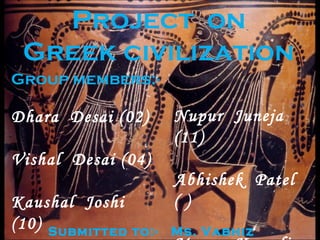
Project  on Greek civilization Group members:- Dhara  Desai (02) Vishal  Desai (04) Kaushal  Joshi (10) Nupur  Juneja (11) Abhishek  Patel ( ) Mayur  Kapadia (12) Submitted to:-  Ms. Vabhiz  Engineer
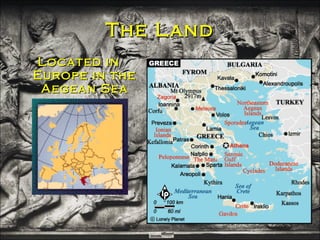
The Land Located in Europe in the Aegean Sea
Brief History of Greece The first great civilization in Greece and Crete was the Minoan. It lasted roughly from 2000 BCE until 1400 BCE. Around 1400 BCE, the Mycenaean civilization supplanted the Minoan, and dominated Greece until about 1100 BCE, when barbarians known as Durians invaded.
EXTEND EARLY BEGINING OF POLIS
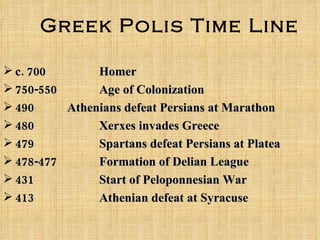
Greek Polis Time Line c. 700 Homer 750-550  Age of Colonization 490 Athenians defeat Persians at Marathon 480 Xerxes invades Greece 479 Spartans defeat Persians at Platea 478-477 Formation of Delian League 431  Start of Peloponnesian War 413 Athenian defeat at Syracuse
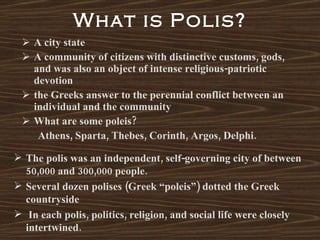
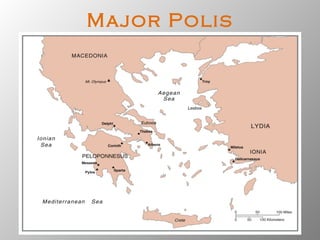
What is Polis? A city state A community of citizens with distinctive customs, gods, and was also an object of intense religious-patriotic devotion the Greeks answer to the perennial conflict between an individual and the community What are some poleis? Athens, Sparta, Thebes, Corinth, Argos, Delphi. The polis was an independent, self-governing city of between 50,000 and 300,000 people. Several dozen polises (Greek “poleis”) dotted the Greek countryside In each polis, politics, religion, and social life were closely intertwined.
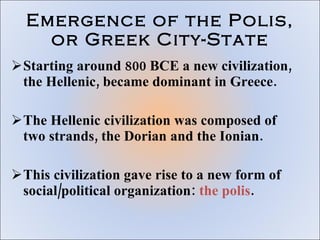
Emergence of the Polis, or Greek City-State Starting around 800 BCE a new civilization, the Hellenic, became dominant in Greece.  The Hellenic civilization was composed of two strands, the Dorian and the Ionian. This civilization gave rise to a new form of social/political organization:  the polis .
Major Polis
Types of Government Two types of government were used in the Greek Polises. The Dorians generally had an  oligarchic  form of government. The Greek word oligarchy means rule by the few. The Ionians developed the first  democratic  form of government.  Democracy means rule by the people.
Sparta and Athens Generally speaking, the Dorians depended upon agriculture, while the Ionians were seafarers and merchants. The two primary polises were Sparta and Athens. Sparta was Dorian, oligarchic, and had an agriculture-based economy. Athens was Ionian, democratic, and depended on seafaring and trade.
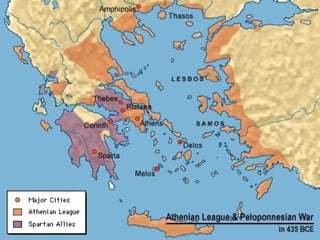
The Great Wars After the Persian Wars, Greece was divided into two power blocs. One, the  Peloponnesian League , was led by Sparta. The other was the  Delian League , led by Athens. These power blocs fought a great war,  from 431-404 BCE. The greatest challenge to Hellenic civilization came from Persia, to the east. Greece fought two Persian wars, in 490 BCE, and in 481 BCE. The Greek polises formed an alliance, led by Sparta and Athens. The Greeks won both wars, ensuring that the roots of western civilization would include Greek thought.
THE PELOPONNESIAN WAR,  431-404 BC  During the war, the soldiers of the Peloponnesian League besieged the cities of the Delian League by land. The Delian League used its navies to supply itself with food, and to harass the home cities of its enemies. The Spartans and their allies finally defeated Athens and its allies.
 
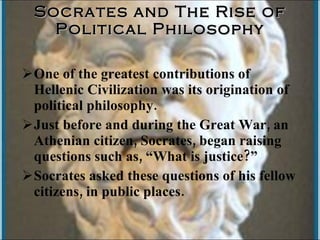
Socrates and The Rise of Political Philosophy One of the greatest contributions of Hellenic Civilization was its origination of political philosophy. Just before and during the Great War, an Athenian citizen, Socrates, began raising questions such as, “What is justice?” Socrates asked these questions of his fellow citizens, in public places.
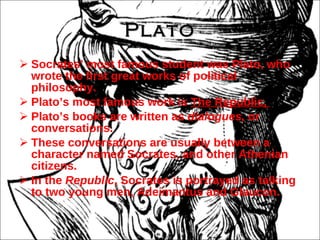
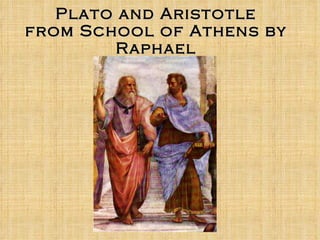
Plato Socrates’ most famous student was Plato, who wrote the first great works of political philosophy. Plato’s most famous work is  The Republic,  Plato’s books are written as  dialogues,  or conversations. These conversations are usually between a character named Socrates, and other Athenian citizens. In the  Republic , Socrates is portrayed as talking to two young men, Adeimantus and Glaucon.
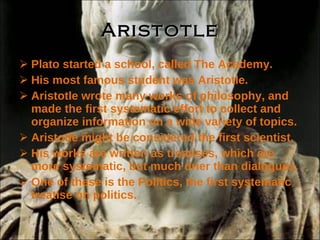
Aristotle Plato started a school, called The Academy. His most famous student was Aristotle. Aristotle wrote many works of philosophy, and made the first systematic effort to collect and organize information on a wide variety of topics. Aristotle might be considered the first scientist. His works are written as treatises, which are more systematic, but much drier than dialogues. One of these is the Politics, the first systematic treatise on politics.
Plato and Aristotle from School of Athens by Raphael
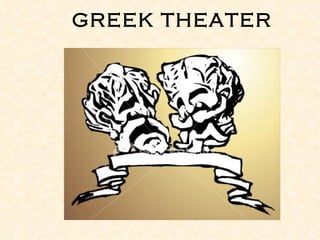
GREEK THEATER
The Origins Of Drama The dithyrambs celebrating Dionysus soon evolved into dramas. The story goes: Thespis, a popular writer of Dithyrambs, is said to have invented drama when he asked one “performer” to stand outside the chorus to engage in some “call and response.”
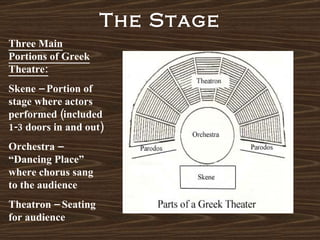
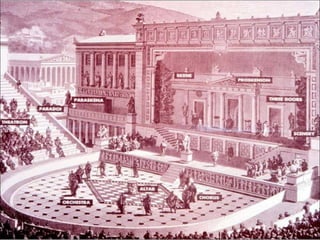
The Stage Three Main Portions of Greek Theatre: Skene – Portion of stage where actors performed (included 1-3 doors in and out) Orchestra – “Dancing Place” where chorus sang to the audience Theatron – Seating for audience
 
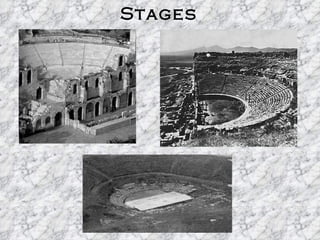
Stages
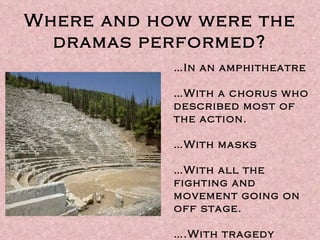
Where and how were the dramas performed? … In an amphitheatre … With a chorus who described most of the action. … With masks … With all the fighting and movement going on off stage. ….With tragedy first, then comedy later.
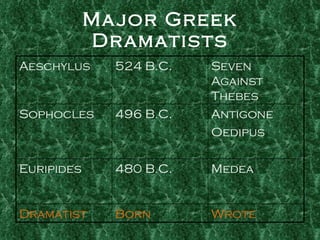
Major Greek Dramatists Aeschylus 524 B.C. Seven Against Thebes Sophocles 496 B.C. Antigone Oedipus Euripides 480 B.C. Medea Dramatist Born Wrote
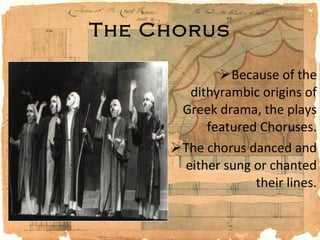
The Chorus Because of the dithyrambic origins of Greek drama, the plays featured Choruses. The chorus danced and either sung or chanted their lines.
Functions of the chorus an agent: gives advice, asks, takes part  establishes ethical framework, sets up standard by which action will be judged  ideal spectator - reacts as playwright hopes audience would  sets mood and heightens dramatic effects  adds movement, spectacle, song, and dance  rhythmical function - pauses / paces the action so that the audience can reflect.
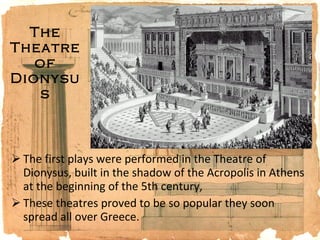
The Theatre of Dionysus The first plays were performed in the Theatre of Dionysus, built in the shadow of the Acropolis in Athens at the beginning of the 5th century,  These theatres proved to be so popular they soon spread all over Greece.
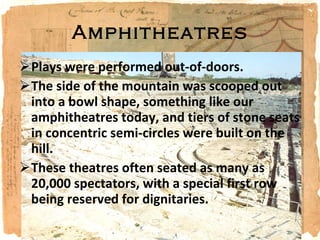
Amphitheatres Plays were performed out-of-doors. The side of the mountain was scooped out into a bowl shape, something like our amphitheatres today, and tiers of stone seats in concentric semi-circles were built on the hill. These theatres often seated as many as 20,000 spectators, with a special first row being reserved for dignitaries.
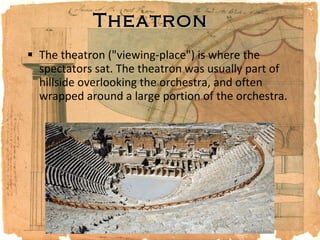
Theatron The theatron ("viewing-place") is where the spectators sat. The theatron was usually part of hillside overlooking the orchestra, and often wrapped around a large portion of the orchestra.
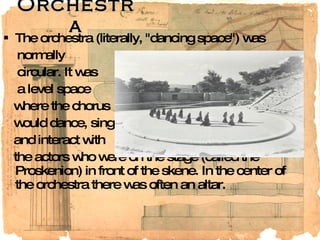
Orchestra The orchestra (literally, "dancing space") was normally  circular. It was a level space where the chorus would dance, sing, and interact with the actors who were on the stage (called the Proskenion) in front of the skene. In the center of the orchestra there was often an altar.
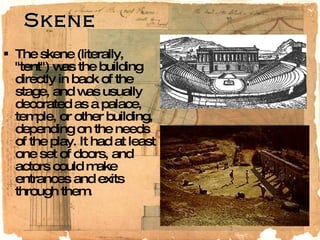
Skene The skene (literally, "tent") was the building directly in back of the stage, and was usually decorated as a palace, temple, or other building, depending on the needs of the play. It had at least one set of doors, and actors could make entrances and exits through them.
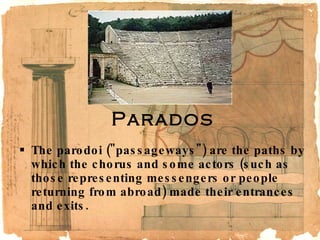
Parados The parodoi ("passageways") are the paths by which the chorus and some actors (such as those representing messengers or people returning from abroad) made their entrances and exits.
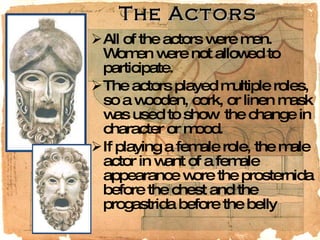
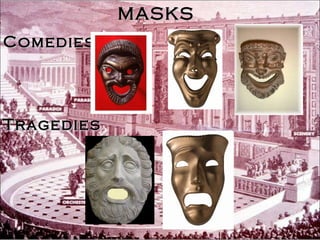
The Actors All of the actors were men.  Women were not allowed to participate.  The actors played multiple roles, so a wooden, cork, or linen mask was used to show  the change in character or mood.  If playing a female role, the male actor in want of a female appearance wore the prosternida before the chest and the progastrida before the belly
MASKS Comedies Tragedies
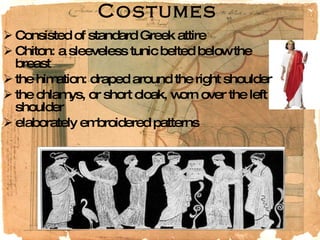
Costumes Consisted of standard Greek attire Chiton: a sleeveless tunic belted below the breast the himation: draped around the right shoulder the chlamys, or short cloak, worn over the left shoulder elaborately embroidered patterns
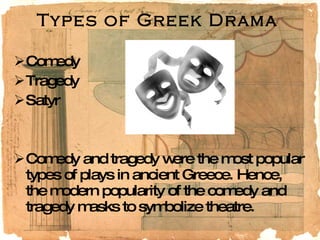
Types of Greek Drama Comedy Tragedy Satyr Comedy and tragedy were the most popular types of plays in ancient Greece. Hence, the modern popularity of the comedy and tragedy masks to symbolize theatre.
Structure of a Comedy Prologue   — leading character conceives a "happy idea"  Parados :  entrance of the chorus  Agon :  dramatized debate between proponent and opponent of the "happy idea"
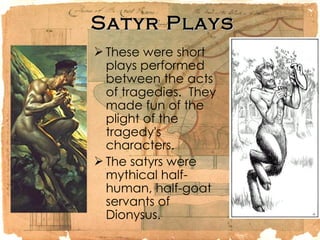
Satyr Plays These were short plays performed between the acts of tragedies.  They made fun of the plight of the tragedy's characters.  The satyrs were mythical half-human, half-goat servants of Dionysus.
Important Playwrights Aeschylus Sophocles Euripides Aristophanes Menander
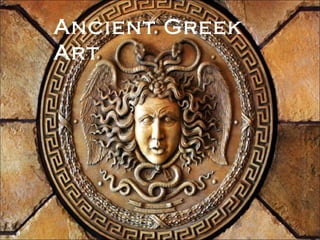
Ancient Greek Art
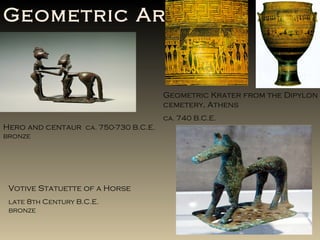
Geometric Art Geometric Krater from the Dipylon cemetery, Athens ca. 740 B.C.E. Hero and centaur  ca. 750-730 B.C.E. bronze Votive Statuette of a Horse  late 8th Century B.C.E. bronze
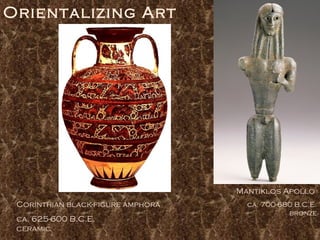
Orientalizing Art Mantiklos Apollo  ca. 700-680 B.C.E. bronze Corinthian black-figure amphora ca. 625-600 B.C.E. ceramic
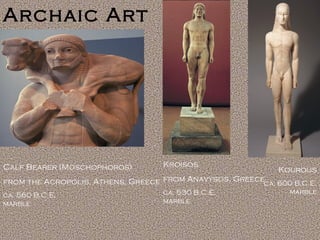
Archaic Art Kourous ca. 600 B.C.E. marble Calf Bearer (Moschophoros) from the Acropolis, Athens, Greece ca. 560 B.C.E. marble Kroisos from Anavysos, Greece ca. 530 B.C.E. marble
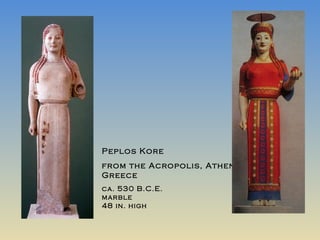
Peplos Kore from the Acropolis, Athens, Greece ca. 530 B.C.E. marble 48 in. high
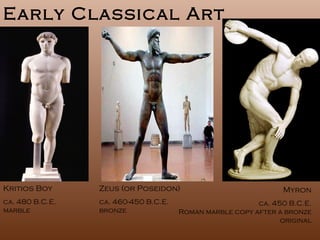
Early Classical Art Kritios Boy ca. 480 B.C.E. marble Zeus (or Poseidon) ca. 460-450 B.C.E. bronze Myron ca. 450 B.C.E. Roman marble copy after a bronze original
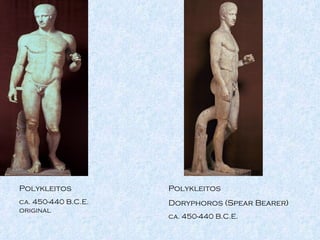
Polykleitos ca. 450-440 B.C.E. original Polykleitos Doryphoros (Spear Bearer) ca. 450-440 B.C.E.
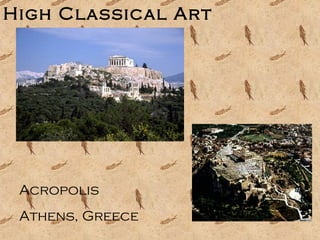
High Classical Art Acropolis Athens, Greece
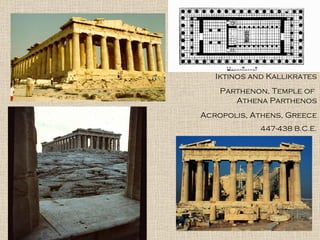
Iktinos and Kallikrates Parthenon, Temple of  Athena Parthenos Acropolis, Athens, Greece 447-438 B.C.E.
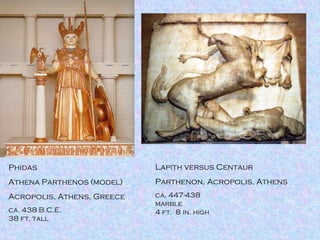
Phidas Athena Parthenos (model) Acropolis, Athens, Greece ca. 438 B.C.E. 38 ft. tall Lapith versus Centaur Parthenon, Acropolis, Athens ca. 447-438 marble 4 ft.  8 in. high
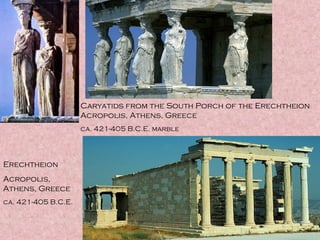
Caryatids from the South Porch of the Erechtheion Acropolis, Athens, Greece ca. 421-405 B.C.E. marble Erechtheion Acropolis, Athens, Greece ca. 421-405 B.C.E.
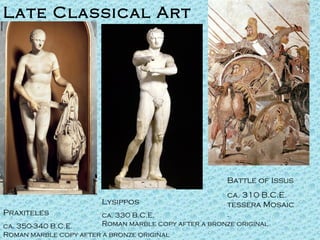
Late Classical Art Praxiteles ca. 350-340 B.C.E. Roman marble copy after a bronze original Lysippos ca. 330 B.C.E. Roman marble copy after a bronze original Battle of Issus ca. 310 B.C.E. tessera Mosaic .
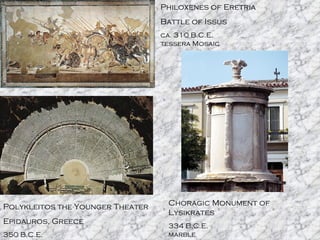
Philoxenes of Eretria Battle of Issus ca. 310 B.C.E. tessera Mosaic Polykleitos the Younger Theater Epidauros, Greece 350 B.C.E. Choragic Monument of Lysikrates 334 B.C.E. marble
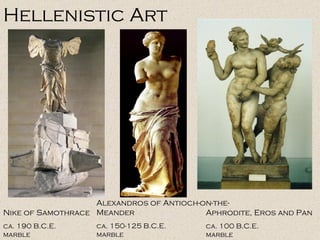
Hellenistic Art Nike of Samothrace ca. 190 B.C.E. marble Alexandros of Antioch-on-the-Meander ca. 150-125 B.C.E. marble Aphrodite, Eros and Pan ca. 100 B.C.E. marble
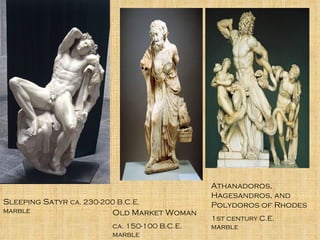
Sleeping Satyr  ca. 230-200 B.C.E. marble Old Market Woman ca. 150-100 B.C.E. marble Athanadoros, Hagesandros, and Polydoros of Rhodes 1st century C.E. marble
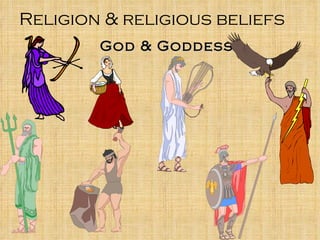
Religion & religious beliefs God & Goddess
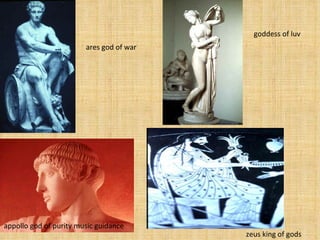
goddess of luv zeus king of gods ares god of war appollo god of purity music guidance
Thank You PPT design & composed by Kaushal  Joshi

Greek civilization

  • 1.
    Project onGreek civilization Group members:- Dhara Desai (02) Vishal Desai (04) Kaushal Joshi (10) Nupur Juneja (11) Abhishek Patel ( ) Mayur Kapadia (12) Submitted to:- Ms. Vabhiz Engineer
  • 2.
    The Land Locatedin Europe in the Aegean Sea
  • 3.
    Brief History ofGreece The first great civilization in Greece and Crete was the Minoan. It lasted roughly from 2000 BCE until 1400 BCE. Around 1400 BCE, the Mycenaean civilization supplanted the Minoan, and dominated Greece until about 1100 BCE, when barbarians known as Durians invaded.
  • 4.
  • 5.
    Greek Polis TimeLine c. 700 Homer 750-550 Age of Colonization 490 Athenians defeat Persians at Marathon 480 Xerxes invades Greece 479 Spartans defeat Persians at Platea 478-477 Formation of Delian League 431 Start of Peloponnesian War 413 Athenian defeat at Syracuse
  • 6.
    What is Polis?A city state A community of citizens with distinctive customs, gods, and was also an object of intense religious-patriotic devotion the Greeks answer to the perennial conflict between an individual and the community What are some poleis? Athens, Sparta, Thebes, Corinth, Argos, Delphi. The polis was an independent, self-governing city of between 50,000 and 300,000 people. Several dozen polises (Greek “poleis”) dotted the Greek countryside In each polis, politics, religion, and social life were closely intertwined.
  • 7.
    Emergence of thePolis, or Greek City-State Starting around 800 BCE a new civilization, the Hellenic, became dominant in Greece. The Hellenic civilization was composed of two strands, the Dorian and the Ionian. This civilization gave rise to a new form of social/political organization: the polis .
  • 8.
  • 9.
    Types of GovernmentTwo types of government were used in the Greek Polises. The Dorians generally had an oligarchic form of government. The Greek word oligarchy means rule by the few. The Ionians developed the first democratic form of government. Democracy means rule by the people.
  • 10.
    Sparta and AthensGenerally speaking, the Dorians depended upon agriculture, while the Ionians were seafarers and merchants. The two primary polises were Sparta and Athens. Sparta was Dorian, oligarchic, and had an agriculture-based economy. Athens was Ionian, democratic, and depended on seafaring and trade.
  • 11.
    The Great WarsAfter the Persian Wars, Greece was divided into two power blocs. One, the Peloponnesian League , was led by Sparta. The other was the Delian League , led by Athens. These power blocs fought a great war, from 431-404 BCE. The greatest challenge to Hellenic civilization came from Persia, to the east. Greece fought two Persian wars, in 490 BCE, and in 481 BCE. The Greek polises formed an alliance, led by Sparta and Athens. The Greeks won both wars, ensuring that the roots of western civilization would include Greek thought.
  • 12.
    THE PELOPONNESIAN WAR, 431-404 BC During the war, the soldiers of the Peloponnesian League besieged the cities of the Delian League by land. The Delian League used its navies to supply itself with food, and to harass the home cities of its enemies. The Spartans and their allies finally defeated Athens and its allies.
  • 13.
  • 14.
    Socrates and TheRise of Political Philosophy One of the greatest contributions of Hellenic Civilization was its origination of political philosophy. Just before and during the Great War, an Athenian citizen, Socrates, began raising questions such as, “What is justice?” Socrates asked these questions of his fellow citizens, in public places.
  • 15.
    Plato Socrates’ mostfamous student was Plato, who wrote the first great works of political philosophy. Plato’s most famous work is The Republic, Plato’s books are written as dialogues, or conversations. These conversations are usually between a character named Socrates, and other Athenian citizens. In the Republic , Socrates is portrayed as talking to two young men, Adeimantus and Glaucon.
  • 16.
    Aristotle Plato starteda school, called The Academy. His most famous student was Aristotle. Aristotle wrote many works of philosophy, and made the first systematic effort to collect and organize information on a wide variety of topics. Aristotle might be considered the first scientist. His works are written as treatises, which are more systematic, but much drier than dialogues. One of these is the Politics, the first systematic treatise on politics.
  • 17.
    Plato and Aristotlefrom School of Athens by Raphael
  • 18.
  • 19.
    The Origins OfDrama The dithyrambs celebrating Dionysus soon evolved into dramas. The story goes: Thespis, a popular writer of Dithyrambs, is said to have invented drama when he asked one “performer” to stand outside the chorus to engage in some “call and response.”
  • 20.
    The Stage ThreeMain Portions of Greek Theatre: Skene – Portion of stage where actors performed (included 1-3 doors in and out) Orchestra – “Dancing Place” where chorus sang to the audience Theatron – Seating for audience
  • 21.
  • 22.
  • 23.
    Where and howwere the dramas performed? … In an amphitheatre … With a chorus who described most of the action. … With masks … With all the fighting and movement going on off stage. ….With tragedy first, then comedy later.
  • 24.
    Major Greek DramatistsAeschylus 524 B.C. Seven Against Thebes Sophocles 496 B.C. Antigone Oedipus Euripides 480 B.C. Medea Dramatist Born Wrote
  • 25.
    The Chorus Becauseof the dithyrambic origins of Greek drama, the plays featured Choruses. The chorus danced and either sung or chanted their lines.
  • 26.
    Functions of thechorus an agent: gives advice, asks, takes part establishes ethical framework, sets up standard by which action will be judged ideal spectator - reacts as playwright hopes audience would sets mood and heightens dramatic effects adds movement, spectacle, song, and dance rhythmical function - pauses / paces the action so that the audience can reflect.
  • 27.
    The Theatre ofDionysus The first plays were performed in the Theatre of Dionysus, built in the shadow of the Acropolis in Athens at the beginning of the 5th century, These theatres proved to be so popular they soon spread all over Greece.
  • 28.
    Amphitheatres Plays wereperformed out-of-doors. The side of the mountain was scooped out into a bowl shape, something like our amphitheatres today, and tiers of stone seats in concentric semi-circles were built on the hill. These theatres often seated as many as 20,000 spectators, with a special first row being reserved for dignitaries.
  • 29.
    Theatron The theatron("viewing-place") is where the spectators sat. The theatron was usually part of hillside overlooking the orchestra, and often wrapped around a large portion of the orchestra.
  • 30.
    Orchestra The orchestra(literally, "dancing space") was normally circular. It was a level space where the chorus would dance, sing, and interact with the actors who were on the stage (called the Proskenion) in front of the skene. In the center of the orchestra there was often an altar.
  • 31.
    Skene The skene(literally, "tent") was the building directly in back of the stage, and was usually decorated as a palace, temple, or other building, depending on the needs of the play. It had at least one set of doors, and actors could make entrances and exits through them.
  • 32.
    Parados The parodoi("passageways") are the paths by which the chorus and some actors (such as those representing messengers or people returning from abroad) made their entrances and exits.
  • 33.
    The Actors Allof the actors were men. Women were not allowed to participate. The actors played multiple roles, so a wooden, cork, or linen mask was used to show the change in character or mood. If playing a female role, the male actor in want of a female appearance wore the prosternida before the chest and the progastrida before the belly
  • 34.
  • 35.
    Costumes Consisted ofstandard Greek attire Chiton: a sleeveless tunic belted below the breast the himation: draped around the right shoulder the chlamys, or short cloak, worn over the left shoulder elaborately embroidered patterns
  • 36.
    Types of GreekDrama Comedy Tragedy Satyr Comedy and tragedy were the most popular types of plays in ancient Greece. Hence, the modern popularity of the comedy and tragedy masks to symbolize theatre.
  • 37.
    Structure of aComedy Prologue — leading character conceives a "happy idea" Parados : entrance of the chorus Agon : dramatized debate between proponent and opponent of the "happy idea"
  • 38.
    Satyr Plays Thesewere short plays performed between the acts of tragedies. They made fun of the plight of the tragedy's characters. The satyrs were mythical half-human, half-goat servants of Dionysus.
  • 39.
    Important Playwrights AeschylusSophocles Euripides Aristophanes Menander
  • 40.
  • 41.
    Geometric Art GeometricKrater from the Dipylon cemetery, Athens ca. 740 B.C.E. Hero and centaur ca. 750-730 B.C.E. bronze Votive Statuette of a Horse late 8th Century B.C.E. bronze
  • 42.
    Orientalizing Art MantiklosApollo ca. 700-680 B.C.E. bronze Corinthian black-figure amphora ca. 625-600 B.C.E. ceramic
  • 43.
    Archaic Art Kourousca. 600 B.C.E. marble Calf Bearer (Moschophoros) from the Acropolis, Athens, Greece ca. 560 B.C.E. marble Kroisos from Anavysos, Greece ca. 530 B.C.E. marble
  • 44.
    Peplos Kore fromthe Acropolis, Athens, Greece ca. 530 B.C.E. marble 48 in. high
  • 45.
    Early Classical ArtKritios Boy ca. 480 B.C.E. marble Zeus (or Poseidon) ca. 460-450 B.C.E. bronze Myron ca. 450 B.C.E. Roman marble copy after a bronze original
  • 46.
    Polykleitos ca. 450-440B.C.E. original Polykleitos Doryphoros (Spear Bearer) ca. 450-440 B.C.E.
  • 47.
    High Classical ArtAcropolis Athens, Greece
  • 48.
    Iktinos and KallikratesParthenon, Temple of Athena Parthenos Acropolis, Athens, Greece 447-438 B.C.E.
  • 49.
    Phidas Athena Parthenos(model) Acropolis, Athens, Greece ca. 438 B.C.E. 38 ft. tall Lapith versus Centaur Parthenon, Acropolis, Athens ca. 447-438 marble 4 ft. 8 in. high
  • 50.
    Caryatids from theSouth Porch of the Erechtheion Acropolis, Athens, Greece ca. 421-405 B.C.E. marble Erechtheion Acropolis, Athens, Greece ca. 421-405 B.C.E.
  • 51.
    Late Classical ArtPraxiteles ca. 350-340 B.C.E. Roman marble copy after a bronze original Lysippos ca. 330 B.C.E. Roman marble copy after a bronze original Battle of Issus ca. 310 B.C.E. tessera Mosaic .
  • 52.
    Philoxenes of EretriaBattle of Issus ca. 310 B.C.E. tessera Mosaic Polykleitos the Younger Theater Epidauros, Greece 350 B.C.E. Choragic Monument of Lysikrates 334 B.C.E. marble
  • 53.
    Hellenistic Art Nikeof Samothrace ca. 190 B.C.E. marble Alexandros of Antioch-on-the-Meander ca. 150-125 B.C.E. marble Aphrodite, Eros and Pan ca. 100 B.C.E. marble
  • 54.
    Sleeping Satyr ca. 230-200 B.C.E. marble Old Market Woman ca. 150-100 B.C.E. marble Athanadoros, Hagesandros, and Polydoros of Rhodes 1st century C.E. marble
  • 55.
    Religion & religiousbeliefs God & Goddess
  • 56.
    goddess of luvzeus king of gods ares god of war appollo god of purity music guidance
  • 57.
    Thank You PPTdesign & composed by Kaushal Joshi

Editor's Notes

  • #19 <number>
  • #25 <number>
  • #26 <number>
  • #27 <number>
  • #28 <number>
  • #29 <number>
  • #30 <number>
  • #31 <number>
  • #32 <number>
  • #33 <number>
  • #35 <number>
  • #36 <number>
  • #37 <number>
  • #38 <number>
  • #39 <number>
  • #44 <number>
  • #45 Slide concept by William V. Ganis, PhD FOR EDUCATIONAL USE ONLY For publication, reproduction or transmission of images, please contact individual artists, estates, photographers and exhibiting institutions for permissions and rights.
  • #48 <number>
  • #49 Slide concept by William V. Ganis, PhD FOR EDUCATIONAL USE ONLY For publication, reproduction or transmission of images, please contact individual artists, estates, photographers and exhibiting institutions for permissions and rights. <number>
  • #50 Slide concept by William V. Ganis, PhD FOR EDUCATIONAL USE ONLY For publication, reproduction or transmission of images, please contact individual artists, estates, photographers and exhibiting institutions for permissions and rights. <number>
  • #51 Slide concept by William V. Ganis, PhD FOR EDUCATIONAL USE ONLY For publication, reproduction or transmission of images, please contact individual artists, estates, photographers and exhibiting institutions for permissions and rights. <number>
  • #52 Slide concept by William V. Ganis, PhD FOR EDUCATIONAL USE ONLY For publication, reproduction or transmission of images, please contact individual artists, estates, photographers and exhibiting institutions for permissions and rights. <number>
  • #53 Slide concept by William V. Ganis, PhD FOR EDUCATIONAL USE ONLY For publication, reproduction or transmission of images, please contact individual artists, estates, photographers and exhibiting institutions for permissions and rights. <number>
  • #54 Slide concept by William V. Ganis, PhD FOR EDUCATIONAL USE ONLY For publication, reproduction or transmission of images, please contact individual artists, estates, photographers and exhibiting institutions for permissions and rights. <number>
  • #55 Slide concept by William V. Ganis, PhD FOR EDUCATIONAL USE ONLY For publication, reproduction or transmission of images, please contact individual artists, estates, photographers and exhibiting institutions for permissions and rights.