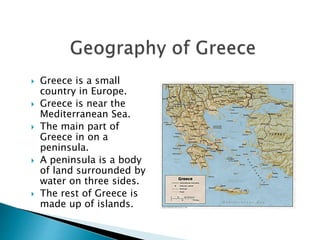
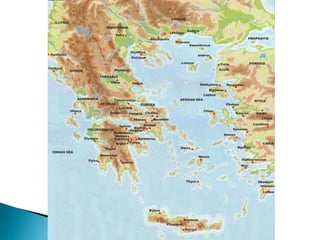
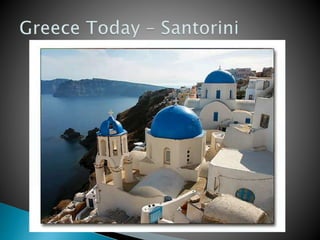
 Greece is a small
country in Europe.
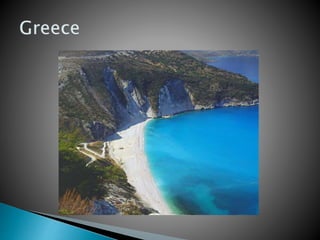
 Greece is near the
Mediterranean Sea.
 The main part of
Greece in on a
peninsula.
 A peninsula is a body
of land surrounded by
water on three sides.
 The rest of Greece is
made up of islands.
 Only about 1/5th of Greece is suitable for
farming because most of the country is
covered with mountains. The islands are
mountain peaks.
 Two Effects of Greek Geography
1. The Greeks became excellent traders and
sailors.
2. The Greeks thought of themselves as
separate countries because it was hard to
get together.
 Because Greece is made up of many islands,
and has many tall mountains, the Greeks
began to build city-states instead of one
country.
 A city-state is a city with its own laws, rulers,
and money.
 City-states were cities that acted like
countries.
 The Minoans lived on the island of Crete from
about 3000 to 1100 BC.
 Because of their location, they were excellent
traders who controlled the Aegean Sea.
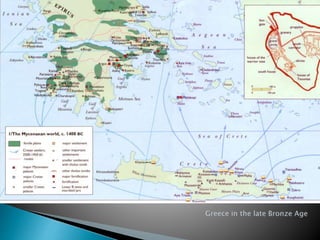
 After the Mycenaeans defeated the Minoans,
the culture of the islands blended with
mainland Greek culture.
 At their height in 1400 BC, the Mycenaeans
controlled trade, spoke an early form of
Greek, and used writing.
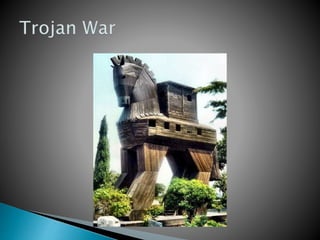
 Greek myth tells the story of the Trojan War
between Greece and the city of Troy in
present day Turkey.
 The Greeks conquered the Trojans by using a
fake wooden horse filled with Greek soldiers.
 The horse was rolled to the Trojan city gates.
Thinking it was a gift, the Trojans rolled it
inside. After nightfall, the Greeks destroyed
Troy and burned the city to the ground.
 Epics – long story-telling poems.
 Two epics exist today telling of the Trojan
War, the Odyssey and the Illiad, written by
Homer. Some historians believe that Homer
exaggerated the story to make it sound
better.
 Soon after the Trojan War, civilization in
Greece collapsed. People no longer traded
for food and other goods beyond Greece and
poverty was everywhere. The Dark Ages took
place from 1100 – 750 BC.
 Acropolis – a high, rocky hill where early
people built cities.
 Historians believe that sometime around 750
BC, villages joined with cities and began to
develop their own traditions, laws, and
governments.
 City-state – a city, that is also a separate
independent state.
 The earliest rulers of city-states were
probably chieftains or kings who were
military leaders.
 By the end of the Dark Ages, most city-states
were ruled by aristocrats – members of rich
and powerful families.
 Because they were wealthy, aristocrats could
afford land, chariots, and the best weapons
that helped make themselves stronger.
 As the Greeks sailed to ports to trade various
goods, the city-states became wealthy. A
middle class of merchants and sailors
developed.
 The middle class wanted representation in
government and began to equip themselves
with armor, swords, and spears.
 Gradually power shifted from the aristocrats
to tyrants – rulers who seize power by force.
 Eventually the people in city-states overthrew
the tyrants. Some city-states developed a
style of government called democracy –
citizens govern themselves.
 The most successful democratic city-state
was Athens.
 Athenian democracy became the leading
government of the ancient world.
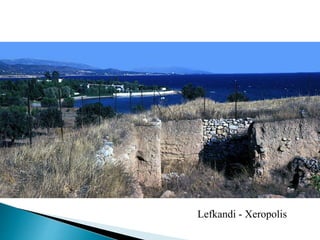
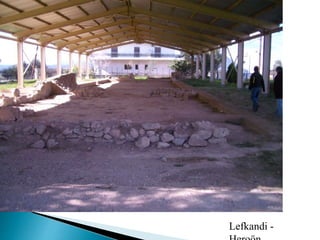
Lefkandi - Xeropolis
Lefkandi -
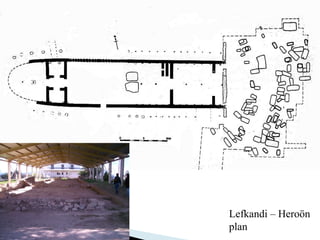
Lefkandi – Heroön
plan
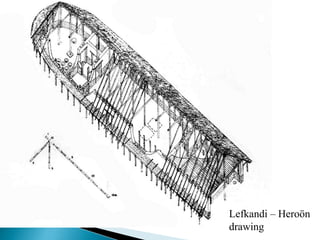
Lefkandi – Heroön
drawing
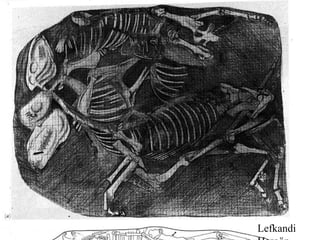
Lefkandi
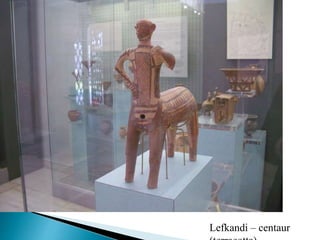
Lefkandi – centaur
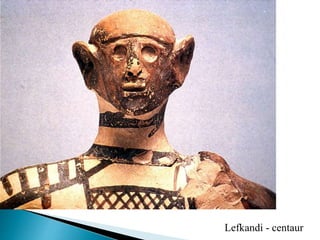
Lefkandi - centaur
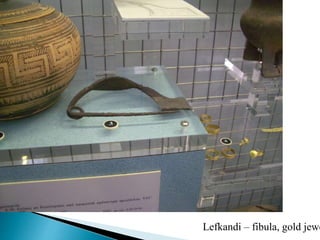
Lefkandi – fibula, gold jewe
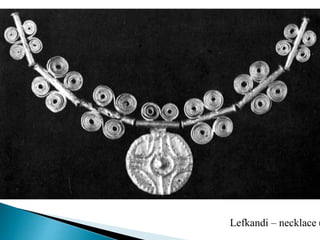
Lefkandi – necklace (
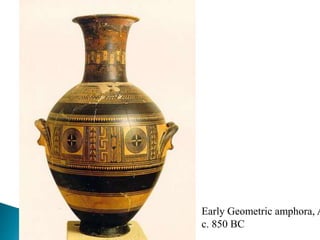
Early Geometric amphora, A
c. 850 BC
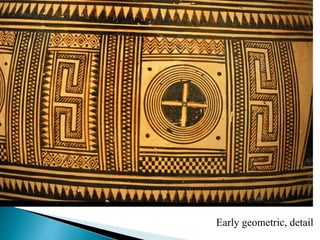
Early geometric, detail
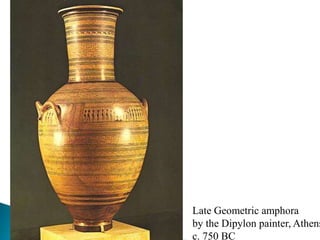
Late Geometric amphora
by the Dipylon painter, Athens
c. 750 BC
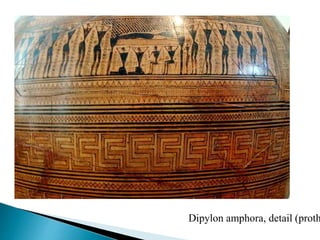
Dipylon amphora, detail (proth
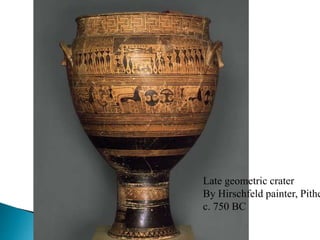
Late geometric crater
By Hirschfeld painter, Pithe
c. 750 BC
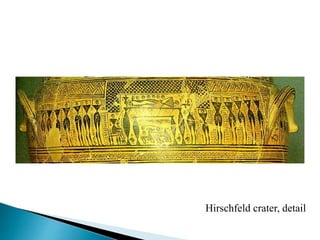
Hirschfeld crater, detail
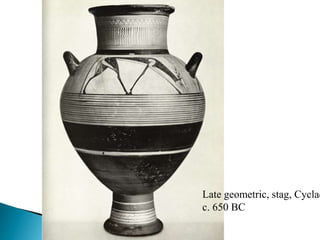
Late geometric, stag, Cyclad
c. 650 BC
 Sparta was a Greek city-state.
 Sparta was very powerful and had its own
army.
 Sparta conquered other city-states to gain
wealth and power.
 There were three classes of people in
Sparta.
 Citizens, non-citizens, and slaves.
 Only men born in Sparta were citizens.
 Women were not allowed to become
citizens, however, women were allowed to
own land and businesses, which gave them
more freedom than other Greek city-states.
 The second class in Sparta was people who
came from other city-states or other
countries. They could own businesses but
not become citizens.
 The third class was slaves.
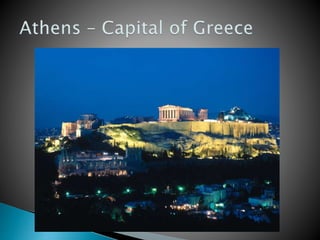
 Athens was another important Greek city-
state.
 The people of Athens wanted to rule
themselves and not have a king or queen.
 Athens became the world’s first democracy
around 508 B.C.
 A democracy is a government in which all
citizens can vote and have equal say in what
happens.
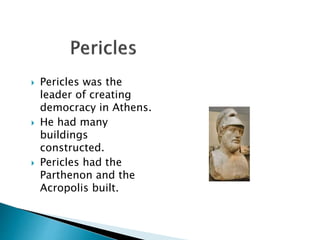
 Pericles was the
leader of creating
democracy in Athens.
 He had many
buildings
constructed.
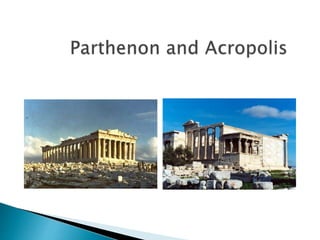
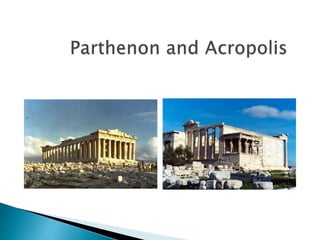
 Pericles had the
Parthenon and the
Acropolis built.
 Greek gods did not make the world, but live
within it
 Gods do not love humans, nor do they ask to
be loved by them
 Gods struggle for power amongst one
another
 No writings to reveal the will of the Greek
gods
 Gods are capricious
 Guilt and sin (in our modern sense) do not
exist
 Temples were where
offerings, libations,
sacrifices and prayers
were performed at the
altar by priests
 Shrine could also take
other forms e.g., a
cave, tree or mountain
top
 Object of the cult could
also be a hero
 Consult priest or
priestess to know
the god’s will
 Sacrifice of an
animal is correct
ritual
 Greek temple –
houses the cult
image of the god
 “often the gods lift up men who were
crushed into the dark earth by their
troubles, and often they smash down on
their faces those who stand firm” -
Archilochus
 Gods often appear to be either neglectful of
humans or their tormentors.
 All are fated to die as the gods did not see
fit to give humans eternal life or youth
 Everyone is subject to Fate, but it can be
good or bad, depending on how you look at it
 Example of this is Oedipus
 Destined to marry his mother and kill his
father, but not destined to know about it
 Oedipus freely chooses to learn the truth
about himself
 Greek gods were called “hoi athanatoi”, or the
deathless ones
 Greeks believed that gods could act as their
protectors, if they honored them
 Every community had special gods to protect
them
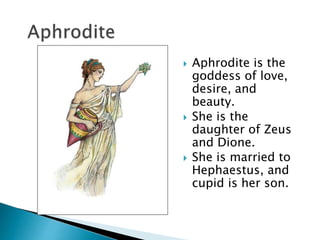
 Aphrodite is the
goddess of love,
desire, and
beauty.
 She is the
daughter of Zeus
and Dione.
 She is married to
Hephaestus, and
cupid is her son.
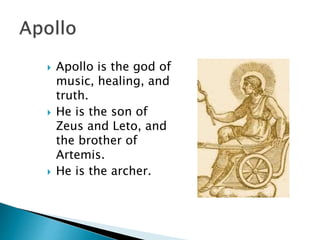
 Apollo is the god of
music, healing, and
truth.
 He is the son of
Zeus and Leto, and
the brother of
Artemis.
 He is the archer.
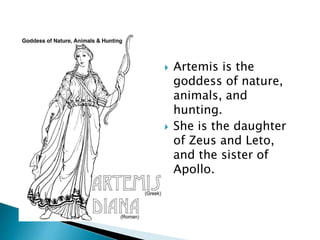
 Artemis is the
goddess of nature,
animals, and
hunting.
 She is the daughter
of Zeus and Leto,
and the sister of
Apollo.
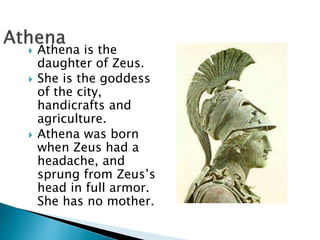
 Athena is the
daughter of Zeus.
 She is the goddess
of the city,
handicrafts and
agriculture.
 Athena was born
when Zeus had a
headache, and
sprung from Zeus’s
head in full armor.
She has no mother.
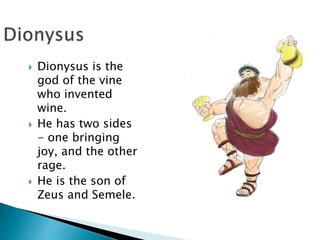
 Dionysus is the
god of the vine
who invented
wine.
 He has two sides
- one bringing
joy, and the other
rage.
 He is the son of
Zeus and Semele.
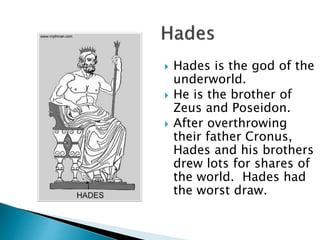
 Hades is the god of the
underworld.
 He is the brother of
Zeus and Poseidon.
 After overthrowing
their father Cronus,
Hades and his brothers
drew lots for shares of
the world. Hades had
the worst draw.
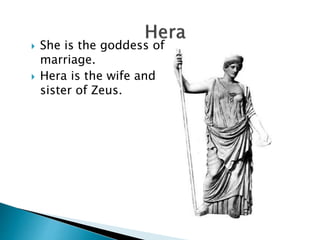
 She is the goddess of
marriage.
 Hera is the wife and
sister of Zeus.
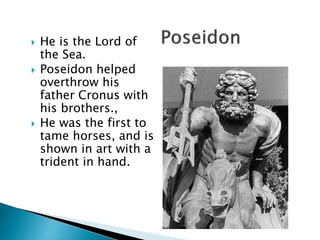
 He is the Lord of
the Sea.
 Poseidon helped
overthrow his
father Cronus with
his brothers.,
 He was the first to
tame horses, and is
shown in art with a
trident in hand.
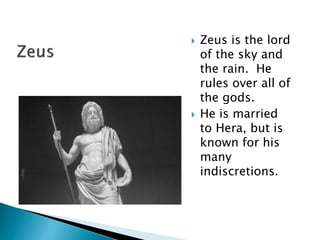
 Zeus is the lord
of the sky and
the rain. He
rules over all of
the gods.
 He is married
to Hera, but is
known for his
many
indiscretions.
 Greeks went to the oracle to find out
information on their future life on
earth, for this they turned to the
oracle.
 Greek oracle was the religion priest or
priestess who acted as a
communicator between man and God.
Every oracle had a distinct method of
divination. Motion of objects in the
spring, movement of birds, rustle of
leaves, interpreted dreams, etc, were
considered valid indicators for
understanding messages from the
gods.
 One of the most famous oracles was
the Oracle at Delphi.

QuickTime™ and a
Photo - JPEG decompressor
are needed to see this picture.
 . The ancient Greeks
considered sacrifice as the
appropriate method to
worship God. Public
worships were held to
obtain public blessings,
rain, good harvest, military
victories, etc. Private
sacrifices were offered for
fulfillment of personal
goals, wishes and victories.
Blood sacrifices of animals
such as oxen, sheep,
horses, swine, dogs, birds,
fish, fowl etc were common
in the temple of Gods.
QuickTime™ and a
Photo - JPEG decompressor
are needed to see this picture.
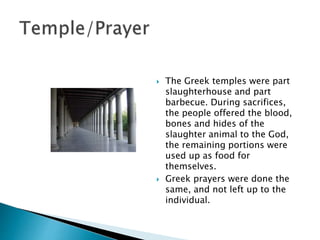
 The Greek temples were part
slaughterhouse and part
barbecue. During sacrifices,
the people offered the blood,
bones and hides of the
slaughter animal to the God,
the remaining portions were
used up as food for
themselves.
 Greek prayers were done the
same, and not left up to the
individual.
 The Greek temples were small
buildings that contained a
statue of the god the temple
was created for. Most of these
temples did not have a
professional or full time clergy
or priest.
QuickTime™ and a
Photo - JPEG decompressor
are needed to see this picture.
 Education was very important in Athens.
 Boys went to school to learn to read and
write. They also learned many sports.
 Girls were not allowed to go to school or
learn to play sports.
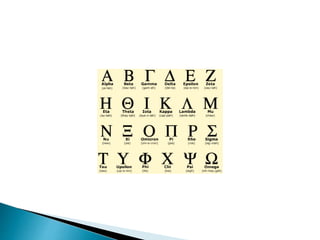
 The Greeks borrowed their alphabet from
the Phoenicians.
 Most European languages, including English
borrowed ideas from the Greek alphabet.
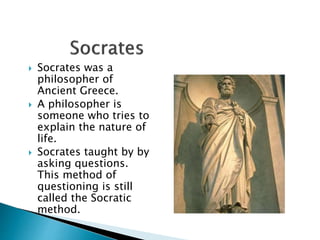
 Socrates was a
philosopher of
Ancient Greece.
 A philosopher is
someone who tries to
explain the nature of
life.
 Socrates taught by by
asking questions.
This method of
questioning is still
called the Socratic
method.
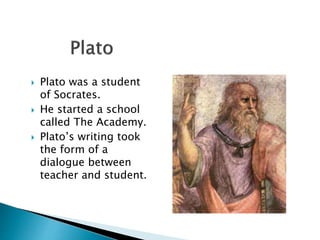
 Plato was a student
of Socrates.
 He started a school
called The Academy.
 Plato’s writing took
the form of a
dialogue between
teacher and student.
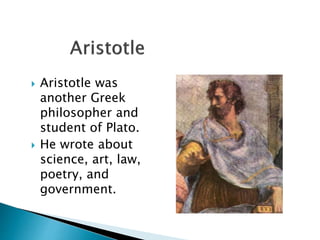
 Aristotle was
another Greek
philosopher and
student of Plato.
 He wrote about
science, art, law,
poetry, and
government.
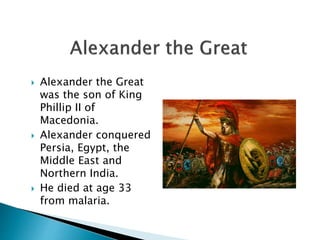
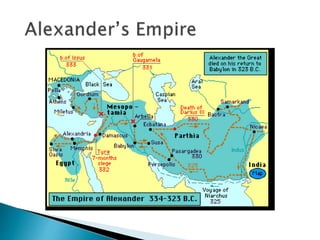
 Alexander the Great
was the son of King
Phillip II of
Macedonia.
 Alexander conquered
Persia, Egypt, the
Middle East and
Northern India.
 He died at age 33
from malaria.
Greece Civilization
Greece Civilization
Greece Civilization
Greece Civilization
Greece Civilization
Greece Civilization

Greece Civilization

  • 2.
     Greece isa small country in Europe.  Greece is near the Mediterranean Sea.  The main part of Greece in on a peninsula.  A peninsula is a body of land surrounded by water on three sides.  The rest of Greece is made up of islands.
  • 3.
     Only about1/5th of Greece is suitable for farming because most of the country is covered with mountains. The islands are mountain peaks.  Two Effects of Greek Geography 1. The Greeks became excellent traders and sailors. 2. The Greeks thought of themselves as separate countries because it was hard to get together.
  • 4.
     Because Greeceis made up of many islands, and has many tall mountains, the Greeks began to build city-states instead of one country.  A city-state is a city with its own laws, rulers, and money.  City-states were cities that acted like countries.
  • 7.
     The Minoanslived on the island of Crete from about 3000 to 1100 BC.  Because of their location, they were excellent traders who controlled the Aegean Sea.
  • 8.
     After theMycenaeans defeated the Minoans, the culture of the islands blended with mainland Greek culture.  At their height in 1400 BC, the Mycenaeans controlled trade, spoke an early form of Greek, and used writing.
  • 9.
     Greek mythtells the story of the Trojan War between Greece and the city of Troy in present day Turkey.  The Greeks conquered the Trojans by using a fake wooden horse filled with Greek soldiers.  The horse was rolled to the Trojan city gates. Thinking it was a gift, the Trojans rolled it inside. After nightfall, the Greeks destroyed Troy and burned the city to the ground.
  • 10.
     Epics –long story-telling poems.  Two epics exist today telling of the Trojan War, the Odyssey and the Illiad, written by Homer. Some historians believe that Homer exaggerated the story to make it sound better.
  • 11.
     Soon afterthe Trojan War, civilization in Greece collapsed. People no longer traded for food and other goods beyond Greece and poverty was everywhere. The Dark Ages took place from 1100 – 750 BC.  Acropolis – a high, rocky hill where early people built cities.
  • 12.
     Historians believethat sometime around 750 BC, villages joined with cities and began to develop their own traditions, laws, and governments.  City-state – a city, that is also a separate independent state.
  • 13.
     The earliestrulers of city-states were probably chieftains or kings who were military leaders.  By the end of the Dark Ages, most city-states were ruled by aristocrats – members of rich and powerful families.  Because they were wealthy, aristocrats could afford land, chariots, and the best weapons that helped make themselves stronger.
  • 14.
     As theGreeks sailed to ports to trade various goods, the city-states became wealthy. A middle class of merchants and sailors developed.  The middle class wanted representation in government and began to equip themselves with armor, swords, and spears.  Gradually power shifted from the aristocrats to tyrants – rulers who seize power by force.
  • 15.
     Eventually thepeople in city-states overthrew the tyrants. Some city-states developed a style of government called democracy – citizens govern themselves.  The most successful democratic city-state was Athens.  Athenian democracy became the leading government of the ancient world.
  • 16.
  • 17.
  • 18.
  • 19.
  • 20.
  • 21.
  • 22.
  • 23.
  • 24.
  • 26.
  • 27.
  • 28.
    Late Geometric amphora bythe Dipylon painter, Athens c. 750 BC
  • 29.
  • 30.
    Late geometric crater ByHirschfeld painter, Pithe c. 750 BC
  • 31.
  • 32.
    Late geometric, stag,Cyclad c. 650 BC
  • 33.
     Sparta wasa Greek city-state.  Sparta was very powerful and had its own army.  Sparta conquered other city-states to gain wealth and power.  There were three classes of people in Sparta.  Citizens, non-citizens, and slaves.
  • 34.
     Only menborn in Sparta were citizens.  Women were not allowed to become citizens, however, women were allowed to own land and businesses, which gave them more freedom than other Greek city-states.  The second class in Sparta was people who came from other city-states or other countries. They could own businesses but not become citizens.  The third class was slaves.
  • 35.
     Athens wasanother important Greek city- state.  The people of Athens wanted to rule themselves and not have a king or queen.  Athens became the world’s first democracy around 508 B.C.  A democracy is a government in which all citizens can vote and have equal say in what happens.
  • 36.
     Pericles wasthe leader of creating democracy in Athens.  He had many buildings constructed.  Pericles had the Parthenon and the Acropolis built.
  • 38.
     Greek godsdid not make the world, but live within it  Gods do not love humans, nor do they ask to be loved by them  Gods struggle for power amongst one another
  • 39.
     No writingsto reveal the will of the Greek gods  Gods are capricious  Guilt and sin (in our modern sense) do not exist
  • 40.
     Temples werewhere offerings, libations, sacrifices and prayers were performed at the altar by priests  Shrine could also take other forms e.g., a cave, tree or mountain top  Object of the cult could also be a hero  Consult priest or priestess to know the god’s will  Sacrifice of an animal is correct ritual  Greek temple – houses the cult image of the god
  • 41.
     “often thegods lift up men who were crushed into the dark earth by their troubles, and often they smash down on their faces those who stand firm” - Archilochus  Gods often appear to be either neglectful of humans or their tormentors.  All are fated to die as the gods did not see fit to give humans eternal life or youth
  • 42.
     Everyone issubject to Fate, but it can be good or bad, depending on how you look at it  Example of this is Oedipus  Destined to marry his mother and kill his father, but not destined to know about it  Oedipus freely chooses to learn the truth about himself
  • 43.
     Greek godswere called “hoi athanatoi”, or the deathless ones  Greeks believed that gods could act as their protectors, if they honored them  Every community had special gods to protect them
  • 44.
     Aphrodite isthe goddess of love, desire, and beauty.  She is the daughter of Zeus and Dione.  She is married to Hephaestus, and cupid is her son.
  • 45.
     Apollo isthe god of music, healing, and truth.  He is the son of Zeus and Leto, and the brother of Artemis.  He is the archer.
  • 46.
     Artemis isthe goddess of nature, animals, and hunting.  She is the daughter of Zeus and Leto, and the sister of Apollo.
  • 47.
     Athena isthe daughter of Zeus.  She is the goddess of the city, handicrafts and agriculture.  Athena was born when Zeus had a headache, and sprung from Zeus’s head in full armor. She has no mother.
  • 48.
     Dionysus isthe god of the vine who invented wine.  He has two sides - one bringing joy, and the other rage.  He is the son of Zeus and Semele.
  • 49.
     Hades isthe god of the underworld.  He is the brother of Zeus and Poseidon.  After overthrowing their father Cronus, Hades and his brothers drew lots for shares of the world. Hades had the worst draw.
  • 50.
     She isthe goddess of marriage.  Hera is the wife and sister of Zeus.
  • 51.
     He isthe Lord of the Sea.  Poseidon helped overthrow his father Cronus with his brothers.,  He was the first to tame horses, and is shown in art with a trident in hand.
  • 52.
     Zeus isthe lord of the sky and the rain. He rules over all of the gods.  He is married to Hera, but is known for his many indiscretions.
  • 53.
     Greeks wentto the oracle to find out information on their future life on earth, for this they turned to the oracle.  Greek oracle was the religion priest or priestess who acted as a communicator between man and God. Every oracle had a distinct method of divination. Motion of objects in the spring, movement of birds, rustle of leaves, interpreted dreams, etc, were considered valid indicators for understanding messages from the gods.  One of the most famous oracles was the Oracle at Delphi.  QuickTime™ and a Photo - JPEG decompressor are needed to see this picture.
  • 54.
     . Theancient Greeks considered sacrifice as the appropriate method to worship God. Public worships were held to obtain public blessings, rain, good harvest, military victories, etc. Private sacrifices were offered for fulfillment of personal goals, wishes and victories. Blood sacrifices of animals such as oxen, sheep, horses, swine, dogs, birds, fish, fowl etc were common in the temple of Gods. QuickTime™ and a Photo - JPEG decompressor are needed to see this picture.
  • 55.
     The Greektemples were part slaughterhouse and part barbecue. During sacrifices, the people offered the blood, bones and hides of the slaughter animal to the God, the remaining portions were used up as food for themselves.  Greek prayers were done the same, and not left up to the individual.
  • 56.
     The Greektemples were small buildings that contained a statue of the god the temple was created for. Most of these temples did not have a professional or full time clergy or priest. QuickTime™ and a Photo - JPEG decompressor are needed to see this picture.
  • 57.
     Education wasvery important in Athens.  Boys went to school to learn to read and write. They also learned many sports.  Girls were not allowed to go to school or learn to play sports.
  • 58.
     The Greeksborrowed their alphabet from the Phoenicians.  Most European languages, including English borrowed ideas from the Greek alphabet.
  • 60.
     Socrates wasa philosopher of Ancient Greece.  A philosopher is someone who tries to explain the nature of life.  Socrates taught by by asking questions. This method of questioning is still called the Socratic method.
  • 61.
     Plato wasa student of Socrates.  He started a school called The Academy.  Plato’s writing took the form of a dialogue between teacher and student.
  • 62.
     Aristotle was anotherGreek philosopher and student of Plato.  He wrote about science, art, law, poetry, and government.
  • 63.
     Alexander theGreat was the son of King Phillip II of Macedonia.  Alexander conquered Persia, Egypt, the Middle East and Northern India.  He died at age 33 from malaria.