The Story of Ancient Greece
2000 BC-300 BC
Ch. 5
Greek gods, Titans, Heroes, Myths, and
Creatures Project-50 Points
• Choose one of each of the above topics and
create either a Powerpoint style presentation
or a video documentary
• Focus on good content, good visuals and good
delivery.
• Two sources per topic-Use Easybib
• Website on Greek Mythology
Questions?
• What do you know about ancient Greece?
• How can geography play an important
role in the development of a civilization?
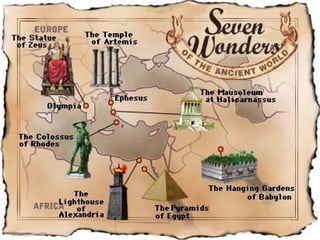
Colossus of Rhodes
• Statue of Helios, Greek
Titan god
• Was made of bronze
• Same size as Statue of
Liberty
• One of the 7 Wonders of the
Ancient World
• Lasted just over 50 years
due to earthquake
• Believed to have been
melted down and sold by
Arab invaders
The Temple/Statue of Artemis
• Built around 800 B.C.
• Artemis is the Greek Goddess of Fertility
• The temple was destroyed several times due to
wars
• Current day archeologists have found the
foundations of 5 temples built on top of each other
The Statue of Zeus at Olympia
• Built around 450 BC
• The statue was said
to be made of gold
and marble
• Eventually
destroyed after
being taken apart
and moved
• Built around 353 BC
• Tomb was built by Queen Artemisia as a tribute to
her husband/brother King Mausolus.
• Destroyed by earthquakes in the 1100-1400’s AD
• All that survives today are the foundation blocks
The Mausoleum at Halicarnassus
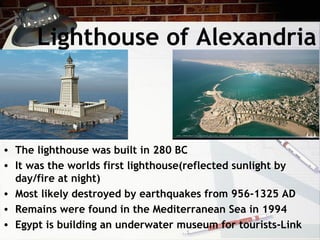
Lighthouse of Alexandria
• The lighthouse was built in 280 BC
• It was the worlds first lighthouse(reflected sunlight by
day/fire at night)
• Most likely destroyed by earthquakes from 956-1325 AD
• Remains were found in the Mediterranean Sea in 1994
• Egypt is building an underwater museum for tourists-Link
Key Terms/People Section 1
• Peninsula
• Minoan
• Mycenaean
• Trojan War
• Dorian
• Homer
• Epic
• Myth
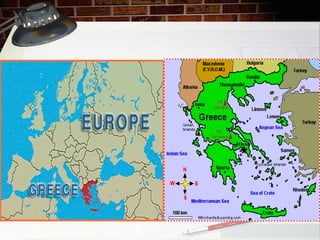
Geography of Greece
• Greece is a small country in Europe
• The main part of Greece in on a
peninsula
• Greece is surrounded by what three large
bodies of water?
– Mediterranean Sea, Aegean Sea, and Ionian
Sea
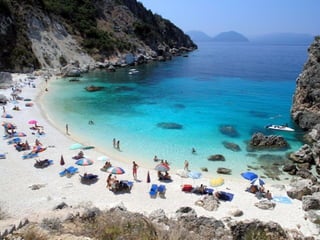
• The rest of Greece is made up of islands
– 6000(227 being inhabited)
Mykonos Island
Crete
Rhodes
Importance of Geography to
Greece
• The sea was extremely important to the
Greeks-Why?
– Did not live “on the land” but “around the
sea”
– Most Greeks lived within 85 miles of the sea
– Used the sea as a means of transportation
– The sea linked all parts of Greece to other
areas for trade which was essential due to
lack of resources
Geography Continued
• Mountains covered around ¾’s of ancient
Greece
Mt. Olympus-
Home of the 12 Olympian Greek gods
Twelve Olympian Greek gods
• Zeus
– King of the gods, sky, thunder
• Hera
– Women, marriage
• Demeter
– Harvest, agriculture
• Poseidon
– Sea
• Athena
– Wisdom, courage, etc.
 
• Apollo
– Music, poetry, healing
• Artemis
– The hunt, wild animals, childbirth
• Aphrodite
– Love, beauty, pleasure
• Ares
– War
• Hermes
– Transitions and boundaries
• Hephaestus
– Blacksmiths, craftsmen, artisans
• Hestia 
– Hearth, home, domesticity, family
• Dionysus
– Vine, Grape Harvest, Winemaking, Wine
• Due to mountains, transportation over land
was difficult
• Greeks did not have much fertile land for
agriculture
• Due to these issues, ancient Greece never had
a large population-no more than a few million
• These issues might have led some leaders to
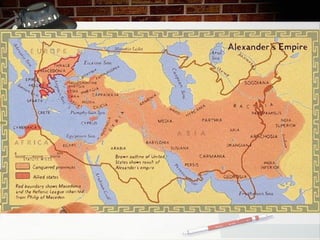
look to expand(map on slide 3)
Greek City-States
• Due to Greece’s geography, city-states
developed instead of a unified country
• What is a city-state?
• More to come on Greek city-states!
Climate
• What does Greece’s average temperature’s
tell you about how they might have lived?
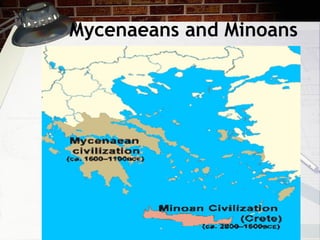
Mycenaeans and Minoans
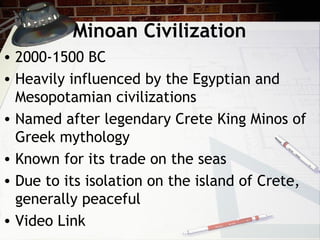
Minoan Civilization
• 2000-1500 BC
• Heavily influenced by the Egyptian and
Mesopotamian civilizations
• Named after legendary Crete King Minos of
Greek mythology
• Known for its trade on the seas
• Due to its isolation on the island of Crete,
generally peaceful
• Video Link
Minoans
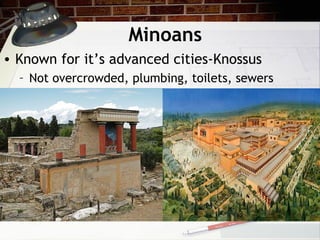
• Known for it’s advanced cities-Knossus
– Not overcrowded, plumbing, toilets, sewers
Minoans
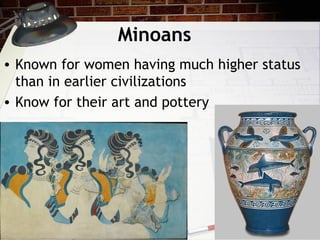
• Known for women having much higher status
than in earlier civilizations
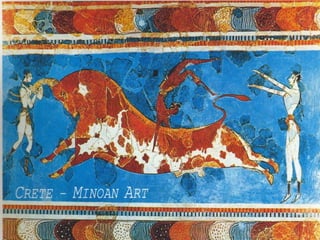
• Know for their art and pottery
Downfall of the Minoans
• Around 1500 BC, the Minoan civilization
ended abruptly
• Historians think it could have been an
earthquake which leveled cities and their
ships
• They could have been over ran by the
Mycenaeans
• Some historians think Minoa could have
been Atlantis--Video
Mycenaeans-Video
• Controlled the area around Greece from 1600
BC-1100 BC
• Heavily influenced by the Minoans
– Much more war-like than Minoans(based on art)
• Know for their trade around the Mediterranean
Sea, Aegean Sea
• Known for their piracy on the seas surrounding
Greece
• Known for their city-states-Athens, Mycenae,
Pylos, Tiryns
• Historians aren’t sure if city-states were
independent or more united
• Mycenaean's did unite to fight the Trojan
War against Troy
• The Mycenaean's fell apart due to wars
and the Sea People’s sacking their city-
states
• Eventually the Dorians came down from
the north and took over Greece
Dorians-1150-750 BC
• Came from the area
north of Greece
• Less advanced than
the Mycenaean’s
• Trade and culture
slowed
• Greece went into a
Dark Age
Homer
• Was a Greek epic poet
from 750-700 BC
• Narrative poems
celebrated heroic
deeds
• The Iliad was about
the Trojan War
• The Odyssey was a
sequel that was after
the Trojan War
Trojan War-Video
• Fought between Mycenaean Greeks and Troy
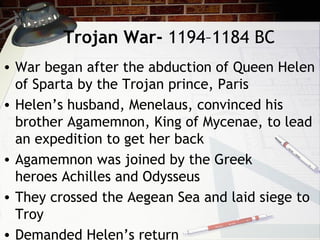
Trojan War- 1194–1184 BC
• War began after the abduction of Queen Helen
of Sparta by the Trojan prince, Paris
• Helen’s husband, Menelaus, convinced his
brother Agamemnon, King of Mycenae, to lead
an expedition to get her back
• Agamemnon was joined by the Greek
heroes Achilles and Odysseus
• They crossed the Aegean Sea and laid siege to
Troy
• Demanded Helen’s return
Movie Clip-Troy
Ch. 5.2-Warring City States
• Polis
• Acropolis
• Monarchy
• Aristocracy
• Oligarchy
• Tyrant
• Democracy
• Military state
• Helot
• Phalanx
• Persian Wars
Greek City-States
• Polis
– city—Minneapolis, Indianapolis
• Acropolis
– a settlement in a city on higher ground used for
defense and a place to discuss politics—Below is
the Athens acropolis
Types of Government in City-
States
• Monarchy
– government ruled by one person-king, queen
• Aristocracy
– government ruled by a small group of wealthy,
landowning families
• Oligarchy
– A government ruled by a few powerful people
Types of Governments in City-
States
• Tyrants
– Powerful individuals who seize control from the
government
– Could be good or bad
– Today we see tyranny as a bad thing
• Democracy
– Rule by the people
– Athens had perhaps the world’s first democracy
– Only allowed citizens to participate
• Women, slaves and foreigners were not citizens
Education in Greece
• Only for the sons of wealthy families
• Started at age 7 and focused on developing
good citizens
• Studied reading, grammar, poetry, history,
math, music, logic and public speaking
• Public debate and athletics were also stressed
• Once older, students went to military school
• Girls were educated by their mothers in the
home to do cleaning, cooking, child-rearing,
etc.
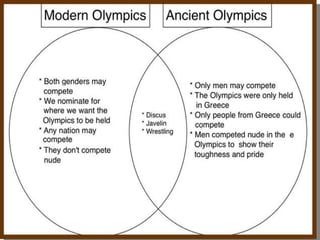
Ancient Olympics
• Records of Olympics date to 776 BC and lasted
until 393 AD when the Romans ended them
• Lasted one day at first but eventually
extended to five days
• Happened every four years-an Olympiad
• Started as a tribute to Zeus and has a
mythological origin
• The modern Olympic Games started up again
in 1896-Where?
Ancient Olympics
• The big competition at the Games was the
Pentathlon(Pente-5)(Athlon-competition)
1. Long jump
2. Javelin
3. Discus
4. Stadion-200 yards
5. Wrestling
This is Sparta!!!!
Greek City-State
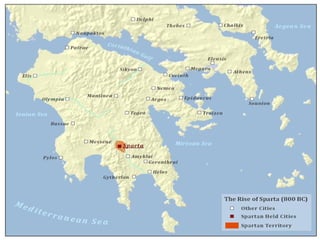
Sparta
• Sparta was very powerful and had its own army
– Defeated the Messenians in 725 BC and in 650 BC
• Unlike Athens and other city-states, it did not have
democracy
• Built a military state
• Sparta conquered other city-states to gain wealth and
power
• Valued duty, strength and discipline over freedom,
beauty and learning
Spartan Classes
• Only men born in Sparta were citizens
• Women were not allowed to become citizens
• The second class in Sparta were people who
came from other city-states or other countries
– They could own businesses but not become
citizens
• The third class were helots/slaves
– Worked the fields or were servants
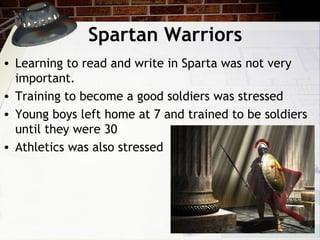
Spartan Warriors
• Learning to read and write in Sparta was not very
important.
• Training to become a good soldiers was stressed
• Young boys left home at 7 and trained to be soldiers
until they were 30
• Athletics was also stressed
Spartan Women
• Service to Sparta was stressed
• Received some military training
• Athletics were stressed
• Had quite a bit of freedom in comparison to
Athens
– Could run family estates when husband was off at
war
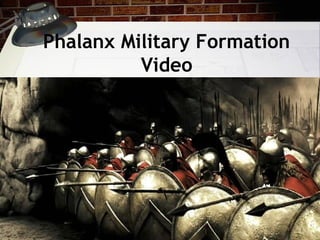
Phalanx Military Formation
Video
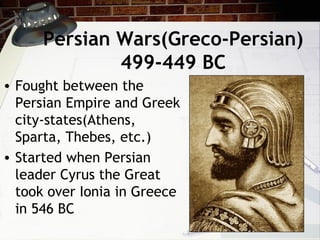
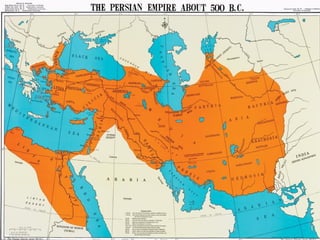
Persian Wars(Greco-Persian)
499-449 BC
• Fought between the
Persian Empire and Greek
city-states(Athens,
Sparta, Thebes, etc.)
• Started when Persian
leader Cyrus the Great
took over Ionia in Greece
in 546 BC
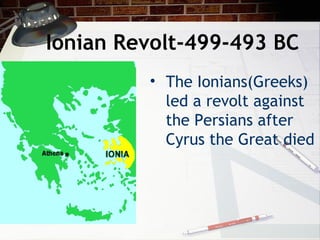
• The Ionians(Greeks)
led a revolt against
the Persians after
Cyrus the Great died
Ionian Revolt-499-493 BC
Ionian Revolt
• The Ionian Revolt was led by
Athenian General Miltiades
• Ionia asked Athens to help them
which they did
• Darius quickly suppresses the
Ionian Revolt but is very mad
• Darius the Great vowed to burn
Athens to the ground before he
died
Miltiades Escapes
• Miltiades escapes back
to Athens and tells the
Athenians that the
Persians are coming to
burn Athens
• This sets up the
beginning of the Great
Persian War
• Persia was the largest
empire in the world at the
time and consisted of
millions of people
• Ancient Greece was about
500,000 total people
• It was truly a David vs.
Goliath battle
Ancient Greece vs. Civilization of Persia
Athens & Sparta United
• Athens & Sparta had
been fighting for
hundreds of years
• They now fought not
for Athens or for
Sparta but for
GREECE
Battle of Marathon-490 BC
• 25,000 Persians
• 10,000 Athenians
Who won?
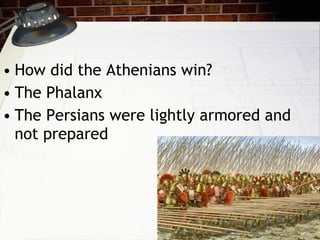
• How did the Athenians win?
• The Phalanx
• The Persians were lightly armored and
not prepared
Pheidippides
• After the battle ended, he ran from
Marathon to Athens to tell the
Athenians of the victory over Persia
• Guess how many miles it was from
Marathon to Athens?
Battle of Thermopylae-
480 BC-Video
• Ten years after the Battle of Marathon, Persia
once again invaded Greece
• Darius the Great’s son, Xerxes, made it a goal
to destroy Athens
• The Persians won the Battle of Thermopylae
but not before the Spartan soldiers held out
for days allowing many Greek troops to retreat
• The movie 300 is based on this battle
Battle of Salamis
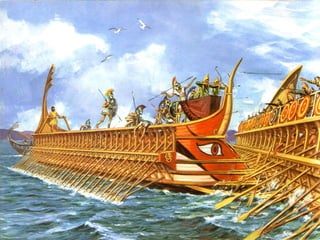
• At the naval Battle of Salamis, the
Greeks destroyed the Persian navy
• The Persians were never the same
after that and were eventually driven out of
Greece
• After the Persian Wars, the Delian League was
established setting up an alliance between the
Greek city-states
• Starting around 470 BC, Greece, and Athens
specifically, entered a golden age
Greece Section 1 and 2

Greece Section 1 and 2

  • 1.
    The Story ofAncient Greece 2000 BC-300 BC Ch. 5
  • 3.
    Greek gods, Titans,Heroes, Myths, and Creatures Project-50 Points • Choose one of each of the above topics and create either a Powerpoint style presentation or a video documentary • Focus on good content, good visuals and good delivery. • Two sources per topic-Use Easybib • Website on Greek Mythology
  • 4.
    Questions? • What doyou know about ancient Greece? • How can geography play an important role in the development of a civilization?
  • 8.
    Colossus of Rhodes •Statue of Helios, Greek Titan god • Was made of bronze • Same size as Statue of Liberty • One of the 7 Wonders of the Ancient World • Lasted just over 50 years due to earthquake • Believed to have been melted down and sold by Arab invaders
  • 9.
    The Temple/Statue ofArtemis • Built around 800 B.C. • Artemis is the Greek Goddess of Fertility • The temple was destroyed several times due to wars • Current day archeologists have found the foundations of 5 temples built on top of each other
  • 10.
    The Statue ofZeus at Olympia • Built around 450 BC • The statue was said to be made of gold and marble • Eventually destroyed after being taken apart and moved
  • 11.
    • Built around353 BC • Tomb was built by Queen Artemisia as a tribute to her husband/brother King Mausolus. • Destroyed by earthquakes in the 1100-1400’s AD • All that survives today are the foundation blocks The Mausoleum at Halicarnassus
  • 12.
    Lighthouse of Alexandria •The lighthouse was built in 280 BC • It was the worlds first lighthouse(reflected sunlight by day/fire at night) • Most likely destroyed by earthquakes from 956-1325 AD • Remains were found in the Mediterranean Sea in 1994 • Egypt is building an underwater museum for tourists-Link
  • 14.
    Key Terms/People Section1 • Peninsula • Minoan • Mycenaean • Trojan War • Dorian • Homer • Epic • Myth
  • 15.
    Geography of Greece •Greece is a small country in Europe • The main part of Greece in on a peninsula • Greece is surrounded by what three large bodies of water? – Mediterranean Sea, Aegean Sea, and Ionian Sea • The rest of Greece is made up of islands – 6000(227 being inhabited)
  • 18.
  • 19.
  • 20.
  • 23.
    Importance of Geographyto Greece • The sea was extremely important to the Greeks-Why? – Did not live “on the land” but “around the sea” – Most Greeks lived within 85 miles of the sea – Used the sea as a means of transportation – The sea linked all parts of Greece to other areas for trade which was essential due to lack of resources
  • 24.
    Geography Continued • Mountainscovered around ¾’s of ancient Greece
  • 25.
    Mt. Olympus- Home ofthe 12 Olympian Greek gods
  • 27.
    Twelve Olympian Greekgods • Zeus – King of the gods, sky, thunder • Hera – Women, marriage • Demeter – Harvest, agriculture • Poseidon – Sea • Athena – Wisdom, courage, etc.  
  • 28.
    • Apollo – Music,poetry, healing • Artemis – The hunt, wild animals, childbirth • Aphrodite – Love, beauty, pleasure • Ares – War
  • 29.
    • Hermes – Transitionsand boundaries • Hephaestus – Blacksmiths, craftsmen, artisans • Hestia  – Hearth, home, domesticity, family • Dionysus – Vine, Grape Harvest, Winemaking, Wine
  • 30.
    • Due tomountains, transportation over land was difficult • Greeks did not have much fertile land for agriculture • Due to these issues, ancient Greece never had a large population-no more than a few million • These issues might have led some leaders to look to expand(map on slide 3)
  • 31.
    Greek City-States • Dueto Greece’s geography, city-states developed instead of a unified country • What is a city-state? • More to come on Greek city-states!
  • 32.
    Climate • What doesGreece’s average temperature’s tell you about how they might have lived?
  • 33.
  • 34.
    Minoan Civilization • 2000-1500BC • Heavily influenced by the Egyptian and Mesopotamian civilizations • Named after legendary Crete King Minos of Greek mythology • Known for its trade on the seas • Due to its isolation on the island of Crete, generally peaceful • Video Link
  • 35.
    Minoans • Known forit’s advanced cities-Knossus – Not overcrowded, plumbing, toilets, sewers
  • 37.
    Minoans • Known forwomen having much higher status than in earlier civilizations • Know for their art and pottery
  • 38.
    Downfall of theMinoans • Around 1500 BC, the Minoan civilization ended abruptly • Historians think it could have been an earthquake which leveled cities and their ships • They could have been over ran by the Mycenaeans • Some historians think Minoa could have been Atlantis--Video
  • 39.
    Mycenaeans-Video • Controlled thearea around Greece from 1600 BC-1100 BC • Heavily influenced by the Minoans – Much more war-like than Minoans(based on art) • Know for their trade around the Mediterranean Sea, Aegean Sea • Known for their piracy on the seas surrounding Greece • Known for their city-states-Athens, Mycenae, Pylos, Tiryns
  • 42.
    • Historians aren’tsure if city-states were independent or more united • Mycenaean's did unite to fight the Trojan War against Troy • The Mycenaean's fell apart due to wars and the Sea People’s sacking their city- states • Eventually the Dorians came down from the north and took over Greece
  • 43.
    Dorians-1150-750 BC • Camefrom the area north of Greece • Less advanced than the Mycenaean’s • Trade and culture slowed • Greece went into a Dark Age
  • 44.
    Homer • Was aGreek epic poet from 750-700 BC • Narrative poems celebrated heroic deeds • The Iliad was about the Trojan War • The Odyssey was a sequel that was after the Trojan War
  • 45.
    Trojan War-Video • Foughtbetween Mycenaean Greeks and Troy
  • 46.
    Trojan War- 1194–1184BC • War began after the abduction of Queen Helen of Sparta by the Trojan prince, Paris • Helen’s husband, Menelaus, convinced his brother Agamemnon, King of Mycenae, to lead an expedition to get her back • Agamemnon was joined by the Greek heroes Achilles and Odysseus • They crossed the Aegean Sea and laid siege to Troy • Demanded Helen’s return
  • 48.
  • 49.
    Ch. 5.2-Warring CityStates • Polis • Acropolis • Monarchy • Aristocracy • Oligarchy • Tyrant • Democracy • Military state • Helot • Phalanx • Persian Wars
  • 50.
    Greek City-States • Polis –city—Minneapolis, Indianapolis • Acropolis – a settlement in a city on higher ground used for defense and a place to discuss politics—Below is the Athens acropolis
  • 51.
    Types of Governmentin City- States • Monarchy – government ruled by one person-king, queen • Aristocracy – government ruled by a small group of wealthy, landowning families • Oligarchy – A government ruled by a few powerful people
  • 52.
    Types of Governmentsin City- States • Tyrants – Powerful individuals who seize control from the government – Could be good or bad – Today we see tyranny as a bad thing • Democracy – Rule by the people – Athens had perhaps the world’s first democracy – Only allowed citizens to participate • Women, slaves and foreigners were not citizens
  • 55.
    Education in Greece •Only for the sons of wealthy families • Started at age 7 and focused on developing good citizens • Studied reading, grammar, poetry, history, math, music, logic and public speaking • Public debate and athletics were also stressed • Once older, students went to military school • Girls were educated by their mothers in the home to do cleaning, cooking, child-rearing, etc.
  • 56.
    Ancient Olympics • Recordsof Olympics date to 776 BC and lasted until 393 AD when the Romans ended them • Lasted one day at first but eventually extended to five days • Happened every four years-an Olympiad • Started as a tribute to Zeus and has a mythological origin • The modern Olympic Games started up again in 1896-Where?
  • 57.
    Ancient Olympics • Thebig competition at the Games was the Pentathlon(Pente-5)(Athlon-competition) 1. Long jump 2. Javelin 3. Discus 4. Stadion-200 yards 5. Wrestling
  • 59.
  • 60.
    Greek City-State Sparta • Spartawas very powerful and had its own army – Defeated the Messenians in 725 BC and in 650 BC • Unlike Athens and other city-states, it did not have democracy • Built a military state • Sparta conquered other city-states to gain wealth and power • Valued duty, strength and discipline over freedom, beauty and learning
  • 62.
    Spartan Classes • Onlymen born in Sparta were citizens • Women were not allowed to become citizens • The second class in Sparta were people who came from other city-states or other countries – They could own businesses but not become citizens • The third class were helots/slaves – Worked the fields or were servants
  • 63.
    Spartan Warriors • Learningto read and write in Sparta was not very important. • Training to become a good soldiers was stressed • Young boys left home at 7 and trained to be soldiers until they were 30 • Athletics was also stressed
  • 65.
    Spartan Women • Serviceto Sparta was stressed • Received some military training • Athletics were stressed • Had quite a bit of freedom in comparison to Athens – Could run family estates when husband was off at war
  • 68.
  • 69.
    Persian Wars(Greco-Persian) 499-449 BC •Fought between the Persian Empire and Greek city-states(Athens, Sparta, Thebes, etc.) • Started when Persian leader Cyrus the Great took over Ionia in Greece in 546 BC
  • 71.
    • The Ionians(Greeks) leda revolt against the Persians after Cyrus the Great died Ionian Revolt-499-493 BC
  • 72.
    Ionian Revolt • TheIonian Revolt was led by Athenian General Miltiades • Ionia asked Athens to help them which they did • Darius quickly suppresses the Ionian Revolt but is very mad • Darius the Great vowed to burn Athens to the ground before he died
  • 73.
    Miltiades Escapes • Miltiadesescapes back to Athens and tells the Athenians that the Persians are coming to burn Athens • This sets up the beginning of the Great Persian War
  • 74.
    • Persia wasthe largest empire in the world at the time and consisted of millions of people • Ancient Greece was about 500,000 total people • It was truly a David vs. Goliath battle Ancient Greece vs. Civilization of Persia
  • 75.
    Athens & SpartaUnited • Athens & Sparta had been fighting for hundreds of years • They now fought not for Athens or for Sparta but for GREECE
  • 76.
    Battle of Marathon-490BC • 25,000 Persians • 10,000 Athenians Who won?
  • 78.
    • How didthe Athenians win? • The Phalanx • The Persians were lightly armored and not prepared
  • 79.
    Pheidippides • After thebattle ended, he ran from Marathon to Athens to tell the Athenians of the victory over Persia • Guess how many miles it was from Marathon to Athens?
  • 80.
    Battle of Thermopylae- 480BC-Video • Ten years after the Battle of Marathon, Persia once again invaded Greece • Darius the Great’s son, Xerxes, made it a goal to destroy Athens • The Persians won the Battle of Thermopylae but not before the Spartan soldiers held out for days allowing many Greek troops to retreat • The movie 300 is based on this battle
  • 81.
    Battle of Salamis •At the naval Battle of Salamis, the Greeks destroyed the Persian navy • The Persians were never the same after that and were eventually driven out of Greece • After the Persian Wars, the Delian League was established setting up an alliance between the Greek city-states • Starting around 470 BC, Greece, and Athens specifically, entered a golden age