

GREASE SAMPLING METHODS:
HOW TO GATHER A
REPRESENTATIVE SAMPLE AND
PERFORM MEANINGFUL ANALYSIS
A Webinar from Rich Wurzbach, MRG Labs
www.greasethief.com
GREASE SAMPLING
• Difficult challenges in gathering representative grease samples
• Sampling from robots
• Wind turbine samples (main, blade, generator, etc.)
• Electric motors
• Pillow block bearings
• Motor Operated Valves (MOVs and valve stems)
• Slewing bearings and other mining applications
• Low-cost analysis solutions
• Case Studies
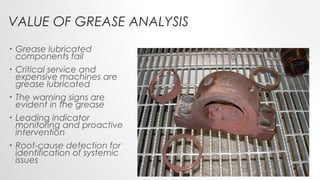
VALUE OF GREASE ANALYSIS
• Grease lubricated
components fail
• Critical service and
expensive machines are
grease lubricated
• The warning signs are
evident in the grease
• Leading indicator
monitoring and proactive
intervention
• Root-cause detection for
identification of systemic
issues
GREASE IS DIFFERENT
• Viscosity is the property of oil that sets the lubricating film, and
dictates how oil flows
• Grease is an oil (base + additives) with a thickener
• Grease behavior is non-Newtonian; it is designed to stay put in
the machine
• Dynamically, grease will flow, but only very close to the
bearing/gear
• Sampling and analysis techniques for oil are inadequate for
grease
ASTM D7718 STANDARD DEVELOPMENT
• Developed in 2009 and published in 2011
• Incorporation of grease sampling research (Danish Wind
Industry, Electric Power Research Institute)
• Inclusion of historical methods for sampling with considerations
and limitations
• Failed component sampling, care in obtaining sample or
multiple samples
• Use of tubing, adequacy of suction alone, possibility of
peripheral grease sampling
• Inclusion of new technologies for active and passive sampling
rev 0 022817
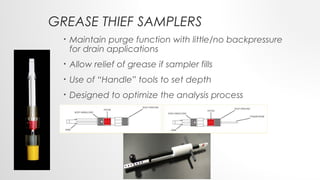
GREASE THIEF SAMPLERS
• Maintain purge function with little/no backpressure
for drain applications
• Allow relief of grease if sampler fills
• Use of “Handle” tools to set depth
• Designed to optimize the analysis process
GREASE THIEF – THE STANDARD
• “Effective Grease Practices” published by Electric Power
Research Institute; MOV Gearbox sampling and analysis studies
• DONG Energy and Vattenfall Main Bearing research project 2011-
2013; DONG and Statkraft Blade Bearing 2014-2016
• ASTM D7718: Standard for sampling greases from inservice
equipment
• ASTM D7918: Standard method for inservice grease analysis by Die
Extrusion, “Integrated Tester” method for 6 tests
• AWEA (American Wind Energy Association) published
“Recommended Practices 812-815” for grease sampling and
analysis with the Grease Thief
Pillow Block Electric Motor Grease Thief SlimTM
MOV Gearbox Robot Kit Wind Turbine
ROBOT SAMPLING
• Industrial robots are often
6-axis gearboxes, grease
or oil lubricated
• Grease lubricated robots
can be evaluated for
wear, contaminants, and
grease breakdown
• Transitioning from time-
based grease purges to
condition based can save
$$$
DRAINS: J1, J2, J3
1. Operate and shut
off power.
2. Lock Out/Tag Out
3. Remove drain
plug
DRAINS: J1, J2, J3
4. Thread adapter into
gearbox drain if
necessary.
5. Thread Grease Thief
into drain hole.
6. Pull plunger handle to
fill Grease Thief with
sample.
7. Cap Grease Thief.
DRAINS: J1, J2,
J3
7. Some locations utilize syringe
with extension tubing.
8. Robot grease is a special
case where it is so fluid, a
syringe and tubing can work.
9. Place Grease Thief in labeled
shipping tube.
10.Mail to MRG Labs for analysis
or process on-site.
11.Grease Thief requires no
further handling; ready to
analyze per ASTM standard.
DRAINS J4, J5, J6
1. Position robot with drains
facing downward if
possible and shut power
off.
2. Lock Out/Tag Out
3. Remove Zerk fitting.
4. Thread provided plastic
syringe into the threaded
Zerk hole.
DRAINS J4, J5, J6
5. Place tip of syringe in Grease
Thief and fill with grease by
withdrawing plunger.
6. Inject grease to fill Grease
Thief.
7. Cap Grease Thief and place in
shipping tube.
8. Mail to lab for analysis or
process on-site.
9. Grease Thief requires no further
handling; ready to analyze per
ASTM recommendations.
WIND MAIN BEARING SAMPLING
• Grease flow dependent on
temperature, bearing movement
• Grease Thief & T-handle used to
capture flowing grease
• Revised T-handle developed for
Denmark Off-shore Wind
Research Project
• Project demonstrated
representative grease taken
without requiring disassembly or
space between rollers
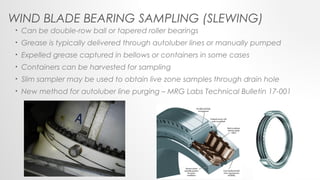
WIND BLADE BEARING SAMPLING (SLEWING)
• Can be double-row ball or tapered roller bearings
• Grease is typically delivered through autoluber lines or manually pumped
• Expelled grease captured in bellows or containers in some cases
• Containers can be harvested for sampling
• Slim sampler may be used to obtain live zone samples through drain hole
• New method for autoluber line purging – MRG Labs Technical Bulletin 17-001
GREASE THIEF SLIM FOR SMALL OPENINGS
• Blade bearing access limited
• Access opening often smaller than sampler
diameter
• Blade bearing research leads to slim version,
dia. drops from 0.50in (13mm) to 0.28in (7mm)
ELECTRIC MOTOR SAMPLING
• Grease Thief can be threaded into drain in
place of a plug
• Quality Controlled to deliver 1-5 psi relief pressure
to ensure purging
• Active methods may be required; T-handle or GT
Slim
• Mixing is a common failure mechanism, causing
softening and separation of grease and allowing
to migrate to windings
• Periodic grease sampling can detect such issues
early; hardened grease can be a source of
energy losses
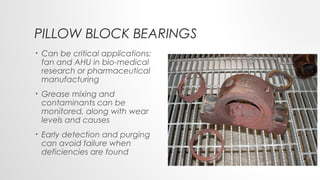
PILLOW BLOCK BEARINGS
• Can be critical applications:
fan and AHU in bio-medical
research or pharmaceutical
manufacturing
• Grease mixing and
contaminants can be
monitored, along with wear
levels and causes
• Early detection and purging
can avoid failure when
deficiencies are found
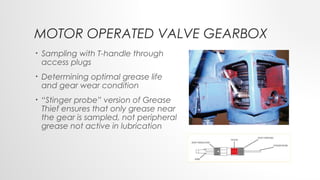
MOTOR OPERATED VALVE GEARBOX
• Sampling with T-handle through
access plugs
• Determining optimal grease life
and gear wear condition
• “Stinger probe” version of Grease
Thief ensures that only grease near
the gear is sampled, not peripheral
grease not active in lubrication
STEM THIEFTM
RELUBRICATOR
• Adapter bushing is first threaded
into body
• Stem lubricator screwed down to
make seal against stem nut
• Grease gun used to pump
grease into threads
• Purged grease is gathered from
other end using a Pillow Block kit
• Analysis can show mixing,
contaminants and wear, along
with grease degradation
MINING APPLICATIONS
• Constant battle with contaminants, abrasives
• Lubrication as a strategy to purge contaminants
• Effectiveness can be evaluated by analyzing grease
• Slewing bearings can be accessed with Grease Thief Slim
• Suctioning grease often not effective as grease hardens
• Root-causes of wear can be determined
• Enhanced analysis methods
developed
• Four types of grease analysis: wear,
contaminant, consistency and
oxidation
• Evaluate reliability of machine and
grease to perform function
• Look for signs of incompatible mixing
• Pinpointing root causes for correction
• Perform analysis cost-effectively
utilizing sampling geometry
GREASE ANALYSIS USING THE GREASE THIEF
ANALYSIS TECHNIQUES: ASTM D7918
• ASTM D7918
approved and
published in
2015.
• Particle counting
and moisture
ppm capabilities
added recently
• 6 tests with 1-
gram of grease
Ferrous
debris
Die
Extrusion
Colorimetry Linear Sweep
Voltammetry
Elemental
Spectroscopy
FTIR
Water in
ppm rev 0 022817
NAVIGATOR-SAMPLES IN PROCESS
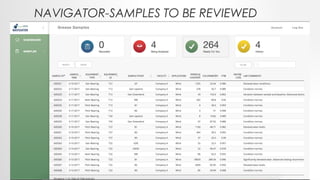
NAVIGATOR-SAMPLES TO BE REVIEWED
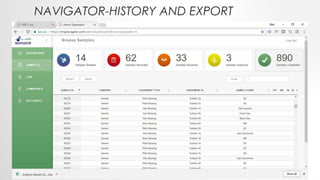
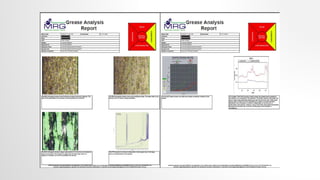
NAVIGATOR-HISTORY AND EXPORT
LOW-COST SCREENING TEST
• Key parameters can be quickly tested
while retaining majority of the sample for
future testing
• Wear, Color, and FTIR for under $30,
including cost of sampling tools
• Pre-paid kits supplied with Barcode labels
and access to App for sampling
identification and Meta-data
• Statistical analysis of sample groups and
comparison to Meta-Matched data sets
CASE 1 – DETERMINING LIFE OF ROBOTICS
GREASES
• Samples were selected from grease lubricated joints on industrial robots used in assembly line
automation.
• Grease is fortified with zinc dialkyl dithiophosphate (ZDDP), a common antiwear and
antioxidant additive.
• Samples were taken from robots assigned varying payloads and cycle times. The remaining
additive concentration as compared to the supplied new lubricant reference were measured
with RULER and with the Pearl 50 um pathlength FTIR.
• Results allowed for condition-based relubrication tasks, with reduction in required manpower
and cost to purchase grease
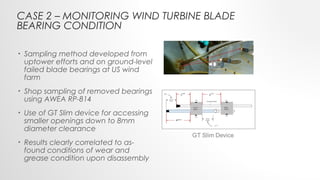
• Sampling method developed from
uptower efforts and on ground-level
failed blade bearings at US wind
farm
• Shop sampling of removed bearings
using AWEA RP-814
• Use of GT Slim device for accessing
smaller openings down to 8mm
diameter clearance
• Results clearly correlated to as-
found conditions of wear and
grease condition upon disassembly
CASE 2 – MONITORING WIND TURBINE BLADE
BEARING CONDITION
WIND TURBINES
WEAR LEVELS IN COMPARISON
33
WEAR LEVELS IN ROBOT FLEET-COMPARISON
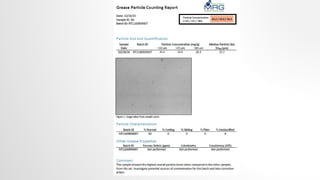
NEW METHOD: PARTICLE COUNTING IN
INTEGRATED TESTER D7918-17
• New method uses ASTM D7718 sampling standard capture
device for presentation of 1 gram representative sample
• Samples can be obtained from:
• new grease in manufacturing process
• packaged new greases upon opening
• stored greases in opened packages
• grease guns and auto-lubers
• inservice samples in the machine
• Method sizes and counts particles reliably down to 10 micron in
major axis, and provides aspect ratio and other
characterization information
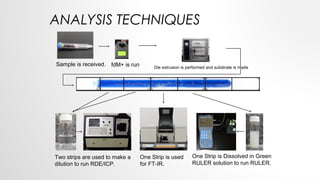
ANALYSIS TECHNIQUES
Sample is received. fdM+ is run Die extrusion is performed and substrate is made
Two strips are used to make a
dilution to run RDE/ICP.
One Strip is used
for FT-IR.
One Strip is Dissolved in Green
RULER solution to run RULER.
CAMERA SET-UP
• Thin Film extrusion sample
preparation
• Lens magnification to achieve
10 micron particle resolution
• Backlit with LED lighting
PARTICLE COUNTING EXAMPLE
PARTICLE COUNTING
Sample Image Image with filter and particles
highlighted
EXAMPLE RECORDINGS
50 mg/g sample10 mg/g sample
1.0 mg/g sample0.1 mg/g sample
MOISTURE ANALYSIS FOR GREASE
• Method uses vial and oven at 175 deg
C
• Moisture is transferred using dessicated
Nitrogen gas, to a humidity sensor
• Humidity values are converted to
water transfer rate with flow totalizer
• When water transfer rate returns to
background levels, the total is
integrated and converted to ppm
• Now included in ASTM D7918 as an
approved standard. On internal lab
runs at 10,000ppm moisture greases Rel
Std Dev at 5.28%
IMPLEMENTING GREASE ANALYSIS
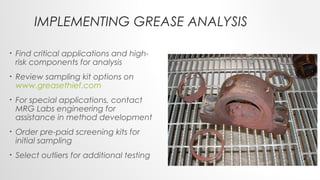
• Find critical applications and high-
risk components for analysis
• Review sampling kit options on
www.greasethief.com
• For special applications, contact
MRG Labs engineering for
assistance in method development
• Order pre-paid screening kits for
initial sampling
• Select outliers for additional testing
VALUE FOR LUBE PROGRAMS
• Grease Cleanliness Studies to determine current conditions
and calculation of benefits using Machine Life Extension Chart
for lubricant cleanliness
• Testing of New Grease Supplies: Characterize for the customer
the current particulate and moisture levels in the new,
unopened greases that they stock (a function of
manufacturing AND packaging cleanliness practices)
• Testing of Delivered Grease cleanliness: sampling some grease
guns, auto-luber reservoirs to determine handling cleanliness
impact prior to delivery to machine
• Spot Checking of Machine grease samples: Determine the
effectiveness of seals and frequency of greasing to keep
contaminants at bay inside the machine
IMPROVING CUSTOMER LUBE PROGRAMS
• Provide customer with data-based recommendations for
grease supplier quality improvement initiatives
• Recommend enhanced storage methods to reduce the
introduction of particulate and moisture (and cross-
contamination of products) based on areas of vulnerability
determined through testing (grease gun storage, auto-luber
refill methods, etc.)
• Use condition-based feedback to optimize grease delivery
volumes and frequencies, particularly in high-contaminant
ingression environments
• Identify wrong lubricant choices, contamination introduction,
and poor practices that are compromising bearing life and
projecting negatively on brand
SOME GREASE THIEF USERS

Grease sampling workshop SKF 011518

  • 1.
    GREASE SAMPLING METHODS: HOWTO GATHER A REPRESENTATIVE SAMPLE AND PERFORM MEANINGFUL ANALYSIS A Webinar from Rich Wurzbach, MRG Labs www.greasethief.com
  • 2.
    GREASE SAMPLING • Difficultchallenges in gathering representative grease samples • Sampling from robots • Wind turbine samples (main, blade, generator, etc.) • Electric motors • Pillow block bearings • Motor Operated Valves (MOVs and valve stems) • Slewing bearings and other mining applications • Low-cost analysis solutions • Case Studies
  • 3.
    VALUE OF GREASEANALYSIS • Grease lubricated components fail • Critical service and expensive machines are grease lubricated • The warning signs are evident in the grease • Leading indicator monitoring and proactive intervention • Root-cause detection for identification of systemic issues
  • 4.
    GREASE IS DIFFERENT •Viscosity is the property of oil that sets the lubricating film, and dictates how oil flows • Grease is an oil (base + additives) with a thickener • Grease behavior is non-Newtonian; it is designed to stay put in the machine • Dynamically, grease will flow, but only very close to the bearing/gear • Sampling and analysis techniques for oil are inadequate for grease
  • 5.
    ASTM D7718 STANDARDDEVELOPMENT • Developed in 2009 and published in 2011 • Incorporation of grease sampling research (Danish Wind Industry, Electric Power Research Institute) • Inclusion of historical methods for sampling with considerations and limitations • Failed component sampling, care in obtaining sample or multiple samples • Use of tubing, adequacy of suction alone, possibility of peripheral grease sampling • Inclusion of new technologies for active and passive sampling rev 0 022817
  • 6.
    GREASE THIEF SAMPLERS •Maintain purge function with little/no backpressure for drain applications • Allow relief of grease if sampler fills • Use of “Handle” tools to set depth • Designed to optimize the analysis process
  • 7.
    GREASE THIEF –THE STANDARD • “Effective Grease Practices” published by Electric Power Research Institute; MOV Gearbox sampling and analysis studies • DONG Energy and Vattenfall Main Bearing research project 2011- 2013; DONG and Statkraft Blade Bearing 2014-2016 • ASTM D7718: Standard for sampling greases from inservice equipment • ASTM D7918: Standard method for inservice grease analysis by Die Extrusion, “Integrated Tester” method for 6 tests • AWEA (American Wind Energy Association) published “Recommended Practices 812-815” for grease sampling and analysis with the Grease Thief
  • 8.
    Pillow Block ElectricMotor Grease Thief SlimTM MOV Gearbox Robot Kit Wind Turbine
  • 9.
    ROBOT SAMPLING • Industrialrobots are often 6-axis gearboxes, grease or oil lubricated • Grease lubricated robots can be evaluated for wear, contaminants, and grease breakdown • Transitioning from time- based grease purges to condition based can save $$$
  • 10.
    DRAINS: J1, J2,J3 1. Operate and shut off power. 2. Lock Out/Tag Out 3. Remove drain plug
  • 11.
    DRAINS: J1, J2,J3 4. Thread adapter into gearbox drain if necessary. 5. Thread Grease Thief into drain hole. 6. Pull plunger handle to fill Grease Thief with sample. 7. Cap Grease Thief.
  • 12.
    DRAINS: J1, J2, J3 7.Some locations utilize syringe with extension tubing. 8. Robot grease is a special case where it is so fluid, a syringe and tubing can work. 9. Place Grease Thief in labeled shipping tube. 10.Mail to MRG Labs for analysis or process on-site. 11.Grease Thief requires no further handling; ready to analyze per ASTM standard.
  • 13.
    DRAINS J4, J5,J6 1. Position robot with drains facing downward if possible and shut power off. 2. Lock Out/Tag Out 3. Remove Zerk fitting. 4. Thread provided plastic syringe into the threaded Zerk hole.
  • 14.
    DRAINS J4, J5,J6 5. Place tip of syringe in Grease Thief and fill with grease by withdrawing plunger. 6. Inject grease to fill Grease Thief. 7. Cap Grease Thief and place in shipping tube. 8. Mail to lab for analysis or process on-site. 9. Grease Thief requires no further handling; ready to analyze per ASTM recommendations.
  • 15.
    WIND MAIN BEARINGSAMPLING • Grease flow dependent on temperature, bearing movement • Grease Thief & T-handle used to capture flowing grease • Revised T-handle developed for Denmark Off-shore Wind Research Project • Project demonstrated representative grease taken without requiring disassembly or space between rollers
  • 16.
    WIND BLADE BEARINGSAMPLING (SLEWING) • Can be double-row ball or tapered roller bearings • Grease is typically delivered through autoluber lines or manually pumped • Expelled grease captured in bellows or containers in some cases • Containers can be harvested for sampling • Slim sampler may be used to obtain live zone samples through drain hole • New method for autoluber line purging – MRG Labs Technical Bulletin 17-001
  • 17.
    GREASE THIEF SLIMFOR SMALL OPENINGS • Blade bearing access limited • Access opening often smaller than sampler diameter • Blade bearing research leads to slim version, dia. drops from 0.50in (13mm) to 0.28in (7mm)
  • 18.
    ELECTRIC MOTOR SAMPLING •Grease Thief can be threaded into drain in place of a plug • Quality Controlled to deliver 1-5 psi relief pressure to ensure purging • Active methods may be required; T-handle or GT Slim • Mixing is a common failure mechanism, causing softening and separation of grease and allowing to migrate to windings • Periodic grease sampling can detect such issues early; hardened grease can be a source of energy losses
  • 19.
    PILLOW BLOCK BEARINGS •Can be critical applications: fan and AHU in bio-medical research or pharmaceutical manufacturing • Grease mixing and contaminants can be monitored, along with wear levels and causes • Early detection and purging can avoid failure when deficiencies are found
  • 20.
    MOTOR OPERATED VALVEGEARBOX • Sampling with T-handle through access plugs • Determining optimal grease life and gear wear condition • “Stinger probe” version of Grease Thief ensures that only grease near the gear is sampled, not peripheral grease not active in lubrication
  • 21.
    STEM THIEFTM RELUBRICATOR • Adapterbushing is first threaded into body • Stem lubricator screwed down to make seal against stem nut • Grease gun used to pump grease into threads • Purged grease is gathered from other end using a Pillow Block kit • Analysis can show mixing, contaminants and wear, along with grease degradation
  • 22.
    MINING APPLICATIONS • Constantbattle with contaminants, abrasives • Lubrication as a strategy to purge contaminants • Effectiveness can be evaluated by analyzing grease • Slewing bearings can be accessed with Grease Thief Slim • Suctioning grease often not effective as grease hardens • Root-causes of wear can be determined
  • 23.
    • Enhanced analysismethods developed • Four types of grease analysis: wear, contaminant, consistency and oxidation • Evaluate reliability of machine and grease to perform function • Look for signs of incompatible mixing • Pinpointing root causes for correction • Perform analysis cost-effectively utilizing sampling geometry GREASE ANALYSIS USING THE GREASE THIEF
  • 24.
    ANALYSIS TECHNIQUES: ASTMD7918 • ASTM D7918 approved and published in 2015. • Particle counting and moisture ppm capabilities added recently • 6 tests with 1- gram of grease Ferrous debris Die Extrusion Colorimetry Linear Sweep Voltammetry Elemental Spectroscopy FTIR Water in ppm rev 0 022817
  • 25.
  • 26.
  • 27.
  • 28.
    LOW-COST SCREENING TEST •Key parameters can be quickly tested while retaining majority of the sample for future testing • Wear, Color, and FTIR for under $30, including cost of sampling tools • Pre-paid kits supplied with Barcode labels and access to App for sampling identification and Meta-data • Statistical analysis of sample groups and comparison to Meta-Matched data sets
  • 31.
    CASE 1 –DETERMINING LIFE OF ROBOTICS GREASES • Samples were selected from grease lubricated joints on industrial robots used in assembly line automation. • Grease is fortified with zinc dialkyl dithiophosphate (ZDDP), a common antiwear and antioxidant additive. • Samples were taken from robots assigned varying payloads and cycle times. The remaining additive concentration as compared to the supplied new lubricant reference were measured with RULER and with the Pearl 50 um pathlength FTIR. • Results allowed for condition-based relubrication tasks, with reduction in required manpower and cost to purchase grease
  • 32.
    • Sampling methoddeveloped from uptower efforts and on ground-level failed blade bearings at US wind farm • Shop sampling of removed bearings using AWEA RP-814 • Use of GT Slim device for accessing smaller openings down to 8mm diameter clearance • Results clearly correlated to as- found conditions of wear and grease condition upon disassembly CASE 2 – MONITORING WIND TURBINE BLADE BEARING CONDITION
  • 33.
    WIND TURBINES WEAR LEVELSIN COMPARISON 33
  • 34.
    WEAR LEVELS INROBOT FLEET-COMPARISON
  • 35.
    NEW METHOD: PARTICLECOUNTING IN INTEGRATED TESTER D7918-17 • New method uses ASTM D7718 sampling standard capture device for presentation of 1 gram representative sample • Samples can be obtained from: • new grease in manufacturing process • packaged new greases upon opening • stored greases in opened packages • grease guns and auto-lubers • inservice samples in the machine • Method sizes and counts particles reliably down to 10 micron in major axis, and provides aspect ratio and other characterization information
  • 36.
    ANALYSIS TECHNIQUES Sample isreceived. fdM+ is run Die extrusion is performed and substrate is made Two strips are used to make a dilution to run RDE/ICP. One Strip is used for FT-IR. One Strip is Dissolved in Green RULER solution to run RULER.
  • 37.
    CAMERA SET-UP • ThinFilm extrusion sample preparation • Lens magnification to achieve 10 micron particle resolution • Backlit with LED lighting
  • 38.
  • 39.
    PARTICLE COUNTING Sample ImageImage with filter and particles highlighted
  • 40.
    EXAMPLE RECORDINGS 50 mg/gsample10 mg/g sample 1.0 mg/g sample0.1 mg/g sample
  • 41.
    MOISTURE ANALYSIS FORGREASE • Method uses vial and oven at 175 deg C • Moisture is transferred using dessicated Nitrogen gas, to a humidity sensor • Humidity values are converted to water transfer rate with flow totalizer • When water transfer rate returns to background levels, the total is integrated and converted to ppm • Now included in ASTM D7918 as an approved standard. On internal lab runs at 10,000ppm moisture greases Rel Std Dev at 5.28%
  • 43.
    IMPLEMENTING GREASE ANALYSIS •Find critical applications and high- risk components for analysis • Review sampling kit options on www.greasethief.com • For special applications, contact MRG Labs engineering for assistance in method development • Order pre-paid screening kits for initial sampling • Select outliers for additional testing
  • 44.
    VALUE FOR LUBEPROGRAMS • Grease Cleanliness Studies to determine current conditions and calculation of benefits using Machine Life Extension Chart for lubricant cleanliness • Testing of New Grease Supplies: Characterize for the customer the current particulate and moisture levels in the new, unopened greases that they stock (a function of manufacturing AND packaging cleanliness practices) • Testing of Delivered Grease cleanliness: sampling some grease guns, auto-luber reservoirs to determine handling cleanliness impact prior to delivery to machine • Spot Checking of Machine grease samples: Determine the effectiveness of seals and frequency of greasing to keep contaminants at bay inside the machine
  • 45.
    IMPROVING CUSTOMER LUBEPROGRAMS • Provide customer with data-based recommendations for grease supplier quality improvement initiatives • Recommend enhanced storage methods to reduce the introduction of particulate and moisture (and cross- contamination of products) based on areas of vulnerability determined through testing (grease gun storage, auto-luber refill methods, etc.) • Use condition-based feedback to optimize grease delivery volumes and frequencies, particularly in high-contaminant ingression environments • Identify wrong lubricant choices, contamination introduction, and poor practices that are compromising bearing life and projecting negatively on brand
  • 47.

Editor's Notes

  • #7 The Grease ThiefTM is pictured here. The red arrow shows the location of the purge hole, which allows excessive grease to purge out without creating backpressue in the bearing. It is recognized that many electric motor designs do not regularly purge grease out the drain hole when properly greased. It is not suggested that greasers pump enough grease in to fill this fitting. However, it can be substituted for the existing drain plug in many motors, and standby to catch any grease that might come out, instead of it falling to the floor. Then the captured grease can be analyzed. The red piston provides a visual indication of when the grease has begun to slump, leak or pressure drain into the fitting, indication of overgreasing, grease property changes, overheating of the bearing, etc.
  • #22 An O-ring is used to create a seal between the StemThief lubricator tube, and the top surface of the stem nut. This allows grease to be pumped through the stem nut, displacing the old grease and purging it to a position below the stem nut. This effectively coats the thread surfaces and the surfaces within the stem nut, re-establishing a layer of grease lubrication in the stem and nut, and purging out the old grease so that it can be gathered as a sample for analysis and evaluation of the condition of the stem and nut wearing surfaces and the previous charge of grease.
  • #37 fdM+ ferrous debris analyzer Determines the amount of ferrous debris in a sample Grease Thief Analyzer Measures the consistency of the grease FT-IR Tests for mixing, contamination, and oxidation RULER Tests for amount of useful antioxidant life remaining RDE Spectroscopy metals spectroscopy Rheometer Tests the consistency, pumpability, and likeliness of tunneling