Examples of
Rolling Bearing
Damage
Symptoms
Remedies
Causes
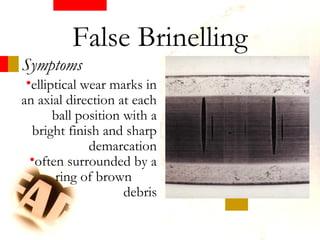
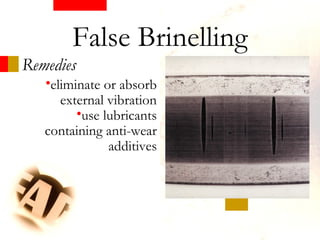
•elliptical wear marks in
an axial direction at each
ball position with a
bright finish and sharp
demarcation
•often surrounded by a
ring of brown
debris
Symptoms
False Brinelling
Causes
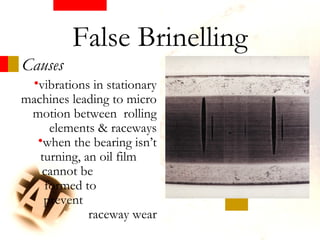
•vibrations in stationary
machines leading to micro
motion between rolling
elements & raceways
•when the bearing isn’t
turning, an oil film
cannot be
formed to
prevent
raceway wear
False Brinelling
•eliminate or absorb
external vibration
•use lubricants
containing anti-wear
additives
Remedies
False Brinelling
Symptoms
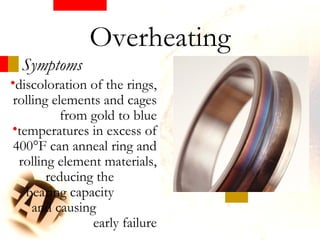
•discoloration of the rings,
rolling elements and cages
from gold to blue
•temperatures in excess of
400°F can anneal ring and
rolling element materials,
reducing the
bearing capacity
and causing
early failure
Overheating
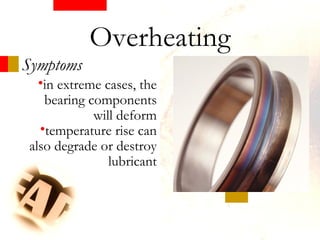
•in extreme cases, the
bearing components
will deform
•temperature rise can
also degrade or destroy
lubricant
Symptoms
Overheating
Causes
•heavy electrical heat
loads
•inadequate heat paths
•insufficient cooling or
lubrication when loads
and speed are
excessive
Overheating
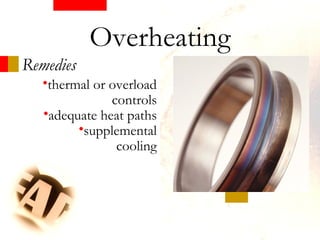
•thermal or overload
controls
•adequate heat paths
•supplemental
cooling
Remedies
Overheating
Symptoms
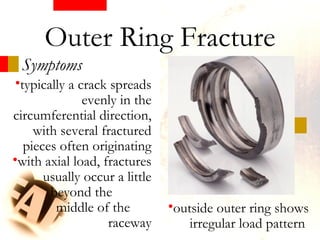
Outer Ring Fracture
•typically a crack spreads
evenly in the
circumferential direction,
with several fractured
pieces often originating
•with axial load, fractures
usually occur a little
beyond the
middle of the
raceway
•outside outer ring shows
irregular load pattern
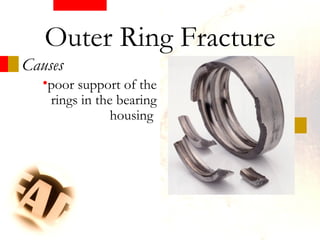
•poor support of the
rings in the bearing
housing
Causes
Outer Ring Fracture
Remedies
Outer Ring Fracture
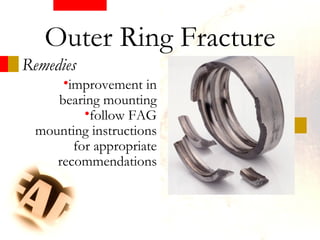
•improvement in
bearing mounting
•follow FAG
mounting instructions
for appropriate
recommendations
Symptoms
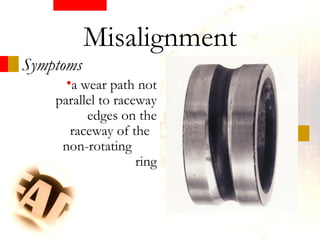
•a wear path not
parallel to raceway
edges on the
raceway of the
non-rotating
ring
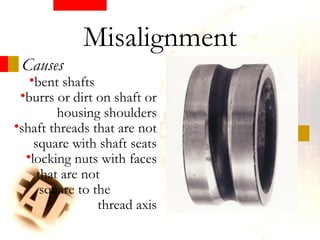
Misalignment
Causes
•bent shaftskjkjjjkj
•burrs or dirt on shaft or
housing shoulders
•shaft threads that are not
square with shaft seats
•locking nuts with faces
that are not
square to the
thread axis
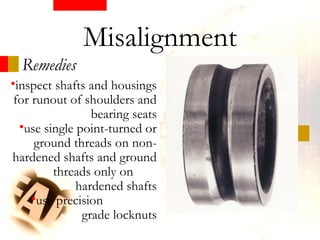
Misalignment
Remedies
•inspect shafts and housings
for runout of shoulders and
bearing seats
•use single point-turned or
ground threads on non-
hardened shafts and ground
threads only on
hardened shafts
•use precision
grade locknuts
Misalignment
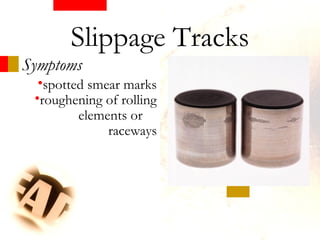
Symptoms
•spotted smear marks
•roughening of rolling
elements or
raceways
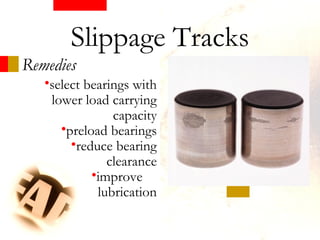
Slippage Tracks
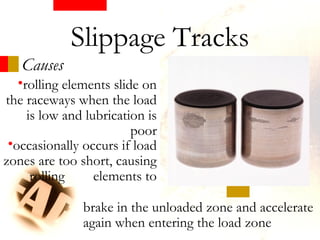
Causes
•rolling elements slide on
the raceways when the load
is low and lubrication is
poor
•also, fast changes in
speed
Slippage Tracks
brake in the unloaded zone and accelerate
again when entering the load zone
•occasionally occurs if load
zones are too short, causing
rolling elements to
Remedies
•select bearings with
lower load carrying
capacity
•preload bearings
•reduce bearing
clearance
•improve
lubrication
Slippage Tracks
Symptoms
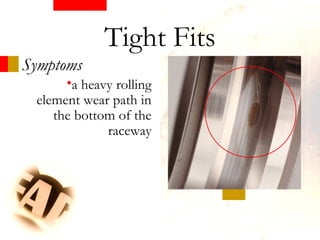
Tight Fits
•a heavy rolling
element wear path in
the bottom of the
raceway
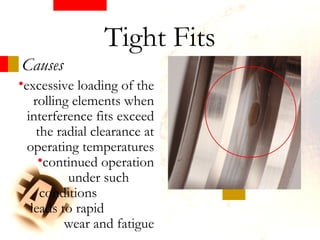
Causes
Tight Fits
•excessive loading of the
rolling elements when
interference fits exceed
the radial clearance at
operating temperatures
•continued operation
under such
conditions
leads to rapid
wear and fatigue
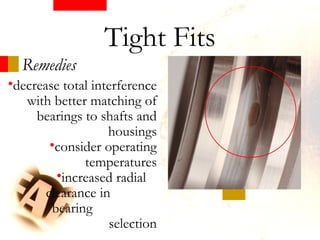
Remedies
Tight Fits
•decrease total interference
with better matching of
bearings to shafts and
housings
•consider operating
temperatures
•increased radial
clearance in
bearing
selection
Symptoms
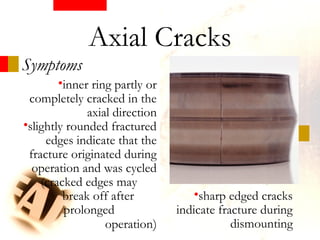
•inner ring partly or
completely cracked in the
axial direction
•slightly rounded fractured
edges indicate that the
fracture originated during
operation and was cycled
(cracked edges may
break off after
prolonged
operation)
•sharp edged cracks
indicate fracture during
dismounting
Axial Cracks
Causes
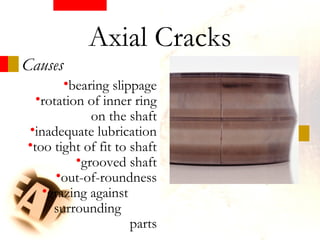
•bearing slippage
•rotation of inner ring
on the shaft
•inadequate lubrication
•too tight of fit to shaft
•grooved shaft
•out-of-roundness
•grazing against
surrounding
parts
Axial Cracks
Remedies
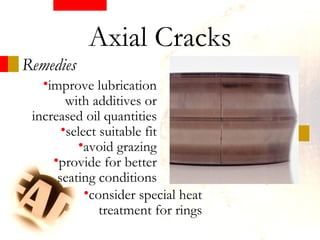
•improve lubrication
with additives or
increased oil quantities
•select suitable fit
•avoid grazing
•provide for better
seating conditions
Axial Cracks
•consider special heat
treatment for rings
Symptoms
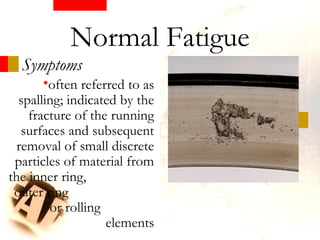
•often referred to as
spalling; indicated by the
fracture of the running
surfaces and subsequent
removal of small discrete
particles of material from
the inner ring,
outer ring
or rolling
elements
Normal Fatigue
Symptoms
Normal Fatigue
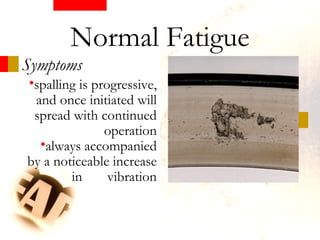
•spalling is progressive,
and once initiated will
spread with continued
operation
•always accompanied
by a noticeable increase
in vibration
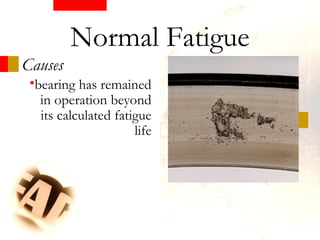
•bearing has remained
in operation beyond
its calculated fatigue
life
Causes
Normal Fatigue
Remedies
Normal Fatigue
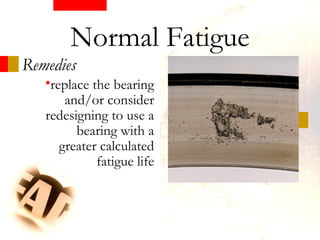
•replace the bearing
and/or consider
redesigning to use a
bearing with a
greater calculated
fatigue life
Symptoms
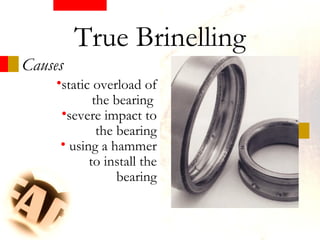
True Brinelling
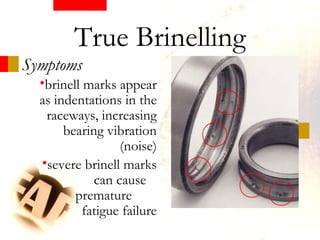
•brinell marks appear
as indentations in the
raceways, increasing
bearing vibration
(noise)
•severe brinell marks
can cause
premature
fatigue failure
Causes
•static overload of
the bearing
•severe impact to
the bearing
• using a hammer
to install the
bearing
True Brinelling
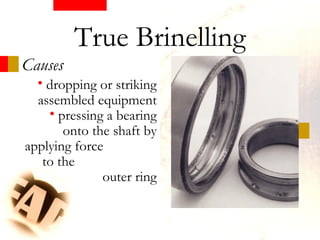
Causes
True Brinelling
• dropping or striking
assembled equipment
• pressing a bearing
onto the shaft by
applying force
to the
outer ring
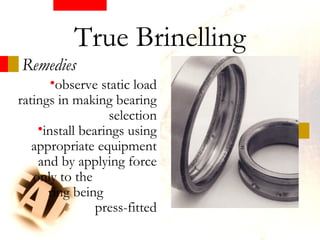
Remedies
•observe static load
ratings in making bearing
selection
•install bearings using
appropriate equipment
and by applying force
only to the
ring being
press-fitted
True Brinelling
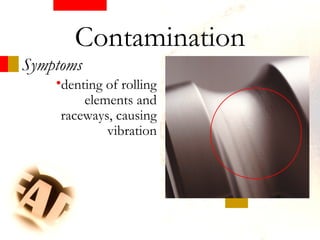
Symptoms
Contamination
•denting of rolling
elements and
raceways, causing
vibration
Causes
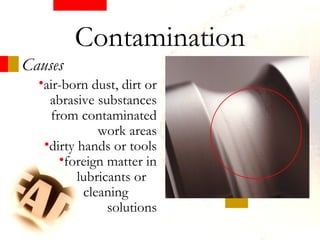
•air-born dust, dirt or
abrasive substances
from contaminated
work areas
•dirty hands or tools
•foreign matter in
lubricants or
cleaning
solutions
Contamination
Remedies
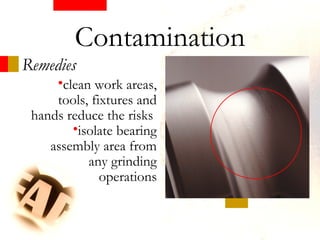
•clean work areas,
tools, fixtures and
hands reduce the risks
•isolate bearing
assembly area from
any grinding
operations
Contamination
Remedies
Contamination
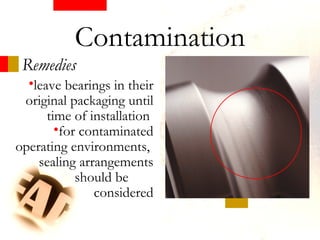
•leave bearings in their
original packaging until
time of installation
•for contaminated
operating environments,
sealing arrangements
should be
considered
Symptoms
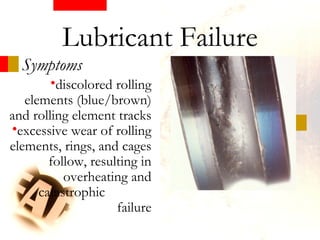
•discolored rolling
elements (blue/brown)
and rolling element tracks
•excessive wear of rolling
elements, rings, and cages
follow, resulting in
overheating and
catastrophic
failure
Lubricant Failure
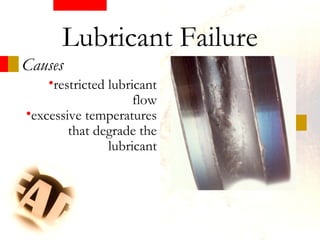
•restricted lubricant
flow
•excessive temperatures
that degrade the
lubricant
Causes
Lubricant Failure
Remedies
Lubricant Failure
•use of the appropriate
and correct amount of
lubricant
•ensure proper
bearing fit
•control preload to
reduce bearing
temperatures
Symptoms
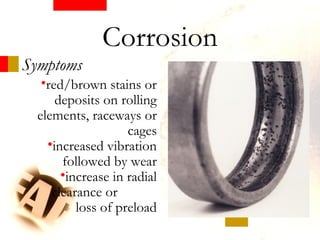
•red/brown stains or
deposits on rolling
elements, raceways or
cages
•increased vibration
followed by wear
•increase in radial
clearance or
loss of preload
Corrosion
Causes
•exposing bearings
to corrosive fluids
or atmospheres
Corrosion
Remedies
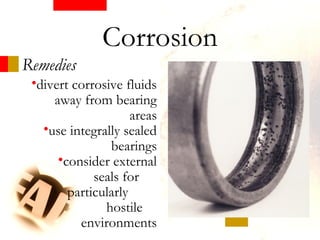
•divert corrosive fluids
away from bearing
areas
•use integrally sealed
bearings
•consider external
seals for
particularly
hostile
environments
Corrosion
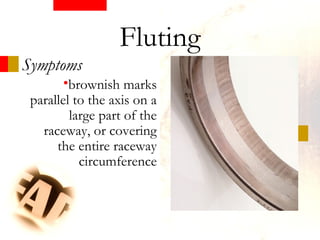
Symptoms
•brownish marks
parallel to the axis on a
large part of the
raceway, or covering
the entire raceway
circumference
Fluting
Causes
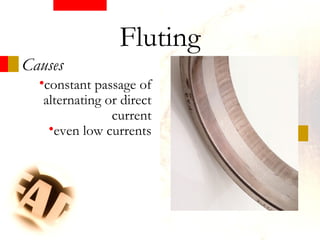
•constant passage of
alternating or direct
current
•even low currents
Fluting
Remedies
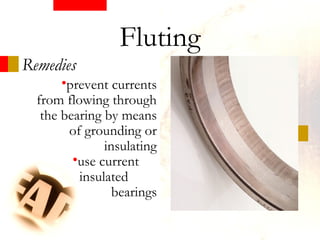
•prevent currents
from flowing through
the bearing by means
of grounding or
insulating
•use current
insulated
bearings
Fluting
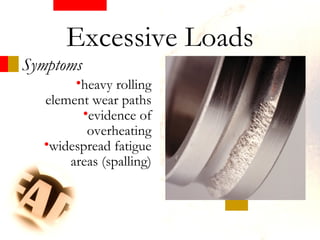
Symptoms
•heavy rolling
element wear paths
•evidence of
overheating
•widespread fatigue
areas (spalling)
Excessive Loads
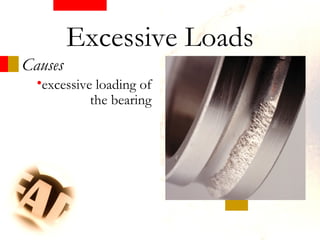
•excessive loading of
the bearing
Causes
Excessive Loads
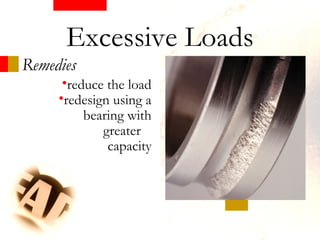
•reduce the load
•redesign using a
bearing with
greater
capacity
Remedies
Excessive Loads
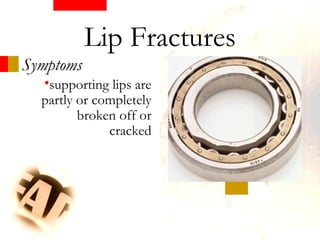
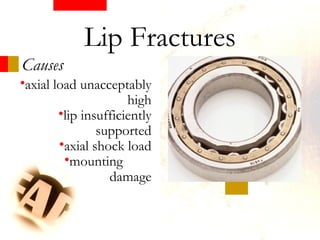
•supporting lips are
partly or completely
broken off or
cracked
Symptoms
Lip Fractures
Causes
•axial load unacceptably
high
•lip insufficiently
supported
•axial shock load
•mounting
damage
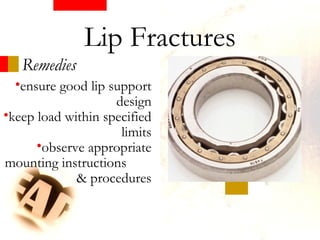
Lip Fractures
•ensure good lip support
design
•keep load within specified
limits
•observe appropriate
mounting instructions
& procedures
Remedies
Lip Fractures
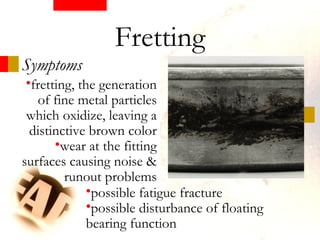
Symptoms
•fretting, the generation
of fine metal particles
which oxidize, leaving a
distinctive brown color
•wear at the fitting
surfaces causing noise &
runout problems
Fretting
•possible fatigue fracture
•possible disturbance of floating
bearing function
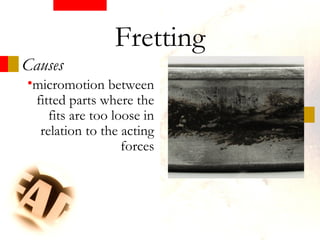
•micromotion between
fitted parts where the
fits are too loose in
relation to the acting
forces
Causes
Fretting
•follow FAG
mounting instructions
for appropriate fit
recommendations
Remedies
Fretting
Symptoms
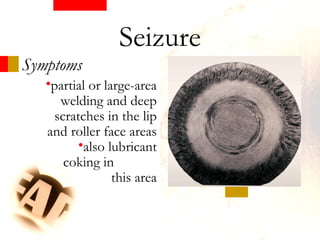
•partial or large-area
welding and deep
scratches in the lip
and roller face areas
•also lubricant
coking in
this area
Seizure
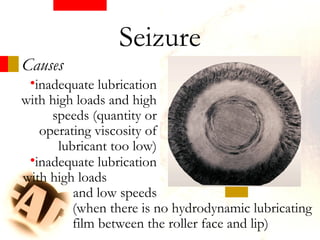
Causes
•inadequate lubrication
with high loads and high
speeds (quantity or
operating viscosity of
lubricant too low)
Seizure
(when there is no hydrodynamic lubricating
film between the roller face and lip)
•inadequate lubrication
with high loads
and low speeds
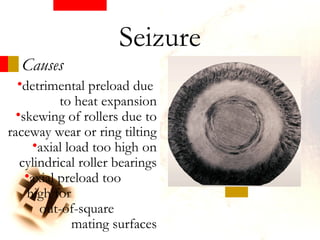
Causes
•detrimental preload due
to heat expansion
•skewing of rollers due to
raceway wear or ring tilting
•axial load too high on
cylindrical roller bearings
•axial preload too
high for
out-of-square
mating surfaces
Seizure
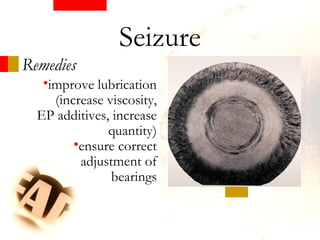
Remedies
•improve lubrication
(increase viscosity,
EP additives, increase
quantity)
•ensure correct
adjustment of
bearings
Seizure
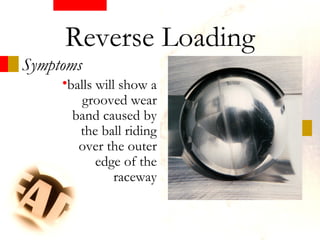
•balls will show a
grooved wear
band caused by
the ball riding
over the outer
edge of the
raceway
Symptoms
Reverse Loading
Causes
Reverse Loading
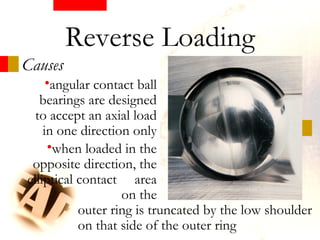
•angular contact ball
bearings are designed
to accept an axial load
in one direction only
outer ring is truncated by the low shoulder
on that side of the outer ring
•when loaded in the
opposite direction, the
elliptical contact area
on the
Causes
Reverse Loading
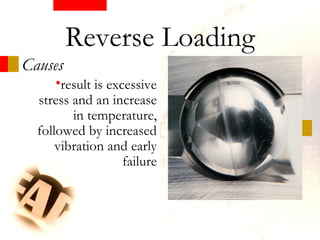
•result is excessive
stress and an increase
in temperature,
followed by increased
vibration and early
failure
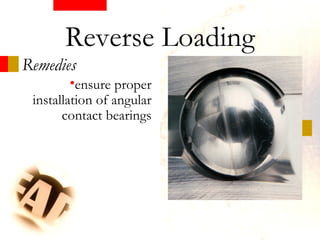
•ensure proper
installation of angular
contact bearings
Remedies
Reverse Loading

Fag roller bearing damages (excellent)