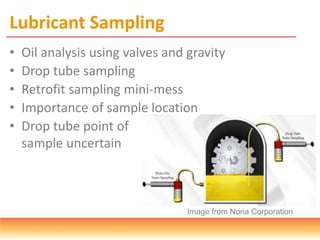
Lubricant Sampling
• Oil analysis using valves and gravity
• Drop tube sampling
• Retrofit sampling mini-mess
• Importance of sample location
• Drop tube point of
sample uncertain
Image from Noria Corporation
Grease Sampling
• Historically during disassembly following failure
• Using “popsicle stick”, screwdriver, cable ties
• Samples only available near access points, ports
• “Grab Sample” has similar limitations to “Drop
Tube Sampling”
• ASTM Grease subcommittee initiates working
group to develop sampling standard, 2009
• Projects initiated in USA and Denmark to test
effectiveness of grease sampling in 2010, 2012
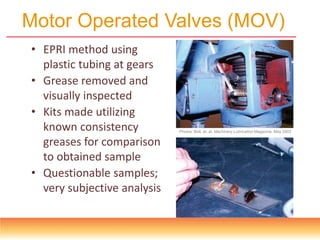
Motor Operated Valves (MOV)
• EPRI method using
plastic tubing at gears
• Grease removed and
visually inspected
• Kits made utilizing
known consistency
greases for comparison
to obtained sample
• Questionable samples;
very subjective analysis
Photos: Bolt, et. al. Machinery Lubrication Magazine. May 2003
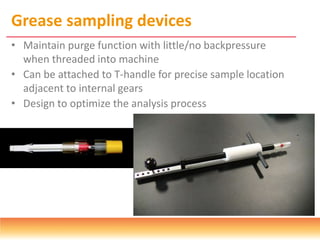
Grease sampling devices
• Maintain purge function with little/no backpressure
when threaded into machine
• Can be attached to T-handle for precise sample location
adjacent to internal gears
• Design to optimize the analysis process
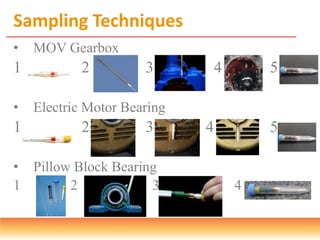
Sampling Techniques
• MOV Gearbox
1 2 3 4 5
• Electric Motor Bearing
1 2 3 4 5
• Pillow Block Bearing
1 2 3 4
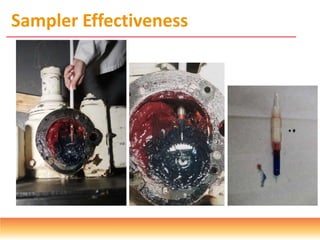
Sampler Effectiveness
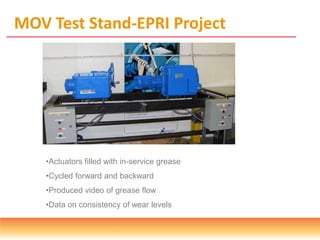
MOV Test Stand-EPRI Project
•Actuators filled with in-service grease
•Cycled forward and backward
•Produced video of grease flow
•Data on consistency of wear levels
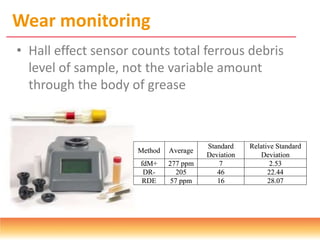
Wear monitoring
• Hall effect sensor counts total ferrous debris
level of sample, not the variable amount
through the body of grease
Method Average
Standard
Deviation
Relative Standard
Deviation
fdM+ 277 ppm 7 2.53
DR- 205 46 22.44
RDE 57 ppm 16 28.07
Method Average
Standard
Deviation
Relative Standard
Deviation
fdM+ 277 ppm 7 2.53
DR- 205 46 22.44
RDE 57 ppm 16 28.07
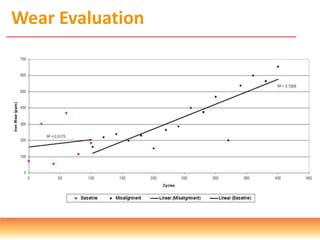
Wear Evaluation
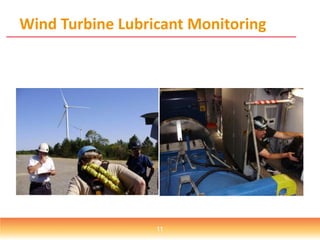
Wind Turbine Lubricant Monitoring
11
Wind Turbine grease sampling and analysis
• 2-year project conducted with DONG Energy and
Vattenfall, two largest offshore wind operators in the
world
• Dr. Kim Esbensen, internationally recognized expert in
Theory of Sampling (TOS), Denmark
• Rich Wurzbach, MRG Labs, inventor of Grease Thief
• Systematic evaluation of grease heterogeneity, sampling
methodology, and analysis validity and repeatability for
wind turbine main bearings in on-shore and off-shore
applications
• Results published at OilDoc, LUBMAT, and AWEA
Richard Wurzbach– OilDoc Conference 2015
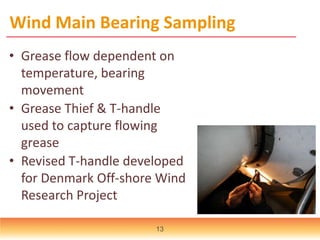
Wind Main Bearing Sampling
• Grease flow dependent on
temperature, bearing
movement
• Grease Thief & T-handle
used to capture flowing
grease
• Revised T-handle developed
for Denmark Off-shore Wind
Research Project
13
ASTM Standard Development
• Incorporation of grease sampling research
• Inclusion of historical methods for sampling
with considerations and limitations
• Failed component sampling, care in obtaining
sample or multiple samples
• Use of tubing, adequacy of suction alone,
possibility of peripheral grease sampling
• Inclusion of new technologies for active and
passive sampling
Richard Wurzbach– OilDoc Conference 2015
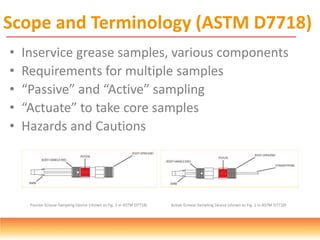
Scope and Terminology (ASTM D7718)
• Inservice grease samples, various components
• Requirements for multiple samples
• “Passive” and “Active” sampling
• “Actuate” to take core samples
• Hazards and Cautions
Active Grease-Sampling Device (shown as Fig. 1 in ASTM D7718)Passive Grease-Sampling Device (shown as Fig. 3 in ASTM D7718)
General Procedures (ASTM D7718)
• cleanliness of sampling tools
• homogeneity of samples
• uniformity and design of the sampling devices
• operator training and knowledge of equipment
being
• shipping considerations and sample labelling
• containers and protective sleeves to prevent
leakage and co-mixing of samples
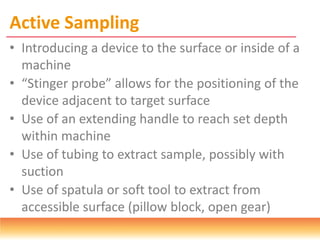
Active Sampling
• Introducing a device to the surface or inside of a
machine
• “Stinger probe” allows for the positioning of the
device adjacent to target surface
• Use of an extending handle to reach set depth
within machine
• Use of tubing to extract sample, possibly with
suction
• Use of spatula or soft tool to extract from
accessible surface (pillow block, open gear)
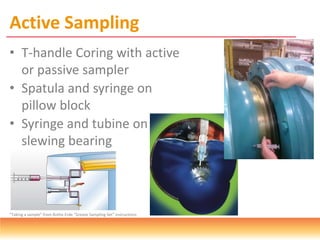
Active Sampling
• T-handle Coring with active
or passive sampler
• Spatula and syringe on
pillow block
• Syringe and tubine on
slewing bearing
“Taking a sample” from Rothe Erde “Grease Sampling Set” instructions
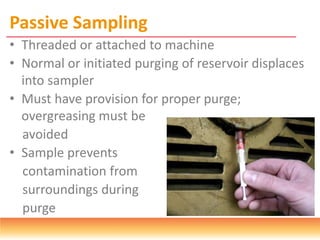
Passive Sampling
• Threaded or attached to machine
• Normal or initiated purging of reservoir displaces
into sampler
• Must have provision for proper purge;
overgreasing must be
avoided
• Sample prevents
contamination from
surroundings during
purge
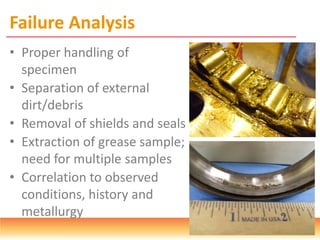
Failure Analysis
• Proper handling of
specimen
• Separation of external
dirt/debris
• Removal of shields and seals
• Extraction of grease sample;
need for multiple samples
• Correlation to observed
conditions, history and
metallurgy
Cautions and Concerns
• Use of plastic tubing may not properly suction
all representative grease, point of sampling may
vary, as in oil “drop-tube” sampling
• Samples must be taken from “live-zone” in the
machine, understanding of flow dynamics
important
• Sample must be properly labeled and protected
during shipment
• Quantity must be sufficient for required tests
Acceptance and Use
• D7718 is basis for AWEA Recommended Practices for
wind turbine sampling
– 812 Grease Sampling - Main Bearing
– 813 Grease Sampling - Generator Bearing
– 814 Grease Sampling - Pitch Bearing
– 815 Grease Analysis
• Used by largest operators in Danish Offshore Wind
industry
• Published by US Nuclear Industry in “Effective Grease
Practices” NMAC Guideline
• Analysis utilized by labs in Europe, Asia, North America
• Sampling kits used on six continents around the globe
Next Steps
• Development of ASTM Standard for Grease Analysis
– Integrated Tester section of ASTM with a balloted Work Item
–Currently in Interlaboratory Study (ILS) in US labs for precision statement
– Laboratories in Asia, Europe and North America to participate in
development of methods
• Development of “Slim” version of sampler to access rail
locomotive wheel bearings, wind bearings
• Mini-lab development for “In-Sampler” Analysis, including
ferrous debris, colorimetry
• Real-time particle counting in grease processed between two
samplers
• Major lubricant manufacturers worldwide utilizing for support of
customer base
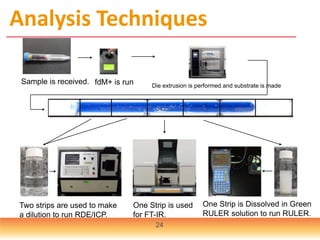
Analysis Techniques
Sample is received. fdM+ is run Die extrusion is performed and substrate is made
Two strips are used to make
a dilution to run RDE/ICP.
One Strip is used
for FT-IR.
One Strip is Dissolved in Green
RULER solution to run RULER.
24
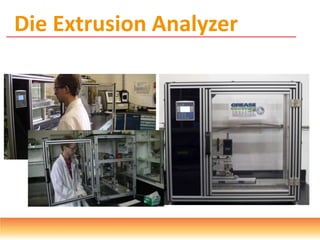
Die Extrusion Analyzer
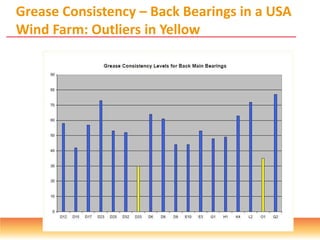
Grease Consistency – Back Bearings in a USA
Wind Farm: Outliers in Yellow
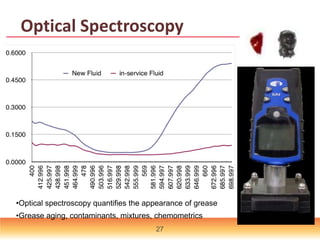
Optical Spectroscopy
•Optical spectroscopy quantifies the appearance of grease
•Grease aging, contaminants, mixtures, chemometrics
27
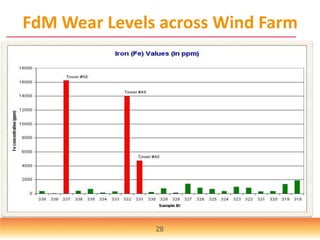
FdM Wear Levels across Wind Farm
28
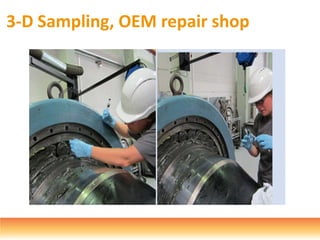
3-D Sampling, OEM repair shop
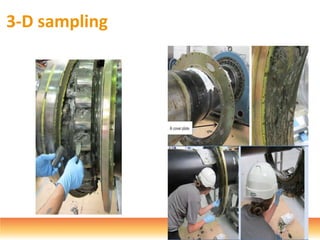
3-D sampling
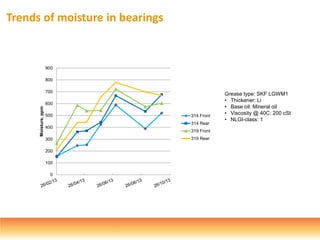
Trends of moisture in bearings
0
100
200
300
400
500
600
700
800
900
Moisture,ppm
314 Front
314 Rear
319 Front
319 Rear
Grease type: SKF LGWM1
• Thickener: Li
• Base oil: Mineral oil
• Viscosity @ 40C: 200 cSt
• NLGI-class: 1
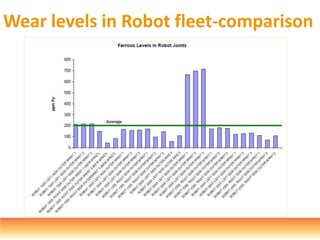
Wear levels in Robot fleet-comparison

ASTM D7718 Sampling Standard (topic presented at OilDoc2015)

  • 2.
    Lubricant Sampling • Oilanalysis using valves and gravity • Drop tube sampling • Retrofit sampling mini-mess • Importance of sample location • Drop tube point of sample uncertain Image from Noria Corporation
  • 3.
    Grease Sampling • Historicallyduring disassembly following failure • Using “popsicle stick”, screwdriver, cable ties • Samples only available near access points, ports • “Grab Sample” has similar limitations to “Drop Tube Sampling” • ASTM Grease subcommittee initiates working group to develop sampling standard, 2009 • Projects initiated in USA and Denmark to test effectiveness of grease sampling in 2010, 2012
  • 4.
    Motor Operated Valves(MOV) • EPRI method using plastic tubing at gears • Grease removed and visually inspected • Kits made utilizing known consistency greases for comparison to obtained sample • Questionable samples; very subjective analysis Photos: Bolt, et. al. Machinery Lubrication Magazine. May 2003
  • 5.
    Grease sampling devices •Maintain purge function with little/no backpressure when threaded into machine • Can be attached to T-handle for precise sample location adjacent to internal gears • Design to optimize the analysis process
  • 6.
    Sampling Techniques • MOVGearbox 1 2 3 4 5 • Electric Motor Bearing 1 2 3 4 5 • Pillow Block Bearing 1 2 3 4
  • 7.
  • 8.
    MOV Test Stand-EPRIProject •Actuators filled with in-service grease •Cycled forward and backward •Produced video of grease flow •Data on consistency of wear levels
  • 9.
    Wear monitoring • Halleffect sensor counts total ferrous debris level of sample, not the variable amount through the body of grease Method Average Standard Deviation Relative Standard Deviation fdM+ 277 ppm 7 2.53 DR- 205 46 22.44 RDE 57 ppm 16 28.07 Method Average Standard Deviation Relative Standard Deviation fdM+ 277 ppm 7 2.53 DR- 205 46 22.44 RDE 57 ppm 16 28.07
  • 10.
  • 11.
  • 12.
    Wind Turbine greasesampling and analysis • 2-year project conducted with DONG Energy and Vattenfall, two largest offshore wind operators in the world • Dr. Kim Esbensen, internationally recognized expert in Theory of Sampling (TOS), Denmark • Rich Wurzbach, MRG Labs, inventor of Grease Thief • Systematic evaluation of grease heterogeneity, sampling methodology, and analysis validity and repeatability for wind turbine main bearings in on-shore and off-shore applications • Results published at OilDoc, LUBMAT, and AWEA Richard Wurzbach– OilDoc Conference 2015
  • 13.
    Wind Main BearingSampling • Grease flow dependent on temperature, bearing movement • Grease Thief & T-handle used to capture flowing grease • Revised T-handle developed for Denmark Off-shore Wind Research Project 13
  • 14.
    ASTM Standard Development •Incorporation of grease sampling research • Inclusion of historical methods for sampling with considerations and limitations • Failed component sampling, care in obtaining sample or multiple samples • Use of tubing, adequacy of suction alone, possibility of peripheral grease sampling • Inclusion of new technologies for active and passive sampling Richard Wurzbach– OilDoc Conference 2015
  • 15.
    Scope and Terminology(ASTM D7718) • Inservice grease samples, various components • Requirements for multiple samples • “Passive” and “Active” sampling • “Actuate” to take core samples • Hazards and Cautions Active Grease-Sampling Device (shown as Fig. 1 in ASTM D7718)Passive Grease-Sampling Device (shown as Fig. 3 in ASTM D7718)
  • 16.
    General Procedures (ASTMD7718) • cleanliness of sampling tools • homogeneity of samples • uniformity and design of the sampling devices • operator training and knowledge of equipment being • shipping considerations and sample labelling • containers and protective sleeves to prevent leakage and co-mixing of samples
  • 17.
    Active Sampling • Introducinga device to the surface or inside of a machine • “Stinger probe” allows for the positioning of the device adjacent to target surface • Use of an extending handle to reach set depth within machine • Use of tubing to extract sample, possibly with suction • Use of spatula or soft tool to extract from accessible surface (pillow block, open gear)
  • 18.
    Active Sampling • T-handleCoring with active or passive sampler • Spatula and syringe on pillow block • Syringe and tubine on slewing bearing “Taking a sample” from Rothe Erde “Grease Sampling Set” instructions
  • 19.
    Passive Sampling • Threadedor attached to machine • Normal or initiated purging of reservoir displaces into sampler • Must have provision for proper purge; overgreasing must be avoided • Sample prevents contamination from surroundings during purge
  • 20.
    Failure Analysis • Properhandling of specimen • Separation of external dirt/debris • Removal of shields and seals • Extraction of grease sample; need for multiple samples • Correlation to observed conditions, history and metallurgy
  • 21.
    Cautions and Concerns •Use of plastic tubing may not properly suction all representative grease, point of sampling may vary, as in oil “drop-tube” sampling • Samples must be taken from “live-zone” in the machine, understanding of flow dynamics important • Sample must be properly labeled and protected during shipment • Quantity must be sufficient for required tests
  • 22.
    Acceptance and Use •D7718 is basis for AWEA Recommended Practices for wind turbine sampling – 812 Grease Sampling - Main Bearing – 813 Grease Sampling - Generator Bearing – 814 Grease Sampling - Pitch Bearing – 815 Grease Analysis • Used by largest operators in Danish Offshore Wind industry • Published by US Nuclear Industry in “Effective Grease Practices” NMAC Guideline • Analysis utilized by labs in Europe, Asia, North America • Sampling kits used on six continents around the globe
  • 23.
    Next Steps • Developmentof ASTM Standard for Grease Analysis – Integrated Tester section of ASTM with a balloted Work Item –Currently in Interlaboratory Study (ILS) in US labs for precision statement – Laboratories in Asia, Europe and North America to participate in development of methods • Development of “Slim” version of sampler to access rail locomotive wheel bearings, wind bearings • Mini-lab development for “In-Sampler” Analysis, including ferrous debris, colorimetry • Real-time particle counting in grease processed between two samplers • Major lubricant manufacturers worldwide utilizing for support of customer base
  • 24.
    Analysis Techniques Sample isreceived. fdM+ is run Die extrusion is performed and substrate is made Two strips are used to make a dilution to run RDE/ICP. One Strip is used for FT-IR. One Strip is Dissolved in Green RULER solution to run RULER. 24
  • 25.
  • 26.
    Grease Consistency –Back Bearings in a USA Wind Farm: Outliers in Yellow
  • 27.
    Optical Spectroscopy •Optical spectroscopyquantifies the appearance of grease •Grease aging, contaminants, mixtures, chemometrics 27
  • 28.
    FdM Wear Levelsacross Wind Farm 28
  • 29.
    3-D Sampling, OEMrepair shop
  • 30.
  • 31.
    Trends of moisturein bearings 0 100 200 300 400 500 600 700 800 900 Moisture,ppm 314 Front 314 Rear 319 Front 319 Rear Grease type: SKF LGWM1 • Thickener: Li • Base oil: Mineral oil • Viscosity @ 40C: 200 cSt • NLGI-class: 1
  • 32.
    Wear levels inRobot fleet-comparison