Advanced methods for
sampling and analysis of
post-tensioned concrete
tendon greases
Rich Wurzbach
ASNT Level III, Infrared and Thermal Testing
Laboratory Lubricant Analyst (LLA-I)
MRG Labs, York, Pennsylvania, USA
Overview
 Background of tendon grease testing
 Failures of post-tension tendons
 Comparison of as-found conditions,
failures, to routine grease testing
 Root-Cause failure analysis and corrective
actions
 Enhanced sampling methods
 Expanded grease analysis techniques
Background
 Some nuclear containment designs
include ungrouted post-tension concrete
tendons
 Tendon sheaths and anchorhead areas
are filled with a corrosion protection
grease
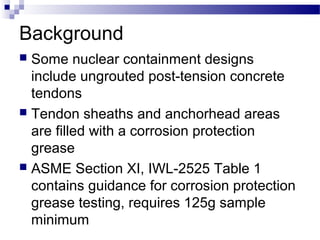
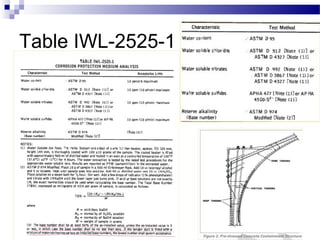
 ASME Section XI, IWL-2525 Table 1
contains guidance for corrosion protection
grease testing, requires 125g sample
minimum
Table IWL-2525-1
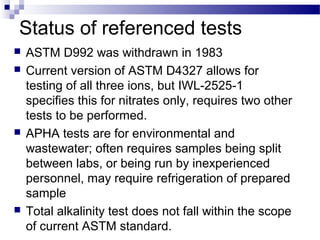
Status of referenced tests
 ASTM D992 was withdrawn in 1983
 Current version of ASTM D4327 allows for
testing of all three ions, but IWL-2525-1
specifies this for nitrates only, requires two other
tests to be performed.
 APHA tests are for environmental and
wastewater; often requires samples being split
between labs, or being run by inexperienced
personnel, may require refrigeration of prepared
sample
 Total alkalinity test does not fall within the scope
of current ASTM standard.
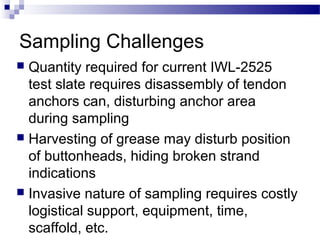
Sampling Challenges
 Quantity required for current IWL-2525
test slate requires disassembly of tendon
anchors can, disturbing anchor area
during sampling
 Harvesting of grease may disturb position
of buttonheads, hiding broken strand
indications
 Invasive nature of sampling requires costly
logistical support, equipment, time,
scaffold, etc.
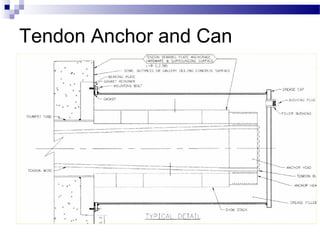
Tendon Anchor and Can
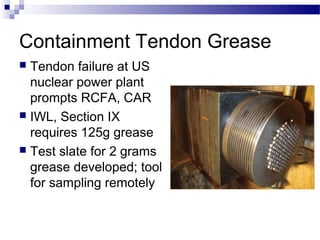
Containment Tendon Grease
 Tendon failure at US
nuclear power plant
prompts RCFA, CAR
 IWL, Section IX
requires 125g grease
 Test slate for 2 grams
grease developed; tool
for sampling remotely
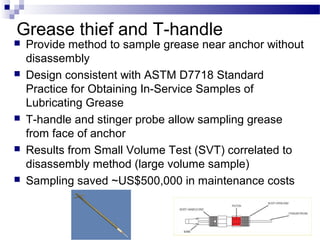
Grease thief and T-handle
 Provide method to sample grease near anchor without
disassembly
 Design consistent with ASTM D7718 Standard
Practice for Obtaining In-Service Samples of
Lubricating Grease
 T-handle and stinger probe allow sampling grease
from face of anchor
 Results from Small Volume Test (SVT) correlated to
disassembly method (large volume sample)
 Sampling saved ~US$500,000 in maintenance costs
Water – D95 (IWL-2525)
 Uses distillation glassware
 Per ASTM: “The amount of water as determined
by this test method…to the nearest 0.05 or 0.1
volume%”, which is 500-1000ppm. 
 Per Noria Training: D95 “is fairly cumbersome
and requires a comparatively large sample to
ensure accuracy, which is why it is rarely used in
production-style oil analysis labs today”
Water – Karl Fischer (SVT)
 Per ASTM: KF allows “direct determination
of water in the range of 10 to 25,000” ppm
 Can be performed on grease via “oven
method” to eliminate interferences and
improve accuracy
 Only a small volume of grease required
(about ¼ gram)
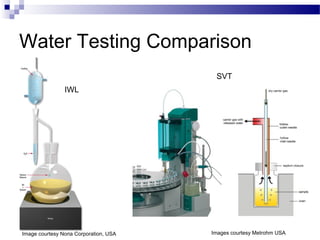
Water Testing Comparison
Image courtesy Noria Corporation, USA Images courtesy Metrohm USA
SVT
IWL
Total Alkalinity Testing
 Uses an “ASTM Modified” procedure.
 Per ASTM: “determination of acidic or basic
constituents in petroleum products and
lubricants soluble or nearly soluble in mixtures
of toluene and isopropyl alcohol.”
 Per ASTM: “This test method is not suitable
for measuring the basic constituents of many
basic additive-type lubricating oils. Test
Method D4739 can be used for this purpose.”
Visconorust contains basic detergents
Total Alkalinty Comparison
 Method developed using 0.5 grams
grease and smaller solvent amount
 Grease fully dissolves, acidification
process followed
 Titration performed with both colorimetric
and potentiometric (D4793) methods,
correlating results
 Titration performed per IWL-2525 and new
small volume method, correlating results
Ion testing
 Two of three methods in IWL-2525 allow
for ion-specific electrodes
 New method for small volume ion-specific
electrode method under development
 Can create more repeatable, reliable, and
quicker test for ions, Chloride, Nitrate and
Sulfide
SVT Small Volume Test Slate
 Ferromagnetic Iron (ppm) – tested with a Hall-effect
sensor
 Metals spectroscopy – multiple elements, ppm (iron,
calcium, etc)
 Moisture, ppm
 Total Base Number (alkalinity) – using 0.5g sample
 Red oxide count (corrosion particulate by microscope or
direct-imaging sensor
 Die Extrusion Index – evaluating unexpected softening or
hardening of the grease
 Microbial content – quantification of ATP by grease thin-
film extraction
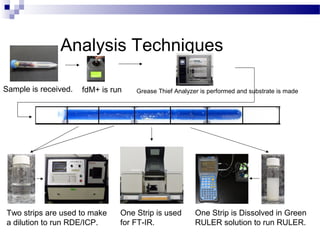
Analysis Techniques
Sample is received. fdM+ is run Grease Thief Analyzer is performed and substrate is made
Two strips are used to make
a dilution to run RDE/ICP.
One Strip is used
for FT-IR.
One Strip is Dissolved in Green
RULER solution to run RULER.
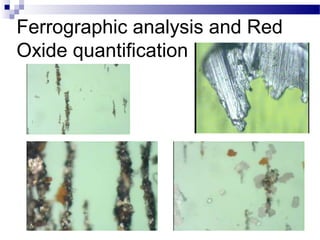
Ferrographic analysis and Red
Oxide quantification
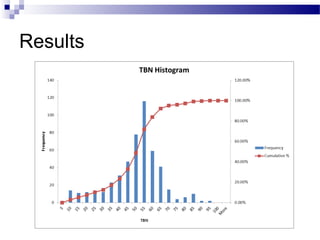
Results
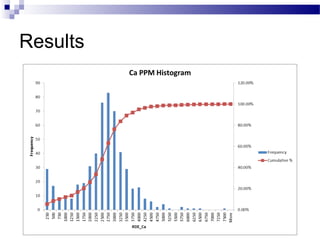
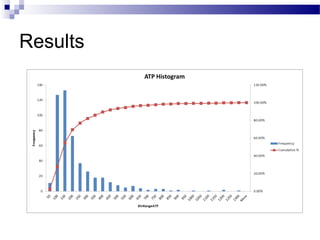
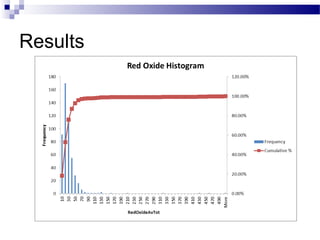
 Data compiled for 500 tendon locations
 Strongest correlation between related
parameters (Calcium and TBN, Red
Oxides and Ferrous Debris)
 Some high Red Oxides were found in
higher Total Alkalinity locations
 Multiple potential failure modes likely
contributor to lack of consistent correlation
Results
Results
Results
Results
Analysis of Data
 Not a clear single failure mode
represented by correlated data
 Several tendons identified for further
testing: high ATP (microbial), several high
Red Oxides, & high Red Oxide/Low TBN
 Testing showed majority of tendons in
good condition, small percentage
candidates for disassembly and inspection
 Advanced statistics package used for
ranking metrics
Analysis of Data
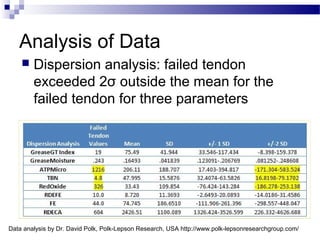
 Dispersion analysis: failed tendon
exceeded 2σ outside the mean for the
failed tendon for three parameters
Data analysis by Dr. David Polk, Polk-Lepson Research, USA http://www.polk-lepsonresearchgroup.com/
Analysis of Data
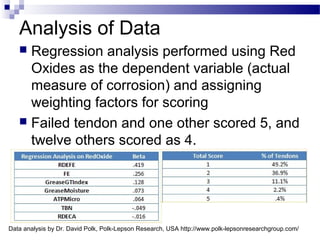
 Regression analysis performed using Red
Oxides as the dependent variable (actual
measure of corrosion) and assigning
weighting factors for scoring
 Failed tendon and one other scored 5, and
twelve others scored as 4.
Data analysis by Dr. David Polk, Polk-Lepson Research, USA http://www.polk-lepsonresearchgroup.com/
Summary
 Tendon failure modes require reliable and
cost-effective method for sampling and
analysis
 Using new sampling tools per ASTM
D7718 without tendon can removal
 Small volume testing methods shown to
be equivalent or superior to traditional
testing
 Additional failure modes detectable with
small volume test slate

Concrete Containment Tendon Grease Sampling and Analysis

  • 1.
    Advanced methods for samplingand analysis of post-tensioned concrete tendon greases Rich Wurzbach ASNT Level III, Infrared and Thermal Testing Laboratory Lubricant Analyst (LLA-I) MRG Labs, York, Pennsylvania, USA
  • 2.
    Overview  Background oftendon grease testing  Failures of post-tension tendons  Comparison of as-found conditions, failures, to routine grease testing  Root-Cause failure analysis and corrective actions  Enhanced sampling methods  Expanded grease analysis techniques
  • 3.
    Background  Some nuclearcontainment designs include ungrouted post-tension concrete tendons  Tendon sheaths and anchorhead areas are filled with a corrosion protection grease  ASME Section XI, IWL-2525 Table 1 contains guidance for corrosion protection grease testing, requires 125g sample minimum
  • 4.
  • 5.
    Status of referencedtests  ASTM D992 was withdrawn in 1983  Current version of ASTM D4327 allows for testing of all three ions, but IWL-2525-1 specifies this for nitrates only, requires two other tests to be performed.  APHA tests are for environmental and wastewater; often requires samples being split between labs, or being run by inexperienced personnel, may require refrigeration of prepared sample  Total alkalinity test does not fall within the scope of current ASTM standard.
  • 6.
    Sampling Challenges  Quantityrequired for current IWL-2525 test slate requires disassembly of tendon anchors can, disturbing anchor area during sampling  Harvesting of grease may disturb position of buttonheads, hiding broken strand indications  Invasive nature of sampling requires costly logistical support, equipment, time, scaffold, etc.
  • 7.
  • 8.
    Containment Tendon Grease Tendon failure at US nuclear power plant prompts RCFA, CAR  IWL, Section IX requires 125g grease  Test slate for 2 grams grease developed; tool for sampling remotely
  • 9.
    Grease thief andT-handle  Provide method to sample grease near anchor without disassembly  Design consistent with ASTM D7718 Standard Practice for Obtaining In-Service Samples of Lubricating Grease  T-handle and stinger probe allow sampling grease from face of anchor  Results from Small Volume Test (SVT) correlated to disassembly method (large volume sample)  Sampling saved ~US$500,000 in maintenance costs
  • 10.
    Water – D95(IWL-2525)  Uses distillation glassware  Per ASTM: “The amount of water as determined by this test method…to the nearest 0.05 or 0.1 volume%”, which is 500-1000ppm.   Per Noria Training: D95 “is fairly cumbersome and requires a comparatively large sample to ensure accuracy, which is why it is rarely used in production-style oil analysis labs today”
  • 11.
    Water – KarlFischer (SVT)  Per ASTM: KF allows “direct determination of water in the range of 10 to 25,000” ppm  Can be performed on grease via “oven method” to eliminate interferences and improve accuracy  Only a small volume of grease required (about ¼ gram)
  • 12.
    Water Testing Comparison Imagecourtesy Noria Corporation, USA Images courtesy Metrohm USA SVT IWL
  • 13.
    Total Alkalinity Testing Uses an “ASTM Modified” procedure.  Per ASTM: “determination of acidic or basic constituents in petroleum products and lubricants soluble or nearly soluble in mixtures of toluene and isopropyl alcohol.”  Per ASTM: “This test method is not suitable for measuring the basic constituents of many basic additive-type lubricating oils. Test Method D4739 can be used for this purpose.” Visconorust contains basic detergents
  • 14.
    Total Alkalinty Comparison Method developed using 0.5 grams grease and smaller solvent amount  Grease fully dissolves, acidification process followed  Titration performed with both colorimetric and potentiometric (D4793) methods, correlating results  Titration performed per IWL-2525 and new small volume method, correlating results
  • 15.
    Ion testing  Twoof three methods in IWL-2525 allow for ion-specific electrodes  New method for small volume ion-specific electrode method under development  Can create more repeatable, reliable, and quicker test for ions, Chloride, Nitrate and Sulfide
  • 16.
    SVT Small VolumeTest Slate  Ferromagnetic Iron (ppm) – tested with a Hall-effect sensor  Metals spectroscopy – multiple elements, ppm (iron, calcium, etc)  Moisture, ppm  Total Base Number (alkalinity) – using 0.5g sample  Red oxide count (corrosion particulate by microscope or direct-imaging sensor  Die Extrusion Index – evaluating unexpected softening or hardening of the grease  Microbial content – quantification of ATP by grease thin- film extraction
  • 17.
    Analysis Techniques Sample isreceived. fdM+ is run Grease Thief Analyzer is performed and substrate is made Two strips are used to make a dilution to run RDE/ICP. One Strip is used for FT-IR. One Strip is Dissolved in Green RULER solution to run RULER.
  • 18.
    Ferrographic analysis andRed Oxide quantification
  • 19.
    Results  Data compiledfor 500 tendon locations  Strongest correlation between related parameters (Calcium and TBN, Red Oxides and Ferrous Debris)  Some high Red Oxides were found in higher Total Alkalinity locations  Multiple potential failure modes likely contributor to lack of consistent correlation
  • 20.
  • 21.
  • 22.
  • 23.
  • 24.
    Analysis of Data Not a clear single failure mode represented by correlated data  Several tendons identified for further testing: high ATP (microbial), several high Red Oxides, & high Red Oxide/Low TBN  Testing showed majority of tendons in good condition, small percentage candidates for disassembly and inspection  Advanced statistics package used for ranking metrics
  • 25.
    Analysis of Data Dispersion analysis: failed tendon exceeded 2σ outside the mean for the failed tendon for three parameters Data analysis by Dr. David Polk, Polk-Lepson Research, USA http://www.polk-lepsonresearchgroup.com/
  • 26.
    Analysis of Data Regression analysis performed using Red Oxides as the dependent variable (actual measure of corrosion) and assigning weighting factors for scoring  Failed tendon and one other scored 5, and twelve others scored as 4. Data analysis by Dr. David Polk, Polk-Lepson Research, USA http://www.polk-lepsonresearchgroup.com/
  • 27.
    Summary  Tendon failuremodes require reliable and cost-effective method for sampling and analysis  Using new sampling tools per ASTM D7718 without tendon can removal  Small volume testing methods shown to be equivalent or superior to traditional testing  Additional failure modes detectable with small volume test slate

Editor's Notes

  • #6 APHA American Public Health Association
  • #10 The Grease ThiefTM is pictured here. The red arrow shows the location of the purge hole, which allows excessive grease to purge out without creating backpressue in the bearing. It is recognized that many electric motor designs do not regularly purge grease out the drain hole when properly greased. It is not suggested that greasers pump enough grease in to fill this fitting. However, it can be substituted for the existing drain plug in many motors, and standby to catch any grease that might come out, instead of it falling to the floor. Then the captured grease can be analyzed. The red piston provides a visual indication of when the grease has begun to slump, leak or pressure drain into the fitting, indication of overgreasing, grease property changes, overheating of the bearing, etc.
  • #18 fdM+ ferrous debris analyzer Determines the amount of ferrous debris in a sample Grease Thief Analyzer Measures the consistency of the grease FT-IR Tests for mixing, contamination, and oxidation RULER Tests for amount of useful antioxidant life remaining RDE Spectroscopy metals spectroscopy Rheometer Tests the consistency, pumpability, and likeliness of tunneling
  • #19 We can prepare a ferrographic slide for inspection. If there is a signficant amount of non-ferrous particulate of interest, a micropatch can be prepared with the same solution for microscopic evaluation.